In the 1960s, there were reports that spontaneous diminution in size or closure of a ventricular septal defect was frequent, based on follow-up and re-catheterisation of large numbers of children.Reference Arcilla, Agustsson and Bicoff 1 , Reference Hoffman and Rudolph 2 Follow-up without specific treatment was considered ethical, because at that time the mortality and morbidity of open-heart surgery in small children were relatively high, and thus allowing the child grow was reasonable unless the child’s life was endangered. These considerations did not pertain to a child with a patent arterial duct, surgery for which was more benign. As a result, our knowledge about the natural history of a patent arterial duct is incomplete. This issue was raised by SullivanReference Sullivan 3 but to my knowledge has never been well studied. In this review, I will consider issues related to spontaneous closure or diminution in size of the duct and the silent duct; problems of the patent arterial duct in premature infants will be excluded.
Spontaneous closure
There have been occasional reports of spontaneous closure of a patent arterial duct, some early examples being cited in 1950 by BrownReference Brown 4 who described it in five patients and in 1952 by BishopReference Bishop 5 who discussed five patients in whom the duct closed or became smaller, and included one of his own. The ages at time of closure ranged from 3 to 14 years, and there were two adults of unknown age. In 1957, CoshReference Cosh 6 assessed 73 patients with a patent arterial duct referred to the medical unit in Bristol by two experienced cardiologists – Dr Carey Coombs and Dr Bruce Perry; four of these patients at ages ranging from 15 to 26 years had lost all signs of the anomaly. In 1968, CampbellReference Campbell 7 followed-up 68 patients with patent arterial ducts, and concluded that the rate of spontaneous closure was 0.6% annually, with a total of 24% over four decades. Dickinson et alReference Dickinson, Arnold and Wilkinson 8 described four spontaneous closures out of 95% patients who qualified for surgical closure; their ages were not mentioned, nor was the length of follow-up.
All these diagnoses were made without the benefit of cardiac catheterisation or echocardiography, and thus it is not possible to know whether these ductuses were indeed closed or merely that the murmurs had become inaudible. Nevertheless, given the expertise of British cardiologists in physical examination, we can exclude disappearance of the murmur as being due to infective endocarditis or pulmonary hypertension, leaving diminution in size or complete closure as the leading possibilities.
With a ventricular septal defect, closure is most frequent in younger patients and with smaller defects. If this holds for patent arterial ducts, it is important because the majority of these are small. In the patent arterial duct coil Registry established by LloydReference Lloyd 9 there were 113 <1-mm diameter, 209 from 1- to 2-mm diameter, 136 from 2- to 3-mm diameter, 53 from 3- to 4-mm diameter, and only six (1.16%) were >5-mm diameter. It is true that a very large duct would probably not be considered for non-surgical closure, but these large lesions are uncommon.Reference Hoffman 10
The silent ductus arteriosus
Absence of the typical ductus murmur is found not only with a very small duct but also with a larger duct if the jet is directed posteriorly,Reference Bennhagen and Benson 11 and at times with congestive heart failure or increased pulmonary vascular resistance with minimal shunting. Occasionally, thrombus or vegetations of infective endocarditis occlude the arterial duct. These major abnormalities can usually be excluded by clinical examination and echocardiography, and the direction of the jet can be assessed by echocardiography. This leaves the tiny silent patent arterial duct to be detected by echocardiography or angiography while the patient is being examined for some other problem.
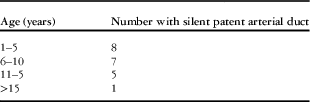
The first major study of this problem was carried out by Houston et alReference Houston, Gnanapragasam and Lim 12 who detected 21 patients with a silent patent arterial duct and concluded that at least 0.5% of patients with an innocent murmur might also have a silent patent arterial duct. The age distribution in their series is given in Table 1.
Prevalence of silent ductus.

In 1993, Glickstein et alReference Glickstein, Friedman and Langsner 13 described six patients aged 3–21 years in whom a silent patent arterial duct was observed; the total number of patients examined was not mentioned. In 1994, Lloyd et alReference Lloyd and Beekman 14 reported that they had observed a silent patent arterial duct in ~1% of children who had undergone echocardiography for Kawasaki disease. Finally, in 2008, Chebab et alReference Chebab, Saliba and El-Rassi 15 observed a silent patent arterial duct in 24/74 consecutive admissions taken from the National Register of Pediatric and CHD, Lebanese Society of Cardiology. No explanation for the high proportion of silent ducts was given. The average diameter for the silent patent arterial duct in their study was 1 mm and for those with a murmur it was 4 mm.
Prevalence
With the exception of the study of Kawasaki patients by Lloyd et al,Reference Lloyd and Beekman 14 none of these studies approximated a true population study, and thus the true incidence of closure or a silent patent arterial duct remains unknown. Nevertheless, Lloyd’s figure of 1% for a silent patent arterial duct is not very different from the >0.5% obtained by Houston et al.Reference Houston, Gnanapragasam and Lim 12
An important question is whether the silent ductus is a stage on the way to complete closure. Few of these silent ducts are reported in adults. This might be the consequence of spontaneous complete closure, but it could also reflect the difficulty of detecting a tiny duct in a large adult because of the limited window and relatively poor resolution in this region.
The reports in the literature suggest that spontaneous closure or diminution in size of a patent arterial duct may be more common than we realise. Until a population study relating the prevalence of patency of the arterial duct to age is carried out, however, we will never know whether spontaneous closure is rare or common. If we had this information, we could use it to plan how to manage our patients. Current practice in the United States of America is to close the patent arterial duct with a catheter-introduced device in virtually every patient in whom a patent arterial duct is diagnosed.
Infective endocarditis
The argument about closing even a small patent arterial duct to prevent infective endocarditis requires further investigation. Balzer et alReference Balzer, Spray and McMullin 16 described infective endocarditis in a 19-year-old man with a silent duct. This is apparently the first report of such a complication. Since then, four more such patients have been reported.Reference Parthenakis, Kanakaraki and Vardas 17 – Reference Celebi, Erdem and Cokugras 20 In the latest of these, however, the duct was not small.
Although any patient with CHD can get infective endocarditis, it occurs infrequently along with a patent arterial duct. In several series from the literature,Reference Hoffman 10 the average incidence of patent arterial duct with infective endocarditis was one patient per institution every 9.8 years.
In Sweden, between 1960 and 1993, only 2/3,000,000 deaths were due to infective endocarditis and a patent arterial duct, and one of these was a very large duct.Reference Thilén and Aström-Olsson 21 A questionnaire of European cardiologists found that over 10 years there were 5400 children and 300 adults with a patent arterial duct, but infective endocarditis occurred in only four children – all over 10 years of age – and one adult.Reference Huggon and Qureshi 22 According to Sullivan,Reference Sullivan 3 at Great Ormond Street Hospital for Children, from 1984 to 1996, there were only two children with infective endocarditis and a patent arterial duct out of 17,887 cardiac admissions; both of these ducts were haemodynamically important. He also reported that in Newcastle-on-Tyne there was one patent arterial duct with infective endocarditis out of 92,093 cardiac admissions. Infective endocarditis was also rare, especially in the elderly, according to a report from Edinburgh; most of these ducts were not small.Reference Marquis, Miller and McCormack 23
The predilection for infective endocarditis to occur with a large patent arterial duct was observed in all the autopsy series. A possible explanation was offered by Glickstein et alReference Glickstein, Friedman and Langsner 13 who pointed out that in general a tiny patent arterial duct did not have a high enough velocity of flow through it to cause the endothelial lesions that form the nidus for bacterial growth. That some of these tiny ducts can be infected is undeniable but also rare, and it is legitimate to ask whether closure of all these small ducts to prevent rare infective endocarditis justifies the cost and risk of complications of closing all of them. In a comprehensive review of this subject in 2010 by Fortescue et al,Reference Fortescue, Lock and Galvin 24 they estimated the risk of major adverse events of duct closure at 0.5–1%. They believed that this risk was greater than the risk of infective endocarditis in a patient with a tiny patent arterial duct, a conclusion also reached by Sullivan.Reference Sullivan 3 This conclusion is reasonable, but would be more secure if better data were available. If a substantial number of patients close their patent arterial duct spontaneously, then the argument for closing every small patent arterial duct becomes untenable.
Mechanism of narrowing or closure
The normal arterial duct closes soon after birth by constriction of its spiral smooth muscles, after which permanent closure takes place by thrombosis and fibrosis associated with intimal cushions.Reference Benson and Cowan 25 In the abnormal duct, however, these mechanisms are defective. There is anecdotal evidence that the abnormal arterial duct is capable of constricting and dilating, and thus narrowing due to sustained muscle contraction cannot be ruled out. It is more difficult to explain how an arterial duct that is 4- to 6-mm in diameter at birthReference Tan, Silverman and Hoffman 26 becomes transformed into a silent duct that is only 1 mm in diameter. The likely scenario is that the medial muscle constricts to narrow the duct, and then re-modelling occurs. Specific mechanisms are for future research to discover.
How can we determine whether spontaneous closure is common without following-up patients with a small arterial duct for 20 years? A possibility is to make use of the thousands of echocardiographic or angiographic views of the aortic arch that exist in all institutions with large cardiology services. Another more expensive possibility is to perform an extensive echocardiographic study in a country where small ducts are unlikely to be closed. Whatever the method used, the question needs to be answered.
Conclusion
Closure of a patent arterial duct by surgery or interventional methods is carried out so frequently and so soon after diagnosis that we have lost the opportunity of determining whether spontaneous closure could occur frequently. It is possible that a patent arterial duct often becomes small enough to present as a silent ductus and that most of these eventually close spontaneously. If this happened, the costs and complications of treating a patent arterial duct would be considerably reduced. It is time that this issue was studied.
Acknowledgement
None.