

Published online by Cambridge University Press: 25 April 2006
The Dutch have been counted among the staunchest supporters ofEuropean integration ever since the parliamentary ratification ofthe European Community for Coal and Steel in late 1951. The majorpolitical parties—the Christian Democrats (CDA) and its forerunners,the Labor Party (PvdA), and the liberal parties VVD andD66—supported all important European treaties of the past decades.Only the smaller orthodox-Calvinist parties, some smaller left-wingparties, and, more recently, the List Pim Fortuyn (LPF) have opposedthese treaties in parliament. This overwhelmingly large support inthe Second Chamber of the Dutch parliament included the Treaty ofRome of 2004—the treaty establishing a constitution for Europe. Onehundred twenty-eight out of 150 members of parliament favored theratification of the European Constitution. This article draws on several chapters in Aarts and van der Kolk 2005.
The Dutch have been counted among the staunchest supporters of European integration ever since the parliamentary ratification of the European Community for Coal and Steel in late 1951. The major political parties—the Christian Democrats (CDA) and its forerunners, the Labor Party (PvdA), and the liberal parties VVD and D66—supported all important European treaties of the past decades. Only the smaller orthodox-Calvinist parties, some smaller left-wing parties, and, more recently, the List Pim Fortuyn (LPF) have opposed these treaties in parliament. This overwhelmingly large support in the Second Chamber of the Dutch parliament included the Treaty of Rome of 2004—the treaty establishing a constitution for Europe. One hundred twenty-eight out of 150 members of parliament favored the ratification of the European Constitution.
Support for European integration was not confined to the political elite. Trend data from the Eurobarometer surveys indicate that since the early 1970s the Dutch population was generally more enthusiastic about the European Union than the populations of the other five founding member states. According to these surveys, three out of every four Dutch citizens judged EU membership to be “a good thing” in late 2004—more than the Germans (60%) or the French (56%). The same survey (Eurobarometer #62) finds that 73% of the Dutch supported a constitution for Europe.1
The corresponding figure for France at the time was 70%. The report with the Eurobarometer #62 survey's first results can be found at: http://europa.eu.int/comm/public_opinion/archives/eb/eb62/eb62first_en.pdf (accessed October 6, 2005).
Yet, at the same time many complained about the low awareness of Europe in the Netherlands. The observation in the Declaration of Laeken (2001) that “within the Union, the European institutions must be brought closer to its citizens” was especially true for the Dutch.2
See for the declaration of Laeken http://europa.eu.int/constitution/futurum/documents/offtext/doc151201_en.htm (accessed October 6, 2005).
In this context, the result of the referendum on the European Constitution held in the Netherlands on June 1, 2005, came as a surprise. The referendum resulted in a 62-38% victory for the No-vote with an unexpectedly high turnout of 63%. How does this result fit in with the traditional image of the Dutch as champions of the European cause? And why did Dutch voters disagree so strongly with the overwhelming majority in the Dutch Parliament?
In this contribution we propose three partial answers to these questions. The first two pertain to the pace and the scope of the process of European integration. The pace of integration is perceived by many citizens to be too fast. The introduction of a common currency, the euro, in 12 member states in 1999–2002 was probably the most tangible result of this process so far, and it has become a preferred target for frustrated consumers. The current image of the EU is not that of an institution stimulating international trade for the open Dutch economy but rather that of an institution costing too much and threatening both our jobs and our social security.
This popular image of the EU is strengthened by its recent and prospective enlargement. In 2004, 10 new states were admitted to the EU, bringing the total number of members to 25. In late 2004, the Dutch presidency of the EU produced a clear time path for the start of membership negotiations with Turkey. Although the actual entry of Turkey will probably take at least another 10 years, the continuing eastbound expansion of the EU has met with growing popular discontent. The public perception of the expansion in 2004 and especially of the start of the negotiations with Turkey can be interpreted in at least three different but interrelated ways: a threat to the Dutch economy, a threat to Dutch (Western) culture, and a threat to Dutch power within the EU.
We show how these perceptions partially explain the popular attitude toward the EU. But why was there such a deep gap between the elite and the voters? We contend that this gap is not new, nor does it occur in the Netherlands only. The referendum instrument, which had never been used on the national scale in the Netherlands before, fully exposed this gap for the first time.
The data analyzed in this paper were collected in the 2005 Dutch Referendum Study.3
The Dutch Referendum Study 2005 is a survey of a sample of the Dutch electorate. The survey consists of a pre- and post-referendum panel study. The pre-referendum study in turn consists of five independent weekly subsamples. The net response was 1,568 (pre-referendum) and 1,284 (post-referendum). The sample frame was formed by an existing large household panel. The interviews were conducted by means of computer-assisted web-based interviewing (2/3) and computer-assisted telephone interviewing (1/3). The fieldwork was conducted by GfK Benelux. The data are currently being processed and documented. Details on the study and on its future availability can be obtained from the authors.
Enthusiasm for a common currency has always been much greater among the political elites than among the general public. A comparison of data from the 1994 European Election Study and a 1994 survey of Members of the European Parliament (MEPs) showed that most of the MEPs were strongly in favor of the introduction of the Euro, whereas the public was much more hesitant.
The introduction of the euro in 2002, led by the then Dutch president of the European Central Bank, went smoothly. The budget requirements of the participating states (the Stability and Growth Pact), however, were a constant source of tension between the ministers of finance of the Euro Zone, with Dutch Minister Gerrit Zalm usually the most outspoken defender of a rigid budget discipline. The Dutch media reported extensively about these tensions and the Dutch position on the issues.
Meanwhile, many people became convinced that the introduction of the euro had led to a general increase in the prices of consumables—a conviction that was hardly affected by the government's frequent protests to the contrary.
The euro assumed a prominent role in the Dutch referendum campaign following a published interview (in April 2005) with one of the directors of the Dutch central bank, in which the director asserted that the Dutch guilder had been undervalued against the euro by 10% compared to the German mark. The euro continued to get extensive media attention during the last month of the campaign. The feeling that the Dutch had “sold” their guilder too cheaply was further fueled by the fact that the Netherlands had been one of the largest net contributors to the EU over the past two decades.
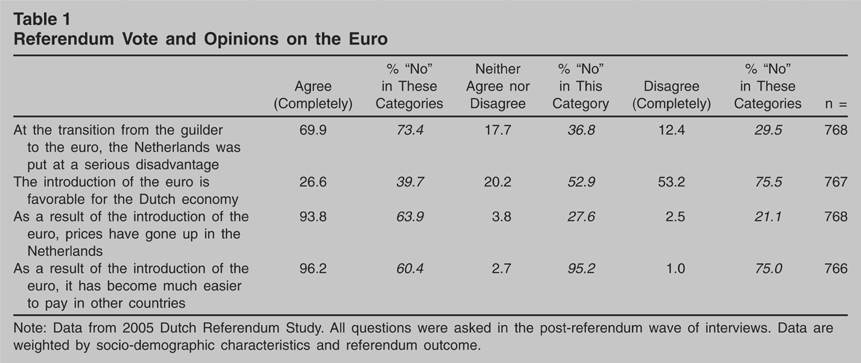
In our survey, we asked the respondents to what extent they agreed or disagreed with four statements about the euro. Table 1 shows both the frequency distributions for each statement as well as the percentage of “No” voters in each category.
Referendum Vote and Opinions on the Euro

At the time of the referendum, a large majority of Dutch voters was convinced that the Netherlands had been financially injured by the introduction of the euro. Although almost everyone believed that spending money in other countries had become much easier, a minority thought that the euro was good for the Dutch economy. Near unanimity existed about the statement that prices had gone up as a result of the conversion to the euro. The answers to these statements point to a clearly negative perception of the euro.
When we look at the reported referendum vote, it is strikingly clear that negative perceptions of the euro go together with large majorities for the “No” vote, whereas positive perceptions are associated with a majority for a “Yes” vote for the Constitution (see Table 1).
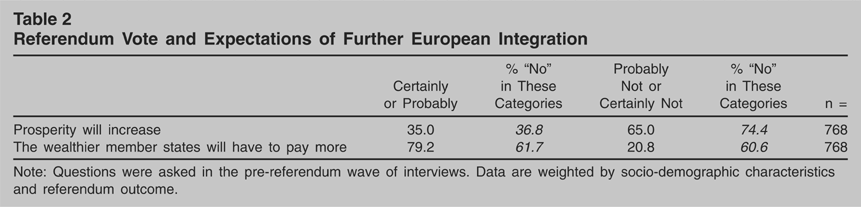
The negative attitude toward the euro reflects a lack of confidence that the EU will foster economic growth. The open Dutch economy depends to a large extent on foreign trade. The ability to foster economic growth had always been one of the strongest arguments for European integration and for the introduction of the euro. In our survey we also asked what people thought about the economic consequences of European integration (Table 2). A large majority was of the opinion that the EU will only cost money and does not produce its main goal: economic prosperity. In addition, our respondents expected that the wealthier member states would have to pay more. Both convictions were strongly related to the “No” vote.
Referendum Vote and Expectations of Further European Integration

From 1973 until 1995, the expansion of the EU took place very gradually. In 1973, Britain, Denmark, and Ireland joined the six founders; in 1981, Greece joined, followed by Spain and Portugal in 1986 and by Sweden, Finland, and Austria in 1995. Nine new member states, all but one located in Western Europe, were thus gradually admitted over a period of 22 years. In 2004, 10 new members joined the EU in a single day, eight of which are located in Central and Eastern Europe. At the same time, the dragging talks with Turkey on the conditions for starting membership negotiations finally resulted in a clear time frame. A Turkish EU membership was no longer a pure theoretical possibility. The year 2004 can therefore be regarded as a turning point in the history of the EU when it comes to its geographical scope.
In the French referendum campaign, the legendary “Polish plumber” became a symbol for the negative side effects of the enlargement process: cheap labor from the newly admitted member states would drive the expensive French craftsmen out of business. In the Netherlands, perhaps because the presence of Polish workers in market gardening is an accepted fact, the possible EU membership of Turkey assumed that role. In September 2004, Geert Wilders, an outspoken member of parliament for the VVD, left that party to found his own party precisely because he could not accept even the possibility that Turkey would join the EU. Wilders, the issue of the Turkish membership, and the enlargement issue more generally received extensive media coverage during the nine months preceding the referendum.
In his campaign, Wilders not only pointed to the threat of new reservoirs of cheap labor, but also to two other aspects of the EU's expansion: the threat to Dutch culture, especially when Turkey joined, and the declining voting power of the older member states. According to the European Constitution, the voting power of the member states would be more dependent on population size than before. When admitted, Turkey would be one of the largest and therefore most powerful member states. Thus, connecting the issue of Turkey's future admittance to the Constitution referendum proved quite simple.
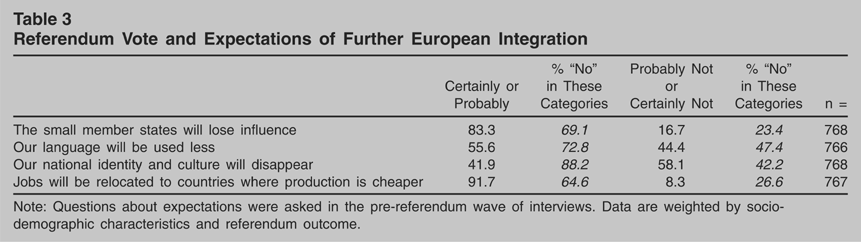
In our survey, we asked the respondents before the referendum about the likelihood of several possible consequences of further European integration. Several of the consequences mentioned in the survey refer to side effects of the enlargement of the Union. Table 3 shows the response frequencies and their relationship with the “No” vote.
Referendum Vote and Expectations of Further European Integration

What are the most likely consequences of further integration according to Dutch voters in 2005? Basically these: jobs will be relocated to countries where production is cheaper than in the Netherlands and the small member states will lose influence. In addition, a large group of voters is of the opinion that Dutch language would be used less often and a large minority thinks Dutch culture would be threatened. The majority of the respondents who believe that these were the most likely consequences if the Constitution was adopted voted “No” in the referendum.
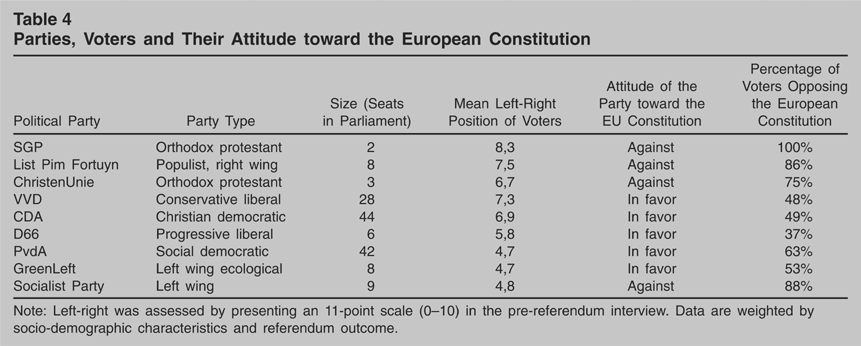
Finally, why did so many Dutch voters disagree with an overwhelming majority of the Dutch Parliament? All major political parties support further European integration; opposition occurs only at the orthodox Christian and extreme left ends of the political spectrum. Table 4 depicts, for each of the parties, its size in the Second Chamber of Parliament (number of seats), the average position of its voters on a left-right scale, the party's position on the European Constitution, and the percentage of its voters who voted against the Constitution.
Parties, Voters and Their Attitude toward the European Constitution

Left and right, or progressive and conservative, are the most important political labels used by both parties and voters in the Netherlands to summarize their positions on a large number of issues. These labels refer primarily to socio-economic issues such as the redistribution of income.4
A second, less important dimension of political opinions is ethical or moral, and refers to issues such as abortion and euthanasia. It is strongly related to the religious beliefs of voters and their parties. In this article we ignore this dimension.
With the notable exception being the period from 1994–2002 when PVDA, VVD, and D66 formed a left-right coalition without the centrist CDA.
As in most other EU member states, voters' opinions about European integration are relatively unimportant for vote decision in elections for the national and the European Parliaments. For this reason, European Parliament elections are known as “second order” national elections: they are dominated by the national political arenas of the various member states (Reif and Schmitt 1980; van der Eijk, Franklin et al. 1996). Only recently, have issues pertaining to the speed and scope of European integration become more important in the voters' minds in, for example, Denmark and Britain. But with some exceptions, these issues have not yet translated into distinct party positions.
Table 4 confirms this general observation. Party choice in the 2003 election is only weakly related to voting behavior in the referendum on the European Constitution. Many voters of VVD, CDA, PVDA, D66, and GreenLeft (128 seats in parliament) voted against the Constitution, whereas their parties had supported and defended it.6
The Pearson correlation coefficient between the referendum vote (Yes/No) and the respondent's position on the left-right scale is −0.02. The position on the left-right scale is also uncorrelated (−0.00) with the respondent's position on a scale running from “European integration has already gone too far” to “European integration should go further.”
The gap between parties and voters will probably not disappear after the referendum. Even after the lively referendum campaign, most of our respondents indicated that they were only “somewhat interested” in European affairs. Less than 4% thought they were “very interesting.” The implication is that European issues will continue to play a secondary role at most in the national elections. As a consequence, new national elections will not radically alter the strong support for the EU in the Dutch Parliament. Political parties do not have incentives to adjust their position on this issue; it will not change their electoral prospects.
Despite the unambiguous rejection of the European Constitution on June 1, many Dutch continue to support European integration, but the form it has assumed is disliked. The perceived costs are too high and the benefits too low. The euro is evaluated very negatively, and the common market is regarded as a threat rather than an opportunity. In addition, the prospective expansion of the EU deepens and broadens these perceptions among voters. It deepens them because the new member states are not seen as new markets to be explored, but as expensive reservoirs of cheap labor threatening Dutch jobs. It broadens the problems, because the power of the Netherlands in the EU will be further watered down, while at the same time Dutch, or Western, values are perceived to be in danger. But since these feelings have not yet affected voting behavior in national elections, the existing gap between a majority of the voters and a large majority of politicians will probably not disappear after the next national elections.
In June 2005, the government and the Second Chamber of Parliament announced a broad public debate about the future of Europe. But only a few months later, the political parties could not agree on the organization of this debate, and they eventually abandoned the idea. Most political parties now pledged to start a debate on the EU within their own ranks. This may eventually turn out to be one of the most important results of the referendum. The referendum itself was accompanied by heated, but short-lived media attention, and did not noticeably increase the public's interest in Europe and the EU. Although voters' awareness of the issues at stake increased during the campaign, many voters still had the feeling that they were not adequately informed.
The lack of political discussion in the Netherlands about the future of Europe cannot be remedied by a single campaign. Whether new debates within the political parties will lead to a change in the attitudes and opinions of politicians and/or voters is still unclear. Voters may eventually begin to appreciate the euro. They may even begin to appreciate the recent expansion of the EU. Politicians may adjust their traditional enthusiasm for European integration. Whatever happens, it will not deepen the gap between the electorate and the elite—we have probably just seen the bottom of it.

Referendum Vote and Opinions on the Euro

Referendum Vote and Expectations of Further European Integration

Referendum Vote and Expectations of Further European Integration

Parties, Voters and Their Attitude toward the European Constitution