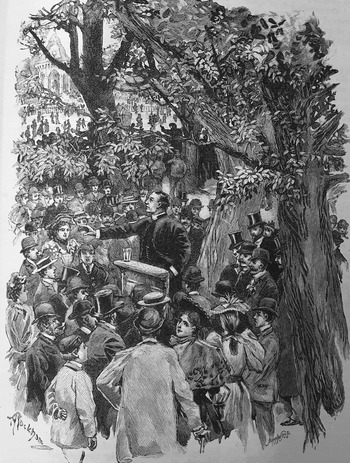
Between September 1894 and January 1895, the Sabbath periodical Sunday at Home took its readers on a revealing journey through the ‘highways and byways’ of East London on a Sunday. Turning the traditionally bleak slumming narrative on its head, journalist Henry Walker sought to enlighten his readers about the East End's varied religious habits. In the summer of 1894, his eyes had been drawn to the young clergyman, Arthur Winnington-Ingram, lecturing to an attentive crowd under the historic elm and willow trees in Victoria Park (Figure 1).Footnote 1 Winnington-Ingram, destined to become bishop of Stepney and then of London, believed that park lecturing on a Sunday was the best way to reach a male working-class park-goer who, he thought, had abandoned local church services in favour of a secular life. Through his open-air lecturing in ‘the People's Park’, Winnington-Ingram tested out and negotiated his public religious identity. This article explores such lecturing as a facet of the religious work undertaken by the university settlement Oxford House based in nearby Bethnal Green, of which Winnington-Ingram was head. Park lecturing, this article argues, fulfilled one of the principal aims of university settlement work by allowing heads, especially those training for ordination in the Church of England, to engage in lively religious dialogue with their local community. Park lecturing enabled Oxford House heads to construct a religious selfhood based on the new ethos of practical Christianity which underpinned many late nineteenth-century university settlements. A vivid picture of urban religious life emerges in the accounts of the Oxford House settlers who used Victoria Park as a laboratory for experimentation in personal and spiritual transformation.Footnote 2
Arthur Winnington-Ingram lecturing from the CES platform in Victoria Park. Henry Walker, ‘Sunday in East London: Victoria Park’, Sunday at Home (1895), p. 791. Author's own copy.

Winnington-Ingram was a well-established figure in the East End by the time Walker found him lecturing in Victoria Park. He had resided in Bethnal Green since taking up the headship of Oxford House in 1889. Oxford House, like its better-known counterpart Toynbee Hall, was established in 1884 with the intention of reconnecting the ‘rich’, specifically those recently graduated from Oxford and Cambridge universities, with the ‘poor’, largely conceptualized in settlement discourse to be the urban working classes.Footnote 3 University settlements, so-called because they were spear-headed by university graduates, were established in poor parts of cities across Britain as a direct response to novels, pamphlets, and journalistic endeavours that ‘rediscovered’ urban poverty in the 1880s.Footnote 4 Settlement houses aimed to unify the rich and poor not by means of financial aid, but rather through the personal service of heads and settlers (the name given to graduates who came to reside in the houses). Settlement heads were appointed to help with the day-to-day running of the houses, to build and maintain community links, and to give guidance to settlers. Prior to Winnington-Ingram, Oxford House had employed three heads, William E. Jackson, James Adderley, and Herbert Hensley Henson. The latter two, like Winnington-Ingram, engaged in park lecturing while working and residing in Bethnal Green.
Oxford House was a high Anglican settlement with strong Anglo-Catholic sympathies. Despite Seth Koven's observation that Oxford House was the model for many other settlements in this period, Toynbee Hall's fame has eclipsed the role that Oxford House played in the formation of the settlement movement. Other than a chapter in Koven's influential Slumming: sexual and social politics in Victorian London, Oxford House's history has largely been relegated to institutional pamphlets and unpublished doctoral theses.Footnote 5 Even there, the role of religion in general, and of park lecturing in particular, has received little or no attention. This reflects the narrowness of settlement historiography where religion is concerned. With the notable exception of Nigel Scotland's Squire in the slums: settlements and missions in late-Victorian Britain, which charts both the social and religious work of Oxford House (and the settlement movement as a whole), recent settlement histories have generally side-lined the formal religious dimensions of the movement.Footnote 6
This article demonstrates that religion, and specifically a new form of practical Christianity, was fundamental to the motivations of Oxford House's early leaders. According to Boyd Hilton, nineteenth-century theology shifted away from theories of atonement, which had placed emphasis on personal faith and sin, to new ideas of incarnation. These theological ideas were more socially aware and emphasized a loving, rather than a vengeful, God. In turn, Jesus was transformed into a compassionate brother. On a social level, this new theology sought to unite mankind in a loving Christian brotherhood. On a personal level, belief was understood as an ongoing experience, a process of self-transcendence that was not egoistical and private, but rather altruistic and active.Footnote 7 The settlement movement emerged alongside these new theological ideals. Indeed, Koven has noted that settlements like Oxford House and Kingsley Hall were animated by a lived theology which emphasized God's love as well as the fellowship of man.Footnote 8 For Scotland, the ‘churchy’ atmosphere of Oxford House merged a Tractarian tradition with the Christian Socialism of Charles Kingsley and Frederick Denison Maurice.Footnote 9 An active and practical Christianity, as this article shows, guided the work of Oxford House's early heads.
This article turns to their Victoria Park lectures in order to provide a close reading of the role of religion in the formation of settler selfhood. Rather than provide an overview of all of the ways in which religion infused the work of Oxford House, the article focuses on park lecturing in order to demonstrate that settlement imaginaries were formed not just within the four walls of the settlement house itself, or in relation to those who chose to attend settlement activities in the house's various clubs, but that they also took shape in direct contact with local communities in spaces beyond the settlement, such as Victoria Park. Unlike the founder of Toynbee Hall, the Rev. Samuel Barnett, who tended to operate within a more hermetically sealed world of church and settlement, Oxford House's early leaders deliberately set out to understand Godliness and Godlessness as it manifested on the streets and in the public spaces of East London. In one sense, university settlements sought to draw people back to traditional church services via contact with settlers and settlements. Oxford House, like Toynbee Hall, can certainly be read as an extra-parochial space where religion was reformulated for those unwilling or uninterested in attending church. Yet, the programme of open-air lecturing undertaken by Oxford House suggests that there was more to the late Victorian transformation of religion than the ‘triumph of worship’ – the reinvigoration of traditional church services – identified by Simon Green.Footnote 10 An investigation into park preaching invites historians to consider the more informal dimensions of religious observance. Sarah Williams has noted that working-class religious belief was more complicated than simply the rejection of formal practices of faith. She has argued that the working classes ‘continued to separate the Sabbath from the rest of the week by a series of rituals and observances which broke from the normal rhythm of life’.Footnote 11 Oxford House can be understood as providing local East London men with informal spaces for Sunday reverence. In order to understand settlement religion, we must look beyond the institutional walls of settlements and their nearby churches. Winnington-Ingram, along with James Adderley and Herbert Hensley Henson, formed their ideas about the religious needs of working-class men on the basis of their experiences in Victoria Park. Like many other settlers, these Oxford House heads especially wanted to reach working-class men who, they feared, had entirely abandoned religion in favour of a secular life.Footnote 12 This kind of man was unlikely to find his own way to a settlement house, they thought.
Ultimately, however, as the article argues, the park preaching undertaken by Oxford House heads in Victoria Park tells us far more about settler identity than it does about the religiosity or otherwise of working-class East Londoners. Oxford House was a space of identity formation for young middle-class heads and settlers. The settlement was important in supporting the work of the Church of England in Bethnal Green, and in providing a spiritual environment in which young middle-class men could make sense of their Christian faith after leaving university. Preaching in Victoria Park provides one focused case-study through which to consider these processes. Historians are certainly now more sensitive to the ways in which religion and religious faith informed the construction of modern selfhoods.Footnote 13 The idea of ‘performance’ has also become an important analytical concept in the consideration of how historical actors articulated, represented, and developed a sense of self both personally and to an external audience. Gender historians, including Penny Summerfield, have suggested that considering selfhood through performance enables us to challenge the notion that ‘life's roles are given’ and that ‘there is little to be done but play the part, even if the actors might endeavour to modify the roles over time’.Footnote 14 This has important implications not only for how we contextualize gender, but also religious subjectivities.
Rather than understand these subjectivities to be natural and fixed, this article argues that historians should consider more fully how people performed their religious faith through everyday practices, ceremonies, and rituals.Footnote 15 In their study of post-1945 religion, Jane Garnett et al. have argued that the notion of performance can help us to understand the formation of religious identity at both a formal and an informal level. Aware that ‘performance’ is a problematic concept, they nevertheless insist that we should consider the lived experiences of individuals in the process of constructing religious identities. On the one hand, they note that religious performance is highly ritualized through church services, for instance, and, on the other, that it is a form of role-play that enables people to construct and reconcile their multiple identities. Authenticity, they argue, is the key aim of these religious performances. To comprehend fully such performances they suggest that scholars should take into account ‘actions as well as words, bodies as well as minds’.Footnote 16 Importantly, they note that not all performances are legitimate. Rather, embodied religious experiences can be conceived as insincere and deceitful at both an individual and a collective level. These moments of discomposure can be just as revealing to the historian. Garnett et al.’s conceptualization of performance can be extended to the nineteenth century. It complements the work of Sioned Davies who has studied the importance of the performance of belief in communicating a religious message for Welsh lecturers during the nineteenth century. She contends that the ‘“performance” or the “event” is far more important than the text or the script, and due attention must therefore be paid to features such as the location of the performance, kinesics, the relationship between the performer and his audience, including the audience's responses’.Footnote 17
This article considers the performances of religious faith and identity expressed in Oxford House heads’ engagement with their park audiences, together with an exploration of their personal motivations for park lecturing and the development of their religious identities. Aware that I will never be able to recreate ‘the charisma of voice and gesture, nor the spiritual passion that was indicated’, I turn instead to ego-documents (personal testimony, sermons, and autobiographies) in order to recreate Oxford House heads’ park performances.Footnote 18 The autobiographical writings of Winnington-Ingram, Henson, and Adderley are used here to determine how these men performed religious faith as part of their settlement work at Victoria Park's Sunday lectures. As Kate Barclay and Sarah Richardson have argued, performance is mediated through ‘the act of writing [which] comes to comprise the self; the self is not a priori to text, but “becomes” as it is expressed in written form’.Footnote 19 In addition to their autobiographies, Oxford House heads reflected upon their Victoria Park lectures in sermons given after their headship. Winnington-Ingram's experience of park lecturing was better documented than Henson's and Adderley's in this respect. Nevertheless, it is useful to consider their collective involvement in the Victoria Park Sunday lecturing series. Park lecturing enabled Oxford House heads to articulate and develop an authoritative self, essential to settlement work, which emerged through their performance of religious faith.
I
Oxford House began lecturing in Victoria Park in 1887 under James Adderley's headship and the practice became a tradition in the house's summer calendar until 1899. Open-air oratory and debate was a long-established tradition in the Park. Thousands of visitors were reported to descend there each Sunday between May and September to hear various political, social, and religious groups.Footnote 20 These visitors would have been struck by the ‘Babel of sound’ from the upper region of the park, said to throb with Salvationist hymns and the sacred music of the YMCA band. Charles Booth noted that Victoria Park provided an arena for ‘every kind of religious, political or social discussion’.Footnote 21 Indeed, park visitors were free to listen to lectures on Malthusianism, atheism, agnosticism, secularism, Calvinism, socialism, Darwinism, teetotalism, and, in exceptional cases, Mormonism and Swedenborgianism.Footnote 22 Political organizations such as the Social Democratic Federation and the Independent Labour party were also represented, as was the local secularist group.Footnote 23 Opposing the secularists were a number of religious groups, including the Salvation Army, Orthodox Jews, the Guild of our Lady Ransom, and the Christian Evidence Society, along with occult groups such as the Theosophical Society. Oxford House heads were among those who went to the Park to defend and promote the Christian message.
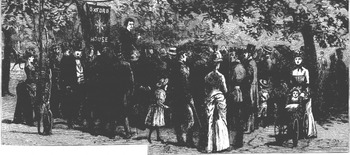
There were two different ways in which Oxford House heads took part in the open-air jamboree at Victoria Park. They either lectured from their own dedicated Oxford House stand or, more often, they joined forces with another organization. Adderley and Henson lectured from an Oxford House stand complete with promotional banner (Figure 2). Although Winnington-Ingram initially started by lecturing in this way, he later abandoned it to act as a direct respondent to the secularist stand. After that, he chose to lecture from the stand of the East London branch of the Christian Evidence Society (CES) on the invitation of Celestine Edwards, the black evangelical lecturer and CES president.Footnote 24 The relationship between Oxford House and the non-domination evangelical CES, an organization which sought to unite Anglicans and nonconformists in the work of defending Christian truth and principles, appears to have been a strong one despite diverging theological positions and growing hostilities between Anglo-Catholics and evangelicals in this period. Both Oxford House and the CES believed that park lecturing was an important means by which the Christianity of working men could be secured and the arguments of secularists undermined. Moreover, the resources offered by the CES gave Winnington-Ingram the best possible chance to engage with the secularists, particularly because the CES stand was directly opposite the secularist platform. The alliance between Oxford House and the CES demonstrates how specific religious groups were able to unite together for a higher purpose in the practical application of bringing their Christian message to the unchurched. On the other, it reveals that an authentic performance of faith needed a specific setting and that within the arena of Victoria Park the CES stand offered the most direct way to engage in battle with secularist opponents.
James Adderley lecturing in Victoria Park. © The British Library Board, The Graphic, 4 Feb. 1888, p. 1.

Moreover, it would have helped that Winnington-Ingram developed a successful park partnership with Edwards, who was fondly known as the ‘black champion’ of Christian Truth by East End residents.Footnote 25 A gruelling schedule of touring lectures across Britain meant that Edwards was often unavailable to lecture in the Park, leaving the stand empty for the popular and charismatic Winnington-Ingram. The two men would lecture on monthly themes to provide continuity between their lectures.Footnote 26 Oxford House's relationship with the CES went from strength to strength when Winnington-Ingram was appointed CES president in 1894 following Edwards's death. Winnington-Ingram maintained the tradition of jointly lecturing with the CES until 1898 when he became bishop of Stepney. Unlike other CES speakers, Winnington-Ingram did not lecture on Bethnal Green streets. Nor did he lecture at any other time than 3·00 pm, a time which did not compete with official church services. Winnington-Ingram probably perceived Victoria Park as a more legitimate space of interaction than the street because it provided him with a more practical arena to talk and engage with local inhabitants without having to contend with the hustle and bustle of street life.
Oxford House returned to lecturing from its own stand under the leadership of the Oxford House Sunday Lecture Society in 1899. This move can be explained in part by Oxford House's decision no longer to work with the CES because of their growing anti-Catholic stance. This coincided with a number of developments in the organization and running of Oxford House's lecture programme. Park lecturing was no longer an expected duty of the Oxford House head after the summer of 1899. Rather, heads chose in subsequent years to hold mission services in St Matthew's parish church, first under the Rev. Bernard Wilson and later under the Rev. Frederick Iremonger. This reflects the fact that both Wilson and Iremonger were given parish livings to coincide with their headships. Neither Adderley nor Henson combined their short Oxford House headship with a parish church commitment, but when Winnington-Ingram was offered the rectorship of Bethnal Green in 1897 he continued to lecture in Victoria Park despite this appointment. This not only illustrates just how important park lecturing was to Winnington-Ingram, but also how much he personally valued park preaching.
II
Performing in the park gave Oxford House heads religious authority and a role outside of the settlement house and club. Lecturing in Victoria Park initially fulfilled, for the younger Winnington-Ingram, the characteristic, if not the most conspicuous activity of the clergyman, namely the Sunday sermon. Anthony Russell has pointed out that, for clergymen, ‘their performance in the pulpit’ allowed them ‘to form their opinions’ and demonstrate their ‘all-round competence and abilities’.Footnote 27 This is confirmed by Simon Gunn, who argues that preaching ‘is the measure of a minister's power, the index of his spiritual culture and of his domain over the faithful’.Footnote 28 Winnington-Ingram thought of park lecturing as an extension of the traditional sermon and a better version of it, matching his commitment to reaching the working man in Bethnal Green. He spent all week preparing and reading around his topic, believing that the park lecturer needed to be well informed about the debates and controversies of the period in addition to having the ability to spread the word of God.Footnote 29 This preparation was essential in order to face down the barrage of questions which would be asked in the park.
Furthermore, Winnington-Ingram's attraction to park lecturing compounded his father's objection to him taking up the Oxford House headship. Winnington-Ingram had originally joined Oxford House from the diocese of Lichfield where he had been the bishop's private chaplain. The Rev. Edward Winnington-Ingram had written to his son stating that the Oxford House headship was ‘a position which I should be very sorry to see you occupy’. His objections related to the physical and financial arrangements of Oxford House. He also maintained that the headship of a settlement was not a legitimate clerical role. He believed that his son's role as a clergyman was to preach to congregations, not to work in a settlement house. He seemed surprised that his son should be determined to leave Lichfield when he had already made his mark there.Footnote 30
By contrast, Henson believed that park lecturing was necessary because it enabled ‘the masses of people, who have wobbling opinions [to] understand that there are two sides to the question; that the church has something to say for the Lord’. Secondly, and more importantly, he believed that people should be shown that ‘the parsons are not afraid to come out of their uncompetitive pulpits and challenge opposition in the open air’, a point reinforced when he overheard a man ‘remarking about me that for once a parson didn't mind coming out of the Church to speak’.Footnote 31 As a narrative trope, this enabled Henson to suggest that the church, and his peers within the church, were static and out of touch with the working classes. Park lecturing illustrates how innovative Oxford House heads were in engaging with their local communities and working with other religious groups. They became part of a group of Anglo-Catholic priests, generally known as Slum priests, who were involved in what John Shelton Reed has described ‘as something of a laboratory experiment with what seemed to many a new startling form of Anglicanism’.Footnote 32 Much of this work was heavily reliant on the personality of individual priests. As Hugh MacLeod has noted, there were a variety of positions and ideas about how to bring religion to the unchurched in the East End of London.Footnote 33 Oxford House heads believed that the legitimacy gained by engaging directly with irreligious working-class men made them the arbiters of the ‘true Christian message’.
Oxford House heads expanded on the evangelical practice of open-air preaching which was used successfully by female and male preachers associated with Methodism together with later nineteenth-century religious groups like the Salvation Army. Although it was largely associated with dissenter groups in the nineteenth century, open-air preaching did carry apostolic authority with both Paul and Peter, two of the leading Apostles. Since the 1851 religious census there had been growing awareness that old styles of religious address no longer met the spiritual needs of society. This and subsequent religious censuses not only highlighted the separation of the established church from the working class but also raised questions about the effectiveness of traditional practices in reaching the ‘unchurched’. Certainly, by the middle part of the century, clergymen were being encouraged to leave the pulpit to address the urban working classes on the streets, theatres, and in their places of work, whilst changing their style of preaching to suit their audience.Footnote 34 Meanwhile, Tom Grimwood and Peter Yeandle have argued, in the case of the Christian socialist clergyman Stewart Headlam, that nineteenth-century lecturing was not necessarily reliant on a pulpit or congregation, but dependent on the creation of alternative rhetorical spaces.Footnote 35
Victoria Park provided Oxford House heads with an arena in which to play out their religious and clerical identity. Role-play, as Garnett et al. have noted, is not necessarily pretending to be someone else, but can provide individuals with the means to experience and develop their religious identity. This was especially important at a time when many novels and autobiographies bemoaned the lack of oral skills in the clergy. Performances of religion for these heads needed to be an active and a practical application of Christianity. Park lecturing allowed Oxford House heads to move from middle-class settlement spaces to largely working-class spaces of leisure. Their decision to lecture in Victoria Park required the conscious decision to interact with the working man in his own sphere. The questions which audience members and adherents asked in Victoria Park enabled them to develop both their ideas about settlement work and their future clerical careers.
Like Winnington-Ingram, Henson's commitment to park lecturing was motivated by his own personal concerns, namely the religious crisis he experienced when a student at Oxford. His diary for the years 1887–8 shows a young man struggling to reconcile university life with his Anglo-Catholic principles. His headship of Oxford House coincided with his diaconate. Three weeks before he was elected, he noted that ‘I am heartily ashamed of my life: it is utterly unworthy of a Christian man: to say nothing of a Christian minister.’ Henson was deeply troubled by his ‘lavish’ lifestyle at All Souls College, Oxford. He felt that his college life failed to adhere to the central tenets of Christianity, both lay and clerical. He constructed a religious identity centred around the development of a ‘higher self’ that privileged an ascetic and monastic life based on practical Christianity and social activism. He wrote in his diary that his Oxford House headship marked ‘another great Epoch in my life…I think God intends me here.’Footnote 36 The ascetic life that he craved was now within his grasp. Henson began lecturing in Victoria Park just five days after being offered the house's headship. His first lecture was on ‘Jesus Christ, the same, yesterday, today and forever’. He argued that ‘these Sunday lectures (if conducted wisely) are capable of doing much good’.Footnote 37 On a personal level, this ‘good’ included enabling him to perform, hone, and refine an authentic religious identity that had so far evaded him in life.
Yet the Oxford House heads’ park lectures were not straightforward church sermons. They were not confined to the church building, for one thing, nor did they privilege the authority of the clergyman. They instead provided Oxford House heads with greater freedom to perform their religious faith than the church pulpit allowed. Owen Chadwick has noted that Henson's experience of park lecturing led him to continue open-air lecturing when he was the vicar of Barking because ‘[I]n the open air he could be more amusing than he liked to be in the pulpit’. Similarly, Adderley would lecture in Hyde Park after leaving the house.Footnote 38 Both found that their open-air performances of religious faith were personable and engaging affairs.Footnote 39 Within in this context, an authentic performance of faith was achieved by encouraging the park audience to participate in the lecture experience by asking questions of the speaker, or in some cases taking the stand for a ten-minute response. This enabled Oxford House heads to create and build greater community bonds based around religious debate than in a religious service where the concept of reverence required the congregation to be quiet and composed during the act of worship.Footnote 40
Winnington-Ingram was keen to demonstrate local residents’ approval and enthusiasm for his park performances. On one occasion, he reportedly asked his audience what they would like to be lectured on the following Sunday. Four hundred voices apparently shouted together, ‘Eternal Punishment’. It is likely that they had been pre-directed by Winnington-Ingram. At the same time, Winnington-Ingram's own recollection of this event might include a degree of exaggeration. He responded: ‘There was a nice topic for a young man to undertake at a week's notice.’Footnote 41 Similarly, Walker, on a separate occasion, showed crowds of listeners eager to follow Winnington-Ingram in the hope of shaking his hand and asking him questions. We cannot know why park visitors were keen to make physical contact with Winnington-Ingram, but by pointing this action out to readers of the Sunday at Home, Walker was signifying that Winnington-Ingram's performance was approved of by his East End audience. The act of touch, implied Walker, showed that Winnington-Ingram was breaking down class barriers by bridging the ‘two nations’. By touching Winnington-Ingram, the audience were seeking to connect with this charismatic public figure.Footnote 42
Oxford House heads’ performances of religious faith were constructed in relation to an engaged and interactive public audience. Oxford House's decision to lecture in Victoria Park was partly due to the lack of space in its own building and its commitment to engage with local inhabitants in spaces beyond the settlement house and various club houses. Unlike its East End rival Toynbee Hall, Oxford House chose not to erect a purpose-built settlement house at first, concerned that their initiative might fail, and instead occupied a converted school house. From the start, they tended to interact with local working men in nearby club buildings. Winnington-Ingram's decision to continue lecturing in Victoria Park even after the purpose-built Oxford House in 1892 was opened reveals just how highly he valued his public performances of religious faith. Oxford House was an extra-parochial institution that sought to reconnect the ‘unchurched’ masses with the Church of England, with many settlers and heads having some formal connection with the church. Oxford House built on a tradition that had seen Bethnal Green become a test parish for church reforms in urban ministry and church extension in the first half of the nineteenth century.Footnote 43 By the time of Oxford House's opening in 1884, it was generally believed that church intervention had failed in Bethnal Green. Social investigator Charles Booth, for instance, objected to the way that ‘Bricks and mortar [by which he meant church buildings] were relied on instead of living agents.’Footnote 44 Oxford House heads thought of themselves as the ‘living agents’ needed to support Bethnal Green's parochial structures. Their park performances of religious faith did not undermine local clergyman, but supported and assisted them in the church's endeavours to reconnect with the unchurched.
Oxford House heads’ performances of religious faith were therefore not individualistic affairs. Rather, they were supposed to demonstrate an understanding of, and sympathy with, their local community. Their decision to lecture in Victoria Park had as much to do with how they valued park space for their performances as it did with inadequate settlement buildings. Autobiographical writings, in addition to articles in the Oxford House Chronicle, suggest that the buoyant local custom of park debating encouraged them to move beyond the settlement house in order to engage with the working classes in their own sphere. J. J. Sexby, the London County Council's first superintendent of parks, reported that Victoria Park was fondly known as the ‘People's Park’ by locals because it offered them a lively site of activity, including sports facilities, flower beds, drinking fountains, cafés, ponds, and, of course, open-air lecturing.Footnote 45 The presence of large numbers of working-class locals, as well as opponents to debate with, provided the ideal arena to put Oxford House's aims into practice and for heads to perform their religious faith.
Oxford House heads’ performances of religious faith had a very specific audience in mind. They thought of their audience as male and of the park as a masculine working-class space. Oxford House heads represented their audience as East London men because for them, working men, in particular, had moved away from Christianity. Winnington-Ingram derisorily depicted the typical working man's Sunday in a series of lectures to Cambridge University divinity students. The working man would lie in bed until late morning before going to the public house until it closed. He would then, according to Winnington-Ingram, come home to eat a roast dinner prepared for him by his wife. After dinner, he would lie around in shirt sleeves with a pot of beer and Lloyd's Weekly, followed by tea at five o'clock and then a walk with friends or relatives.Footnote 46 While this image demonstrated that Winnington-Ingram thought the working man to be physically rested on a Sunday, he was clearly aggravated that Sunday was not ‘a day of spiritual rest’.Footnote 47 Christianity, he implied, no longer had a role to play in the working man's Sunday. By contrast, the Oxford House lectures in Victoria Park encouraged and renewed religious engagement in working men. As Winnington-Ingram noted to Henry Walker in 1895,
I may be asked…why I attach so much importance to these open-air efforts of ours to deal with working men. An objector might say, ‘Are there no church services, no mission services, no house-to-house visiting, no City missionaries, and others for the defence and confirmation of the Gospel.’ Well, my answer to that is that we must look to the habits of the East-End working men and take them as we find them.Footnote 48
The Victoria Park lectures were intended, therefore, as a means of bringing Christian spirituality into the pattern of working-class male leisure.
Oxford House heads’ emphasis on working men both supports and challenges the feminization of religion thesis. According to this theory of nineteenth-century religious transformation, men were undergoing a process of secularization with the privatization and domestication of religion that favoured female piety.Footnote 49 Callum Brown maintains that the feminization of religion meant that men were perceived to be the ‘antithesis of religiosity’. Brown's revision of the secularization thesis and focus on the personalization of faith in female piety charts the right path methodologically, but men were not as excluded from alternative religiosity in Victorian Britain as Brown suggests. Brown's theory of discursive Christianity allows us to consider the ‘“the personal” in piety’ and how religious engagement was not exclusively tied to formal religious practices but to specific ‘rituals or customs of behaviours, economic activity, dress, speech and so on’.Footnote 50 East London men were able to participate in a vibrant religious (and secular) landscape by descending to Victoria Park on a Sunday if they chose to. Oxford House heads actively sought out a male audience in the park, perceiving this as a (male) space of rational debate where religion could be re-masculinized.
Oxford House heads’ emphasis on male listeners in Victoria Park was consequently a part of the imaginative process which went into their park performances. Visual sources suggest that the make-up of Adderley and Winnington-Ingram's audiences could in fact have been more diverse than they might have liked to acknowledge. Artists for The Graphic and Sunday at Home periodicals included women, children, and men of all classes in their images of Oxford House park lecturing. This is despite the fact that the text accompanying the Sunday at Home confirmed settlement rhetoric by focusing on working men. By including women in their illustrations, the artists could have been making a deliberate attempt to depict the lectures as respectable. Women's presence symbolized respectability in the political and visual culture of the time.Footnote 51 The artists’ decision to draw principally middle-class listeners could have reflected this concern rather than being an accurate representation of the park audience. Either way, these images reveal that Oxford House heads created an idealized notion of their park audience which almost certainly did not do justice to the diversity of people in attendance. Rather it demonstrates how their authentic performances of religious faith were dependent on specific audiences.
Little reliable evidence exists to tell us if Victoria Park lectures were in fact exclusively tied to one class or gender.Footnote 52 Victoria Park, as Booth noted, was situated in a socially mixed area. His survey of the East End revealed that Hackney, which bordered Victoria Park, was unlike Bethnal Green and Shoreditch in this respect. It was a well-to-do suburb that had better quality houses and wider streets.Footnote 53 Moreover, Victoria Park was apparently used by the respectable working classes because it was free from the rowdiness and immoral behaviour that dominated other large East London open spaces such as London Fields and Hackney Downs. However, it is clear that Oxford House heads gave the impression that their audience was made of working men because it enabled them to create an authentic audience for their performance of religious faith. This highlights how their performance of religious faith went beyond the lecture stand and into textual articulations of park lecturing. Performing a public self is, according to Barclay and Richardson, dependent on an audience who ‘help to define, construct and represent individual identities’.Footnote 54 This is why it was so important for Oxford House heads to represent their lectures as collective endeavours of male religiosity.
Scholars of personal testimony have long reminded us not to take autobiographical accounts at face value. Accounts of the Victoria Park lectures should instead be understood as evidence of how settlement heads wanted their performances of religious faith to be conceptualized beyond Bethnal Green. It was important to Adderley, Henson, and Winnington-Ingram that they were seen by the world-at-large to be experts on working men's religious ideas. This expertise allowed Oxford House heads to extend their religious authority over those middle-class people (including readers of the Sunday at Home, for example) who lacked knowledge of inner-city communities. To gain additional authenticity, they needed their performances of religious faith not to be solely confined to the park but for an external audience to validate their identity. They therefore wanted middle-class observers to read their autobiographies and settlement magazines because their sense of self depended on representing the working man to those outside Bethnal Green. Their performances were based on commitment to and, more importantly, knowledge of, the working-class man. They saw themselves as pioneers in this respect. Winnington-Ingram and other settlement heads argued that the Church of England had lost its link to the working man because it knew little of his habits.Footnote 55 Settlement work ultimately made Oxford House heads better mediators and carriers of true Christian knowledge to the urban labourer than other churchmen.
Oxford House heads drew on their park lectures to legitimatize their religious and social authority. Rather than disparage working-class men in their accounts, Oxford House heads claimed that they had a friendly relationship with the working men in the Victoria Park audience, and that their exchanges were not confrontational, but sociable and lively. Few members of Winnington-Ingram's audience were reported to be drawn through ‘idle curiosity’.Footnote 56 The Oxford House Chronicle used words such as ‘attentive’ and ‘serious’ to describe them.Footnote 57 They describe how park visitors were informed about the religious controversies of the day as active readers of the sceptical literature in circulation at the time. The Freethinker, the weekly journal of the secularists, was apparently a particular favourite among lecture-attendees. However, the Oxford House Chronicle elevated the Oxford House head above his working-class listener by arguing that only an ‘embryonic philosophy’ was expressed by audience members.Footnote 58 The use of the word ‘embryonic’ suggests that working men were intellectually infantile compared to Oxford House heads. It implies that they nonetheless had the potential to grow as a result of their exposure to park lectures. Koven has suggested that much of Oxford House's understanding of the poor rested on the idea that they were primitives.Footnote 59 Yet, with regards to the park lectures, heads were inclined to treat working men as potentially intelligent. Winnington-Ingram reported that the best lecturers were not condescending to either the audience or to opponents. He argued that it was necessary to refer in detail to church, civil, and economic history. He encouraged speakers to attack the idea and not fellow debaters or listeners.Footnote 60 He advised a friend that, ‘If you don't know, say you don't know!…and if you can't keep your temper don't go in for these open-air meetings at all.’Footnote 61 Working-class men were not ‘lost’ as many other social commentators supposed them to be, but embryonic Christians desperately in need of contact with organizations such as Oxford House. Acceptance of this argument was one of the reasons Mandell Creighton, bishop of London, offered Winnington-Ingram the bishopric of Stepney.
Yet it is clear that these performances of religious faith were not predicated on developing an equal relationship between Oxford House heads and their park audience. As Oxford graduates, there was a sense of intellectual, religious, and social superiority in the writings of the heads. This continued in the park where they presented themselves as intellectually superior to local working men, but also superior to other Victoria Park lecturers, both secular (because they had abandoned God) and religious (because they had deviated from the true word of God). For instance, Adderley was ‘amused’ by the ‘dear old chairman’ who announced him as a lecturer in Victoria Park by saying ‘The week before last we had a colonel; last week we had a reverend gentleman; to-day we have a “honourable” (h not mute).’Footnote 62 By highlighting his class status, this introduction would have differentiated him from his audience and the speakers around him. Adderley's decision to note that the ‘h’ was not silent serves to divide him from the house's chairman and to engage in a private joke with his readers. At the same time, the platform the heads stood upon physically separated them from their audience by placing them above their intended listener and their body language was shown to be assertive and powerful (see Figures 1 and 2). Oxford House heads were depicted as conveying an important message, reaching forcefully into the crowd in order to do so. This not only drew the audience in, but was also intended to signal the loftier place of the lecturer in the intellectual hierarchy at work in the lectures.
III
Park performances gave Oxford House heads the chance to develop an authentic religious identity which challenged, questioned, and undermined the various explanations of religion being presented in Victoria Park.Footnote 63 Since the park hosted a whole range of religious and secular speakers, Oxford House heads saw their role as guiding listeners to the most balanced spiritual outlook.Footnote 64 Their involvement was needed to counteract the varied and inaccurate representations of Christianity that were present. They recognized that their opponents were twofold: the ‘hell-fire’ Christian and the secularist. As such, they implied that the park was divided along ‘good’ and ‘bad’ lecturers, and ultimately aligned theirs with the former.Footnote 65 Winnington-Ingram's particular animosity was indeed directed towards the secularists. He remembered that the secularists and atheists tried to ‘mislead’ working men by arguing that the modern age could not be reconciled with the outdated knowledge system of religion.Footnote 66 He noted that those who congregated in the park were always ‘eager to pick up something new’.Footnote 67 ‘[S]ecularist scoff…robbed boys of their faith’, he thought, by ‘sowing in their hearts the seeds of distrust and disbelief.’Footnote 68 He argued that the great travesty was that working men were led to believe that by becoming a Christian they were no longer able to think for themselves.Footnote 69 In contrast to those whose intellectuality was aligned with secularism, heads constructed a religious identity that was intellectually informed. Religion and rationality, for them, were mutually compatible. In order to demonstrate this, they offered substantial illustrative facts intended to counter the supposedly vague and sweeping negative statements of the other side, both religious and secular.
Yet the validity of their performances of religious faith was highly dependent on how their listeners and opponents engaged with them. The accounts below reveal that for some of their listeners, the heads’ performances of religious faith were inauthentic, or worse still had the potential to deceive their audiences. Religious authority, it seems, was not naturally given over to the heads but needed to be earned in the lecture stand. Perhaps unsurprisingly, secularist orators were keen to highlight the class differences between the middle-class settler and his working-class audience by forcing heads to consider the varying material realities between themselves and their audience. Two objections were continually raised by the secularists to Winnington-Ingram's park performances. These related to the theological controversies of the period and to the relationship between the church and the poor. Secularists wanted Winnington-Ingram to reflect on the truth of the Bible. While Winnington-Ingram found secularist questions about East End poverty uncomfortable, he was clearly in his element when they were directed towards theological issues. His Oxford education and clerical training, together with personal reflection, had provided him with the means to answer these questions. For instance, when one audience member asked ‘“Who was Cain's wife?…There was no-one for him to have married except his own mother, Eve”’,Footnote 70 he was able to acknowledge the possibility that Cain had married his mother but argued that the difficulty of the question only remained if it was supposed that the Bible was a complete document. He directed the question back: ‘“Ah, my friend, but how do you know there was no-one else but Eve?”’Footnote 71 Biblical criticisms were turned on their head by Winnington-Ingram because he required those who argued against the legitimacy of the Bible to have a complete knowledge and understanding of it. He argued that Christians should still think of the Bible as a sacred text, but that they needed to recognize that it was not a complete document. In this way, Winnington-Ingram joined a group of Victorians following the publication of Lux Mundi who, according to Mark Bevir, ‘believed they could reconcile religious faith with Darwinism and historical criticism by replacing a transcendent God who acted spontaneously and miraculously with an imminent God who acted slowly through earthly processes’.Footnote 72 As a consequence, Winnngton-Ingram asserted that ‘[T]he Bible was never meant to teach us Science, or Astronomy, or History; it was meant to teach us Goodness.’Footnote 73 In doing so, he asserted his intellectual superiority through the park lecture.
Similarly, Winnington-Ingram was keen to move from theological controversies to male religious exemplars. Jesus Christ was referred to by both Winnington-Ingram and Henson, revealing how both heads and the park audience engaged with an incarnate image of Christ as a loving and compassionate brother. This tapped into a shared spiritual imaginary which resonated with the non-religious. In doing so, they hoped to demonstrate greater understanding and awareness of working-class religiosity than the secularists. Winnington-Ingram discovered that if the secularists wanted to win the support of their audience all they had to do was attack the church, but if they attacked Jesus Christ then they would lose their listeners’ support altogether.Footnote 74 Similarly, Henson found that his audience responded well to the example of Jesus Christ. ‘I lectured for nine years in the open air in East London, and I never heard a word said against Jesus Christ Himself. I have heard plenty of criticisms of the Church, but always on the grounds that the Church had ceased to represent Jesus Christ.’Footnote 75
Examining Oxford House heads’ park performances reveals how they constructed the park as a legitimate space for religious engagement. On a personal level, their accounts reveal the strains inherent in creating an authentic religious selfhood because audience reactions could ‘imply inauthenticity, [and] dishonesty’.Footnote 76 Winnington-Ingram's autobiographical writings reveal that he was not always made to feel comfortable when lecturing. Winnington-Ingram's motivation for interacting with the secularist stand was not just because he thought that they misled the working man, but also because they often directly undermined or challenged his own arguments. Of course, much of this was stoked by the location of his CES platform which was directly opposite that of the secularists. However, secularist orators continually undermined the validity of Winnington-Ingram's arguments. From the accounts above, it is easy to assume that, as middle-class men, Oxford House heads had a stable class and religious identity. However, a certain level of discomposure was experienced during their park performances. Paul Deslandes has argued with reference to Oxford and Cambridge graduates that ‘assertions and reiterations of superiority, distinctiveness, and difference also betrayed fundamental insecurities about just how long this status could be maintained’.Footnote 77 As middle-class Oxford graduates, Adderley, Henson, and Winnington-Ingram were outsiders in East London. They had little personal experience of the hardships that faced working families there. Opponents of religion were keen to ask, why does God not help the poor? Winnington-Ingram later reported that speaking on this topic was always a difficult task because it had a tendency to make the lecturer feel uncomfortable and his audience hostile to him.Footnote 78 It was impossible for Winnington-Ingram to answer questions regarding East End poverty because, if he acknowledged that God could not cure the misery of the people, it suggested that either He did not exist or that He was not as powerful and loving as Christians supposed. These questions also challenged the theological shift towards a benevolent God. As David Vincent has argued, ‘the apparent failure of Christianity to provide an adequate response to the cruelty and inequality of industrial society’ led many working-class men to experience a crisis of faith.Footnote 79 This perhaps explains why Winnington-Ingram felt the need to add to a ‘cockney twang’ to his ‘Oxford accent’.Footnote 80
This is further illustrated in an example provided by Charles Herbert, Winnington-Ingram's biographer, who noted that Winnington-Ingram once tried to argue that God could be found in nature. This was quickly dismissed by the secularist opposite him because it overlooked the harsh realities of the natural world. The secularist speaker asked his audience to imagine a parson, whom he sarcastically named the Reverend Mr Stiggins after a character from Charles Dickens's Pickwick papers. He contended that if Stiggins was stranded in an Indian jungle, he would have said ‘“Look at that beautiful fawn! Notice the designs of Providence in its lightness and beauty!”’ While Stiggins was finding God in the ‘beautiful fawn’, the secularist speaker gestured the entrance of a tiger and exclaimed to his audience ‘Now notice the designs of Providence in its marks and colour that the tiger may easily conceal itself! But at this moment the providentially-striped tiger leaps upon the providentially-shaped fawn, and devours it.’ Stiggins lived up to his reputation as a hypocrite because, the lecturer declared, ‘if you have any reverence for Providence you will stay yourself to be the tiger's next meal! But Mr. Stiggins rushes with horror from that place of Providence!’Footnote 81
These supposedly uncomfortable and duplicitous performances of religious faith were not necessarily confined to the moment in which they occurred. They could have long-term significance. Winnington-Ingram's anecdote above comes from his sermon Why I am a Christian (1929), where he acknowledged that ‘say[ing] a great deal about the beneficence of God as seen in the sunshine and in the flowers’ is problematic when ‘you are reminded of the animals preying on one another in the jungle’.Footnote 82 He must have realized that he could not ask his audience to turn to the beauty of the park's trees in order to find God because they must have known of the hardship beyond the park's boundaries. Winnington-Ingram's park performance therefore enabled him to construct a religious identity that was mindful of audience, while forcing him to question his youthful assumptions. His decision to include the anecdote in his autobiographical sermon, almost forty years after the event, certainly suggests that as an older man he understood that he had grown through experience and mocked the inexperience of his youthful self. Yet the fact that it is recounted also highlights a certain level of discomposure he must have endured both during and after the lecture. Eve Colpus has argued that memory and imagination are important for the ‘interpretation and transmission’ of religious selfhood.Footnote 83 In this case, the slippages in park performances are as important as the silences because they reveal the difficulty of creating equilibrium between authoritative religious selfhood and a confrontational audience.
IV
This article has argued that park lecturing provided three heads of the university settlement Oxford House with the space needed to articulate and develop a religious identity predicated on religious activism and social involvement. However, park lecturing was a complex performative act. Oxford House heads were forced to mediate a number of social relationships which they hoped would place religious and social authority upon them. By depicting the working man as intellectually infantile, they were able to imply that they were carriers of true Christian knowledge. We may never know whether their lectures had the intended outcome, but descriptions of their performances of religious faith were highly respected by many of their listeners according to Walker's reports. Audience members were impressed that clergymen were prepared to leave the pulpit for the open-air lecture platform. Oxford House heads constructed an identity that was based on their dedication to and knowledge of working-class men, but also their ability to stand up to the scrutiny of secularists. The public space of Victoria Park was crucial in both of these processes. Distinct from the church and the settlement house, park space was a realm in which people from different classes and persuasions could meet outside of institutional hierarchies of power. Lynda Nead has argued that ‘social space is not a passive backdrop to the formation of identity, but an active ordering and organizing of social and cultural relations in the city’.Footnote 84 The ‘People's Park’ acted as a source of authentic religious experience for Oxford House heads, allowing them to perform their religious faith.
All three Oxford House heads discussed in this article held chief roles in British Anglicanism in the twentieth century. It was their early experiences at Oxford House and in Victoria Park that provided them with the platform to develop an authentic religious identity. Henson's diary demonstrates that, as a young Oxford graduate, he was developing and shifting his religious self. Winnington-Ingram was already thinking about such questions. His reflections in later life highlight how crucial his time at Oxford House had been to his development as a clergyman, while open-air lecturing would continue to play a role in all three men's ministry. Joy Dixon has argued that historians should consider the ‘slippages’ and ‘dynamic relationships’ that occur between the secular and the sacred/spiritual, between public and private, between orthodoxy and heterodoxy, and between masculine and feminine.Footnote 85 Settlement historians have too readily confined their investigations to the familiar institutional spaces, but this article purposes that by moving beyond the settlement house we can re-discover the vibrant and varied interactions settlement heads had with religion and their local communities. For Oxford House heads, Victoria Park gave them the space they needed to perform and construct their religious identity. They were not simply acting out their faith but conceiving and articulating a sense of self that was centred on a genuine, if fraught, engagement with local secularists and working-class men.