

1. INTRODUCTION
Analogical design (also known as design by analogy) pertains to addressing new design problems by analogy to similar, familiar design problems. Artificial intelligence (AI) research has been exploring a variety of methods of analogical design for more than 25 years (e.g., Goel, Reference Goel1997; Goel & Craw, Reference Goel and Craw2005; Hayes et al., Reference Hayes, Goel, Tumer, Agogino and Regli2011). At one end of the similarity spectrum, AI research has investigated within-domain case-based reasoning (Sycara et al., Reference Sycara, Guttal, Koning, Narasimhan and Navinchandra1991; Goel & Chandrasekaran, Reference Goel, Chandrasekaran, Tong and Sriram1992; Hua et al., Reference Hua, Faltings and Smith1996; Gebhardt et al., Reference Gebhardt, Voß, Gräther and Schmidt-Belz1997; Maher & Gomez, Reference Maher and Gomez1997; Maher & Pu, Reference Maher and Pu1997) as a core process of everyday routine design in which the new problem (or the target problem) is in the same domain as and very similar to a familiar problem (or a source case). On the other end of the similarity spectrum, AI research has explored cross-domain analogical reasoning (Bhatta & Goel, Reference Bhatta and Goel1997; Qian & Gero, 1997; Kulinski & Gero, Reference Kulinski and Gero2001; Davies et al., Reference Davies, Goel and Nersessian2009) as a fundamental process of design creativity in which the target problem and the source case are from different domains and thus superficially less similar.
Biologically inspired design (also known as biomimicry, biomimetics, and bionics) entails cross-domain analogical reasoning. The paradigm espouses the use of biological systems as analogs for inspiring the design of technological systems as well as standards for evaluating technology designs (French, Reference French1994; Benyus, Reference Benyus1997; Vogel, Reference Vogel2000; Vincent & Mann, Reference Vincent and Man2002; Turner, Reference Turner2007; Bhushan, Reference Bhushan2009; Gleich et al., Reference Gleich, Pade, Petschow and Pissarskoi2010; Bar-Cohen, Reference Bar-Cohen2011; Shu et al., Reference Shu, Ueda, Chiu and Cheong2011). Although nature has inspired many a designer in the history of design, including some famous ones like Leonardo da Vinci and the Wright brothers, it is only over the last generation that the paradigm has become a movement with a rapidly growing literature, including both patents (Bonser & Vincent, Reference Bonser and Vincent2007) and publications (Lepora et al., Reference Lepora, Verschure and Prescott2013).
The rapid growth of the movement of biologically inspired design has led to a rapid proliferation of educational courses and programs for learning about the paradigm. For example, the Biomimicry 3.8 Institute (http://biomimicry.net/about/biomimicry38/institute/) offers a variety of courses on biomimicry for professional designers, and Georgia Tech's Center for Biologically Inspired Design (http://www.cbid.gatech.edu/) offers a sequence of undergraduate courses that leads to a certificate in biologically inspired design. The various courses across different educational programs vary in scope, depth, methodology, and pedagogy. For example, the Biomimicry 3.8 Institute's courses use a high-level process for biologically inspired design called the Design Spiral (Baumeister et al., Reference Baumeister, Tocke, Dwyer, Ritter and Benyus2012). Our in situ observations of the teaching and the learning in a Georgia Tech course over several years (Yen et al., 2011) gave rise to a task model of biologically inspired design (Goel, Vattam, et al., Reference Goel, Vattam, Wiltgen, Helms, Goel, McAdams and Stone2014) that in turn has significantly influenced the teaching and the learning in the courses (Yen et al., Reference Yen, Helms, Goel, Tovey, Weissburg, Goel, McAdams and Stone2014). Despite the many differences, all courses on biologically inspired design cover two core elements: knowledge, that is, the content, acquisition, representation, organization, access, and use of knowledge of biological and technological systems; and process, that is, the methods, tools, and practices of biologically inspired design. However, there are few studies at present that systematically analyze student work in biologically inspired design classes.
The rapid growth of the movement of biologically inspired design has also led to a proliferation of interactive tools for supporting its practice and education. For example, the Biomimicry 3.8 Institute has developed a publicly available webportal called AskNature (http://www.asknature.org/) that provides access to a functionally indexed digital library of textual and visual descriptions of biological systems for generating design concepts (Deldin & Schuknecht, Reference Deldin, Shuknecht, Goel, McAdams and Stone2014). Chakrabarti et al. (Reference Chakrabarti, Sarkar, Leelavathamma and Nataraju2005) developed an interactive tool called IDEA-INSPIRE that contains a functionally indexed digital library of multimodal and structured representations of biological and technological systems for design ideation. Vincent et al. (Reference Vincent, Bogatyreva, Bogatyrev, Bowyer and Pahl2006) are developing BioTRIZ, a biomimetic version of the famous TRIZ system for supporting engineering design (Altshuller, Reference Altshuller and Williams1984). DANE (http://dilab.cc.gatech.edu/dane/) is another publicly available webportal that provides access to a digital library of functionally indexed multimodal and structured representations of biological and technological systems for idea generation in conceptual design (Goel et al., Reference Goel, Vattam, Wiltgen and Helms2012). Biologue (Vattam & Goel, Reference Vattam and Goel2013) is an interactive tool for collaborative tagging of biology articles with semantic labels and foraging for biology articles based on the semantic tags. Despite the number of current interactive tools, they all focus on capturing knowledge of biological and technological systems, not on capturing the processes of biologically inspired design. There are few tools at present that support learning of biologically inspired design processes.
These observations lead to the two research questions in this work: how can we systematically analyze student work in biologically inspired design classes, and, more important, how can we support interactive learning of biologically inspired design processes? Both questions are important as well as difficult to answer. They are important because answers to them may potentially enhance the quality of teaching and learning in biologically inspired design courses. They are difficult to answer because of a lack of a commonly accepted design methodology and a well-defined community of practice of biologically inspired design.
The first insight in this work is based on the observation that biologically inspired design courses typically make extensive use of the case study method of learning. For example, both the Biomimicry 3.8 Institute (Baumeister et al., Reference Baumeister, Tocke, Dwyer, Ritter and Benyus2012) and Georgia Tech's Center for Biologically Inspired Design (Yen et al., 2011, Reference Yen, Helms, Goel, Tovey, Weissburg, Goel, McAdams and Stone2014) use successful biologically inspired design projects as case studies for motivating and illustrating biologically inspired design in the classroom. This is because case studies situate design knowledge in authentic contexts and real practice. The case study method is related to the notion of situated learning in cognitive science (Clancey, Reference Clancey1997), education science (Greeno, Reference Greeno1998), learning science (Lave & Wenger, Reference Lave and Wenger1991), as well as science education (Herrid, Reference Herrid2007). Thus, a potential solution to the first research question might be to develop a digital library of case studies of biologically inspired design that capture the design processes used in the projects. The teachers and students of biologically inspired design courses may then use such a digital library for complementing and supplementing the use of case studies in the classroom.
However, many extant case studies of biologically inspired design appear to be skeletal, anecdotal, and retrospective, and do not necessarily provide detailed and accurate accounts of the processes and practices of successful biologically inspired design (Hoeller et al., Reference Hoeller, Goel, Freixas, Anway, Upward, Salustri and Miteva2013). Some scholars have raised questions about the completeness, accuracy, and depth of biological research in some of the extant case studies (Gebeshuber et al., Reference Gebeshuber, Gruber and Drack2009; Turner & Soar, Reference Turner and Soar2008). Our previous analysis of some 70 case studies described in the literature indicated that although the authors of almost all the case studies retrospectively described their work in terms of problem-driven analogy from a single biological analog, many of the projects had used solution-based analogy or compound analogy from multiple biological sources (Vattam et al., Reference Vattam, Helms and Goel2007). More generally, other scholars have questioned whether analogy is sometimes used to communicate, explain, and justify a solution after it already had been generated by some other method (Dunbar, Reference Dunbar, Ward, Smith and Vaid1997).
The second insight in this work is that biologically inspired design courses themselves may be a source of case studies for future classes. Both the Biomimicry 3.8 Institute (Baumeister et al., Reference Baumeister, Tocke, Dwyer, Ritter and Benyus2012) and Georgia Tech's Center for Biologically Inspired Design (Yen et al., 2011, Reference Yen, Helms, Goel, Tovey, Weissburg, Goel, McAdams and Stone2014) make extensive use of problem-based learning. In problem-based learning, students learn by addressing real problems, with the teacher acting as a facilitator rather than as an instructor (Hung et al., Reference Hung, Jonnasen, Liu, Spector, Merrill, van Merriënboer and Driscoll2008; Prince & Felder, Reference Prince and Felder2006; Thomas, Reference Thomas2000). Problem-based learning is active, collaborative, constructionist, as well as constructivist, with students collaboratively constructing knowledge and playing an active role in the learning process. In the Georgia Tech ME/ISyE/MSE/PTFe/BIOL 4740 class, for example, students work in small, interdisciplinary teams on extended, open-ended, and self-selected design projects. Each team also documents its work. Thus, the design projects in the class are potential case studies for future classes.
However, the use of case studies based on design projects from courses on biologically inspired design engages some hard trade-offs. On the one hand, the documentation is extensive, describes the design processes and tools used by the team, and was written by the designers during the course of or right at the end of the projects. On the other hand, the design projects in these case studies were conducted by students, are limited to conceptual design, and the documentation is of uneven quality. It is an open question whether the quality of the case studies is high enough that a digital library would provide any analogical transfer of the processes of biologically inspired design. If a prima facie case for some analogical learning of biologically inspired design processes can be established, then it would make sense to investigate the goal of using the digital library for complementing and supplementing classroom learning. An added benefit of developing a digital library of these case studies is that it may also answer the other research question we mentioned above: it may provide an avenue for systematically analyzing student work across several years and thus detecting broader patterns and trends in the biologically inspired design projects.
We describe a digital library called the Design Study Library (DSL) that provides on-demand access to 83 case studies of biologically inspired design collected over 8 years of the Georgia Tech ME/ISyE/MSE/PTFe/BIOL 4740 course. Our analysis of the 83 case studies shows that sustainability was a major factor in about a third of the case studies and an explicit design goal in about a fourth. We present a small exploratory study indicating that the use of DSL enhances novice designers' understanding of the processes of biologically inspired design. Finally, we discuss limitations of the work presented here, propose an agenda for future work, and draw some preliminary conclusions.
2. BROADER CONTEXT OF ANALOGICAL THINKING
This research builds on several large bodies of literature. The introduction to the paper already situates this work in the literature on analogical design and biologically inspired design. In this section, we briefly situate the work in the broader context of analogical thinking that is the topic of this Special Issue of Artificial Intelligence for Engineering, Design Analysis and Manufacturing.
Analogical thinking addresses a fundamental conundrum in cognitive science and artificial intelligence: given any problem or situation, an intelligent agent can begin only from what it already knows. How, then, can an intelligent agent address any novel problem or situation? In analogical thinking, the intelligent agent addresses novel problems and situations by analogy to its experiences with similar, familiar problems and situations (Hofstadter, Reference Hofstadter1996; Holyoak & Thagard, Reference Holyoak and Thagard1996; Dunbar, Reference Dunbar, Ward, Smith and Vaid1997; Gentner & Markman, Reference Gentner and Markman1997; Clement, Reference Clement2008; Prade & Gilles, Reference Prade and Gilles2014). AI research on analogical design has ranged from model-based analogies (Qian & Gero, Reference Qian and Gero1996; Bhatta & Goel, Reference Bhatta and Goel1997) to visual analogies (Davies et al., Reference Davies, Goel and Nersessian2009). The IDeAL system (Bhatta & Goel, Reference Bhatta and Goel1997), for example, first used structure–behavior–function models of technological systems to abstract design patterns that specified abstract design functions and abstract causal mechanisms for achieving the functions. Then, given a target design problem, IDeAL analogically accessed and transferred relevant generic design patterns to generate a conceptual design for the target problem. Christensen and Schunn (Reference Christensen and Schunn2007) studied the role of analogical thinking in engineering design in practice, and Hey et al. (Reference Hey, Linsey, Agogino and Wood2008) stressed the importance of analogical thinking for engineering education.
Case-based reasoning is a well-known and well-established method of analogical reasoning (Riesbeck & Schank, Reference Riesbeck and Schank1989; Kolodner, Reference Kolodner1993; Aamodt & Plaza, Reference Aamodt and Plaza1994). AI research on case-based design has entailed the development of digital libraries of design cases in many domains (Sycara et al., Reference Sycara, Guttal, Koning, Narasimhan and Navinchandra1991; Goel & Chandrasekaran, Reference Goel, Chandrasekaran, Tong and Sriram1992; Hua et al., Reference Hua, Faltings and Smith1996; Gebhardt et al., Reference Gebhardt, Voß, Gräther and Schmidt-Belz1997; Maher & Gomez, Reference Maher and Gomez1997; Maher & Pu, Reference Maher and Pu1997). Early examples of digital libraries of design cases included ARCHIE and AskJef. The ARCHIE system (Pearce et al., Reference Pearce, Goel, Kolodner, Zimring, Sentosa and Billington1992), for example, provided access to a digital library of design cases in the domain of building design in architecture. Each design case in ARCHIE contained a problem description, a solution description, and a critique of the solution. Similarly, AskJef (Barber et al., Reference Barber, Bhatta, Goel, Jacobson, Pearce, Penberthy, Shankar, Simpson and Stroulia1992) provided access to a digital library of design cases in the domain of human–machine interface design. Each design case in AskJef contained several versions in the evolution of a design, including critiques of each version that contextualized guidelines for designing human–machine interfaces. Thus, while ARCHIE focused on providing access to design knowledge, AskJef provides access to the design process by capturing the evolutionary history of the design case punctuated by critiques of different versions of the evolving design. Kolodner (Reference Kolodner1997) has advocated case-based reasoning as an organizing principle for education.
3. BROADER CONTEXT OF BIOLOGICALLY INSPIRED DESIGN
All 83 case studies in this work come from collaborative design projects from 2006 through 2013 in the Georgia Tech ME/ISyE/MSE/PTFe/BIOL 4740 class. This is a yearly, interdisciplinary, project-based class taken mostly by senior-level students. During 2006–2013, the class was taught jointly by biology, engineering, and design faculty, with Professor Jeannette Yen, a coauthor on this paper, as the primary coordinator and instructor. During these years, the classes were composed of students from biology, biomedical engineering, industrial design, industrial engineering, mechanical engineering, and a variety of other science and engineering disciplines. The precise disciplinary composition of the class varied from year to year, but in general, the class consisted of a majority of engineers.
In the Georgia Tech ME/ISyE/MSE/PTFe/BIOL 4740 class, students work in small teams of four to five on extended, open-ended, self-selected design projects. Instructors ensure that each team has at least one student with a biology background and a few from different engineering and design disciplines. Each design team identifies a problem that can be addressed by a biologically inspired solution, and develops a conceptual design based on one or more biological design cases. Each team has one or more faculty as mentors who give expert advice as and when needed. At the end of the term, each team presents and defends its design to a jury of design faculty who critique and assess the designs from various perspectives.
Yen et al. (2011) discuss many of the challenges in teaching and learning about biologically inspired design in the Georgia Tech ME/ISyE/MSE/PTFe/BIOL 4740 class. They note the special challenge of learning about the processes of biologically inspired design. From a cognitive perspective, knowledge of design processes often is procedural rather than declarative, episodic rather than semantic, and tacit rather than explicit, which makes it hard to articulate and transfer the process knowledge. Pragmatically, the class has several, competing learning goals, with only limited time, energy, and attention available to learning about biologically inspired design processes. Yen et al. (Reference Yen, Helms, Goel, Tovey, Weissburg, Goel, McAdams and Stone2014) trace the evolution of the class from 2006 through 2012 to address some of these challenges, including the use of interactive tools such as AskNature, DANE, and Biologue.
4. ACCESSING THE CASE STUDIES
Students in the Georgia Tech ME/ISyE/MSE/PTFe/BIOL 4740 class engaged in 83 design projects over 2006–2013. We collected all the available documentation on all the projects. The quality and quantity of the available documentation varies from year to year as well as from project to project. The course instructors typically provide high-level requirements for the documentation, which provides some regularity to the documentation. Some case studies have scores of files associated with them, including requirements analysis, preliminary design, design sketches, and design assessments; thus, given the extensive documentation for many of the case studies, for now we have chosen to include only one or two important files for each case study.
DSL is a web-based, interactive, digital library of case studies of biologically inspired design. A case study in DSL consists of one or more documents describing a design project. DSL allows users to access these documents. DSL supports two search methods: by keywords and by semantic tags. In the Search Files by Keyword method, a user can use any string as input. DSL will retrieve the Microsoft Word and Microsoft PowerPoint documents that contain text that matches the input string. In the Search Files by Semantic Tag method, a user selects one of four tag categories from a drop-down menu: Function, Structure, Principle, or Operating Environment. Next, the user provides an input string representing a tag of the selected category. DSL will retrieve any document that has a tag of the selected category that exactly matches the tag specified by the user.
5. DOCUMENTING THE CASE STUDIES
In this section, we present a case study in DSL titled Desert Chiller. We chose this case study for presentation here because the design processes in the case study can be directly mapped into the task model of biologically inspired design process we had developed earlier (Goel, Vattam, et al., Reference Goel, Vattam, Wiltgen, Helms, Goel, McAdams and Stone2014). The documentation of the case study in DSL is more extensive than sampled here. Our goal here is simply to illustrate the kinds of information a user may find in DSL.
In the Desert Chiller case study, the designers sought to develop a refrigeration system for sub-Saharan Africa that requires no electricity to function. In DSL, this case study has a single, detailed Microsoft PowerPoint document associated with it. We derived all quotes and diagrams below from this file. Let us begin with the statement of the design problem:
PROBLEM STATEMENT: Many nations in sub-Saharan Africa lack electricity. In fact, only 8% of the population in that region have access to electricity. One of the necessities that nations without power cannot utilize is refrigeration of perishable foods. Residents of these locations are restricted to methods of food preservation that greatly decreases the nutritional value of foods, as well as increases the exposure of the residents to food-borne pathogens.
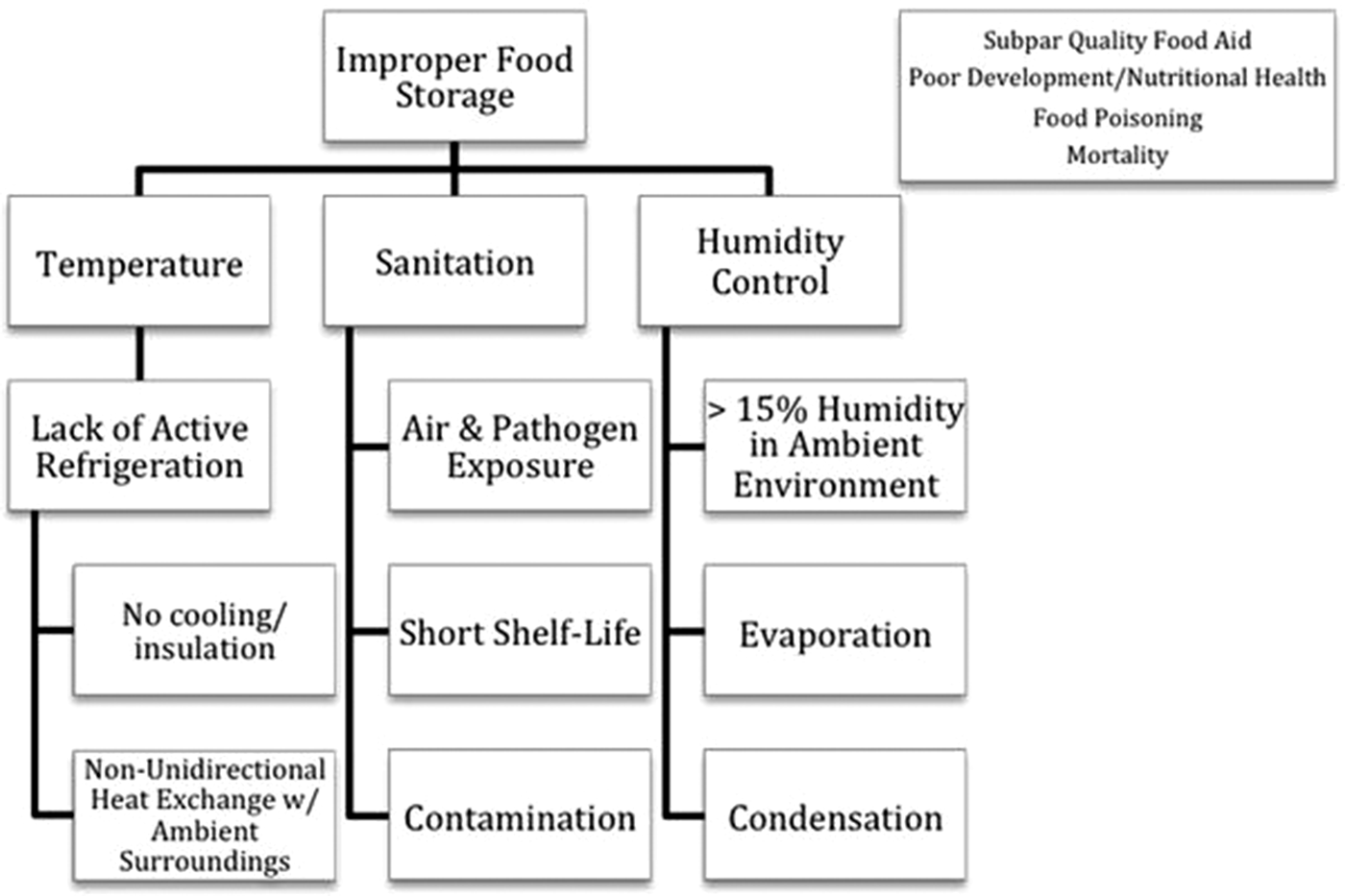
Figure 1 illustrates the designer's decomposition of this problem.
Problem decomposition in the Desert Chiller case study.

In the documentation of this case study, the designers highlight five biological sources of inspiration: termite mounds, hind limb of birds, prairie dog mounds, zebra stripes, and beach spiders. Here is a snippet about prairie dog mounds:
Wind capture in black-tailed prairie dog mounds: Prairie dog mound structures are constructed such that one entrance is higher than the others. This modification harnesses the physical principle in which a velocity gradient of wind is produced while moving over and through the burrow. This in turn produces a pressure gradient that induces the desired airflow through the burrow. Further, the amount of airflow captured is a positive correlation of wind speed.
Figure 2 illustrates the design from this case study. In the documentation, the designers provide a detailed description of their design and how biological solutions inspired aspects of it:
The main goal of the Desert Chiller is to passively cool temperature-sensitive food items that sub-Saharan African villages previously have had trouble storing. Our design would create a stationary cooling unit for arid, rural villages that uses biologically inspired designs to cool perishable goods without the use of electricity. One beneficial outcome of our design would be the reduction of food-related illnesses from spoiled foods.
The proposed design will consist of a stainless steel container buried half a meter underground, covered by an external shell built from local Kaolin clay that insulates air temperatures from the ambient conditions. The inner food container would be a 2 m3 stainless steel cylinder. The external shell would be sufficiently large to allow for easy access to the inner food container while minimizing the amount of unwanted space in between the two.
The external structure of the Desert Chiller is inspired by both Ivory Coast termite mounds as well as prairie dog mounds. This structure of interconnected hollow spires and tunnels would utilize the natural velocity gradient of wind, which would in turn create a pressure gradient that would induce air circulation inside the outer shell. Air circulation is necessary to prevent air from stagnating inside the unit.
The prairie dog tunnel systems incorporate a network of air pipes. The outer shell of the unit will have two large pipes coming from it, one that transports fresh air into the unit and the other that transports the stale air out. The pipe allowing stale air out of the unit will be somewhat taller than the pipe transporting fresh air in. This utilizes the velocity gradient as stated above. While inducing airflow, we do not wish to allow heat transfer between the ambient environment and the air inside the chamber. In order to achieve this, we would utilize a counter-current heat exchanger within the airflow system.
The concept is modeled after the counter-current heat exchanger found in ducks that keeps their bodies warm as their blood circulates into their feet in icy water. Blood flowing through arteries into the feet is very warm, and blood flowing through the veins is very cold. To prevent shock from the high temperature difference, the duck's veins and arteries form a counter-current heat exchange system. Its arteries form a gridlike cross section with the veins and arteries in immediate contact so that the cool venous blood gets warmed by the arterial blood before it returns to the duck's core, which maintains its homeostatic internal temperature, even in frigid temperatures.
The large pipes will run into the interior of the mound and then divide into a large number of small tubes. These tubes will enter a square cross-section copper grid with openings 0.5 cm across. Each intake pipe (warm air) will run parallel in direct contact with four outflow pipes (cool air) and vice versa, acting as a heat exchanger to cool the air flowing into the unit and reduce the amount of atmospheric heat exchange.
The inner food container would utilize a system of copper tubing and a hand-pumped device that circulates water through tubing wrapped around the food container from an underground holding tank 4 meters below the surface level. This water is cooled by constant subterranean temperatures, which average 9 degrees Celsius. As the water circulates through the tubing, it effectively absorbs heat from the adjacent container to cool the air and contents inside of it.
The circulated water would be recycled by being drained back into the tank, and then it would be re-chilled by the lower subterranean temperature. This cycle would take a maximum of 12 hours in order to chill the contents of the container to 14 degrees Celsius. This would also give the water inside the subterranean tank enough time to be re-chilled overnight. The pump does not require to be run overnight because of the drastic temperature differences between night and day in arid environments.
The design from the Desert Chiller case study.
Finally, evaluation is an important step in designing. In this case study, the Quantitative Analysis Section and Environmental Impact Assessment Section are both examples of evaluation. Below is one of these sections:
ENVIRONMENTAL IMPACT ASSESSMENT:
The primary materials of the Desert Chiller are copper and Kaolin clay. Copper production techniques such as the flash melting technique reduce the energy requirements for 1 ton of copper from 40,000 MJ to 20,000 MJ. This further reduces the energy production requirement of one unit to 200 MJ. This is equivalent to 56 kWh of energy.
Depending on the type of energy production, different levels of CO2 would be emitted. Assuming a coal power production at 33% efficiency and 28 MJ/kg coal, we would need 200/28 MJ/kg or 7.14 kg of coal for the energy needed. At 33% efficiency, this means that 14.28 kg of coal is burned with particulates emitted to the atmosphere. This equates to 14.28 * (12/13 carbon–coal ratio) = 13.2 kg of carbon, equating to 13.2 * (44/12 CO2–carbon ratio) = 48.4 kg of CO2 emitted per unit. This represents the worst-case production scenario.
This excess energy is emitted as heat, which typical plants cool with water. Our 200 MJ of energy would result in 400 MJ of waste heat at 33% efficiency. Assume a power plant that can take water in and heat it by 10 degrees C before placing it back into the source. 400 MJ with a specific heat of water of 4.2 J/g/deg C would need 42 J/g (for 10 deg C) and would need 42 KJ (or 0.042 MJ) per kg water. This would use 9524 liters of water (run through the system, not evaporated) for each unit.
Kaolin clay is a common, easily found resource in sub-Saharan Africa. The primary energy use in the clay production would be the firing heat. Clay must be fired at temperatures of around 900 degrees Celsius. The energy required to reach this temperature at a specific heat of 1 j/g/deg C is (1 j * 870 degrees * 1000 g) = 0.87 MJ/kg. This is a relatively low-energy expenditure.
As we mentioned in the Introduction, in earlier research, we developed a task model of biologically inspired design (Goel, Vattam, et al., Reference Goel, Vattam, Wiltgen, Helms, Goel, McAdams and Stone2014) based on our in situ observations of the design practices in the Georgia Tech ME/ISyE/MSE/PTFe/BIOL 4740 class, and this task model has significantly influenced the teaching and learning in the class. The task model describes two main methods of biologically inspired design: problem-driven design and solution-based design. Each method spawns subtasks of its own. Further, problem decomposition may result in compound analogical design in which different parts of the target design are transferred from multiple source cases.
We tried to map the design processes described in the documentation of the Desert Chiller case study to our task model. Our preliminary analysis indicates that while it is unclear to what extent the designers followed problem-driven design, solution-based design, a combination of the two, or some other design method, almost all of the high-level subtasks in our task model can be identified in the design processes documented in the case study. The one missing subtask is that of “solution abstraction,” which is only implicit in the documentation.
6. ANALYZING THE CASE STUDIES
In the Introduction, we observed that one of the goals of this work is to systematically analyze student work in biologically inspired design courses. As a first example of such an analysis, we analyzed the case studies in DSL to understand the relationship between Georgia Tech ME/ISyE/MSE/PTFe/BIOL 4740 student biologically inspired design projects and environmentally sustainable design.
Sustainable design refers to the design of products, materials, processes, and services in accordance with the principles of biological diversity, ecological integrity, and environmental responsibility (Ehrenfeld Reference Ehrenfeld2008). According to Benyus (Reference Benyus1997), environmental sustainability is, or should be, the driving force of the movement. Thus, environmentally sustainable design is one of the fundamental organizing principles of Biomimicry 3.8's educational programs and courses on biologically inspired design (Baumeister et al., Reference Baumeister, Tocke, Dwyer, Ritter and Benyus2012). In contrast, Georgia Tech's Center for Biologically Inspired Design's courses such as ME/ISyE/MSE/PTFe/BIOL 4740 view the desire for creativity and innovation in design as driving biologically inspired design. In general, the class contained only one lecture on environmental sustainability toward the end of the term. Although the course instructors asked the students to select design projects related to sustainability in a couple of the years during the 8 years from 2006 through 2013, in general the students were free to select the design goals of their projects. DSL enables us to systematically analyze how often the students selected design projects related to sustainability on their own.
We limited this analysis to the 65 case studies in DSL that resulted in complete and fully documented designs because of the concern that in some cases even if sustainability was a design goal at the start of the project, it may have been abandoned during the course of the project. By focusing on the 65 case studies with complete and fully documented designs, we can be sure that sustainability remained a design goal throughout the project.
We categorized a case study as intentionally sustainable if the primary goal of the case study related to sustainability. The case study titled Garden Veins Passive Irrigation System from 2011 is one example of an intentionally sustainable design. The final design report for this case study specifies the design goal as “design irrigation systems for urban farming that are extensive and intensive without hindering light to plants or using excessive energy to distribute water.” In addition to “without using excessive energy,” the final design also incorporated a mechanism for water conservation. The WASP Paper case study from 2008 is another example of an intentionally sustainable design. Here, the design team designed a paper production system that conserved water and energy relative to existing methods.
In contrast, we categorized the case study, titled Zipper Lock, from 2011 as not sustainable because sustainability was not an explicit design goal of the project. In this case study, the design team intended to protect bicycles from theft by inventing biologically inspired locks. We could not detect any statement about environmental concern in any of the documentation associated with this case study.
We found that sustainability was the primary design goal in 28 (or 43%) of the 65 case studies. However, we note that in the 2008 and 2009 versions of the biologically inspired design class, the instructors specifically asked the students to target sustainability, which skews our data. If we consider only the other years 2006–2007 and 2010–2013, in which the design teams had complete freedom to formulate design goals, we are left with only 48 case studies with complete and fully documented designs. Of these 48 case studies, 13 (or 27%) were intentionally sustainable. This suggests that environmental sustainability was an explicit goal of about one fourth of the biologically inspired design case studies.
The above analysis also yielded an unexpected and intriguing result. We found that in some case studies, although the design teams did not have sustainability as the primary design goal, the designers' own analysis indicated that the design would be more sustainable than conventional designs. We call this phenomenon serendipitous sustainability. The Fog Collection System case study from 2008 is an example of a serendipitously sustainable project. In this case study, the designers' “challenge of the design problem” was to “develop a system that can effectively collect water from vapor-filled fog.” When summarizing “commercial applications” for their technology, the designers wrote, “In its full-scale size, the device may be of interest to those interested in sustainable home development because of its non-intrusive capacity (does not have to be installed in the ground like many cisterns).” Because the designers themselves analyzed that their solution was more sustainable than a conventional solution (“cisterns”), we categorized this case study as serendipitously sustainable.
We found 5 of the 65 case studies (or 8%) to be serendipitously sustainable. This means that sustainability was a major factor in 33, and not just 28 (or 51%, not just 43%), of the 65 case studies. If we again ignore the case studies from 2008 and 2009, then 4 of the 48 case studies from 2006 to 2007 and 2010 to 2013 (or 8%) were serendipitously sustainable. Thus, taking into account both intentionally sustainable and serendipitously sustainable case studies, and sustainability was a major factor in about a third, 17 (or 35%) of 48, of the case studies.
From the perspective of environmental sustainability, these results appear encouraging: sustainability was not only a factor in about a third of the biologically inspired design case studies but also an explicit design goal in about a fourth of the projects, and perhaps more important, 8% of the biologically inspired design projects were evaluated by their designers to be sustainable even when sustainability was not an explicit design goal. Jacobs, Nichol, and Helms (Reference Jacobs, Nichol and Helms2014) provide additional examples of using digital libraries of case studies to analyze broader trends in biologically inspired design.
7. LEARNING FROM THE CASE STUDIES
As we mentioned in the Introduction, one of the main goals of this work is to foster interactive learning about the processes of biologically inspired design. Thus, we conducted a preliminary, formative, exploratory study on the use of DSL for analogical learning of biologically inspired design processes. This study is exploratory research in that it is not testing a specific, precise, or well-defined hypothesis. Instead, the goal here is to use the empirical data to determine if there is any analogical learning, and if so, whether we can formulate a data-driven hypothesis for further investigation (Corbin & Strauss, Reference Corbin and Strauss2008).
7.1. Method
The exploratory study consisted of four graduate students from different schools at Georgia Tech, none of whom had ever taken a course on biologically inspired design. Each participant followed the same procedure. We obtained informed consent from the participant. Next, we gave the participant a pretest in the form of a questionnaire. After the participant completed the questionnaire, we gave the participant a 10-page tutorial on DSL as well as access to DSL. We gave the participant 15 min to follow the tutorial document and explore DSL.
We then gave the participant both a written and a verbal description of a design problem. Next, we asked the participant to individually solve the design problem within 30 min. We told the participant that he or she could use DSL as well as the web. We also equipped the participant with paper and pen.
After the participants had completed their designs, we asked each participant to verbally describe how he or she solved the design problem. Next, we requested each participant to complete a posttest identical to the one on the pretest with only one difference: this questionnaire asked the participant to reflect on his or her interaction with DSL and give feedback on it.
We note that we conducted this exploratory study in the fall of 2013 with an earlier version of DSL than the one described in Sections 4 and 5. In particular, the version of DSL used in the exploratory study on analogical learning had fewer case studies (we have added about 20 new case studies since then) and was less usable (we have tried to improve the design of DSL based in part on the feedback of the participants in the exploratory study).
7.2. Design problem
All participants were given the same design problem: to fix the overheating problem in solar thermal collectors. Solar thermal collector technology harnesses solar energy by absorbing sunlight and heating fluids flowing through the device. A solar thermal collector is usually composed of a dark flat-plate absorber of solar energy, a transparent cover that allows solar energy to pass through but reduces heat losses, a heat-transport fluid to remove heat from the absorber, and a heat insulating backing. The heat-transport fluid to remove heat from the absorber is usually a mixture of glycol (55%) and water (45%). However, solar thermal collectors tend to overheat, especially when exposed to high temperatures during peak summer. Beyond a certain temperature, glycol becomes unstable, leading to degradation, flocculation, and formation of solid residues. Without adequate protection, this could lead to damaged internal components, high maintenance costs, and reduced lifespan of the device. Current protection methods, such as blocking the heat absorber's surface with wooden panels, are inefficient.
Participants were asked to develop a bioinspired heat regulation system that can fit onto an existing absorber to constantly maintain suitable temperature, and a bioinspired feedback control system that regulates the temperature of glycol by managing the regulation system. We chose this problem because we had studied it earlier and thus were familiar with it.
7.3. Results
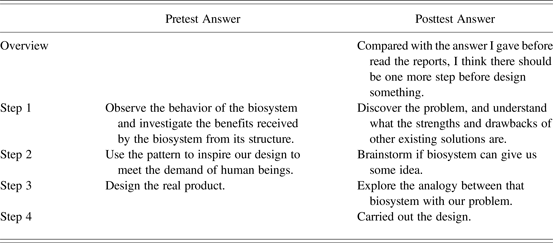
We found that the use of DSL enhanced participants' knowledge of the processes of biologically inspired design, indicating some analogical learning. In both the pretest and the posttest, we asked the participants to define biologically inspired design. In Table 1, we present a comparison between answers given by one of the participants. In both tests, the participants were required to organize their answers on the two tests into bullet points. We have organized the answers of one participant, Participant 2, on the pretest into the middle column and answers on the posttest into the right column of Table 1. We posit that the differences in the answers to this question indicate an enhancement in the participant's knowledge of the biologically inspired design processes. Although the use of DSL to address the design problem is the likely proximate cause for this positive change, in principle it is possible that the change may have been caused by other factors such as the participant's reflection on the previous characterization or on the design problem solving.
Participants' definitions of biologically inspired design on both the pre- and posttests
Note: The table shows Participant 2's answers on the two tests.
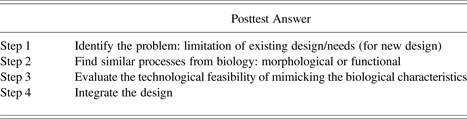
As we noted earlier, none of the participants in our study had any training or experience in biologically inspired design. Some participants had heard of the term biologically inspired design before, and/or were able to infer something about the design methodology from the term itself. Most participants in our study showed a pattern of analogical reasoning indicated in Table 1. However, one participant, Participant 3, initially had “no idea” about biologically inspired design. Table 2 indicates a substantial change in Participant 3's understanding of biologically inspired design processes as a result of using DSL in the context of addressing a design problem.
Answers from Participant 3 for the same question as in Table 1
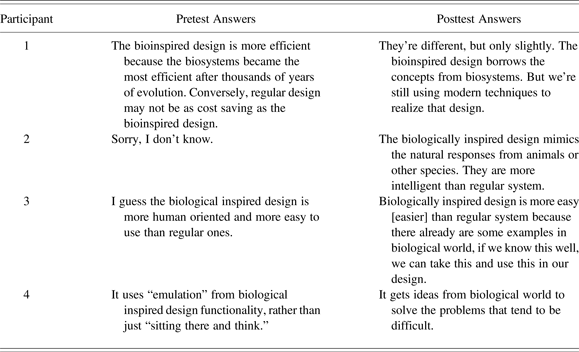
Let us consider another question on the pre- and posttests: “How do you think ‘biological inspired design’ differs from regular design?” Table 3 presents the answers provided by all four participants in the study. It suggests that the participants' understanding of the processes of biologically inspired design improved as a result of using DSL.
Answers from participants to the question “How do you think “biological inspired design” differs from regular design?”
Our results indicate not only opportunities but also challenges regarding DSL's potential role as an interactive tool for teaching novice designers about the processes of biologically inspired design. In particular, although we had designed DSL as an interactive tool for learning about the processes of biologically inspired design, some participants viewed it more as a search engine for finding biological analogues relevant to the given design problem. This is consistent with our in situ observations of the participants' actual use of DSL during the experiment. We believe that this challenge derives from DSL's interface and the type of interaction participants had with it.
The preliminary evidence from this exploratory study suggests a specific research goal for the next study: investigation of the use of DSL for supporting the learning of biologically inspired design processes as a complement and a supplement to classroom learning in the Georgia Tech ME/ISyE/MSE/PTFe/BIOL 4740 class. In Section 3, we noted that learning about biologically inspired design processes in the class has been a challenge for both cognitive and pragmatic reasons. In Section 5, we noted that the design processes in at least one of the case studies in DSL can be directly mapped into the task model of biologically inspired design. DSL may potentially help address both the cognitive and the pragmatic challenges in learning about biologically inspired design processes. Cognitively, DSL provides access to well-documented case studies of biologically inspired design, including case studies that illustrate the design processes and tools. Pragmatically, any student can in principle access any case study at anytime and from anywhere. The exploratory study suggests a specific, precise hypothesis for the next study: analogical learning using DSL may result in enhancement of most students' understanding of the processes of biologically inspired design, and substantial enhancement in case of beginning students.
8. FUTURE WORK
The current work has some limitations in each of its four dimensions: documentation, access, analysis, and learning. First, DSL contains only 83 case studies. We could put DSL in the public domain and perhaps also make it open source so that anyone could add case studies to the growing library. However, this raises hard issues of intellectual property rights, and at present, we do not have a solution to this problem.
Second, while DSL in principle provides on-demand access to the case studies, our exploratory study indicates that some users view DSL mainly as a library of biological systems to be searched and used (as in DANE). Thus, we need to rethink the user interactions DSL presently supports and redesign the user interface so that we can better support learning of design processes. To do this, we have already reduced the search facilities, for example, by removing search by author. In contrast, we intend to augment the search by adding semantic tags. As we mentioned in Section 4, the currents tags are Function, Structure, Principle, and Operating Environment. These tags refer to the content of the designs, but not to the design processes. We plan to add semantic tags that directly relate to our task model of biologically inspired design, such as problem-driven design, solution-based design, and compound analogical design. Further, following Vattam and Goel (Reference Vattam and Goel2013), we plan to enable designers to collaboratively add their own semantic tags to the case studies in DSL.
Third, while DSL provides a platform for analysis of case studies of biologically inspired design, our analysis of the relationship between biologically inspired design and environmental sustainability is limited. On the one hand, we found that sustainability was an explicit goal in about one in four case studies (intentional sustainability). Further, we found that in 8% of the case studies, sustainability was a positive, if unintentional, side effect of biologically inspired design (serendipitous sustainability). This suggests adding semantic tags to the case studies related to sustainability such as Intentional Sustainability and Serendipitous Sustainability. On the other hand, our analysis of sustainability is based directly in terms of the design goals in the case studies. Additional analysis of sustainability in the case studies would require a multidimensional examination of the designs themselves.
Fourth, as we mentioned above, our exploratory study of analogical learning about the processes of biologically inspired design is preliminary and formative. As an exploratory study, it consists of only four subjects, each of whom worked individually in a laboratory setting on a single design problem for only 30 min. The value of this exploratory study as we noted above lies in that it establishes a prima facie case for some analogical learning of biologically inspired design processes, and it suggests a research goal and hypothesis for a large-scale, more detailed, and better controlled experiment: DSL may be a useful interactive tool that supplements and complements classroom instruction for enhancing learning about biologically inspired design processes. We hypothesize that analogical learning using DSL will result in enhancement of most students' understanding of the processes of biologically inspired design and substantial enhancement in the case of beginning students.Footnote 1
As we mentioned in Section 3, the design projects in the Georgia Tech ME/ISyE/MSE/PTFe/BIOL 4740 class are critiqued and assessed by design juries composed of interdisciplinary faculty. Thus, following ARCHIE (Pearce et al., Reference Pearce, Goel, Kolodner, Zimring, Sentosa and Billington1992) and AskJef (Barber et al., Reference Barber, Bhatta, Goel, Jacobson, Pearce, Penberthy, Shankar, Simpson and Stroulia1992), we plan to augment the case studies in the next version of DSL with their critiques and assessments.
9. CONCLUSION
Digital libraries of case studies of analogical design have been popular since their advent in the early 1990s. In this paper, we revisited some of the benefits of digital libraries of case studies in the context of biologically inspired design. In particular, we studied four key benefits of case studies of analogical design. First, case studies enable documentation of design processes and practices. This is important because detailed documentation of design processes often has been missing from the literature on biologically inspired design. The 83 case studies in our work come from 8 years of extended, collaborative design projects in an interdisciplinary class on biologically inspired design.
Second, a digital library of case studies provides on-demand access to case studies. We described a web-based digital library of our case studies of biologically inspired design called DSL. DSL enables a user to browse the case studies in the library as well as search for specific case studies. Insofar as we know, DSL is the first interactive tool that captures detailed case studies of biologically inspired design documenting the design processes used in design projects.
Third, a digital library of case studies supports analyses of broader patterns and trends. For example, we analyzed the case studies in DSL from the perspective of sustainability. We found that sustainability was a major factor in about one in three of the case studies, and about one in four were explicitly targeted toward sustainable design. We also found that in 8% of the case studies, sustainability was a serendipitous by-product of the biologically inspired design method. This seems to suggest that sustainability is both a major goal and a salient outcome of many biologically inspired design projects.
Fourth, a digital library of case studies may support analogical learning about the processes of biologically inspired design. We reported a small exploratory study to investigate this hypothesis about analogical learning. Preliminary results indicate that DSL supports novice designers in interactive learning of the processes of biologically inspired design. Teaching and learning about biologically inspired design processes in general is challenging both cognitively and pragmatically. The exploratory study suggests that analogical learning using DSL may result in enhancement of most students' understanding of the processes of biologically inspired design, and substantial enhancement in the case of beginning students. A systematic evaluation of this hypothesis requires larger scale, more detailed, and better controlled studies. We plan to conduct such a study, using DSL as a cyberlearning tool that supplements and complements learning about biologically inspired design processes in the Georgia Tech ME/ISyE/MSE/BME/BIOL 4740 class.
ACKNOWLEDGMENTS
We are grateful to the instructors and students of the Georgia Tech ME/ISyE/MSE/BME/BIOL 4740 class from 2006 through 2013. We thank the US National Science Foundation for its support of this research through a CreativeIT Grant (0855916) and a TUES Grant (1022778). This work has benefited from discussions with our colleagues at Georgia Tech's Design & Intelligence Laboratory and Center for Biologically Inspired Design, especially Titilayo Craig, Michael Helms, and Spencer Rugaber. We note that this paper is a substantial revision and expansion of Goel, Zhang, et al. (Reference Goel, Zhang, Wiltgen, Zhang, Vattam and Yen2014) and that Section 4 revises and extends a similar analysis in Goel et al. (Reference Goel, Bras, Helms, Rugaber, Tovey, Vattam, Weissburg, Wiltgen and Yen2011). Finally, we thank the three anonymous reviewers of earlier drafts of this paper: their detailed critiques significantly helped improve the quality of the paper.
Ashok K. Goel is a Professor in the School of Interactive Computing at the Georgia Institute of Technology He is the Director of the School's Design & Intelligence Laboratory and a Co-Director of Georgia Tech's Center for Biologically Inspired Design. He is also Vice-Chair of the Board of Directors of the Biomimicry Institute. Ashok conducts research into artificial intelligence, cognitive science, and human-centered computing, with a focus on computational design, discovery, and creativity. His current research on computational design develops information-processing theories of biologically inspired design to help systematize its practice as well as interactive tools for scaling up the practice.
Gongbo Zhang has an MS in computer science from the College of Computing at the Georgia Institute of Technology. He is also a member of Dr. Ashok Goel's Design & Intelligence Lab. Gongbo is interested in computer science related topics, especially AI, computer-supported cooperative work, and natural-language processing. He has conducted research in interactive learning technologies and machine learning algorithms in computational linguistics.
Bryan Wiltgen is a PhD candidate in computer science in the School of Interactive Computing at the Georgia Institute of Technology. He is also a member of Dr. Ashok Goel's Design & Intelligence Lab. Bryan's research lies at the intersection of AI, analogical reasoning, and biologically inspired design. He seeks to develop an AI agent that can evaluate biologically inspired design analogies to help people better evaluate and rank such analogies. Bryan's research interests are in knowledge-based AI, analogical reasoning, and cognitive science, with a special interest in computational technologies that support and/or interact with people.
Yuqi Zhang currently works for Rakuten Inc. in Tokyo. She obtained her dual master's degrees in computer science from the Georgia Institute of Technology and Shanghai Jiaotong University in March 2014. From September 2012 through March 2013, she was a Visiting Scholar at Georgia Tech's Design & Intelligence Laboratory. She has conducted research in AI, cognitive science, and especially personalized recommendation systems.
Swaroop Vattam is currently a Postdoctoral Research Associate with the US Naval Research Laboratory. He obtained his PhD in computer science from the Georgia Institute of Technology, where his doctoral research in biologically inspired design studied the information-seeking practices of novice designers searching for their biological sources of inspiration and developed computational tools to support such practices. Dr. Vattam's research interests in AI and cognitive science include knowledge representation and reasoning, with an emphasis on understanding and supporting analogical reasoning.
Jeannette Yen is the Director of the Georgia Institute of Technology's Center for Biologically Inspired Design and a Professor in the School of Biology. She received her PhD in oceanography from the University of Washington. Dr. Yen is an oceanographer, working at the interface connecting animal behavior, fluid mechanics, and environmental sciences. In 2004, she was Chief Scientist on a 12-day oceanography research cruise to Antarctica. Her research is supported by the National Science Foundation Offices of Biological Oceanography, Sensory Systems, and Polar Programs as well as by the Office of Naval Research.