


Introduction
Donors in many developed countries are increasingly seeking out more sophisticated and strategic forms of giving. Such giving is of increased importance in the face of decreasing public investment and foreign aid.Footnote 1 In the United States, this desire of donors has been linked to an explosion in the creation of ‘donor-advised funds’ (‘DAFs’), being management accounts within a public charity in relation to which the donor can advise how they wish funds to be ultimately distributed.Footnote 2 DAFs are commonly provided by charities affiliated with financial institutions or trustee service providers and, to a lesser extent, by community foundations and operating charities that engage in significant fundraising like universities and health organisations. DAFs appear to offer many of the benefits of private foundations, without the cost of establishing a new foundation, whilst also being subject to less onerous regulation.Footnote 3 That reduced regulation has led commentators such as Madoff, Brakman Reiser and Dean to question the value of intermediaries like DAFs.Footnote 4
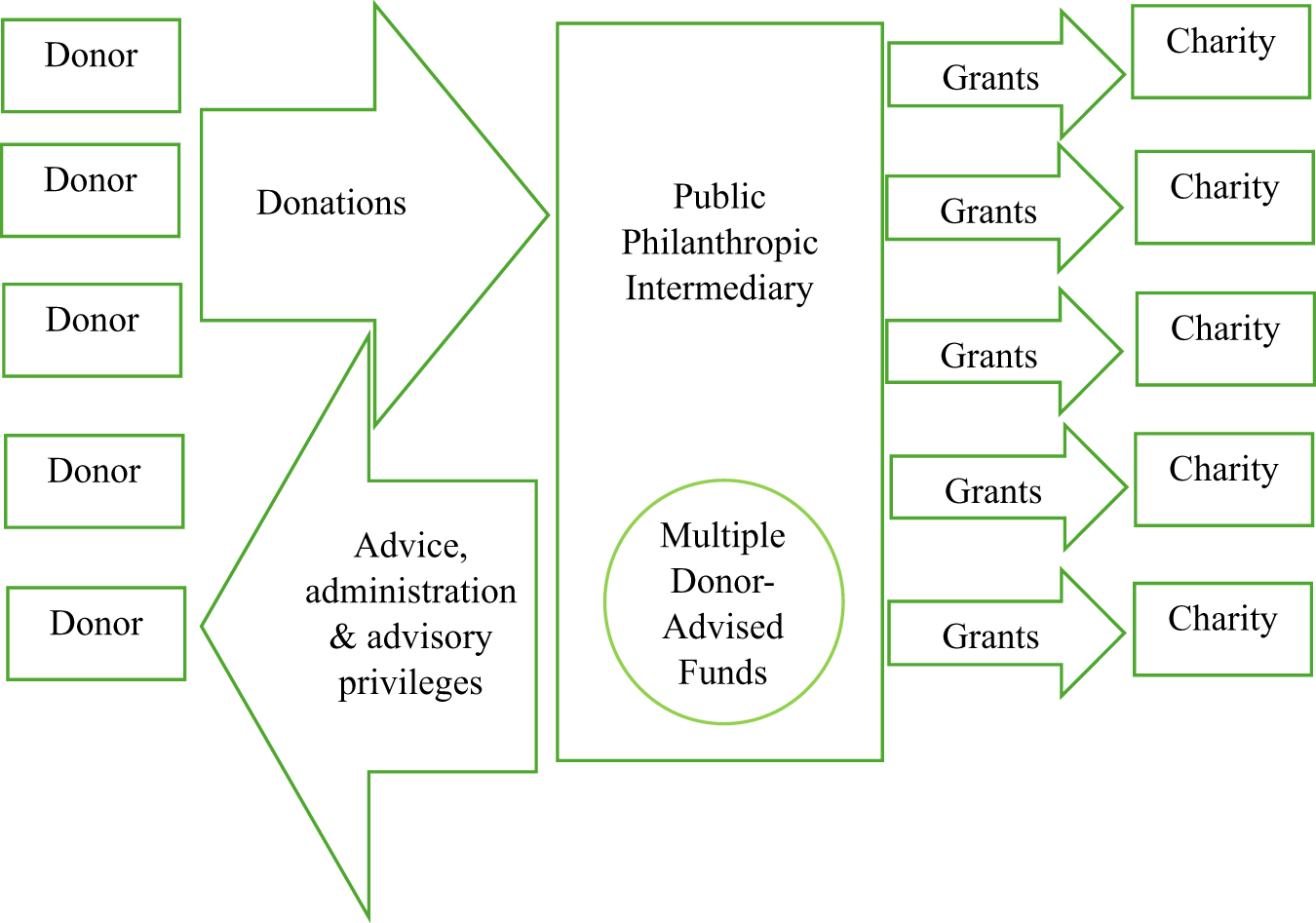
We term broadly available structured giving vehicles ‘public philanthropic intermediaries’ (see Figure 1). Unlike private foundations that are usually limited to a small pool of donors, these entities receive contributions from a broader set of donors. They are structured in that there is a sufficient degree of organisation to enable giving plans to take place over time and to support and inform donor choice of ultimate recipients. These entities are philanthropic in that they are vehicles whose objective is to receive gifts and put them to a public purpose. Finally, they are intermediaries because, mostly, they do not directly carry out a public purpose, but rather invest and distribute funds to others to carry out public purpose activities. Public philanthropic intermediaries thus offer many of the benefits of private foundations, such as enabling strategic giving and assisting succession planning, including by providing a structured tool for ongoing family involvement in philanthropy.Footnote 5 In that sense, as noted by Colinvaux, public philanthropic intermediaries can be seen as ‘private foundation substitutes’.Footnote 6 However, they potentially also offer greater expertise in handling donations of illiquid assets and administrative efficiencies in relation to a range of matters, including pooled investments,Footnote 7 or, as demonstrated in Singapore, cross-border giving. In this way, public philanthropic intermediaries have the potential to generate new giving that may not otherwise have occurred.Footnote 8
Public Philanthropic Intermediaries.

With notable exceptions,Footnote 9 most comparative work on public philanthropic intermediaries that enable ongoing donor involvement, such as DAF sponsor organisations, centres on the United States.Footnote 10 That is not because there is less desire for institutional support for strategic giving in other jurisdictions.Footnote 11 Indeed, as will be discussed, in some jurisdictions, community foundations have a prime place in meeting these desires. Accordingly, this article takes a different cross-section, comparing the presence and use of public philanthropic intermediaries such as DAF sponsors and community foundations in three Asia-Pacific jurisdictions. The comparative approach involves identifying the common nature of the problem, being the desire for institutional supports for broadly available sophisticated and strategic giving.Footnote 12 We then describe the public philanthropic intermediary forms provided as an institutional response to this problem, outlining their benefits.Footnote 13
The next part of the article discusses specific concerns that have emerged about public philanthropic intermediaries.Footnote 14 First, there are temporal concerns about delay between giving to an intermediary and the ultimate use of funds for public benefit activities. That is, concerns about intergenerational equity. Second, worries exist that public philanthropic intermediaries can be used as ‘dark money’ tools for political advocacy without the need for the same level of disclosure as other giving vehicles. Third, there are concerns that the organisations operating intermediaries will lose focus on their public purpose and be tempted to stream private benefits to managers or affiliated organisations or delay payouts to philanthropic causes. We then compare the institutional responses from the Asia-Pacific jurisdictions, regarding their ability to address the identified concerns while still retaining the benefits of a strategic giving vehicle.Footnote 15 Finally, our last section highlights areas of success or failure as potential areas for further investigation and reform.
In adopting a functional comparative approach, we make the most of the differences and similarities between Singapore, Australia and Japan in exploring the ways in which public philanthropic intermediaries have been embraced to address the desire for sophisticated and strategic giving. Australia and Singapore are common law jurisdictions, whereas Japan is a civil law country. Nevertheless, each of the three countries has a developed economy and a (full or partial) democratic system of government,Footnote 16 ensuring a sufficient level of property rights and individual liberty that broad-based philanthropy is practised and has engendered desires for more structured giving. From a social origins theory characterisation of the nonprofit sector,Footnote 17 Australia is in the liberal model (along with the UK and US),Footnote 18 while Singapore is a mix of ‘statist-corporatist’.Footnote 19 Japan is statist by origin, and as such has been less hospitable to nonprofits.Footnote 20 Nevertheless, after its economy faltered in the 1990s, the loss of trust in the state and expanding government spending on social welfare have moved Japan towards a corporatist/welfare-partnership model.Footnote 21
In addition to providing a comparative account of the institutional forms of public philanthropic intermediaries across the three jurisdictions, the article’s key contribution is to consider how those different institutional forms permit the advantages and address the concerns that have been raised about public philanthropic intermediaries. This can help policymakers in the three jurisdictions and beyond broaden the range of regulatory approaches that they consider and help predict whether these intermediaries are likely to be a significant feature of the philanthropic landscape.
The Problem: Cost Efficient, Yet Sophisticated and Strategic Giving
Ultra-high-net-worth families in the Asia-Pacific will see an intergenerational wealth transfer of about US$5.8 trillion between 2023 and 2030.Footnote 22 It is expected that philanthropy will feature prominently within the inheritance and succession planning process as in other parts of the world.Footnote 23 The last few decades in each of Singapore, Australia and Japan have seen a desire on the part of a greater range of donors for more sophisticated, strategic and connected (to purposes and benefit recipients) forms of giving, especially among the younger generations of wealthy families.Footnote 24 This reflects a range of factors, with some variance across countries. However, common factors include changes in social expectations, improved data and data-tools (such as Candid, Tencent Charity and the creation of public charity registers), tax advantages and the greater availability of institutional forms such as foundations or quasi-foundations.Footnote 25
In Australia, social and cultural changes include greater acceptance of open discussion of giving, greater focus on giving earlier in life, and greater adoption of business practices and ideas, including increased managerial professionalism and more formalised program evaluation.Footnote 26 Many Asian countries are also experiencing increased willingness on the part of donors to be transparent about their giving and a desire to be more involved in the strategic direction of that giving, partly influenced by demographic change.Footnote 27 This also applies in Japan, although the trend is less conspicuous in a relatively egalitarian society where individual donors have played a smaller philanthropic role as compared to corporate foundations.Footnote 28 In each of Japan, Australia and Singapore, demographic change is also increasing the proportion of older persons, many of whom hold material assets, such that there is a greater need for intergenerational philanthropic vehicles to aid succession planning.Footnote 29
Public Philanthropic Intermediaries as an Institutional Response
While the term DAF is commonly used in the literature, this terminology appears to be new in the jurisdictions under consideration. Hence we use the term ‘public philanthropic intermediary’.
Singapore, Australia and Japan each provide legal structures that can act as public philanthropic intermediaries so as to meet the demand outlined in the preceding part, with Singapore doing so most recently and exhibiting less variety of institutional forms. Japan and Australia have long provided legal forms of public philanthropic intermediaries, but recent years have seen changes in the way these forms are used and regulated. We outline these institutional responses below and then compare the extent to which they have attracted donations.
Singapore
Singapore’s public philanthropic intermediaries were set up by the state, state-linked entities, financial institutions and more recently by a registered charity. They are all in the form of companies limited by guarantee. The current DAF sponsors are Community Foundation of Singapore, Credit Suisse’s SymAsia Foundation Limited (‘SymAsia Foundation’), UBS’s Optimus Foundation, the Asia Community Foundation, TT Foundation Advisors and AVPN Limited. The key benefits of these DAFs are said to be: (a) facilitating impact; (b) providing flexibility in terms of managed assets; (c) lower costs as compared to setting up a private foundation; (d) ease of management; (e) privacy; (f) tax benefits; (g) advisory privileges for the family; and (h) providing an effective succession planning vehicle.Footnote 30
The Community Foundation of Singapore (‘CFS’) was established in 2008 by the National Volunteer and Philanthropy Centre, a state-sponsored enabling organisation for charities. In terms of legal form, CFS is a company limited by guarantee under Singapore’s Companies Act 1967. CFS is a registered charity with the Commissioner of Charities and an Institution of a Public Character, meaning that donations to CFS attract 250% tax relief.Footnote 31 The Singapore government sponsored CFS’s start-up costs and continues to cover the bulk of CFS’s operating expenses.Footnote 32 CFS is regarded as a ‘starter kit for foundations’ in that it is envisaged as a philanthropic tool for ultra-high-net-worth individuals who wish to set up a charitable arm with the eventual ambition that these individuals will establish fully fledged philanthropic foundations.Footnote 33 Further, CFS is seen as a ‘wealth adjacent’ organisation, supporting the philanthropic ambitions of the increasing number of ultra-high-net-worth families.
In Singapore, financial institutions have begun to view the provision of philanthropic services as part of their offerings in wealth management and financial services and to cater to the burgeoning number of family offices. This is in line with the state’s vision of making Singapore a philanthropic hub.Footnote 34 For instance, Credit Suisse established the SymAsia Foundation in 2010.Footnote 35 Prospective donors must be clients of Credit Suisse. Credit Suisse waives the establishment costs of setting up DAFs, but the usual bank charges apply in relation to assets under management. The impetus for setting up SymAsia Foundation is to make it easier for international donors to give in Singapore and Asia. Significantly, SymAsia Foundation’s early success lay in convincing Alibaba founders, Jack Ma and Joseph Tsai, to start DAFs.Footnote 36 As Ma and Tsai do not receive any United States or Chinese tax relief by setting up a Singaporean DAF, their primary motivation appears to be a desire for a reliable and well-governed philanthropic vehicle.
SymAsia Foundation Limited is incorporated as a company limited by guarantee under Singapore’s Companies Act 1967 as an umbrella philanthropic foundation established to support clients’ philanthropic needs and to promote philanthropy in Asia. The Singapore government appears supportive of SymAsia Foundation because it has been designated a nonprofit organisation under the Singapore Economic Development Board’s Tax Incentive Scheme, meaning that SymAsia Foundation’s income is tax exempt.Footnote 37 The Chairman of SymAsia Foundation is Professor Tommy Koh, Ambassador-at-Large at the Ministry of Foreign Affairs. SymAsia Foundation Ltd also controls the SymAsia Singapore Fund, which enjoys Institution of a Public Character status.
Like Credit Suisse, UBS has seen growing client demand for philanthropic vehicles in Singapore, with UBS offering the UBS Optimus Foundation from 2009 and launching a Singapore chapter of the UBS Optimus Foundation in 2019.Footnote 38 UBS Optimus Foundation Singapore Ltd is a company limited by guarantee. It is a registered grant-maker under the purview of the Inland Revenue Authority of Singapore and hence, if donors direct their donations to Institutions of a Public Character, they can receive a 250% tax relief. A separate fund, the UBS Singapore Donor Advised Fund, manages all donations designated for the community in Singapore.
In 2023, the Asia Community Foundation was launched in Singapore by the former Chairman of CFS with some funding from the Gates Foundation. It was founded with a focus on transnational causes in AsiaFootnote 39 and is a company limited by guarantee under Singapore’s Companies Act 1967. Two further DAF providers were launched in recent years, TT Foundation Advisors and AVPN Limited. TT Foundation Advisors, a company limited by guarantee, was set up by Temasek Trust, the philanthropic arm of Singapore’s sovereign wealth fund, with the aim of encouraging interest in philanthropy and enabling access to Temasek Trust’s networks, capabilities and programs.Footnote 40 AVPN Limited has also begun offering DAFs following its experience with setting up philanthropic pooled funds during the COVID-19 pandemic.Footnote 41
Australia
To offer donation tax concessions, most Australian public philanthropic intermediaries are in the form of ‘public ancillary funds’.Footnote 42 Public ancillary funds are required by tax legislation to be established under a will or instrument of trust, and so must be purpose trusts.Footnote 43 The public requirement relates to the range of persons who may donate to and administer the trust.Footnote 44 These philanthropic intermediaries can receive tax-deductible donations and on-distribute them to other deductible gift recipients, but are not permitted to distribute to other ancillary funds.Footnote 45 Some major public intermediaries – which routinely provide advisory privileges to donors, though typically in the form of a single choice of a relatively immediate recipient organisation – are also specifically listed by name in tax legislation.Footnote 46 As obtaining specific listing is essentially a political process, there are no legal form restrictions.
Donation concessions are also provided to other ‘deductible gift recipients’ that fall within multiple categories, such as public hospitals, public universities and public cultural entities.Footnote 47 These organisations also seek donations and some provide advisory privileges, though these often relate to a selection of projects carried out by the organisation itself. These other entities typically more directly pursue their own purposes rather than purely acting as conduits to pass funds onFootnote 48 and might therefore be expected to use most donations for their own purposes.Footnote 49 Nevertheless, there are many non-public ancillary fund entities that seek funds from the public and that make some grants to other organisations, including recent case examples of ‘public benevolent institutions’ that fundraise in Australia and then pass grants onto affiliated overseas organisations to carry out development activities.Footnote 50
However, the chief institutional means for providing medium to longer term advisory privileges to donors is by establishing sub-funds (ie management accounts) within a public ancillary fund in the form of a charitable trust,Footnote 51 even if that public ancillary fund is then administered by another organisation, such as a community foundation, as trustee. These intermediaries provide flexibility in planning ultimate giving and also enable legacy planning and the involvement of family members in philanthropy.Footnote 52 This is potentially set to change as Australia has recently extended donation concessions to approved community foundations without the need for a public ancillary fund and permitted either a corporate form or a charitable trust.Footnote 53
In terms of their origins, public ancillary funds have been in existence since 1923 and comprise community foundations, organisations established by trustee services or financial services companies, independent national DAF providers (such as Australian Philanthropic Services Foundation, established by a financial services executive), corporate foundations, single issue foundations and foundations established as public foundations by wealthy individuals.Footnote 54 The first public ancillary fund appears to be a community foundation, the Lord Mayor’s Charitable Foundation, established in 1923 as a result of government, business and community consultation.Footnote 55 While longstanding, major changes to modernise the regulation of public ancillary funds commenced in 2012, with the aim of strengthening their integrity and clarifying the regulatory requirements.Footnote 56 Further changes are also possible due to the new tax donation concession for community foundations and a broader philanthropy inquiry conducted by the Productivity Commission.Footnote 57
In terms of legal form, public ancillary funds must be purpose trusts; and restrictions on the creation of purpose trusts mean that almost all such trusts should be charitable trusts, though some appear to be statutory charitable trusts.Footnote 58 Additionally, to be a public ancillary fund, the trustees must have agreed to comply with public ancillary fund guidelines,Footnote 59 which are a set of regulations that impose various conditions, including requirements for minimum annual distributions and for a majority of the individuals involved in decision-making to be ‘responsible persons’.Footnote 60
Community foundations exist in various legal forms. These include corporate forms, most particularly a company limited by guarantee,Footnote 61 but also incorporated associations under state incorporation legislation.Footnote 62 Some are statutory foundations established under specific legislation.Footnote 63 Many of these corporations have in turn established public ancillary funds of which they are the trustee to enable donations accompanied by advisory privileges.Footnote 64 Other community foundations appear to offer more restricted donor privileges (eg to select a cause or sometimes a specific recipient at the time of creation of a sub-fund) via donation to a sub-fund created within the community foundation.Footnote 65 Many community foundations have a specific geographic focus, though some have relatively broad foci, such as an entire state,Footnote 66 or the whole of Australia.Footnote 67
Japan
There are no regulatory rules that specifically apply to public philanthropic intermediaries that provide advisory privileges. The chief institutional form that has played a philanthropic intermediary role in Japan is the community foundation. They are generally incorporated as public interest corporations and regulated by the Public Interest Commission (公益認定等委員会).Footnote 68 Public interest corporations enjoy tax concessions, but attract restrictive regulation that has limited their potential as philanthropic intermediaries. Nonetheless, the restrictive environment is gradually shifting. In 2024, under then-Prime Minister Kishida’s ‘New Capitalism’ initiative, legislative reforms were introduced to increase flexibility and disclosure for public interest corporations and to relax financial restrictions and requirements for tax concessions.Footnote 69
The first community foundation, the Osaka Community Foundation (‘OCF’: 大阪コミュニティ財団), was established in 1991. The initiative came from the Osaka Chamber of Commerce, which sent delegates to the US to visit community foundations and provided a JPY 100 million endowment to establish the foundation, along with endowments from the Osaka Prefecture and Osaka City.Footnote 70 One of OCF’s stated missions is to provide individual donors with a means to engage in tailored philanthropic giving. Today, it manages 282 separate funds, of which 14 are similar to DAFs, making distributions in a way that reflects the donors’ advice.Footnote 71 A large majority of funds, however, allow donors more limited advisory privileges to designate certain areas of charitable focus, and the Foundation’s Selection Committee determines which charities to fund.Footnote 72 It is the largest community foundation in Japan, holding JPY 3.2 billion.Footnote 73
The year before OCF was established, the stock and real estate markets collapsed, diminishing philanthropic sentiment, and no new community foundation was created for nearly two decades. Nonetheless, the 1990s and 2000s were a pivotal period, as Japanese civil society underwent a shift from a statist to a more corporatist/welfare-partnership oriented structure.Footnote 74 The Hanshin Earthquake and popular dissatisfaction with the government’s responses led to a significant rise in voluntarism. This triggered calls for legislative reform to ease the restrictions on incorporating grass-roots nonprofits, ultimately leading to the enactment of the NPO Corporation Act in 1998.Footnote 75 Meanwhile, public interest corporations, which were longer established and generally larger in scale than NPO corporations, faced public criticism in the 1990s due to revelations of mismanagement.
To increase fiduciary governance and accountability, legislative reforms in 2006 created the Public Interest Commission to provide oversight, following the model of the Charity Commission in England and Wales.Footnote 76 The 2006 legislation also contained a set of restrictive financial regulations.Footnote 77 One notorious example was a requirement that public interest corporations maintain parity between revenue generated from and expenditures made for their public benefit activities,Footnote 78 which was widely criticised as limiting nonprofits’ flexibility and capacity to expand or prepare for unforeseeable events.Footnote 79
In 2009, the Kyoto Foundation for Positive Social Change (京都地域創造基金) was created with an endowment of JPY three million as the second community foundation established in Japan. Within the same year, the Kobe Culture Aid Foundation (神戸文化支援基金) was created with an endowment of JPY 34 million. Regular establishment of community foundations has continued. In 2014, an umbrella body, Community Foundation Japan (一般財団法人全国コミュニティ財団協会) was established, which now has 31 community foundation members.Footnote 80
The community foundations created from 2009 onward are much smaller than OCF. In fact, the total assets held by a group of 24 community foundations (for whom financial statements are available) are JPY 1.4 billion, which is less than half of the JPY 3.2 billion held by OCF alone.Footnote 81 This reflects Japan’s broader civil society in the 1990s and 2000s: the rise of voluntarism has not been matched by an increase in philanthropic funding. Most community foundations are created by community activists as a means of collecting funds needed for providing services to the community. Because their primary concerns are community service provision, serving philanthropists’ needs has often remained secondary.Footnote 82 Their service orientation and the small scale of endowed assets have limited the capacity of community foundations to play significant philanthropic intermediary roles.
However, recent years have seen signs of change; more philanthropist-driven intermediaries have appeared. One is the Public Resource Foundation (‘PRF’: パブリックリソース財団), established in 2013 with the stated vision of realising philanthropists’ desires to create a better society. PRF manages 52 Original Funds, which are analogous to DAFs, while for most funds the donors designate certain charitable areas within which the PRF exercises discretion as to which charities to support.Footnote 83 In addition to funds management and grant-making services, PRF offers various nonprofit-related services including NPO consulting, social enterprise assessment and grant impact assessment. One of PRF’s strengths is its willingness to receive diverse assets, including real estate.
The other new philanthropist-driven intermediary is the Japan Philanthropic Foundation (‘JPF’: 日本フィランソロピック財団), established in 2020. This new foundation places greater weight on offering sophisticated giving options for wealthy individuals. Headed by a Chief Executive who had previously worked for Japan’s largest securities firm, the foundation emphasises its commitment to donors’ wishes and its expertise in managing entrusted funds.Footnote 84 JPF offers Design Funds, which permit donors to advise on distributions. Assets in Design Funds amount to JPY 312.9 million, representing a large share, compared to the JPY 10.7 million in conventional Thematic Funds, where donors only specify the charitable area.Footnote 85
Against these developments, the broad legislative reforms that took place in 2024 can be understood. The ‘New Capitalism’ policy package included measures to ‘enhance private-sector-led public interest activities and promote efforts to address social issues by public interest corporations and other entities.’Footnote 86 Although not specifically intended to promote philanthropic intermediaries, some of the reforms could facilitate greater use of sophisticated philanthropic intermediation. For instance, the public interest corporation legislation has been amended to relax the financial requirement to maintain parity between income and expenditure on public interest activities, giving greater discretion to directors to accumulate assets and prepare for unforeseen events.Footnote 87 The ongoing review of guidelines for public interest corporations might also include the regulatory framework for DAFs (as charitable conduits), program-related investment, and impact investment.Footnote 88
Success in Attracting Giving
As noted by Madoff and Colinvaux in the US context, there are reasons to question whether DAFs have actually resulted in new giving, as opposed to causing substitution of existing forms of giving.Footnote 89 We therefore touch on both levels of giving to public philanthropic intermediaries and their size, as well as drawing what inferences are available about whether this giving is new or substitutes for existing giving.
Table 1 sets out estimates of the number and size of public philanthropic intermediaries in each of the three jurisdictions, along with giving to those intermediaries for the relevant 2021-2022 financial year.
Intermediary Number, Size and Levels of Giving

Table 1: Long description
Measures counts of public philanthropic intermediaries enabling donor advised funds, their total assets at the start and end of the 2021 to 2022 financial year, giving received during the year, and the share of individual donations going to these intermediaries, for Singapore, Japan, and Australia. Number of intermediaries at the start of 2021 to 2022 is 391 for Singapore, 3,492 for Japan, and less than 1,379 for Australia. Total assets at the start of 2021 to 2022 are S$165 million for Singapore including non IPC fund assets, with S\$151 million excluding non IPC fund; JPY6.3 billion for Japan; and AU\$4.8 billion for Australia. Total assets at the end of 2021 to 2022 are S\$197 million for Singapore including non IPC fund, with S\$185 million excluding non IPC fund; JPY6.5 billion for Japan; and AU\$4.2 billion for Australia. Giving to public philanthropic intermediaries in 2021 to 2022 is S\$62 million for Singapore, JPY1.3 billion for Japan, and AU\$898 million for Australia. Percentage of donations to public philanthropic intermediaries as a proportion of all donations by individuals in 2021 to 2022 is 4.45% for Singapore, 0.41% for Japan, and 20% for Australia.
The Singapore figures are underestimates because they exclude Optimus Foundation, which did not publicly disclose sufficient financial information for the calculations. The Japanese data underestimates the size of DAFs in some ways as it excludes charitable trusts. They are not discussed as public philanthropic intermediaries because many of the settlors are corporate donors and, even for individual donors, donor advisory privileges can be exercised, if ever, only indirectly through an expert managing committee that is required by regulation.Footnote 102 On the other hand, the foundation data above does not distinguish what proportion of assets are held in DAF-equivalent accounts. For instance, in the case of OCF, a best estimate for funds held subject to advisory privileges is JPY 852.8 million out of the entire JPY 3,169 million.Footnote 103 The more philanthropist-driven intermediaries reflect much higher proportions of DAF assets. As at March 2024, PRF holds JPY 1,810 million worth of assets, of which JPY 867.1 million is held in DAFs (as ‘designated donation funds’).Footnote 104 JPF, as at June 2023, holds JPY 1,809 million, of which JPY 1,467.2 million is held in DAFs (as ‘design fund assets’).Footnote 105
The Australian data is an overestimate as not all public ancillary funds provide DAFs. However, it is the most robust data available as there is no mandatory reporting on Australian sub-funds. Earlier survey research on sub-fund providers indicated that, based on 2017-2018 data, there were over 1,995 Australian sub-funds with assets of AU$ 1 billion.Footnote 106 If this number is updated to reflect the percentage increase in public ancillary fund assets between 2017-2018 and 2021-2022, it would be AU$ 1.2 billion.Footnote 107 This number is an underestimate as it does not cover all sub-fund providers and also excludes some types of providers such as universities, or public benevolent institutions focussed on overseas aid.
Applying a method analogous to Phillips, Dalziel and Sjogren for estimating expected DAF asset levels,Footnote 108 based on US participation and giving rates and adjusting for GDP (using 2022 data), we can compare the expected DAF asset levels to the size of public philanthropic intermediaries in Singapore, Japan and Australia.
In Australia, the assets held by public ancillary funds (an overestimate) sit at the expected level for Australian DAFs. However, the bottom of the range estimate of sub-fund assets is around 3.5 times lower than this.
The differences are starker in Japan and Singapore. The expected size of Japanese DAFs is JPY 512.6 billion. This is nearly 80 times the assets held by community foundations, PRF and JPF combined. That is unsurprising given Japan’s statist past and the 2006 legislation’s restrictive approach, which have combined to suppress the ability of intermediaries to attract donations. Assets held in Singaporean DAFs appear to be over 10 times smaller than expected levels, which is too big to be accounted for by the exclusion of Optimus Foundation data.Footnote 117
In terms of overall giving, giving to public philanthropic intermediaries is increasing in the three jurisdictions, such that gaps between expected and actual levels of DAF assets are partially being filled. In Japan, the social and legal environment is changing. The amount of individual donations declared for tax deduction has increased more than 10 times from JPY 28.3 billion in 2012 to JPY 319.3 billion in 2022, reflecting, as a percentage against individual income, an increase from 0.08% to 0.69%.Footnote 118 Such trends, together with regulatory changes including the 2024 reforms, represent Japan’s shift from statist to a more corporatist/welfare-partnership model.
Expected Size of Public Philanthropic Intermediaries

Table 2: Long description
Three countries, Singapore, Japan, and Australia, are compared across inputs used to estimate intermediary assets and then convert the estimate to local currency. GDP adjusted US donor advised fund assets are US\$4.4 billion for Singapore, US\$37.8 billion for Japan, and US\$15.1 billion for Australia. Giving participation rate is 55 percent in Singapore, 16 percent in Japan, and 56 percent in Australia, with participation rate adjustments relative to a US giving rate of 61 percent of 0.902, 0.262, and 0.918. Giving as a percentage of income is 0.606 percent for Singapore, 0.689 percent for Japan, and 0.388 percent for Australia, with corresponding adjustments of 0.345, 0.393, and 0.221. Expected intermediary assets are US\$1.38 billion for Singapore, US\$3.90 billion for Japan, and US\$3.06 billion for Australia. Converted to local currency using the annual average exchange rate for 2022, the expected assets are S\$1.9 billion for Singapore, JPY512.6 billion for Japan, and AU\$4.4 billion for Australia.
These shifts are partially reflected in (and could readily incorporate in absolute terms) increases in giving to public philanthropic intermediaries. For instance, the total amount held by Japanese public philanthropic intermediaries increased by 20% (JPY 5.4 billion to JPY 6.5 billion) between 2020 and 2022.Footnote 119 Looking just to Japanese community foundations, in 2019-2020, 17 community foundations received JPY 336.3 million in donations, whereas in 2021-2022, 24 community foundations received JPY 704.9 million.Footnote 120 The more philanthropist-driven intermediaries are growing even faster. For instance, in only 10 years, PRF has built up assets amounting to around 25% of all public philanthropic intermediary assets.Footnote 121 The more recent entrant, JPF, is probably the most capitalist and individual philanthropist-oriented foundation. The entire assets reported in its balance sheet as of June 2023 are JPY 1,809 million, a threefold growth from the previous year.Footnote 122 However, overall, the growth of community foundations and other foundations offering DAFs has not fully absorbed the increased giving by wealthy Japanese individuals.
Donations to public philanthropic intermediaries in Singapore have nearly tripled from 1.7% of total donations by individuals in 2011-2012Footnote 123 to 4.45% in 2021-2022 as set out in Table 1. This is much higher than the increase in overall giving for the same period, measured as the percentage of donations to assessable income, which increased from 0.47% of assessable income to 0.61%.Footnote 124 However, the absolute increase in overall giving is sufficiently large to include the increased giving to public philanthropic intermediaries, such that there is not necessarily any substitution.Footnote 125
Australia reflects material levels of giving to public philanthropic intermediaries, with Table 1 demonstrating that this giving represents about 20% of tax concession donations by individuals. Annual donations to public ancillary funds have roughly tripled in size between 2012 and 2021.Footnote 126 This is a much higher rate than the modest increase in giving as measured by giving as a percentage of gross assessable income, from 0.31% to 0.39% over the same period.Footnote 127 Giving to intermediaries could explain part of that increase in overall giving, although if so, it would account for almost two-thirds of that increase.
Specific Concerns about Public Philanthropic Intermediaries
In recent times, public philanthropic intermediaries in the form of DAFs have come under trenchant criticism in the United States and have raised queries elsewhere too.Footnote 128 This is partly because the extraordinary growth of US DAFs has not been matched with an increase in charitable giving, such that as more donations are given to DAFs, fewer donations find their way to charities that more directly carry out service delivery and advocacy.Footnote 129 This trend, which is also reflected in Australia and Singapore (see previous part), but is not clearly present in Japan, accentuates the more substantive concerns about DAFs. Those concerns are threefold.
Temporal Concerns
Intermediaries inevitably create a delay between the making of a donation and the ultimate use of those funds for a charitable activity. This creates a warehousing effect. There are concerns that this delay is too long, as measured in different ways such as the maximisation of community benefit, the preferences of the charity sector, or failure to meet societal expectations.Footnote 130 Madoff has also highlighted the temporal gap between the public (via the government) providing immediate generous donation tax concessions to donors and the ultimate application of intermediary funds to ‘charitable activities’.Footnote 131 This is partly because while donors transfer ownership of the donated property, they retain advisory privileges which, in practice, permit them to continue influencing what happens to the donated property.Footnote 132 Colinvaux has examined this issue from the perspective of DAFs as substitutes for public charities that directly carry out charitable activities.Footnote 133 Murray has framed these temporal issues as a normative question involving intergenerational justice; considering the issue of delay in terms of the obligations that the current generation owes to past and future generations.Footnote 134 Delay is neither automatically good nor bad; rather what is needed is a set of normative principles to evaluate that delay. For instance, sufficientarian principles would justify the current generation setting aside assets for future generations that ensure a minimum threshold standard for those future generations, which could include sufficient resources to support the institutions of civil society.Footnote 135 However, once the threshold has been reached the current generation would not be obliged to save more. Indeed, we should arguably switch to prioritarian principles for allocating the remaining resources amongst the neediest in the current generation, which would often count against accumulating too many resources in intermediaries.Footnote 136
Tools to Build Political Power: Concerns around Disclosure and Political Advocacy
US public philanthropic intermediaries in the form of DAFs must only report to regulators the aggregated assets held and amounts distributed to charities and a list of donors, without needing to specify what precise assets held or distributions made are attributable to a particular donor.Footnote 137 The list of donors is not publicly disclosed.Footnote 138 As noted by Madoff, this aggregation ‘undermine[s] transparency’.Footnote 139 Concerns about the lack of information reporting on sub-fund accounts (DAFs) within Australian public philanthropic intermediaries have also been raised by the Australian Productivity Commission.Footnote 140
Such a lack of information is inefficient for charities because they don’t know which donors have influenced the donations to the charity or which donors support causes of relevance to the charity’s purposes.Footnote 141 However, there are also implications for systems of democratic government. DAFs have been accused of being used as ‘dark money’ tools for political advocacy donations without the necessary disclosure.Footnote 142 Indeed, research by Flannery and Mittendorf suggests that while the absolute rate at which DAFs facilitate political advocacy is low, in comparison with other giving vehicles (or direct giving), DAFs distribute to charities engaged in political advocacy at 1.7 times the rate of other giving vehicles.Footnote 143 More troubling, while absolute rates are far lower, Flannery and Mittendorf also examined DAF giving to organisations advocating hate or the overthrow of the government, finding that giving to these types of political advocacy organisations from DAFs is 3.5 times that of other giving vehicles.Footnote 144
Concerns about Mission Drift and Private Benefits to Managers
Many DAF sponsors in the United States charge material administration fees to cover the services provided to donors such as for grant-making, grant selection, etc.Footnote 145 Further, many of the US DAF sponsors are affiliated with financial institutions which in turn charge investment fees for helping to manage the DAF sponsor’s investments.Footnote 146 Often these fees are based on the quantum of assets under management, therefore incentivising public philanthropic intermediaries to discourage donors from adopting a high payout rate to charities.Footnote 147 While a community foundation intermediary that seeks to maximise administration fees to fund its community giving may cause less worry, there are mission drift concerns about intermediaries affiliated with financial institutions in that those financial institutions effectively see the charitable philanthropic intermediary as a source of fee income, even if fiduciary duties and regulatory requirements impose some constraints on the volume of that income. Indeed, there have been suggestions that financial affiliates have sought to influence philanthropic intermediaries in this way.Footnote 148 As Murray notes, the risk is that there is ‘an unwritten cultural and institutional bias for DAF sponsors established by a financial services firm to promote the interests of that firm’.Footnote 149 Similarly, financial advisors who recommend to clients that they transfer their assets to a DAF sponsor may potentially be eligible to receive fees based on funds held by the DAF sponsor.Footnote 150
How do Institutional Responses in the Three Comparator Jurisdictions Address the Specific Concerns While Maintaining the Advantages?
Temporal Concerns
It is useful to preface the discussion with some statistics on distribution levels in each of the jurisdictions.
Australia has witnessed muted concern over the disbursement rate from public ancillary funds, with several government consultations over the last decade including requests for views as to the appropriate rate, mooting both lower and higher rates.Footnote 153 While the most recent review recommended a modest rate increase and there is currently consultation on this proposal,Footnote 154 it has not yet eventuated, such that the public ancillary fund guidelines continue to require that an ancillary fund meet a minimum annual distribution requirement of 4% of the market value of the fund’s net assets as at the end of the preceding financial year.Footnote 155 Unlike the position in the United States, distributions to other public ancillary funds (or private ancillary funds) do not count towards the minimum distribution,Footnote 156 helping maintain the measure’s integrity.Footnote 157 Similar rules apply for the new donation tax concessions for community foundation intermediaries.Footnote 158
This level of minimum distributions was intended to enable public ancillary funds to continue indefinitely, maintaining the real value of their assets.Footnote 159 This appears to be borne out by data on net assets, with public ancillary funds building their net assets from additional donations and retained earnings over time.Footnote 160 The trend towards increased assets in philanthropic intermediaries seems set to continue as it is federal government policy to double philanthropy by 2030 and the Australian Productivity Commission conducted an inquiry into how this can be achieved.Footnote 161 The Commission’s report supports a continued role for public philanthropic intermediaries, although it recommends a modest increase in the minimum distribution rate to between 5% and 8%.Footnote 162 As can be seen from Table 3, the actual aggregate payout rate for 2021-2022 was 8.4%, which is slightly higher than the 6% rate based on Seibert’s survey of Australian sub-funds.Footnote 163
Distribution Levels

Table 3: Long description
Values compare total level of distributions in 2021 to 22 and payout rate for 2021 to 22 across Singapore, Japan, and Australia. For total distributions, Singapore lists S\$50.2 million including Non-IPC Fund used for overseas giving, and S\$30.6 million excluding Non-IPC Fund. Japan lists JPY2.3 billion with a footnote marker 151. Australia lists AU$401 million with a footnote marker 152. For payout rate, Singapore lists 30.3% including Non-IPC Fund and 20.2% excluding Non-IPC Fund. Japan lists a payout rate of 36.5%. Australia lists a payout rate of 8.4%. The payout rate is described as distributions in 2021 to 22 divided by total assets at 30 June 2021, then multiplied by 100.
Australian regulatory settings (such as tax rules, perpetuities requirements and charity commission registration obligations) are otherwise permissive of retention and limited distribution of assets by charities.Footnote 164 Accordingly, the minimum annual distribution rate is a major institutional lever for ensuring a degree of timeliness in distributions to meet societal expectations. It is a fairly blunt instrument that may often be broadly consistent with sufficientarian notions of intergenerational equity. However, a set distribution rate may still fail to meet sufficientarian standards in the event of materially changed circumstances that affect the level of need of the current generation so as to push them below the sufficientarian threshold (the US Great Depression provides a historic example) or that affect the threshold itself (for instance, the COVID pandemic would probably contract the sufficientarian threshold to refocus on resources to meet core health and economic needs, rather than a broader basket of resources for a good life).Footnote 165
In Singapore, there are no formal regulations on minimum annual payouts. However, as Table 3 shows, among the two oldest DAFs, CFS and SymAsia, the aggregate payout rate is relatively high, being just over 30% for 2022.Footnote 166 However, this is partly because SymAsia also operates a fund that makes grants for causes outside Singapore. This fund appears to be operating on a flow-through basis with donations being very quickly distributed. Removing the impact of that separate fund means that the aggregate payout rate for CFS and SymAsia for 2022 is just over 20%.
Japan is approaching temporal concerns from the opposite perspective to the US and Australia. The 2006 legislation required public interest corporations to retain parity between the revenue generated from and the expenditures made for public interest activities, which limited public interest corporations’ ability to accumulate assets.Footnote 167 The 2024 reforms relax this stricture but public interest corporations are still required to achieve a mid-term balancing.Footnote 168 If excess revenue is to be retained beyond that period, public interest corporations are required to set it aside in a separate fund to which greater accounting disclosure and other requirements apply.Footnote 169 This appears broadly consistent with the wishes of Japanese donors, who tend to request that funds be expended quickly.Footnote 170 Whether the relaxation of the revenue-expenditure parity requirement will enhance the use of intermediated philanthropy or whether temporal concerns suddenly become a serious issue remains to be seen.
In sum, the temporal concerns of philanthropic intermediaries as expressed in the US are not as pronounced in Australia, Singapore, or Japan. Japan and Australia, which have a longer history of public philanthropic intermediaries, both have institutional settings that seek to address temporal concerns, at least to some degree. For instance, Australia has a minimum annual distribution rate, whereas Japan still retains direct regulations on the balance between income/contributions and distributions, even considering the recent legislative reforms. Strict rules like these may be broadly consistent with a sufficientarian approach, but they do not appear to deal well with the impact of changed circumstances on a sufficientarian threshold. The fact that much philanthropic intermediation is offered by community foundations and other non-financial institutions that work with the community or otherwise directly engage in charitable activities may also dampen conflicts of interest (discussed further below) which may cause financial institutions to tend to accumulate rather than distribute funds.
Singapore follows the United States model a little more closely in providing significant flexibility in the formal rules that apply to the timing of distributions and in relying to a material degree on financial institutions or wealth-management focussed organisations to operate intermediaries. However, the state still retains influence over distributions under the largest intermediary, CFS, and the practice at CFS may to some degree guide (and indicate the state’s expectations of) behaviour at other intermediaries. Certainly, based on the available data, Singaporean distribution rates appear significantly higher than in Australia, such that the lack of institutional controls may not presently be a problem, while in Japan, institutional controls appear to be effective in achieving high distribution rates.
Tools to Build Political Power: Concerns around Disclosure and Political Advocacy
In Australia, public ancillary fund purposes are required to be purposes of funding other organisations to carry out activities in pursuit of charitable purposes.Footnote 171 Thus, typically, a public ancillary fund would not itself conduct advocacy, but could fund other (including affiliated) organisations to undertake political advocacy. There is relatively broad freedom for recipient organisations to do so. That is because while a charity cannot be, or have a purpose of supporting, a political party,Footnote 172 it can carry out activities of supporting a political party or candidate, provided those activities are consistent with its charitable purpose and do not form a separate purpose in their own right. Further, there is no general rule (political purpose rule) that precludes charities from having a purpose (or activities) of advocating for changes in the law or government policy.Footnote 173 Thus, political advocacy in the forms of electioneering, grassroots lobbying and issues-based advocacy are all permitted, though electoral legislation, which applies generally to non-party political actors, including charities, does impose reporting requirements and potential caps or prohibitions on the use of foreign donations for electioneering.Footnote 174
In terms of disclosure, in addition to the general reporting obligations for income tax exemption and charity registration which include aggregated financial information, ancillary funds are also obliged to lodge annual information returns, including assets, liabilities, (relatively aggregated) donations, income, expenses, and (individual details of) distributions.Footnote 175 This is somewhat similar to the form 990 information required of DAF sponsors in the United StatesFootnote 176 and affords the Commissioner insight into ancillary fund accumulation. However, unlike the form 990, Australian ancillary funds do not report on the number of DAF accounts.Footnote 177 Recipients of public ancillary fund distributions that are required to report under Australian electoral legislation are also required to disclose details of each donation (requiring only the public ancillary fund trustee to be identified, not the sub-fund advisor) and aggregated campaigning expenditure.Footnote 178 Japan broadly prohibits political advocacy for organisations receiving tax concessions. Although this is not express,Footnote 179 political activities have not been interpreted as falling within ‘activities for the purpose of public interest’, to which both charitable trusts and public interest corporations must be devoted.Footnote 180 As noted by Pekkanen, despite the vibrant activities of so many local groups, there are few professionally managed national organisations that are capable of influencing national policy debates.Footnote 181 As political advocacy is formally precluded and community foundations do not fund political activities, no corresponding disclosure is required. Many community foundations voluntarily disclose financial information at the entity level, but this does not extend to individual DAF management accounts.
What constitutes public interest activities is, however, an evolving matter. A recent case suggests some easing of the restrictive approach, although its implications are obscure. The case arose because the Public Interest Commission declined the public interest corporation registration application of Japan Society for Dying with Dignity on several grounds, including that its promotion of living wills, which have not been legalised in Japan, constituted activities outside of ‘activities for the purpose of public interest’. This implied that the Society carried out impermissible political purposes. The Tokyo High Court overruled the Commission, holding that just because the Society’s activities are controversial or not sanctioned by law does not prevent a finding that the activities contribute to the promotion of public interest.Footnote 182
Charities in Singapore are, by legal design, apolitical organisations, ie a registered charity cannot engage in political advocacy as one of its main purposes.Footnote 183 In fact, the Commissioner of Charities has stated that the governing board members of a charity ‘should not allow its funds and/or premises to be used for political purposes and should refrain from conducting itself in a way that can be reasonably construed as involving partisan politics.’Footnote 184 This may be due to a broad reading of when activities are relevant to identifying a political purpose (including as a result of a declaration that an entity is a political organisation under the Political Donations Act), or because regulators have broad powers to de-register (or refuse to incorporate or register) charities that are considered to be against the public interest.Footnote 185 Given this, there are no disclosure requirements in relation to public philanthropic intermediary donors or grantees. Interestingly, however, CFS voluntarily lists grantee names in its annual report, although not the specific sums given.Footnote 186
Thus, in Singapore and Japan, the charity recipients of distributions from public philanthropic intermediaries are largely precluded from engaging in political advocacy activities. This is in keeping with their ‘statist-corporatist’ and ‘statist’ social origins theory classifications, which suggest a lesser role for civil society expressive activity.Footnote 187 This may explain why there are also very limited reporting or disclosure obligations as to political activities, or even as to donors or sometimes grant recipients – certainly not at the DAF or donation account level.Footnote 188 Although Japan is slowly moving closer towards a corporatist model, as far as formal law and regulations are concerned, public interest corporations and other nonprofits enjoying tax concessions are not allowed to engage in political advocacy. Nonetheless, vigilance is warranted against the risk that public philanthropic intermediaries might be abused by wealthy individuals to build political power.
In contrast, Australia, as a liberal state, would be expected to feature greater expressive activities, which is consistent with the very permissive regulatory settings for political advocacy and its funding via public philanthropic intermediaries.Footnote 189 At the same time, Australian electoral legislation requirements for disclosing donations can be circumvented to some extent using public philanthropic intermediaries because intermediary donations are reported at the entity, not sub-fund, level and because tax reporting for philanthropic intermediaries largely aggregates contributions to the intermediary. There is no way to track funds from a particular contributor to a sub-fund through to the eventual (political advocacy) recipient.
Concerns about Mission Drift and Private Benefits to Managers
In Australia, sub-funds/DAFs are provided under public ancillary funds by a range of providers, including community foundations, professional trustee service companies, financial service providers, independent national DAF sponsors, and charity sector support organisations. These organisations range from small organisations largely reliant on volunteersFootnote 190 to very large organisations with teams of professional advisers. They also vary in type from community foundations, with a specific charitable mission for a geographic area and charity sector support organisations with particular purposes, to professional trustee/financial service providers that do not have their own specific charitable mission, but rather have established public charitable funds with very general objects and material discretion for donors. Historically, community foundations and charitable trusts managed by professional trustee companies have been providers, but there is now a much broader range of providers, including financial services organisations.
Many of the large providers are, formally, subject to extensive regulation. For instance, professional trustees are prescribed by regulations to the Corporations Act 2001 (Cth) and are required to hold an Australian financial services (AFS) licence for the provision of traditional trustee company services, which include administering a charitable trust.Footnote 191 The regulatory regime for professional trustees requires the trustee company to be a fit and proper person and to be capable of providing traditional trustee services, contains rules about fees and imposes duties on trustee company officers and employees. The AFS licence requirements bring further obligations. However, concerns have been expressed about a tendency on the part of professional trustee companies to act passively, letting fund assets accumulate. That is because it appears that fees are often negotiated by private agreement or based on a statutory percentage of the annual value of trust assets, such that trustee companies are rewarded for maintaining high asset levels.Footnote 192 Any such bias has the potential to be magnified if professional trustees offer investment services through an affiliated entity.
In Singapore, the largest DAF provider, CFS, is funded by the state and is subject to direct and indirect regulatory control by the Ministry of Culture, Community and Youth. It is also customary for a senior government official to sit on CFS’s board. Hence, mission drift from a shift to maximising benefits for donors and managers rather than the public is highly unlikely. Of the other DAF providers, SymAsia and UBS Optimus Foundation are affiliated with international banks. Therefore, the usual criticisms levelled against DAFs provided by financial institutions are probably applicable. However, the high percentage of payouts by SymAsia is a possible response. UBS Optimus Foundation, Asia Community Foundation, TT Foundation Advisors and AVPN Limited are recently established and hence there is no track record of payouts, making it difficult to determine the extent of any problem.
For decades, Japanese community foundations have been subject to very strict regulation aimed at limiting private benefits and financial mismanagement. For instance, the Public Interest Commission introduced guidelines requiring that grant-making bodies make the ultimate selection of recipients on the merits. This necessitates a public call to eligible persons to apply for grants and, for selection, sufficient expertise on the public interest corporation’s board or selection committee.Footnote 193 Community foundations and other organisations acting as philanthropic intermediaries or managing DAFs invariably adopt this public offering process.Footnote 194
Additionally, Japanese community foundations tend to evince a strong commitment to local communities such as Osaka, Kyoto, and Kobe and hence there is a degree of community oversight and pressure to pursue community purposes. In comparison, more recently established national foundations such as the PRF and the JPF have a much broader range of purposes and a stronger focus on serving donors. Their tendency to de-emphasise local community purposes and oversight could potentially increase risks of mission drift and private benefit.
Japan’s procedural requirements and institutional constraints can serve as a guard against mission drift. Nonetheless, they are costly and can foreclose grant-making bodies’ ability to adopt alternatives that defer to donors’ desires to remain involved in the management and distribution of charitable assets. This is exemplified by Japanese charitable trusts, which, due to heavy restrictions designed to ensure independent stewardship by trust banks, have failed to absorb increased Japanese philanthropic momentum.Footnote 195 In addition to restricting trustee fees and compensation, applicable regulations mandate the use of trust supervisors, who cannot be related to the donor/settlor or trustee by way of family or employment relationship.Footnote 196 The managing committee also cannot be under the influence of any particular group of individuals connected by any family relationship.Footnote 197 These safeguards make it very difficult for the donor/settlor’s wishes to be expressed via advisory privileges.
The dual reform of public interest corporations and charitable trusts in 2024 retains a fairly guarded position against mission drift by requiring independent directors and auditors for public interest corporations and independent trust supervisors for charitable trusts.Footnote 198 However, the reforms relax financial regulation of public interest corporations and charitable trusts and permit a broader range of entities to serve as trustees and to accept a broader range of assets (than cash) as donations.Footnote 199 They thus have the potential to make public philanthropic intermediaries more attractive vehicles for strategic giving. Given that a grant-making body closely aligned with financial institutions, like JPF, has recently arrived on Japan’s philanthropic scene and is growing quickly, there is reason to be vigilant about an attempt by less community-focussed organisations to increase fees and remuneration at the expense of mission.
In sum, while some providers of philanthropic intermediaries across each of the three jurisdictions have been subject to regulatory controls that limit mission drift, those regulatory controls are either partially circumvented (Australia), applicable to only some providers (Singapore) or in the process of being liberalised (Japan). The shift to a broader range of intermediary providers across each of the jurisdictions, with that shift involving a greater focus on providers that view their role as akin to wealth management services, will increase the risks of mission drift and associated concerns about intermediary managers promoting donor services and their own private benefit.
Further Analysis & Reform
Public philanthropic intermediaries have been available for a long time in Australia and Japan but have only more recently been established in Singapore. In terms of philanthropic practices and institutions adopted, public philanthropic intermediaries in Australia and Japan have historically been provided by a limited pool of (local) community foundations and trust banks or professional trustees that have community-focussed or conservative stewardship mandates. That is now changing as a broader range of providers are appearing, many with a far greater focus on the provision of wealth management services for donors and a more capitalistic ethos. This reflects several key aspects of philanthrocapitalism, which broadly involves attempting to ‘promote market forces and business strategies to, and measur[e] outcomes of, philanthropic activities’.Footnote 200 Singapore features much newer public philanthropic intermediaries, with CFS a state-linked body and the other intermediaries offered by financial services firms, with a focus on philanthropy as a wealth management-adjacent activity. Even CFS has a board with a majority of members drawn from financial services, management consulting and finance backgrounds,Footnote 201 suggesting that business practices are likely to be prioritised.
In some ways this is a little surprising in that one might anticipate Singapore (as an island city-state with a population drawn largely from more collectivist cultures),Footnote 202 along with Japan,Footnote 203 to reflect more communal philanthropic practices than Australia, which has a more individualistic culture.Footnote 204 However, Singapore has long promoted an emphasis on self-reliance and family and kin-group support to help meet social welfare needs.Footnote 205 Given the high cost of family foundations (as private philanthropic intermediaries)Footnote 206 and its focus on being a wealth management (including philanthropy) hub, it is then less surprising that Singapore features lower-cost alternatives, that include both community foundations such as CFS and financial services-sponsored DAFs. Slower adoption of new forms of philanthropic intermediaries in Japan might also be explained in part by reason of Japan being a civil law system that has transplanted institutional forms for community foundations and charitable trusts that were thus tailored top-down to meet certain philanthropic needs and practices, rather than more general purpose common-law concepts that potentially permit more flexible responses to arising needs.Footnote 207
Nevertheless, in all three jurisdictions, the level of assets held by public philanthropic intermediaries appears to be very far below (Japan), far below (Singapore) or only recently approaching (Australia) the expected level of assets when compared with the assets held by US DAFs.Footnote 208 This may partially explain why the three problems we have explored do not seem as firmly entrenched. However, due to developments in each jurisdiction, it appears that reform will likely be needed in the future to deal with temporal concerns and disclosure (at least to regulators) at the DAF account/donor account level, as well as to reduce risks of mission drift arising from greater adoption of financial services models by intermediaries.
Further, overall donation rates in Australia and Singapore are increasing at a slower rate than the rate of increase in donations to public philanthropic intermediaries, suggesting that intermediaries are becoming more popular and that warehousing of assets may gain more attention. However, the absolute increase in giving is large enough that it could theoretically subsume the increased giving to public philanthropic intermediaries (ie new giving), although this is unlikely the full story. Additionally, Singapore’s donation figures do not consistently capture donations to outbound philanthropy as disclosure of outbound philanthropy outside the tax concession regime is not mandated. Outbound philanthropy in Asia potentially represents public philanthropic intermediaries’ contributions to new forms of giving in terms of transnational giving. Japan has also recently liberalised its regulatory settings and it seems that policymakers in all three jurisdictions are supportive of the existence of intermediaries, again suggesting a likely increase over time in assets held by intermediaries.
These developments are consistent with many of the underlying drivers for the greater demand for cost-efficient, yet sophisticated and strategic giving as discussed earlier. Accordingly, we might expect the trend to continue in Australia, Japan and Singapore. The developments are also broadly consistent with a liberal model of civil society (such as Australia) in which the state is expected to take a lesser role in welfare provision, although some regulation might be expected to protect democratic institutions if philanthropists form an increasingly concentrated group of wealthy individuals.Footnote 209 They are also broadly consistent with Singapore’s statist-corporatist model in which the state has collaborated to some extent with social elites, although the state retains significant power over nonprofit organisations and has adopted neo-managerial practices to increase the efficiency of welfare provision and has used these practices to increase state oversight of sector activities.Footnote 210 Another unique feature of Singapore is the ambition to develop public philanthropic intermediaries as vehicles for outbound Asian philanthropy as exemplified by Asia Community Foundation, TT Foundation Advisors and AVPN Limited’s DAF, as well as the tax incentive schemes for family offices for outbound philanthropy.
Japan’s departure from a statist model is also partially consistent with the developments. For this departure, we might anticipate moving from significant state control, to the state retaining responsibility for and control of social welfare provision, but with greater space for voluntary association.Footnote 211 If the trajectory of Japan’s transformation leans more towards a corporatist or liberal model, which is entirely possible given mounting fiscal deficits are constraining the government’s provision of social welfare,Footnote 212 a more prominent role might be expected of philanthropic intermediaries that facilitate business and market practices to enable greater private (or elite) input into social welfare provision.
In thinking about how the three problems manifest and might be addressed in each of the jurisdictions, the discussion in the preceding part demonstrates that different regulatory approaches are possible and likely desirable, due to differences between Australia, Japan and Singapore as seen through the lens of social origins theory.
For instance, Singapore, as a statist-corporatist jurisdiction, does not have the problem that public philanthropic intermediaries might be used to build political power because there is a blanket rule that registered charities are precluded from engaging in political advocacy. This is also in keeping with social and cultural norms, with Ruth Shapiro suggesting that ‘Asian philanthropy tends not to go to advocacy organizations, but is in line and often in partnership with governmental objectives’.Footnote 213 Thus, even if public philanthropic intermediaries form a greater share of the charity sector, they would not be used as instruments to further political ends and there is less need for institutional frameworks to impose reporting and disclosure requirements.
In contrast, Australia, as a liberal jurisdiction, broadly permits political advocacy by grantees of public philanthropic intermediaries and Japan, while originally classified as ‘statist’ and originally adopting an approach akin to that of Singapore, appears to be taking some small steps towards a more corporatist model that accepts a greater expressive role for civil society. Accordingly, increased use of public philanthropic intermediaries in Australia and, potentially over time, Japan, may create a greater need for reporting on the flow of funds at the DAF account level so that there is disclosure of who is funding what political advocacy, especially in relation to electioneering. Public philanthropic intermediaries would already record these details internally to track each donor advisor’s funds, such that requiring intermediaries to provide these details to regulators should not impose material additional costs and should not jeopardise the administrative simplicity (for donors) of intermediaries.
As set out above, all three jurisdictions appear to be witnessing greater use of public philanthropic intermediaries that employ financial services approaches to managing donations, raising risks of mission drift and private benefit. The Australian and Japanese experience suggests that it can be difficult to impose effective restrictions on intermediary fees and procedural requirements concerning related party dealings and fit-and-proper character, without also impeding efficiency and flexibility. Singapore has relied to a greater degree on direct or indirect governmental influence of decision-making bodies, though this is less so for more recently created public philanthropic intermediaries by non-state-linked entities, presumably because such governmental control brings its own failings.Footnote 214
One indirect method of reducing the risks of mission drift is to impose a minimum distribution requirement, to ensure that intermediary funds are progressively distributed for the pursuit of public benefit, rather than being dissipated in fees. Minimum distribution requirements could also help ensure that temporal concerns do not increase if increased popularity of intermediaries means that greater levels of assets are being warehoused. Although not perfect, Australia’s institutional settings already include a minimum distribution rate for most public philanthropic intermediaries. This is still partially consistent with a liberal state setting in that while such a rule imposes some constraints on intermediary decision-makers, it does not permit the executive to impose government welfare objectives via philanthropic intermediaries, maintaining a degree of independence from the state.
Japan has a slightly differently formulated and, arguably with a nod to its statist history, still stricter distribution measure which focuses on achieving a degree of balance between the revenue of intermediaries and their grant expenditure. The impact of Japan’s statist origins can also be seen in the grant-making guidelines and other procedural requirements that have historically been applied to community foundations and other philanthropic intermediaries to ensure merit-based grants to keep intermediaries focussed on their missions.
Singapore instead relies on state influence over board members of the largest public philanthropic intermediary, CFS (and then indirect behavioural influences on the boards of other intermediaries), to ensure adequate grant-making. If public philanthropic intermediaries materially increase in size and number and donor advisors become more active and more DAFs are set up by financial institutions, it may become more difficult to set behavioural norms in this way. Instead, Singapore may need to formalise these unwritten norms. One avenue would be to more clearly articulate the temporal expectations of public philanthropic intermediary directors and trustees under their fiduciary duties.Footnote 215 For instance, by the Commissioner of Charities issuing guidance materials setting out the sorts of factors that directors and trustees ought to consider when deciding when to distribute funds, or the sorts of policies that would be needed to comply with fiduciary duties, such as inactive account policies. However, relying on fiduciary duties is likely to permit more flexibility and independence for decision-makers (to respond to changed circumstances) than minimum distribution rules, suggesting that this sort of institutional setting would be more suited to a liberal state like Australia,Footnote 216 while a minimum distribution rule by the charity regulator might be a better norm-setting tool for a statist-corporatist jurisdiction like Singapore.
Conclusion
In each of Australia, Singapore and Japan, there is public demand for cost-efficient, yet sophisticated and strategic giving. A key institutional response has been the provision of legal structures in the form of public philanthropic intermediaries that facilitate such giving. Presently, public philanthropic intermediaries feature lower levels of asset build-up compared to the United States, though Australia appears to have recently moved close to expected levels. Hence it is unsurprising that concerns around the temporality of distributions, use of intermediaries to build political power and mission drift seem less pronounced than in the United States discourse. However, increasing demand for intermediary structures, along with changes in intermediary providers, indicates the need to adjust institutional settings in all three jurisdictions to ensure that these problems are dealt with into the future. Taking account of the differences between the jurisdictions, using the lens of social origins theory, we compare the different institutional mechanisms that are presently being used in each jurisdiction to deal with the problems; and that could be considered in other jurisdictions also.
We also suggest some pathways for further reform. For jurisdictions with permissive rules about accepting donations and making distributions, there may be a need for reporting rules on the flow of funds at the DAF account level to enable electioneering and integrity rules to apply. Further, to address both mission drift and temporal concerns, we propose consideration of minimum distribution requirements and/or more clearly expressed fiduciary duties for the directors or trustees of public philanthropic intermediaries, including via guidance issued by charity regulators.
Supplementary material
The supplementary material for this article can be found at https://doi.org/10.1017/asjcl.2026.10046


 Open access

