Introduction
According to estimates more than 413,000 children and adolescents will suffer from childhood cancer by the end of 2020, whereof the global annual death rate is estimated to be 328,000 children and adolescents. Globally, this further implies that every 90 s, a child or adolescent dies from a malignant disease (Atun et al., Reference Atun, Bhakta and Denburg2020). The most common cancer types affecting children are leukemia, lymphomas, and tumors of the central nervous system. Symptoms most commonly mentioned include pain, poor appetite, and fatigue (Collins, Reference Collins, Doyle, Hanks, Cherny and Calman2004; Abu-Saad Huijer et al., Reference Abu-Saad Huijer, Sagherian and Tamim2013; Schulte et al., Reference Schulte, Russell and Pelletier2019) as well as nausea, lack of energy, hair, and weight loss (Olagunju et al., Reference Olagunju, Sarimiye and Olagunju2016). Children not only suffer physical symptoms but also experience psychosocial and spiritual distress (Sourkes, Reference Sourkes, Goldman, Hain and Liben2006; Lown et al., Reference Lown, Phillips and Schwartz2015). Yet, not only the sick child is affected by cancer but also the whole family (Björk et al., Reference Björk, Wiebe and Hallström2005; Cantrell and Conte, Reference Cantrell and Conte2009; van Schoors et al., Reference van Schoors, de Paepe and Norga2019). Parents have an unique role during the illness trajectory including the vulnerable end-of-life phase.
Studies showed that having a child with cancer depicted an everyday struggle, in which the familial environment was dramatically altered (Steele and Davies, Reference Steele and Davies2006; Björk et al., Reference Björk, Wiebe and Hallström2009). Parents experienced changes in their daily work routines since caring for a child with cancer became a full-time job (Björk et al., Reference Björk, Wiebe and Hallström2005). A major burden rests on parents given the intense and very prolonged treatment processes (Lackner et al., Reference Lackner, Benesch and Schagerl2000), the need to watch medication side effects as well as continuing their responsibilities within the entire family unit (Popp et al., Reference Popp, Conway and Pantaleao2015). Besides the changes in the family environment, parents suffer from emotional, physical, and spiritual distress as well as financial hardship (Steele and Davies, Reference Steele and Davies2006; Roser et al., Reference Roser, Erdmann and Michel2019).
Paediatric palliative care (PPC) is a concept for supporting children with life-limiting conditions and their families and is defined as the “active total care of the child's body, mind and spirit, and also involves giving support to the family” [World Health Organisation (WHO), 2018]. PPC starts at the point of the child's diagnosis and continues regardless of whether or not the disease is treated (WHO, 2018). In this narrative review, care that is provided during the palliative phase at the child's end of life is referred to “end-of-life care” and begins when curative treatment is no longer an option.
As PPC embraces physical, emotional, social, and spiritual elements for supporting families, we used the biopsychosocial–spiritual model for end-of-life care (Sulmasy, Reference Sulmasy2002) as a guiding framework. The model understands a person as “a being in relationship,” which means human existence is based on relationships. In this model, illness disturbs intrapersonal (physical, mental) and extrapersonal relationships (social, spiritual). Spirituality according to this model of care may be defined as the person's connection to the transcendent and search for purpose and meaning in life. Although spirituality may be connected to a divine figure/religious faith, it significantly goes beyond religious affiliation (Rego et al., Reference Rego, Pereira and Rego2018). The social dimension encompasses relationships with others such as family, friends, and professionals, social roles, such as professional, familial, and community as well as participation in social activities. Following the biopsychosocial–spiritual model, the social and spiritual well-being domains are interrelated and connected through relationships with self, others, and transcendence (Prince-Paul, Reference Prince-Paul2008).
Nurses play a key role in supporting families of a child with cancer at the end of life. Social and spiritual support are likewise important not only for the child himself/herself but also for the parents (Wolfe et al., Reference Wolfe, Grier and Klar2000; Mu et al., Reference Mu, Lee and Sheng2015). In order to provide comprehensive care, nurses must understand the parents’ beliefs, hopes, and values (Wolfe et al., Reference Wolfe, Grier and Klar2000; Mu et al., Reference Mu, Lee and Sheng2015) as well as know the parent's spiritual and religious point of view (Desai et al., Reference Desai, Ng and Bryant2002; Penson et al., Reference Penson, Partridge and Shah2005; Robinson et al., Reference Robinson, Thiel and Backus2006).
There is a need to better understand the social and spiritual experiences, and beliefs of parents. Therefore, the aim of this paper was to highlight the social and spiritual dimension of parental experiences on end-of-life care of their child with cancer, in order to develop strategies to provide the best possible care for the dying child and his/her family.
Methods
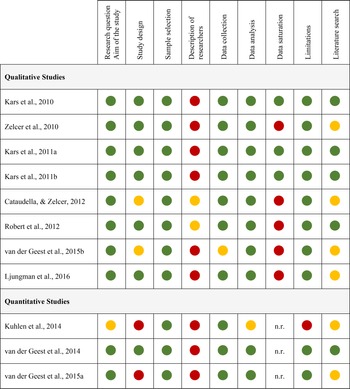
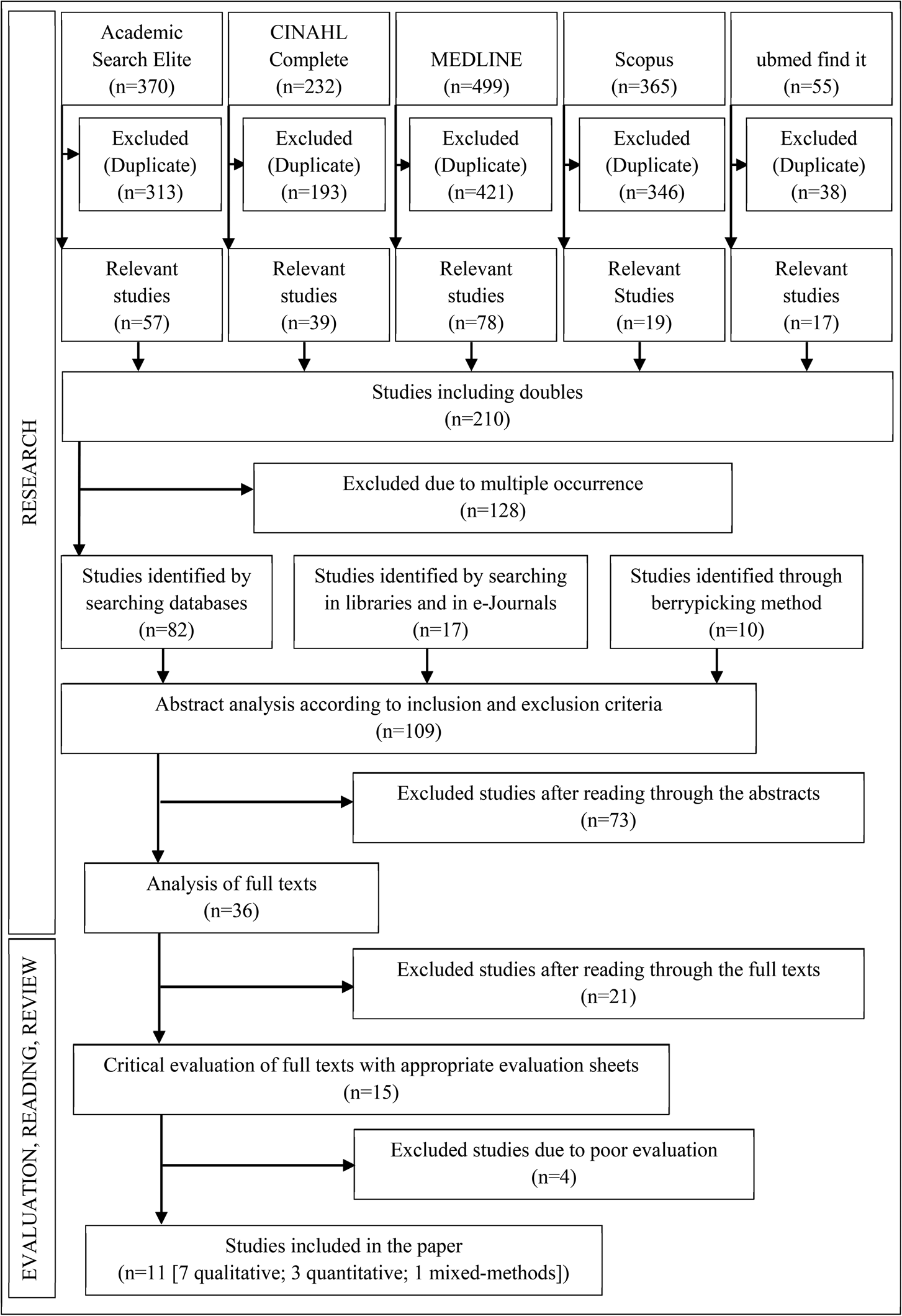
This narrative literature review was prepared as part of a PPC practice research carried out in 2017. A narrative literature review is a “comprehensive narrative synthesis of previously published information” (Green et al., Reference Green, Johnson and Adams2006, p. 6) by integrating peer-reviewed literature. Due to time restraints, we purposely decided against a systematic review. Nevertheless, we used a comprehensive search approach aiming at increasing the quality of the search. The literature review was prepared by using the formal rating scale for quality assessment of narrative review articles (SANRA; Baethge et al., Reference Baethge, Goldbeck-Wood and Mertens2019). A structured literature search was conducted by two independent authors (MJ, PS) via EBSCO-Host in the electronic databases CINAHL Complete and Academic Search Elite as well as in MEDLINE via PubMed. In addition, Scopus was checked by combining the following keywords and synonyms by using the wildcard function: child, bereavement, palliative, end of life, terminal, cancer, parent, experience, social, and spiritual. Also, the berrypicking technique (Bates, Reference Bates1989) was used to search for additional relevant sources. English as well as German publications from 2010 until 2016 were included. The population consisted of parents of a child with incurable cancer or a child who died of cancer. Parents had to be at least 18 years of age and were only considered if their child was under the age of 21 years. The chosen settings were hospitals, oncology centers, or the patients’ homes. Included were parental experiences regarding social and spiritual dimensions, whereas experiences concerning any other dimensions of PPC were excluded. Initially, two authors (MJ, PS) identified a total of 210 studies. Removing duplicates (n = 128) left a total of 82 studies identified by searching databases. Together with publications identified by searching libraries and e-Journals (n = 17) as well as through the berrypicking technique (n = 10), a total of 109 studies appeared to be relevant. Seventy-three studies were eliminated by the two authors after abstracts were analyzed according to the inclusion and exclusion criteria, another 21 studies after reading the full texts. Reasons for discarding publications were shortcomings of inclusion criteria and irrelevant to answer the research questions. The remaining 15 studies were critically appraised regarding their methodological quality by using traffic light symbols (Figure 1). Risk traffic lights describe the quality of a study by using the colors red, yellow, and green. The red color stands for a problematic methodological quality, the yellow color depicts unclear methodological quality, and green represents adequate methodological quality (Panfil and Ivanovic, Reference Panfil and Ivanovic2011).
Critically appraisal regarding methodological quality by using traffic light symbols (Panfil and Ivanovic, Reference Panfil and Ivanovic2011).

Due to poor evaluation results, such as inappropriate sample characteristics and inconclusive methodology, four more studies were discarded leaving a total of eleven studies to be included in this narrative review. All steps of study selection as well as strengths and weaknesses of publications were discussed within the author team. Decisions on included studies were consensus-based. The systematic literature search is shown in Figure 2.
Flowchart of the research process.

Results
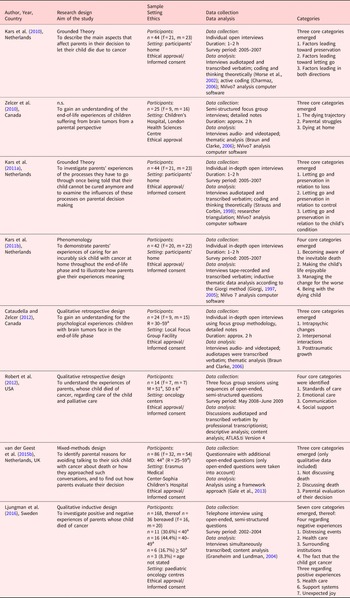
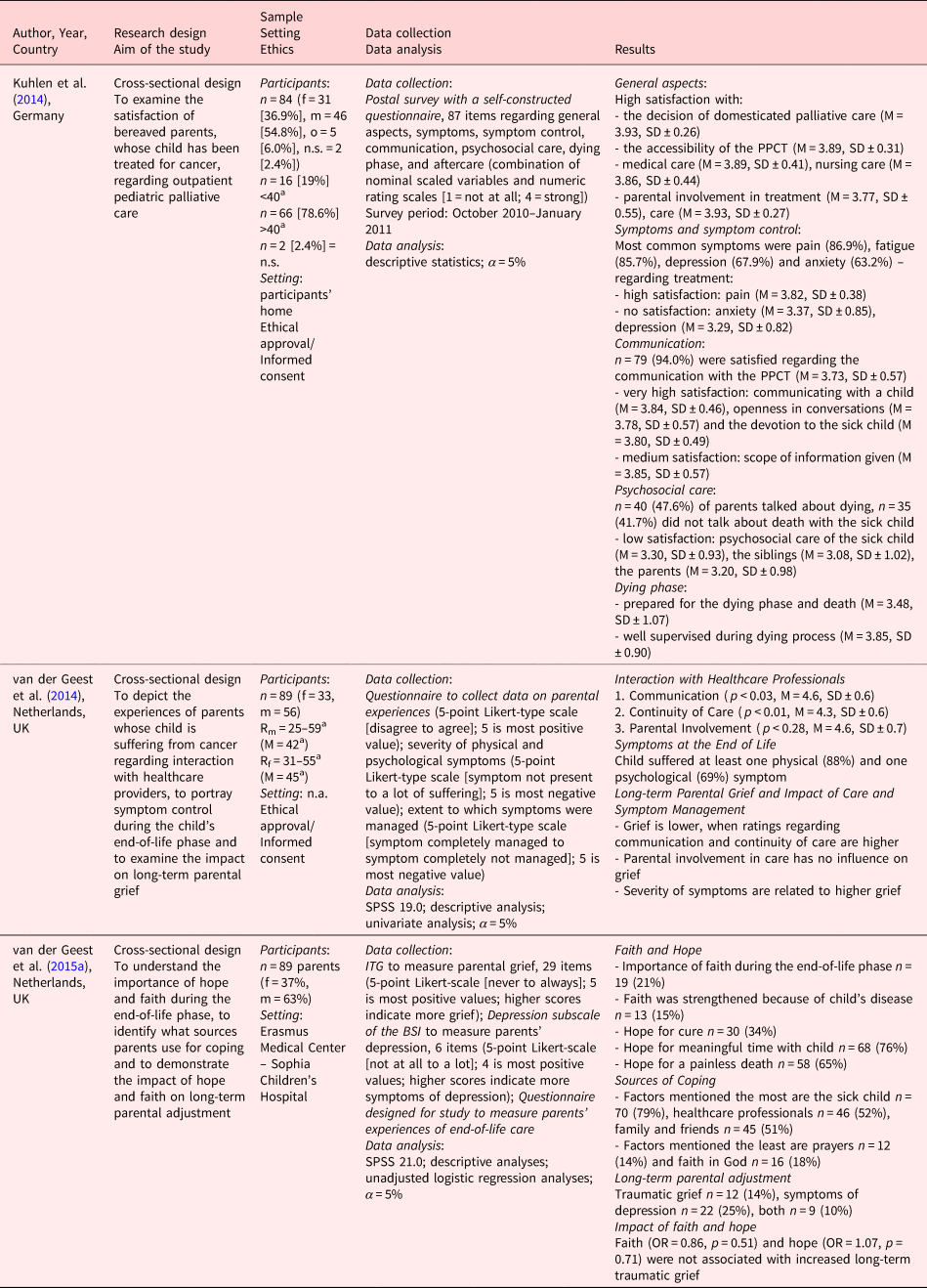
Eleven studies, seven qualitative, three quantitative, and one mixed-methods study were included to answer the research question. Studies were conducted either in a European country (Netherlands, Sweden, UK, Germany), in the United States of America, or in Canada. Various research designs, like Grounded Theory, Phenomenology, qualitative retrospective, or inductive designs as well as cross-sectional designs, were used within the included studies. Seven of the included studies presented data that could be sorted to both, the spiritual and the social dimension (Kars et al., Reference Kars, Grypdonck and Beishuizen2010, Reference Kars, Grypdonck and de Korte-Verhoef2011a, Reference Kars, Grypdonck and van Delden2011b; Zelcer et al., Reference Zelcer, Cataudella and Elizabeth Cairney2010; Cataudella and Zelcer, Reference Cataudella and Zelcer2012; van der Geest et al., Reference van der Geest, van den Heuvel-Eibrink and van Vliet2015b; Ljungman et al., Reference Ljungman, Boger and Ander2016). Three studies contained data that only fit the social dimension (Robert et al., Reference Robert, Zhukovsky and Mauricio2012; Kuhlen et al., Reference Kuhlen, Schlote and Borkhardt2014; van der Geest et al., Reference van der Geest, Darlington and Streng2014) and only one study simply presented data best fitting the spiritual dimension (van der Geest et al., Reference van der Geest, van den Heuvel-Eibrink and Falkenburg2015a). Within the studies, the parental role as well as parents’ relationship with their child and healthcare professionals were particularly evident (social dimension). Regarding the spiritual dimension, parents’ coping strategies such as staying hopeful and keeping faith, while also remaining an emotional bond in the sense of spiritual connection to their child were presented within identified studies (Tables 1 and 2).
Overview of qualitative studies

f, female; m, male; n.s., not stated; M, mean; SD, standard deviation; MD, median; R, range.
a years of age.
Overview of quantitative studies

f, female; n.s., not stated; m, male; M, mean; o, others; PPCT, pediatric palliative care team; R, range; SD, standard deviation; a, age; BSI, Brief Symptom Inventory; ITG, Inventory of Traumatic Grief; OR, odds ratio.
a years of age.
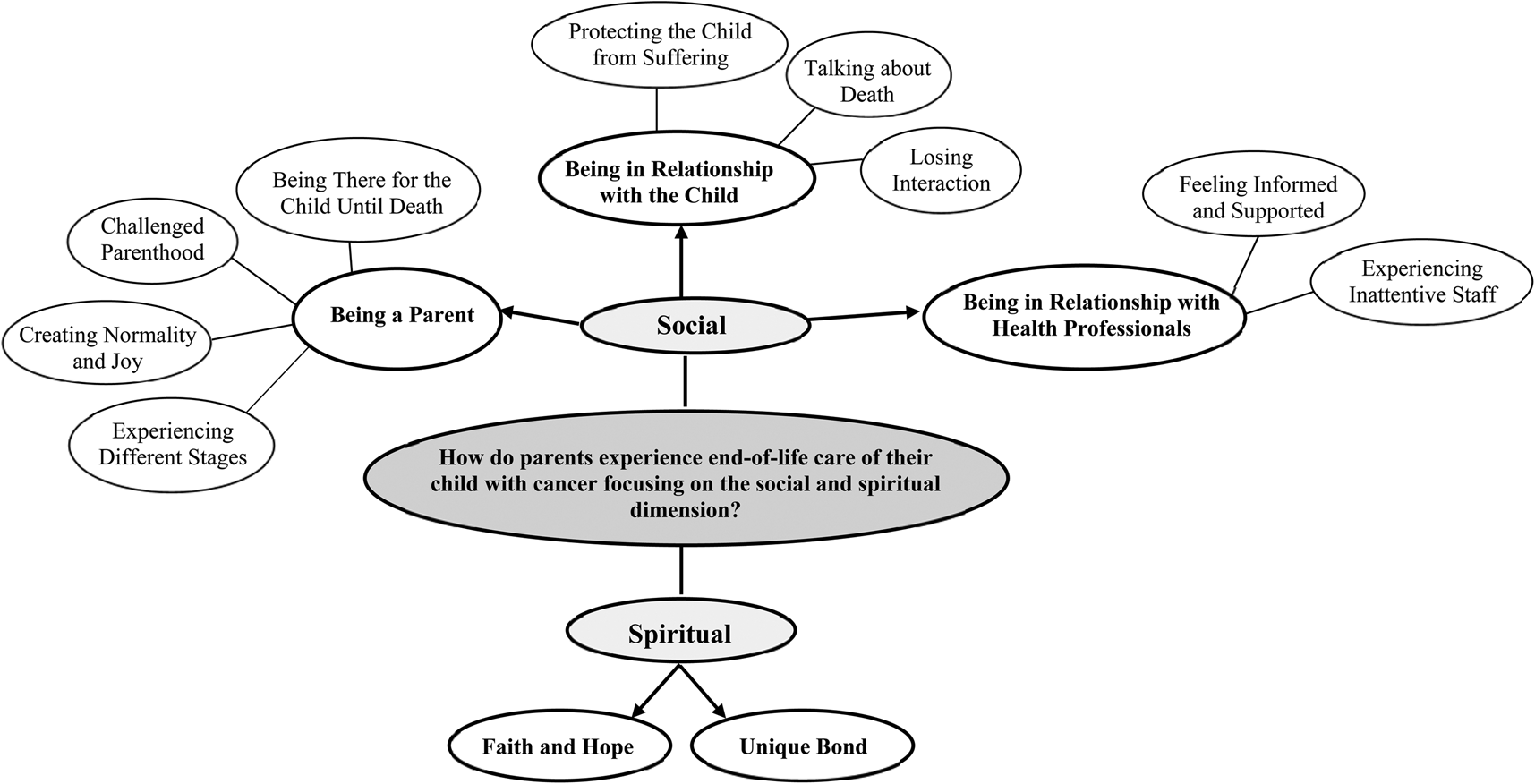
All identified results were thematically grouped resulting in a total of three core categories for the social dimension and two core categories for the spiritual dimension. Sulmasy's biopsychosocial–spiritual framework (Reference Sulmasy2002) guided the category building. Two authors (CK, MJ) independently labeled categories based on the results of the studies. The category building was then discussed within the author team until consensus regarding the category label was reached. Similarly, the authors together decided which finding best fits which category.
Figure 3 presents a graphical overview of the core and subcategories.
Graphical presentation of core and subcategories.

Hereinafter, the categories developed are presented separately for the social and spiritual dimension, each beginning with a brief introduction into the core category. Afterwards, subcategories are presented, which contain the direct findings from the included studies. The sources in parentheses indicate the origin of the result.
Social dimension
In terms of the social dimension, three categories emerged that are important for parents: Being a Parent, Being in Relationship with the Child, and Being in Relationship with Health Professionals.
Being a Parent
During a child's end-of-life phase, the parent's role became particularly evident. Parents were constantly challenged as they had to maintain normality, but also kept control over the ongoing situation. While striving for joy and comfort for their child, feelings of uncertainty, powerlessness, and fear accompanied them. Four subcategories highlight the parent's role at the end of life: Experiencing Different Stages, Creating Normality and Joy, Challenged Parenthood, and Being There for the Child Until Death.
Experiencing Different Stages
Parents described the end-of-life phase in four stages, from the moment of becoming aware of their child's imminent death until actually witnessing it (Kars et al., Reference Kars, Grypdonck and van Delden2011b). Stage one (“Becoming aware of the inevitable death”) and two (“Making the child's life enjoyable”) included learning about the incurability of the child's illness, the perception of the collapsing parenthood, and the wish for their child to enjoy life as much as possible. Parents described the last two stages (“Managing the change for the worse” and “Being with the dying child”) as worsening of disease. They focused on their child's comfort and well-being, and needed to provide familiarity and safety. During those stages, parents dealt with factors leading either to preserving life, or to letting go (Kars et al., Reference Kars, Grypdonck and de Korte-Verhoef2011a).
Creating Normality and Joy
For the sick children, it is important to be treated the same way as their healthy surrounding (Cataudella and Zelcer, Reference Cataudella and Zelcer2012). Therefore, parents continued life for the sick child's happiness and joy as well as enabled their child to participate in school, meeting with friends and family, and plan special activities (Zelcer et al., Reference Zelcer, Cataudella and Elizabeth Cairney2010; Kars et al., Reference Kars, Grypdonck and van Delden2011b; Cataudella and Zelcer, Reference Cataudella and Zelcer2012). Yet, parents feared that if their child gave up on activities, death would soon approach (Kars et al., Reference Kars, Grypdonck and de Korte-Verhoef2011a, Reference Kars, Grypdonck and van Delden2011b). Seeing their child's happiness and joy helped parents forget about the threat of the disease (Kars et al., Reference Kars, Grypdonck and van Delden2011b). Moments of joy were further mentioned to have occurred during hospital stays, when parents got to eat ice-cream in the hospital park or had Christmas dinner arranged by the hospital staff (Ljungman et al., Reference Ljungman, Boger and Ander2016).
Challenged Parenthood
Parents mentioned that being told about their child's incurability felt as if their parenthood would collapse, suddenly having thoughts of not being a parent anymore once their child would die. They also mourned their future perspectives, which included experiencing the child's school entry, first love or becoming grandparents. In those moments, parents felt powerless and unable to provide comfort (Kars et al., Reference Kars, Grypdonck and van Delden2011b). Mothers and fathers were afraid of witnessing their child's suffering and deterioration (Kars et al., Reference Kars, Grypdonck and Beishuizen2010) thinking that the manifestation of symptoms and physical changes in their son or daughter posed a threat to their stability (Kars et al., Reference Kars, Grypdonck and van Delden2011b). Therefore, to prevent themselves from breaking down, they used shielding mechanisms such as fragmentation by splitting up the child's symptoms into isolated complaints treating one at the time (Kars et al., Reference Kars, Grypdonck and Beishuizen2010). Parents regarded control to be a requisite to fulfil their parental role; however, they sometimes lost sight of the reality causing a discrepancy between their perception and the actual situation (Kars et al., Reference Kars, Grypdonck and de Korte-Verhoef2011a). Parents often felt caught in the midst of being their child's parent and being their child's “nurse.” They experienced the task of taking over some nursing responsibilities, such as administering medication, as hindering in just being the child's mother or father (Zelcer et al., Reference Zelcer, Cataudella and Elizabeth Cairney2010). Since all the attention was paid to the child with cancer (Robert et al., Reference Robert, Zhukovsky and Mauricio2012; Ljungman et al., Reference Ljungman, Boger and Ander2016), many parents struggled with attending to their sick child's needs as well as taking care of other healthy children (Zelcer et al., Reference Zelcer, Cataudella and Elizabeth Cairney2010). For this reason, they not only neglected their parental role but also their responsibilities within the family unit (Robert et al., Reference Robert, Zhukovsky and Mauricio2012). In contrast, parents deferred their own grief to care for the child with cancer as well as other family members (Kars et al., Reference Kars, Grypdonck and Beishuizen2010).
Being There for the Child Until Death
Entering the later stage of end-of-life came along with parents’ feelings of certainty that their child's approaching death was inevitable. The acceptance of the irreversibility was easier for parents who were told in advance that the child's previous treatment was the last one possible to try (Kars et al., Reference Kars, Grypdonck and Beishuizen2010) and for those who were able to separate their needs from their child's needs (Kars et al., Reference Kars, Grypdonck and Beishuizen2010, Reference Kars, Grypdonck and de Korte-Verhoef2011a). In the study of Kuhlen et al. (Reference Kuhlen, Schlote and Borkhardt2014), most parents felt prepared for the dying phase and death of their child. When the child's death was near, parents felt powerless since they realized that their child had to go through the process of dying alone (Kars et al., Reference Kars, Grypdonck and van Delden2011b). Thereby, they found meaning in their parental role by providing their child an enjoyable and valuable life (Kars et al., Reference Kars, Grypdonck and Beishuizen2010), adapting to the child's situation focusing on comfort and well-being (Kars et al., Reference Kars, Grypdonck and van Delden2011b). Furthermore, parents explained the importance of being with their dying child during all his/her suffering at the end of life. They felt that nobody besides them was able to provide the desired comfort, safety, and sense of familiarity (Kars et al., Reference Kars, Grypdonck and van Delden2011b). By the very end of their son's or daughter's life, parents narrowed the visitors to those being closest to the child and family (Robert et al., Reference Robert, Zhukovsky and Mauricio2012). The child with cancer was either being surrounded by friends or shared intimate moments with their healthy siblings (Cataudella and Zelcer, Reference Cataudella and Zelcer2012, p. 1194).
Being in Relationship with the Child
Parents mentioned the importance of a strong relationship with their sick child. They, on the one hand, wanted to protect their child from suffering, but, on the other hand, felt the urge to talk to them about dying. Losing the ability for interaction with their child was especially hard for parents. The importance of the relationship between parents and their sick child is revealed in three subcategories: Protecting the Child from Suffering, Talking about Death, and Losing Interaction.
Protecting the Child from Suffering
Parents could not bear to watch interventions hinder the quality of their child's life, which led some parents to be ahead of the actual situation, waiting for death to step in although the moment was not there yet. This was illustrated in a parent's quote “My biggest fear is that he will suffer. […] if it's going to start now, then let it be over very quickly, just go to sleep now” (Kars et al., Reference Kars, Grypdonck and de Korte-Verhoef2011a, p. 31). Some parents preferred to accelerate death in order to end their child's and their own suffering (Kars et al., Reference Kars, Grypdonck and de Korte-Verhoef2011a). Mothers and fathers even encouraged their children to go, wishing them a peaceful death as they could not give any positive meaning to their child's pain and suffering (Kars et al., Reference Kars, Grypdonck and van Delden2011b). Apart from that they often mentioned the dying child being the one saying goodbyes first (Zelcer et al., Reference Zelcer, Cataudella and Elizabeth Cairney2010). To prevent the child with cancer from being afraid of dying, parents explained to them what could be expected during and after death (Kars et al., Reference Kars, Grypdonck and de Korte-Verhoef2011a).
Talking about Death
During the end-of-life phase, many parents considered engaging their child with cancer in conversations about dying and death but had fears about the impact this might have on their relationship with the child (Kuhlen et al., Reference Kuhlen, Schlote and Borkhardt2014; van der Geest et al., Reference van der Geest, van den Heuvel-Eibrink and van Vliet2015b). In the study of Kuhlen et al. (Reference Kuhlen, Schlote and Borkhardt2014), a total of 40 parents (47.6%) mentioned to have had such talks, whereas 35 mothers and fathers (41.7%) did not discuss these topics. Parents struggled with the way they should best approach conversations about dying and death (van der Geest et al., Reference van der Geest, van den Heuvel-Eibrink and van Vliet2015b). Reasons cited by parents for not being able to discuss such difficult topics included being afraid of how their child would react emotionally and not wanting to be responsible if their child could not enjoy their remaining days (van der Geest et al., Reference van der Geest, van den Heuvel-Eibrink and van Vliet2015b). Furthermore, parents mentioned being concerned that their child's personality was not strong enough or they were not old enough to talk about death (van der Geest et al., Reference van der Geest, van den Heuvel-Eibrink and van Vliet2015b). Finally, parents feared that conversing about what happens at the end of life would result in them losing their child's trust, tearing the parent–child bond apart (Kars et al., Reference Kars, Grypdonck and van Delden2011b). Healthcare professionals, on the one hand, advised parents not to talk to the child about its death (van der Geest et al., Reference van der Geest, van den Heuvel-Eibrink and van Vliet2015b), but on the other hand encouraged them to honestly and openly discuss the impending death in consideration of the child's age and developmental stage (Kars et al., Reference Kars, Grypdonck and van Delden2011b). Parents felt grateful if healthcare professionals assisted to ease the discussion between parents and their children (Cataudella and Zelcer, Reference Cataudella and Zelcer2012).
It was important for parents that their child with cancer was in control over end-of-life conversations (Robert et al., Reference Robert, Zhukovsky and Mauricio2012) and to talk about death since they thought that talking about death dispelled the child's fear of dying (van der Geest et al., Reference van der Geest, van den Heuvel-Eibrink and van Vliet2015b). Mothers and fathers who approached conversations about dying and death described different strategies they used. These included symbolic stories or reading specific books, for example one parent stated “My child wanted to hear this story […]. At the end of the story, he would always start to cry, […] he really understood the message” (van der Geest et al., Reference van der Geest, van den Heuvel-Eibrink and van Vliet2015b, p. 1323). A direct approach or waiting for the child to ask first were common strategies as well (van der Geest et al., Reference van der Geest, van den Heuvel-Eibrink and van Vliet2015b).
Losing Interaction
Within the end-of-life phase parents noticed their child losing his/her abilities to communicate either verbally or non-verbally (Zelcer et al., Reference Zelcer, Cataudella and Elizabeth Cairney2010). Parents mentioned that as a result of the child not being able to verbalize himself/herself anymore none of the family members understood his/her needs, which further led to the child with cancer being angry and frustrated (Zelcer et al., Reference Zelcer, Cataudella and Elizabeth Cairney2010; Cataudella and Zelcer, Reference Cataudella and Zelcer2012). For those parents, whose last contact to their child took place when the child was screaming or crying, loss of communication was especially hard (Kars et al., Reference Kars, Grypdonck and van Delden2011b).
Being in Relationship with Health Professionals
Finally, parents mentioned their ambivalent experiences regarding their relationship with health professionals. The feeling of being well-informed and receiving support as well as shared decision-making was helpful. Ideally, a relationship of trust was built with health professionals. Negative experiences with stressed and insensitive staff were disempowering. Two subcategories (Feeling Informed and Supported and Experiencing Inattentive Staff) were created in order to strengthen the meaning this core category.
Feeling Informed and Supported
Healthcare professionals played an important role in parents’ attitude toward preserving life or letting go (Kars et al., Reference Kars, Grypdonck and Beishuizen2010). Parents appreciated healthcare professionals being supportive, honest, and fully devoted to the children, really caring about their patients’ well-being. Parents positively mentioned the medical staff grieving with them after their child had died. Parents highly appreciated supportive services their child received during hospital stays. By joining their child in play therapy or hospital clowns, parents got the chance of meeting and talking to other parents in a similar situation (Ljungman et al., Reference Ljungman, Boger and Ander2016). They highlighted the importance of maintaining friendships between parents in similar situations (Robert et al., Reference Robert, Zhukovsky and Mauricio2012). Regarding the interaction with healthcare professionals, both communication and continuity of care showed significant results in the study of Kuhlen et al. (Reference Kuhlen, Schlote and Borkhardt2014), whereas parental involvement was not regarded significant. Some parents (n = 84) only showed medium satisfaction with the scope of information given (Kuhlen et al., Reference Kuhlen, Schlote and Borkhardt2014). However, in the study of van der Geest et al. (Reference van der Geest, Darlington and Streng2014), most parents felt clearly informed about the child's prognosis during the end-of-life phase and the exhaustion of curative options. In both studies, parents’ ideas on how end-of-life care should be organized was respected well by healthcare professionals (Kuhlen et al., Reference Kuhlen, Schlote and Borkhardt2014; van der Geest et al., Reference van der Geest, Darlington and Streng2014). Thereby, parents (n = 89) highly rated the attention staff paid to their concerns and the shared decision-making process (van der Geest et al., Reference van der Geest, Darlington and Streng2014). Overall, care was considered ideal when healthcare staff and the child grew together, knowing and trusting each other well. This was quoted by a parent in this way: “At the funeral, the first two people who showed up were [hospital staff]. They came early and were thereafter. They grow to love these kids. They're not just patients” (Robert et al., Reference Robert, Zhukovsky and Mauricio2012, p. 325–326).
Experiencing Inattentive Staff
Parents not always talked about healthcare professionals in a positive manner since some experienced unfriendly and stressed staff, who talked to the child with cancer in an insensitive and disrespectful way. Parents felt that this led to the children feeling unnecessarily distressed. They further complained about doctors talking about death in front of the affected child instead of taking the parents outside the room, as illustrated in a father's quote “When he [the doctor] said to me, out loud in front of the child: ‘[…] accept […], that she will die!’ He […] could have asked me to follow him out” (Ljungman et al., Reference Ljungman, Boger and Ander2016, p. 8).
Spiritual dimension
The spiritual dimension comprises two main categories, namely the meaning of Hope and Faith and the meaning of a Unique Bond.
Hope and Faith
Throughout the end-of-life phase, it was important for parents to keep-up their hope in order to deal with the situation. The type of hope changed over time, from the hope for healing to the hope for a peaceful death. For some parents, faith was their source of power, others reported that they also received their power from the courage and strength of their child.
Hope was reported as an important source of spiritual strength, not only for the child with cancer, but also for parents (Zelcer et al., Reference Zelcer, Cataudella and Elizabeth Cairney2010). Even knowing the predicted outcome, parents maintained their hope for a miracle (Zelcer et al., Reference Zelcer, Cataudella and Elizabeth Cairney2010) and that the disease would end positive for their child (Kars et al., Reference Kars, Grypdonck and Beishuizen2010). Thereby, they never gave up hope for a cure (Zelcer et al., Reference Zelcer, Cataudella and Elizabeth Cairney2010; van der Geest et al., Reference van der Geest, van den Heuvel-Eibrink and Falkenburg2015a, Reference van der Geest, van den Heuvel-Eibrink and van Vliet2015b). With the acceptance of the disease's incurability, hope for a positive outcome changed to hope for a short end-of-life phase and a quick, peaceful death (Kars et al., Reference Kars, Grypdonck and Beishuizen2010). The study by van der Geest et al. (Reference van der Geest, van den Heuvel-Eibrink and Falkenburg2015a) reported that mothers and fathers (n = 68 [76%]) wished for a meaningful remaining time with their dying child and 58 (65%) parents wished their son or daughter to suffer a painless death. For parents, staying hopeful was an effective way to postpone their confrontation with feelings of loss (Kars et al., Reference Kars, Grypdonck and Beishuizen2010).
Whereas hope was regarded important, the study of van der Geest et al. (Reference van der Geest, van den Heuvel-Eibrink and Falkenburg2015a) revealed that only 19 (21%) of the parents mentioned the necessity of faith. Furthermore, few mothers and fathers mentioned prayers (n = 12 [14%]) and faith in God (n = 16 [18%]) as helping spiritual sources of coping. A minority (n = 13 [15%]) felt as if their faith was strengthened by their child's disease. More than half of parents (n = 45 [51%]) disagreed on faith being important. Traumatic grief was found in 12 (14%) and depression in 22 (25%) parents; yet, no association was found between faith and hope for a cure with increased long-term grief (van der Geest et al., Reference van der Geest, van den Heuvel-Eibrink and Falkenburg2015a). Spiritual and religious beliefs were regarded as supportive factors if parents felt strongly about faith (Kars et al., Reference Kars, Grypdonck and Beishuizen2010). Parents saw their child's dying from a religious point of view as being in god's hands. Some characterized a positive picture of heaven according to their religious belief in order to comfort their sick child. Other parents assured their child that a spiritual connectedness will remain after death (Kars et al., Reference Kars, Grypdonck and Beishuizen2010).
Most parents (n = 70 [79%]) in the study from van der Geest et al. (Reference van der Geest, van den Heuvel-Eibrink and Falkenburg2015a) viewed their sick child to be an important coping source during the end-of-life phase. Their child's ability to cope with the situation of suffering a life-threatening disease strengthened parents (Kars et al., Reference Kars, Grypdonck and de Korte-Verhoef2011a, Reference Kars, Grypdonck and van Delden2011b). The amazement of their son's or daughter's maturity of accepting their disease (Cataudella and Zelcer, Reference Cataudella and Zelcer2012) and their ability to enjoy life made parents proud of their child (Kars et al., Reference Kars, Grypdonck and de Korte-Verhoef2011a, Reference Kars, Grypdonck and van Delden2011b). On the one hand, mothers and fathers expressed feelings of respect believing that they could not be as brave as their child if they were in the same situation (Zelcer et al., Reference Zelcer, Cataudella and Elizabeth Cairney2010); on the other hand, they reported about a changed self-awareness since they had proved themselves that they could handle more than they thought. Parents also viewed themselves as more empathetic after going through their child's illness trajectory wanting to help other families in similar situations. They also had new life perspectives and regarded their child's disease a wakening call showing them what was truly important (Ljungman et al., Reference Ljungman, Boger and Ander2016).
A Unique Bond
For parents, the unique bond with their sick child, which went far beyond the “spoken,” was particularly important. The emotional connection with their child was a source of meaning as well as a foundation, on which parents based their decisions regarding the child's end-of-life care or farewell on. Using various strategies parents even tried to preserve this connection beyond the child's death.
Once curative treatment was still the aim, parents considered the healthcare professionals’ recommendations and treatment protocols in guiding their decision-making process. However, when they were informed about their child's incurability, they retook their parental responsibilities making end-of-life decisions on behalf of their parent–child relationship. The decision-making process was regarded as very tough as parents regarded treatment decisions as either “doing something” or “doing nothing.” They equaled “doing nothing” to letting the child die, never forgiving themselves if they had not tried everything possible (Kars et al., Reference Kars, Grypdonck and van Delden2011b). When death was near, many mothers and fathers withdrew from social life to be with the child during his/her last months. They distanced themselves completely from others except a few close people and started preparations for the funeral (Kars et al., Reference Kars, Grypdonck and van Delden2011b). Some parents who were informed of the impending death were able to involve their child with cancer in his/her funeral planning. Thereby, they could respect their son's or daughter's wishes (Kars et al., Reference Kars, Grypdonck and van Delden2011b; van der Geest et al., Reference van der Geest, van den Heuvel-Eibrink and van Vliet2015b). Parents regarded taking memorabilia an option to keep something of their diseased child once he/she was gone (Kars et al., Reference Kars, Grypdonck and van Delden2011b). In order to be with the child after his/her death, some parents chose to place the grave close to them. They thought this helps to maintain connection to their child (Kars et al., Reference Kars, Grypdonck and van Delden2011b).
Discussion
The results emphasize the importance of social and spiritual dimensions for parents in end-of-life care of children with cancer. In terms of the social dimension, three categories emerged: Being a Parent, Being in Relationship with the Child, and Being in Relationship with Health Professionals. Parents tried to maintain normality and joy for their child, but also kept control over the situation, while their parenthood was challenged. They wanted to protect their child from suffering but were also urged to talk to them about dying. Parents had ambivalent experiences with helpful but also burdensome staff. The spiritual dimension comprised two main categories: Hope and Faith and a Unique Bond. Hope was found to be an important source of strength, while Faith was only mentioned by some parents. For parents, the emotional connection with their child was a source of meaning as well as a foundation, on which they based their decisions. According to Prince-Paul (Reference Prince-Paul2008), the social and spiritual well-being domains were interrelated and connected through relationships with self, others, and transcendence.
The study highlights the need for psychosocial interventions for parents supporting them in tackling the challenges they are facing in this challenging situation. Parents need information regarding prognosis and treatment options to best make end-of-life decisions (O'Shea and Kanarek, Reference O'Shea and Kanarek2013; Wang et al., Reference Wang, Wu and Yang2019). It is the healthcare professionals’ task to inform parents about possible therapies in addition to support them by talking about how to spend the remaining time with their dying child (Hinds et al., Reference Hinds, Oakes and Hicks2009). Even though mothers and fathers are aware of their child's prognosis, several studies showed that most parents decide on cancer-directed treatment in order to prolong the child's life or to remain hopeful for a cure of the disease (Hinds et al., Reference Hinds, Drew and Oakes2005; Bluebond-Langner et al., Reference Bluebond-Langner, Belasco and Goldman2007; Wang et al., Reference Wang, Wu and Yang2019). Tomlinson et al. (Reference Tomlinson, Bartels and Gammon2011) revealed that remaining hopeful for a cure might be such a strong factor that parents oversee the impacts of treatment on the child's quality of life and survival. Hope could be regarded as a spiritual belief, thus being an important aspect in the caregiving process (O'Shea and Kanarek, Reference O'Shea and Kanarek2013). In their study, Hinds et al. (Reference Hinds, Drew and Oakes2005) showed that the parents’ need to avoid loss was tremendous; however, not all parents fought their child's death, but rather subordinated their own needs to their child's needs. A publication from Hinds et al. (Reference Hinds, Oakes and Furman1997) already brought to light that single parents who lack a supportive family structure were more likely to preserve their child's life at any cost. Darlington et al. (Reference Darlington, Korones and Norton2018) highlight the importance of the social aspect of coping within the family.
Various studies in this review mention that parents either talk about the impending death with their child with cancer or avoid talking about death (Zelcer et al., Reference Zelcer, Cataudella and Elizabeth Cairney2010; Kars et al., Reference Kars, Grypdonck and van Delden2011b; van der Geest et al., Reference van der Geest, van den Heuvel-Eibrink and van Vliet2015b). Studies on that topic show that even though parents are afraid of bad news, they prefer receiving reliable and precise information (Kars et al., Reference Kars, Grypdonck and Beishuizen2010; Nesbitt, Reference Nesbitt2019). Parents deal with an inner conflict as they on the one hand like to make their child's remaining life worthwhile and on the other hand feel responsible to support their child to cope with their death (Kreicbergs et al., Reference Kreicbergs, Valdimarsdóttir and Onelöv2004). Not talking to children about death seems to be a parental way of protecting their child, as Nitschke et al. (Reference Nitschke, Meyer and Sexauer2000) stated. Mack and Joffe (Reference Mack and Joffe2014) revealed that parental readiness to converse with a dying child about his/her death can be negatively influenced by feelings of guilt. Some parents show feelings of remorse for not having talked about death with their child with cancer (Kreicbergs et al., Reference Kreicbergs, Valdimarsdóttir and Onelöv2004).
The included studies demonstrate some limitations that hinder the generalizability of results. The most frequent limitation regarded sample characteristics. Data were gathered in one group only (White, Caucasian, Dutch) or just in a single institution (Kars et al., Reference Kars, Grypdonck and Beishuizen2010, Reference Kars, Grypdonck and de Korte-Verhoef2011a, Reference Kars, Grypdonck and van Delden2011b). Furthermore, biases, such as a selection bias (Robert et al., Reference Robert, Zhukovsky and Mauricio2012) and a recall bias (Cataudella and Zelcer, Reference Cataudella and Zelcer2012; Robert et al., Reference Robert, Zhukovsky and Mauricio2012; van der Geest et al., Reference van der Geest, Darlington and Streng2014, Reference van der Geest, van den Heuvel-Eibrink and Falkenburg2015a), limit the results. Recall biases of parents result in the time span from their child's death until the point of data gathering. A further limitation was that data saturation, setting information, and research design were not properly mentioned in all included studies. A weakness of this review is that only studies from 2010 to 2016 were included. This review was conducted as part of a practice project in 2017, however, time constraints led to the decision regarding the time period of included studies and to the decision to conduct a narrative review instead of a systematic review. More recent studies would possibly add depth to the findings. Nevertheless, we see the strength of the review in its grounding in Sulmasy's biopsychosocial–spiritual framework as well as in our comprehensive search strategy. This led to a comprehensive and in-depth description of the parents’ social and spiritual experiences.
Conclusion and implications
This narrative review demonstrates the importance for nurses to consider the social and spiritual dimension of parental experiences when supporting parents of a child with cancer. The relationship between the child and the parents should be noticed and encouraged, and the parents’ challenging situation should be reflected and addressed. Additionally, parents should be supported in talking to their child about dying and death. Hope and the unique bond between parents and their child can be a resource for the parents’ purpose and meaning of life and may help them to cope with losing their child to cancer.
Nursing research should develop and validate concepts for the holistic support of parents by focusing the structure of relationships. The biopsychosocial–spiritual model could form a basis for future studies.
Funding
This research received no specific grant from any funding agency in the public, commercial, or not-for-profit sectors.
Conflict of interest
The authors declare that there is no conflict of interest”
Statement of authors’ roles
All authors have made substantial contribution to the manuscript.