Elections have the potential to confer legitimacy, moderate dissent, engender compliance and heighten citizen efficacy. But do elections fulfil these functions in Africa, where competitive elections are often unfamiliar and imperfect? Specifically, do citizens who feel close to ruling parties (winners) believe that their government institutions are significantly more legitimate than do citizens aligned with opposition parties (losers)? If losers are more disgruntled than winners, is it because they doubt the procedural fairness of the recent elections?
Analyses of Round 1 Afrobarometer survey data from more than 20,000 respondents in twelve African countries demonstrate that winners are more inclined than losers to trust their political institutions, consent to government authority, and feel efficacious.Footnote 1 Contrary to initial expectations, however, winners are less willing than losers to defend their institutions against manipulation by elected officials.Footnote 2 While losers doubt the trustworthiness, rightful authority and responsiveness of their political institutions, winners are willing to support their current governments even as they undermine the pillars of liberal democracy. It seems that elections in Africa may generate too little support for the current government among losers and too much support among winners. Critical losers may withhold their consent from current institutions, but they nonetheless are willing to protect their imperfect institutions against elite sabotage. Satisfied winners easily comply with the current establishment, but they are also more willing to acquiesce as their chosen leaders erode the independence of political institutions.
This article also investigates the hypothesis that winners and losers express different levels of political support because they view elections differently. The analysis indicates that partisan affiliation is strongly associated with perceptions of electoral integrity: winners tend to excuse imperfections and judge recent elections as free and fair, whereas losers are more inclined to report that the elections were fraudulent and forged. Importantly, however, divergent attitudes about the fairness of elections are only responsible for a small portion of the gap in political support between winners and losers. It seems that the legitimacy gap results more from loser dissatisfaction with what happens between elections than with what happens during them. All else being equal, losers have a hard time accepting their government as legitimate even if they think the election was free and fair, and winners are overly supportive of their government even if they think the election was fraudulent. These findings suggest that efforts to ensure free and fair elections – and to help citizens perceive them as such – will have only a limited effect on creating constructive and shared levels of political legitimacy in new democracies.
Perceived institutional legitimacy in unconsolidated electoral systems
For democracies to survive and govern effectively, losers as well as winners must accept electoral outcomes and comply with the laws set by elected leaders. Craig et al. argue that ‘a crucial aspect of legitimacy has to do with losers’ acceptance of the election outcome as valid and with their willingness to consent to the winners’ rightful authority to implement policies advocated during the campaign – policies to which losers may be strongly opposed.’Footnote 3 Equally important, democratic survival requires that winners do not use their current position of power to undermine structures of political accountability and that citizens aligned with the ruling party do not condone or participate in such anti-democratic behaviour.Footnote 4 Mass perceptions of political legitimacy are especially crucial in transitional polities where political systems are unstable and democracy is not yet ‘the only game in town’. If a sizeable portion of the population desires, or is agnostic about, institutional change then there is little to protect the system from elite tampering or more severe challenges to the system.Footnote 5 Understanding how citizens across the political spectrum evaluate the legitimacy of their institutions is important for anticipating the trajectories of hybrid and nascent democratic regimes.
In theory, elections are legitimating institutions because they provide citizens with fair procedures for selecting leaders. Research shows that when individuals believe decision-making procedures are fair, they tend to be more satisfied with the leaders overseeing the process and more accepting of the outcomes of the process – even when the outcomes are deemed undesirable.Footnote 6 In practice, however, most electoral contests in hybrid systems and new democracies are plagued by irregularities, either by design or due to lack of resources, infrastructure and experience. Furthermore, it is difficult for citizens to assess the causes and consequences of irregularities – election observers and investigative journalists have limited reach, while public-opinion surveys and exit polls are rare. In the face of uncertainty and poor information, one would expect winners to give their leaders the benefit of the doubt; citizens who emerged from an election victorious will tend to believe that alleged irregularities were unintentional, that the proper candidate won and that the system is legitimate. In contrast, one would expect losers to assume the worst and conclude that electoral fraud was deliberate and consequential. Additionally, losers might actually witness or be subject to more abuse during campaigns and elections than are winners, especially if the winning party was an incumbent party. As a result, losers may withhold their support not only from elected leaders but also from their political institutions.
Despite its importance, individual-level research on electoral outcomes in new democracies or hybrid systems is quite limited.Footnote 7 Instead of evaluating citizen attitudes, most studies of transitional elections rely on expert assessments of electoral quality. Expert assessments are well suited for determining whether electoral outcomes accurately reflect the wishes of the voters and are also very revealing of elite behaviour. However, expert assessments are less well suited for informing us about whether elections have a legitimizing effect on the mass public. Elections may be deemed free and fair by experts, but not by citizens, and vice versa. Furthermore, even if elections are perceived as free and fair, they may not confer legitimacy on government institutions. This research project takes a different approach by examining ordinary citizens’ assessments of electoral integrity as expressed in public opinion polls rather than expert assessments.
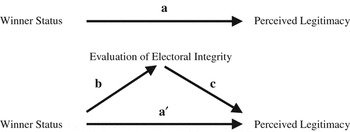
Individual-level survey data is employed to evaluate two hypotheses based on the preceding discussion. The first hypothesis is that Africans who feel close to parties in power tend to award their government institutions greater legitimacy than do independents and those who identify with losing parties. The second hypothesis is that (to the extent that there is a legitimacy gap in political support between winners, independents and losers in Africa) the relationship between identification with the winning party and perceived legitimacy is mediated by evaluations of electoral fairness. This second hypothesis generates the following predictions: (1) winner status is positively associated with perceived legitimacy of government institutions; (2) winner status is positively associated with opinions of the freeness and fairness of their elections; (3) evaluations of electoral honesty are positively related to perceived political legitimacy; and (4) the initial relationship between winner status and perceived legitimacy is attenuated or eliminated in the presence of electoral evaluations. Figure 1 depicts these four parts as a, b, c and a minus a′ respectively.Footnote 8
The hypothesized effect of winner status on political legitimacy with evaluation of electoral integrity as a mediating variable

Before proceeding, one unavoidable weakness in the analysis in this article must be addressed. Cross-sectional data are used to test for associations that are consistent with the hypothesized causal links shown in Figure 1. Given the available data, however, it is impossible to establish the direction of causation between the associated variables. It may be that alternative causal explanations are consistent with the same evidence. For example, it is possible that individuals who feel the government is illegitimate would be subsequently motivated to support opposition parties and also believe the election was forged.Footnote 9 Or citizens who have witnessed election fraud and corruption may think the resulting government is illegitimate and switch their allegiance to the opposition.Footnote 10 More conclusive tests of the causal influences will have to await panel data, field experiments or qualitative interviews. Nonetheless, the analysis in this article allows us to reject hypotheses that are not consistent with the existing data, including the ones represented in Figure 1. Furthermore, given what is known about the continuity of party identificationFootnote 11 and the influences of procedural justice,Footnote 12 the proposed causal theory is the most plausible one.
Data and measurement
This study employs data from the first round of the Afrobarometer surveys, which were administered between 1999 and 2001 in twelve sub-Saharan African countries undergoing political and economic reform.Footnote 13 Nationally representative samples were drawn through a multi-stage, stratified, clustered-sampling procedure. The use of a standardized questionnaire facilitates cross-national comparisons.
The dozen countries surveyed in Round 1 were not representative of the continent as a whole. They tended to be more democratic than the African average. However, they did include a range of regime and election types in 2001. There were two ‘liberal democracies’ (South Africa and Botswana); four ‘electoral democracies’ (Ghana, Mali, Namibia and Malawi); three ‘ambiguous regimes’ (Tanzania, Nigeria and Zambia); and three ‘liberalized autocracies’ (Lesotho, Zimbabwe and Uganda).Footnote 14 Observers judged the most recent elections prior to the first round Afrobarometer surveys as: (1) fully free and fair only in Botswana; (2) exhibiting deficiencies that did not affect the outcome of the election in Ghana, Lesotho, Malawi, Namibia, South Africa, Tanzania and Uganda, and (3) containing numerous irregularities that affected the election results in Mali, Nigeria, Zambia and Zimbabwe. Zimbabwe’s election was wracked by widespread and co-ordinated violence, while Lesotho, Malawi, Mali, Nigeria, South Africa, Tanzania and Zambia experience violence primarily in the form of isolated incidents. At the time of the surveys: Botswana had just had its seventh consecutive democratic election; Mali its third; Ghana, Malawi, South Africa, Tanzania and Zimbabwe their second; and Lesotho, Namibia, Nigeria and Uganda their first. Namibia and South Africa had proportional representative electoral systems, Mali had a majoritarian system and the remaining countries had plurality systems.Footnote 15
Institutional legitimacy, or diffuse support, is a multidimensional concept that is defined and measured in slightly different ways by different authors. Vanessa Baird discusses the concept of legitimacy as follows: ‘Diffuse support is the belief that although at times specific policies can be disagreeable, the institution itself ought to be maintained – it ought to be trusted and granted its full set of powers.’Footnote 16 Gibson writes: ‘Legitimate institutions are those one recognizes as appropriate decision making bodies even when one disagrees with the outputs of the institution.’Footnote 17 Gibson and Caldeira add:
We define diffuse support as institutional commitment – that is, willingness to defend the institution against structural and functional alterations that would fundamentally alter the role of the institution in society. At the extreme, this means willingness to defend the institution against attempts to abolish it.Footnote 18
Finally, Weatherford notes:
Political legitimacy is too unwieldy and complex a concept to be grappled in a frontal assault, and virtually all the empirical literature follows the tactic of breaking it into component parts. Thus various lines of research (on alienation, political trust, modes of participation, political efficacy) all partake of a common interest in how citizens evaluate governmental authority.Footnote 19
Rather than selecting a single dimension of this complex concept, this analysis includes a range of indicators that reflect the descriptions of institutional legitimacy quoted previously. The Afrobarometer instrument necessarily limits what indicators are available, but it nonetheless yields four measures associated with different aspects of institutional legitimacy: institutional trust, consent to authority, external efficacy and defending democracy.Footnote 20
The first measure of legitimacy, Institutional Trust, is an index variable that sums trust in four government institutions: the electoral commission, courts of law, the army and the police.Footnote 21 The second, Consent to Authority, is derived from a question that asks respondents how much they agree or disagree with the statement: ‘Our government has the right to make decisions that all people have to abide by whether or not they agree with them.’ The third variable, External Efficacy, gauges whether citizens feel the system is responsive. Finally, citizens should be more willing to act in defence of institutions they deem legitimate, than ones they think are illegitimate. The fourth variable, Defending Democracy, is an index constructed from questions that asked what citizens would do if the government: ‘shut down newspapers that criticized the government’; ‘dismissed judges who ruled against the government’; and ‘suspended the parliament and cancelled the next elections’.Footnote 22
For purposes of comparison, the four dependent variables were recoded so that they range from −1 (no legitimacy) to +1 (full legitimacy), with intermediate responses arrayed evenly between the two poles. Negative numbers indicate that citizens think their political institutions are illegitimate, and positive numbers indicate that individuals think their institutions are legitimate. Neutral answers were coded 0. As mentioned earlier, these four indicators measure different dimensions of legitimacy rather than a single unified concept and are thus analysed separately rather than combined together in an index variable.Footnote 23
The intervening variable, Election Free and Fair, records citizens’ evaluations of electoral integrity. It is based on a question that asks respondents to rate the freeness and fairness (or honesty) of the most recent presidential or national elections. The variable has five possible values and is also recoded to range from −1 to +1 for ease of comparison.
Winner Status is the key independent variable of interest in this article and it takes on three different values for winners, non-partisans and losers.Footnote 24 Citizens who said they feel close to the parties that make up the government (winners) are coded as 2. Citizens who claim they are not close to any party (non-partisans) are coded as 1. Citizens who report feeling close to opposition parties in the legislature or parties that did not win seats at all (losers) are coded as 0.Footnote 25 Roughly 17 per cent of respondents would be considered losers, 45 per cent were non-partisans, and 38 per cent are coded as winners, although there is considerable variation in the distributions across countries.Footnote 26
Winner status and perceived legitimacy
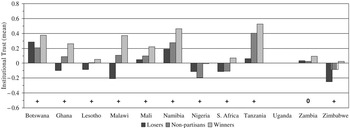
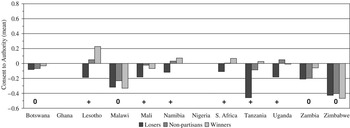
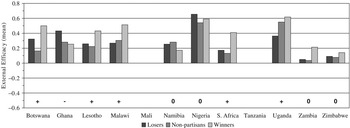
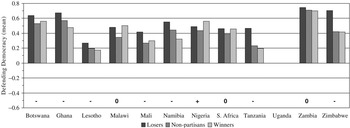
Is there a winner–loser legitimacy gap, and how deep and widespread are doubts about political legitimacy among losers in Africa? Figures 2–5 allow us to compare the mean perceived legitimacy scores for losers, non-partisans and winners in the twelve countries surveyed.Footnote 27 The signs indicate differences between winners and losers at the 0.05 level of significance. A positive sign (+) indicates that, on average, winners are significantly more supportive than losers, a negative sign (−) indicates that, on average, winners are significantly less supportive than losers, and a zero (0) indicates that, on average, winners are not significantly different from losers in their attitudes. The bars for the figures depict whether (1) losers and winners, on average, see their government institutions as legitimate (above 0) or illegitimate (below 0); (2) there are cross-national differences in the level of legitimacy; and (3) there are cross-national differences in the legitimacy gap – the difference between the first bar and the last for each country.
Institutional trust among losers, non-partisans and winners Note: Sign indicates winner–loser gap at 0.05 level of significance.

Consent to authority among losers, non-partisans, and winners Note: Sign indicates winner–loser gap at 0.05 level of significance.

External efficacy among losers, non-partisans and winners Note: Sign indicates winner–loser gap at 0.05 level of significance.

Willingness to defend democracy among losers, non-partisans and winners Note: Sign indicates winner–loser gap at 0.05 level of significance.

Figure 2 reveals a positive gap in institutional trust between winners and losers in each of the eleven countries where the relevant questions were included in the survey.Footnote 28 With the exception of Zambia, the winner–loser gaps are statistically significant at the 0.05 level. Winners expressed significantly greater trust in the electoral commission, courts of law, the army and the police than did losers in nearly every country. Taking all the countries together, winners expressed significant trust in their political institutions (winner mean = 0.270), while losers were significantly distrustful (loser mean = −0.023).Footnote 29
The picture is bleaker with regard to the variable consent to authority depicted in Figure 3. Regardless of their political affiliations, most citizens are unwilling to grant their governments authority to make binding decisions. However, once again, there is a legitimacy gap whereby winners are significantly more willing than losers to consent to government decisions (winner mean = −0.049, loser mean = −0.231). The winner–loser gap is significantly positive in six of the ten countries.Footnote 30
Figure 4 reveals that external efficacy ratings are generally quite high. In the ten countries where the question was asked, Africans agreed that they could improve their circumstances by electing responsive leaders.Footnote 31 The winner–loser gap in external efficacy is smaller than it was for the other perceived legitimacy measures considered so far (winner mean = 0.370, loser mean = 0.313). There is a statistically significant positive gap in half the countries, and the gap is not significant in four others. In Ghana there is a significant reverse gap – losers felt they have more power through the ballot box than do the winners. Indeed, following the survey the opposition managed to win the 2000 election and change their leaders, and possibly their circumstances.
Finally, Figure 5 presents the mean values for whether citizens say they will act to defend their democratic institutions from threatening government actions. Most Africans surveyed report that they would act against hypothetical government attacks on media freedom, judicial independence and democratic elections. This is important because if legitimacy is to be meaningful for political outcomes it must induce supportive behaviour as well as attitudes. Surprisingly, the winner–loser gap in defending democracy is the opposite of what was hypothesized. Winners are less inclined to act in defence of their system than are losers (winner mean = 0.404; loser mean = 0.535). Winners are significantly less inclined to act in defence of their system in seven countries. Only in Nigeria is the mean value for winners significantly higher than it is for losers. There is no significant winner–loser gap in the remaining three countries.
Why is it that the losers seem to place a higher value on protecting core democratic institutions than do the winners? Why is the legitimacy gap the reverse of what it is for all other measures? It is impossible to give a conclusive answer post hoc, although informed analysis suggests a possible explanation. The original assumption was that willingness to defend democratic institutions was a good measure of citizens’ perceptions of institutional legitimacy. However, a careful review of the question’s wording indicates that the instrument pits support of the current government against the legitimacy of democratic institutions. It asks: ‘If the government took an action against current democratic institutions, what would you do?’ Both winners and losers, on average, would act to support democratic institutions. However, when forced to choose between the government in power and their nascent democratic institutions, winners are more willing to support a government that violates democracy than are the losers. This interpretation is consistent with Bratton et al.’s finding that ‘winning is negatively related to citizen rejection of authoritarian rule’.Footnote 32 In this sense, there is such a thing as too much government legitimacy and citizen compliance. Some Africans are willing to support the government even as it violates fundamental democratic precepts – and winners are more susceptible to ‘over-compliance’ with their governments than are the losers. This result also suggests that although government legitimacy and citizen compliance may be good for government effectiveness, such attitudes are not necessarily beneficial for democratic survival, especially in unconsolidated democracies.
In sum, Figures 2–5 depict a fairly common legitimacy gap between citizens who feel close to winning parties and those who are aligned with losing parties. Winners exhibit greater support for their institutions than do losers. The gap is evident across the different attitude dimensions and most countries. Even so, the figures do not depict a severe legitimacy crisis for losers in most states. Losers are less sanguine about their political institutions, but they do not indicate that they are inclined to withdraw from the political sphere or reject democratic governance as a result. Instead, losers say their votes matter nearly as much as those of winners and, additionally, losers express a greater willingness to act to defend democratic institutions than do those citizens whose favoured party is in power. Furthermore, the size of the gap varies considerably by country.
An additional test is warranted to see if the bivariate relationships between winner status and perceived legitimacy remain significant after possibly confounding factors are taken into consideration. Table 1 displays the results of the multivariate analyses.Footnote 33 In the four A models, the measures of perceived legitimacy are regressed on the key independent variable, winner status, and a series of control variables;Footnote 34 previous research in old and new democracies found that these traits were often related to partisan affiliation and to perceived legitimacy.Footnote 35 These controls include index variables that gauge citizen satisfaction with the political and economic outcomes (Government Performance and Economic Performance).Footnote 36 Those who think their government is performing well are also more likely to view it as legitimate, but partisan predispositions are also likely to be associated with performance assessments; partisanship may colour assessments of performance, or perceived good or bad performance may cause citizens to change their partisan affiliations. The controls also include measures of civic participation and engagement (Electoral Participation, Political Interest, and Exposure to Mass Media) because more engaged citizens tend to view their governments as legitimate, but government partisans may have more opportunities and encouragement to get involved. Finally, the model controls for key demographic indicators (Education, Gender and Age) to ensure that personal characteristics do not confound the relationship between winner status and perceived legitimacy.Footnote 37 The model also incorporates dummy variables for each country in the Afrobarometer.Footnote 38 There are likely to be cross-national differences in how citizens feel as a result of historical legacies, type of political system, ethnic origins, margins of victory, electoral quality, length of democracy, level of democracy and economic development. Including dummy country variables ensures that differences in perceived legitimacy between the twelve countries are not confounded with the differences in perceived legitimacy between winners and losers. It would be better if country names could be replaced with national-level variables in a multi-level model, but, with less than twelve countries per analysis, such an approach may be more misleading than enlightening.
The Effects of Electoral Influences on Perceived Institutional Legitimacy

*p ⩽ 0.05 **p ⩽ 0.01 ***p ⩽ 0.001
Notes: Entries are standardized regression coefficients (Beta). Botswana is the excluded category.
Source: Afrobarometer Round 1.
Table 1 shows that the coefficients on winner status are substantively and statistically significant for all four dependent variables. For the first three indicators, winners are more supportive than are losers even when controlling for confounding factors. For defending democracy, the relationship is negative such that losers are more willing to defend democracy than are winners, ceteris paribus. Importantly, comparing the beta coefficients shows that government performance, economic performance and education have larger substantive effects than winner status in nearly all of the equations. However, partisan affiliation is typically more influential than are other variables (electoral participation, political interest, exposure to mass media, gender and age). The substantive effect of winner status is largest in the equation predicting institutional trust and lowest for the measure of defending democracy.
In sum, winners are significantly more pleased with political outcomes than losers. However, feeling close to the winning party is not the most important factor affecting legitimacy beliefs. The results in Table 1 indicate that performance evaluations matter more than partisan attachments. Poor performance of the economy or the government can overwhelm the loyalty of winners and good performance can gain the allegiance of even opposition supporters. Ultimately, state institutions have to work well or both winners and losers will withhold their support.
Free and fair or fraudulent and forged
Given the evidence of winner–loser gaps in legitimacy beliefs, the question remains as to why the gaps exist. Earlier I hypothesized that the causal pathway between partisan affiliations and institutional legitimacy runs through procedural evaluations of elections. In this section three observable implications of this theory are tested: winner status is positively associated with evaluations of the freeness and fairness of recent elections; electoral evaluations are associated with perceived institutional legitimacy; and the influence of winner status on perceived legitimacy is attenuated or eliminated when electoral evaluations are added to the analysis.
Partisan Attachments and Electoral Evaluations
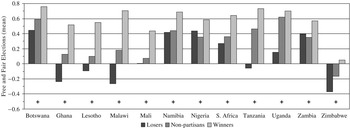
Do winning voters in African elections have more positive views of electoral fairness than do losers? Figure 6 shows the mean values of the variable free and fair election for losers, non-partisans and winners in each of the twelve countries surveyed. For each country, the winners’ average ratings of electoral fairness are significantly higher than the losers’ average ratings.Footnote 39 Furthermore, the winners’ average rating was significantly above 0 in eleven of the twelve countries surveyed, but the losers’ average rating was significantly above 0 in only six countries.Footnote 40 It seems there is a vast gulf separating winners and losers in how they rate their elections.
Free and fair election ratings among losers, non-partisans and winners Note: Sign indicates winner–loser gap at 0.05 level of significance.

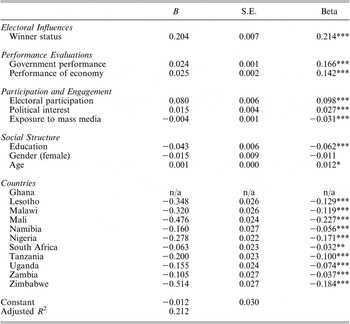
Table 2 shows that winner status in Africa is positively related to the perception of a free and fair election, even when controlling for other possible influences.Footnote 41 Compared with all the other variables in the model, winner status has the largest influence on evaluations of electoral integrity in both substantive and statistical terms. In the face of elections of uncertain quality, winners tend to think they won fair and square, whereas losers are far more inclined to cry foul.
The Effects of Winner Status on Free and Fair Election Ratings

*p ⩽ 0.05 **p ⩽ 0.01 ***p ⩽ 0.001
Notes: Entries are unstandardized OLS regression coefficients (B), standard errors (S.E.), and standardized coefficients (Beta). Botswana is the excluded category.
Source: Afrobarometer Round 1.
Fair Elections and Perceived Legitimacy
Are evaluations of electoral fairness related to the perceived legitimacy of government institutions? The four B models in Table 1 provide evidence of an association between opinions of procedural fairness and citizen satisfaction with the outcomes of the process. The coefficients on the intervening variables, free and fair election, are positive and significant in both substantive and statistical terms (p < 0.000) for three of the four measures. Citizens who believe that the most recent election was free and fair also tend to exhibit these three traits: trust in their government institutions; granting government the authority to make binding decisions; and believing that their vote matters, ceteris paribus. In the model predicting citizens’ willingness to defend democracy, the effect is negative and somewhat less significant in both substantive and statistical terms (p = 0.018). Citizens who thought that the last election was free and fair are less willing to act to defend democratic institutions against government incursion – perhaps because they are inexorably devoted to their current government.
The Mediating Effect of Electoral Evaluations
The final step is to determine whether the relationship between winning an election and perceived legitimacy is reduced or eliminated when electoral evaluations are taken into account. The amount of mediation can be gauged from Table 1 by comparing the coefficients for winner status in the absence (Models A) and in the presence (Models B) of the free and fair election variable.
For all four dependent variables, there is evidence of partial mediation. The inclusion of the indicator of electoral fairness reduces slightly (but does not eliminate) the estimated effect of winning the election. For each of the four legitimacy measures, the coefficient on winner status in Model B is closer to 0 than it is in Model A, but remains substantively and statistically significant.Footnote 42 The estimated effect of winning never decreases by more than half of its original value. Winners and losers have different opinions about the fairness of the electoral process and those opinions matter for institutional legitimacy, but there must be alternative aspects of winning that also boost political support. The evidence suggests that perceived electoral integrity is a causal pathway linking partisan attitudes and legitimacy, but it is not the only (or even the most important) causal connection. This analysis suggests that even if losers could be convinced that they lost fair and square, they would still doubt the legitimacy of their government institutions – at least in comparison to non-partisans and winners.
Conclusion
Improving the quality of elections is a primary concern of foreign and domestic policy makers in Africa. Donors, advisers and activists direct significant resources towards making electoral procedures more free, fair and transparent. One of the primary goals of electoral reform is to increase the legitimacy of nascent democratic institutions, especially among citizens aligned with opposition parties. This research evaluates the extent to which African elections build institutional legitimacy among losers as well as winners, and whether or not winner–loser legitimacy gaps are the result of perceptions of electoral integrity. The analysis yields a number of insights.
First, the evidence reveals significant gaps in perceived legitimacy between winners and losers. While not ubiquitous, these gaps are relatively common across three different indicators and twelve countries. In general, citizens who feel close to winning parties think that their governments are more trustworthy, acceptable and responsive than do citizens who are unaligned or aligned with the losing side. African elections reveal insiders and outsiders who have quite different perceptions of the probity of their political institutions.
Secondly, the analysis showed reverse gaps with respect to acting in defence of democracy. Compared to losers, winners are more attached to their sitting governments than they are to their democratic institutions; winners are less willing to defend press freedoms, judicial independence and parliamentary elections if it means going against a government to which they feel attached. Some level of government legitimacy and citizen compliance is necessary for democracy to function effectively, but unconditional allegiance can be dangerous for democratic development, especially in hybrid systems. It seems that winners in Africa grant too much support to their current government while losers may offer too little.
Thirdly, this article provides a causal explanation (although only a partial one) for the winner–loser gaps in perceived legitimacy. In all twelve African countries where the surveys were conducted, winners and losers expressed significantly different opinions about how free and fair their elections are. Many Africans who watched their favoured party lose an election doubt the integrity of the contest (and often they have many tangible reasons to be suspicious). In contrast, winners tend to overlook or excuse irregularities. Once again, it seems that winners are more willing to acquiesce to undemocratic behaviour by their chosen leaders. In Africa, the divergent views of procedural fairness are also associated with different levels of acceptance of political outcomes. In theory, elections generate legitimacy and ensure the compliance of losers because they provide fair mechanisms for choosing leaders and resolving disputes. However, in practice, Africans who feel attached to losing parties are less inclined to think their process was fair, and are also less likely to view the outcomes as legitimate. This evidence is consistent with the second hypothesis; different perceptions of procedural fairness among winners and losers help explain gaps in legitimacy beliefs. Footnote 43
While there is evidence that electoral evaluations play a mediating role between partisan affiliations and perceived legitimacy, the causal explanation evaluated in this article does not tell the full story. Even after accounting for respondent attitudes about elections, there are significant gaps in perceived legitimacy between winners and losers. Africans who emerge from an electoral contest victorious not only have a more favourable view of their elections, they also have other reasons to view political life more auspiciously.
A fruitful avenue for future research would be to specify these alternative causal pathways. Evaluations of government and economic performance are plausible links; previous research indicates that winners have higher opinions of government performance than do losers,Footnote 44 and performance evaluations exert a large influence on perceived legitimacy (see Table 1 in this article). Additionally, the analysis showed considerable variation across countries in the level of perceived legitimacy and the size of the winner–loser gaps. National-level traits such as the level of democracy and rule of law, the type of political system, opposition party behaviour and institutional performance would also seem to be possible candidates for influencing the link between partisanship and perceived legitimacy.Footnote 45 Unfortunately, with less than twelve country cases per dependent variable in this analysis, it is difficult to evaluate statistically the influence of such national-level characteristics. Alternative approaches are necessary to evaluate national-level influences.
Regardless of the reason for partisan differences, it important to recognize that performance evaluations have a strong estimated affect on institutional legitimacy even after electoral influences are accounted for. Partisan affiliations and the fairness of elections matter for institutional legitimacy, but government performance and economic conditions matter more. This evidence suggests that institutional legitimacy in Africa is based more on citizens’ rational calculations than on their affective party loyalties.Footnote 46 Regardless of what happens during intermittent election periods, the institutions of the state have to perform in the intervening years if they are to gain the full allegiance, support and protection of the citizenry.
Finally, this research offers a mix of positive and negative news for democracy activists and policy makers who have devoted their energies to improving electoral quality in Africa. First, I offer the good news. To the extent that electoral reforms and assistance help Africans to feel better about the integrity of their elections, this research suggests that individuals will become more supportive of their government institutions and more willing to consent to official policies. However, the bad news is that individuals often view electoral processes very differently – improvements in the quality of elections may not always be perceived as such by African citizens, especially by the losers. Furthermore, even if losers can be convinced that the electoral procedures are fair, they will still hold some residual negative attitudes. Cleaning up elections will not be enough to win the full support of Africans aligned with the losing side.
Appendix: question wording and response codesFootnote 47
Institutional Trust: How much do you trust the following institutions [to do what is right]: the police, courts of law, the army, the electoral commission? Not at all = −0.250; Distrust somewhat = −0.125; Don’t know = 0; Trust somewhat = 0.125; Trust a lot = 0.250. (The combined ‘institutional trust’ scale for four items ranges from −1 to 1.)
Consent to Authority: Please say whether you agree or disagree with the following statements. There are no right or wrong answers. Just tell me what you think: ‘Our government has the right to make decisions that all people have to abide by, whether or not they agree with them.’ Strongly disagree = −1; Disagree = −0.5; Don’t know/neither agree nor disagree = 0; Agree = 0.5; Strongly agree = 1.
External Efficacy: Please tell me which one you agree with most. Choose statement A or statement B. (A) ‘No matter who we vote for, things will not get any better in the future.’ (B) ‘We can use our power as voters to choose leaders who will help us improve our lives.’ Agree strongly with A = −1; Agree somewhat with A = −0.5; Don’t know/do not agree with either = 0; Agree somewhat with B = 0.5; Agree strongly with B = 1.
Defending Democracy: What would you do if the government took any of the following actions: Shut down newspapers that criticized the government? Dismissed judges who ruled against the government? Suspended the parliament [national assembly] and cancelled the next elections? Support the government = −0.333; Don’t know/do nothing = 0; Contact an elected representative, support an opposition party, join a protest or boycott, or other = 0.333. (The combined ‘defending democracy’ scale for three items ranges from −1 to 1.)
Free and Fair Election: On the whole, how would you rate the freeness and fairness [honesty] of the last national election, held in [ ____ ]? Not free and fair/very dishonest=-1; Free and fair but with several major problems/somewhat dishonest=-0.5; Don’t know=0; Free and fair with some minor problems/somewhat honest=0.5; Completely free and fair/very honest=1.)
Winner Status: Do you feel close to any political party? If yes, which one? (If party choice does not match with the party that won the most recent national election [loser] = 0; if they do not choose a party [non-partisan] = 1; if party choice matches with the party that won the most recent election [winner] = 2.)
Government Performance: How well would you say the government is handling the following matters? Would you say very well, fairly well, not very well, not at all well, or haven’t you heard enough about this to have an opinion: Addressing the educational needs of all [nationality name]? Improving health services? Creating jobs? Ensuring that prices remain stable?’ (Not at all well = 0; Not very well = 1; Don’t know = 2; Fairly well = 3; Very well = 4. (The combined ‘government performance’ scale for four items ranges from 0 to 16.)
Economic Performance: How satisfied are you with the condition of the [ ____ ] economy today? How do economic conditions in [ ____ ] now compare to one year ago? What about in twelve months time: do you expect economic conditions in [ ____ ] to be worse, the same, or better than they are now? Would you say that your own living conditions are worse, the same, or better than other [nationality name]? Very dissatisfied/much worse = 0; Dissatisfied/worse= = 1; Don’t know/neither/same = 2; Satisfied/better = 3; Very satisfied/much better = 4. (The combined ‘economic performance’ scale for four items ranges from 0 to 16.)
Electoral Participation: Understanding that some [ ____ ] choose not to vote, let me ask you: did you vote [in the most recent national election]? Did not vote/not able to vote/don’t know = 0; Voted = 1.) I will read out a list of things that people sometimes do as citizens. Please tell me how often you, personally, have done any of these things [during the last five years]: Attended an election rally? Work for a political candidate or party? Never/no chance to/don’t know = 0; Only once/once or twice = 0.333; Sometimes/a few times = 0.667; Often = 1. (The combined ‘electoral participation’ scale for three items ranges from 0 to 3.)
Political Interest: Some people seem to follow what’s going on in government and public affairs most of the time, whether there’s an election going on or not. Others aren’t that interested. Would you say you follow what’s going on in government and public affairs:________? How interested are you in politics and government? Hardly/not interested = 0; Only now and then = 1; Some of the time/somewhat interested = 2; Always/most of the time/very interested = 3.
Exposure to Mass Media: How often do you get news from the following sources: Radio? Television? Newspapers? Never = 0; Less than once a month = 1; About once a month = 2; About once a week/few times a month = 3; Several times a week/a few times a week = 4; Every day = 5. (The combined ‘exposure to mass media’ scale for three items ranges from 0 to 15.)
Education: How much education have you had? No formal schooling = 0; Primary only = 1; Secondary = 2; Post-secondary = 3.
Gender: Male = 0; Female = 1.
Age: ranges from 15 years old to 100 years old.