The survival rate in cardiac arrest patients is 3 to 5 percent in out-of-hospital settings and 10 to 20 percent in hospital settings (17). Early defibrillation has been shown to improve survival rates in cardiac arrest patients, especially when delivered within 8 minutes from the onset of a cardiac arrest (16). However, in out-of-hospital settings and in certain areas within a hospital, trained personnel and their equipment may not be available within 8 minutes. This finding suggests that “first responders” should take up the responsibility of delivering shock. The first responders in out-of-hospital settings are usually bystanders, paramedics, ambulance drivers, firefighters, police, and community volunteers, and in hospital settings they are usually nurses (9;17). These first responders are generally not trained in reading electrocardiograms, identifying shockable heart rhythms, and operating defibrillators.
An automated external defibrillator (AED) is a device that can be used by first responders to analyze heart rhythm and deliver shocks if needed (2). Thus, on-site availability of AEDs may save lives provided they are used in a timely manner when cardiac arrests occur. This finding has prompted deployment of AEDs in public sites. However, the Ontario Prehospital Advanced Life Support (OPALS) study showed that 79 percent of cardiac arrests occur in homes: 56 percent in single residential dwellings and 23 percent in multiple residential dwellings (18). Furthermore, specific predisposing risk factors for cardiac arrest are not precisely known, although the arrest rate is high in heart failure patients who have a left ventricular ejection fraction (LVEF) <35 percent (3). Thus, we carried out an economic evaluation of AEDs in the early management of cardiac arrest, and report the cost-effectiveness of a variety of strategies for deploying AEDs in Ontario.
METHODS
Population
The population is composed of fictitious male and female new cardiac arrest patients in Ontario, Canada (mean age, 69,±,13 years). In hospital settings, the emergency response system is typically composed of a “code blue” system. In the event of a cardiac arrest, a code blue is issued, and a trained code blue team takes over the management of the cardiac arrest patient. The standard target is to reach the patient with a defibrillator within 3 minutes (1). In out-of-hospital settings, the emergency response system consists of a 911 telephone call system linked to police, firefighters, and ambulance-based emergency medical services (EMS). The first responders to a 911 call are usually firefighters and police. Upon arrival of the ambulance, care of the patient is taken over by EMS personnel. Almost all fire engines and 30 percent of police responders in Ontario are equipped with AEDs. All ambulances are equipped with defibrillators. The standard target is to reach the site of arrest with a defibrillator within 8 minutes of receiving a call for 90 percent of calls (6). Whether the arrest occurs in hospital or out-of-hospital, after initial resuscitation, the patient is transferred to an intensive care unit for further management.
Comparisons
We evaluated five strategies of deploying AEDs: (i) hospi- tals—in areas where the code blue team may not reach the patient within 3 minutes of calling the code; (ii) office buildings; (iii) apartment buildings; (iv) homes of “high-risk” patients (i.e., heart failure plus LVEF <35 percent); and (v) homes of people greater than 55 years of age. For each strategy, we compared the survival rate after the deployment of AEDs to the current survival rate, after an arrest.
Type of Evaluation and Perspective
We carried out cost-effectiveness analyses of deploying AEDs for the initial management of new cases of cardiac arrest over 5 years, from a payer's perspective. This strategy involved calculating cost per quality-adjusted life-year (QALY) gained. We chose a 5-year time horizon because this is the usual life span of an AED.
The Model
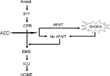
The starting point of the model was the fictitious deployment of AEDs in hospitals, office buildings, apartment buildings, and homes where two or more persons at each site were trained in cardiopulmonary resuscitation (CPR) and the use of AEDs. From this point onward, fictitious cardiac arrests occurred at these sites. In the event of an arrest, the bystander called code blue or 911, initiated CPR, and used an on-site AED until the call responders arrived at the site. The end point was 5 years from the starting point. Figure 1 diagrammatically presents the model.

A diagrammatic presentation of the model. Vertical arrows show the sequence of actions taken in the management of cardiac arrest, that is, the chain of survival that involves calling 911 (or code blue in a hospital setting), initiating cardio pulmonary resuscitation (CPR),assessment by emergency medical services (EMS) personnel (or code blue teamin a hospital setting) for shock treatment, transfer to intensive care unit(ICU), and discharge home. Horizontal arrows show the sequence of actions of the by stander(s) following the application of an automated external defibrillator (AED); the AED assesses for the presence of a shockable rhythm, that is, ventricular tachycardia (VT) or ventricular fibrillation(VF). If VT or VF is detected, the AED prompts the by stander to deliver ashock and re-assesses the rhythm.
Assumptions
We assumed that on-site availability of AEDs would reduce time-to-defibrillation by 2 minutes on average in relation to the current defibrillation time in hospital settings and by 3 minutes in out-of-hospital settings; the probability that a patient with a cardiac arrest would have a shockable rhythm is .36 (16); and each minute reduction in time-to-defibrillation would improve survival in patients with a shockable rhythm by 10 percent (8).
Data Sources
Table 1 presents the sources of data that were used to build the model. In the following text, we describe the details.
Current Cardiac Arrest Incidence and Survival Rates
For in-hospital settings, we used data from the Canadian Institute of Health Information. We created a single binary variable to estimate the annual incidence rate of cardiac arrest in hospital settings. That is, we assigned a “yes” value to this variable if the ICD 10 code was I460, I461, or I469, and Type was 2, but a “no” value otherwise. Next, we counted the total number of “yes” values for the year 2004 and excluded cases that occurred in the emergency department. We used this count as an estimate of the annual incidence rate of cardiac arrest in hospital settings. Next, we linked this variable to patient status at hospital discharge. Again, we created a binary variable to estimate the rate of survival to hospital discharge—we assigned a “yes” value to this variable if the patient was discharged home or discharged home with home care, and a “no” value otherwise. Finally, we counted all the “yes” values to estimate the current survival rate following cardiac arrest in hospital settings. We used published data from the OPALS study to estimate the annual incidence rate of cardiac arrest, distribution of these arrests by sites, percentage of shockable heart rhythm out of the total arrest rhythm, and survival to hospital discharge (current survival rate), in out-of-hospital settings.

Resource Volumes
We contacted key informants in hospitals (personal communication, University Health Network., Toronto, Ontario, December 5, 2005) and in government facilities (personal communication, Ministry of Government Services. Government of Ontario, December 2, 2005) for information on the needs assessment of AEDs; for apartments and homes, we made conservative estimates because no needs assessments were available. Thus, for 135 hospitals in Ontario, we estimated that, on average, 45 AEDs (range, 10–100 AEDs) would be needed per hospital. The total number of office buildings is not known—we restricted resource volumes to 3,000 government facilities in Ontario where we estimated that, on average, four AEDs (range, 1–9 AEDs) would be needed per facility. There are 677,800 apartment buildings with five or more stories (14). We conservatively estimated that one AED would be needed per building.
Simpson and colleagues (13) estimated that there are 85,000 patients in Canada who have a LVEF <35 percent (at high risk for sudden cardiac death attributed to a ventricular arrhythmia), and thus are candidates for an implantable cardiac defibrillator (ICD). This finding corresponds to 33,150 patients in Ontario, where the current capacity for implanting ICDs is 1,600 per year. If this steady state persists for 5 years, 25,150 of the 33,150 patients would not have received an ICD and would represent the high-risk population who might benefit from an AED at home. It is recognized that the number of ICDs for the primary prevention of sudden cardiac death may well increase over this time so that the number of high-risk patients without an ICD could represent an overestimate.
The annual incidence rate of cardiac arrest is 59/100,000 in out-of-hospital settings (18). The total population of Ontario is 12.5 million (14), which means that, based on this incidence rate, 7,399 out-of-hospital cardiac arrests annually occur in Ontario. We estimated that 90 percent of 7,399 cardiac arrests occur in people older than 55 years of age, who make up 23 percent of the total population (14). Assuming each person has a spouse of similar age, we conservatively estimated that one AED would be needed per home in a total of 1.43 million homes. In addition, we accounted for training at least two persons per home/apartment and four people per office building. We did not account for training hospital staff because the unit price estimates of hospitals included training costs.
Costs
To capture all costs, that is, those of AEDs plus those related to their deployment and use, we included cost items as AEDs and training costs. We did not include costs related to staff salaries, loss of productivity from premature death, or downstream healthcare consumption. Finally, we obtained unit prices for cost items from key informants (personal communication, University Health Network, Toronto, Ontario, December 5, 2005; Ministry of Government Services. Government of Ontario, December 2, 2005) and multiplied these unit prices with resource volumes in each setting to estimate the total costs.
Outcome
The main outcome was survival to hospital discharge following cardiac arrest, from which we computed QALYs. To compute QALYs, we estimated the survivor's life expectancy from a life table of Ontario (10), and multiplied life expectancy with a utility value of .8 (11).
Analysis
We calculated QALYs associated with the current survival rates and QALYs projected from the model in each setting. Next, we subtracted projected QALYs from current QALYs—this represented the annual gain in QALYs attributable to the use of AEDs. We discounted future QALY gains at a 3 percent annual rate (7), and calculated the cumulative QALY gains in 5 years.
We performed sensitivity analyses upon our assumptions. We varied reduction in time-to-defibrillation from .5 to 3 minutes in hospital settings and from 1 to 5 minutes in out-of-hospital settings, the probability of shockable rhythm from .3 to .58, and the odds ratio of survival to hospital discharge per minute of defibrillation time from .93 to .77 (8;15). We reported costs in Canadian dollars (1 Canadian dollar =.86 U.S. dollar; December 2005).
RESULTS


Economic Analyses
The cost per QALY gained was lowest in hospitals followed by homes of high-risk patients. The same pattern was observed in the sensitivity analyses (Table 4).

DISCUSSION
We estimated the cost-effectiveness of five strategies for preventing postcardiac arrest deaths through deployment of AEDs in Ontario. When all costs were included, the total cost of deploying AEDs was $18,225,000 in hospitals, $33,204,000 in office buildings, $1,684,333,000 in apartment buildings, $62,497,750 in homes of high-risk patients, and $3,553,550,00 in homes of people older than 55 years of age. When cost per QALY gained was computed, the most cost-effective strategy appeared to be the deployment of AEDs in hospitals; cost per QALY gained was $12,768, which varied from $1,300 (best case) to $60,408 (worst case).
Our results are comparable to previous economic evaluations, despite differences in analytic framework. For example, Nichol and colleagues (12) evaluated the cost-effectiveness of AEDs in a variety of public settings from a U.S. societal perspective. They estimated cost per QALY gained in the range of $55,200 to $10,324,900 (U.S.). In similar settings, estimates of Cram and colleagues (4) were in the range of $13,000 to $12,000,000 (U.S.). In another study, Cram and colleagues (5) evaluated cost-effectiveness of deploying AEDs in homes compared with deploying AEDs to EMS for the management of cardiac arrest. Assuming that survival will double with in-home AED use compared with AED use by EMS, they estimated from the U.S. societal perspective that cost per QALY (U.S. dollars) gained would be $216,000 when all adults over 60 years of age are provided with AEDs in their homes. When they considered adults with a higher risk for cardiac arrest, the cost per QALY gained was $132,000 (multiple risk factors), $104,000 (previous myocardial infarction) and $88,000 (ischemic cardiomyopathy with LVEF <30 percent and unwilling to get an ICD). The authors concluded that in-home AEDs for all adults over 60 years of age appeared relatively expensive. Thus, despite a different analytic framework, we arrived at similar conclusions, that is, AED use is a cost-effective approach to control mortality in settings where the cardiac arrest rate is high, and a response plan is in place which reduces time to defibrillation.
Our results should be used in the context of study limitations. We modeled a hospital setting with a centralized code blue system and out-of-hospital settings with a centralized EMS response system. Thus, our results are not generalizable to other provinces or countries where such systems either do not exist, or because of geographical conditions, a rapid response to call is not achievable. One limitation in our study was the limited data in hospital settings to demonstrate survival benefit with the use of AEDs. However, sensitivity analyses revealed that, when these assumptions were tested, the conclusions did not change, that is, AED use was cost-effective in hospital settings. Finally, to the best of our knowledge, no studies have been conducted on the effectiveness of AEDs in improving survival in high-risk individuals at home. Thus, our inference on this population is “hypothesis seeking” and should be confirmed through appropriate studies.
In conclusion, we believe that deployment of AEDs in all public places is not a cost-effective approach to improve survival after a cardiac arrest. The best use of AEDs may be in hospitals and in the homes of patients at high-risk for sudden cardiac death and who do not have an ICD. However, we would emphasize that, based on existing knowledge, AEDs should not be regarded as a substitute for ICDs for high-risk patients. Further research is needed to determine the value of AEDs in these patients.
POLICY IMPLICATIONS
Our analyses suggest that, in areas where the probability that a cardiac arrest would occur is high, that is, in hospitals and in the homes of high-risk patients, AED placement would be a cost-effective strategy for controlling subsequent mortality. Thus, before placing an AED at a site (including public places), the decision makers must determine the chance that a cardiac arrest would occur at that site; they may do so by examining local data from previous years—if no arrest occurred at that site in past 5 years, it may not be worth placing an AED at that site. Therefore, AEDs should be placed after identifying the site as “high-risk,” and the first-responders at these sites should be adequately trained in CPR and AED use (1). However, these measures should be adopted as “backup” rather than “substitution” to the role of 911 (or code blue) responders.
CONTACT INFORMATION
Waseem Sharieff, MD PhD (doc.sharieff@utoronto.ca), Adjunct Faculty Member, Department of Health Policy, Management and Evaluation, University of Toronto, 155 College Street, Toronto Ontario M5T 3M6, Canada; Clinical Epidemiologist/Health Economist, Medical Advisory Secretariat, Ministry of Health and Long-Term Care, Government of Ontario, 20 Dundas Street West, 10th floor, Toronto ON M5G 2N6, Canada
Kellee Kaulback (kelleek@gmail.com), Medical Information Science Consultant, Medical Advisory Secretariat, Ministry of Health and Long-Term Care, Government of Ontario, 20 Dundas Street West, 10th floor, Toronto ON M5G 2N6, Canada
This work was supported by the Medical Advisory Secretariat, Ministry of Health and Long-Term Care, Government of Ontario. The Ministry of Health and Long-Term Care had no role in study design, data acquisition, data analysis, and data interpretation, or in writing the paper. We also acknowledge Brenda Antliff at the Information Management Unit, Ministry of Health and Long-Term Care, for her assistance in data acquisition.