Introduction
Woodpeckers and sapsuckers (Piciformes: Picidae) are widespread and familiar birds in Canada, known for their cavity-nesting habits and strong, pointed bills for hammering through the bark of trees, and for sending audio signals. Of 14 species recorded in Canada (Godfrey Reference Godfrey1986), 10 have been recorded in Manitoba (Manitoba Avian Research Committee 2003), one of which, the red-headed woodpecker, Melanerpes erythrocephalus (Linnaeus), is listed as threatened in Canada (Committee on the Status of Endangered Wildlife in Canada 2007).
Three of the genera of lice that commonly infest woodpeckers and sapsuckers have undergone recent taxonomic treatment. Menacanthus Neumann (Amblycera) infesting Piciformes were revised by Price and Emerson (Reference Price and Emerson1975), Picicola Clay and Meinertzhagen and Penenirmus Clay and Meinertzhagen (both Ischnocera) by Dalgleish (Reference Dalgleish1969, Reference Dalgleish1972). One additional species, Brueelia straminea (Denny) (Ischnocera), is found on Piciformes in Manitoba (Price et al. Reference Price, Hellenthal and Palma2003). Considering the diversity and abundance of woodpeckers in Canada and the relative stability in taxonomy of their lice, surprisingly little attention has been paid to their relationships, other than for the species of lice appearing in various lists of ectoparasites published more than 50 years ago (e.g., Thompson Reference Thompson1934; Whitehead Reference Whitehead1934; Brown and Wilk Reference Brown and Wilk1944; Spencer Reference Spencer1948; Stirrett Reference Stirrett1952; Judd Reference Judd1953). The only recently published records of lice on woodpeckers in Canada are those of Threlfall and Wheeler (Reference Threlfall and Wheeler1986), and that almost 30 years ago, and Galloway et al. (Reference Galloway, Proctor and Mironov2014). We are aware of no substantive treatments of infestation parameters for lice on woodpeckers anywhere in the world.
We see the chewing lice infesting Picidae in Manitoba as an opportunity to explore the ecology and evolution of host-parasite relationships. There are seven species of lice found on the eight species of woodpeckers that typically breed in Manitoba; Menacanthus pici (Denny) (Amblycera), Brueelia straminea, Penenirmus auritus (Scopoli), Penenirmus jungens (Jungens), Picicola marginatulus (Harrison), Picicola porisma Dalgleish, and Picicola snodgrassi (Kellogg). Of these, only P. marginatulus and P. porisma are monoxenous (restricted to one host), the rest of the species being oligoxenous (occurring on several host species). These relationships allow for comparisons of the same species of lice infesting different species of hosts, and among different species of lice in the same genus. Comparisons can also be made between closely related hosts, for example, hairy woodpecker, Picoides villosus (Linnaeus) and downy woodpecker, Picoides pubescens (Linnaeus), and between migratory (northern flicker, Colaptes auratus (Linnaeus) and yellow-bellied sapsucker, Sphyrapicus varius (Linnaeus)), and resident hosts (e.g., downy woodpecker; hairy woodpecker; and pileated woodpecker, Dryocopus pileatus (Linnaeus)). We had the opportunity to examine relatively large samples of these five species of woodpeckers for lice in Manitoba over a span of 20 years. In this paper, our objectives are to describe the host-parasite associations and infestation parameters (prevalence, mean intensity, and abundance) for the seven species of lice collected on these five species of birds over the duration of the study. An analysis of ecological relationships such as population variability and seasonal patterns of infestation will be addressed in a future paper.
Materials and methods
Woodpeckers and sapsuckers were mostly salvaged from rehabilitation hospitals at the Wildlife Haven (Manitoba Wildlife Rehabilitation Organization, Île des Chênes, Manitoba, Canada) and Prairie Wildlife Rehabilitation Centre (Winnipeg, Manitoba, Canada). The vast majority of birds, with the exception of pileated woodpeckers, came from Winnipeg. Other birds were submitted from a variety of locations across southern Manitoba. A small number of woodpeckers were salvaged as window strikes at local buildings in Winnipeg. Birds were handled and processed in the hospitals and laboratory as described by Galloway and Lamb (Reference Galloway and Lamb2014). Lice were collected by washing birds twice in warm soapy water and once in clean water (Mironov and Galloway Reference Mironov and Galloway2002). The washing method removes nearly the entire population of lice infesting the host (Clayton and Drown Reference Clayton and Drown2001; T.D.G., personal observation). Voucher specimens of lice were deposited on slides (Richards Reference Richards1964) and in ethanol in the J.B. Wallis/R.E. Roughley Museum of Entomology, Department of Entomology, University of Manitoba. Terms for infestation parameters follow those recommended by Bush et al. (Reference Bush, Lafferty, Lotz and Shostak1997).
Hosts salvaged from rehabilitation hospitals can provide relatively large numbers of specimens from which full counts of lice can be obtained. Samples of woodpeckers are otherwise difficult to obtain, especially as collecting from wild populations is subject to regulation and ethical considerations. On the other hand, the number of specimens depends on how many birds are submitted by the general public, and are not always sufficient for some analyses. Furthermore, hosts from rehabilitation hospitals may not represent a random sample in relation to louse abundance in the wild population. Birds brought to rehabilitation may have been unhealthy before the event that led to their capture, and therefore perhaps subject to higher intensity of infestation by ectoparasites. Alternatively, long stays in a rehabilitation hospital might result in transfer of lice among birds in captivity. In the case of woodpeckers, however, most of the specimens were submitted as a result of injuries from window strikes and were otherwise apparently healthy, based on plumage condition and body mass. Their injuries were usually severe enough that they were euthanised immediately, sealed individually in a plastic bag and frozen. We found no evidence of cross-contamination among specimens. There are potential biases and limitations in using birds submitted to rehabilitation hospitals, but other methods of collecting wild birds, for example shooting or mist-netting, might also provide specimens that are not random in relation to louse abundance; the limitations of these methods are unknown. Our data are presented with the caveat that we assume, but cannot prove, that the hosts represent a random sample in relation to the abundance of lice in the wild population.
The following data were recorded for each individual bird: number of lice of each species, number of adult females and males, and number of nymphs. Most birds were weighed. Host specimens were sometimes identified as chicks or juveniles, but birds that had fledged recently could not be reliably distinguished from adults.
The degree of aggregation of each louse species on each host was assessed by calculating the ratio of variance to mean for the numbers of lice on each bird, and by testing the normality and log-normality of the distributions using the Shapiro–Wilk Test (SYSTAT 2009). The prevalence of louse species was compared among host species using χ2-tests of independence (SYSTAT 2009), followed by a two-sided Fisher’s exact test for pairs of hosts or pairs of louse species (Reiczigel and Rózsa Reference Reiczigel and Rózsa2005). The mean intensities of louse species were compared between pairs of host or louse species using a bootstrap two-sample t-test (2000 replicates) (Reiczigel and Rózsa Reference Reiczigel and Rózsa2005), and confirmed by t-tests when data did not deviate from normal and variances were homogeneous, or otherwise by Mann–Whitney rank sum tests (SigmaPlot 2010). Bootstrap 95% confidence intervals were calculated using Quantitative Parasitology 3.0 (Rózsa et al. Reference Rózsa, Reiczigel and Majoros2000). The association of louse species on the same host was assessed using χ2-tests of independence to test whether species co-occurred more or less frequently than would be expected by chance, and for birds with two or more species of lice by estimating Pearson correlation coefficients for intensity (SYSTAT 2009).
Results
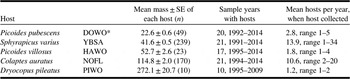
Characteristics of the host woodpeckers examined for lice are presented in Table 1. Collections were made in 10–21 years with samples from 12 to 292 specimens for the five hosts. The numbers of specimens available for downy, hairy, and pileated woodpeckers were low, particularly for the latter species, which limited the power of some statistical tests used to assess the relative abundance of lice.
Woodpeckers (Piciformes: Picidae) (arranged in order of host body mass) collected in southern Manitoba, Canada, and parameters for the collections.

* Acronyms for common names according to the Institute for Bird Populations (2014).
DOWO, downy woodpecker; HAWO, hairy woodpecker; PIWO, pileated woodpecker; NOFL, northern flicker; YBSA, yellow-bellied sapsucker.
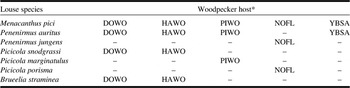
The distribution of the seven louse species among host species is shown in Table 2. Each woodpecker species hosted two to four louse species. All five woodpecker species were infested by M. pici (an occasional blood-feeder) and were also infested by P. auritus or in the case of northern flicker, by its congener, P. jungens. Downy and hairy woodpeckers were infested by the same four louse species, and had two species in common with yellow-bellied sapsuckers and pileated woodpeckers (Table 2). Among the five hosts in Manitoba, three louse species were monoxenous, one on pileated woodpecker and two on northern flicker (Table 2).
Chewing lice (Phthiraptera: Menoponidae, Philopteridae) infesting woodpeckers (Piciformes: Picidae), and their host species in southern Manitoba, Canada.

* See Table 1 for acronyms for common names of woodpeckers.
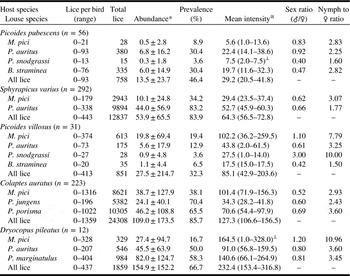
Infestation parameters for the lice are presented in Table 3. Downy and hairy woodpeckers had relatively low prevalence of lice, with the four species of lice on these two hosts occurring on less than 31% of the birds. On the other three hosts, prevalence usually exceeded this value and reached as high as 83% for P. auritus on yellow-bellied sapsuckers. Mean intensity varied from about six M. pici on downy woodpeckers to about 100 on hairy woodpeckers and northern flickers, and reached 165 on pileated woodpeckers. Other species of lice tended to have fewer than 100 individuals per infested bird, but mean intensity reached 141 for P. auritus on pileated woodpeckers. Prevalence and mean intensity were not related for louse – host species combinations (Pearson product moment correlation, r=0.266, P=0.32, n=16), or for the overall abundance of lice on the hosts (Pearson product moment correlation, r=0.273, P=0.66, n=5). The overall abundance of lice ranged from a mean of 13.5 per bird on the smallest host, downy woodpecker, to 154.9 per bird on the largest host, pileated woodpecker (Table 3).
Infestation parameters for lice on five species of woodpeckers (Piciformes: Picidae) (arranged in order of host body mass, Table 1), from 1991 to 2014 in southern Manitoba, Canada.

* Mean±SD.
≅ Mean (95% confidence interval).
⊥ 95% confidence interval uncertain.
The sex ratio (total males to total females) of a louse species on a given host was usually less than one, except for M. pici and B. straminea on hairy woodpeckers and M. pici on pileated woodpeckers, but the latter higher ratios might be spurious as they are based on only two to three host specimens each (Table 3). For all species of lice infesting northern flickers and yellow-bellied sapsuckers, where sample sizes of infested hosts and lice were sufficiently large for analysis, females significantly outnumbered males (χ2 values=54.71–292.52; P<0.001; df=1). Nymphs always outnumbered females, with a nymph to female ratio usually from 1.5 to 3.6, although the ratios were 7.8 to 11.0 for the same three louse and host species that had high male to female ratios and only two to three host specimens (Table 3). For the resident hosts, downy, hairy, and pileated woodpeckers, male, female, and immature lice were present in all seasons.
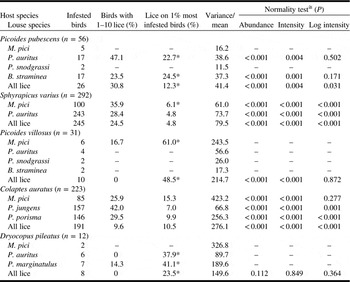
The distribution of lice on individual birds was highly aggregated, with variance to mean ratios usually greater than two (Table 4). On average, about 30% of all lice were on birds with 1–10 lice per bird, estimated for the three hosts with adequate numbers of specimens (Table 4). Some individual specimens of northern flicker had over 1000 lice of a particular species (Table 3), but the most heavily infested specimens accounted for only 5–15% of the lice on yellow-bellied sapsuckers and northern flickers where sample sizes of hosts were large (Table 4). Neither abundance nor intensity of infestation were normally distributed for any host or louse species, except for the case of all lice on pileated woodpeckers where the sample of host specimens was small (n=12, Table 4). When intensity was log-transformed, the distribution approached normal for some species, but the distributions were usually too skewed to be considered normal even after transformation (Table 4).
Distribution of lice among birds for five species of woodpeckers (Piciformes: Picidae) in southern Manitoba, Canada.

* Most infested single bird.
≅ Shapiro–Wilk test of normality of distribution (SYSTAT 2009).
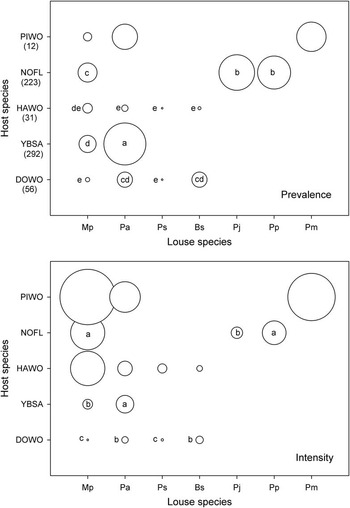
The numbers of lice of the seven species that infested woodpeckers varied both among species that infested the same host and among species that infested different hosts (Fig. 1). Menacanthus pici had relatively low prevalence on all five hosts, compared with that of other species on northern flickers, yellow-bellied sapsuckers and downy woodpeckers. The intensity of this species tended to be high on northern flickers, hairy woodpeckers, and pileated woodpeckers. Penenirmus auritus, which occurred on four hosts, had the highest prevalence and high intensity on yellow-bellied sapsuckers. Picicola snodgrassi and B. straminea, which occurred only on downy and hairy woodpeckers, tended to have lower prevalence and intensity than the louse species that occurred on other hosts. Penenirmus jungens and P. porisma, which occurred only on northern flickers, were more prevalent than M. pici on this host but had similar or lower intensity. The lice on downy and hairy woodpeckers had relatively low prevalence compared to lice on the other three hosts. Lice on downy woodpeckers and yellow-bellied sapsuckers tended to have lower intensity than some of the louse species on the other three hosts. Pileated woodpeckers tended to have the highest louse intensity (Table 3), although the small sample of birds prevented statistical confirmation of this trend (Fig. 1). The high intensity of lice on this host is supported by a comparison of the intensity of all lice and its confidence interval with the equivalent values for other hosts (Table 3).
Comparison of prevalence and mean intensity for seven species of lice infesting five woodpecker species (see Tables 1 and 2 for species names). The diameter of each circle represents the value of prevalence or intensity (Table 3); circles with the same letter do not differ significantly among louse species on the same host (see text for statistical analyses), and the data for circles with no letter could not be analysed because the power of tests was inadequate due to small sample sizes. The numbers of birds assessed for each host species are shown on the y-axis for prevalence.

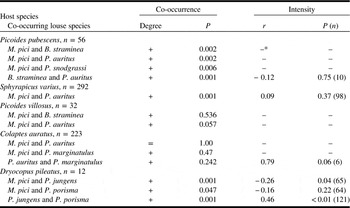
Louse species tend to co-occur on the same host specimen (Table 5). In other words, if a specimen has one louse species, it is more likely to have another louse species that occurs on that host as well. This statement is true for 12 of 13 possible pairs of species, and significantly so in nine of the 13 cases (Table 5). This frequency of co-occurrence was expected by chance only for M. pici and P. auritus on pileated woodpeckers. We saw no examples of one species occurring less frequently than expected by chance if another species is present. In those cases where two species of lice co-occupied the same bird, irrespective of species, and where the sample of birds was sufficient, the intensity of one species was sometimes correlated with that of the other (Table 5). The mean intensity of M. pici was negatively correlated with that of P. jungens on northern flickers, but positively correlated for P. jungens and P. porisma (Table 5).
Association between louse species infesting the same host for five species of woodpeckers (Piciformes: Picidae) collected from 1991 to 2014, in southern Manitoba, Canada.

Note: A χ2-test of independence assessed whether two species of lice occurred on the same host specimen more (+) or less (−) frequently than by chance (=): P<0.05 indicates significance. Pearson Product moment correlation (r) assessed the relationship between intensities for two co-occurring louse species.
* Not estimated because sample of infested birds was too small.
Discussion
This study includes five of the 10 woodpecker species that occur in Manitoba. Four of these are the most frequently encountered species of Piciformes in populated areas, especially Winnipeg. We sampled only 12 pileated woodpeckers, but these birds came from eight different locations. It is not considered a common bird in Manitoba (Manitoba Avian Research Committee 2003), but perhaps because of its size and spectacular appearance, people are disproportionately more likely to rescue these birds than smaller, less remarkable-looking woodpeckers. Other species of woodpeckers in the province are predominately forest-dwellers/boreal where there are few people to rescue injured birds.
All the species of lice expected to infest the five species of woodpeckers sampled (Price et al. Reference Price, Hellenthal and Palma2003) occurred in Manitoba. Brueelia straminea is known to infest yellow-bellied sapsucker (Price et al. Reference Price, Hellenthal and Palma2003), but none were found on this host in our study. All seven species of lice are specific to the Picidae (Price et al. Reference Price, Hellenthal and Palma2003). Among this assembly of species, P. porisma and P. marginatulus are monoxenous, infesting only northern flicker and pileated woodpecker, respectively (despite being recorded by Dalgleish (Reference Dalgleish1969) infesting red-bellied woodpecker, Melanerpes carolinus (Linnaeus)); P. jungens occurs only on northern flickers in Manitoba but infests other hosts in the genus Colaptes Vigors elsewhere. The other five species are polyxenous, each infesting many species of woodpeckers in several genera: M. pici infests at least 27 species in seven genera, B. straminea infests 16 species in five genera, P. auratus infests 53 species in 11 genera, and P. snodgrassi infests 18 species in three genera (Price et al. Reference Price, Hellenthal and Palma2003). Thus our analyses include phylogenetically diverse taxa infesting a phylogenetically related group of hosts, and exhibiting a range of host specificity. All host associations were previously published by Galloway et al. (Reference Galloway, Proctor and Mironov2014), with the exception of those for lice infesting pileated woodpecker. Menacanthus pici (Price and Emerson Reference Price and Emerson1975) and P. marginatulus (Spencer Reference Spencer1948; Dalgleish Reference Dalgleish1969) have been recorded from this latter host in Canada, but we believe ours to be the first records of P. auritus for pileated woodpecker in this country, from six different locations in Manitoba (Clearwater, Île des Chênes, Interlake Region, Otterburne, Portage la Prairie, and Winnipeg).
Woodpecker species were each infested by two to four species of louse. No obvious pattern of distribution of louse species among hosts was detected except that the two non-migratory Picoides were infested by the same four louse species. Northern flicker, which is migratory, had three louse species, the same number as the non-migratory pileated woodpecker. Yellow-bellied sapsucker, which is also migratory, was infested by two louse species.
The genera Menacanthus, Penenirmus, and Picicola have been revised relatively recently and we presumed the taxonomy of these species to be stable. However, specimens of M. pici from northern flickers look quite different from those infesting other woodpeckers in the study, being larger and more heavily sclerotised. Despite these obvious differences in general habitus, they do not differ in standard morphological characters (R.L. Palma, Museum of New Zealand Te Papa Tongarewa, Wellington, New Zealand, personal communication). However, in a preliminary examination of CO1 using primers LCO1490 and HCO2198, the same region examined by Grossi et al. (Reference Grossi, Sharanowski and Galloway2014) for the genus, Anatoecus, there were sufficient differences, at least between the flicker and sapsucker M. pici sequences to consider these two populations of Menacanthus different species (L. Peixoto, Department of Entomology, University of Manitoba, personal communication). Further research is needed to determine the distinctiveness of these Menacanthus populations, as well as those from other Piciformes. Here we maintain the status of all Menacanthus pici populations on picids in Manitoba as being conspecific (Price and Emerson Reference Price and Emerson1975). It may be necessary to re-interpret each infrapopulation in our study based on host species infested in light of future taxonomic investigation.
There is little basis for comparing infestation parameters for woodpeckers in this study with published data because so few birds have been examined in previous studies. For example, Keirans (Reference Keirans1966) provided prevalence data for four species of lice on five species of woodpeckers, but only one to six hosts were examined for each host species. Threlfall and Wheeler (Reference Threlfall and Wheeler1986) and Najer et al. (Reference Najer, Sychra, Kounek, Papousek and Hung2014) reported on lice from just one individual woodpecker in each study. Clayton et al. (Reference Clayton, Gregory and Price1992) examined 11 species of Neotropical Picidae, but sample sizes ranged from one to seven birds. They collected lice from dead birds by ruffling feathers after birds had been held in a fumigation chamber, or by visual inspection. González-Acuña et al. (Reference González-Acuña, Ardiles, Moreno, Muñoz, Vásquez and Celis2014) reported prevalence of P. auritus on two species of woodpeckers in Argentina from reasonable sample sizes collected over several years. Prevalence in pampas flicker, Colaptes campestroides (Malherbe) (n=13), was 100% and in green-barred woodpecker, Colaptes melanochloros (Gmelin) (n=15), it was 53%. They collected lice by visual inspection of individual feathers of dead birds. Compared to our washing technique, their efficiency of measuring prevalence is likely comparable, while intensity is probably underestimated. Prevalence of P. auritus varied considerably in Manitoba, ranging from as low as 6.5% in hairy woodpecker, to 83.2% in yellow-bellied sapsucker. Prevalence for P. jungens infesting northern flicker was 70.4%. In our study, prevalence for M. pici was generally lower than for the Penenirmus species, and ranged from 8.9% for hairy woodpecker to 38.1% for northern flicker. Prevalence of infestation by B. straminea was consistently low (3.6%) on the two Picoides species.
Prevalence of infestation is a function of the ability of each louse taxon to disperse to a new host individual and then establish and maintain a population once a new host has been infested. None of the woodpeckers in our study are particularly social or communal, so presumably lice infest new hosts primarily as a result of parent to offspring contact, and to a lesser extent during copulation and perhaps allogrooming. Hippoboscidae (Diptera) may serve as important phoretic hosts for dispersal of ischnoceran lice in some bird-host systems (Keirans Reference Keirans1975; Harbison et al. Reference Harbison, Jacobsen and Clayton2009) and ultimately impact prevalence of infestation. Small numbers of hippoboscids were collected from woodpeckers in Manitoba during our study (predominately Ornithomya anchineuria Speiser; T.D.G., personal observation). This species is a host generalist and present in such low prevalence and intensity that it is unlikely to be a primary means of dispersal for any of the species of lice infesting woodpeckers in Manitoba.
Once a host has become infested by a species or infracommunity of chewing lice, the dynamics of the intensity of infestation is a process subject to a variety of intrinsic and extrinsic factors. The mean level and year-to-year variability of intensity of infestation appear to be inherent properties of each species of louse (Galloway and Lamb Reference Galloway and Lamb2014). As a louse population grows from its initial founders, the ultimate number of lice on the host is greatly affected by host grooming activity. This host pressure is no doubt a function of host morphology (Clayton et al. Reference Clayton, Koop, Harbison, Moyer and Bush2010), as well as health and fitness of the host and, in the case of amblyceran lice for which host blood may be an important component of their diet, level of host immune competence. Individual levels of host tolerance to louse infestations have not been extensively investigated, but may vary considerably and affect the ultimate louse burden for the host, mediated by grooming activity, as seen for attack by biting flies (Anderson and Brust Reference Anderson and Brust1996). Environmental conditions such as relative humidity (Moyer et al. Reference Moyer, Drown and Clayton2002) and perhaps temperature extremes also may play a role in intensity of infestation. Throughout a host’s life, from the time of first infestation with each species of louse, to the time it dies, it may have the capacity to exterminate an infrapopulation, or may be faced with subsequent compound infestations or re-infestation.
Consequently, mean intensity of infestation within and among host species is difficult to compare and interpret unless similar collection protocols are followed. There are no comparable studies on intensity of infestation of woodpeckers with lice, certainly none that might indicate intensities as high as for some host species in our study. Northern flicker and pileated woodpecker had total mean intensities exceeding 100 and 200, respectively, and infested hairy woodpeckers had a mean of 85 lice. Downy woodpeckers and yellow-bellied sapsucker had 29 and 64 lice, respectively. Thus, as a group, Manitoba woodpeckers are relatively heavily infested with lice. The louse species which occurred at the highest intensity were M. pici and P. marginatulus, with the highest intensity tending to occur on the hosts that were largest.
None of the sex ratios for the one amblyceran and six ischnoceran species of lice collected from woodpeckers in this study significantly favoured males. This is not surprising given the data presented by Marshall (Reference Marshall1981), but Clayton et al. (Reference Clayton, Gregory and Price1992) reported on populations of Ischnocera on Neotropical birds where the sex ratios for some species were male-biased. In our study, females of all species of lice infesting flickers and sapsuckers significantly outnumbered males. In all other cases, keeping in mind sample sizes for some species were small, there were no examples where the sex ratio deviated significantly from 50:50. There is no reason to suspect unequal sex ratios at the time of hatching. Presumably longevity in males is shorter than for females or mortality rates for males are higher (Marshall Reference Marshall1981).
Chewing lice are well known for their site specificity. Dubinin (Reference Dubinin1947), Clay (Reference Clay1957), and Nelson and Murray (Reference Nelson and Murray1971) long ago described how chewing lice partition the body of their hosts, with corresponding structural adaptations in the lice themselves. It has been suggested that interspecific competition may have been responsible for this site specificity, though empirical evidence for the negative effects of competition has been demonstrated only recently (Bush and Malenke Reference Bush and Malenke2008). When louse populations are high, body lice on pigeons (Campanulotes compar (Burmeister)) may out-compete wing lice (Columbicola columbae (Linnaeus)) in the face of host defense in the form of preening, thereby influencing community structure. Chewing lice (Columbicola Ewing) infesting mourning doves (Zenaida macroura (Linnaeus); Columbiformes: Columbidae) have also been shown to compete with one another (Malenke Reference Malenke2008). However, there are examples of positive co-occurrence in chewing lice. Ward (Reference Ward1957) found strong positive associations among the many genera of chewing lice infesting tinamous (Tinamiformes: Tinamidae), as we have for chewing lice infesting woodpeckers in Manitoba. We are somewhat at a loss to explain why there is greater than expected likelihood that different species of woodpecker lice infest the same host individuals, even when prevalence of some species is relatively low. This is certainly contrary to the notion of competitive exclusion among chewing lice. Bush and Malenke (Reference Bush and Malenke2008) found that competition between species of chewing lice on pigeons was mediated by host preening behaviour. It is possible there is little overlap in resource requirements among members of the infracommunity on each woodpecker host, so we could find no evidence of competition among species. Perhaps woodpeckers tolerate louse infestations at intensities described in our study, to the point where competitive interactions between species of chewing lice are not expressed. Detailed examination of host partitioning and host grooming behaviour are necessary to test these hypotheses.
In this study conducted over more than 20 years, we have presented a foundation for infestation parameters in chewing lice parasitising woodpeckers as a basis for comparison with other louse/host systems. Given the sample sizes available for some species of woodpeckers in our study, there is scope for further detailed ecological investigation, including seasonal trends in louse populations, louse population variability and the relationship between host size and louse infestation. These investigations we leave for later publications.
Acknowledgements
The authors thank the staff at the rehabilitation hospitals of the Wildlife Haven and the Prairie Wildlife Rehabilitation Centre for the care with which they handled the birds for this study before they reached our laboratory; Paula Grieff kindly allowed us to examine piciforms submitted at the Oak Hammock Marsh Interpretive Centre. Special thanks go to Dave Holder, Lisa Babey, and the many students who helped by washing birds. We thank the Canadian Wildlife Service for issuing scientific permits to carry out this study. This research was funded in part by Discovery Grants to T.D.G. from the National Sciences and Engineering Council of Canada and by Manitoba Conservation (Sustainable Development Initiatives Fund). The continued support of the Department of Entomology and the Faculty of Agricultural and Food Sciences at the University of Manitoba is greatly appreciated.