Lameness is one of the most serious threats to dairy cow welfare owing to its associated pain and widespread occurrence (Clarkson et al. Reference Clarkson, Downham, Faull, Hughes, Manson, Merritt, Murray, Russell, Sutherst and Ward1996). The problem often arises during the winter housing period (Leonard et al. Reference Leonard, O'Connell and O'Farrell1996), can prevail through the following lactation (Somers et al. Reference Somers, Schouten, Frankena, Noordhuizen-Stassen and Metz2005) and can culminate in cows being culled at a young age (Grohn et al. Reference Grohn, Gonzalez, Wilson, Hertl, Bennett, Schulte and Schukken2005). Although the aetiology of bovine lameness is multifactorial (Enevoldsen & Grohn, Reference Enevoldsen and Grohn1991) housing indoors on concrete is considered a risk factor (Webster, Reference Webster2001).
Out-wintering pads (OWP) represent a low-cost alternative to free-stall housing for small to medium sized Irish dairy producers who need to increase their herd sizes in order to remain competitive. Problems associated with indoor housing that do not apply to OWP accommodation include exposure to concrete flooring and inadequately bedded cubicles (Egan et al. Reference Egan, Leonard, Griffin, Hanlon and Poole2001). These can lead to disorders such as lameness and physical injuries, due to both the direct effect of increased contact with hard surfaces (Weary & Tsazkun, Reference Weary and Taszkun2000; Vanegas et al. Reference Vanegas, Overton, Berry and Sischo2006) and to indirect effects on animal behaviour (DeVries et al. Reference DeVries, von Keyserlingk and Weary2004). However, although the wood chip surface of an OWP is likely to provide a softer, more yielding substrate for cows to stand on than concrete, O'Driscoll et al. (Reference O'Driscoll, Boyle, French and Hanlon2008a) found that there were no benefits to hoof health for cows on these systems compared with concrete-floored free-stall accommodation.
The relationship between housing design and injuries is well documented (Zurbrigg et al. Reference Zurbrigg, Kelton, Anderson and Millman2005) and several studies have demonstrated an association between hock lesions and stall design (Wechsler et al. Reference Wechsler, Schaub, Friedli and Hauser2000; Vokey et al. Reference Vokey, Guard, Erb and Galton2001). Furthermore, falling on slippery concrete floors is responsible for most upper leg injury (Philipot et al. Reference Philipot, Pluvinage, Cimarosti, Sulpice and Bugnard1994). A study comparing limb injuries of yearling dairy heifers housed in free-stalls or on an OWP found that adventitious bursae only affected the knees of animals indoors (Boyle et al. Reference Boyle, Boyle and French2008). Other factors associated with lesion development are friction between the animal and its environment (Weary & Taszkun, Reference Weary and Taszkun2000) and level of exercise (Gustafson, Reference Gustafson1993; Keil et al. Reference Keil, Wiederkehr, Friedli and Wechsler2005). Gustafson (Reference Gustafson1993) surmised that daily exercise improves circulation, which in turn improves limb health. It is likely therefore that the less restrictive environment and secure underfoot conditions on an OWP compared with free-stall accommodation is likely to be reflected in fewer, and less serious, injuries to the limbs.
Out-wintering pads are generally constructed when financial restrictions prevent construction of a more expensive free-stall system (Regan et al. Reference Regan, Maher and Ryan2002). Erection of a shelter above an OWP adds to construction costs, and thus farmers may confine more cows per unit area on this type of OWP. Indeed Hourihan (Reference Hourihan2006) reported that stocking densities as high as 5·65 m2/cow are in use on OWP systems. The present experiment was designed to reflect management systems that are likely to occur on farms in Ireland. Two OWP systems (sheltered, high stocking density; and unsheltered, low stocking density) were compared with indoor free-stalls, with regard to hoof health and locomotion ability during the winter and subsequent lactation, and limb health during the winter.
Materials and Methods
The study was conducted at Teagasc ‘Ballydague’ research farm, which is part of Moorepark Dairy Production Research Centre, Fermoy, Cork, Ireland (50°07′N; 8°16′W) between December 2004 and August 2005.
Animals and treatments
A randomized complete block design was used. One-hundred-and-forty-seven pregnant dairy cows (Bos taurus) were grouped into 49 blocks of 3 animals. Blocks were balanced according to breed [Holstein-Friesian (HF), n=26; Normande (NM), n=14; Montbeliarde (MB), n=26; Norwegian Red (NRF), n=28; Montbeliarde×Holstein-Friesian (MBX), n=28; Normande×Holstein-Friesian (NMX), n=20], parity (1·78±1·58, mean±sd), expected calving date (ECD; median=14 February 2005, range=14 January 2005–23 April 2005) and body condition score (BCS; 3·09±0·29). In brief, one cow from each block was randomly assigned to one of the following treatments on 6 December 2004: (i) indoor free-stall housing (FS), (ii) an uncovered OWP (UP) and (iii) a covered OWP (CP). Thus there were 49 animals in each of the three treatments.
The FS were bedded with rubber mats (23 mm in depth: Farm Mat™, Alfco Farm Services Ltd., Ireland) provided at a ratio of 1:1. They were of a ‘Super Dutch Comfort’ design. An automatic scraper cleaned the solid concrete floor 6 times daily. The OWPs were constructed as described by O'Driscoll et al. (Reference O'Driscoll, Boyle, French and Hanlon2008a). Cows in UP had a woodchip space allowance of 12 m2/cow while CP cows were provided with 6 m2 woodchip per cow. The latter OWP was sheltered on two sides by erecting a 1·83-m high semi-porous barrier (Nicofence®, RJM Mooney and Son Ltd., Dublin 12, Ireland) and overhead by a green polythene tunnel. Cows in all three treatments were fed grass silage from a post and rail style feed barrier with 60 cm/cow, and 4·2 m in width. Manure was manually cleaned from the feed face areas on both OWPs once a day. Out-wintering pad cleanliness was scored weekly using a four-point scale (1=clean woodchip to 4=thick faecal layer). The percentage area of each OWP containing woodchips that conformed to each point on the scale was estimated. The overall score for each OWP replicate was calculated using weighted averages; i.e. the percentage area of each score was multiplied by that score, and the results totalled. Dirty woodchips were removed and replaced with a clean layer on 18 January 2005 and 5 February 2005.
Approximately 6 d pre-calving, cows were moved to a straw-bedded calving shed. The space allowance was adjusted to maintain the correct stocking density for the remaining animals in each treatment. Post partum, cows that calved between 25 January and 14 February (n=88) were kept in their pre-calving treatments by night and were at pasture by day. From 15 February onwards all cows were at pasture by day and night. Cows were milked twice daily at approx. 8.00 and 15.30.
Nutrition
During the winter confinement period, fresh grass silage of dry matter (DM) content 19·9% containing (% DM): crude protein 14·1; DM digestibility, 72·7; neutral detergent fibre, 44·8; ash, 6·2% was offered ad libitum every morning. Fresh water was available from two self-filling troughs in each treatment.
While at pasture cows were managed as a single herd. Pasture consisted primarily of perennial ryegrass (Loilum perenne). Cows were allocated fresh grass daily, and pre-grazing yield was maintained between 1800 and 2200 kg DM/ha (>4 cm). Cows were supplemented with concentrate in individual stalls in the milking parlour in two equal feedings daily. During the study period the concentrate intake in each treatment was: FS=405·1±20·46 kg, UP=371·3±21·04 kg and CP=371·1±21·14 kg (P>0·05). The ingredient composition of the concentrate offered (kg/t) was as follows: barley 250, corn gluten 260, beet pulp 350, soy bean meal 110, and minerals plus vitamins 30. The chemical composition was 180 g/kg crude protein and 800 g/kg cellulose gamanase digestibility.
Hoof scoring
The hind feet of each animal were examined for lesions at the start of the experiment (18–30 November 2004), immediately (5±2 d), 6 weeks (42±1 d) and 12 weeks (84±1 d) post partum. Animals were restrained in a metal crate and the hind feet lifted individually. The hind claws were cleaned and a sliver of horn was pared from the whole area of the weight-bearing surface to expose fresh horn, using a quittor knife (Hauptner Quittor Hoof Knife, Channelle Vet Products, Loughrea, Ireland).
Sole lesions:
Sole haemorrhages were localized as to zone of the sole (6 regions as per Greenough & Vermunt, Reference Greenough and Vermunt1991) and their severity scored on a 5-point scale (1=diffuse red, 2=stronger red colouration, 3=deep dense red, 4=port colouration and 5=red raw, possibly fresh blood, from Leach et al. Reference Leach, Logue, Randall and Kempson1998). Sole ulcers were scored from 6 to 8 (6=corium exposed, 7=severe sole ulcer–major loss of horn, and 8=infected sole ulcer (Leach et al. Reference Leach, Logue, Randall and Kempson1998). Both sole haemorrhage and sole ulcer scores were geometrically adjusted in order to produce a severity score (sole haemorrhage: 1, 2, 4, 8 and 16, sole ulcer: 32, 64 and 128). This method of scoring recognizes the greater clinical significance of higher scores (Greenough & Vermunt, Reference Greenough and Vermunt1991). Scores for all four claws were added to give a single sole lesion score for each animal at each inspection.
Heel erosion:
Presence of heel horn erosion (HE) was determined according to a scale described by O'Driscoll (Reference O'Driscoll, Boyle, French and Hanlon2008a). Heel bulbs on both claws were examined, and rated on a six-point scale (where 0=normal heels and 5=heel disappearance to the point where the corium is exposed). Scores from all four claws were added together to give a single HE score for each cow at each examination.
Locomotion scoring
Locomotion score was determined using the scoring system described by Gleeson et al. (Reference Gleeson, O'Brien, Boyle and Earley2007). Six aspects of locomotion (spine curvature, speed, tracking, head bob, abduction/adduction, general locomotion) were scored from 1 to 5, then the scores added together to give an overall score for each cow on each recording occasion. Cows were released individually from a crush and scored as they walked past and then away from the observer, over a distance of approx. 10 m, while walking on a level concrete surface. A single observer scored all animals for the duration of the trial. Locomotion scoring occurred at assignment to treatment, and thereafter every 2 weeks prior to calving until 18 February (6 examinations in total). Post partum, animals were scored weekly for 13 weeks.
Limb lesion scoring
All four limbs of each cow in CP and in FS were inspected for lesions at the start of the experiment and thereafter every 2 weeks until 18 February. Cows were placed in one of the following three categories at each examination: lesion free, at least one minor lesion (bare, hairless areas or bare, red, hairless area) or at least one serious lesion (presence of blood and/or scabs, swelling, open infected wounds, swelling and/or adventitious bursae). Cows were allocated to the most severe category applicable, i.e. if a cow had both minor and serious lesions, she was categorized as having at least one serious lesion.
Data management and statistical analysis
Data were analysed using the Statistical Analyses System (SAS, Version 9.1). Data were tested for normality prior to analysis, by examination of box and normal distribution plots (Proc Univariate). Only animals that calved after 15 February were used in analysis of hoof scores and post-calving locomotion scores, in order that all cows included in statistical analysis had the same post calving treatment (22±2 cows per treatment at each inspection).
SL scores were transformed using a square root transformation in order to approach a normal distribution and analysed using repeated measures ANOVA (Proc Mixed). The model included terms for treatment, inspection, the interaction between treatment and inspection, breed and lactation number. Initial score and duration on treatment were included as covariates. Examination day was included as a repeated effect. Residuals were examined to verify normality. Differences between least squares means were investigated using the t test following Tukeys adjustment for multiple comparisons. Model-fit was determined by choosing models with the minimum finite-sample corrected Akaike Information Criteria (AIC). HE scores approached a normal distribution, and as such were analysed using a similar model.
Locomotion scores during the treatment period and post partum were analysed separately. The dataset during the winter period included all cows that were present for at least 5 examinations (FS and UP, n=18; CP, n=21). Data were ranked prior to analysis by repeated measures ANOVA (Proc Mixed). The model for both datasets was similar to that used in analysis of SL and HE.
Differences in the individual aspects of locomotion were also investigated. An ordinal logistic regression model was used (Proc Genmod). The cumulative logit of the probability that the score for speed, spine curvature, head movement, tracking and abduction was greater in each treatment was investigated. Odds ratios (OR) and 95% confidence interval (CI) were calculated as the exponent of the model solutions. Individual animal was included as a repeated effect. Treatment and test day were forced into the model as class variables. Parity was also considered a class variable and tested for significance. The initial inspection day and free-stall accommodation were used as the reference classes.
Limb lesion data were analysed using generalized-estimating equations (GEE) (Proc Genmod). The logit of the probability that a cow exhibited any lesion or a severe lesion during the experimental period was investigated. OR and 95% CI were calculated as before. Cow was included as a repeated effect. Treatment and test day were forced into the model as class variables. Parity was also considered a class variable and tested for significance. Significance was based on GEE score. The initial inspection day and free-stall accommodation were used as the reference classes.
Results
Hoof health
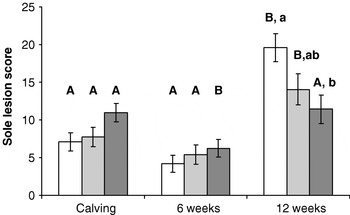
Only one animal developed a sole ulcer during the experiment, and this was an FS cow at the 12-week examination. All other SL were sole haemorrhages. There was no overall effect of treatment on SL scores. However, there was an effect of inspection date and an interaction between treatment and inspection date (both P<0·001; Fig. 1). SL scores at calving (8·60±0·72) were higher than at 6 weeks post partum (5·26±0·69; P<0·001). However, SL scores at 12 weeks post partum (15·03±1·12) were higher than at either of the other two examinations (both P<0·001).
Mean (least squares) sole lesion scores at calving, 6 and 12 weeks post partum (Uncovered out-wintering pad (OWP)=□, Covered OWP=  , Free-stalls=
 ). Cows were managed at pasture at the 6- and 12-week inspections. Significant differences between treatments within inspection are indicated by a, b. Significant differences between inspections within treatment are indicated by A, B.

SL scores of FS cows were lower 6 weeks post partum than either at calving (P<0·01) or at 12 weeks post partum (P<0·05) but there was no difference between score at calving and at 12 weeks (Fig. 1). At 12 weeks post partum SL scores in CP cows were higher than at 6 weeks post partum (P<0·001) and tended to be higher than that at calving (P=0·06). There was no difference between score at calving and 6 weeks post partum. Similarly, there was no difference in SL scores of UP cows at calving and the 6-week post-partum inspections. However scores at 12 weeks post partum were higher than at calving (P<0·001) and at 6 weeks post partum (P<0·001). Furthermore, at the 12-week post-partum examination SL scores in UP cows were higher than those of FS cows (P<0·05).
There was no treatment effect or interaction between treatment and examination on HE score. However, there was an effect of examination (P<0·001). Scores at calving (4·5±0·25) were higher than that at 6 weeks (3·0±0·17; P<0·001) and at 12 weeks (2·7±0·18; P<0·001) post calving. There was no difference between the latter two examinations.
Locomotion scores
During the winter accommodation period there was no effect of treatment or interaction between treatment and examination on locomotion scores. There was no effect of treatment on the odds of a cow having a greater score for spine curvature, speed, head movement or abduction. However, there was an effect on tracking (P<0·05). Cows in CP were less likely to have a high score than cows in FS (OR=0·25, CI=0·06–1·01; P=0·05).
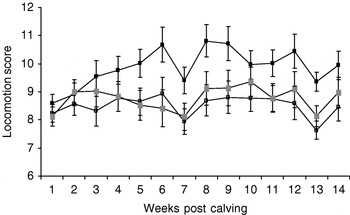
There was an effect of treatment and an effect of examination day on post-partum locomotion score (P<0·001; Fig. 2). Cows from UP had lower scores (8·5±0·35) than cows from FS (9·9±0·36; P<0·01). Scores of cows from CP were intermediate (8·8±0·38) and tended to be lower than FS (P=0·07). However, there were no differences between treatments on any individual examination day.
Mean (least squares) locomotion scores in each treatment after calving (Uncovered OWP=□, Covered OWP= , Free stalls=■) calculated using raw data. Cows were managed at pasture during this period. The 6 aspects of locomotion that were recorded (scale of 1 to 5) were added to give a total locomotion score for each cow on each recording occasion. Therefore, the minimum possible score was 6, and the maximum was 30.

Post partum, there was an effect of treatment on the odds of a cow having a greater score for speed (P<0·05) and on tracking (P<0·001). There was no difference in the odds of a cow from either UP or CP having a high score for speed than FS. However, cows in CP were less likely to have a high tracking score than FS (OR=0·18, CI=0·05–0·62; P<0·01), as were cows in UP (OR=0·10, CI=0·03–0·40; P=0·001).
Limb lesions
Both treatment and time had a significant effect on the proportion of cows that had at least one limb lesion (P<0·001 for both). The odds of an animal having at least one limb lesion was lower in CP than in FS (OR=15·01, CI=6·34–35·50; P<0·001). There was no difference in the proportion of cows with a limb lesion on the first or second examination days. However, more cows had a limb lesion at subsequent examinations than they did at the first one (Table 1). There was also an effect of treatment and time on the proportion of animals exhibiting severe lesions (P<0·001 in both cases). Again, there was a higher odds of animals in FS having a severe limb lesion than in CP (OR=11·44, CI=3·22–40·73; P<0·001). The proportion of animals exhibiting at least one severe lesion also increased over time (Table 1).
Odds ratios (OR) and confidence intervals (CI) for presence of limb lesions at each examination

Discussion
Previous reports show that confining cows on soft substrates prior to calving has benefits for hoof health, particularly with regard to sole lesion development (Webster, Reference Webster2001; Somers et al. Reference Somers, Schouten, Frankena, Noordhuizen-Stassen and Metz2003). However, in the current study, although both hoof lesion and heel erosion scores of animals in both OWP treatments were similar to cows in free-stalls at calving, sole lesion scores in animals on the OWPs increased post partum. O'Driscoll et al. (Reference O'Driscoll, Boyle, French and Hanlon2008a) found that cows on OWPs had similar sole lesions scores to cows in free-stalls. Thus it appears that OWPs do not provide the same benefits for hoof health as straw or rubber flooring. These findings are in accordance with those of Kiernan (Reference Kiernan2004) who found a similar pattern of lesion development in early lactation in heifers out-wintered on an OWP, compared with heifers wintered indoors in free-stalls. This suggests that some property of the underfoot surface on an OWP predisposes hooves to injury once cows are turned out to grass. O'Driscoll et al. (Reference O'Driscoll, Boyle, French and Hanlon2008a) found that cows on uncovered OWPs had softer hooves than cows on a covered OWP, and concluded that exposure of the hooves to wet, dirty woodchip resulted in the absorbing water and becoming softer (Borderas et al. Reference Borderas, Pawluczuk, dePassille and Rushen2004). However, in the study of O'Driscoll et al. (Reference O'Driscoll, Boyle, French and Hanlon2008a) cows were not all returned to pasture post partum – some cows were placed back on an OWP for up to 4 weeks prior to turning out to grass. Thus our results may be more representative of lesion development when cows are managed using a pasture based system directly post partum. The distances walked to and from pasture to the milking parlour twice each day probably contributed to the hoof damage that was seen during the lactation. Sole lesion scores recorded in cows around 12 weeks post calving were probably caused by damage occurring 8–10 weeks previously (Bergsten & Frank, Reference Bergsten and Frank1996). Our hypothesis supports their finding that the hooves of cows on the OWP were more susceptible to injury in early lactation once the cows were turned out to pasture.
The uncovered feed-face of both OWPs was exposed to rainfall and cleaned less frequently than the feed face indoors. The lack of shelter over the woodchip surface in the uncovered pad, and hence a lack of any dry standing area, could have exacerbated sole lesions in these animals in particular. Cows in the covered OWP had a covered, dry bed area to stand and lie on, so hooves were only exposed to rain and manure when feeding, which helps explain why these cows did not develop sole haemorrhages to the same extent.
The lack of a difference between treatments in heel erosion scores is in agreement with the report of O'Driscoll et al. (Reference O'Driscoll, Boyle, French and Hanlon2008a) who also found that there was no difference in heel erosion scores between cows managed in similar treatments. However, a crucial difference between both studies is that the feed face area of the OWPs in this experiment was only scraped once per day, as opposed to 6 times in the study by O'Driscoll et al. (Reference O'Driscoll, Boyle, French and Hanlon2008a). Exposure to moisture and manure is a risk factor in the development of heel erosion (Enevoldsen & Grohn, Reference Enevoldsen and Grohn1991). Our findings are important with regard to practical management of OWPs, as the installation of automatic scrapers may not always be possible in these systems.
Treatment differences in sole lesion score were not reflected in treatment differences in locomotion score. In fact, although sole lesion scores of cows on the OWP systems increased post partum, it was cows that had been managed in the FS system that had the higher locomotion scores during this period. Cows are known to show little behavioural response to injuries until they are advanced (O'Callaghan, Reference O'Callaghan2002). As only one of the recorded lesions was a sole ulcer, our results are in accordance with previous studies, which also suggested that mild lesions do not affect cow gait (Whay et al. Reference Whay, Waterman and Webster1997; Flower & Weary, Reference Flower and Weary2006; O'Driscoll et al. Reference O'Driscoll, Boyle, French and Hanlon2008a).
Post partum, low locomotion scores at 6 weeks and 12 weeks coincide with the weeks that hoof scoring was carried out. In these weeks cows were locomotion scored after their hooves had been examined; in other weeks cows were locomotion scored as they were released from the milking parlour. It is likely that the lower scores recorded at these times were due to the different treatment that the cows experienced immediately prior to scoring. Scores in other weeks may be considered more normal representations of cow locomotion score, as they were recorded during the usual daily routine of the animals.
Analysis of the individual aspects of cow locomotion identified cows in the free-stalls had higher locomotion scores post calving because they were more likely to have higher scores for ‘tracking up’ than animals on the OWPs. Poor tracking is a result of the hind leg not reaching forward during each step, possibly owing to loss of flexibility in the hip joint. Research in man has shown that even low levels of exercise over prolonged periods can significantly improve joint flexibility (Brown & Holloszy, Reference Brown and Holloszy1991; Godges et al. Reference Godges, MacRae and Engelke1993). Although cows are hypothesized to have an internal motivation to perform exercise (Loberg et al. Reference Loberg, Telezhenko, Bergsten and Lidfors2004) this motivation may be thwarted somewhat in confinement systems. Hernandez-Mendo et al. (Reference Hernandez-Mendo, von Keyserlingk, Veira and Weary2007) also hypothesized that increased exercise taken by cows managed at pasture, compared with free-stall housing positively affected locomotion score. However, further work is necessary in order to estimate the levels of activity that cows in both types of system perform.
Physical injuries are an important indicator of the health status of the herd and of individual animal comfort (Enevoldsen et al. Reference Enevoldsen, Grohn and Thysen1994) as injuries result in pain and suffering (Wechsler et al. Reference Wechsler, Schaub, Friedli and Hauser2000). Lesions to the skin and hair loss are widely used animal-based indicators of welfare status (Whay et al. Reference Whay, Main, Green and Webster2003; Winckler et al. Reference Winckler, Capdeville, Gebresenbet, Horning, Roiha, Tosi and Waiblinger2003) because they are indicators of abrasion between the animal and its environment (Livesey et al. Reference Livesey, Marsh, Metcalf and Laven2002). Our results were similar to results from previous studies (Kiernan, Reference Kiernan2004; Boyle et al. Reference Boyle, Boyle and French2008) which that found that heifers housed in free-stall accommodation had higher limb lesion scores and more serious injuries than those on an OWP. Hence, OWPs represent an unrestricted, comfortable environment with a secure underfoot surface and this appears to have benefits in terms of reducing injuries to the limbs.
The present findings indicate that out-wintering cows on a wood chip pad offers welfare benefits in terms of fewer injuries to the limbs during late pregnancy and improved locomotion during lactation while at pasture. It may be necessary, however, to provide some form of shelter for cows on these pads as wet conditions may result in a propensity to develop sole lesions during lactation.
The authors thank Noel Byrne and Frank Buckley for their technical assistance and the Ballydague farm staff for their care of the experimental animals during the study.