Introduction
Grown on 1% of US cropland (Wallander, Reference Wallander2013), cover crops are used by 3–7% of farmers in the USA (SARE et al., 2015). In some areas of intense farming cover crop use among farmers is greater, such as in the Corn Belt where 18% of farmers reported using cover crops (Singer et al., Reference Singer, Nusser and Alf2007). Cover crops are also becoming more popular, with an increase of 20% among farmers in the USA reported from 2013 to 2014 (Wallander, Reference Wallander2013). The increase in cover crop adoption is beneficial to both farmers and the environment. Given the many benefits of cover crops (Dabney et al., Reference Dabney, Delgado and Reeves2001; Hartwig and Ammon, Reference Hartwig and Ammon2002; Lal, Reference Lal2004), there is potential for more widespread adoption. Barriers to increased cover crop use by farmers include practical concerns (Groff, Reference Groff2015) such as reliable cover crop performance, effects on cash crop yields and cover crop suitability for different regions of the country (Carlson and Stockwell, Reference Carlson and Stockwell2013).
Farmer surveys focused on cover crops have been conducted by the Conservation Technology Information Center (CTIC) and the Sustainable Agriculture Research and Education (SARE) program annually since the 2011–2012 winter season. The results from these SARE and CTIC surveys were recently analyzed by Dunn et al. (Reference Dunn, Ulrich-Schad, Prokopy, Myers, Watts and Scanlon2016) to determine which farmer demographic factors were associated with continuous cover crop use, with the goal of providing recommendations for increasing cover crop adoption. These surveys focused on elucidating barriers to cover crop adoption, motivations for planting cover crops and farmer perceptions of cover crop benefits and drawbacks (SARE, 2013; SARE and CTIC, 2014; SARE et al., 2015). Soil erosion was one of the most important reasons for growing cover crops in all 3 years of the survey (SARE, 2013; SARE and CTIC, 2014; SARE et al., 2015). Other desired cover crop benefits included increased soil organic matter, improved weed control and legume-based nitrogen fixation.
A promising way to increase farmer adoption of cover crops is through farmer-driven cover crop variety development and breeding. Relative to the progress made in cash crop breeding, cover crop breeding has seen few advances, and thus there is an opportunity for a large return on investment in cover crop breeding (Sims and Slinkard, Reference Sims, Slinkard and Hargrove1991). Given the tremendous advances in breeding cash crops for increased yield, we could expect similarly strong outcomes from breeding cover crops for ecosystem services (Brummer et al., Reference Brummer, Barber, Collier, Cox, Johnson, Murray, Olsen, Pratt and Thro2011). The extensive variation in legume performance (Teasdale et al., Reference Teasdale, Devine, Mosjidis, Bellinder and Beste2004; Parr et al., Reference Parr, Grossman, Reberg-Horton, Brinton and Crozier2011), especially in regard to nitrogen fixation, indicates that more research on legume cover crop improvement could have a large impact.
One barrier to cover crop adoption is a lack of regionally adapted varieties that meet farmers’ needs. Current variety options for cover crops are minimal compared with those available for cash crops, and access to appropriate varieties is especially critical for organic farmers. Wilke and Snapp (Reference Wilke and Snapp2008) identified the need for improved cover crop traits, but they did not report if breeding priorities differed between organic and conventional farmers. Before developing cover crop varieties to better meet farmer needs, farmers should first be surveyed to explore which cover crop traits are most important.
Our survey focused on four cover crop species: Austrian winter pea (Pisum sativum subsp. arvense L.), crimson clover (Trifolium incarnatum L.), hairy vetch (Vicia villosa Roth) and cereal rye (Secale cereal L.). Typical uses and issues associated with these four cover crop species are described below.
Austrian winter pea is a vine and is the most common type of pea used as a cover crop (McGee and McPhee, Reference McGee and McPhee2012; Pavek, Reference Pavek2012). Austrian winter pea typically produces 4,480–5,600 kg ha−1 dry weight (Clark, Reference Clark2007, p. 67). Crimson clover is a forb with a smaller seed size than winter pea. Crimson clover typically produces between 3,900 and 6,100 kg ha−1 dry weight (Clark, Reference Clark2007, p. 67). Diseases can be a problem with both Austrian winter pea and crimson clover. Hairy vetch is a vine and typically produces between 2,600 and 5,600 kg ha−1 dry weight (Clark, Reference Clark2007, p. 67). One of the main challenges associated with hairy vetch is hard seededness (persistence in the soil seedbank), which can lead to becoming a weed in subsequent crops (Jacobsen et al., Reference Jacobsen, Gallagher, Burnham, Bradley, Larson, Walker and Watson2010; Maul et al., Reference Maul, Mirsky, Emche and Devine2011). All three of these cover crops are annual legumes that can be seeded in late summer and fix large amounts (e.g., >150 kg ha−1) of nitrogen before being terminated the following spring. Although all three can be grown as winter annuals in warmer regions, their use as winter annuals in colder regions is limited by their winter hardiness, with hairy vetch being the most and crimson clover being the least cold tolerant (Clark, Reference Clark2007). Cereal rye is a winter annual grass that can produce 3,000–10,000 kg ha−1 dry weight (Clark, Reference Clark2007, p. 67) and is often used as a catch crop to recycle nutrients that would otherwise be lost over the winter. It is one of the most widely grown cover crops, mainly due to its ability to be planted late in the fall and tolerate very cold climates.
The objectives of our survey were to: (1) determine the extent of cover crop use by organic and conventional farmers; (2) quantify perceptions about cover crops among organic and conventional farmers; and (3) identify desirable traits in four cover crop varieties. Ultimately, the aim of this work is to guide cover crop breeding.
Materials and Methods
Design and participants
The survey used in this project was created using the online survey tool Qualtrics (Qualtrics, LLC.; Provo, UT) and was deemed exempt by the Cornell University Institutional Review Board (protocol number 1502005344). No unique personal information was collected to identify participants. Survey participants were solicited over a 1 month period from February 25, 2015 through March 27, 2015.
Survey distribution
The survey link was distributed through a variety of networks, with a slight focus on organic farmer networks to ensure sufficient organic farmer participation. A ‘tweet’ on the Cornell FieldCrops.org page was ‘re-tweeted’ by the USDA NRCS and reached an estimated 26,100 people (J. Thomas Murphy, personal communication); 42% of survey responses occurred on the day of the ‘re-tweet’, which suggests that the NRCS venue produced the single largest influx of respondents. Emails were sent to cover crop researchers and extension agents who focus on cover crops across the USA with a request that they distribute the survey to their agricultural networks. A link to the survey was also sent to administrators of regional farming networks including the Northeast Organic Farmers Association and similar organic associations in Texas, Nebraska, Louisiana, Alabama, Wisconsin, and the Midwest and Organic Sustainable Education Services (MOSES), FarmsReach farmer network and the Cornell University FieldCrops.org webpage. The online survey link was also emailed to a subset of farmers on the National Organic Program email list. A brief introduction included with the survey link invited individuals to forward the link to other potential participants, i.e., snowball sampling (Biernacki and Waldorf, Reference Biernacki and Waldorf1981), thus the survey was also distributed through venues of which we were unaware. As a result, total distribution, and thus the response rate, cannot be estimated.
Survey structure
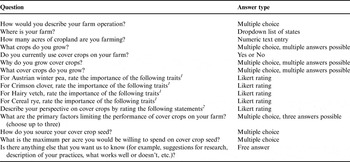
The survey opened with a paragraph informing participants: (1) about the goals of the survey, (2) how long the survey was expected to take, (3) that no unique personal identifying information would be collected, (4) that participation was voluntary and (5) providing contact information for our research team. The survey contained 18 questions in total (Table 1). Questions fell into four categories: (1) demographic, (2) general cover crop information, (3) specific cover crop traits and (4) perspectives about cover crops. The five demographic questions asked about operation type (e.g., organic or conventional), acreage farmed, cash-crops grown, plant hardiness zone location, farm location by state and if participants grew cover crops (Table 1). If participants indicated they did not grow cover crops, they were asked why they did not grow cover crops and then were re-routed to finish the survey. If farmers indicated they grew cover crops, subsequent questions were asked, which cover crop varieties participants grew, the reasons they grew cover crops, where they sourced their cover crop seed and how much they were willing to pay per acre for seed. Only those farmers who indicated they grew cover crops were included in this paper.
List of questions and answer types presented in the survey.

1 Traits were: early vigor/quick establishment, winter hardiness, early maturity, N fixation, disease resistance, biomass production, weed suppression, no hard seed, other (free response).
2 Statements were: (1) cover crops are more important for organic farmers than for conventional farmers, (2) I would pay more for cover crops if they provided more benefits, (3) I would grow more cover crops if I had regionally-adapted varieties, (4) I am concerned with cover crops becoming weeds on my farm, (5) participatory breeding (involving farmers in the selection process) is important for developing new cover crop varieties, (6) more research should be conducted on cover crop breeding and variety improvement.
If participants indicated they grew any of the four focus cover crops (Austrian winter pea, crimson clover, hairy vetch, or cereal rye), they were directed to questions asking them to rate the importance of traits for those specific cover crops. Thus the responses on cover crop traits represent the opinions of only those farmers who grew those specific cover crops. The final category of questions asked participants to describe their perspectives on cover crops and to identify the factors limiting cover crop success on their farms.
Questions about cover crop species and reasons for growing cover crops were multiple-choice (Table 1). Questions about cover crop perspectives and the importance of given traits for the focus cover crops were on a Likert-type scale (Allen and Seaman, Reference Allen and Seaman2007) with five levels (e.g., ‘Strongly Disagree’, ‘Disagree’, ‘Neither disagree nor agree’, ‘Agree’ and ‘Strongly Agree’). Only two questions required responses before allowing participants to move on to the next question; all other questions allowed respondents to skip the question if desired.
Statistical analysis
R version 3.1.2. was used for statistical analysis (R Core Team, 2014). The Pearson's chi-squared test for count data [chisq.test()] was conducted to find linkages among farmer demographics and cover crop question responses. To compute post-hoc tests on the resulting chi-square contingency tables, chisq.post.hoc() from ‘fifer’ package (Fife, Reference Fife2014) was run using Fisher's test, which tested for significant differences among all specific combinations of cells in the contingency table. The P-values reported from the chi-square post hoc tests were adjusted using the ‘fdr’ method (Benjamini and Hochberg, Reference Benjamini and Hochberg1995).
All statistical analyses were done on organic and conventional farmers only, excluding those farmers in mixed organic and conventional production (n = 43). The original designations for different types of organic operations (‘certified organic >10 years’, ‘certified organic <10 years’, ‘transitioning to organic’ and ‘non-certified organic’) were combined into one simplified category of ‘organic’. To analyze question responses that were on a Likert Scale, the five Likert options were combined into three options to meet the criteria of the chi-square tests (for instance ‘important’ and ‘very important’ were combined, and ‘very unimportant’ and ‘unimportant’ were combined). To analyze how much respondents were willing to spend on cover crop seed, the lowest two categories of responses (‘<US$25 ha−1’ and ‘US$25–62 ha−1’) were combined into a single category due to low number of responses.
Results and Discussion
Survey response and farmer demographics
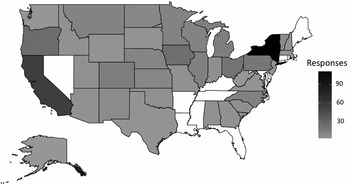
A total of 504 participants started the survey and 417 participants (representing over 121,000 ha of land farmed) completed the survey. Twenty-one percent of the respondents were conventional farmers, 59% were certified organic farmers, 1% were transitioning to organic, 9% were non-certified organic and 10% were mixed organic and conventional. Farmer respondents were distributed across the USA, with the greatest concentration of respondents in CA and NY (Fig. 1). The mode plant hardiness zone was 5 (n = 164, 37% of respondents), with a range of zones 3–10. The mean farm size was 275 ha, with a range of 0.4–8,579 ha. Farmers already growing cover crops represented 87% of all participants.
Cover crop online farmer survey response rate by state (n = 440); states with no response are shown in white.

The top three types of crops grown by farmers were grains (grown by 50% of respondents, n = 197), vegetables (47%, n = 185) and forages (44%, n = 171). More conventional farmers (75%) than organic farmers (43%) grew grains (χ2 = 25.2, P < 0.001.), which reflects the high concentration of conventional grain farmers in the Midwest who responded to our survey. More organic farmers (53%) than conventional farmers (27%) grew vegetables (χ2 = 19.0, P < 0.001) but more conventional farmers (62%) than organic farmers (38%) grew forages (χ2 = 13.1, P < 0.001).
Motivations for cover cropping
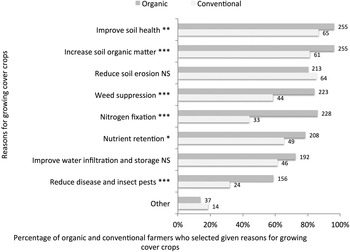
The three most frequently selected reasons for why farmers grow cover crops were focused on soil and were to: (1) improve soil health; (2) increase soil organic matter; and (3) reduce soil erosion (Fig. 2). Of the farmers who reported they grew cover crops, a greater percentage of organic than conventional farmers (P < 0.05) considered seven of the eight reasons to be important or very important: (1) improve soil health, (2) increase soil organic matter, (3) weed suppression, (4) nitrogen fixation, (5) nutrient retention, (6) improve water infiltration and storage and (7) reduce disease and insect pests (Fig. 2). This suggests that organic farmers value ecosystem services from cover crops and rely more heavily on cover crops as multifunctional management tools than do conventional farmers. Growing cover crops was not associated with hardiness zone location of the farm, signifying that farmers in all represented hardiness zones consider cover crops to be important.
Percentages of organic (n = 265) and conventional (n = 75) farmers who grow cover crops who selected the given reasons for growing cover crops. The question was: ‘Why do you grow cover crops? (Select Multiple)’. Numbers at the end of the bars indicate the count of respondents answering each question. Stars indicate significant differences between organic and conventional growers based on a chi-square test: * is P < 0.05, ** is P < 0.01, *** is P < 0.001.

Congruent with our findings, previous research reported that reducing soil erosion was a principal reason that farmers plant cover crops (Singer et al., Reference Singer, Nusser and Alf2007; Arbuckle and Roesch-McNally, Reference Arbuckle and Roesch-McNally2015). More than 80% of the farmer respondents in an Iowa cover crop survey agreed that cover crops can significantly reduce soil erosion and 66% agreed or strongly agreed that cover crops can improve soil productivity (Arbuckle and Roesch-McNally, Reference Arbuckle and Roesch-McNally2015). Snapp et al. (Reference Snapp, Swinton, Labarta, Mutch, Black, Leep, Nyiraneza and O'Neil2005), in a review article, wrote that soil conservation is a ‘socially desirable’ benefit of cover cropping. Additionally, the SARE, CTIC, and ASTA (2015) survey reported soil erosion as one of the most important reasons for growing cover crops, as did Hively et al. (Reference Hively, Duiker, McCarty and Prabhakara2015) in Pennsylvania.
Factors limiting cover crop performance
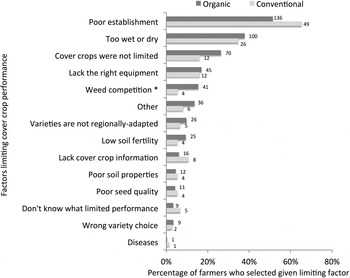
Twenty-six percent and 16% of organic and conventional farmers, respectively, indicated that there were no factors limiting cover crop performance on their farms (Fig. 3). Of the 13 factors limiting cover crop performance that were listed in our survey, ‘poor establishment’ was most frequently selected (Fig. 3). Residual herbicide activity might help explain why 65% of conventional farmers reported poor establishment as a factor limiting cover crop performance. Although there was no significant difference between the amount of organic and conventional farmers considering poor establishment a limiting factor (P = 0.064), the underlying factors responsible for poor establishment could be quite different between organic and conventional farmers. For example, soil applied residual herbicides, used in conventional but not organic systems, can persist for months or even years depending on chemical formulation and environmental conditions and have been cited as a concern regarding poor cover crop establishment for conventional farmers (Johnson and Legleiter, Reference Johnson and Legleiter2015).
Percentages of organic (n = 265) and conventional (n = 75) farmers growing cover crops who indicated the given factors limited cover crop performance on their farms. The question was: ‘What are the primary factors limiting the performance of cover crops on your farm? (choose up to three)’. The asterisk (*) indicates a significantly different number of organic and conventional farmers by chi-square test at P < 0.5. Numbers on outside of bars indicate the counts of farmer respondents.

More organic (15%) than conventional (5%) farmers indicated ‘weed competition’ limited cover crop performance (P = 0.031; Fig. 3). As weed control options are more restricted in organic than conventional cropping systems, weed competition with cover crops is likely more of an issue with organic than conventional farmers. Interestingly, no difference was observed between the number of organic and conventional farmers who indicated that the 12 other factors limited performance.
Cover crop traits
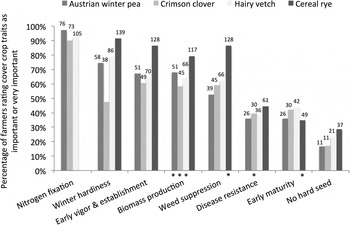
Of the eight traits related to cover crop performance that we asked farmers to rate on a Likert scale for the four focus cover crops, the highest ranked trait for the legume cover crops was nitrogen fixation (Fig. 4). Nitrogen fixation is an important ecosystem service provided by legume cover crops. Respondents considered winter hardiness, early vigor, biomass production and weed suppression the most important traits for cereal rye (Fig. 4). Understanding what cover crop traits farmers prioritize is an important first step in developing a cover crop breeding program.
Percentage of farmers (organic and conventional together) who rated each given trait for the four focus cover crops as ‘important’ or ‘very important’ out of total number of five rating levels (‘not at all important’ to ‘very important’). Numbers above bars indicate count of farmer respondents for each cover crop and trait. Stars on bars indicate significant differences between conventional and organic farmers for that particular trait and cover crop (chi-square test, * is P < 0.05).

Winter hardiness and tolerance of extreme temperatures are critically important to determine the range for where a cover crop can be grown (Wilke and Snapp, Reference Wilke and Snapp2008). Cold tolerance is correlated with pubescence of leaves or spikelet glumes in legumes and grasses, respectively (Maes et al., Reference Maes, Trethowan, Reynolds, van Ginkel and Skovmand2001; Teasdale et al., Reference Teasdale, Devine, Mosjidis, Bellinder and Beste2004). Leaf pubescence allows plants to better moderate temperature and evapotranspiration in stressful environments (Wilke and Snapp, Reference Wilke and Snapp2008). Cold tolerance may confer trade-offs with other traits like rapid growth rate, however (Wilke and Snapp, Reference Wilke and Snapp2008). Rapid growth in cool temperatures is especially important for winter annual cover crops that are used to produce biomass in late fall and early spring, outcompete weeds and cover soil to reduce erosion.
Both organic and conventional farmers considered nitrogen fixation, winter hardiness and early vigor to be the top-ranked traits of importance. However, organic and conventional farmers responded differently in how they rated the importance of the traits of biomass production in the three legumes, disease resistance in crimson clover, and early maturity in cereal rye (Fig. 4). More organic than conventional farmers considered biomass production to be ‘important or very important’ in Austrian winter pea (3 versus 30%, P = 0.016), crimson clover (62 versus 25%, P = 0.045), and hairy vetch (67 versus 30%, P = 0.004). The significant difference between organic and conventional farmers regarding the trait of biomass production in legumes, but not the trait of nitrogen fixation, suggests that organic farmers are looking to legume biomass for other benefits as well, such as increased organic matter (Reicosky et al., Reference Reicosky, Kemper, Langdale, Douglas and Rasmussen1995). More organic than conventional farmers (P = 0.001) considered weed suppression to be ‘important or very important’ in cereal rye (93 versus 70%). Whereas conventional farmers rely on external inputs, organic farmers cannot use chemical inputs and thus rely more strongly on cover crops for management than do conventional farmers.
Disease resistance in crimson clover was rated as ‘important or very important’ by 45% of organic farmers, compared with 0% of conventional farmers. Disease, such as pythium-rhizoctonia complex, is a concern in crimson clover when used as a self-seeding winter annual in the Southeast (Clark, Reference Clark2007, p. 30). The difference between organic and conventional farmers suggests that organic farmers relay more heavily on genetic resistance for disease suppression, whereas conventional farmers have other tools that they can use to control diseases. Early maturity in cereal rye was rated as ‘important or very important’ by 41% of organic farmers and 21% of conventional farmers. Early maturity in cereal rye is important for organic farmers who use roller-crimpers to terminate cover crops prior to no-till planting cash crops such as soybean (Mirsky et al., Reference Mirsky, Curran, Mortensen, Ryan and Shumway2009). Conventional farmers implementing no-till could terminate a cereal rye cover crop using herbicides, whereas organic farmers need to wait until anthesis for effective roller-crimper termination (Mirsky et al., Reference Mirsky, Curran, Mortensen, Ryan and Shumway2009; Wayman et al., Reference Wayman, Cogger, Benedict, Burke, Collins and Bary2015).
In addition to comparing responses between organic and conventional farmers, we evaluated the relationship among other demographic factors for two cover crop traits that are known to be issues: (1) winter hardiness in crimson clover and (2) hard seed in hairy vetch. The importance of winter hardiness for crimson clover varied by hardiness zone (χ2 = 10.3, P = 0.036). Farmers in cooler zones (zones 3, 4 and 5 grouped together) rated winter hardiness for crimson clover differently than farmers in the mid-range zones (zones 6, 7 and 8 grouped together) (chi-square post-hoc test, P = 0.019). More farmers in zones 6, 7 and 8 (n = 36) rated winter hardiness in crimson clover as ‘important or extremely important’ than did farmers in zones 3, 4 and 5 (n = 35). As crimson clover typically winter kills in colder environments, farmers in zones 6, 7 and 8 might use it as an overwintering cover crop, whereas farmers in zones 3, 4 and 5 might consider the use of crimson clover as an overwintering cover crop to be unfeasible.
We also explored the relationship between grain and non-grain farmers and how they rated the importance of hard seed in hairy vetch. Hard seed is a concern for grain farmers because hairy vetch seed can remain in the seedbank and act as a weed in grain crops (Clark, Reference Clark2007, p. 36; Mirsky et al., Reference Mirsky, Wallace, Curran and Crockett2015). Grain farmers differed significantly from non-grain farmers in how they rated the importance of hard seed in hairy vetch (χ2 = 23.8, P < 0.001). More grain farmers (49%) than non-grain farmers (6%) considered the trait of no hard seed to be ‘important or extremely important’ in hairy vetch, whereas more non-grain farmers (69%) than grain farmers (46%) considered no hard seed ‘unimportant or very unimportant.’
Perspectives on cover crops
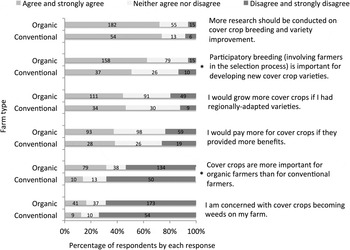
A greater percentage of organic (31%) than conventional farmers (14%) agreed or strongly agreed that ‘Cover crops are more important for organic farmers than for conventional farmers’ (P = 0.011, Fig. 5). This could be due to organic farmers relying more heavily on cover crops to perform functions that conventional farmers can achieve through other means. A greater percentage of organic (63%) than conventional farmers (51%) agreed or strongly agreed that ‘participatory breeding (involving farmers in the selection process) is important for developing new cover crop varieties’ (P = 0.047, Fig. 5). Work by The Organic Seed Alliance confirms farmer interest in participatory plant breeding (Hubbard and Zystro, Reference Hubbard and Zystro2016). For instance, a survey by The Organic Seed Alliance of 46 organic crop breeding researchers reported that more than 50% of their research projects were hosted on organic farmers’ land (Hubbard and Zystro, Reference Hubbard and Zystro2016). In that survey, 30% of the researchers reported that farmers were involved in the evaluation of plant material.
Percentages of organic and conventional farmers answering ‘strongly agree or agree’, ‘neither disagree or agree’, or ‘disagree or strongly disagree’ on Likert response scale for six perspective questions involving cover crops. Stars indicate significant differences between conventional and organic farmers for that question, with chi-square tests at P < 0.05 represented by *. Numbers on the bars indicate number of respondents.

No differences were found between organic and conventional farmers for the four other perspective statements in Fig. 5. Seventy-two percent of organic farmers and 74% of conventional farmers agreed or strongly agreed that more research should be conducted on cover crop breeding and variety improvement (Fig. 5). This suggests a high degree of farmer interest in cover crop research and variety development. For the questions on regionally adapted cover crop varieties and paying more for benefits of cover crops, more farmers agreed or strongly agreed with these statements than those who disagreed or strongly disagreed (Fig. 5). For the statement, ‘I am concerned with cover crops becoming weeds on my farm’, 74% of conventional and 69% of organic farmers disagreed or strongly disagreed. This indicates that most farmers who took our survey believe they can adequately manage cover crops and prevent them from competing with cash crops or causing other problems.
Amount willing to spend on seed
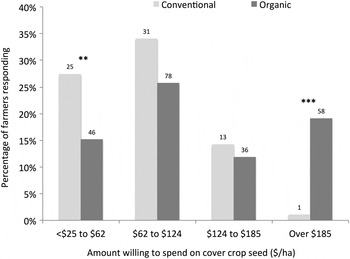
More organic (19%) than conventional farmers (1%) reported willingness to pay over US$185 ha−1 on cover crop seed (P < 0.001; Fig. 6). Conversely, more conventional (27%) than organic (15%) farmers were willing to spend between only <US$25 and 62 ha−1 on cover crop seed (P = 0.012; Fig. 6). This suggests that there is high demand for cover crop seed among organic farmers and shows their willingness to pay more for expensive varieties that would possibly deliver greater benefits. This also suggests that conventional farmers would prefer to spend less money on cover crop seed. Additionally, organic farmers are often growing higher value crops, due to price premiums (Caldwell et al., Reference Caldwell, Mohler, Ketterings and DiTommaso2014), and thus they can afford to pay more for cover crop seed to support their cash crops. Organic and conventional farmers responded no differently from each other about their willingness to pay for cover crop seed in the middle levels of US$62–124 ha−1 and US$124–185 ha−1 (Fig. 6).
The percentages of organic and conventional farmers who report willingness to spend a given amount in USD per ha on cover crop seed. Numbers at the end of bars indicate number of respondents. Stars indicate significant difference between organic and conventional growers based on chi-squared test: ** is P < 0.01, *** is P < 0.001. The answer categories were originally posed in the survey using dollar per acre units, which were: <US$10–25 acre−1, US$25–50 acre−1, US$50–75 acre−1, and over US$75 acre−1.

Whether farmers grew vegetables or grains also influenced how much they were willing to spend on cover crop seed. More vegetable farmers (27%) than farmers who did not grow vegetables (4%) reported that they were willing to spend over US$185 ha−1 on cover crop seed (P < 0.0001, data not shown). On the other hand, more grain farmers (24%) than farmers who did not grow grains (12%) reported that they were willing to spend <US$25–62 ha−1 on cover crop seed (P = 0.002, data not shown). As with the difference between organic and conventional farmers regarding their willingness to pay and the value of their crops, these results are likely due to vegetables being higher value crops than grains.
A survey by the National Wildlife Federation collected information from cover crop seed dealers in the Midwest to study patterns in cover cropping and purchasing of cover crop seed (Bryant et al., Reference Bryant, Stockwell and White2013). The survey reported that <5% of farmers in the Mississippi River basin saved their own seed (‘bin-run’ seed), but that more farmers in some states like Michigan and Wisconsin may be likely to use bin-run seed. The median cost of what farmers were typically spending on cover crop seed was US$62 ha−1 (US$25 acre−1), which is congruent with our survey results (Bryant et al., Reference Bryant, Stockwell and White2013).
Survey limitations
As with any survey, our results could be biased in unanticipated ways. For instance, data type can influence the results of a survey analysis. Baumgart-Getz et al. (Reference Baumgart-Getz, Prokopy and Floress2012) demonstrated how when ‘years of education’ was collected as a continuous variable it had a negative impact on adoption of certain practices, but when ‘years of education’ was collected in binary or ordinal form, these data showed a non-significant positive impact on adoption. Additionally, response bias may influence the response rates of surveys. For instance, the cover crop survey in Iowa (Arbuckle and Roesch-McNally, Reference Arbuckle and Roesch-McNally2015) was included as a section in a larger questionnaire, thus increasing its distribution. Other surveys focusing only on cover crops might be answered primarily by those directly interested in cover crops, thus increasing the percentage of farmers who report growing cover crops. Although organic farmers account for only 1% of farmers in the USA (2012 Census of Agriculture, 2014) more organic farmers responded to our survey than conventional farmers. This suggests that caution is warranted in the interpretation of the results from conventional farmers in our survey. Finally, our results are based on responses from US farmers who report growing cover crops, thus our findings cannot be generalized to all organic and conventional farmers in the USA, or to farmers in other countries.
Conclusions
Our results show clear differences between organic and conventional farmers in how they use and perceive cover crops. The results of our survey illustrate that farmers are interested in cover crops and believe that benefits from cover crops are important (Figs. 2 and 4). However, farmers are often risk-averse and are therefore hesitant to adopt new practices that add layers of uncertainty. A survey of Iowa farmers explored factors that influence whether or not farmers adopt a certain farming practice (Arbuckle and Roesch-McNally, Reference Arbuckle and Roesch-McNally2015). The survey found that although Iowa farmers recognized the benefits of cover crops, they more keenly perceived cover crop drawbacks and were thus disinclined to use cover crops on their farms. However, a review of 46 farmer adoption studies found that over time farmers have become less resistant to adopting best management practices, and as best management practices have become more widely used, their perceived risk decreased (Baumgart-Getz et al., Reference Baumgart-Getz, Prokopy and Floress2012).
The goal of this work was to identify cover crop traits that could be targeted for cover crop breeding programs and to explore the perspectives of organic and conventional farmers about cover crops. Farmers responded that improving soil health is the main reason they plant cover crops. Based on responses to our survey questions, the main difference between conventional and organic farmers with regard to cover crop use was that organic farmers rely more heavily on cover crops as multifunctional management tools. A larger percentage of organic than conventional farmers indicated that ecosystem services (e.g., nitrogen fixation and increased soil organic matter) were important reasons why they grew cover crops and that they were more willing to spend a higher amount of money on cover crop seed. Organic farmers also identified several cover crop traits as being more important than did conventional farmers and more organic farmers agreed that participatory plant breeding was important. Our results indicate both similarities and differences between organic and conventional farmers in respect to their perspectives on cover crop breeding priorities and approaches and thus can be used to tailor future research and development to better meet the needs of both organic and conventional farmers.
Acknowledgements
The authors would like to thank Jenn Thomas-Murphy for survey distribution assistance. This project was funded by USDA OREI project # MD.W-2015-07406, ‘Creating the Cover Crops that Organic Farmers Need: Delivering Regionally Adapted Varieties Across America’.