Introduction
Depolymerizable polymers and closely related self-immolative polymers are triggerable materials that respond to a specific stimulus by unzipping into small molecules. They have been developed as triggerable delivery vehicles, recyclable and restructurable materials, disappearing or sacrificial composites, and lithographic resists.[Reference Peterson, Larsen and Boydston1–Reference Wong, DeWit and Gillies6] Specifically, depolymerizable polymers regenerate constituent monomers by chemically reversing propagation,[Reference Jenkins, Kratochvíl, Stepto and Suter7] while self-immolative polymers afford small molecular products that differ from parent monomers.[Reference Peterson, Larsen and Boydston1–Reference Phillips, Robbins, DiLauro and Olah3] For either case, the unzipping sequence is initiated by chemically or physically cleaving the polymer backbone, side-chains, or end-groups to expose a reactive intermediate that subsequently liberates molecular products in a stepwise fashion.[Reference Phillips and DiLauro2] These steps are spontaneous under certain conditions. Although there are other approaches to polymer chain depolymerization and self-immolation, the focus herein is on polymers that fully and spontaneously unzip to monomer on demand; partial depolymerization that proceeds via radical mechanisms during thermal degradation has been comprehensively reviewed elsewhere.[Reference David, Bamford and Tipper8] It is important to note that “depolymerization” is a concept distinct from degradation. Many polymers have been prepared with cleavable bonds within their backbone or side-chains; however, cleaving these bonds, by hydrolysis for example, constitutes degradation and not intentionally designed, triggerable depolymerization.
This “Prospective” highlights the discovery, preparation, and development of depolymerizable polymers with a major focus on polymers exhibiting low ceiling temperatures (T c), the critical threshold temperature above which depolymerization and thus monomer formation are thermodynamically favored. Within this discussion, we briefly introduce another class of polymers, termed “self-immolative polymers,” that unzip to small molecular products, whose role in the development of depolymerizable polymers is crucial to recent advances in the field. We also survey several applications of stimuli-responsive, low T c polymers while providing an outlook on future technologies that will greatly benefit from continuous exploration of depolymerizable materials.
The ceiling temperature phenomenon
The concept of a ceiling temperature was first described and reported by Snow and Frey in 1943, followed by further elucidation by Dainton and Ivin in several seminal studies on poly(olefin sulfone) polymerizations.[Reference Snow and Frey9, Reference Dainton and Ivin10] The researchers independently discovered that copolymerizations between sulfur dioxide and olefins were paused as temperatures increased; further increasing the temperature to drive the polymerization to completion led to reduced monomer conversions and polymer molecular weights. On the contrary, decreasing polymerization temperature correlated with increasing tendency for the monomers to polymerize to high polymers.[Reference Dainton and Ivin11, Reference Cook, Dainton and Ivin12]
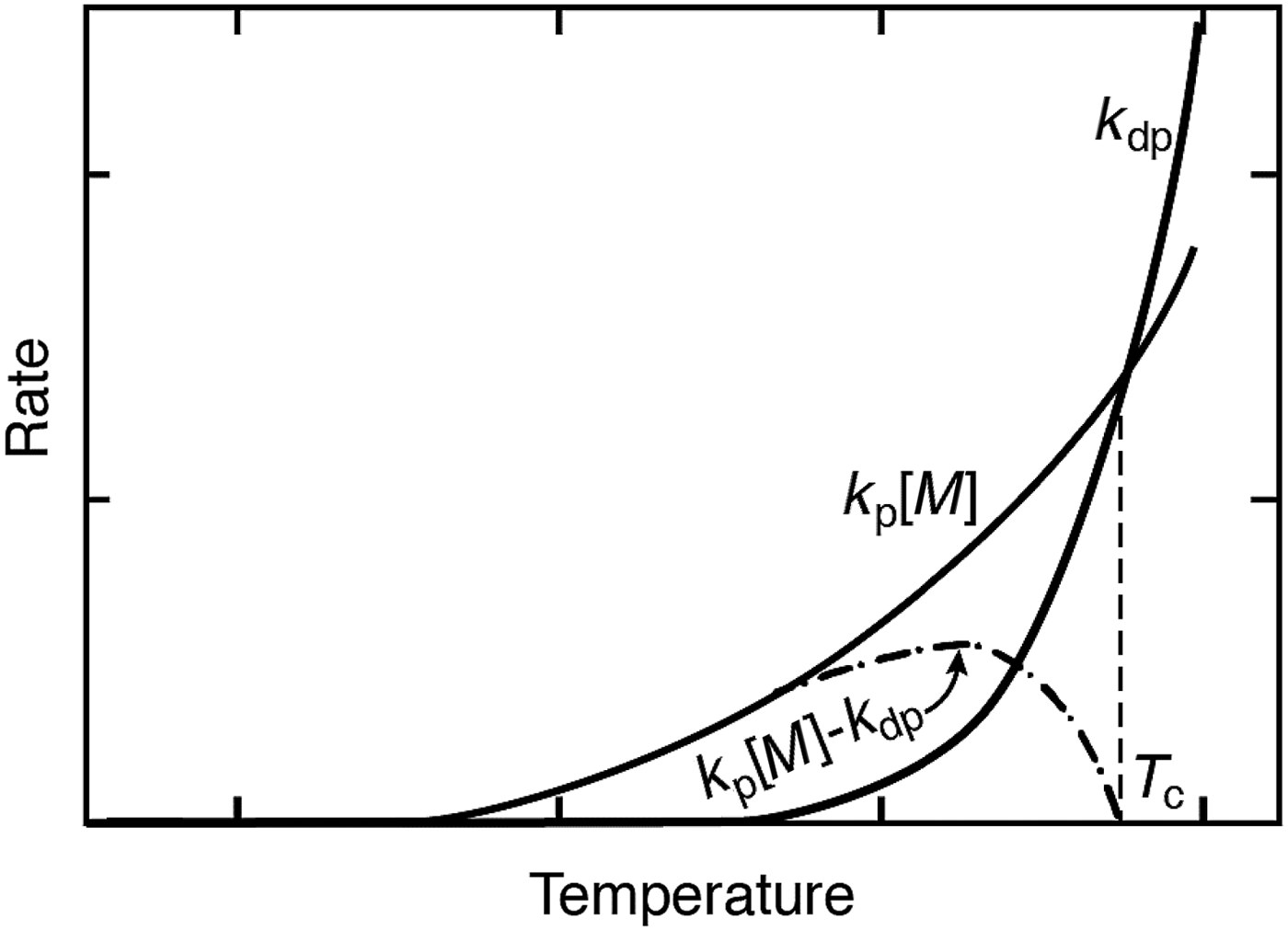
The authors correctly interpreted this counterintuitive result as unfavorable thermodynamics in poly(olefin sulfone) polymerizations.[Reference Dainton and Ivin13–Reference Ivin15] With a few exceptions, polymerizations are inherently exothermic and exoentropic (ΔH < 0 and ΔS < 0; there are few known examples of endothermic and endoentropic polymerizations, which exhibit a floor temperature[Reference Ivin15]). It was surmised that polymer propagation steps are reversible processes, and that there exists a temperature at which the free energy for a polymerization crosses from negative to positive (Scheme 1). At this cross-over temperature, the rate of propagation is equivalent to the rate of depropagation, establishing equilibrium. Therefore, when the polymerization temperature is raised to this point, polymer growth is halted. Beyond this critical temperature, however, depropagation outcompetes propagation such that further increasing the reaction temperature favors the reverse reaction and results in polymer “unzipping” (Fig. 1).[Reference Dainton and Ivin13]
Schematic of monomer–polymer equilibrium.

Polymer propagation and depropagation rates as a function of temperature. T c is defined as the temperature at equilibrium, where the rates intersect (at [M]0 = 1 M). (Reprinted with permission from Ref. Reference Dainton and Ivin13. Copyright 1958 Royal Society of Chemistry.)
The cross-over temperature was termed a ceiling temperature (T c), and represents a critical threshold above which depropagation rate surpasses propagation rate (Fig. 1).[Reference Sawada16, Reference Sawada17] The T c is an inherent thermodynamic constraint in any polymerization and depends on free energy parameters for any given monomer:
 $$\Delta G_{\rm p} = \; \Delta H_{\rm p} - T \Delta S_{\rm p},$$
 $$\Delta G = 0\; {\rm at}\; T_{\rm c},$$
 $$T_{{\rm c\;}} = \; \displaystyle{{\Delta H_{\rm p}} \over {\Delta S_{\rm p}}}.$$
Since the entropy of polymerization depends on concentration, pressure, and effects of solvation, the T c is generally reported for any given monomer at standard pressure and for an initial monomer concentration of 1.0 mol/L.[Reference Ivin15] A more general form of the monomer–polymer equilibrium is expressed below, where [M]e is the equilibrium monomer concentration at a given temperature:
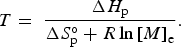 $$T = \; \displaystyle{{\Delta H_{\rm p}} \over {\Delta S_{\rm p}^{\circ} + R\,{\rm ln}\left[ M \right]_{\rm e}}}.$$
These relationships enable facile determination of polymer ceiling temperatures. Rearranged, a linear relationship is evident between 1/T and ln[M]e, with a slope of  $\displaystyle{{\Delta H_{\rm p}^{\circ} } / R}$ and a y-intercept of −ΔS p°/R:
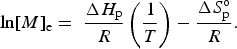 $$\; {\rm ln}[M]_{\rm e} = \; \displaystyle{{\Delta H_{\rm p}} \over {R}} \left( {\displaystyle{1 \over T}} \right) - \displaystyle{{\Delta S_{\rm p}^{\circ}} \over R}.$$
Equation (5) provides a framework for experimental determination of T c. With increasing temperature, the monomer concentration required to meet equilibrium conditions increases. Thus, measuring monomer equilibrium concentrations at various temperatures enables accurate determination of thermodynamic parameters and gives a reliable estimate of a polymer's T c. Alternatively, it is possible to measure the rates of polymerization or the polymer molecular weights at various temperatures, followed by extrapolation to zero in a plot of either parameter versus temperature.[Reference Ivin15–Reference Sawada17] While these last two techniques are less accurate than the first, they were the methods of choice in many early studies on the thermodynamics of low T c polymer synthesis.
That the existence of a T c was not discovered until the 1940s is a direct result of the fact that typical olefin polymerizations are extremely exothermic and that the resultant polyolefins exhibit impractically high T c's.[Reference Sawada16, Reference Sawada17] Compared to typical olefin polymerizations known at the time, the exothermicity of poly(olefin sulfone) preparation is significantly reduced (i.e., more positive). The less exothermic polymerization results in a concomitant decrease in T c, which was impressively recognized and interpreted by the early researchers, paving the way for the discovery of other polymers with low T c's.
It is worth noting here that reverse propagation above T c is one pathway that leads to depolymerization, which is a concept distinct from degradation. All polymers are theoretically capable of depolymerization if the temperature is raised above their T c. However, the majority of common polymers have such high T c's that thermal degradation is observed before depolymerization. Low T c polymers are thus a special class of depolymerizable polymers with a T c sufficiently low that depropagation is possible at or near ambient temperatures. Other commonly known depolymerizable polymers besides poly(olefin sulfone)s include many different polyaldehydes, polymers from certain cyclic ethers or acetals, and poly(α-methyl styrene). An emergent class of closely related “self-immolative” polymers that unzip will also be discussed in later sections (see Refs. Reference Peterson, Larsen and Boydston1–Reference Wong, DeWit and Gillies6 and Reference Vogl18–Reference Vogl21 for reviews on these types of polymers).
Preparation of depolymerizable polymers by kinetic stabilization of chain-ends
Low T c, depolymerizable polymers are inherently thermodynamically unstable at, or just above, room temperature. This property raises an important question: how can low T c polymers be prepared and exploited as useful materials in ambient conditions? To prepare stable, isolable polymers based on these types of monomers, it is critical to prepare the materials below their T c and then block or impede the depolymerization process at elevated temperatures. This feat has been achieved in several different manners for various polymerization methods, but all necessitate “capping” chain-ends to block the depolymerization pathway. End-capping kinetically stabilizes depolymerizable polymers above their T c because there is not sufficient energy at room temperature to cleave capping groups and permit access to intermediates that undergo depropagation.
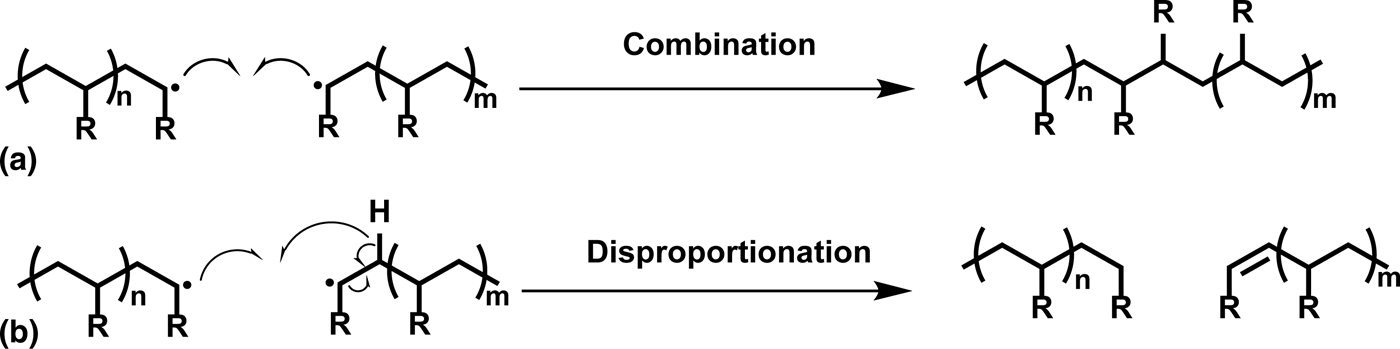
For radical polymerizations such as poly(olefin sulfone) preparation, blocking the chain-ends from unzipping is relatively trivial.[Reference Dainton and Ivin11, Reference Cook, Dainton and Ivin12] Polymerization at low temperature is accompanied by termination via radical combination or disproportionation, which effectively quenches the reactive chain-ends and end-caps the polymer to inactivate it from depropagation (Scheme 2).[Reference Odian22] Only by re-initiating the capped chain-ends or cleaving the polymer backbone to expose new chain-ends will unzipping proceed to effect depolymerization. In this manner, low T c polymers synthesized by free radical polymerizations essentially stabilize themselves spontaneously by termination.
Termination “end-capping” processes in free radical polymerizations.
However, in living chain-growth and step-growth polymerizations, termination steps that quench or otherwise inactivate chain-ends do not occur spontaneously (barring termination by cyclization or chain-transfer). It was not until the late 1950s that researchers at DuPont began to identify strategies that effectively stabilize low T c polymers from depropagation. Polyoxymethylene (POM or polyformaldehyde) was known at the time to be thermally unstable, thereby limiting interest in its study and industrial application.[Reference Brown23, Reference Masamoto24] Several pioneering efforts demonstrated that anionic polymerization of formaldehyde below its T c followed by a post-polymerization esterification greatly enhanced the thermal stability of this polymer, culminating in a series of publications that, for the first time, characterized the polymer's physical, thermal, and mechanical properties (Scheme 3).[Reference Schweitzer, MacDonald and Punderson25–Reference Alsup, Punderson and Leverett29] The enhanced thermal stability is a consequence of esterification of the chain-end hemiacetal, blocking the polymer from depolymerization at elevated temperatures. Importantly, this enabled melt processing of the polymer at temperatures well above its T c.
End-capping POM by esterification. R depends on polymerization initiator.
A later discovery introduced an alternative method to effectively stabilize depolymerizable polymers: copolymerization with small quantities of comonomers that do not depolymerize, thereby acting as “chain-stoppers” within the polymer chain.[Reference Masamoto24] Polymers formed in this way unzip until they reach a unit incapable of depropagation, subsequently stopping depolymerization and leaving the polymers end-capped. One example of such chain-stoppering approach is the cationic copolymerization of 1,3,5-trioxane—the cyclic trimer of formaldehyde—with epoxide (Scheme 4). The aldehyde units can unzip via their acetal linkages. However, the additional carbon spacer, introduced by epoxide, halts depropagation, so that the ethylene unit persists as a stable chain-end. A variety of other cyclic ethers and acetals have also been used as comonomers to stabilize polyaldehydes.[Reference Masamoto24] Although polymers prepared with this method cannot fully depolymerize from head-to-tail due to the blocking comonomers, they are activated to depolymerize into smaller subunits by cleaving sites within the backbone to create new chain-ends.
Copolymerization of trioxane with chain-stoppering ethylene oxide. R depends on initiator.
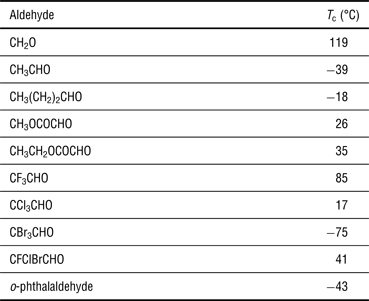
The discovery of these methods for end-capping ionic chain-growth polymerizations immediately stimulated a large outgrowth in the synthesis and study of polyaldehydes other than POM.[Reference Vogl30–Reference Tagami, Kagiyama and Aso39] Vogl et al. notably embarked on the preparation of a wide range of higher aliphatic polyaldehydes, demonstrating a general approach to stabilized the polymers by post-polymerization esterification (Table I).[Reference Vogl30–Reference Brame, Sudol and Vogl35] Later, the first aromatic polyaldehydes were discovered by the Aso group in the low-temperature cyclopolymerization of o-phthalaldehyde and related monomers (Scheme 5, Table I).[Reference Aso, Tagami and Kunitake36–Reference Tagami, Kagiyama and Aso39] Advantages of aromatic polyaldehydes include enhanced monomer stability relative to aliphatic aldehydes, and improved polymer solubility due to their atactic nature, unlike the highly crystalline aliphatic polyaldehydes.[Reference Vogl18, Reference Kostler19]
Anionic cyclopolymerization and stabilization of o-phthalaldehyde.[Reference Aso and Tagami37]
Aldehyde monomers and associated ceiling temperatures.[Reference Vogl18]
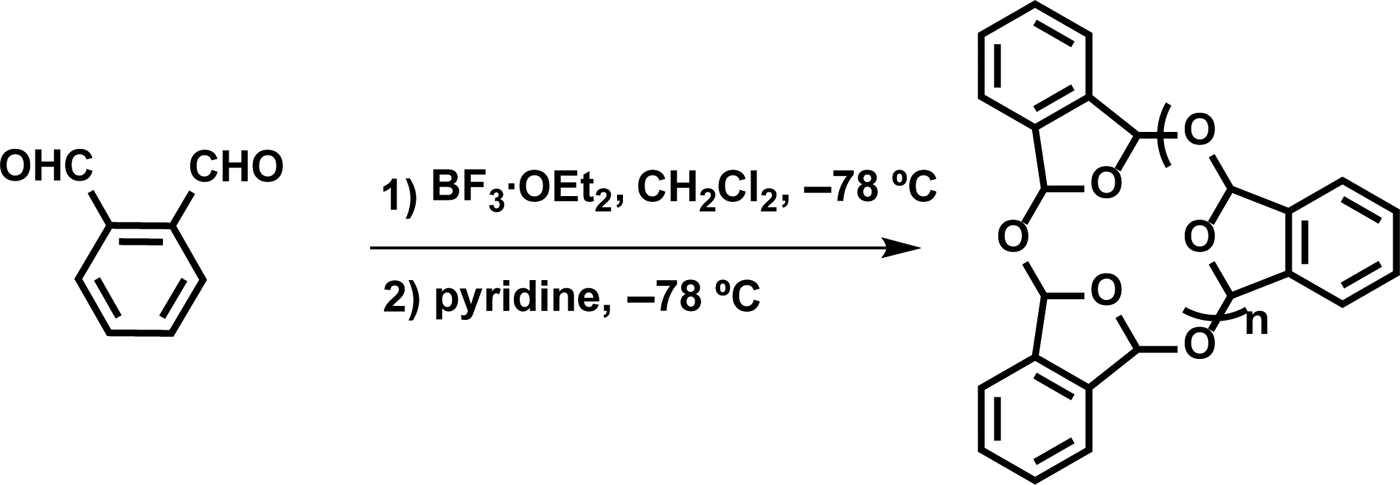
In recent years, our laboratory discovered that the cationic polymerization of o-phthalaldehyde surprisingly yielded macrocyclic polymer.[Reference Kaitz, Diensendruck and Moore40] Stability is conferred to polymer chains not by capping the chain ends, but by the macrocyclization process itself, which yields “endless” polymers. The cyclic polymers are synthesized with a variety of Lewis acids as initiators, and the polymerization reaction is quenched by neutralization with base (Scheme 6). Under polymerization conditions, macrocyclization is reversible, enabling ring-expansion, ring-contraction, and ring-mixing, the latter of which was employed to produce copolymers of controlled microstructure.[Reference Kaitz, Diensendruck and Moore40, Reference Kaitz, Diensendruck and Moore41] We later demonstrated a similar macrocyclization mechanism in the cationic polymerization of an aliphatic aldehyde, ethyl glyoxylate, to produce another low T c polyaldehyde.[Reference Kaitz, Diesendruck and Moore42]
Cationic, macrocyclic polymerization of o-phthalaldehyde.[Reference Kaitz, Diensendruck and Moore40]
Analogous polymers prepared by step-growth polymerizations have also emerged in the literature.[Reference Gnaim and Shabat4–Reference Wong, DeWit and Gillies6] The first such linear polymer, termed a “self-immolative polymer,” was reported in 2008,[Reference Sagi, Weinstain, Karton and Shabat43] and many other classes of similar polymers have since been reported.[Reference Weinstain, Sagi, Karton and Shabat44–Reference Liu, Wang, Hu, Zhang and Liu58] Synthesis of these materials is accomplished with AB-type monomers containing a blocked reactive unit. Polymerization ensues on activation of blocked functional groups, for example by catalytic activation of blocked isocyanates or exposure of reactive amines, to form linear polyurethanes and polycarbonates.[Reference Sagi, Weinstain, Karton and Shabat43, Reference Chen, McBride and Gillies52] These polymers unzip via a mechanism unique from low T c polymers, expelling gaseous byproducts to drive the unzipping process forward (discussed in the Section “Recent advances in triggered depolymerization”). However, preventing these polymers from unwanted head-to-tail self-immolation again relies on adding a reagent to end-cap the reactive polymer chains. In this case, a monofunctional nucleophilic species, which is added near the end of the polymerization reaction, is employed to serve as a chain-capping and stabilizing group (Scheme 7).
Polymerization and stabilization of self-immolative polymers.[Reference Sagi, Weinstain, Karton and Shabat43]
Recent advances in triggered depolymerization
Depolymerizable polymers have witnessed a resurgence in the literature over the past decade due to their capacity to undergo triggered depolymerization.[Reference Peterson, Larsen and Boydston1–Reference Phillips, Robbins, DiLauro and Olah3] There are numerous applications of triggered depolymerization, which will be discussed in the ensuing section. Regardless of polymer type, triggered depolymerization or self-immolation relies on a physical or chemical stimulus that reacts with either the polymer end-caps to expose chain-ends, or induces chain-scission in polymer backbones to create new chain-ends capable of unzipping. Among others, the stimuli of interest include acid, base, redox reagents, electromagnetic irradiation and heat. Polymers highlighted in this section take advantage of ionic and nucleophilic mechanisms to achieve rapid and complete unzipping to small molecules at room temperature. In contrast, general thermal degradation processes that proceed via radical mechanisms often exhibit partial unzipping of polymer chains due to competitive termination and chain-transfer events. Quantitative treatment of this pathway is beyond the scope of this Prospective and reviewed in detail elsewhere.[Reference David, Bamford and Tipper8] This section also discusses the comparative rates of each depolymerization or self-immolation pathway and highlights important milestones in recent progress.
Triggered head-to-tail unzipping of linear, self-immolative polymers was reported by Shabat and co-workers in 2008.[Reference Sagi, Weinstain, Karton and Shabat43] For this purpose, they synthesized polymers derived from quinone-methide-based self-immolative dendrimers previously prepared by the same group.[Reference Gnaim and Shabat4] They demonstrated that, to enact triggered polymer unzipping, it was necessary to end-cap the polymers with a stimulus-responsive functionality rather than the conventional, inert blocking group. When the responsive cap is removed to expose the chain-ends, head-to-tail self-immolation is initiated and driven to completion by expulsion of CO2 (Scheme 8). Specifically, they employed 4-hydroxy-2-butanone as a trigger, which is removed by enzymatic cleavage, thereby activating the unzipping cascade. Later examples expanded the triggering modes to groups that respond to acid, base, UV light, near-IR light, heat, enzymes, and redox reagents.[Reference Weinstain, Sagi, Karton and Shabat44–Reference DeWit, Beaton and Gillies50]
Triggered unzipping of self-immolative polymers.[Reference Sagi, Weinstain, Karton and Shabat43]
Two mechanisms are available in quinone-methide eliminations: 1,6- and 1,4-eliminations (para and ortho variants, respectively). First-generation self-immolative polymers employed 1,6-eliminations in polyurethane backbones, requiring approximately 10 h to achieve complete unzipping in physiological conditions.[Reference Sagi, Weinstain, Karton and Shabat43] The analogous 1,4-elimination occurred at slightly slower rates, taking about twice as long to achieve complete degradation of monomeric model compounds under identical conditions.[Reference Erez and Shabat59] Exploiting these dual elimination mechanisms, researchers went on to develop linear polymers based on 1,6-quinone-methide backbones bearing side chains capable of further disassembly via 1,4-elimination.[Reference Weinstain, Sagi, Karton and Shabat44 These so-called “self-immolative comb-polymers” feature rapid backbone unzipping followed by side-chain disassembly to release multiple reporter compounds.
The Gillies group successfully expanded the scope of linear self-immolative polymers and modulated the rates of their head-to-tail unzipping by designing analogs with cyclizing spacers and alternative main-chain atoms.[Reference DeWit, Beaton and Gillies50–Reference McBride and Gillies53] They demonstrated this approach by incorporating a cyclizable thiol spacer into a polycarbonate backbone such that self-immolation rates were amplified by over an order of magnitude compared with analogs containing amine spacers (Scheme 9).[Reference Chen, McBride and Gillies52] Complete transformation of thiol-spaced polymers into small molecular products occurred in 5 h in a neutral buffer at 37 °C, compared with several days for the corresponding polymers with amine spacers. The researchers further prepared small, monodisperse self-immolative oligomers and polymers by stepwise synthesis to demonstrate conclusively that, as expected, the rate of unzipping is directly related to the overall chain-length for this class of polymers.[Reference McBride and Gillies53] Times to reach 50% self-immolation (polymer “half-lives”) ranged from under 10 min for dimer, 24 min for octamer, and up to 40 min for a polydisperse polymer sample with average degree of polymerization ~50.
Triggered self-immolation with enhanced rates by alternating cyclization-elimination.[Reference Chen, McBride and Gillies52]
An analogous class of polymers, the “chain-shattering” polymers, also undergoes triggered degradation by a similar quinone-methide elimination mechanism. However, rather than head-to-tail unzipping proceeding from chain-ends, these polymers cleave from alternating sites within the backbone (Scheme 10).[Reference Fomina, McFearin, Sermsakdi, Edigin and Almutairi60–Reference Zhang, Yin, Yin, Ma, Tang and Cheng66] Since the degradation cascade does not proceed along polymer chains and requires multiple initiation events, the reaction rates are notably governed by triggering conditions and stimuli. Complete degradation has been observed on time scales of several minutes for UV-sensitive polymers, several hours for near-IR-, acid-, and base-sensitive polymers, and even days for oxidation-sensitive polymers.[Reference Fomina, McFearin, Sermsakdi, Edigin and Almutairi60–Reference de Gracia Lux, Joshi-Barr, Nguyen, Mahmoud, Schopf, Fomina and Almutairi62, Reference Zhang, Ma, Deng and Cheng65, Reference Zhang, Yin, Yin, Ma, Tang and Cheng66] Advantages of chain-shattering polymers include their facile preparation by step-growth copolymerization between activated, bifunctional quinone-methide moieties and bifunctional comonomers, thereby enabling integration of a wide variety of functional motifs into polymer chains.[Reference Fomina, McFearin, Sermsakdi, Edigin and Almutairi60, Reference Zhang, Ma, Deng and Cheng65] In fact, the Cheng group demonstrated that copolymerization with a reactive therapeutic allows for direct insertion of target drugs into polymer backbones for on-demand release.[Reference Zhang, Yin, Yin, Ma, Tang and Cheng66] One could further envision the incorporation of multiple unique, stimuli-responsive triggers to afford chain-shattering polymers responsive to multiple stimuli.
Triggered degradation of chain-shattering polymers.[Reference Zhang, Ma, Deng and Cheng65]
For low T c polyaldehydes, triggered depolymerization from head-to-tail was first demonstrated in 2010[Reference Seo and Phillips67] and further expanded in subsequent years.[Reference DiLauro, Robbins and Phillips68–Reference Kaitz, Possanza, Song, Diesendruck, Spiering, Meijer and Moore71] It was already known that acid exposure was a viable route to achieve polyaldehyde depolymerization by random chain-scission along the acetal backbone.[Reference Tsuda, Hata, Nishida and Oikawa72] However, triggering stimuli were limited to acidic reagents capable of backbone cleavage. Taking inspiration from the self-immolative polymer literature, Seo and Phillips demonstrated that end-capping poly(phthalaldehyde) with a responsive functionality enabled triggered depolymerization (Scheme 11).[Reference Seo and Phillips67] They employed protective groups that are cleavable by palladium sources or fluoride ions and showed that complete depolymerization to monomer is nearly instantaneous upon exposure to the chemical stimulants. In this case, polymer unzipping at room temperature is not driven by expulsion of gaseous byproducts but rather results from the extremely low T c of the poly(phthalaldehyde) (−43 °C). Using available thermodynamic data,[Reference Aso, Tagami and Kunitake36] it can be estimated that the equilibrium monomer concentration for this polymer at room temperature is 14 mol/L (at 25 °C), so depolymerization continues until reaching this condition, which is unachievable in practice. Poly(phthalaldehyde) exhibits the most rapid depolymerization rates observed for any class of depolymerizable polymers. In fact, the extremely rapid unzipping speeds have hindered attempts to monitor reaction progress in solution, as complete reversion to monomer is observed on analytical time scales. In the solid state, total degradation has been observed within 15 min.[Reference Seo and Phillips67]
Triggered depolymerization of poly(phthalaldehyde).[Reference Seo and Phillips67]
Triggered depolymerization of low T c polyaldehydes, specifically poly(phthalaldehyde), has many advantages compared to self-immolative polymers that have made this class of materials a system of choice for continued research over several decades. High molecular weight poly(phthalaldehyde) is prepared and end-capped with a variety of stimuli-responsive triggers from commercially available reagents, although rigorous purification of o-phthalaldehyde monomer is required for anionic polymerizations.[Reference DiLauro, Robbins and Phillips68, Reference Winter, Dove, Knoll, Gerbaux, Dubois and Coulembier69] Furthermore, it is possible to functionalize related polymers by post-polymerization modification to achieve cross-linking or tailor the polymer with specific moieties.[Reference Kaitz and Moore70, Reference Kaitz, Possanza, Song, Diesendruck, Spiering, Meijer and Moore71] Most importantly, the depolymerization process of polyaldehydes is nearly instantaneous on exposure to acid, heat, or triggering reagents. Even macrocyclic poly(phthalaldehyde), which lacks triggering end-groups, depolymerizes rapidly by main-chain scission on exposure to acid.[Reference Tsuda, Hata, Nishida and Oikawa72] As a result, polyaldehydes have found widespread use in a variety of applications.[Reference Phillips and DiLauro2, Reference Kostler19]
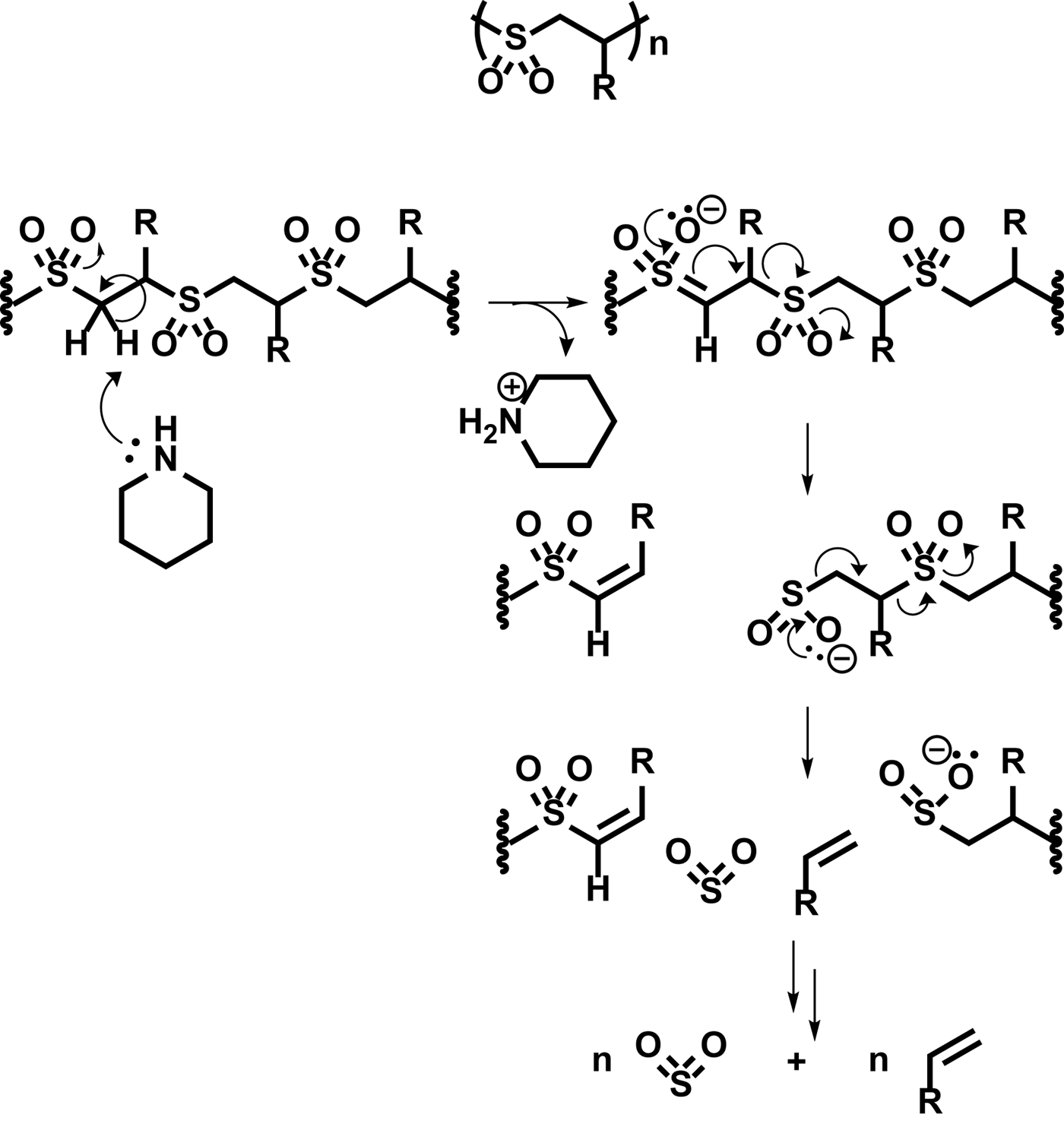
Like self-immolative polymers and polyaldehydes, triggered depolymerization has also been explored in low T c poly(olefin sulfone)s. In the 1930s, researchers found that heating poly(olefin sulfone)s in aqueous alkaline solutions yielded the constituent olefin monomers and sulfur dioxide, which was isolated in the form of sodium sulfite.[Reference Frederick, Cogan and Marvel73–Reference Ryden and Marvel75] Removing the backbone protons by base led to random backbone scission, creating new chain-ends that initiate the depolymerization cascade (Scheme 12).[Reference Shinoda, Nishiwaki and Inoue76] Lobez and Swager later investigated amine-initiated depolymerization of poly(2-methyl-1-pentene sulfone) using ammonium hydroxide, n-butylamine, and piperidine.[Reference Lobez and Swager77] At 25 °C, depolymerization reached completion within 30 min in 0.7 M of amine bases and after 24 h in 0.7 M ammonium hydroxide. The researchers also compared the depolymerization of poly(2-methyl-1-pentene sulfone) and poly(1-hexene sulfone) triggered by 0.3 molar equivalents (relative to repeat units) of piperidine. While both polymers remained intact after 60 min at 25 °C, heating the samples to 80 °C for 30 min led to depolymerization, with poly(1-hexene sulfone) degrading to a greater extent than poly(2-methyl-1-pentene sulfone) due to less side-chain steric hindrance and thus ease of deprotonation.[Reference Lobez and Swager77] Despite these observations, there have yet to be any reports on rigorous kinetic treatment of base-triggered poly(olefin sulfone) depolymerization. Besides base as a triggering stimulus, it has also been known since 1960s that poly(olefin sulfone)s exhibit high sensitivity to gamma-ray and electron-beam exposure and depolymerize upon irradiation.[Reference Bowmer and O'Donnell78–Reference Bowden and Thompson82]
Base-triggered depolymerization of poly(olefin sulfone)s.[Reference Shinoda, Nishiwaki and Inoue76]
The limited ability to functionalize poly(olefin sulfone)s with stimuli-responsive end-groups during free radical polymerizations has narrowed the scope of triggering modes available to activate their head-to-tail depolymerization (See the Section “Preparation of depolymerizable polymers by kinetic stabilization of chain-ends”). This limitation in poly(olefin sulfone) synthesis also presents a great opportunity in their preparation via controlled radical polymerization methodologies. In 2007, Yaguchi and Sasaki partially addressed the challenge of expanding triggering modes and developed UV-sensitive poly(olefin sulfone)s by functionalizing the polymer side chains with a UV-responsive photobase generator.[Reference Yaguchi and Sasaki83] Exposure to UV irradiation first generated amine base from the side chains, and subsequent heating of the irradiated polymer at 150 °C for 15 min induced base-triggered depolymerization (Scheme 13). The researchers later enhanced the UV-sensitivity of these poly(olefin sulfone)s by additionally grafting base amplifiers onto the polymer backbone.[Reference Sasaki and Yaguchi84] One could envision employing other amine protecting groups in future designs of poly(olefin sulfone)s to sensitize polymers to additional stimuli. Although the olefin monomers are regenerated as the major products in these systems, triggered depolymerization of poly(olefin sulfone)s also produces a variety of side products. Furthermore, activating the depolymerization cascade requires both UV light and heat rather than a single stimulus. To optimize poly(olefin sulfone) depolymerization efficiency, future exploration will focus on developing triggerable side-chains that respond to a single stimulus and lead to direct backbone cleavage when removed.
UV-triggered depolymerization of photobase-functionalized poly(olefin sulfone)s.[Reference Yaguchi and Sasaki83]
Applications of depolymerizable, low T c polymers
Lithographic materials
One of the earliest applications of depolymerizable polymers was for lithographic purposes. The high sensitivity of poly(olefin sulfone)s to high-energy radiation was an attractive feature for the development of electron-beam resists. Poly(1-butene sulfone), for instance, is more sensitive to electron-beam radiation than the standard poly(methyl methacrylate) resists by nearly one order of magnitude.[Reference Bowden and Thompson82] Following the initial discovery, other aliphatic and aromatic poly(olefin sulfone)s were extensively investigated for application in lithography.[Reference Thompson and Bowden85–Reference Willson, Thompson, Wilson and Bowden88] Despite their rapid depolymerization rates on exposure, only poly(1-butene sulfone) has been used commercially, while most of the other polymers display poor film-forming properties and low thermal stability.[Reference Willson, Thompson, Wilson and Bowden88] Poly(1-butene sulfone) has also been used as a wet-etch mask instead of a dry-etch electron-beam resist due to its lack of resistance to plasma and reactive ion etching environments.[Reference Willson, Taylor and Wolf89]
In the 1980s, researchers at IBM began to explore the use of low T c polyaldehydes as photoresist materials for lithography.[Reference Ito and Willson90–Reference Ito, Ueda and Renaldo93] Poly(phthalaldehyde) was chosen for research due to its ease of preparation and solubility in common organic solvents. When combined with photoacid generators, exposure of poly(phthalaldehyde) films to light triggers acid-catalyzed depolymerization, permitting fabrication of patterned films.[Reference Ito and Willson90] Depolymerization was found to be a particularly effective mechanism in lithography because of the drastic and rapid physical changes between polymer and monomer that occur on exposure.[Reference Ito and Willson90–Reference Ito, Ueda and Renaldo93] More recently, IBM has shown probe-based nanolithography to be a useful tool for patterning poly(phthalaldehyde) by thermal depolymerization. A heated scanning probe is used to stimulate depolymerization and evaporation of the resultant monomer, allowing for rapid patterning with high resolution. Remarkable two-dimensional (2D) and three-dimensional (3D) architectures were fabricated with unprecedented resolution (Fig. 2).[Reference Coulembier, Knoll, Pires, Gotsmann, Duerig, Frommer, Miller, Dubois and Hedrick94, Reference Knoll, Pires, Coulembier, Dubois, Hedrick, Frommer and Duerig95]
AFM topographic image of a 3D world map written into a poly(phthalaldehyde) layer by thermally induced depolymerization via probe-based nanolithography (Reprinted with permission from Ref. Reference Knoll, Pires, Coulembier, Dubois, Hedrick, Frommer and Duerig95. Copyright 2010 John Wiley and Sons).
Responsive composites
Incorporation of depolymerizable polymers into composite materials allows for a dramatic change in physical or chemical properties upon exposure to specific stimuli. Lobez and Swager developed a gamma-ray sensor containing a network of multiwalled carbon nanotubes coated with poly(1-hexene sulfone), which served as insulting materials to separate the conductive carbon nanotubes from one another.[Reference Lobez and Swager96] Irradiating the network with ionizing gamma rays led to rapid depolymerization of the polymer matrix and permitted the carbon nanotubes to form conductive contacts, thereby increasing the conductance of the sensor (Fig. 3). The authors further found that functionalizing poly(1-hexene sulfone) with pyrene and triphenylbismuth moieties via “click” chemistry resulted in a fivefold conductance improvement when the device was exposed to low-dose radiation (5 × 10³ rad). This result was attributed to the favorable π–π interactions between pyrene and the carbon nanotubes and to the enhanced radiation absorption from the presence of bismuth.
Gamma-ray irradiation depolymerizes the insulating poly(1-hexene sulfone) coating on the carbon nanotubes (a) and allows the carbon nanotubes to form low-resistance contacts (b), thereby increasing sensor conductance (Reprinted with permission from Ref. Reference Lobez and Swager96. Copyright 2009 John Wiley and Sons).
One major advantage of depolymerizable polymers is the capacity to transform into small molecular units, thereby facilitating the breakdown and recycling of bulk materials. The Swager group demonstrated rapid disassembly of a polymer composite consisting of poly(dimethylsiloxane) and poly(1-hexene sulfone).[Reference Lobez and Swager77] Poly(dimethylsiloxane) is a common elastomer that exhibits high thermal stability and tunable mechanical properties[Reference Grassie and Macfarlane97–Reference Cademartiri and Ozin99]; however, its robust nature also inhibits degradation and recycling. By chemically incorporating poly(1-hexene sulfone) into segments of poly(dimethylsiloxane), the researchers developed composites that exhibited similar mechanical properties to poly(dimethylsiloxane) but were capable of undergoing disassembly in the presence an amine base (Fig. 4).[Reference Lobez and Swager77] From a sustainability standpoint, continued development of depolymerizable composites facilitates the fabrication of recyclable materials, thereby reducing waste production. As carrier materials, the stimuli-responsive composites presented in this example also apply to the transport, delivery and triggered release of active compounds.
Schematic representation of poly(olefin sulfone)-poly(dimethylsiloxane) composite assembly and base-triggered decomposition (Reprinted with permission from Ref. Reference Lobez and Swager77. Copyright 2010 American Chemical Society).
Triggered release
Perhaps the most ubiquitous application of depolymerizable polymers is their use in triggered release.[Reference Peterson, Larsen and Boydston1–Reference Phillips, Robbins, DiLauro and Olah3, Reference Blencowe, Russell, Greco, Hayes and Thornthwaite100–Reference Fan, Trant, Wong and Gillies103] Several methods to achieve triggered release are possible and have been reported with depolymerizable polymers. The monomer itself may serve as the compound of interest or disassemble further to release a compound of interest; alternatively, the depolymerizable material may serve as a structural container that releases sequestered active agents on triggered destruction. Triggered release itself is further categorized according to the function of the released additive. For example, liberated compounds may serve as reporter molecules for signal-amplified sensing, fluorescent probes, active drug components for drug delivery, healing agents in autonomic self-healing, or many other functions.[Reference Blencowe, Russell, Greco, Hayes and Thornthwaite100, Reference Esser-Kahn, Odom, Sottos, White and Moore101] The focus herein is given to reports of depolymerizable polyaldehydes used in triggered release.
Two different low T c polyaldehydes have been reported thus far for application in triggered release: poly(phthalaldehyde)[Reference DiLauro, Abbaspourrad, Weitz and Phillips102] and poly(glyoxylate)s.[Reference Fan, Trant, Wong and Gillies103] In either case, the polyaldehyde serves as a structural container that encapsulates the active compounds (Fig. 5). Phillips and co-workers demonstrated the fabrication of core–shell microcapsules with poly(phthalaldehyde) shell walls. Subjecting the capsules to chemical reagents that cleave polymer end-groups triggers shell-wall depolymerization and leads to successful release of encapsulated actives.[Reference DiLauro, Abbaspourrad, Weitz and Phillips102] Gillies and co-workers later reported the preparation of micellar nanoparticles formed from amphiphilic poly(ethyl glyoxylate)-poly(ethylene glycol) block copolymers. Triggered release was achieved via photolysis of poly(glyoxylate) end-groups to induce depolymerization and initiate nanoparticle decomposition, thereby liberating core contents.[Reference Fan, Trant, Wong and Gillies103]
Schematic representation of triggered release: core-shell containers are disassembled by triggering shell-wall depolymerization or self-immolation to release sequestered actives (Reprinted with permission from Ref. Reference Esser-Kahn, Odom, Sottos, White and Moore101. Copyright 2011 American Chemical Society).
Unlike self-immolative polymers, generating active or reporter molecules directly from depolymerized polyaldehydes has not yet been reported.[Reference Gnaim and Shabat4] One could envision that future systems will take advantage of the inherently amplified response in depolymerizable polyaldehydes by incorporating a monomer designed for a targeted purpose such as drug delivery or sensing. Alternatively, monomers could undergo further disassembly to produce an active agent in an autonomic fashion, as has been reported for self-immolative comb polymers.[Reference Weinstain, Sagi, Karton and Shabat44]
Adaptive structural materials
One remarkable feature of depolymerizable polymers is their capacity to serve as dynamic structural materials. By selectively triggering their depolymerization, structural materials can be designed to erode at specified times to permit recycling, patterning, regeneration, or other relevant shape-shifting transformations. Phillips and co-workers capitalized on this application by fabricating a patterned plastic block composed of poly(phthalaldehyde) with two distinct and responsive end-groups. Exposure to one triggering condition selectively etched the corresponding polymers, thereby disintegrating portions of the plastic to reveal predesigned patterns while leaving the remainder polymer intact.[Reference Seo and Phillips67]
Researchers later extended the concept of adaptive polyaldehyde materials by demonstrating a reversible cycle of depolymerization followed by repolymerization, mimicking regenerative biomaterials such as bone (Fig. 6).[Reference Diesendruck, Peterson, Kulik, Kaitz, Mar, May, White, Martinez, Boydston and Moore104] It was found that depolymerization of poly(phthalaldehyde) is mechanically activated by ultrasonication, which cleaves polymer chains that subsequently unzip to monomer. Incredibly, the monomer thus generated was directly repolymerized to poly(phthalaldehyde), albeit by first cooling below its T c and adding initiator. This finding highlights the potential for poly(phthalaldehyde) to serve as a recyclable or regenerative synthetic material. While these studies served merely as preliminary proof-of-concept demonstrations, they emphasize the potential importance of adaptive, dynamic structural materials in future material designs.
Adaptive polyaldehyde material exhibiting reversible cycle of depolymerization and orthogonal repolymerization. Poly(phthalaldehyde) was mechanically depolymerized by exposure to high-intensity ultrasonication, and resulting monomer (o-phthalaldehyde) repolymerized by anionic polymerization.[Reference Diesendruck, Peterson, Kulik, Kaitz, Mar, May, White, Martinez, Boydston and Moore104]
Transient substrate and template materials
A final key application of depolymerizable polyaldehyde materials has been their use as temporary substrate or template materials. While most prior polymer research has focused on preparing permanent, mechanically and thermally robust structures, there is a growing interest in depolymerizable substrates that could serve as temporary barrier materials, transient substrate materials, or other adaptive structures. In one example, triggered depolymerization of poly(phthalaldehyde) films was employed to activate a microfluidic pumping system on command.[Reference Zhang, Yeung, Robbins, Pavlick, Wu, Liu, Sen and Phillips105] It was shown that modifying polymer end-group polarity allows the chain-end triggers to be exposed at interfaces between film and water rather than buried within polymer layers; this approach was a productive means to enhance solid-state depolymerization capabilities in the microscale pumps.[Reference DiLauro, Zhang, Baker, Wong, Sen and Phillips106] Toward depolymerizable packaging, it was shown that, in conjunction with photoacid generators, light-sensitive poly(phthalaldehyde) films are fabricated and employed as substrate materials for transient electronics.[Reference Lopez Hernandez, Kang, Lee, Hwang, Kaitz, Inci, Park, Chung, Sottos, Moore, Rogers and White107] When suitably irradiated, film depolymerization induces loss of mechanical integrity and concomitant electronic device destruction (Fig. 7). One could envision expanding this concept to other applications where triggered destruction is desirable.
Triggered depolymerization of poly(phthalaldehyde) films for transient electronics. Films are embedded with photoacid generators such that UV irradiation initiates acid-catalyzed depolymerization of substrate followed by electronic destruction (Reprinted with permission from Ref. Reference Lopez Hernandez, Kang, Lee, Hwang, Kaitz, Inci, Park, Chung, Sottos, Moore, Rogers and White107. Copyright 2014 John Wiley and Sons).
In analogous efforts, depolymerizable polyaldehydes have been utilized as removable templating materials to drive nanostructure formation. Patterned poly(phthalaldehyde) films were shown to be effective, removable scaffolds for directed gold nanoparticle assembly.[Reference Holzner, Kuemin, Paul, Hedrick, Wolf, Spencer, Duergi and Knoll108] Likewise, poly(phthalaldehyde)-polystyrene block copolymers were shown to self-assemble under suitable conditions, and subsequent acid treatment depolymerized and etched away the poly(phthalaldehyde) blocks, leaving behind porous nanochannels.[Reference Vogt, Winter, Krolla-Sidenstein, Geckle, Coulembier and Barner-Kowollik109] With the growing importance of nanostructured and nanoporous materials, there is a clear opportunity for additional utilization of depolymerizable polymers as sacrificial templating scaffolds.
Current status and future directions
A great deal of research effort has been invested into the field of depolymerizable and self-immolative polymers. While a number of depolymerizable and self-immolative polymer scaffolds have been prepared and studied, there is still demand for novel and versatile materials. For one, new materials need to be mechanically and chemically stable toward environmental conditions; polyaldehydes are exceedingly sensitive to acidic conditions, while self-immolative polymers are known to undergo unwanted side reactions with nucleophiles.[Reference Peterson, Larsen and Boydston1] There is undoubtedly a great challenge in preparing materials that can be triggered to fall apart on command, yet are stable to any orthogonal conditions. The Phillips group has begun exploring new materials to address this need and pioneered a class of poly(benzyl ether)s that depolymerize on triggering but are stable to both acid and base.[Reference Olah, Robbins, Baker and Phillips110] The window for achieving these contrasting properties in synthetic polymers is exceedingly small, leaving a high demand for similar types of robust yet depolymerizable structures.
Opportunities also exist in the rational design of aldehyde monomers with programmed function. As detailed in the preceding section, the development of polyaldehyde materials where the generated monomer performs a function could be exploited, as in the case for self-immolative polymers. Likewise, small molecules released by further disassembly of aldehyde monomers would be an effective means to add functionality to depolymerizable polyaldehydes.
In the context of biomaterials and drug delivery, there is an increasing demand for biocompatible materials and triggers sensitive to biologically relevant small molecules, receptors, and enzymes. New triggers will need to be developed and evaluated in terms of their capability to initiate stimuli-responsive depolymerization in complex biological environments. Furthermore, it is crucial to expand the availability and scope of biocompatible polyaldehyde materials. While poly(phthalaldehyde) depolymerizes to the toxic o-phthalaldehyde monomer, the poly(glyoxylate) family represents a biocompatible class of depolymerizable polyaldehydes that merits further exploration for biological applications.[Reference Fan, Trant, Wong and Gillies103, Reference Vairon, Muller and Bunel111–Reference Kaitz and Moore116]
Finally, with further refinement in the preparation of depolymerizable polymers, the materials will undoubtedly find expanded use in diverse, and perhaps unexpected, applications. The use of sacrificial templates for the fabrication of nanoporous materials or degradable elastomer composites, and the use of these polymers for transient or other adaptive structures will almost surely continue. One might additionally expect new depolymerizable materials developed specifically to address the rising challenge of finding green, recyclable materials that minimally impact the environment. Depolymerizable polymers, notably those prepared from renewable resources, would represent an ideal way to achieve materials capable of recycling on command. Beyond that, could these reversible materials be used for energy storage and delivery? It remains to be seen how this field will grow and into which areas it will expand, but the prospects certainly look bright that the coming years will witness major progress in this dynamic field.
Acknowledgments
This work was supported as part of Defense Advanced Research Project Agency Air Force Contract FA8650–15-C-7522. J. A. K. thanks the Springborn Endowment for a graduate fellowship.