On January 30, 2020 a Public Health Emergency of International Concern was declared by the World Health Organization (WHO) due to the Coronovirus disease (COVID-19) pandemic. Non-pharmaceutical interventions (NPIs), such as social distancing, masks, and limiting social and economic activities, have proven effective in reducing transmission, but have been applied variably and inconsistently. As a result, hospitals see demand fluctuations and must adapt by repurposing space, mobilizing resources, and modifying care when conditions warrant, and then return to normal operations to serve routine patients, including emergency patients, when excess demand diminishes.
In order to support health care response to the COVID-19 pandemic, Currie et al. Reference Currie, Fowler and Kotiadis1 discussed how simulation modeling techniques, such as system dynamics, agent-based modeling, and discrete-event simulation (DES), can be applied to tackle challenges to hospitals caused by COVID-19, and Wood et al. Reference Wood, McWilliams and Thomas2 proposed a stochastic DES framework for modeling Intensive Care Unit (ICU) operations. They tested various strategies, such as increasing the number of beds, decreasing length of stay (LOS), and flattening peak demand, for reducing deaths caused by insufficient ICU bed capacity. Results of their work indicate that mortality resulting from ICU capacity shortage could be reduced by up to 90% (from 3780 to 382) through a combination of strategies. A current tool, COVID-19 Hospital Impact Model for Epidemics (CHIME), 3 uses an epidemiological model to aid hospitals in capacity planning. CHIME projects daily numbers of admitted pandemic patients based on the population in the surrounding area, the hospital’s market share, assumptions about the spread and behavior of the virus, average length of stay of pandemic patients, and other parameters.
Herein, systematically-designed, numerical experiments were conducted using whole-hospital, DES models with incorporated COVID-19 patient flows. The models account for the hospital-wide impacts of bottlenecks arising in units that are not captured in single-unit (ICU) models, Reference Wood, McWilliams and Thomas2 and can take as input, demand estimates from models such as CHIME. Experiments were devised to capture the varying pandemic circumstances arising over place and time and how the circumstances impact hospital performance.
This paper assesses potential strategies for increasing hospital capacity to handle demand surges and considers the timing for implementing and withdrawing these strategies as surge demand ebbs and flows. These outcomes have broader implications for other infectious disease outbreaks.
Methods
This investigation uses whole-hospital, resource-constrained, patient-based, stochastic, DES models of a generic 200-bed urban U.S. tertiary hospital serving routine emergency and COVID-19 patients. DES has been used widely over previous decades to inform hospitals and other healthcare entities in support of operational decisions, including, for example, personnel and procedure scheduling, bed capacity and admissions management, equipment deployment, capital investment and possible patient flow improvements. Reference Günal and Pidd4–Reference Zhang6
The models used in this paper were constructed on previously developed models that formed the basis for a series of prior, pre-COVID-19 hospital performance studies. Reference TariVerdi, Miller-Hooks and Kirsch7–Reference Shahverdi, Tariverdi and Miller-Hooks9 These prior works investigated the importance of taking a whole-hospital, resource-constrained, and patient-based approach. Tariverdi et al. Reference TariVerdi, Miller-Hooks and Kirsch7 also studied the impact of modified operations and adapted standards of care (ASCs), Reference Paganini, Conti and Weinstein10 such as the cancellation of elective surgeries, coping with surge demand as might arise from a slow-onset event, a severe flu season or sudden-onset disaster event, a Mass Casualty Incident (MCI) etc., on hospital capacity and capability. The previous models were expanded to include 12 (from 10) critical treatment units with adapted workflows and altered plans for space and resource utilization as needed to incorporate COVID-19 patient care.
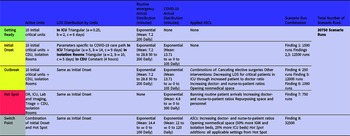
A total of 4 surge levels that correspond with changing COVID-19 pandemic conditions of the hospital’s service area are considered: Getting Ready, Initial Onset, Outbreak, and Hot Spot. Getting Ready involves ordinary operations and standards of care without pandemic patients. Initial Onset and Outbreak levels involve the integration of added care paths specific to infectious (COVID-19) patients while a hospital continues to serve routine emergency patients. The level moves from Initial Onset to Outbreak when the design and preliminary ASCs cannot support the incoming patients and additional care path modifications are required. The specifications of ASCs by surge level are given in Table 1. The Hot Spot level is necessary if pandemic patient arrivals continue to surge and prior changes and ASCs are insufficient. This Hot Spot level presumes that nearly all hospital resources are turned toward pandemic patient care and all reasonable modifications and care alternatives, including ASCs, are taken. Routine emergency patients will be turned away or even transferred out, creating a COVID-19 only care facility. Reference Goswami and Dutt11–Reference Edwards, Breitman and Kovatch13 External support will be required to create additional capacity.
COVID-19 modeling details

Systematically designed numerical experiments, findings from which are reported herein, suggest how overall hospital functionality, as well as the performance of specific hospital units, will be affected by the care of pandemic patients along specially designated care paths under changing surge levels. Details of these findings, along with insights for action as might inform policy changes or implementation, are presented in Section 3.
Plans for implementing hospital capacity enhancements to cope with the increasing demand can be made by estimating the COVID-19 patient arrival rates at which each surge level is reached. These transitions are referred to herein as switch points. This study identifies the switch points for the illustrative hospital for both increasing and decreasing cases. As surge demand recedes, modifications can be relaxed to again begin to serve routine emergency patients with usual levels of care.
The simulation framework
The base hospital model includes 10 critical units: Emergency Department (ED) including triage, Intensive Care Unit (ICU), Surgical Intensive Care Unit (SICU), Stepdown, Operating Rooms (ORs), Internal General Wards (IGW), ED Trauma, Pre-Op, Post Anesthesia Care Unit (PACU), and laboratories. The model is resource constrained and patient based. Limited resources, including doctors, nurses, and beds, are specialized and tracked. Patient care paths begin from entry to the ED and end at hospital discharge. The care path assigned to a patient is a function of the injury or illness described by an Emergency Severity Index (ESI), a validated indicator of severity and health outcome. 14 Patient treatment priorities in the model are consistent with their ESI levels and time spent waiting, and follow settings from prior works. Reference TariVerdi, Miller-Hooks and Kirsch8,Reference Paul, George and Yi15 Patient survival times are a function of time spent waiting to receive the first critical service within their care paths.
The chosen modeling approach recognizes that the functionality of a hospital and its individual units depend on interconnections between units. These dependencies are both direct, as backups in 1 unit can cascade to another, and indirect, as a consequence of overlap in patient care paths and patient resource needs.
Model details were built based on extensive interviews with the director of operations and an administrative director of ED/trauma, safety, security, and employee health services, head nurse, and others, at the Johns Hopkins Hospital, Johns Hopkins Suburban Hospital, and Johns Hopkins Office of Critical Event Preparedness and Response (CEPAR). Reference Whyme, Notobartolo and Sasenick16 Parameters that could not be obtained from these interviews were developed from national averages and values from case studies in the literature. Reference TariVerdi, Miller-Hooks and Kirsch8
In order to test the validity of the developed models, multiple numerical experiments were designed and implemented. Through experimental runs under routine conditions, model outputs were compared against averages from similar Trauma-level I and II hospitals. Unusual model behavior was investigated, refinements to model details were made and parameters were adjusted through further discussion with hospital experts. This process of model construction and verification is described in more detail by Tariverdi et al. Reference TariVerdi, Miller-Hooks and Kirsch8
Incorporating protected care paths for COVID-19 patients and the 4 surge levels
The basic hospital model was redesigned to incorporate COVID-19 care paths and accompanying work flows, special equipment including ventilators and personal protective equipment (PPE), modifications to operations including repurposing of hospital space, and the application of ASCs as employed in a typical U.S. urban tertiary hospital. Care flows and parameters specific to COVID-19 were designed from information obtained from discussion with hospital administrators and other health professionals, including nurses, personnel involved in modifications to the hospitals to change workflows, and modelers across several hospitals from early in the pandemic. As protocols and work flows changed as the pandemic progressed, specific COVID-19 patient arrival rates and related reductions in routine emergency patient arrivals were replaced with systematically chosen combinations over a range, and a generic approach to handling COVID-19 patients was adopted.
The ‘Getting Ready’ level assumes few or no COVID-19 patients. As the number of patients increase to reach the Initial Onset level, work flow changes to meet rising pandemic patient demand. To model this, COVID-19 patients are presumed to enter the hospital through a separate ED Critical Decision Unit (CDU). This protects other un-exposed ED patients. Following a probability distribution, 10% of these patients are assigned an ESI level of 1, and are sent directly to the ICU. After ED testing and observation, the remaining patients are either admitted (60% to isolation rooms) or discharged (40%). At Initial Onset and Outbreak surge levels, IGW and a limited number of ED beds are repurposed for isolation of admitted COVID-19 patients. In the test hospital model, 70 isolation beds were created from 20 ED beds and 50 IGW beds.
At low COVID-19 patient arrival rates, routine emergency patient demand is presumed. Routine emergency arrivals decrease as COVID-19 patients increase, either because patients forgo hospital visits to reduce their exposure, or because capacity for these patients is limited, creating long wait times and the potential need to turn patients away. Reference Mehrotra, Chernew and Linetsky17,Reference Vespa18 When reaching a Hot Spot surge level, almost all resources are repurposed to expand the capacity of the COVID-19 care paths; in this model, half of the ED, all IGW and Stepdown beds, and related staff are used to expand the capacity of the isolation rooms. ED beds, nurses, and doctors are also added to the ICU (Table 1).
Numerical experimental design
The hospital models were coded in Extendsim 10 (Imagine That Inc., San Jose, CA, USA), 19 a microscopic simulation platform designed for generic queueing applications. This software is highly flexible, allowing direct coding of all elements, uncertainty modeling, and the monitoring of dynamically varying performance characteristics.
In order to create generalizable findings, systematically designed numerical experiments were conducted (Table 1). Each simulation run replicated 62 days, the first 20 days of which are the warm-up period during which the simulation outputs reach a steady state. The outcomes (random variates) of random variables, each representing an activity, such as time spent by a single patient in the ED, depend on a sequence of random numbers, governed by an initial seed value given to the random number generator. Each seed begins a specific stream of random numbers and, thus, a specific realization of the random variables for which a single performance outcome (random variate) is obtained. Run again on a different seed, the simulation will produce a second performance estimate. This variability is desirable, as it allows for the occurrence of a range of situations and behaviors and can capture day-to-day variabilities seen in reality. Each run design was repeated over 250 seeds, which was chosen based on tradeoffs between confidence interval stability over the many variables and computational burden as determined from experiments with between 10 and 5000 seeds per run batch.
Note that as the study had no human data, it was exempted from Institutional Review Board review.
Results
Key findings from this analysis involving Initial Onset, Outbreak, and Hot Spot surge levels are synopsized in Table 2 and discussed in this section. For completeness, 3 relevant insights from studying the results of runs associated with the Getting Ready level in earlier works are also included in the table.
Summary of findings (Initial Onset through Switch Point findings from this work)

Initial Onset: hospital unit performance with integrated COVID-19 patient care paths
Finding 1
The hospital can serve up to 75% of its usual routine ED demand with 50% of the number of ED beds and 3-quarters the number of IGW beds retained for routine patients.
Creating isolation rooms from ED and IGW rooms for infected patients can enhance a hospital’s capacity to serve COVID-19 patients while preserving its ability to care for routine emergency patients. The results predict that with 50% of the ED beds and 75% of IGW beds available to routine patients, the hospital can serve up to 75% of its routine emergency demand with the bottleneck in the IGW. However, usual ED excess capacity is depleted due to this diversion of beds to the COVID-19 response (Figure 1).
Impact of Redesigning Hospitals on Routine Emergency Patients: IGW and ED Bed Utilization.

Finding 2
During the Initial Onset surge, a hospital may need to turn away emergency patients.
The simulation model replicates patient behaviors related to arriving, leaving without treatment (LWOT) due to long waits, waiting, and transfers. When hospitals reach their capacity for emergency or critical care, some patients will not receive treatment or the standard of care must be lowered. To avoid turning away patients, hospitals may respond by placing patients in unconventional locations or even requiring 2 patients to share a single piece of equipment (e.g., ventilator) to cope with significant backups. Reference Beitler, Mittel and Kallet20 Hence, to study the need for external support and estimate the surge level at which rationing of care may be required, simulation features were added in 5 locations within the models to account for LWOT cases: at the entry to the ED, entry to the CDU, entry to the ICU by routine (non-COVID-19) emergency patients, entry to the ICU by COVID-19 patients, and entry to the isolation rooms.
Together, the daily average routine emergency and COVID-19 patients that cannot be served in the ICU can be as high as 67% ((8.2+4.9)/ 20)) of the ICU’s total bed capacity (Figure 2). The model demonstrates that if the hospital continues to treat its usual daily 200 routine emergency patients of which 5 are admitted to the ICU, when COVID-19 patients account for 105 arrivals of which 11 are bound for the ICU, 82% of patients ((4.9+8.2)/ 16 = 0.82) would need alternative care. With such an estimate, hospitals can, in advance, repurpose space, modify operations, implement ASCs, prepare to collaborate with other health care facilities, or request external support (tents, personnel, and so forth), increasing the likelihood that all patients will receive treatment.
Impacts of Increased Daily Arrivals of COVID-19 Patients on Routine Patients Turned away from the ICU for Lack of Capacity.

Finding 3
With 25 COVID-19 and 200 routine emergency patient arrivals daily, each ICU bed serves up to 5 patients per month (that number decreases to about 3.5 as the number of COVID-19 patient arrivals increases).
The number of patients per month that an ICU bed can serve is significantly higher with fewer COVID-19 patients due to the longer average LOS required of COVID-19 patients (median of between 4 and 21 days) compared with that of routine patients (approximately 3 days on average for non-COVID-19 patients). Reference Rees, Nightingale and Jafari21,Reference Hunter, Johnson and Coustasse22 The difference is as high as 57% ((7.7 - 3.3)/ 3.3 = 0.57) for the test hospital. For routine times, for the typical daily arrival rate (200) of emergency patients, it is estimated that an ICU bed can serve up to nearly 8 patients per month.
Outbreak: Implementing ASCs or other interventions for added capacity
Finding 4
Cancelling elective surgery frees up in-patient (IGW) beds, increasing capacity for treating routine emergency patients, while simultaneously coping with the COVID-19 patient surge.
Results show that by redesigning the hospital to add a specialized care path for COVID-19 patients, the ED and larger hospital lose 30% (1107 to 770 weekly patient throughput) and 32% (1432 to 970 weekly patient throughput) capacity, respectively. Hence, to cope with periods of COVID-19 surge, hospitals have cancelled elective surgeries either by choice or mandate. 23 From run results, it is estimated that cancelling elective surgeries (75% of scheduled operations) enables the ED to serve 22% more patients (1148 instead of 970 weekly) and results in an 18% greater overall routine emergency patient throughput (943 instead of 770 weekly). It was also noted that more than 50% of the routine emergency patients (ESI level 2 - 5) who could not previously receive timely service (185 instead of 386 weekly) can be served as a consequence of the canceled surgeries.
Finding 5
Treatments that reduce COVID-19 patient intensive care LOS by a day increase a hospital’s ICU capacity by 24%.
The most at-risk COVID-19 patients require ICU care. The simulation run results indicate that each 1-day reduction in ICU LOS increases ICU patient throughput by between 9 and 24% (highest for the first day of reduction, with an overall average of 15%) in scenarios with usual emergency arrivals (200 daily arrivals of routine emergency patients) and high COVID-19 patient arrivals, i.e. 30 daily patient arrivals and higher. As expected, the greater the proportion of COVID-19 ICU patients, the greater the benefit of treatments that reduce average ICU LOS. Overall, for a wider range of 5 - 100 daily COVID-19 patient arrivals at a daily routine 200 emergency patients, the single-day reduction in ICU LOS average value ranged between 0.8 -15%. A reduction in ICU LOS by 4 - 9 days enables up to double the throughput at a 100 COVID-19 average daily arrival rate.
Finding 6
A hospital’s capacity for routine emergency and COVID-19 patients is highly dependent on the number of COVID-19 patients seeking care, as serving each COVID-19 patient requires, on average, more of the hospital’s capacity (e.g. longer LOS in the ICU) than a single routine emergency patient.
Figure 3 demonstrates the impact on ICU capacity as the percentage of COVID-19 patients increases even with a fixed total daily arrival of 200 routine emergency and COVID-19 patients. The results confirm that as the percentage of COVID-19 patients increases, more resources are needed to serve the same number of emergency patients. Under routine conditions with no COVID-19 patients, the ICU bed utilization of the test hospital is 64% on average, but with 5% of the arrivals (10 patients per day) with COVID-19, the ICU averages 92% capacity. With 10% being COVID-19 patient arrivals or, equivalently, 16% of admitted COVID-19 patients, the ICU bed utilization is 99%, a 35-percentage point increase above that of no COVID-19 patients. Isolation bed utilization (red line in Figure 3) simultaneously approaches 100% soon after the ICU reaches its maximum capacity.
ICU and Isolation Bed Utilization by COVID-19 and Routine Emergency Patient Arrival Combinations.

Hot spot: unified COVID-19 care increases capacity
Finding 7
COVID-19 designated hospitals can serve up to 5 times the number of COVID-19 patients compared with a similar facility accepting mixed patients.
This increase is accomplished by: allowing ASCs and using all the available beds, nurses, and doctors ordinarily assigned to routine patients in the IGW, pre- and post-op units, and the ED for COVID-19 patient treatment. Increases of approximately 350% and 140% in throughput were noted for the ICU and isolation rooms, respectively. This can only be improved further with additional space (i.e. beds). It is estimated that a 3-fold increase in the number of COVID-19 patients can be served without compromising standards of care. ASCs add nearly 38% improvement (Figure 4).
Hot Spot Throughput.

Switch points
Finding 8
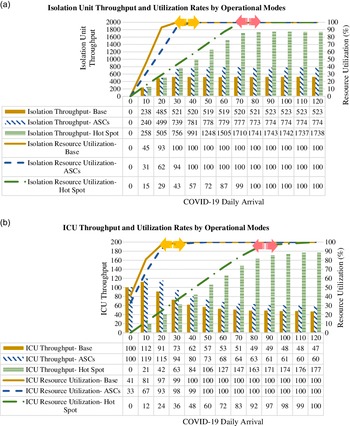
There are 2 key switch points when hospitals must introduce strategies for increasing capacity, or dedicate all resources to COVID-19 treatment to meet COVID-19 patient surge. Without such an action, it may become necessary to ration care. A hospital can prepare for action by predicting the timing of these points.
2 key switch points can aid a hospital in coping with increasing COVID-19 patient demand. The first uses ASCs, specifically increased patient-to-staff ratios and repurposing of nonmedical space, and the second designates nearly all medical space and staff for COVID-19 treatment. Implementing ASCs allows the test hospital to serve, on average, 30 COVID-19 patient arrivals per day (∼10 additional patients or 33% increase based on ICU throughput).
Dedicating the hospital to COVID-19 patients along with ASCs allows the hospital to serve an average of 40 more COVID-19 patient arrivals per day in the isolation rooms (a 133% increase) and an average of 80 more in the ICU (a 400% increase) (Figure 5). With additional negative pressure rooms for isolation and critical care nurses, the designated hospital could serve even higher numbers.
Isolation and ICU Throughput.

These estimates can help a region forecast its total COVID-19 patient response capability. By taking actions at the switch points or in advance of these points, hospitals will be prepared to meet increased COVID-19 patient arrivals at the onset of a surge and recognize tipping points where outside help or a hospital’s complete dedication to COVID-19 would become essential. Anticipating switch points as surge demand diminishes can also aid in efficiently restarting routine services that were canceled during the surge.
Limitations
The team is currently working with a significant hospital system to fully validate the COVID-19 model extensions against real-world data, a process that is expected to take another year or 2, and is complicated by inconsistencies in data collection procedures over the course of the pandemic.
The models are U.S.-centric. Modifications to hospital layouts, workflows and other details may be required to replicate operations in other countries. They were also created generically, with the aim of capturing the most important features of COVID-19 patient care. Additional details may be desired to model specific hospitals, proposals for restructuring and alternative settings to those used herein.
Discussion
Meeting the challenges of surge demand on hospitals is crucial for regional, national, and international COVID-19 response efforts. Hospital administrators and regional directors are faced with decisions whose implications depend on hospital functionality. Each hospital is a complex, dynamically changing, constrained system with interconnected work flows and users (patients) with unique needs and care paths. As hospitals in a region form an interacting, complex, dynamic priority system, it is difficult to predict the impact of any decision on hospital or regional health care performance. State-of-the-art computer simulation modeling as proposed herein can aid decision makers in meeting these challenges and avoiding circumstances where a patient in need of care is unable to find it. It also facilitates the study of individual strategies whose benefits would be difficult to isolate in reality due to confounding effects of simultaneous actions and changing circumstances.
The authors are extending the modeling capabilities developed herein to assess regional hospital capacity for coping with COVID-19 or other pandemics under varying collaboration strategies extending prior hospital coalition work. Reference Shahverdi, Tariverdi and Miller-Hooks9 Other extensions might include the study of: (1) the potential impacts of changing strategies on special patient populations by segmenting the routine patient stream into multiple classes; (2) the effects of limited PPE by restricting the PPE resource and requiring its use whenever a staff member is assigned to a patient (currently modeled, but with infinite PPE supplies); and (3) nurse, doctor, or technician absenteeism, the probability of which might increase with increasing number of patient contacts, and/or limited PPE availability, or decrease when suggested interventions are taken.
Conclusions
This paper fills several critical gaps in literature for assessing the utility of possible hospital preparedness and response actions to the COVID-19 pandemic. Other works have studied hospital operations for more general applications. Reference Zhang6 These works focus primarily on 1 hospital function (e.g., operations), Reference Luo, Liu and Liao24 or a single hospital unit (e.g., laboratory Reference Kadı, Kuvvetli and Çolak25 ; ED Reference Duguay and Chetouane26–Reference Cimellaro, Malavisi and Mahin28 ; radiology Reference Luo, Zhang and Qing29 ; OR Reference Wang, Roshanaei and Aleman30 ; or ICU). Reference Hasan, Bahalkeh and Yih31 The authors are not aware of any works that take a similar whole-hospital approach. With few exceptions, Reference TariVerdi, Miller-Hooks and Kirsch7–Reference Shahverdi, Tariverdi and Miller-Hooks9 prior works have not taken patient-based and resource-constrained perspectives. A couple of works consider emergency situations. For example, Yi et al. Reference Yi, George and Paul32 used simulation and a regression model for capacity planning of hospitals under earthquake or other hazard events. Hospital capacity is presumed to be sufficient for any event.
5 specific interventions and 2 critical shifts in care strategies were identified that can potentially significantly increase hospital capacity for routine emergency and COVID-19 patients during a pandemic. Estimates and considerations presented in this paper inform hospitals in repurposing space, modifying operations, implementing crisis standards of care, and requesting external support, thus, increasing the likelihood that arriving patients, both routine emergency and pandemic, can be served. This type of predictive modeling can be critical to assist with planning for future epidemics.
Funding statement
This work was funded by National Science Foundation grant 2027624 and the World Bank Group. This support is gratefully acknowledged, but implies no endorsement of its findings.