Introduction
It is well established that manic and depressive symptoms combine in many ways in persons with bipolar disorder, and when they combine there are important diagnostic and treatment implications.Reference Kraepelin 1 – Reference Perugi, Quaranta and Dell’Osso 9 Various terms have been used to describe such combinations of manic and depressive symptoms. In this article, we attempt to define and discuss 3 of these terms: dysphoric mania, mixed state, and mania with mixed features specifier.
Dysphoric Mania
As the precise meaning of dysphoria is unclear, so is the meaning of the term dysphoric mania. In its glossary, the Diagnostic and Statistical Manual of Mental Disorders, Fifth Edition (DSM-5) 10 defines dysphoria as “a condition in which a person experiences intense feelings of depression, discontent, and in some cases indifference to the world around them” (p 821). Using this definition of dysphoria, dysphoric mania is simply another term for mania with prominent depressive symptoms, also called mixed mania, depressive mania, or, in DSM-5, mania with mixed features.
However, the term dysphoria is also used more broadly to denote unpleasant, negative, or uncomfortable affective states beyond depression.Reference Swann 11 , Reference Starcevic 12 Webster’s Third New International Dictionary 13 defines dysphoria as a “generalized state of feeling unwell or unhappy,” as “opposed to euphoria” (p 712). Medical dictionaries have defined dysphoria as “a mood of general dissatisfaction, restlessness, depression, and anxiety; a feeling of unpleasantness or discomfort” 14 ; “an emotional state marked by anxiety, depression, and restlessness” 15 ; or “a disorder of affect characterized by depression and anguish.” 16 Indeed, SwannReference Swann 11 said dysphoria “can refer to many ways of feeling bad” (p 325). Using this meaning of dysphoria, dysphoric mania refers to unpleasant mania or mania accompanied by negative or painful mood states such as irritability, anger, or anxiety, as well as depression. Dysphoric mania would thus include mixed (depressive) mania, as well as paranoid-destructive mania, irritable mania, and anxious mania. An advantage to this use of the term dysphoric mania is that it stresses that mania is often an unpleasant condition, and that the nature of the unpleasantness is highly variable. In other words, depression is not the only unpleasant mood state that occurs in mania. For example, Cassidy et al Reference Cassidy, Forest, Murry and Carroll 17 rated 237 patients with Diagnostic and Statistical Manual of Mental Disorders, Third Edition Revised (DSM-III-R)-defined bipolar manic or mixed episodes on 15 classic features of mania and 5 related to dysphoric mood, and identified 5 clinically interpretable factors. The first and strongest factor represented dysphoric mood and included depressed mood, anxiety, guilt, mood lability, and suicide. The other 4 factors were psychomotor pressure, psychosis, increased hedonic function, and irritable aggression.
However, several authors have conceptualized dysphoria as a “third possibility of mood swing,” a “third emotional field,” or a “third dimension” in addition to mania and depression, and defined it as “a morose, tense, and irritated mood.”Reference Starcevic 12 , Reference Berner, Musalek and Walter 18 – Reference Bertschy, Gervasoni and Favre 20 Dayer et al Reference Dayer, Aubry, Roth, Ducrey and Bertschy 19 argued that dysphoria was a combination of irritability and aggression, and proposed the dysphoric syndrome be defined as the presence during at least 24 hours of overt irritability with 2 of the following 4 criteria: expressed (subjective) internal tension; expressed (subjective) irritability or feelings of hostility in reaction to external stimuli; aggressive or destructive behaviors; and suspiciousness. StarcevicReference Starcevic 12 argued that dysphoria was “a complex emotional state, consisting of intense unhappiness and irritability” (p 12). Bertschy et al Reference Bertschy, Gervasoni and Favre 20 defined dysphoria as 3 of the following 4 symptoms: inner tension, irritability, aggressive behavior, and hostility. They evaluated the presence of dysphoria in 165 patients hospitalized for Diagnostic and Statistical Manual of Mental Disorders, Fourth Edition (DSM-IV)-defined 21 manic or major depressive episodes and found that when defined this way, dysphoria occurred in 17.5% of the group with pure depression, 22.7% of the pure mania group, and 73.3% of the mixed episode group. The rate of dysphoria increased from 14.3% to 69.2% (p=0.057) when the member of depressive symptoms in manic patients increased from 2 to 3. The authors concluded that dysphoria is strongly, but not necessarily, associated with mixed states, for which it might serve as a marker.
Dilsaver et al Reference Dilsaver, Chen, Shoaib and Swann 22 suggested that dysphoric mania was a third type of manic episode, distinct from euphoric mania and depressive mania. They conducted a factor analysis of 37 behavior rating items from the Schedule of Affective Disorders and Schizophrenia in 105 inpatients meeting DSM-III-R 23 criteria for mania; 57 (54%) patients had a clinical diagnosis of mixed mania while 48 (46%) had non-mixed mania. Four factors were found, described as manic activation, depressed state, sleep disturbance, and irritability/paranoia. Cluster analysis separated the patients into 2 groups that differed with respect to depressed mood. Forty-five (94%) of the patients with non-mixed mania and 30 (53%) of the patients with mixed mania were in the manic-activation cluster, while 27 (47%) mixed and 3(6%) non-mixed patients were in the depressed-state cluster. Non-mixed patients from the manic-activation cluster appeared to be experiencing predominantly euphoric-grandiose manic episodes; they had low scores for depressed state and irritability/paranoia. Patients in the depressed-state cluster appeared to be experiencing depressive mania and had high scores for all factors. Clinically mixed patients from the manic-activation cluster, however, differed from non-mixed patients by having lower scores for manic activation and higher scores for depressed state and irritability/paranoia. They differed from depressed-state cluster patients by having lower scores for both depression and mania. The authors concluded that there were 3 types of manic episodes: pure or euphoric mania, depressive mania, and dysphoric mania. In the latter subtype, mania scores were lower than those in the other 2 subtypes, while depression scores were intermediate.
An important caveat is that many of these studies were cross sectional, and naturalistic studies have suggested that an individual manic episode has different levels of severity over time. In a study evaluating 20 patients who had at least 1 complete manic episode in which they proceeded from a normal or depressed mood state through mania, returned to a normal or depressed state, and were often off medication, Carlson and GoodwinReference Carlson and Goodwin 24 documented 3 stages of mania. Mood was qualitatively different during these 3 stages, being predominantly euphoric in Stage 1, predominantly angry and irritable in Stage 2, and extremely dysphoric, with panic-level anxiety, in Stage 3. Importantly, as manic episodes progressed, ratings of mania and dysphoria (and psychosis) increased in parallel. In cross-sectional studies of the phenomenology of mania, therefore, mood differences might be due to the stage of mania rather than episode subtype.
Mixed State
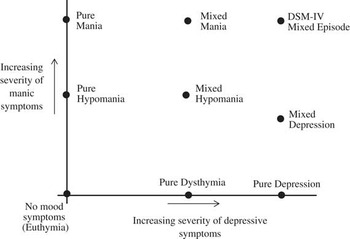
Mixed state is a broad term that connotes some combination of manic/hypomanic and depressive symptoms occurring together over a period of time.Reference Kraepelin 1 , Reference Goodwin and Jamison 5 , Reference Swann, Lafer and Perugi 7 – Reference Perugi, Quaranta and Dell’Osso 9 Alternatively, mixed states are conditions resulting from the combination of 2 dimensions, a manic dimension with a depressive dimension (see Figure 1). The term mixed state is often used as the opposite of pure state,Reference Winokur, Clayton and Reich 2 , Reference Cassidy, Yatham, Berk and Grof 6 which means the occurrence of only 1 dimension over a period of time—of only manic/hypomanic symptoms or of only depressive symptoms.
Two Dimensional Model of Mixed States.

More precise definitions of mixed states vary regarding the number and type of required manic and depressive symptoms, the temporal relationship between manic and depressive symptoms (occurring simultaneous and/or rapidly alternating), and the duration of co-occurrence. Thus, in DSM-III, 25 DSM-III-R, 23 and DSM-IV, 21 there was only 1 type of mixed state, each requiring at least 5 symptoms of a major depressive episode during a full manic episode. In DSM-III, mixed bipolar disorder was defined as the current or most recent episode involving “the full symptomatic pictures of both manic and depressive episodes,” with the depressive symptoms being “prominent” and lasting “at least a full day” (p 217). 25 In DSM-III-R, mixed bipolar disorder was similarly defined, except the depressive symptoms did not have to occur for 2 weeks and the manic and depressive symptoms were “intermixed or rapidly alternating every few days” (p 226). 23 In DSM-IV, a mixed episode was defined as “a period of time (lasting at least 1 week) in which the criteria are met for a both a Manic Episode and for a Major Depressive Episode nearly every day” (p 333). 21 In DSM-5, 10 3 types of mixed states are recognized based on coupling episode type with the mixed features specifier: a manic episode with mixed features, a hypomanic episode with mixed features, and a depressive episode with mixed features. There are 4 mixed states if mixed depression is further categorized as bipolar or unipolar. Mixed features, in turn, are defined as at least 3 of 6 specific depressive symptoms for mania and hypomania, and at least 3 of 7 specific manic/hypomanic symptoms for depression (see below). These “opposite polarity” symptoms must be “present during the majority of days” of the episode.
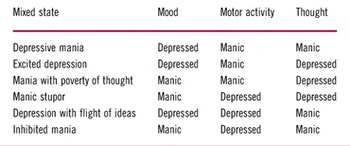
In contrast, KraepelinReference Kraepelin 1 defined 6 mixed states according to increases (excitation) or decreases (inhibition) in 3 psychological dimensions (mood, thought, and activity), and differentiated them from pure states, where mood, thought, and activity were all increased or excited (mania) or all decreased or inhibited (depression). According to his classification, there were 6 different types of mixed states: depressive or anxious mania, excited depression, unproductive mania, manic stupor, depression with flight of ideas, and inhibited mania (see Table 1). In later work, Kraepelin and his apprentice Wilhelm Weygandt extended this three-dimensional model of the psyche to a multidimensional one, and broadened the concept of mixed states to “the infinite possibilities” of the co-existence of manic and depressive symptoms.Reference Maina, Bertetto, Domene Boccolini, Di Salvo, Rosso and Bogetto 8 That there are in fact an infinite number of mixed states seems possible when looking at Figure 1: every possible point of intersection between a mania dimension and a depression dimension could reflect a discrete mixed state.
Kraepelinian definitions of mixed states

However, there is disagreement in the field as to how much depression or how many depressive symptoms are needed for a manic episode to be mixed. Thus, most authors do not view mania with 1 symptom of depression (even if it is suicidal ideation) as a mixed state.Reference Dilsaver, Chen, Swann, Shoaib and Krajewski 26 Some have argued that the presence of 2 depressive symptoms is enough for a mixed state, as mania with at least 2 depressive symptoms, as compared to mania with no depressive symptoms or 1 depressive symptom, has been associated in some studies with female preponderance, lower frequency of core manic symptoms, higher prevalence of psychotic features, and better response to valproate over lithium.Reference Akiskal, Hantouche and Bourgeois 27 – Reference Swann, Bowden and Morris 30 Our group,Reference McElroy, Keck, Pope, Hudson, Faedda and Swann 3 Swann et al,Reference Swann, Steinberg, Lijffijt and Moeller 31 and DSM-5 10 have argued that the number of depressive symptoms required for a manic episode to be definitely mixed should be at least 3. Our group further suggested that mania with 2 depressive symptoms could be considered probable mixed mania, while mania with 1 depressive symptom be considered possible mixed mania.Reference McElroy, Keck, Pope, Hudson, Faedda and Swann 3
There is also disagreement as to which particular depressive symptoms may count toward a mixed state. Some proposed definitions of mixed states suggest that only certain core depressive symptoms be allowed to count toward a mixed manic state. Our group proposed that mixed mania be defined as mania with 3 or more of the following: depressed mood; markedly diminished interest or pleasure in all, or almost all, activities; substantial weight gain or increase in appetite; hypersomnia; psychomotor retardation; fatigue or loss of energy; feelings of worthlessness or inappropriate guilt; feelings of helplessness or hopelessness; or recurrent suicidal ideation, a suicide attempt, or a specific plan for committing suicide.Reference McElroy, Keck, Pope, Hudson, Faedda and Swann 3 We proposed not to include insomnia, reduced appetite, psychomotor agitation, or diminished ability to concentrate because of the difficulty in reliably determining if these symptoms are primarily manic or depressed. As discussed later, a manic episode with mixed features is defined in the DSM-5 as syndromal mania with at least 3 of the following symptoms: prominent dysphoria or depressed mood; diminished interest in all, or almost all, activities; psychomotor retardation; fatigue or loss of energy; feelings of worthlessness or excessive or inappropriate guilt; and recurrent thoughts of death, recurrent suicidal ideation, a suicide attempt, or a specific plan for committing suicide. 10 In contrast, Cassidy et al Reference Cassidy, Ahearn, Murry, Forest and Carroll 28 evaluated 237 manic patients and identified the following 6 symptoms as best defining mixed bipolar episodes: depressed mood, anhedonia, guilt, suicide, fatigue, and anxiety. Thus, criteria sets for mixed episodes usually include depressed mood, anhedonia, fatigue, and suicidal ideation but differ regarding inclusion of anxiety and changes in appetite or weight.
Yet another unresolved issue is how severe a particular depressive symptom must be in ordered to be considered present in mania. McIntyre et al Reference McIntyre, Tohen, Berk, Zhao and Weiller 32 conducted a post-hoc analysis in 900 bipolar manic patients using different levels of severity (mild, moderate, and severe) of certain Montgomery–Åsberg Depression Rating Scale (MADRS) and Positive and Negative Symptom Scale (PANSS) items as a proxy for DSM-5 with mixed features. They found that rates of mixed features decreased as required severity of depressive symptoms increased. Specifically, 34%, 18%, and 4.3% of manic patients had 3 or more depressive symptoms of mild, moderate, and severe intensity, respectively.
But this leaves many unanswered questions. Is 1 depressive symptom during mania enough to be a mixed state if it is severe and clinically relevant, such as suicidal ideation or delusional guilt?Reference Dilsaver, Chen, Swann, Shoaib and Krajewski 26 Should other negative or uncomfortable symptoms that often occur with depression, but are not necessarily considered “core” depressive symptoms, be allowed to count toward a mixed state, such as irritability, anxiety, obsessions, panic attacks, hypochondriasis, or binge eating? In other words, should mixed states denote the co-occurrence of discordant psychiatric target symptoms, such as manic symptoms with anxiety, eating, or impulse control disorder symptoms, as well as core depression symptoms?
This in turn raises the question of what exactly is a manic versus a depressive symptom. Like the term bipolar, the term mixed implies that manic and depressive symptoms differ and are even polar opposites. Some manic and depressive symptoms do in fact appear to be polar opposites, such as euphoria versus sadness, increased energy versus fatigue, increased interest and motivation versus anhedonia and reduced motivation, increased sex drive versus decreased sex drive, elevated self-esteem or grandiosity versus reduced self-esteem or feelings of worthlessness, racing thoughts versus slow thoughts, and reduced need for sleep versus hypersomnia. These polar opposite symptoms are often viewed as core symptoms specific to mania (elevated or euphoric mood, increased energy, grandiosity, and increased sex drive) or depression (depressed mood, anhedonia, low energy, hopelessness, guilt, and suicidality). However, there is considerable overlap between manic and depressive symptoms. Indeed, manic and depressive symptoms are generally positively correlated in persons experiencing both sets of symptoms.Reference Cassano, Rucci and Frank 33 , Reference Bauer, Simon, Ludman and Unutzer 34 Symptoms that occur in both mania and depression to considerable degrees are irritability, anxiety, impaired thinking or concentration, psychomotor agitation, and insomnia. As a result, these symptoms are sometimes referred to as nonspecific symptoms. Few definitions of mixed states include these symptoms, but they are often included in definitions of dysphoric mania. Mixed states, however, are frequently characterized by these symptoms, especially irritability, anxiety, and psychomotor agitation.Reference Swann, Lafer and Perugi 7 , Reference Cassidy, Ahearn, Murry, Forest and Carroll 28 , Reference Cassidy and Carroll 35 , Reference Singh, Bowden and Gonzalez 36 For example, Cassidy et al Reference Cassidy and Carroll 35 rated 316 bipolar inpatients with mania or mixed episodes on 20 signs and symptoms, and found dysphoric mood, mood lability, anxiety, guilt, suicidality, and irritability to be more common in the mixed versus the manic group. Indeed, several authors have argued that anxiety is a core symptom of mixed mania.Reference Singh, Bowden and Gonzalez 36 , Reference Cassidy 37
A mixed state, therefore, may not be 1 unique condition but rather a group of heterogeneous clinical entities that vary according to the selected defining criteria. Different mixed states can be distinguished as to preponderance of manic or depressive symptoms, or as Kraepelin postulated, different combinations of manic (or excited) versus depressive (or inhibitory) mood, motor activity, or thought. In the first model, there are at least 2, and possibly 3, mixed states: syndromal mania with subsyndromal or syndromal depressive symptoms; syndromal depression with subsyndromal manic symptoms; and the combination of subsyndromal manic and subsyndromal depressive symptoms. In Kraeplinian models, there are at least 6 mixed states and perhaps an infinite number.
Mania with Mixed Features Specifier
A manic episode with mixed features is defined in the DSM-5 as a full manic episode with at least 3 of the following depressive symptoms present during the majority of days of the manic episode: prominent dysphoria or depressed mood; diminished interest in all, or almost all, activities; psychomotor retardation; fatigue or loss of energy; feelings of worthlessness or excessive or inappropriate guilt; and recurrent thoughts of death, recurrent suicidal ideation, a suicide attempt, or a specific plan for committing suicide. 10 , Reference Vieta and Valenti 38 , Reference Verdolini, Agius, Ferranti, Moretti, Piselli and Quartesan 39 The occurrence of mania with syndromal depression is considered a manic episode with mixed features, rather than a depressive episode with mixed features (as in DSM-5) or a mixed episode (as in DSM-IV).
Several empirical studies have compared prevalence rates of DSM-5 mania with mixed features with DSM-IV mixed bipolar disorder. Shim et al Reference Shim, Woo and Bahk 40 reviewed the medical records of 331 inpatients with bipolar I disorder, bipolar II disorder, or bipolar disorder not otherwise specified by DSM-IV criteria and reclassified them into 4 groups based on the DSM-5 definition of mixed features. Rates of DSM-5 mixed episodes were threefold higher than DSM-IV mixed episodes. McIntyre et al Reference McIntyre, Soczynska and Cha 41 evaluated 255 patients with bipolar I disorder and found that 20.4% had mania/hypomania with mixed features compared with 12.9% meeting criteria for a DSM-IV-defined mixed episode. Thus, as expected, both studies found that DSM-5 mania with mixed features was more common than DSM-IV mixed bipolar disorder.
Several studies have empirically compared manic patients with and without the DSM-5 mixed feature specifier. Vieta et al Reference Vieta, Grunze, Azorin and Fagiolini 42 gave an online survey consisting of a 54-item questionnaire to 700 people with bipolar disorder to examine the phenomenology of mania, including 4 of the 6 DSM-5-defined mixed features. During a past manic episode, 39% participants reported 3 or more DSM-5 depressive symptoms. Patients with at least 3 depressive symptoms had a markedly lower prevalence of typical manic manifestations and greater anxiety associated with irritability/agitation. Tohen et al Reference Tohen, McIntyre, Kanba, Fujikoshi and Katagiri 43 pooled data from 3 placebo-controlled studies of olanzapine in 447 bipolar I patients with manic or mixed episodes. Patients were re-categorized into those with (28%) or without (72%) DSM-5 mixed features, determined by an item score ≥ 1 on 3 or more of 6 Hamilton Depression Rating Scale (HAM-D) items. Compared with non-mixed patients, mixed patients had higher total HAM-D scores and earlier age of onset, and were more likely to meet DSM-IV criteria for a mixed episode, have a rapid-cycling course, and were more likely to be Caucasian. They had similar total Young Mania Rating Scale (YMRS) scores and rates of psychotic features. Young and EberhardReference Young and Eberhard 44 evaluated 1035 bipolar patients with a manic episode, and found that 34% met criteria for DSM-5 mixed features. Bipolar manic patients with mixed features had more severe symptoms of anxiety, irritability, and agitation, and a higher incidence of suicide attempts compared with patients with 2 or fewer depressive symptoms. Reinares et al Reference Reinares, Bonnín Cdel and Hidalgo-Mazzei 45 found that 27% of 169 adult patients with mania had DSM-5 mixed features. Number of episodes and rates of suicidal ideation, rapid cycling, and personality disorders were greater in mixed patients. Seo et al Reference Seo, Wang, Jun, Woo and Bahk 46 retrospectively assessed 334 hospitalized bipolar patients and found the presence of DSM-5 mixed features to be strongly related to suicidal behavior. Finally, 2 studies performed post hoc pooled analyses exploring the presence of DSM-5 mixed features and pharmacotherapy response. In the first,Reference Tohen, McIntyre, Kanba, Fujikoshi and Katagiri 43 olanzapine was superior to placebo for reducing manic symptoms in manic patients with and without mixed features. In the second,Reference McIntyre, Tohen, Berk, Zhao and Weiller 32 a pooled analysis of 960 patients with bipolar mania showed that increasing baseline severity of depressive features was associated with poorer outcome for olanzapine and placebo but remained stable for asenapine. All of these studies concluded that their findings supported the validity of the DSM-5 mixed features specifier.
Virtually every symptom of depression can occur in mania. The DSM-5 does not provide a rationale for why certain depressive symptoms were not included in the mixed features specifier for mania (or hypomania). Thus, significant weight loss or weight gain, decreased or increased appetite, and insomnia or hypersomnia were not listed as potential mixed symptoms, even though they are criteria for the diagnosis of a depressive episode. Perhaps these symptoms were considered nonspecific or non-polar opposite symptoms, but empirical data to support this possibility are lacking. Indeed, MalhiReference Malhi 47 has argued that the symptoms of the DSM-5 mixed features specifier are themselves nonspecific. Moreover, DSM-5 has other specifiers that contain primarily depressive symptoms, including melancholic and atypical features. While atypical features can be applied only to a major depressive episode, this is not the case for melancholic features, which include depression that is regularly worse in the morning, marked psychomotor agitation, and significant anorexia or weight loss. As these symptoms are not included in the mixed features specifies, it is possible that a patient can have mania with melancholic features and not meet criteria for mixed features.
The DSM-5 mixed feature specifier also does not capture the importance of anxiety as a core symptom of mixed states. Rather, there is a separate specifier for “anxious distress,” which is to be used if 2 of the following 5 symptoms are present: feeling keyed up or tense, feeling unusually restless, difficulty concentrating because of worry, fear that something awful will happen, and feeling like the individual will lose control of him- or herself (p 149). Thus, although mania with 2 depressive symptoms and 1 anxious distress symptom might best be viewed clinically as a mixed state, it would not be classified as such by DSM-5.
Therefore, instead of specifying a certain number of certain types of depressive symptoms be present, it might be better to use scales, including self-report tools, to measure severity of depressive (and other unpleasant) symptoms in patients with mania—without regard to whether symptoms are primarily manic or depressed.Reference Bauer, Whybrow, Gyulai, Gonnel and Yeh 48 – Reference Cassidy, Ahearn and Carroll 50 In one study, 94 inpatients with DSM-IV-defined mania were evaluated with the HAM-D and the self-rated Carroll Depression Scale.Reference Cassidy, Ahearn and Carroll 50 Self-rated depressive symptoms were highly concordant with observer-rated depressive symptoms. Eight dysphoric symptoms discriminated mixed from pure episodes on both scales: depressed mood, pathological guilt, suicidal tendency, anhedonia, psychomotor agitation, psychic anxiety, somatic anxiety, and general somatic symptoms (fatigue). The authors concluded that patient self-report rating was another way to recognize depressive symptoms during mania.
Conclusion
The terms dysphoric mania, mixed state, and mania with mixed features are overlapping constructs that have subtle yet important differences. All describe the co-occurrence of manic and depressive symptoms. Dysphoric mania can refer to mania with prominent depression (or mania with mixed features) or mania that is unpleasant due to irritability, anxiety, or depression—depending on how the term dysphoria is defined. Mixed state is a broad term that usually means a period of mood disturbance that has some combination of manic or depressive symptoms. Most descriptions of mixed states argue that there are there are different types. By contrast, mania with mixed features (according to DSM-5) is a manic episode with at least 3 of 6 specified depressive symptoms; it is a type of mixed state, another term for depressive mania, and depending on the definition of dysphoria, is also another term for dysphoric mania. However, it does not necessarily encompass other types of unpleasant mania, such as mania with prominent irritability and/or anxiety.
Some have argued that the DSM-5 mixed feature specifier represents a nosological advance and that more people with mixed states will be properly diagnosed. Though it may be an advance over DSM-IV, it is not necessarily an advance over historical (ie, Kraeplinian) conceptualizations of mixed states. Moreover, the definition of both a manic episode and hypomanic episode in DSM-5 is narrower than in DSM-IV because “persistently increased goal-directed activity or energy” (p 124) is required, as well as elevated, expansive, or irritable mood.Reference Angst 51 Retrospective analyses have found higher rates of mania with mixed features than DSM-IV mixed bipolar disorder, which suggests that the DSM-5 mixed specifier will enable proper diagnosis of more patients.Reference Shim, Woo and Bahk 40 , Reference McIntyre, Soczynska and Cha 41 However, these studies did not re-evaluate whether their bipolar patients’ abnormal moods were also associated with increased goal-directed activity or energy. Thus, by requiring an extra stem criteria for mania/hypomania, it is unknown if the DSM-5 mixed features specifier will in fact lead to greater recognition of mixed manic states. Conversely, it has been argued that DSM-IV mixed symptoms are nonspecific and will lead to falsely elevated diagnosis of mixed states and additional diagnostic uncertainty.Reference Malhi 47
Great strides have been made in recognizing, describing, and defining mixed states. The DSM-5 mixed features specifier is likely a step forward, but further empirical study is essential and further refinement is likely. Potential limitations of the DSM-5 mixed features specifier are that they do not account for data showing that 2 symptoms of depression are enough to differentiate mixed from manic states, and that key symptoms, such as anxiety, are not included. Perhaps the 2 most important concepts are that mania and depression are not polar opposite states which can combine in various ways, and that mania, like depression, is often unpleasant, and can be unpleasant in a variety of ways. The attempt to define a mixed state, therefore, should not become so precise that it becomes artificial and excludes the innumerable mixed states that occur in nature. Indeed, Akiskal et al Reference Akiskal, Hantouche and Bourgeois 27 noted that depression during mania ran “along a spectrum that is without firm cutoffs” (p 182).
Disclosures
Susan McElroy reports personal fees from Bracket, personal fees from F. Hoffmann-La Roche, Ltd., grants and personal fees from Myriad, grants and personal fees from Naurex, personal fees from Novo Nordisk, grants and personal fees from Shire, grants and personal fees from Sunovion, grants from Agency for Healthcare Research & Quality (AHRQ), grants from Alkermes, grants from Cephalon, grants from Forest, grants from Marriott Foundation, and grants from Takeda Pharmaceutical Company Limited, outside of the submitted work. Paul Keck reports personal fees from Merck, personal fees from ProPhase, grants and personal fees from Shire, personal fees from Supernus, and grants from Marriott Foundation, outside of the submitted work.