THE 1831 EXCAVATION
Dr James Raine (1791–1858) excavated St Cuthbert’s tomb in Durham Cathedral in 1827.Footnote 1 The spectacular discoveries of that controversial investigation no doubt then encouraged him to turn his attention to Bede’s tomb in the Galilee chapel. In 1830 workmen dismantled the table tomb down to pavement level and then – with his well-honed sense of dramatic timing – Raine excavated the grave beneath on the anniversary of Bede’s death on 27 May 1831. His report was published in 1833 as part of a history of the cathedral building, and this information can be supplemented by a draft of its text, which is contained in Raine’s autograph annotations to his earlier book on St Cuthbert.Footnote 2
According to Raine, when he opened Bede’s tomb he found human bones that:
Although by no means furnishing the full complement of those belonging to a perfect skeleton, appeared nevertheless to have been purposely arranged in their respective places, in a coffin of the full size, of which, though in a very decomposed state, there were numerous traces. 1. The palvarium, tolerably perfect, consisting of the os frontis and the ossa parietalia, the former so remarkably flat (still more so than that of Cuthbert above) that a cast was made of the whole bone before its re-internment. 2. The ossa temporalia and portions of the bones of the basis of the scull. 3. The lower jaw, apparently that of a man advanced in years, who had lost the greater part of his teeth at an early age. The cavities from which the teeth had fallen had disappeared in the bone, so that a considerable portion of time must have intervened between that period and the death of the individual to whom the jaw had belonged. 4. A portion of the malar bones. 5. The heads of both the humeri. 6. The radius and ulna of one fore-arm. 7. The os humeri of the other. 8. A portion of the sternum. 9. The thigh bones. 10. Eight bones of the tarsi of the feet. The above bones were found, as we have already stated, stretched along a space of nearly six feet in length, and that the grave had contained no other human remains was proved by very careful excavation.Footnote 3
THE CASTS
This published record refers to Raine’s commissioning of a single cast of the palvarium (recte: the calvarium), or the upper part of the skull cavity, including the brow. Other elements of the skull (nos 2–4 in Raine’s list) were reinterred with the limb bones (nos 5–10) without a cast or other record being made of them. Derivative accounts, such as those published in 1834 and 1860, also refer to ‘a’ or ‘the’ cast, in the singular.Footnote 4 But Raine’s autograph draft report of the excavations shows that, in fact, three casts of the calvarium were subsequently taken from a master mould:
During the time the grave was open I obtained a perfect cast of the Calvarium or front part of the scull which was of the most peculiar formation
For a mould & three casts from St Bede’s scull
s d
0–8–4½
G. Robson Plasterer.Footnote 5
Of these three casts, one is readily traceable through part of its subsequent history. The Accessions Register of the Society of Antiquaries of Newcastle shows that the Revd James Raine presented a cast of the skull to the Society on 7 February 1859.Footnote 6 It presumably reached the Antiquaries as a consequence of the death of Dr James Raine the elder in 1858, for the timing of the gift significantly coincides with the month in which his library at Crook Hall was sold.Footnote 7 After its donation, however, there is no subsequent trace of the cast’s fate; it was certainly not listed among the Society’s holdings when they were transferred to the new museum at Newcastle University in 1962.
With the loss of the Newcastle cast, a review of ‘Bede’s bones’ in 2001 concluded that ‘there is now no visible trace of Bede’s body or his relics’.Footnote 8 However, one of the other two casts made for Raine in 1831 has recently emerged from the Duckworth Laboratory collection in the Leverhulme Centre for Human Evolutionary Studies at the University of Cambridge.
The Duckworth cast
The Duckworth cast of Bede’s skull survives as part of a collection of crania that was made between 1847 and 1872 by the medical doctor and antiquary, John Thurnam MD, FRCP, FSA (1810–73). Thurnam’s collection comprises twenty-five plaster casts and 280 crania obtained from archaeological and ethnographic contexts, and survives largely complete in the Duckworth Laboratory along with two copies of the catalogue made under his direction.Footnote 9 The ‘reputed calvarium of the Venerable Bede’ is no. 4 in Thurnam’s collection of plaster casts, and his catalogue notes that it had been ‘presented by the late Rev. James Raine’.Footnote 10 It could have been an early addition to his collection; Thurnam worked in York from 1838 to 1849, before moving south to become medical superintendent of the Wiltshire County Asylum in Devizes, Wilts, which opened in 1851.Footnote 11 This complements the recorded excavation dates of the first few items in Thurnam’s collection of original crania (nos 1–12), all of which came from sites in northern England that had been opened before 1850; thereafter the majority of skulls and artefacts that he acquired came from excavations in Wessex, closer to his new home in Wiltshire.Footnote 12
Annotations to a bookplate at the front of the primary copy of Thurnam’s catalogue show that the ‘collection of skulls, chiefly obtained by excavation during 25 years, 1847–72, by or with the aid of John Thurnam’, was presented to the University of Cambridge by Sir George M Humphry (1820–96), Professor of Anatomy 1866–83, and then of Surgery. Humphry was a noted collector of specimens for the museum of anatomy and surgical pathology in Cambridge, and it was doubtless through his efforts that Thurnam’s collection of skulls was acquired for the university.Footnote 13 The catalogue frontispiece notes that: ‘A fair copy of this catalogus was made under the direction of Dr Thurnam and sent with the crania’, suggesting that Humphry may have acquired the collection shortly before Thurnam’s death in September 1873. Below this, the same hand records that ‘This [ie the primary copy of the] catalogus was sent by his son Mr F. W. Thurman after Dr Thurman’s death in 1873’.
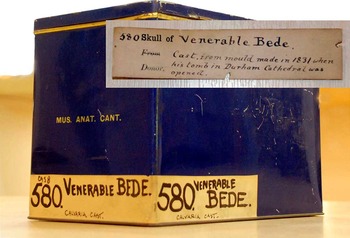
Thurnam’s collection of skulls was subsequently incorporated within the collection of ‘Crania and Cranial Bones in the [Anatomy] Museum of Cambridge University’, where they were catalogued for Alexander MacAlister (1844–1919) who succeeded Humphry as Professor of Anatomy in 1883, and who was also a noted antiquary and FSA. The cast of Bede’s skull is no. 580 in the MacAlister catalogue, and this number corresponds to that on the blue rectangular tin box in which the cast is still kept, and with a label stuck on the front of the cast itself (figs 1 and 2).Footnote 14 A label within the box reads ‘580. Skull of Venerable Bede. Cast from mould made in 1831 when his tomb in Durham Cathedral was opened’. The MacAlister collection was transferred in 1968 from the Department of Anatomy to the Department of Physical Anthropology, and moved thence to the reference collections of the Duckworth Laboratory that became part of the Leverhulme Centre for Human Evolutionary Studies, established in new premises on Fitzwilliam Street, Cambridge, in 2000.
The storage box for the cast of the skull of Bede and its accession label (Cambridge, Duckworth Laboratory, MacAlister catalogue, no. 580). Photograph: J Story

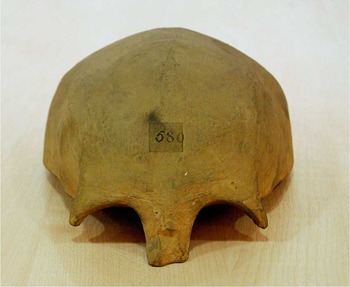
Front view of the cast of the skull of Bede, numbered 580. Photograph: J Story

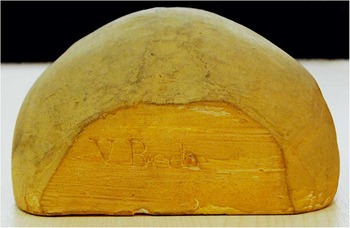
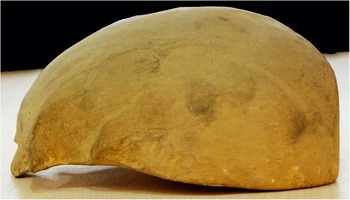
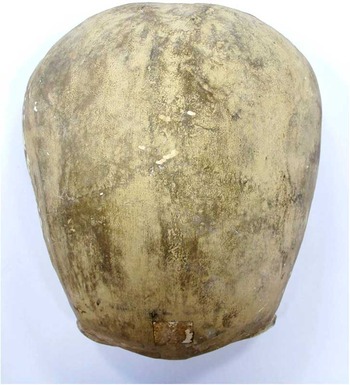
The Duckworth cast is readily identifiable; the back of the cast is truncated and the letters ‘V. Beda’ are inscribed on the flat surface (fig 3). It consists of the upper part of the cranium only, comprising all of the os frontale, both ossa parietalia and the upper parts of the temporal bones at the side of the head, as well as the upper part of the nasal bone. However, the quality of the cast is far below the technical standards required by modern science and, since it is also an incomplete record of the original skull (preserving only the shape of its upper part), areas crucial for osteological evaluation of sex – such as the nuchal crest and mastoid processes – are missing. Skulls often exhibit a mosaic of male and female features and, even when complete, estimates of the sex are considered to be only about 85 per cent reliable.Footnote 15 The sloping forehead and rather pronounced temporal lines of this specimen are male features, although it lacks a prominent glabellar region (the area between the eyes and above the nose). Age also has a significant effect on the morphology of the adult human skeleton, including the skull, especially if teeth have been lost, making older male skulls often appear more female than younger male skulls.Footnote 16 Raine had noted that the Durham skeleton had lost many teeth in life, and this feature, especially if it had occurred in an older individual, could account for some slightly more ambiguous ‘feminine’ elements of this cast. However, the Duckworth cast clearly corresponds to Raine’s description and shows the anatomical features that he considered unusual and worthy of three-dimensional record. He had described the condition of the original cranium as ‘tolerably perfect’, and noted that the frontal bone was ‘remarkably flat’. The cast shows what Raine meant by this observation: the superciliary arches (brow ridge) of the frontal bone are insignificant viewed in profile and the angle of the forehead is markedly shallow (figs 4 and 5).
Back view of the cast of the skull of Bede, engraved ‘V. Beda’. Photograph: J Story

Side view of the cast of the skull of Bede showing the shallow angle of the front of the cranium, about which Raine and Thurnam commented. Photograph: J Story

The top of the cast of the skull. Photograph: J Story

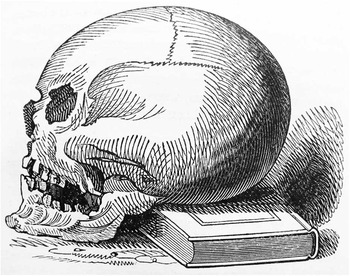
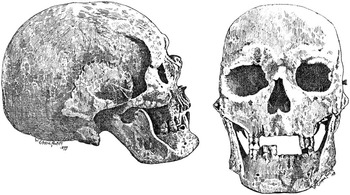
It was this feature that had attracted Raine’s attention and he invited his readers of the published report to compare the shape of the frontal bone of this skull to the engraving of the skull that he had earlier extracted from the tomb of St Cuthbert (fig 6).Footnote 17 Raine’s motive was to demonstrate that the human remains that he had uncovered in Cuthbert’s tomb were the same as those that had been seen and described by the Durham monks in 1104, and thence to prove the evident folly of their belief that the saint’s remains were incorrupt. Raine’s engraving of Cuthbert’s skull showed how ‘the bone of his nose was observed to turn rapidly outwards, and the tip of his chin was furrowed with a line of such depth that a finger might almost be laid in the cavity’. Re-examining Cuthbert’s skull in 1899, Selby Plummer concluded that Raine’s illustration had exaggerated these features, including ‘the slightly low retreating forehead’, and that it was little more than ‘a caricature of the actual skull’ (fig 7).Footnote 18 Raine drew no conclusion from his observations of the unusual shape of the foreheads of the skulls excavated from the Durham tombs of Cuthbert and Bede, but evidently thought the feature so extreme in the latter case that a cast should be made for future study and discussion. It was probably in this context that Raine gave a cast of the skull of Bede to Thurnam to augment his growing comparative collection of human crania.
Raine’s engraving of the skull of St Cuthbert. Source: Raine Reference Raine1828, 214; Raine Reference Raine1833, 63

Engraving of the skull of St Cuthbert made at the 1899 exhumation. Source: Plummer Reference Plummer1899, pl 1; reprinted in Fowler Reference Fowler1900, 19–24

John Thurnam’s interest in the shape of skulls arose from his work with inmates of the asylums for which he was medical superintendent, first at the Friends’ Retreat in York, then at the Wiltshire County Asylum in Devizes. Thurnam was at the forefront of a move to medicalise the treatment of the ‘insane’ and, to that end, in 1841 was a founding member of the Medico-Psychological Association, the forerunner of the Royal College of Psychiatrists. He developed at this time a professional interest in cranioscopy (the basis of phrenology), which endeavoured to establish brain function through external observation of the surface anatomy of the skull.Footnote 19 Through the study of human skulls, Thurnam’s interests in humanity past and present came together, and his collection of crania included a few contemporary ethnographic examples as well as archaeological specimens.
Comparative craniology was prominent in Thurnam’s earliest archaeological investigations. The first five skulls in his collection came from his excavation in 1849 of an ‘Anglo-Saxon’ cemetery at Lamel Hill in York, which lay within the grounds of the Friends’ Retreat. His account of that excavation includes a description and drawings of the shape and condition of the skulls recovered. He noted variations between those that were ‘generally small … the frontal region being decidedly narrow and low’ and those that ‘approximate more closely to the modern European standard, and are better proportioned and tolerably ample in the frontal region’.Footnote 20 The desire to recover further skeletal material drove his subsequent investigations of prehistoric barrows in Wessex and his reports to learned societies about the variations that he perceived in skull morphology were based on data carefully recorded from hundreds of examples. Thurnam understood that their interpretation depended on diagnostic artefacts and on the archaeological context of the burials that he was investigating, and he kept careful records of both.Footnote 21 The conclusions that he drew from his osteological and archaeological research argued that observed and measurable variations in skulls were a result of biological difference and admixtures of distinct populations in the distant past.Footnote 22 As such, his science was very much in tune with that of the leading thinkers of the day, developing alongside the research of such antiquaries as James Cowles Prichard, William Wilde, Daniel Wilson, Thomas Bateman and John Lubbock, who wove the new Scandinavian theory of the ‘three ages of man’ into British antiquarian scholarship.Footnote 23
Thurnam’s reflections on the ‘historical ethnology’ of prehistoric Britain are best represented by his contributions to Crania Britannica, published in six fascicules between 1856 and 1865.Footnote 24 His discussion of the recovery of bones and artefacts, and the conclusions that he draws from his observations of both, are much more prosaic than those of his co-author, Joseph Barnard Davis, whose poetic glosses on the probable character traits of the people whose skulls he was examining undermine his data collection and efforts at scientific objectivity.Footnote 25 Both men were primarily interested in the peoples that they regarded as the ‘aboriginals’ of the British Isles, and most of the book is devoted to analysis of ‘ancient Britons’, rather than to ‘invading’ Romans, Anglo-Saxons or Scandinavians.Footnote 26
Although acknowledging Weber’s Reference Weber1830 thesis that a greater diversity of cranial types existed within a population than between populations, the authors of Crania Britannica argued nevertheless that a preponderance of characteristics could be attributed to, and be used to identify, individuals belonging to a particular cultural group, whose members were linked by shared biology or ‘race’. Davis argued that ‘individual skulls may occur in these races which deviate from the rule in some particulars; rarely do they deviate in such an association of peculiarities as to carry them over strictly into the form of a different race’.Footnote 27 To this end, Davis and Thurnam published illustrated accounts of selected skulls from known archaeological sites, with the measurement data of each one, alongside an account of the artefacts and context of each burial and an exquisite lithograph engraving of each specimen.Footnote 28 They drew conclusions about the chronological, biological and cultural origin of each example, and commented on the extent of agreement with or deviation from the skull type that they considered typical of that ‘race’, based on measurements of many more examples. Davis argued that the skulls of women tended not to exhibit the hereditary features that were considered peculiar to a particular population, so their published analysis was restricted primarily to the skulls of men, fifty-four of the fifty-seven examples having been taken from skeletons assumed to have been male.Footnote 29 Their analyses also made inferences about the physical and intellectual capacity of the individuals whose skulls lay before the reader, although Thurnam’s comments in this regard were considerably more restrained and far less inclined to the poetic fancies of ‘JBD’.
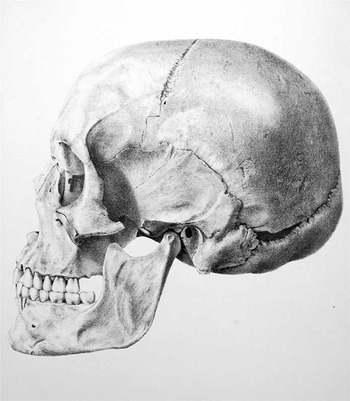
Thurnam contributed descriptions and analysis of three of the eleven Anglo-Saxon skulls presented in Crania Britannica, deriving from cemeteries in West Harnham, Wilts, Brighthampton, Oxon, and Fairford, Glos.Footnote 30 These are important for understanding Thurnam’s comments on the cast of the skull from Bede’s tomb. In all three cases, he considered that the frontal region was ‘somewhat narrow’. Of the skull from West Harnham (fig 8), which he considered to have been that of a male of about twenty-five years of age, he said that ‘the forehead is poorly developed, being narrow and but moderately elevated’. Comparing it with others from the site, he concluded that:
On the whole, the examination of the skulls from the Harnham cemetery warrants only the conclusion of a somewhat low grade of intellectual endowment and mental cultivation; and would lead us to assign these graves to the lower rather than the upper ranks of West Saxon settlers, the, perhaps degenerate, successors of the conquerors of this district.Footnote 31
Crania Britannica, the skull of an Anglo-Saxon man from West Harnham, Wilts. Source: Davis and Thurnam 1856–Reference Davis and Thurnam65

Of the skull from Fairford, which he considered had belonged to a pagan Mercian, he observed that ‘the frontal region, somewhat narrow, rises with a uniform though receding sweep and moderate elevation to the coronal suture’. He argued here that ‘the general form of this skull is such as pertains rather to the Anglo-Saxon than the ancient British type’. But he thought that the characteristics of the face – the brows, jaws and teeth – that is, ‘the parts which constitute the general physiognomy, are such as belong to the aboriginal Celtic population’. He concluded that the skull must have been ‘the cranium of a Mercian of mixed blood; on the paternal side of Angle, and on the maternal of British descent’. Here, Thurnam concurred with contemporary theory that, in cases of intermarriage between ‘races’, the mother provided the characteristics of the face and ‘nutritive organs’ and the father the structure of the head and the locomotive powers (that is, ‘brain, nerves, organs of sense, and skin and likewise the bones and muscles more particularly of the limbs’).Footnote 32 To Thurnam, therefore, observed variations from the norm reflected gender and social hierarchy as much as ‘race’.Footnote 33
Thurnam’s observations on the shape of the frontal regions of these three specimens, and their contribution to his conclusions about the cranial capacity of the ‘Anglo-Saxon race’ as a whole, were prefigured by Davis’s more overt racial stereotyping, where the shape of the frontal region was especially important. Davis had argued that:
The lowest races have undersized and ill-developed brains, narrow and low anterior lobes, manifested in crania of small capacity, of little elevation, contracted and recedent in their frontal region, with generally a large amount of osseous matter in their composition, deposited in comparatively irregular nodular masses so as to occasion heaviness and thickness and rudeness. In this category may be placed the skulls of Australians, almost universally. At the other end of the scale is situated a large fully expanded cranium. Well-developed in every part, lofty and graceful in its vault – wide, capacious, elevated in the frontal region – with all its outlines gently moulded and curved so as to produce the impression of beauty. This is the picture of the skull of a man of European race, usually that of an enlarged capacity.Footnote 34
Of the Anglo-Saxon skulls presented in Crania Britannica, Davis concluded that:
the pleasing oval, rather dolichocephalic, form may best be deserving the epithet ‘typical’ among them. The eye at once perceives that it is the conformation so generally repeated in modern English skulls. Its permanence, as a characteristic of race, is at once unquestionable and impressive.Footnote 35
Thurnam’s thoughts about the Anglo-Saxon skulls in his collection (contextualised by Davis’s sweeping generalisations) go some way to explaining the doubts that he had about the identity of the skull that Raine had recovered from Bede’s tomb in Durham. Thurnam’s catalogue records the following entry:
Plaster Casts
4. Anglo-Saxon? Male aet c. 60. Reputed Calvarium of the Venerable Bede from his tomb in Durham Cathedral, opened in 1831. See ‘Rev. J. Raine’s Brief account of Durham Cathedral’ 1833 p 78, ‘Giles’ Bede and Anglo-Saxon Chronicle’ Preface XXII. Much doubt exists as to this very poorly developed calvarium being that of the celebrated man. The story is that the bones of Bede were stolen by Elfred the Sacrist & brought by him from Jarrow to Durham, but though believed to be such, did he succeed in obtaining the actual remains?
Presented by the late Rev. James Raine
Where Raine had observed a ‘remarkably flat’ calvarium ‘of the most peculiar formation’, Thurnam saw one that he considered ‘very poorly developed’. Elsewhere, Thurnam had interpreted this kind of physical feature as profoundly negative, and a sign of low status and meagre intellectual capacity – the antithesis of the reputation of the Venerable Bede. What is more, the skull clearly did not conform to his expectation of a ‘typical’ cranium of a male of the Anglo-Saxon race, less still the ‘pleasing oval’ that Davis considered a permanent legacy of Anglo-Saxon breeding to modern Englishmen.
THE IDENTITY OF THE BONES
The discovery of the Duckworth cast revives a long-standing dispute: did Raine excavate genuine parts of Bede’s skeleton? Raine himself claimed ‘no inclination to enquire’, noting that ‘Bede’s bones … were widely dispersed – much, we dare say to the profit of the man who is reported to have stolen them from their first resting-place at Jarrow’.Footnote 36 Thurnam, as we have seen, was far more sceptical. The answer is best considered in four stages of reverse chronology.Footnote 37
From 1832 to the Reformation destruction of Bede’s shrine
There seems no reason to question the fact that Raine excavated a coffined burial that had lain undisturbed since the destruction of Bede’s shrine in November 1542 – an act for which the relevant payments survive in the cathedral’s accounts:
Post Festum Divi Michaelis die S. Andreae. Solut’ Johanni Symson pro ablacione Tumbae S. Cuthberti & Tumbae S Bedae pro quattuor diebus ijs per me Robertum Dalton …
Payd to Rayffe Skelis and iij fellows for taking away Sanct Beds Tummbe 15d.Footnote 38
According to the late sixteenth-century Rites of Durham the saint’s remains were buried where the shrine had once stood, and the description in Rites of the position of the pre-Reformation shrine on the south side of the Galilee chapel certainly equates with the site of the tomb as it was depicted in eighteenth-century illustrations.Footnote 39 In that position the modest tomb had remained an object of post-Reformation pilgrimage and of occasional offerings.Footnote 40 There were, however, claims recorded by the poet Robert Southey in 1826 that the zealous Protestant William Whittingham had removed the skeleton during his stormy tenure as Dean (1563–79), so that the tomb might no longer ‘be visited by Papists’.Footnote 41 It is true that Whittingham (and his wife), in the words of Rites, ‘could not abyde anye auncyent monuments, nor nothing that appteyned to any godlie Religiousnes or monasticall liffe’.Footnote 42 But the author of Rites was ever anxious to chronicle the extent of Whittingham’s destructive activities and it is therefore significant that he makes no mention of any interference with Bede’s tomb. Moreover Raine’s discovery, after Southey’s publication, of a partial skeleton in the grave, is difficult to explain if Whittingham had indeed emptied the burial. The evidence thus points to Raine’s skeletal remains being those that were removed from the shrine in the Galilee chapel at the time of the Reformation.
From the Reformation destruction to the 1104 translation of St Cuthbert’s shrine
The bones that were re-buried in November 1542 can reasonably be identified with those described by Symeon of Durham in his Libellus de Exordio as having been found, quite separate from other relics, in a small linen bag (in lineo saccello) in the coffin of St Cuthbert when the island saint was translated into the new Norman cathedral in 1104.Footnote 43 Symeon was writing in 1115 at the latest, and more probably between 1104 and 1107. He had been present at the translation and there can therefore be no question that he had seen a bag of bones that he believed to be the remains of Bede.Footnote 44 What is more, the audience for his Libellus included a large number of his community who had witnessed Cuthbert’s coffin being opened; their presence argues against any suspicion that Symeon has invented a discovery narrative. The same information, though in a more ambiguous form, is repeated in a second Durham text, De Miraculis et Translationibus Sancti Cuthberti (the ‘Anonymous Account’) whose relevant section was composed around 1124.Footnote 45
Symeon repeated the claim to Durham’s possession in a letter to Dean Hugh of York in 1130–2 while, slightly later, the 1143/52 Durham relic list acknowledges the presence of corpus venerabilis Bede presbiteri et doctoris among Durham’s treasures.Footnote 46 Acceptance of Symeon’s assertion – though far from universal and not always wholehearted – had reached as far as Malmesbury, Winchester and Exeter in the first half of the twelfth century.Footnote 47
The Anonymous Account records that the relics found in Cuthbert’s coffin in 1104 were subsequently – with the exception of Oswald’s head, which was replaced alongside Cuthbert – preserved honourably in the church (celebriter reservantur reliquiae); Reginald of Durham, writing c 1167, described them as being placed in specially prepared wooden receptacles (vasculis ligneis).Footnote 48 Soon after, according to Geoffrey, writing from the Durham cell of Coldingham in c 1214, Bishop Hugh of le Puiset (1154–95) removed the Bedan bones into an elaborate shrine of gold and silver – a gift commemorated by a verse inscription preserved in the post-Reformation Rites of Durham.Footnote 49 The same enshrinement is recorded in a continuation of Symeon’s Libellus found now in Cambridge, University Library,Footnote 50 written in the last quarter of the twelfth century. Significantly, for present purposes, this text adds the further information that the Bedan bones were placed in the shrine ‘together with the relics of many other saints’ (cum multorum aliorum sanctorum reliquiis).Footnote 51 If true, this might seem to raise the possibility that his remains could have been fused, or confused, with other relics at this point. Given, however, that it was Bede’s bones that formed the primary element of the shrine’s contents and that the Reformation workmen had no problem in assembling a partial skeleton, it is probable that the other reliquiis were non-corporeal or, even if they were not, that Bede’s remains continued to be kept distinct from those associated with aliorum sanctorum. Indeed it is worth noting that their identity was probably aided by some form of authenticum or written identification. Such labelling was an essential part of veneration;Footnote 52 early medieval continental examples survive in some numbers at Chelles and Sens and the practice is attested in Anglo-Saxon England from St Wilfrid in the seventh century to Exeter in the tenth.Footnote 53 It is perhaps particularly relevant here to recognise that the lack of such labelling (sine billis) in post-Norman Durham was sufficiently exceptional as to merit noting in the 1383 relic list.Footnote 54
Until 1370 le Puiset’s shrine was set in the feretory of the cathedral but it was then moved to the Galilee chapel, according to another verse inscription recorded in The Rites of Durham, at the instigation of Richard of Barnard Castle, Archdeacon of Northumberland; the relocation may well, as Halsey has argued, have been designed to ease crowd pressure in the sanctuary.Footnote 55 Here the relics remained, apart from occasional processional excursions, until the Reformation destruction.Footnote 56
It follows from all this that the skeletal remains excavated by Raine, with some reservations stemming from the information provided by the Libellus continuator, can be plausibly traced back to those found at the 1104 translation of St Cuthbert and subsequently deposited in le Puiset’s shrine; their fragmentary nature indeed chimes well with the fact that they could be contained in a small linen bag.
A larger problem remains, however: was Symeon justified in claiming that the bagged bones he had seen were those of Bede? The answer to that question depends on three interrelated issues: the credibility of Symeon’s account of how the Bedan bones reached Durham; the date of the late Old English poem De Situ Dunelmi; and the plausibility of alternative modern narratives.
The Bedan identity of Symeon’s bagged bones
Symeon explained the presence of Bede’s bones in the Cuthbert coffin as the work of Elfred, son of Westou (fl c 1020– c 1060):
Every year on the anniversary of the death of Bede the teacher, Elfred was accustomed to visit Jarrow, where he knew Bede to have lived, died and been buried, and there he would stay saying prayers and keeping vigil. On one occasion when he had gone there according to his custom, and had passed several days alone in the church engaged in praying and keeping vigil, he left at the crack of dawn without his companions knowing (which he had never been accustomed to do before) and returned to Durham, clearly not wishing to have any witness to his secret. For, although he afterwards lived for many years, he never again visited the aforesaid monastery, as if he had gained possession of what he desired. So that when he was asked by those close to him, as he very often was, where the bones of the venerable Bede rested, he was accustomed to reply as though he were quite sure of the answer: ‘No one knows this more certainly than I. O beloved friends! You may regard it as firm and certain and beyond any doubt, that the same coffin which contains the most sacred body of father Cuthbert also contains the bones of the venerable doctor and monk Bede. No one should look for any portion of his relics outside the shelter of this coffin’. Having said this he instructed those close to him to keep silent about it, lest the outsiders who were at that time living in the church, should contrive some mischief, for their chief aim was to carry off relics of the saints, and above all those of Bede, if they could. For this reason when he enshrined the bones of the saints with the body of St Cuthbert (as was described above), he took care to do this very secretly. His account of Bede agrees also with that poem in the English language which, when it speaks of the condition of this church and the relics of saints which are contained in it, mentions the relics of Bede there with those of other saints. It is known for certain that it was his bones which were found many years later enshrined with the incorrupt body of the father Cuthbert, where they had been kept separate from the other relics by being contained in a linen bag.Footnote 57
Elfred was sacristan and custodian of the Cuthbert shrine and therefore had access to the reliquary; a late twelfth-century source indeed describes him as clipping the saint’s nails and beard.Footnote 58 He was also assiduous in collecting together in Durham the relics of early Northumbrian saints as part of an apparent policy by the secular canons of the Congregatio Sancti Cuthberti to assert their role as the spiritual and land-holding inheritor, and relic repository, of the golden age of Northumbrian monasticism associated with Cuthbert and Bede – a policy continued by their Benedictine and Norman successors.Footnote 59
It must be admitted that the story, as narrated by Symeon, is a strange one. It is not surprising therefore that a series of distinguished documentary and literary historians have rejected the Elfred narrative.Footnote 60 But there are strong arguments in its favour which are set out below.
Firstly, that Bede’s relics were believed to be present in Durham before Symeon’s record is seemingly supported by their listing in the Old English poem De Situ Dunelmi; its composition date is uncertain but it certainly pre-dates Symeon’s text since, as seen above, he alludes to it. The standard edition of the poem, however, assigns it to a period after 1104, and influential arguments, notably by Kendall, have convinced many writers that its text reflects information which could only have been available after the 1104 translation of Cuthbert’s remains into the new Norman cathedral.Footnote 61 In their view, therefore, the poem does not provide independent evidence for knowledge of the presence of Bede’s relics in Durham before that translation. Against this near-total critical consensus, however, two recent papers have set out a detailed rejection of the ‘post-1104’ thesis, arguing inter alia that the poem’s riddling allusions fail to carry the chronological significance assigned to them by Kendall.Footnote 62 More importantly, these two papers stress the significance of the context in which Symeon refers to the poem. Writing probably between 1104 and 1107 – and certainly before 1115 – he is using it as evidence to support his story about Elfred’s removal of Bede’s bones from Jarrow. It is difficult to see why he should refer to that poem to strengthen his case if it were such a recent composition – and, moreover, a work that must have emerged from the same small local literate community to which Symeon himself belonged. In our view, these arguments, combined with the lack of explicit reference in the poem to the discoveries made in 1104, imply knowledge of claims to Bede’s Durham presence before the great translation ceremony.Footnote 63
The fact that Symeon was drawing upon a traditional view that Bede’s relics were present in Durham does not, of course, offer full endorsement of the truth of the Elfred narrative. The bones, if present, could have arrived at another date. Among these possibilities, the most fully argued is a proposal by Kendall and Ward.Footnote 64 They suggest that, if the bones ever were actually translated from Jarrow, then they arrived in the period c 1083 when the Benedictine monks of Jarrow were brought to Durham to replace the expelled Congregatio clerks. This scenario is, however, actually less plausible than Symeon’s narrative. Symeon had entered the Benedictine community in c 1089/91, at which stage at least four of the monks who had been transferred from Jarrow were still alive; falsifying the date and circumstances of a recent acquisition would consequently have been somewhat difficult.Footnote 65 There are two further arguments against a 1083 transfer. Firstly, unless we view the Anonymous Account’s description of the monks’ ignorance as to the internal arrangements of the Cuthbert coffin in 1104 as a literary device, then it is highly unlikely that there could have been any intrusion as late as the 1080s, given the extent of contact between the Benedictine monks and their Congregatio predecessors.Footnote 66 Secondly, delivery of Bede’s remains to Durham by the transferred Jarrow monks would actually have better fitted with Symeon’s main agenda of reinforcing the Benedictine priory’s claims to be the proper monastic custodians of Northumbria’s saintly relics; that he did not make this claim is thus doubly significant.
Granted, on the evidence of the Old English poem, that knowledge of the claimed presence of Bedan relics in Durham pre-dates Symeon and the 1104 opening of Cuthbert’s coffin – and recognising the weakness of the case for a transfer c 1083 – we are thrown back on Symeon’s story of Elfred. This, however, as we have noted, has not found widespread acceptance among historians, despite the fact that Symeon’s information came from Elfred’s contemporaries, notably a monk called Gamel.Footnote 67 But many of the claimed peculiarities in Symeon’s account are now more readily explicable than once they seemed. Thus Kendall objected to the clandestine nature of Elfred’s theft on the grounds that the monastic house at Jarrow had collapsed in the later ninth century, and that there would therefore be no local opposition to the open removal of relics.Footnote 68 Yet this ignored the fact that there is sculptural evidence for continuity of Christian activity on the site, a continuity which has been more recently confirmed by archaeological discoveries.Footnote 69 Moreover, Elfred and his companions (sociis) were described by Symeon as being regular worshippers at Jarrow on Bede’s anniversary (anniuersaria dormitionis), a phrase that implies the existence of some form of local liturgical celebration. Against this background, illicit removal under cover of darkness would have been essential.
The puzzle of Elfred’s insistence on secrecy about the presence of Bedan relics in the Cuthbert reliquary coffin is also readily explained. Symeon refers to Elfred’s justification as lying in response to threats posed by ‘outsiders’ (extranei) in Durham who might be tempted to remove relics. It is not difficult to identify these outsiders, for Symeon supplies a full account of the depredations of the successive eleventh-century bishops, Æthelric and Æthelwine, who occupied the see between 1041 and 1071 and who both had strong links to Peterborough.Footnote 70 The Congregatio had good reason to suppress news of its acquisition.
Awkward as some aspects of the story of Elfred may now appear, it can probably be accepted as true. The removal of Bede’s bones from Jarrow would also explain, as Cramp has emphasised, why Symeon notes that it was a Jarrow porticus and not his tomb that ‘provides the faithful with a memorial to his [Bede’s] name which they should revere’ (uenerandam fidelibus nominis eius ibidem prestat memoriam).Footnote 71
Exactly how Symeon and his colleagues were able to identify the bagged bones discovered in 1104 as the Bedan relics purloined by Elfred might seem an unanswerable question. But, as noted above, they could have carried some form of authenticum. There is, however, another reason that could have contributed to his certainty. If we examine the mid-twelfth-century Durham relic list, it includes a number of items that came from Cuthbert’s coffin, including bones of Balthere and Billfrith, Æbbe and Æthelgitha, which Symeon listed as being among Elfred’s acquisitions.Footnote 72 But these relics, like almost all of the other corporeal remains in the twelfth-century record, are listed as ‘bones’ (ossa). The term corpus (body) is only applied to the relics of Cuthbert, Boisil and Bede and thus implies the survival of significantly large remains. Since we know that Boisil’s bones, after their removal from Melrose by Elfred, were separately enshrined in Durham’s Anglo-Saxon cathedral, the only contents of the reliquary coffin that would merit the description of corpus were the relics of Cuthbert and Bede.Footnote 73 If we place this information alongside Elfred’s claim that no portion of Bede’s relics remained outside the Cuthbert reliquary coffin – and thus, by implication, that he had removed all the bones that were available at Jarrow – then it follows that Bede’s relics must have formed a substantial contribution to the coffin’s contents, recognisably distinct from the other smaller corporeal fragments that had accumulated over the centuries alongside Cuthbert.
On balance, therefore, the elusive evidence points to the authenticity of the Durham tradition of Elfred’s theft and the Jarrow derivation of the bones found in lineo saccello.
From Elfred to Bede’s death
The final part of the history takes us back to Bede’s death on Ascension Eve, ad 735, and his assumed burial at Jarrow. As has been discussed elsewhere, it is clear that Cuthbert, Bede’s own pupil and abbot of Wearmouth–Jarrow in the second half of the eighth century, was actively engaged in promoting Bede’s cult. His description of his master’s death and the promise of a fuller Vita would have provided crucial components of that cult.Footnote 74 And that it had some limited success is indicated by a letter of 764 from Cuthbert to Lul, Archbishop of Mainz, thanking him for his gift of pure silk for the relics of Bede.Footnote 75 Whether this silk was to wrap corporeal or other relics, or, indeed, to cover Bede’s tomb, the gift does indicate that a cult was developing at Jarrow in the later eighth century and (whether translated from his burial place or not) his bodily remains must have been central to that devotion; their location cannot have been in doubt. It has been suggested that the cult seems to have faltered after Abbot Cuthbert’s death, though in the late eighth century Alcuin did record an unlocated miracle achieved by his relics and some form of Bedan relic had reached Fulda by 819.Footnote 76 But Bede’s name is noticeably absent from eighth- and ninth-century English or English-derived calendars and from several of the pre-Conquest lists of saints’ resting places;Footnote 77 and his cause cannot have been helped by the collapse of the monastery at Jarrow in the course of the later ninth century, which is suggested by its estates being granted to other landlords even though, as we have seen, some excavated structures and finds, together with stone sculpture, show that an active Christian church continued at the site into the tenth and eleventh centuries.Footnote 78
Though the cult may have temporarily failed to gain widespread acceptance – ‘temporarily’ because it was to be revived in the tenth and eleventh centuries in southern England – belief in its continued existence at Jarrow is recorded in one list of saints’ resting places preserved by the twelfth-century chronicler Hugh Candidus of Peterborough.Footnote 79 Writing in, or soon after, 1155, he cites the resting place of sanctus Beda presbyter under Girum (Jarrow). His lists seem to have been compiled in the late eleventh century and partly derive, in a complex manner, from pre-Conquest material. Whatever the date at which Girum entered the train of transmission that resulted in its appearance in Hugh’s text, it is valuable additional evidence for awareness of a Bedan cult centre at Anglo-Saxon Jarrow to be set alongside Elfred’s recognition of Bede’s anniversary.
In summary, despite the general lack of ninth- and tenth-century documentation, which is common to all Northumbria, there is no real reason to doubt that the location of Bede’s bones, whether translated or not, was known in Jarrow from the date of his death through to the period of Elfred’s appearance and theft. What is also clear from the evidence we have reviewed is that the cast made by Raine was taken from a skull that, from at least the early twelfth century, was regarded as that of Bede. Acceptance of the main lines of Elfred’s narrative would allow us to take that identification back to his eighth-century burial. On balance we regard the line of evidence as plausible; the Duckworth cast could indeed have been taken from the skull of the Venerable Bede.
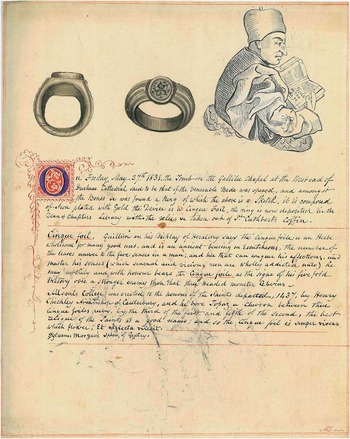
Manuscript addition to Newcastle City Library’s copy of Mackenzie and Ross Reference Mackenzie and Ross1834. Photograph: courtesy of Newcastle City Library

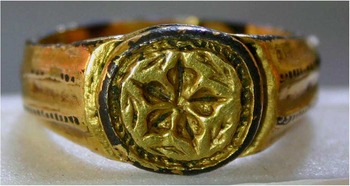
The ring found in Bede’s tomb. Photograph: courtesy of the Chapter of Durham Cathedral

APPENDIX
The ring from Bede’s tomb
James Raine’s account of his 1831 excavation of Bede’s tomb describes the discovery of a ‘massy ring of iron, plated with a thick coat of gold, and containing upon a boss the device of a cinquefoil, a common ornament at the time of the dissolution’.Footnote 80 No illustration of this ring was published by Raine, nor has it been figured in any subsequent publication – though it was listed as among the Cathedral Library’s holdings in a 1925 catalogue and a 1978 exhibition guide.Footnote 81 A pen-and-ink drawing of the ring does, however, appear as a paste-in to the Newcastle City Library’s copy of Mackenzie and Ross’s Reference Mackenzie and Ross1834 description of the County Palatine of Durham.Footnote 82 This drawing of the ring is accompanied by a pen-and-ink sketch of the seated figure of Bede, based on a woodblock image originally published in 1493 in the Nuremberg Chronicle.Footnote 83 The sketch of Bede is dated 1832 and thus pre-dates Raine’s published account (fig 9). The artist initialled his work in the lower corner of the page as ‘M T’. We are grateful to Dr Ian Doyle for his identification of the initials as those of Matthew Thompson, a Durham artist who had been employed by Raine in his publication of the excavation of the tomb of St Cuthbert. His record provides useful confirmation of the Bedan identification of the ring now surviving in the cathedral collection as ‘Ring no. 3(28) – 2’ (fig 10).
The ring is made of some form of alloy and is heavily gilded, but with the original base metal showing through where worn. It has an internal diameter of c 230mm. The shank carries diagonal mouldings at the back, decoration that changes to two parallel mouldings marked by raised small pellets running up towards the shoulders. The round bezel is surrounded by two frames, the internal one decorated with pellets. The central cast motif, flanked by four arrow-like foliate forms, consists of a five-leaved flower or cinquefoil, the leaf forms being heart-shaped with a central vein. The intaglio cutting of the decoration shows that it was originally designed as a signet ring for sealing letters or instructions.
The cathedral’s label dates the object to the sixteenth century and we are grateful to John Cherry, FSA, for his view that the object can be assigned to the late fifteenth or early sixteenth centuries. It therefore has no early medieval association with Bede or his relics; as a non-episcopal cleric Bede would not, in any case, have worn a ring. Consequently it must have been placed in the grave during the re-burial after the 1542 destruction of the shrine recorded in the Durham accounts.Footnote 84 Whether it had been found among recent shrine offerings during the 1542 works, or was newly introduced as a final tribute, remains an insoluble problem.Footnote 85 However, when set alongside the respectful manner in which the fragmentary skeletal remains had been laid out full length in anatomical order within the coffin, the ring’s presence does point to a continued veneration of the Jarrow scholar even at the moment of his shrine’s destruction.
Raine’s account suggests that the ring had been placed in the position where it would have been if the hand had been raised in blessing; given the seeming absence of any finger bones this appears an unlikely interpretation. He also records that the ring was ‘lined internally with one or two folds of thick woollen cloth, as if to fit it to its situation’.Footnote 86 It is far from clear what he meant by the latter phrase unless he believed that the ring had been placed on a now-lost finger which was much thinner than the internal dimensions of the ring and thus would have been worn over a glove, of which the woollen cloth may have been the fragmentary survival. But the cloth might equally have been a fragment of textile associated with either the saint or the shrine – possibly even a piece de tunica Sci Bede that figures in the Durham relic inventory in an early fourteenth-century York Minster manuscript and in Richard de Segruk’s list of 1383.Footnote 87
In the absence of an inscription or highly distinctive armorial on the ring, its original ownership cannot now be ascertained, and the online catalogue of the magnificent seal collection in Durham Cathedral provides no exact parallel for this combination of cinquefoil and arrow-like leaves;Footnote 88 neither do any of the numerous publications by C H Blair of regional seals and armorials.Footnote 89 In the Durham collection there are, however, two round signets with cinquefoils, without accompanying inscription – nos 623 and 1,241, dated respectively to 1457 and 1538 – and in the same archive there are other seals using the motif, though these latter are accompanied by inscriptions and non-foliate decoration as well as being often of larger or non-circular form (nos 946, 1,152, 1,654, 1,677, 1,731, 1,796, 1,821, 2,322, 2,507–2,511, 2,600, 2,647, 2,939 and 2,984). This list includes a cluster associated with the local Umfraville family for whom the motif, with its distinctive heart-shaped leaves, is a persistent armorial device.Footnote 90
ACKNOWLEDGEMENTS
We are especially grateful to Dr Marta Mirazon Lahr, Director of the Duckworth Laboratory, and her colleagues at the Leverhulme Centre for Human Evolutionary Studies at the University of Cambridge, for her enthusiastic support for this project, for providing us with access to John Thurnam’s collection and for permission to publish figures 1–5. Dr Lahr and Maggie Bellatti also kindly made a replica of the Duckworth cast for display at Bede’s World: the Museum of Early Medieval Northumbria at Jarrow. Sarah Mulligan, of the Heritage Team in Newcastle Libraries, and Gabriel Sewell, Head of Collections at Durham Cathedral, generously gave access to items in their collections and permission to publish images of them (figures 9 and 10). We are also grateful to Rosemary Sweet, Rebecca Gowland, John Cherry, Eric Cambridge and Ian Doyle for helpful discussion and information. The University of Leicester provided study leave to Joanna Story to complete this article and the Leverhulme Trust supplied generous support through its funding of a research programme at Leicester on ‘The Impact of Diasporas on the Making of Britain: evidence, memories, inventions’ (programme grant: F/00 212/AM).