Many American adolescents initiate drug use before 15 years of age, with alcohol, tobacco, and marijuana being the most common drugs of onset (Swendsen et al., Reference Swendsen, Burstein, Case, Conway, Dierker and He2012). Although early initiation of drug use has consistently been linked to substance use disorders (SUD), it still remains unclear whether early drug use is a causal contributor to SUD (Grant & Dawson, Reference Grant and Dawson1997; Hawkins et al., Reference Hawkins, Graham, Maguin, Abbott, Hill and Catalano1997; Odgers et al., Reference Odgers, Caspi, Nagin, Piquero, Slutske and Milne2008) or simply a marker of underlying vulnerabilities (e.g., behavioral disinhibition) common to both early onset and subsequent SUD (Bobova, Finn, Rickert, & Lucas, Reference Bobova, Finn, Rickert and Lucas2009; Krueger et al., Reference Krueger, Hicks, Patrick, Carlson, Iacono and McGue2002; McGue, Iacono, Legrand, Malone, & Elkins, Reference McGue, Iacono, Legrand, Malone and Elkins2001; Prescott & Kendler, Reference Prescott and Kendler1999). Much of the research supporting the causal role of early drug use in the development of SUD has been retrospective in nature, relying on adult recall of age at first use (Grant & Dawson, Reference Grant and Dawson1997). Besides issues related to recall bias, this line of research has overlooked the important distinction between different forms of early drug use, namely, occasional experimentation with drugs versus the more persistent progression in use. Not all adolescents who experiment with drugs at a young age progress toward SUD; it is the adolescents who engage in consistent and progressive drug use following initial exposure who are at greater risk for subsequent SUD (Chassin, Presson, Pitts, & Sherman, Reference Chassin, Presson, Pitts and Sherman2000; Flory, Lynam, Milich, Leukefeld, & Clayton, Reference Flory, Lynam, Milich, Leukefeld and Clayton2004; Li, Duncan, & Hops, Reference Li, Duncan and Hops2001).
The guiding premise of our research is that by disentangling the heterogeneity in early forms of drug use (Colder, Campbell, Ruel, Richardson, & Flay, Reference Colder, Campbell, Ruel, Richardson and Flay2002; Duncan, Duncan, & Strycker, Reference Duncan, Duncan and Strycker2006; Flory et al., Reference Flory, Lynam, Milich, Leukefeld and Clayton2004; Li et al., Reference Li, Duncan and Hops2001) we can obtain critical information about the underlying vulnerabilities that predispose some adolescents to more dysfunctional forms of drug use following initial exposure. To that end, we test the utility of an emerging neurobehavioral model (Everitt et al., Reference Everitt, Belin, Economidou, Pelloux, Dalley and Robbins2008; Everitt & Robbins, Reference Everitt and Robbins2005) that makes clear predictions about the vulnerabilities associated with SUD and their role in drug use experimentation versus progression. Derived mainly from research with animals, we believe this model can provide important insights into why some adolescents engage in more dysfunctional forms of drug use, while others experiment with or use drugs only occasionally. Here we provide the first empirical test of this model in a human adolescent sample.
Neurobehavioral Systems of Drug Use
Research with both animal and human models increasingly points to the role of two interrelated neurobehavioral systems in the development of SUD: the reward motivation system, mediated by mesolimbic dopamine circuitry, and the executive control system, centered in the prefrontal and parietal networks (Dalley, Everitt, & Robbins, Reference Dalley, Everitt and Robbins2011; de Wit & Richards, Reference de Wit and Richards2004; Jentsch & Taylor, Reference Jentsch and Taylor1999). The “neurobehavioral imbalance model” attributes the development of SUD to predisposing vulnerabilities in each of these two systems, albeit at different stages of the addiction process (Everitt et al., Reference Everitt, Belin, Economidou, Pelloux, Dalley and Robbins2008). For instance, high levels of reward motivation can increase propensity for experimentation with drugs (George & Koob, Reference George and Koob2010), whereas weakness in executive control is associated with progressive (Tarter et al., Reference Tarter, Vanyukov, Giancola, Dawes, Blackson and Mezzich1999; Zucker, Heitzeg, & Nigg, Reference Zucker, Heitzeg and Nigg2011) and compulsive forms of drug use (Everitt & Robbins, Reference Everitt and Robbins2005; Heitzeg, Nigg, Yau, Zucker, & Zubieta, Reference Heitzeg, Nigg, Yau, Zucker and Zubieta2010; Koob & Volkow, Reference Koob and Volkow2010). Crucially, and of relevance to the present research, this model posits that individual differences in the imbalance between the two neurobehavioral systems is what poses particular risk for the escalation of drug use (Dalley et al., Reference Dalley, Everitt and Robbins2011; Robbins, Gillan, Smith, de Wit, & Ersche, Reference Robbins, Gillan, Smith, de Wit and Ersche2012). More specifically, this imbalance results from a hyperactive striatal reward system that is inadequately controlled by a hypoactive prefrontally mediated executive control system.
An important prediction of this model observed in animals (Belin, Mar, Dalley, Robbins, & Everitt, Reference Belin, Mar, Dalley, Robbins and Everitt2008; Dalley et al., Reference Dalley, Fryer, Brichard, Robinson, Theobald and Laane2007; Everitt et al., Reference Everitt, Belin, Economidou, Pelloux, Dalley and Robbins2008), but not yet tested in humans, is that certain forms of impulsivity characterized by strong reward-seeking tendencies and weakness in executive control are more strongly related to the escalation in drug use than are other dimensions like sensation seeking (SS) that do not necessarily represent a failure of the top-down regulatory control. Impulsivity is broadly characterized as a tendency to act prematurely, with little forethought for the consequences of one's behavior (Eysenck & Eysenck, Reference Eysenck and Eysenck1980). Although impulsivity is commonly implicated as a core deficit in SUD (Giancola & Tarter, Reference Giancola and Tarter1999; Nigg et al., Reference Nigg, Wong, Martel, Jester, Puttler and Glass2006), it is a multifaceted construct that can include several different dimensions (Whiteside & Lynam, Reference Whiteside and Lynam2001), each of which can contribute differentially and at different stages of the addiction process (Dalley et al., Reference Dalley, Everitt and Robbins2011; Winstanley, Olausson, Taylor, & Jentsch, Reference Winstanley, Olausson, Taylor and Jentsch2010).
Impulsivity is usually assessed in two interrelated domains: first, in its most classic form as an inability to inhibit prepotent behavior, namely, acting without thinking (AWT; Barratt, Reference Barratt, Spence and Izard1985), and second, as an inability to delay the gratification of a small immediate reward in favor of a larger deferred reward, that is, delay discounting (DD; Madden & Bickel, Reference Madden and Bickel2010). Although impulsivity is reflective of a hypofunctioning executive control system (Bechara, Reference Bechara2005), it also shares characteristics with SS by virtue of its association with the mesolimbic dopamine reward system (Buckholtz et al., Reference Buckholtz, Treadway, Cowan, Woodward, Li and Ansari2010; Pattij & Vanderschuren, Reference Pattij and Vanderschuren2008; Zald et al., Reference Zald, Cowan, Riccardi, Baldwin, Ansari and Li2008). This link between different dimensions of impulsivity and SS is further established by neuroimaging research, which has found overlapping activation patterns in ventral striatal reward circuitry for all three personality dimensions: DD (Ballard & Knutson, Reference Ballard and Knutson2009; Hariri et al., Reference Hariri, Brown, Williamson, Flory, Wit and Manuck2006; McClure, Laibson, Loewenstein, & Cohen, Reference McClure, Laibson, Loewenstein and Cohen2004), AWT (Buckholtz et al., Reference Buckholtz, Treadway, Cowan, Woodward, Li and Ansari2010), and SS (Zald et al., Reference Zald, Cowan, Riccardi, Baldwin, Ansari and Li2008).
In comparison, what most saliently distinguishes SS from AWT and DD is the level of functioning of the executive control system, especially as indicated by working memory (WM) performance. WM is a higher order cognitive ability that facilitates flexible, goal-directed behavior (Cools, Sheridan, Jacobs, & D'Esposito, Reference Cools, Sheridan, Jacobs and D'Esposito2007; Miller & Cohen, Reference Miller and Cohen2001; Miyake & Shah, Reference Miyake and Shah1999). Executive attention, an important component of WM (Kane, Conway, Hanbrick, & Engle, Reference Kane, Conway, Hanbrick, Engle, Conway, Jarrold, Kane, Miyake and Towse2007), enables individuals with stronger WM to exert inhibitory control over impulses and to consider alternatives that may be more adaptive, making them less prone to engaging in impulsive and potentially risky behaviors (Romer et al., Reference Romer, Betancourt, Brodsky, Giannetta, Yang and Hurt2011; Shamosh et al., Reference Shamosh, DeYoung, Green, Reis, Johnson and Conway2008). Because youth high in SS do not share weakness in executive control (Dalley et al., Reference Dalley, Everitt and Robbins2011), they may be better able to control their drug use urges (Gullo & Dawe, Reference Gullo and Dawe2008). This is confirmed by research that finds that although sensation seekers may be attracted to novel and exciting experiences (like drug use) due to their reward-seeking tendencies (Cyders, Flory, Rainer, & Smith, Reference Cyders, Flory, Rainer and Smith2009; Magid, MacLean, & Colder, Reference Magid, MacLean and Colder2007), they are not likely to exhibit signs of progression or loss of control over the use of drugs, leading to symptoms of SUD (Dick et al., Reference Dick, Smith, Olausson, Mitchell, Leeman and O'Malley2010; Smith et al., Reference Smith, Fischer, Cyders, Annus, Spillane and McCarthy2007). Furthermore, evidence from cross-sectional research with human drug-abusing populations reveals weaknesses in executive control and greater impulsive (but not SS) tendencies (Ersche, Turton, Pradhan, Bullmore, & Robbins, Reference Ersche, Turton, Pradhan, Bullmore and Robbins2010; Rogers & Robbins, Reference Rogers and Robbins2001). The strength of the executive control system commonly reported among sensation seekers (Raine, Reynolds, Venables, & Mednick, Reference Raine, Reynolds, Venables and Mednick2002; Spear, Reference Spear2010) suggests that adolescents high in SS would be able to learn from their experiences, especially the negative consequences associated with drug use (Romer, Duckworth, Sznitman, & Park, Reference Romer, Duckworth, Sznitman and Park2010), and not engage in repetitive patterns of dysfunctional behaviors.
Developmental Changes in Reward Versus Control Systems
Longitudinal research focusing on individual differences in the developmental trajectories of SS and impulsivity in relation to drug use has found a slower developmental decline in impulsivity (indicative of an imbalance between the two systems) to be associated with a more rapid increase in alcohol, marijuana, and tobacco use from ages 15 to 26 (Quinn & Harden, Reference Quinn and Harden2013). While similar associations were also reported between the slower rate of decline in SS and increase in alcohol use, this evidence was weaker in comparison and not supported in supplemental analyses with nonabstainers. Analogous findings have been reported by Littlefield, Sher, and Wood (Reference Littlefield, Sher and Wood2009) in a young adult sample. However, replication of these findings in an early adolescent sample is warranted. According to the neurobehavioral imbalance model, a slower decline in SS is more likely to be associated with experimentation with drugs (Cyders et al., Reference Cyders, Flory, Rainer and Smith2009), whereas developmental delays in the maturation of the cognitive control system (associated with impulsivity dimensions of AWT and DD) are more likely to predict chronic and progressive drug use (Ivanov, Schulz, London, & Newcorn, Reference Ivanov, Schulz, London and Newcorn2008).
Weaknesses in the executive control system, as indexed by WM deficits, have frequently been reported in substance-abusing populations (Squeglia, Spadoni, Infante, Myers, & Tapert, Reference Squeglia, Spadoni, Infante, Myers and Tapert2009). However, in such samples where drug use has already been initiated, it is difficult to establish whether the WM impairments preexisted or were induced by drug use. In a recent longitudinal study modeling alcohol use trajectories from early to midadolescence, Khurana et al. (Reference Khurana, Romer, Betancourt, Brodsky, Giannetta and Hurt2013) found that preexisting weakness in WM predicted individual differences in drinking frequency at baseline as well as the rate of increase in drinking frequency over time. Furthermore, consistent with the neurobehavioral imbalance model, impulsivity dimensions of AWT and DD (indicators of strong reward but weak executive control system) mediated the relation between WM and alcohol use in their sample, whereas SS did not (Khurana et al., Reference Khurana, Romer, Betancourt, Brodsky, Giannetta and Hurt2013). However, this study did not explore the possibility of qualitatively distinct trajectories of alcohol use. It is possible that the average alcohol use trajectory modeled for the entire sample could have included heterogeneous groups that were at low or high risk based on the patterns of alcohol use and the underlying vulnerabilities. Furthermore, this study was focused exclusively on alcohol use, and developmental trajectories of other addictive drugs commonly used by adolescents, such as cigarettes and marijuana, were not examined. Based on past research documenting similar developmental courses and underlying risk profiles for common drugs of onset (Jackson, Sher, & Schulenberg, Reference Jackson, Sher and Schulenberg2008), it can be expected that an imbalance between the reward and control systems would be associated with escalating use of all three commonly used drugs (alcohol, marijuana, and tobacco) during early adolescence.
Present Study
In this study, we test the implications of the neurobehavioral imbalance model for early drug use progression in human adolescents. We evaluate the level of functioning of the executive control system using individual differences in adolescents' WM ability. Reward motivation is assessed using self-reported SS tendencies, as well as other impulsivity dimensions that uniquely represent both reward sensitivity and loss of executive control. Based on the model, we expect that an imbalance between the two systems, as indexed by low executive control and high reward sensitivity (captured by AWT and DD), will be predictive of early escalation in drug use. In contrast, occasional experimentation that is not followed by progression in drug use is likely to be associated with a relatively stronger executive control system that is better able to regulate the reward-driven tendencies (captured by SS).
Using a longitudinal sample of 11- to 13-year-olds at baseline, we modeled heterogeneous patterns of common drug use (alcohol, marijuana, and tobacco) from early to middle adolescence. Based on past research (Li et al., Reference Li, Duncan and Hops2001; Sher, Jackson, & Steinley, Reference Sher, Jackson and Steinley2011), we expected to observe at least two discrete drug use patterns in our sample: a low-use/low-risk group composed of abstainers and occasional experimenters, and a high-use/high-risk group characterized by consistent and progressive use of all three drugs. Next, we tested whether baseline differences in WM and associated impulsivity dimensions (SS, AWT, and DD) were able to predict likelihood of membership in these distinct drug use groups. We hypothesized AWT and DD to be predictive of membership in the high-use/high-risk trajectory group because these tendencies represent a lack of executive control as indexed by their negative associations with WM. However, SS was hypothesized to be a predictor of membership in the low-use/low-risk group, because occasional experimentation is likely to signify heightened sensitivity to rewards but does not necessarily represent a lack of executive control. Separate supplemental analyses were conducted as needed to examine differences between the trajectory groups.
Method
Participants
Data were obtained from a 5-year longitudinal study of an urban, community-based sample of adolescents (N = 382), ages 10–12 at baseline (M = 11.4 ± 0.87 years; 52% females). Only the last four annual assessments of this longitudinal study were used in the present analyses, because the low rate (<4%) of any drug use at the first assessment resulted in unstable estimates and poor model convergence. The four time points used in the present analyses are termed Times 1–4 (T1–T4). The mean age of the sample at T1 was 12.4 ± 0.87 years (range = 11–13 years). Adolescents were recruited mainly through schools in the Philadelphia area, as well as from libraries and community centers. The majority of the sample was from low-middle socioeconomic background, assessed using the Hollingshead Two Factor Index of Social Status (M = 47.0 ± 15.8; reverse scored). In terms of racial-ethnic composition, most participants self-identified as non-Hispanic White (56%), followed by non-Hispanic Black (26%), Hispanic (9%), and the remaining 9% were categorized in the other category, primarily including Asian and Native American, due to their low representation. Further details regarding recruitment and testing are provided in Romer et al. (Reference Romer, Betancourt, Giannetta, Brodsky, Farah and Hurt2009). There was less than 10% loss to follow-up over the course of the study. Missing data were handled using full information maximum likelihood in Mplus version7. Time-invariant covariates (sex, age, race–ethnicity, and socioeconomic background) and predictors (WM, AWT, and SS) included in the model were assessed at T1. DD, assessed at T2, was also included in the model.
Measures
WM
Participant WM was assessed based on performance on the following tasks: Corsi block tapping, digit span backwards, letter two-back, and a spatial WM task. All four tasks were found to significantly load on a single latent factor, with loadings ranging from 0.40 to 0.60. All tasks were scored such that higher scores indicated better WM performance. A brief description of these tasks follows.
Corsi block tapping
This task is a nonverbal variant of the digit span task (Milner, Reference Milner1971). Participants view a set of identical blocks that are spatially dispersed on the screen and are individually lit up in a random sequence. Participants are asked to tap each box in the reverse order of the sequence of lit boxes. We used the total correct score, ranging from 0 to 12, as an indicator of WM performance on this task. This task also assesses spatial WM because the visual sequence must be maintained and reversed in WM in order to guide the response.
Digit span backwards
This task tests the auditory–verbal WM of participants by having them repeat back, in reverse order, sequences of digits to the experimenter. The test was administered in standard format according to the procedures listed in the Wechsler Intelligence Scale for Children, Fourth Edition (Wechsler, Reference Wechsler2003). The digit span total raw score, ranging from 4 to 14, was used as an indicator of WM performance for this task.
Letter two-back
This task involves monitoring a series of letters for a repeat “two-back.” Letters are presented for 500 ms each, separated by a 1-s interval. Participants must continually update their WM in order to compare the current letter to the letter shape presented two trials back. This task was adapted for children by Casey et al. (Reference Casey, Cohen, Jezzard, Turner, Noll and Trainor1995). The participants' total correct score, ranging from 38 to 122, was used as an indicator of their WM performance on this task.
Spatial WM
This self-directed computerized task requires the participant to search for hidden tokens one at a time within sets of four to eight randomly positioned boxes. Tokens are hidden only once in each box per trial. WM skills are tapped because the participant, while searching, must hold in WM the locations already checked and, as tokens are found, must remember and update information about the locations of those tokens (Owen, Downes, Sahakian, Polkey, & Robbins, Reference Owen, Downes, Sahakian, Polkey and Robbins1990). Between-search errors on this task are made if the participant returns to a box where a token had already been found during a previous search sequence. In comparison, a within-search error is made when a participant returns to a box that has already been checked during the same search sequence. WM performance was indexed using the between-search errors score, because it places more demands on WM of participants because they have to remember where the token was found in the last search when beginning a new search for the next token. The between-search error score was reverse scored to indicate better WM performance, and ranged from 0 to 109.
Recent drug use
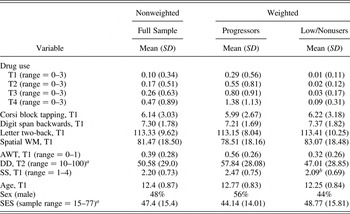
Self-reported recent (past 30 days) use of alcohol, marijuana, and tobacco was assessed using a binary (yes/no) response variable at each of the four repeated assessments. Even though participants were asked to report their frequency of recent drug use, frequency of use was quite low in this age group, producing extremely skewed responses. Hence, we used consistency in the yes/no categorization for the present analyses, which enabled us to observe progression in drug use over time. Responses on recent drug use for the three drugs were summed to create a recent drug use index: 0 (no use), 1 (used only one drug), 2 (used two of the three drugs), and 3 (used all three drugs) in the past 30 days. This outcome variable was used when modeling cumulative drug use patterns. Descriptive statistics of individual drug use and cumulative drug use patterns across the four time points can be found in Table 1.
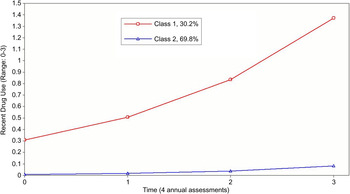
(Color online) Estimated recent drug use curves from the two-class latent growth class analysis solution. Class 1 is the progressors and Class 2 is the low/nonusers.

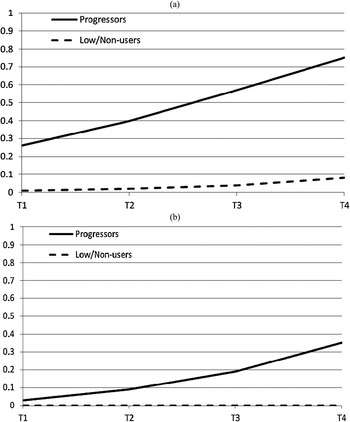
Item response probabilities for recent (past 30 days) drug use: (a) class-specific probabilities of at least one drug used in the past 30 days, and (b) class-specific probabilities of having used more than one drug in the past 30 days.

Mean (standard deviation) of past 30 day drug use for individuals and overall across the four assessment time points

Note: T1–4, Times 1–4.
SS
Adolescents' tendency to seek exciting and novel behaviors was assessed using the brief SS scale (Hoyle, Stephenson, Palmgreen, Lorch, & Donohew, Reference Hoyle, Stephenson, Palmgreen, Lorch and Donohew2002). Four items that were representative of each of the four dimensions of SS (i.e., experience seeking, boredom susceptibility, thrill/adventure seeking, and disinhibition) were included in our scale. Respondent's level of agreement with each of these items was assessed using a Likert-type scale, ranging from 1 (strongly disagree) to 4 (strongly agree). Confirmatory factor analysis revealed high item loadings (0.53–0.73), representing a single underlying latent factor, with a ρ of 0.77. Participants' scores on the four items were averaged to create a SS index that ranged from 1 to 4.
AWT
Nine self-report items were used to assess participants' tendency to act on impulse, without thinking through the consequences (e.g., Do you usually do or say things without thinking?) with a binary (yes/no) response option (Eysenck, Easting, & Pearson, Reference Eysenck, Easting and Pearson1984; Kuo, Chih, Soong, Yang, & Chen, Reference Kuo, Chih, Soong, Yang and Chen2004). The items loaded on a single latent factor, with loadings ranging from 0.37 to 0.71, with a ρ of 0.80. Responses on the nine items were averaged to create an AWT score that ranged from 0 to 1.
DD
Participants' ability to delay immediate gratification was assessed using a hypothetical monetary choice procedure adapted from Green, Fry, and Myerson (Reference Green, Fry and Myerson1994). Respondents were asked in the context of payment for a job to identify an amount of money between $10 and $90 that, if received immediately, would be equivalent to receiving $100 6 months later. Respondents are initially asked if they would accept a payment of $50 immediately in lieu of being paid $100 in 6 months. Those who accepted the $50 offer were then asked if they would accept an amount lower than $50 in $10 decrements. The lowest amount they accepted was taken as their equivalent value. A comparable procedure with successively increasing values was used for those who did not accept $50. Scores on this variable ranged from 10 to 100, which were reverse-scored such that higher scores were indicative of greater DD (i.e., greater inability to delay gratification). Similar procedures have been shown to be valid with this age-group youth (Duckworth & Seligman, Reference Duckworth and Seligman2005) and to be valid indicators of the ability to delay gratification (Reynolds & Schiffbauer, Reference Reynolds and Schiffbauer2005). Research comparing hypothetical with real rewards and delays indicates that this procedure produces comparable estimates of individual differences (Johnson & Bickel, Reference Johnson and Bickel2002). DD was assessed starting at Wave 3 of the original study (time point T2 in present analyses).
Analytic approach
The purpose of this study was twofold. Our first goal was to assess the heterogeneity in the patterns of common drug use in an early adolescent sample. Our second goal, informed by the neurobehavioral imbalance model of drug addiction, was to test the role of weak WM as an underlying risk factor that could serve to distinguish between different drug use trajectory groups and their relationships with the different impulsivity dimensions. To that end, we conducted a conditional latent growth class analysis (LGCA) to determine the number and nature of latent classes of drug use trajectories in our early adolescent sample and examined the ability of preexisting weaknesses in WM to distinguish between distinct patterns of early drug use as mediated by SS, AWT, and DD.
LGCA is a group-based modeling approach that helps to identify discrete classes (of individuals) within the population that differ from each other in terms of their starting values and patterns of change on an outcome variable over time. Individuals who are similar to each other in terms of their intercepts and slopes are grouped into one homogeneous latent class. Unlike latent growth curve modeling, which assumes that a single developmental trajectory captures the drug use patterns for the entire sample, LGCA tests for the presence of one or more relatively homogeneous groups within the sample (Bauer & Reyes, Reference Bauer and Reyes2010). In conditional LGCA models, individual membership in these latent classes can be predicted by model covariates/risk factors (Muthén & Muthén, Reference Muthén and Muthén2000). This analytic method was chosen because of its utility in identifying population subgroups based on developmental trajectories of drug use and examining the underlying vulnerabilities that predispose membership in the high-risk group.
Models with increasing number of latent classes were tested, starting with a single latent class, and the fit statistics were compared to evaluate model fit. Adolescents were not artificially assigned to the latent class to which they had the highest likelihood of belonging. Instead, each individual's probability of belonging to each class was used as weights in the analyses. All analyses, including descriptive statistics, are based on adolescents' estimated probability of belonging to the different latent classes. This probabilistic classification of individuals into the different latent classes was also the outcome variable used in the regression analyses. Key sociodemographic variables like age, sex, race-ethnicity, and socioeconomic background were included as covariates in the model.
Results
Model fit
Both linear and quadratic growth curves were estimated for each of the three drugs and the cumulative drug use index. In each case, the linear model provided a better fit to the data. Several model fit criteria specified by Muthén (Reference Muthén and Kaplan2004) were used to evaluate the optimal number of classes in our sample, including lower Bayesian information criteria values; nonsignificant adjusted Lo–Mendell–Rubin likelihood ratio test (LMR LRT) and bootstrap LRT test for deciding on k versus k + 1 number of classes; high entropy score (with values close to 1), class prevalence (>5%), and class interpretability (based on underlying theory and past research).
A two-class solution was found to fit the data well for all three drugs individually as well as for the cumulative common drug use index. The latent class distribution and characteristics were found to be similar for the three drugs: alcohol (Latent Class 1 [LC1] = 35%, Latent Class 2 [LC2] = 65%), tobacco (LC1 = 15%, LC2 = 85%), and marijuana (LC1 = 11%, LC2 = 89%). The role of the key predictors (WM and associated impulsivity dimensions) in predicting adolescents' likelihood of membership in these two latent classes was also comparable for the three drugs. Therefore, instead of focusing on each of these drugs individually, we used the cumulative common drug use index as our final outcome variable.
The following criteria resulted in the selection of a two-class solution for the cumulative drug use outcome variable: lower Bayesian information criteria value: 14,399 (two class) versus 14,423 (three class) and 15,709 (one class); nonsignificant p values for the three- versus the two-class solution using the adjusted LMR LRT test (p = .27) and the bootstrap LRT (p = .38); and significant p values (p < .001) for the one- versus two-class solution using LMR LRT and bootstrap LRT. High classification probabilities (>0.91), high entropy (0.80), and class prevalence (>5% of sample) also suggested that a two-class solution provided a good fit to the data, with clear distinguishability between the two classes.
Latent class characteristics
The first latent class (30.2%, n = 115) exhibited a high starting value and a steep slope, with consistent and progressive drug use at each follow-up. In contrast, the second latent class (69.8%, n = 267) was characterized by low starting values of drug use with relatively low use at all assessments (see Figure 1). Based on the item response probabilities for the repeated assessments (plotted in Figure 2a, b), the first latent class was labeled as “progressors,” given the high probability of use of one or more drugs over the course of the study, while the second latent class was labeled as “low/nonusers” because of the minimal drug use over the course of the study. Although the low/nonusers latent class included both the “experimenters” and the “abstainers,” the variability between the patterns of drug use was not significant enough to necessitate two separate latent classes. More important, the experimenters and abstainers did not differ from each other in terms of the underlying risk factors. Sample descriptives based on adolescents' estimated probabilities of belonging to each of the two latent classes can be found in Table 2.
Mean (standard deviation) and proportion sample statistics weighted by estimated class probabilities

Note: T1–4, Time 1–4; WM, working memory; AWT, acting without thinking; DD, delay discounting; SS, sensation seeking; SES, socioeconomic status.
aDD and SES were reverse scored such that higher scores are indicative of greater discounting and higher SES respectively.
bWithin the low/nonusers group, the mean (SD) SS score for abstainers was 2.05 (0.65), and that of experimenters was 2.35 (0.65). The output for SS is not weighted, but is derived from forced assignment of participants into latent classes with highest posterior probabilities.
Predictors of latent class membership
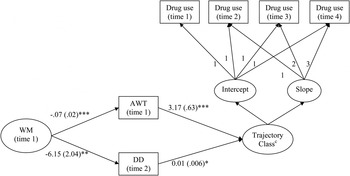
Individual probability of membership in the two latent classes was predicted by baseline scores of WM, AWT, and DD. Adolescents who had a high probability of being in the progressors group were more likely to have weak WM and had higher scores of AWT and DD at baseline (see Figure 3). The effect of weak WM on higher likelihood of membership in the progressors group was significant and fully mediated by the associated impulsivity dimensions of AWT and DD, β (SE) = 0.26 (0.12), p < .05. There was no direct effect of WM on latent class membership, β (SE) = –0.23 (0.19), p = .21. Although SS was correlated with AWT (r = .38, p < .001), SS did not predict latent class membership, once the effect of AWT and DD was controlled. This was anticipated inasmuch as SS tended to be positively correlated with WM over the waves of the study (r T1 = .05, r T2 = .17, r T3 = .12, r T4 = .15), as has been reported in previous analyses with this sample (Romer et al., Reference Romer, Betancourt, Brodsky, Giannetta, Yang and Hurt2011). Because SS did not have a significant predictive or mediating role, it was not included in the final model.
Preexisting weaknesses in working memory predict latent classes of adolescent drug use trajectories. *p < .05, **p < .01, ***p < .001. WM, Working memory; AWT, acting without thinking; DD, delay discounting. cThe trajectory class variable represents latent probabilities of belonging to the progressors class as compared to the low/nonusers class. Regression coefficients on significant paths represent the effects of background variables on being in the progressors class versus the low/nonusers class. Higher scores on AWT (odds ratio = 23.8, p < .001) and DD (odds ratio = 1.01, p < .05) were associated with greater likelihood of being in the progressors than the low/nonusers class. The mediated effect of WM suggests that high WM at baseline was inversely related to AWT and DD, resulting in a net lower likelihood of belonging to the progressors than the low/nonusers class. There was no leftover direct effect of WM on trajectory class membership. The effect of age, sex, and socioeconomic background was covaried out.

Given that the experimenters and the abstainers were grouped together in the low/nonusers latent class, in a separate follow-up analysis we further explored the differences between the experimenters (who reported yes to at least one common drug on at least one measurement occasion) and the abstainers (who reported no recent drug use on all occasions), especially in terms of underlying vulnerabilities. The experimenters comprised about 14% of the low/nonusers class (n = 267), and had low and intermittent drug use patterns across all four waves. Findings from a logistic regression analyses conducted with the low/nonusers group (n = 267) revealed that the experimenters had marginally high rates of SS as compared to the abstainers, β (SE) = 0.27 (0.15), p < .08, but were nondistinguishable from the abstainers in terms of their WM, AWT, and DD scores. We also compared the experimenters with the progressors, and found that the experimenters did not share the underlying weakness in WM, AWT, or DD as was the case with progressors. The net effect of weak WM on the likelihood of being in the progressors group as compared to the experimenters group, as mediated by AWT, β (SE) = 0.09 (0.03), p < .05, and DD, β (SE) = 0.08 (0.03), p < .01, was significant. Mean SS scores across these two groups were not statistically different.
Discussion
This study was designed to assess the translation of a neurobehavioral imbalance model of addiction derived from research with animals (Belin et al., Reference Belin, Mar, Dalley, Robbins and Everitt2008; Everitt et al., Reference Everitt, Belin, Economidou, Pelloux, Dalley and Robbins2008) to the prediction of early drug use patterns in human adolescents. Repeated assessments of drug use in a community sample of early adolescents (ages 11–13 at baseline) were analyzed to distinguish between patterns of early drug use and to identify the role of WM and mediating forms of impulsivity as predictors of these distinct drug use patterns. We found clear evidence of two latent classes in our early adolescent sample: low/nonusers and progressors. Progressors had higher baseline drug use scores and were more likely to use multiple drugs persistently and increasingly over the course of the study. The low/nonuser group included those who occasionally experimented with drugs (with no consistent pattern of use) as well as those who abstained from any form of drug use over the course of the study. As such, the first main finding of our study is that early use of drugs is not a uniform phenomenon and only some early initiators go on to exhibit progression of drug use during adolescence.
Our findings also supported the neurobehavioral imbalance model, which predicts that forms of impulsivity (AWT and DD) characterized by heightened sensitivity to immediate rewards and weakness in executive control (WM) are important precursors of drug use progression in early adolescence. At the same time, the model predicts that these forms of impulsivity are distinguishable from another personality dimension that has often been identified as a risk factor for drug use, namely, SS (Colder et al., Reference Colder, Hawk, Lengua, Wiezcorek, Eiden and Read2013). Consistent with what has been observed in research with rats (Belin et al., Reference Belin, Mar, Dalley, Robbins and Everitt2008), we found that SS was marginally predictive of early occasional experimentation with drugs in our sample. However, it was not predictive of progression in drug use once the effects for AWT and DD were controlled. These findings suggest that adolescents high in SS may be better able to exert executive control by virtue of their greater WM ability, and thus are likely to be protected from early progression of drug use. Impulsivity dimensions characterized by weakness in WM and not merely by heightened reward seeking are predictors of risk for chronic and heavy drug use (Dawes et al., Reference Dawes, Antelman, Vanyukov, Giancola, Tarter and Susman2000; de Wit & Richards, Reference de Wit and Richards2004; Gullo & Dawe, Reference Gullo and Dawe2008; Tarter, Kirisci, Habeych, Reynolds, & Vanyukov, Reference Tarter, Kirisci, Habeych, Reynolds and Vanyukov2004). Thus, our study provides the first test of the imbalance model for early drug use in humans and shows how an imbalance between the reward and control systems can lead to early progression of drug use.
The findings also extend research done with animals by showing that AWT in addition to DD is an impulsivity dimension that predicts drug use escalation. In the research by Everitt et al., rats that displayed steeper discounting of delayed rewards exhibited greater behavioral risk for addiction while rats with SS phenotypes did not (Everitt et al., Reference Everitt, Belin, Economidou, Pelloux, Dalley and Robbins2008; Everitt & Robbins, Reference Everitt and Robbins2005; Dalley et al., Reference Dalley, Everitt and Robbins2011). The present study shows that AWT, which also reflects weakness in executive control, is an additional vulnerability factor for drug use escalation in early adolescence. Recent review of animal models suggests that these two dimensions of impulsivity may play unique roles during the different phases of the addiction process (Winstanley et al., Reference Winstanley, Olausson, Taylor and Jentsch2010). Specifically, impulsive action (characterized by AWT) appears to be a stronger predictor of drug use progression, whereas impulsive choice (characterized by DD) is more closely related to drug use relapse. In our young sample of human adolescents, we find that the effect of AWT on drug use progression tends to be much stronger than DD. Nevertheless, weakness in top-down control as evidenced by low WM and high levels of both types of impulsivity (DD and AWT) was predictive of early progression in drug use.
Support for the imbalance model also highlights the reality that not all adolescents are subject to heightened risk taking as many have suggested (Casey & Jones, Reference Casey and Jones2010; Steinberg, Reference Steinberg2004). Although sensitivity to reward increases during adolescence as indexed by increased attraction to novel and exciting experience (Romer & Hennessy, Reference Romer and Hennessy2007), youth with relatively weak executive control systems are far more susceptible to adverse consequences of risk taking. In our study, adolescents who occasionally experimented with drugs (but were not on a progressive drug use trajectory) did not exhibit weaknesses in WM at baseline. From a purely analytic perspective, the occasional experimenters were indistinguishable from the abstainers in terms of patterns of drug use and the underlying vulnerabilities. The heightened novelty seeking that characterizes adolescence (and “occasional experimenters” in our study) is an evolutionarily adaptive tendency that encourages separation from parents and exploration of new identities (Spear, Reference Spear2010). In contrast, the more adverse forms of risk taking observed during adolescence, such as early progression in drug use, are linked with deficits in impulse control and other risk factors that are evident even prior to adolescence (Moffitt et al., Reference Moffitt, Arseneault, Belsky, Dickson, Hancox and Harrington2011).
The finding that early weakness in WM and associated forms of impulsivity were predictive of progression in use of all three drugs adds to the conclusion that weakness in executive control can predispose to risk for SUD. According to the imbalance model, increasing use of addictive drugs will eventually undermine executive control over the use of those drugs, a phenomenon observed in both animals (Dalley et al., Reference Dalley, Everitt and Robbins2011) and humans (George & Koob, Reference George and Koob2010). Given that all three drugs were involved in the progressive trajectory, the risk for loss of control over drug use will likely be magnified in adolescents using more than one drug at the same time. Although we did not assess SUD at this young age, our findings suggest that youth on the high-risk trajectory, given their chronic patterns of drug use, will be at greater risk for SUD as they reach late adolescence. Likewise, in a longer follow-up, it may be possible to examine the adverse impact of chronic drug use on impulsivity (Goldstein & Volkow, Reference Goldstein and Volkow2002) and the underlying executive control system (Squeglia, Schweinsburg, Pulido, & Tapert, Reference Squeglia, Schweinsburg, Pulido and Tapert2011).
A longer follow-up may also reveal that some of the occasional experimenters in our sample exhibit a developmentally limited rise of drug use during late adolescence, resembling the “adolescent-limited” group in Moffitt's theory (Moffitt, Reference Moffitt1993). The “early progressors,” by comparison, are more likely to have a developmental trajectory of drug use that is akin to the “life-course persistent” group. Although SS may become a significant predictor of drug use frequency during later years (Cyders et al., Reference Cyders, Flory, Rainer and Smith2009), the imbalance model predicts that this rise would be limited to the adolescent period and would decline along with the decline in SS by early adulthood (Littlefield et al., Reference Littlefield, Sher and Wood2009).
Although studies modeling heterogeneity in early drug use behaviors are fewer in number, the latent classes obtained in our analyses are consistent with past findings, with a few exceptions of studies that involved larger sample sizes (Colder et al., Reference Colder, Campbell, Ruel, Richardson and Flay2002; Tucker, Ellickson, Orlando, Martino, & Klein, Reference Tucker, Ellickson, Orlando, Martino and Klein2005). Our sample is also unique in that it is a community-based urban sample and thus relatively higher risk as compared to school-based samples used in previous studies. Therefore, the typical variations in normative patterns of drug use may be limited in our sample. Nevertheless, our two-class solution is in line with the developmental patterns of early drug use (Maggs & Schulenberg, Reference Maggs, Schulenberg, Galanter, Lowman, Boyd, Faden, Witt and Lagressa2005) and resembles past findings with early adolescent samples (Chassin, Flora, & King, Reference Chassin, Flora and King2004; Li et al., Reference Li, Duncan and Hops2001; White, Pandina, & Chen, Reference White, Pandina and Chen2002). Furthermore, our classes were of meaningful sizes (>5%) and had practical implications, a criterion that is often overlooked resulting in overextraction of classes (Bauer & Reyes, Reference Bauer and Reyes2010). During later years, we do expect the number of drug use trajectory classes in our sample to increase. Specifically, the experimenter group is expected to diverge into two groups: the consistently low users/abstainers and the developmentally limited high users.
Implications for intervention
By empirically testing the neurobehavioral imbalance model of the etiology of SUD, the present study identified the individual vulnerabilities that precede and predict dysfunctional forms of early drug use and serve to distinguish it from the more normative experimentation with drugs. The core deficits in top-down control over impulsive tendencies that we examined can be detected at an early age and are found to act as “developmental snares” (Moffitt et al., Reference Moffitt, Arseneault, Belsky, Dickson, Hancox and Harrington2011), predisposing the adolescent to other risks besides SUD (Krueger et al., Reference Krueger, Hicks, Patrick, Carlson, Iacono and McGue2002). Therefore, targeting these weaknesses at an early stage may prove to be more advantageous than simply delaying the age at onset of drug use. Because many of the risk factors that predispose youth to risk for SUD were shared by the early progressors and not the occasional experimenters (George & Koob, Reference George and Koob2010), our results tend to suggest that the robust association observed between early drug use initiation and SUD (Grant & Dawson, Reference Grant and Dawson1997; Hawkins et al., Reference Hawkins, Graham, Maguin, Abbott, Hill and Catalano1997) is more likely attributable to early escalation in drug use than mere experimentation. Interventions that can reduce adolescents' vulnerability to progressive drugs use during younger years may also help reduce their risk of developing SUD later in life.
Our findings pertaining to the role of WM highlight the potential of cognitive training interventions as a means for enhancing executive control (Diamond & Lee, Reference Diamond and Lee2011). WM training-based interventions (Jaeggi, Buschkuehl, Jonides, & Shah, Reference Jaeggi, Buschkuehl, Jonides and Shah2011; Klingberg, Reference Klingberg2010) could be considered as a potential means to reduce problematic drug use during adolescence and later SUD risk. To improve chances of far-transfer effects on to behavioral control, WM training could be delivered in combination with problem-solving and social-skill building interventions that provide a context to translate cognitive skills into behavioral change (Botvin & Griffin, Reference Botvin and Griffin2004; Greenberg, Kusche, Cook, & Quamma, Reference Greenberg, Kusche, Cook and Quamma1995). Interventions that can improve self-control can be especially helpful for preventing adolescents from embarking on potentially harmful forms of drug use by targeting an important underlying vulnerability (Moffitt et al., Reference Moffitt, Arseneault, Belsky, Dickson, Hancox and Harrington2011). Early detection can also help in delivering interventions at an early stage before the addictive and damaging drug use processes become more established.
Limitations
Our findings should be interpreted in light of the study limitations. First, because of lack of information, we could not account for the influence of other variables besides WM, such as family history of substance abuse (Dawson & Grant, Reference Dawson and Grant1998) and deviant peer influences (Dishion & Owen, Reference Dishion and Owen2002), that can impact adolescent drug use trajectories. Second, although our measure of recent (past 30 days) drug use was less subject to recall decay, it is limited in the amount of information it can provide us about the drug use patterns during the 12-month time period between assessments. Third, we did not examine reverse effects of substance use on WM (Brown & Tapert, Reference Brown and Tapert2004) and impulsivity (Bickel & Yi, Reference Bickel and Yi2008), because that was not the focus of this study and these effects were unlikely to have already developed given the still low levels of drug use in our early adolescent sample. By examining the effects of both WM and impulsivity prior to the escalation of drug use, we can be relatively confident that the patterns we observed were at least partly attributable to early vulnerabilities in WM and associated forms of impulsivity.
Conclusion
In sum, by testing an emerging neurobehavioral model (de Wit & Richards, Reference de Wit and Richards2004; Everitt & Robbins, Reference Everitt and Robbins2005), our findings reveal that individual differences in the balance between the reward motivation system and the executive control system influence early drug use patterns in human adolescents, much as they appear to influence the progression of drug use in rats. Thus, our findings highlight fundamental similarities in the functioning of mammalian brain systems that control the onset and progression of drug use. Our study also highlights the critical role played by WM as an indicator of the executive control system in predicting early forms of drug use, through its divergent associations with SS and impulsivity dimensions of AWT and DD. Specifically, we found evidence that impulsivity dimensions associated with weak executive control predated drug use onset and were associated with progressive patterns of drug use over time. Future research would benefit from systematically examining the role of distinct impulsivity dimensions and the underlying neural systems as predisposing risk factors in the development of drug use behaviors.