In this article, I follow Emmanuel Levinas's ethical theory of the face in conjunction with Gilles Deleuze and Felix Guattari's more political, though highly related, theory of faciality, which I interpret as a diagnosis of and commentary on the disciplinary situation in which subjects are created through a process of terrorizing and shaming.Footnote 1 In my reading of DV8 Physical Theatre's most celebrated work, Dead Dreams of Monochrome Men (1988), I take as the basis of my argument that social codes are physically inscribed within individuals through the instantiation of enduringly negative affective states and that choreographed variations of normative relations transform negative affect, loosen oppressive disciplinary bounds, and integrate individuals into an alternate, more ethical form of social discourse. I then argue that the choreographer of the piece, Lloyd Newson, ultimately strove to develop a redemptive ethics of sex and romance that could compete with and replace the restrictive sexual ethos that social forces were intent on imposing upon gay men, and I contend that he sought to do so by delving into what he felt to be at the very core of the ethical problems encountered by gay men in their romantic and sexual relations—namely, the men's fears of vulnerability and their toxic shame about their sexual identities.
Background
After a short run, DV8 Physical Theatre's Dead Dreams was restaged for film in collaboration with the director David Hinton, and the resulting fifty-minute film was aired on the BBC. Newson remarks that during this time, his way of working was “calculated to cause controversy” (Arditti Reference Arditti1993), and indeed the frank presentation of gay male sexuality in the film did just that. One headline the next day read “Gay Sex Orgy on TV” (Arditti Reference Arditti1993). In the performance, we observe the four men of DV8 alternately playing Dennis Nilsen and his victims in scenes reminiscent of those discussed in Killing for Company (1985), Brian Masters's biography about England's first known gay mass-murderer. The two main settings for the film are likewise drawn from the book: a gay disco, where Nilsen met several of his victims, and the various rooms of his apartment, where he murdered them. However, Lloyd Newson insists that the work was even more informed by the personal experiences of the performers in the piece. As Newson says, “We four men fed our lives into it” (Shank Reference Shank1993, 18).
One of the events of their collective lives that undoubtedly influenced the performance was the AIDS crisis, which in 1988 was near its height. In his groundbreaking work, Policing Desire, Simon Watney writes that AIDS “involves a crisis of representation itself, a crisis over the entire framing of knowledge about the human body and its capacities for sexual pleasure” (Reference Watney1989, 9). I would argue that Dead Dreams of Monochrome Men was intended in part to counter the negative way that homosexuals were being portrayed in the midst of the AIDS crisis, as supported by Newson's assertion that the parliamentary discussion on clause 28—in which funding for homosexual art was debated and his work was mentioned—was one of the motivations for the performance (Giannachi and Luckhurst Reference Giannachi and Luckhurst1999, 108).
Watney declares that at the root of England's problematic response to the AIDS epidemic was, first, “an inability” among public officials and caregivers to identify “with the vast majority of those most closely affected by the illness” (Reference Watney1989, 86), and second, a fear among people in general that homosexuality was somehow itself contagious (49). He also remarks on the way in which the AIDS crisis intensified the negatively tinged affective identities that gay men had acquired as a result of their difficult processes of socialization, since at this time many groups were accusing homosexuals of being immoral, citing homosexuality as the cause of the epidemic, and using AIDS “to articulate profound social fears and anxieties” (8) about gay men. On the basis of this general social background and Newson's own imbrication in it, I believe that Newson hoped through his presentation of intense physical and emotional suffering, abjection, and vulnerability in the performance to work against the prevailing lack of compassion for gay men in society and to unwind the affiliation of fear and shame that formed the core of gay sexual identity.Footnote 2
Watney comments that, “How we individually think of AIDS, and respond to it, depends on our own relationship to our own sexuality—at least in so far as AIDS is endlessly and inaccurately read as a venereal disease, like syphilis or gonorrhea, rather than the result of a blood disease” (Reference Watney1989, 10), and he argues that in order to fight the notions prevalent in a society where AIDS is conceived negatively as a “moral issue” (48), it is necessary “to adopt a ‘pro-(safe) sex’ position, to affirm the multiple erotic possibilities of our own bodies and other people's, and to challenge bigotry on our terms, rather than those supplied by the bigots” (76). Newson's decision to portray gay male sexuality on stage as explicitly as he did would suggest that he had a similar idea in mind.
In the 1980s, gay men had commonly been framed as perverts in a negative sense, and it is clear from Newson's choice of name for his group (“DV8” = “deviate”/“deviant”) that Newson wanted to affirm the positive potential of perversion through his work. But I would argue that he ultimately wished to go beyond perversion and that he himself should be thought of as what Deleuze might call a schizo-masochist—i.e., someone who draws shame and terror to himself to the absolute limit, in such a way that these negative affective impressions are able to flip over and become something positive and affirming. Newson understood that in order to avoid the potential pitfalls of perversion, vulnerability needed to be embraced, shame needed to be burned out completely, and compassion had to be planted in its place. He also understood the gestural ways that a superseding of perversion might be portrayed.
The Performance
Levinas (Reference Levinas and Lingis1969, 72) argues that in the reality of our ethical relation with others, we can in no way expect from them what they can expect from us. We are here for them; they are not here for us. In this sense, we experience them as commanding us from on high. Unethical relations, in contrast, enact inversions of this ethical inflection, and that is indeed exactly what we see graphically illustrated in much of DV8's performance: men start out on a planar field of relations and then work very hard to put others beneath them. All of the vignettes furthermore have one thing in common: the distortion emerges from one or more of the individuals ignoring or misrecognizing their ethical obligations to each other. Instead of heeding the command of their partners and, as Levinas would say, substituting themselves in suffering for the suffering of another, they act to force the other person to take on their suffering for them, and by so doing, they simply compound their own suffering with the suffering of another.
But at the same time, the performance of the dancers themselves is profoundly ethical in regard to their relation to “the face” of Nilsen. In Levinas's Totality and Infinity, the face is conceived of as a suffering surface of expression that exceeds “the idea of the other in me” (Reference Levinas and Lingis1969, 50), and in Otherwise than Being, as the trace of a trace of an absence (Levinas Reference Levinas and Lingis1981, 90). I would say that during DV8's preparation for Dead Dreams, the face of Nilsen as absolute expressiveness was felt by the dancers through their relation to his writings, which impacted upon them and inspired them, and that the face of Nilsen as irrecoverable absence was felt more in the midst of the performance. Levinas makes clear that his concept of “the face” is not reducible to the phenomenal face and that to the extent that it is phenomenal, “the face” overlaps with the body. As he says, “the whole body—a hand or a curve of the shoulder—can express as the face” (Levinas Reference Levinas and Lingis1981, 262). He also insists that the face is something that we respond to more than we perceive. In the performance, we sense Nilsen in physical absence and ethical lapse, Nilsen in irrevocable withdrawal, as the source of the representational slippage from the performers as themselves to the performers as Nilsen to the performers, as Nilsen's victims. We watch and witness the performers in the grip of the compulsion that they discover in the murderer's face, being impelled to substitute themselves in suffering for his suffering, making themselves vulnerable, performing their own unethical behavior, sadness, loneliness, and despair that relate to the lived events and condition of Nilsen, and in our visceral reception of and compassionate response to their gestural expressions of pain and yearning come to know both their faces and Nilsen's.
The first scene of the performance takes place in a gay disco and seems to draw its initial inspiration from a quote from Nilsen that was included in the program: “I was left with an endless search through the soul-destroying pub scene and its resulting one-night stands … passing faces and bodies, the unfulfilled tokens of an empty life. A house is not a home and sex is not a relationship. We would only lend each other our bodies in a vain search for inner peace” (Masters Reference Masters1985, 104–5). Here, the performers are, as Newson says explicitly, “slaves to their desires and the environment they” inhabit, “victims of the sadness and oppression which” (Shank Reference Shank1993, 13) surrounds them. The flashing lights and repetitive beat of the disco resound in the background, making the disco a site in which individuals can literally say nothing. It is a place of erotic play, where the possibility of ethical discourse is stifled.
Newson choreographs a dance of the totalizing gaze—a type of gaze that acts, as Levinas would say, to reduce the Other to Same. At the beginning we observe four men—Lloyd Newson, Nigel Charnock, Russell Maliphant, and Douglas Wright—lined up along the wall, looking out to the dance floor, and experiencing the action vicariously. As Levinas remarks, our greatest desire is for the silence and deadly seriousness of a face-to-face encounter—to become naked beyond all nudity, vulnerable beyond all vulnerability, in ethical relation with another (Reference Levinas and Lingis1981, 49). In the scene of the men at the club, we get a presentation of the erotic distortion of the ethical encounter. Each in his own way, they are all Dennis Nilsen, trying to find whatever short-cut they can to experience the safe and pleasant semblance of an ethical connection.
Levinas remarks that in a distorted situation, one does violence to the Other and isolates oneself (Reference Levinas and Lingis1969, 229–30). One is like the mythical Gyges, seer but unseen, a person who maintains contact but without deriving his being from this contact. Levinas writes that “Gyges is the very condition of man, the possibility of injustice and radical egoism, the possibility of accepting the rules of the game, but cheating” (Reference Levinas and Lingis1969, 173), and says further that,
The myth of Gyges is the very myth of the I and interiority, which exist non-recognized. They are, to be sure, the eventuality of all unpunished crimes, but such is the price of interiority, which is the price of separation. The inner life, the I, separation are uprootedness itself, non-participation, and consequently the ambivalent possibility of error and of truth. (61)
In the ethical encounter, subjectivity emerges as a result of the violent passage of the Other: one becomes subject to the Other. But in the unethical encounter, the other becomes subjected to us and our narcissistic demands, and as a result, we no longer can be said to have any real (viz., ethical) subjectivity. In the unethical situation, we have only what Deleuze and Guattari in their related theory of faciality describe as a social subjectivity that is derived from our relation to the gaze of an abstract and imagined disciplinary agent.
I believe that Newson's commentary on the gaze follows a very similar line of thinking and inevitably includes the audience in its critique. To stand at a comfortable remove from relation is to stand in a position of insecurity. Fearing rejection and pain and demanding immediate pleasure to still his worries, the insecure man “totalizes” the other by means of imagination. As we see demonstrated in the performance, if such a man gets pleasure enough, he might allow himself to feel love, but it will only be a very tightly bound circuit of affection that results. Newson implies that the insecure man will always find himself stuck in the paradoxical situation of trying to open up from a position of closure—trying to vampirically suck life from others in order to fill the hole in himself that will never be filled—for what the man really desires (the ethical relation) has been disallowed him by his very own actions.
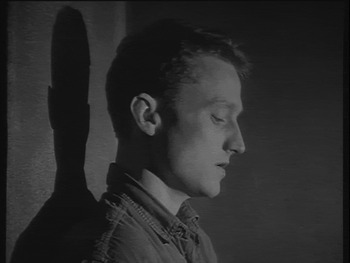
In the first shots of the performance, the men exchange glances with each other, as though looking for a potential partner. Newson steps away from the wall, walks past Maliphant and Wright, without receiving any positive response from either. He then looks directly at Charnock. Hinton, the director, subsequently gives us a close-up shot of Charnock's face (Photo 1). It is what Deleuze would call an “affection-image” (Deleuze Reference Deleuze, Tomlinson and Habberjam1986, Reference Deleuze and Guattari87), and it signals both the emotion and problem that is at the center of piece. Charnock's face expresses his absence of a feeling of self-worth. What is he most vulnerable to? Not to his immediate others, it seems, but to some psychological disturbance, some history of personal shaming, as evidenced by a clear example of what the psychologist Silvan Tomkins (Reference Tomkins2008) would label the shame response: loss of tonus in the head, neck, and shoulders, gaze turned downward and away.Footnote 3 Charnock is afterward dismissed by Newson, who turns away in disappointment from Charnock's obvious desperation and self-loathing.
DV8 Physical Theatre's Dead Dreams of Monochrome Men (1989; London: Arthaus, 2007). Nigel Charnock's profile (Nicholas D. Knowland, cinematographer; David Hinton, director). Used with permission from Arthaus Studios.

Minutes later, when Charnock notices the successful meeting of two other men, the shame response intensifies and spreads through a deepening engagement of his body, which begins contracting into a posture of beggarly submission: arms down, palms out, mouth open, and knees slowly bending down and to the ground. His whole body eventually assumes the attitude of some kind of dog-like, aching, silent scream. In a sense, his body apologizes for his inability to face, to connect, to be. But it is not what Levinas would identify as an ethical apology made to others, nor any kind of attempt to repair the separation that Charnock has in some sense caused. Instead, it is a hateful and desperate confession made to an imagined and internalized other. Therefore, it simply isolates and excludes him, and it does not appeal.
Charnock and Newson are presented as being at two equally dysfunctional poles of relationship. Like Charnock's visage, Newson's exudes loneliness, sensitivity, and desire, but unlike Charnock, Newson is aggressive. Newson's gaze holds steady but is nevertheless unsettling because it seems merely to seek an openness within his partner without also allowing for a reciprocal openness on Newson's part. Driven by his own desperation, Newson apparently wants to feel the solidity of another body against his hands, against his lips, and wants to get to the feeling quickly. Thus his caress takes on the violent qualities of what Levinas distinguishes as grasping. Maliphant, Newson's quarry, compulsively and uncomfortably turns away—an action that perversely excites rather than deters Newson, as suggested by the demonstration of physical resonance that Hinton details for us in a mid-range shot. With Maliphant's back toward him, Newson begins miming Maliphant's gestures and then moves closer, trying to get Maliphant's eyes to acquiesce to his advances.
At the moment when Maliphant drops his gaze in a shame response and disengages from the gaze of Wright, who has moved to the dance floor, Newson puts his arm around Maliphant's waist while looking away, and Wright, in anger and shame, turns his face away, too, in a sequence that succinctly illustrates the disruptive effect of shame in relationships. Afterward Maliphant, sunk in the misery of the seeming rejection and loss of connection to Wright, does not deny Newson's contact. Newson proceeds to maneuver Maliphant's body into various forms of embrace, places Maliphant's arms up and against the wall in a posture of full submission, and gropes and kisses Maliphant. However, it would seem that Newson, driven by his shame to try to find love in the satisfaction of physical desire, remains insular, encapsulated by his enjoyment, can only love the image projected by his narcissism—can only love something already inside himself, for he only once meets Maliphant's eyes and never notices Maliphant's increasing discomfort, nor even his eventual departure.
Maliphant leaves Newson in order to return to Wright. In terms of the ethics of the relation, we may say that what appeals is Wright's soft, steady gaze, his confidence, his seemingly solid connection to a ground that supports him and that makes it possible for him to support others. What also appeals is the angling of his body away and the maintenance of his distance, as if Wright is not needing relation, but inviting it, and allowing the room necessary for a positive affective resonance to take place. Earlier in the scene, we saw this affective resonance developing as Wright and Maliphant started to move in rhythm with each other across the dance floor and breaking off once Newson placed his hands on Maliphant. After Maliphant detaches from Newson and approaches Wright directly, we notice Maliphant try to go deeper into affective relation with Wright by connecting eye-to-eye at close range. In this moment of reengagement, however, Wright's gaze has become blank, and he acts as if he must be won over by expressions on Maliphant's part of a willingness to touch and submit.
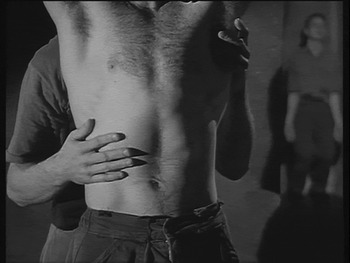
The shift toward a more explicitly erotic encounter manifests itself in a further distortion of their once solid eye-to-eye gaze. Wright gropes Maliphant under his shirt while hardly looking at his face, and then pushes him to a darker area, near a pillar, for sexual role-play. Simultaneously in the background on either side of the pillar, we see an image of Charnock, who is shivering in his silent scream, and Newson, blinded by a totalizing desire for the Other and still groping and kissing an empty police outline laid out in the place where Maliphant had been. The logic of the film image implies that the romantic pair in the foreground is in much the same psychic space as those in the background. Wright lifts Maliphant's shirt up, covering Maliphant's head and exposing the torso (Photo 2). The camera moves in close to show Wright's caress suddenly become a vicious slap and Maliphant's belly flinch away. And in that moment, the dark spots of Maliphant's nipples and navel against the white of the skin are oddly reminiscent of a face, an effect augmented by a quick cut to a close-up shot of Charnock's visage, open-mouthed, voyeuristic, followed immediately by Maliphant's, looking down in disappointment, hurt, and pain. Afterward, Wright remains clothed but strips Maliphant to his underwear, then blindfolds him and ties Maliphant's wrists behind his back with the cast-off clothing: instead of the opportunity to answer to the ethical command of his partner, Maliphant simply receives dominance and brutality.
Levinas suggests that the ethical relation may be envisioned as a physical inversion of the disciplinary relation:
The truth of being is not the image of being, the idea of its nature; it is the being situated in a subjective field which deforms vision, but precisely thus allows exteriority to state itself, entirely command and authority: entirely superiority. This curvature of the intersubjective space inflects distance into elevation; it does not falsify being, but makes its truth first possible (Reference Levinas and Lingis1969, 291).
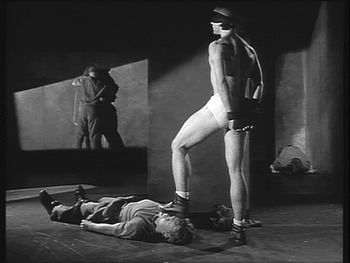
In the interaction of Wright and Maliphant, we do get an apparently similar moment (Photo 3). Wright curls into a fetal position, presses the side of his face to the ground, and places Maliphant's foot squarely on the other. Then Wright quivers and contorts until his forearms are held between his thighs. In this position, Wright's posture is essentially a prone variation of the one held by Maliphant standing, implying some kind of inner sympathy between the two. However, what is represented is nothing more than a failed attempt at ethical union. The fact that their faces and hands—the most gesturally expressive surfaces of their bodies—remain bound and covered suggests first of all that there can be no emotional resonance, and no real connection. And perhaps for a moment we can imagine Wright persuading himself of the reality of his union with Maliphant, subjugated as they both seem to be by the same powerful forces. But what gets graphically illustrated is, I would say, simply the situation of two people isolated and disconnected, their bodies curved inward by the affective imprint of shame. When Wright is broken from the fantasy of union by the slip of Maliphant's foot, Wright gets up in anger and disgust, and, as if to prove the veracity of his independence and the power of his will in the scenario, begins playing cop with Maliphant more violently, forcing the latter to “spread’em” against the wall, tugging at the waistband of Maliphant's underwear, making Maliphant's hips move back and forth, and then roughly tearing off Maliphant's blindfold to signal that they are done.
DV8 Physical Theatre's Dead Dreams of Monochrome Men (1989; London: Arthaus, 2007). Douglas Wright's arm, Russell Maliphant's torso, Nigel Charnock in the background (Nicholas D. Knowland, cinematographer; David Hinton, director). Used with permission from Arthaus Studios.

This sequence can be analyzed from a Deleuzian perspective as constituting a facing away-facing relationship of perversion. Deleuze's gestural understanding of perversion is shown most distinctly in his comments on his early relation to the discipline of academic philosophy: “I suppose the main way I coped with it at the time was to see the history of philosophy as a sort of buggery or (it comes to the same thing) immaculate conception. I saw myself as taking an author from behind and giving him a child that would be his own offspring, yet monstrous” (Deleuze Reference Deleuze and Joughin1995, 6). The perverse facing away-facing relation varies the disciplinary face-to-face relation. In the most simple face-to-face disciplinary relation, the individual caught by the panoptic gaze of the authority figure turns away in fear and at the same time turns inward through guilt to become a subject who obeys. In the perverse relation, in contrast, the initial turning away may begin as something like the fear and shame reaction, but it is eventually taken over by something else. The looking away becomes an evasion, which is an active choice rather than a passive, automatic reaction. And the turning toward the other who is turned away is of course a very willful subversion, in which one chooses to extend to another that productive, asocial potential that arises in the initial turn away. In an effective use of perversion, individuals take over the process of disciplining and turn it toward other, more positive ends. As part of this procedure of redirection, terror normally turns into excitement and shame turns into shamelessness, but Wright and Maliphant fail to enact this transformation because, in their attempt at perversion, the ends remain the same as those of the hetero-normative forces of society: the terrorizing and demoralizing of gay men. They just wind up acting out their responsibility to the state, without ultimately experiencing much inner transformation.
Deleuze describes the relation that succeeds perversion as a double-facing away/schizoid relation, and in the image of Maliphant with his foot on Wright's face, we notice a close representation of such a relation.Footnote 4 However, this depiction evokes nothing more than a semblance of the schizoid relation, since the relation between the dancers is vertical, rather than planar, meaning, in part, that there is no deep sympathy here, no equality in mutual embrace of vulnerability, nor compassion in recognition of each other's suffering. The two stay in the grip of their shame and fear, lacking the faith that would enable them to move on.
DV8 Physical Theatre's Dead Dreams of Monochrome Men (1989; London: Arthaus, 2007). Douglas Wright on the ground, Russell Maliphant standing (Nicholas D. Knowland, cinematographer; David Hinton, director). Used with permission from Arthaus Studios.

In viewing this scene, the members of the audience are each of them, in Levinas's terms, Gyges, and in Deleuze's terms, perverts. But in being exposed to the extreme vulnerability and undeniable suffering of the performers, the audience is, as Levinas would say, called to account and compelled to respond from a profoundly pre-personal and pre-conscious level. Are they going to remain at a safe remove? Are they going to continue to look down from above, or not? At least from the perspective of the audience members engaged in emotional resonance with the performers, the reality of the suffering of the players becomes irrefutable, and the realization of the value of compassion becomes inevitable. In these moments when the performers abandon themselves to the expression of their misery and devastation, we no longer read the affect on the surfaces of their faces and bodies; it registers immediately within us, and we plunge inward toward the feeling of compassion that naturally arises. This relation between performer and audience of pre-personal vulnerability and deep, inner sympathy is, I believe, the ultimate schizo-relation that Newson works toward through his presentation of the performers' failure and dysfunction.
Substitution
In subsequent scenes, Newson further develops the idea that murder is the logical extension of the uneven relational dynamics perpetuated by society. Newson does so by portraying throughout the middle portion of the performance an acceleration of the consequences of unethical relations, which eventually culminates, during the late scenes, in some fairly explicit references to Nilsen's crimes. For instance, a scene between Charnock and Wright reflects many of the details of Nilsen's assault on his victim Paul Stottor, whom Nilsen repeatedly strangled and revived one evening. The scene begins with Charnock leaping onto Wright's shoulders and smothering Wright's face while the latter, in increasing terror and desperation, tries to push him away. It ends with the first full presentation of a murder in the show, and afterward, the remaining dances are all done with one or more of the performers playing a corpse.
A different quality clearly pervades the latter dances because of the extent of the displacement going on, i.e., the earlier scenes can be said to be related to the performers’ personal lives, but the last few scenes cannot, for certainly the dancers have never gone so far as to kill anyone. In this last part of the performance, then, we see the dancers substituting themselves in suffering for the suffering of Nilsen (and his victims) in a way that we have not thus far seen. There is a transcendent quality to these sequences, not only in the way the performers relate to each other on stage but also in regard to the overtly religious types of music and symbolism Newson chooses. The transcendent quality imbues the final scenes with a strange and abiding sense of extreme tenderness, and I would say, invites a Levinasian analysis even more than the earlier segments of the performance.
In the scene following the first murder, beautiful church bells chime as Newson in the role of the murderer puppets Maliphant's limp form, holding the dead Maliphant up to the mirror and moving with him in a dance that evokes Newson's desperate desire to be responded to. The dance is not so much an apology for what Newson/Nilsen has done as an apology for who he is: unworthy of love, incapable of really loving himself or others, but needing it, crying out for it, in a way we cannot help but be affected by. In one moment, Newson makes the dead Maliphant embrace him from behind, puts Maliphant's hands tightly between Newson's thighs, and then lets them slip slowly out across Newson's crotch. In another, Newson drapes Maliphant's hand on Newson's shoulder and then lets the dead hand drop the length of Newson's torso. Newson tries a hundred different combinations of movements: anything, anything, anything so that he can pretend that Maliphant is caressing him. And what is affecting for us is the regret—the plain desire for a face-to-face relation that is expressed through this dance of loss and failure.
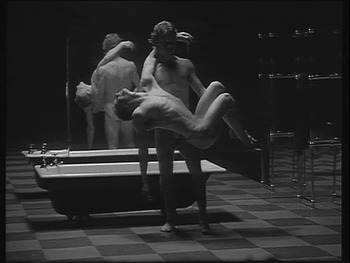
In the next room, we see Wright-as-Nilsen, trying to do a slow dance with Charnock, but eventually having to just resort to carrying him. Following Levinas, we would say that the character of Wright murdered the character of Charnock in the first place because of Wright's unethical insistence that Charnock act as a support to slow Wright's descent into death. But here we see the proper ethical reversal, where Wright is forced to fully support the dead Charnock. Wright drags Charnock upside down by the legs, and the image is that of a crucified Christ. Once in the bathroom, Wright strips down to his underwear, like Charnock, and spoons with him, then, after a pause, rolls over and slams his body into Charnock's in an apparent attempt to make Charnock seem to come alive in fits and spasms. But Charnock just remains in the same lifeless state throughout. Wright sits Charnock against the tub and two times lifts Charnock's head to look at him face to face, but Charnock's head keeps falling down. Wright then strips the underwear from himself and Charnock and exchanges it, in the most desperate attempt yet to feel a sense of intimate contact. Afterwards, Wright picks Charnock up in order to bring him to the bath—an action that is reminiscent of Nilsen's practice of bathing and drowning his victims—but the image at that moment is also, unmistakably, that of Michelangelo's Pietà, with Charnock's one arm around Wright's neck and the other arm draping down (Photo 4).
DV8 Physical Theatre's Dead Dreams of Monochrome Men (1989; London: Arthaus, 2007). Douglas Wright holding Nigel Charnock (Nicholas D. Knowland, cinematographer; David Hinton, director). Used with permission from Arthaus Studios.

The imagery of Charnock as Christ imparts to Nilsen's victims a holy status, which draws from us sympathy for the men's suffering. At the same time, it conveys to us the sense that a more virulent form of Christian moralism may have contributed to the murder. This essential duality is reflected in the person of Wright's character, as well. In one image, he is depicted as someone who murders his victim in the most cruel way possible (through crucifixion), and in a second, he is portrayed in the role of the Virgin Mary in the context of the ultimate image of grief and compassion within the Christian tradition. I would argue that the duality of these images serves to present us as audience members with a clear choice. Will we make the ethical response of compassion? Will we, as Levinas would say, go to the limit of making ourselves a material support for the other and suffer for the suffering of this other so that there can be some form of resurrection?Footnote 5 The power of the Pietà image and the fact that it comes second effectively make the choice for us. But the question then becomes, will we continue to make this choice afterward?
We may query what it is that allows us to remain open enough to make this final choice. The Christian imagery that Newson employs suggests that it is a matter of faith. And indeed, in an interview Newson remarks that in Dead Dreams and other dances in the late 1980s and early 1990s, where his explicit intention was to show “vulnerability and failure on stage” (Newson Reference Newson1993, 11), he used Christian imagery to express the importance of having “faith in something outside of oneself” (Shank Reference Shank1993, 19). Translating this idea into Deleuzian terms, we would say that the faith required is one that is far removed from the ethos implicit within the construction of any kind of social (or even sexual) identity, and that the image of Christ in the above performance functions as a symbol to guide the individuation of choreographer, performer, and audience member to an asubjective position.Footnote 6
Going back to the image of the Pietà presented in the bathtub scene, we notice first of all that it is an image of a face away-face away relation, since Wright looks outward and Charnock's head and body twist downward. It also, in Deleuzian terms, signals the construction of a masochistic body without organs (BwO) that counters faciality. Charnock as a masochistic Christ-figure is raised and idealized, held suspended above the ground (of Being) by a maternal figure.Footnote 7 The logic of the image, with Charnock as not only the Christ, but the dead Christ, works, I believe, to ensure that the emotional infolding of loss, shame, and grief drives downward into a form of death/BwO that includes both performers and audience.Footnote 8 In the BwO that is constructed, the constraints of faciality are dissolved, the negativity of the affect is transformed, and the Charnock-Christ is, as it were, reborn in the compassionate opening of our hearts.
However, and quite significantly, this is not the moment that Newson chooses to leave us with. Charnock comes back to life within the piece and embodies Nilsen through an outward expression of Charnock's own nasty, needy, self-loathing inner aspect. Charnock emerges from the tub, like a strange sea creature of arms and legs, while Wright lies lifelessly on the ground, and in this form, Charnock is both fascinating and revolting. Climbing up from the bathroom into the rafters and then sliding back down the body of Maliphant that is now suspended by rope from the ceiling, Charnock passes on a last, slimy caress, and then falls dead upon the floor. Afterward, dragging in Wright as the third dead body, Newson puts on a record, which plays, “Stay awhile, I want to hold you… .” It is daybreak. Newson/Nilsen sits in the midst of the wreckage of the night before, all alone.
In this last scene, we are left with the sad irony of the song, an image of an inverted crucifixion (the suspended Maliphant), and a pervading sense of loneliness and alienation. The ending, I believe, seeks to lay the problem bare rather than impart a feeling of resolution. It is an ending that does not allow us as perverts to sit back comfortably and point fingers. Indeed, the only resolution comes in terms of our being together in the immediately felt reality of the situation and the shared sense of culpability for it. This is, of course, a discomfiting position to be placed in, and yet, it is the one that we have seen each of the performers assume. They have expressed the parts of them that are most shameful, despicable, and murderous. Rather than deny their inner kinship with the stranger who is Nilsen, they have gone to the limit of sympathy, whereby they actually became him. The performance evokes the idea that the difference the stranger embodies and that we normally think of as being external to us can be felt as something inside of us and is in fact at the very core of our beings. We are shown that to deny difference is to participate in a process that does violence to ourselves and others, and to embrace difference is to participate in the establishment of peace.
The Ethics of Sex
In the first of his major works, Totality and Infinity, Levinas develops a safe notion of marriage and “fecundity” as a way of resolving the problems associated with Eros (Reference Levinas and Lingis1969, 267). In addition, he speaks about sexuality as taking place outside of the sphere of ethics. He was roundly criticized for the heterosexist limitations of his analysis—most notably, by Luce Irigaray—and in his later work, never returned to the topic; nonetheless, if we are careful not to repeat his mistakes and if we furthermore follow the suggestion of the Levinasian critic Michael Marder and connect Levinas's analysis of Eros with Levinas's commentary on murder and violence, then we can, I believe, make an ethical analysis of sexuality on the basis of the real potential for grievous harm that can come out of it, and we may better understand how Lloyd Newson could not only empathize with Nilsen but also see Nilsen's situation as emblematic of the “problems relating to people” (Constanti Reference Constanti1989, 6) that so many other men faced.
Levinas implies that the ethical encounter with an Other impacts upon a person like a metaphysical form of rape, where the unassumable infinite that is inserted within the person leads to “a bursting of inwardness” (Levinas Reference Levinas and Lingis1987, 163). In his later work, Levinas discusses the Other's effect upon us in terms of “persecution” (Levinas Reference Levinas and Lingis1981, 56), “maternity,” impregnation, “the gestation of the other in the same” (75), and the situation of being held “hostage” (59). In the earlier work of Totality and Infinity, the Other is likewise tied to violence: “The Other, inseparable from the very event of transcendence, is situated in the region from which death, possibly murder, comes” (Levinas Reference Levinas and Lingis1969, 233). The Other's suffering surface of expression, the Other's “face,” “rends the sensible” (198), and I, fearing what I glimpse in the face of the Other, am subsequently tempted to murder in hopes of defending myself and regaining my power. As Levinas says, “I can wish to kill only an existent absolutely independent, which exceeds my powers infinitely, and therefore does not oppose them, but paralyzes the very power of power. The Other is the sole being I can wish to kill” (198).
In his direct commentary on sexuality, Levinas writes that the Other's beauty and fragility promises ultimate comfort, and yet the Other always retreats from me, “intact in her nudity” (Reference Levinas and Lingis1969, 258). In this moment of vacillation, in which I am continually thwarted in my attempts to reduce the Other to the state of being purely an object of my need, is found the essential fun of sexuality, what returns my lover and myself to “infancy” and “animality” (263). However, this moment of vacillation is also what makes it possible for the spheres of sexuality and ethics to collide in the dynamics of the “caress” (259). As a “future never future enough” (257), the Other incites me to further and further violence and social impropriety, while at the same time making me drop my guard. The more I am violated and laid open by the teasing play of the Other, the more I feel the wants and needs and reality of the Other, the more of the Other I am made to assume, the more intensely raw I feel, the more I want his tacitly promised hospitality for myself, the more I will strive to violate him to get it, and the more he will inevitably respond with attempts to violate me.
In the romantic relation, one is battered and enticed into greater and greater vulnerability, all the while assured by the dense rhythm of touches, movements, forms, words, sounds, and smells that one can receive the Other without bursting completely. Yet as a lover, there will always be something that can break one out of one's reverie: hurt, that one has allowed oneself to come too close to this Other before one was prepared; fear, at how one will be judged; shame, that one is undesirable and unworthy of love… . Perhaps it is simply that the lover's distance will continually reassert itself, and so will one's yearning. Perhaps one will be ripped out of one's daydreams by the lover's over-anxious challenges, by his own Bacchanalian attempts to rend and break. As Levinas would say, even the unpredictability of a lover's reactions can do this.Footnote 9
Because nobody can ever hurt one as deeply or as easily as a lover can, because of the depth of vulnerability to which one can be drawn, and because of one's expectations that are sure to be broken, there is always the danger that one will be confronted with what Marder (Reference Marder2008) calls “the facelessness of the face.” The face cracks open, the absolutely fraught, material inundation of the there is shines through, and then the unending work of recuperation that is responsibility may no longer seem possible—in fact, no recuperation at all may seem possible. In being confronted with the overwhelming horror of the there is, one will work to resist receiving it, will strike out at the person nearest, will try to open only on one's own terms and make the lover a thing of one's own will and understanding.
As we can see from Nilsen's description of the scene of his first murder, his fear of being abandoned is what originally drove him to kill his lovers:
He was on his side turned away from me. I ran my hand over him exploring him. I remember thinking that because it was morning he would wake and leave me. I became extremely aroused and I could feel my heart pounding and I began to sweat. He was still sound asleep. I looked down on the floor where our clothes lay and my eyes fixed on my tie. I remember thinking that I wanted him to stay with me over the New Year whether he wanted to or not. I reached out and got the neck tie. I raised myself and slipped it on under his neck. I quickly straddled him and pulled tight for all I was worth. (Masters Reference Masters1985, 132–3)
And yet, such was his desperation for an ethically valid connection that he was actually able to imagine that he had made what Levinas would call a true act of substitution and had suffered for the suffering of another. Speaking about Stephen Sinclair, another one of his victims, Nilsen writes: “Here in this cell he is still with me. In fact I believe he is me, or part of me. How can you feel remorse for taking his pain into yourself? I loved him more than anyone else he ever met in his twenty years. The image of the sleeping Stephen is and will be with me for all my life. No court or person can take that from me, or this almost holy feeling” (Masters Reference Masters1985, 225).
Of course, such attempts to connect with others ultimately only flung Nilsen deeper into an aching well of remorse: “I have gone a million miles beyond the pale,” writes Nilsen, “and in the depths of my space I can't even hear myself scream” (Masters Reference Masters1985, 349). However, there remained one way for Nilsen to genuinely relate to people, and that was through his writings. As the privileged and only means by which he expressed his suffering, these writings came to function as his “face.”Footnote 10 And indeed they did have a profound impact upon at least some people, as shown by the quotations from Nilsen copiously included in Masters's book and Newson's program notes.
Levinas remarks that in the face of the Other, we feel called to give an account of ourselves and to be ethically responsible to the Other as well as to all Others of the Other. In an interview, Newson speaks along these lines in regard to his motivation for creating Dead Dreams:
I was concerned about my own sense of isolation, loneliness, oppression, as a gay man. Someone had lent me, incidentally, the book Killing for Company by Brian Masters, which was about a man who is a closeted homosexual who had killed 14 young men. Of these 14 men who went missing, only two were reported to the police as missing. Several things struck me: why had no one pursued these other 12 men …? (Shank Reference Shank1993, 14–5)
In his statement, we sense his compassion for the suffering of these other gay men. We also sense his outrage in regard to the social circumstances that led to this suffering. He wants to do something for these Others of Nilsen, his most immediate Other in relation to the book. In a comment that he makes soon after, we notice his sense of feeling personally called to account. Newson specifies that for him Dead Dreams is “about victimization, (and) playing the victim, which I had done a lot in my life” (Shank Reference Shank1993, 15). The implication is that his relation to Nilsen and Nilsen's victims brought him to realize not only the extent to which he was being held in the grip of a cycle of oppression, but also the extent to which he had become complicit in this process. We can say that to play the victim means to apologize for oneself continually as a sort of manipulative strategy: feeling that in the past one did not get the sort of support one needed and by all rights deserved, one artificially creates an occasion for apology in order to demand that others give the support one is owed. But in the midst of the overwhelming desperation evinced by the story and writings of Nilsen, Lloyd Newson was no longer able to fall back on the usual abusive strategies of relation. I would say that what happened was that the power of the murderer's writings and the relevance that they had for Newson's own life brought Newson into affective resonance with Nilsen in such a way that Newson came to sense both the implicit apology and accusation of lack of care that Nilsen was making. And I would argue that this face-to-face relation subsequently compelled Newson to make an apology of his own and that this, now fully ethical, apologetic response ultimately evolved into the creation of his dance performance.
To better understand how an apology could transform into an artistic creation, we must first understand the difference between confession and apology.Footnote 11 In the situation of a socially prescribed confession, individuals immersed in a flood of great fear and shame make themselves into blanks so that social forces may more freely pass: individuals denounce themselves, admit to infractions, and reaffirm their allegiance to a certain set of social principles. The difference with apology is first that it implies not just one apology, but a cycle of apologies, a rhythm of call and response, which blanks both partners in the relation and thus incorporates them into a much larger circulation of desire. While confession may be thought of as a monologue dictated to individuals by the instruments of the state, apology is an ethical mode of conversation; as Levinas notes, it is the very “essence of conversation” (Levinas Reference Levinas and Lingis1969, 40).
In apology, one feels compelled to hold tightly to one's sadness in order to maintain some kind of genuine relationship with another person. One experiences with utmost intensity a sadness that has been caused by an ethical breach—a holding back that fails to recognize others. Holding tightly to one's sadness in the face of the other redoubles the original sadness of holding back. It performs for and makes the other a witness to one's loneliness, one's absence from relation. This absence is claimed as one's own fault. This breach is a fault line, a rip that rips further, rupturing in a shaking of spasms, mucus, tears. And what is felt by the other—what appeals—is one's undeniable desire for the Other, an Other which is immediately the other spoken to. I'm lonely. I want to be in relation with somebody, anybody. I want to be in relation with you. But what also appeals, what catches, inescapably, is that the Other's awareness of one's desperate sadness calls the Other into question. The fault line, then, is a line shared. From the point of view of the other, the performed absence of the one bespeaks distance, transcendence, and an original wounding. The intensities that overwhelm me also pass over to you. The apology I make becomes an apology you want to make to me, for you, too, feel the sadness of this breach, this distance. You are the one who removed yourself from relation. You are the brother who failed to protect me. I grew sick and you did not care for me. I fell down and you watched me die. You are the one that killed me.
In the situation of ethical encounter with Nilsen, Lloyd Newson certainly saw him as completely culpable. At the same time, however, I believe Newson also saw him as a gay man in extremum, someone who had been denied the possibility of love and emotional connection, and who had as a result become desperately lonely, self-loathing, and sad. In witnessing the “face” of the murderer, Lloyd Newson was necessarily exposed to a phenomenally powerful accusation: “You are the lover that killed me. You are the brother who let me die …” To see the murderer's face was to be impacted by what Newson could not possibly ever assume and which he would nonetheless feel forced to assume: the sum total of all Nilsen's regret and remorse and pain and the weight of all Nilsen's relations. As Levinas would argue, due to the infinition of responsibility of the ethical encounter, Lloyd Newson felt at some level not only compelled to make an apology for the suffering Nilsen experienced and to give an account of himself as if Newson had been the cause of this suffering, but also obliged to expiate for Nilsen and for the massive suffering that had been caused by Nilsen. Thus Lloyd Newson acted to take on the suffering of the victims as well as to work through the ethical problems implicit within sexual and romantic relations.
We can likewise detect the way in which this drive for ethical integrity extended into Newson's manner of working with his dancers. He questioned his “own and the performers' motivation, reasons, thoughts, assumptions” and asked “the performers to take on responsibility for themselves, to think actively and challenge themselves” (Newson Reference Newson1993, 12). By telling the dancers to use Masters's book as a stimulus, to look into their lives as gay men, and to explore their feelings, and by setting up exercises where the dancers would, for instance, have to improvise around what they could do with a corpse if they could do whatever they wanted or “reveal something of their inner selves that they may not want to show in public” (13), he got his dancers to “feel totally exposed and vulnerable” (Shank Reference Shank1993, 18). And in this way, the relation to Dennis Nilsen was maintained as the point of ethical exposure, while Dead Dreams became at the same time “a very personal investigation” (Newson Reference Newson1993, 13).
I would say that the effectiveness of this way of working came from the fact that Newson essentially connected himself and his performers to a compulsion that impelled them beyond the constraints of the normative society to which their past socialization as gay men had kept them bound. In connecting to this compulsion, risk was key, and Newson knew it. As Newson said, quoting the Canadian choreographer Edouard Lock: “Risk stimulates hope, which in turn creates passion” (Shank Reference Shank1993, 18). Risk produces fear, which excites the flow of desire, and when that flow is fed into an ever-increasing well of shame and then released in an ethical response to the suffering of another, it catapults the performers out of the non-productive repetition compulsions that they had come to be trapped in. That trust in risk allows for a shift in the circulation of affect to take place. Desire is sublimated and ramified into an intensive flow, and in this way, the dancers are able to answer to their ultimate responsibility not only to Nilsen and his victims, but also to the gay community as a whole. The performers are able to discover a gay ethics of sexual and romantic relations, an ethics of vulnerability, caring, and compassion—one that corrects abuses and helps liberate people from the tragic necessity of trying to adhere to what wider society thinks of as accepted and proper and beautiful.Footnote 12
Sex Redeemed
Eventually the infinite and ever increasing responsibility that the members of DV8 felt for Nilsen met its internal limit. As Newson explained, “With Dead Dreams there was such a direct line between what we felt and what we showed: we felt angry, we showed anger immediately. And it got to a point where we burned ourselves out with that directness” (Meisner Reference Meisner1992, 13). Their expanded responsibility, which came to include even responsibility for Nilsen's responsibilities toward them, demanded that they give in to self-care and finish the performance's run after just five weeks.
As Dead Dreams so extensively illustrates, in its most unethical manifestations, the erotic caress can function simply to make use of the other as a material support, a balm for one's wounds, and an antidote to one's deep-seated shame and fears. And yet, it does not have to lead to situations of violence and abuse, for, as the members of DV8 also show in their struggles to work through the real and imagined horrors of dying through sexual contact with other men, it is always possible to find something generative in sex and thereby redeem it and ourselves: sex as sharing, sex as an opportunity to face our failings. Somehow just admitting to our brokenness within the context of sexuality can be nourishing, for the cycle of apology initiated by a dropping of our guard and an affirmation of vulnerability immerses us and our partners in a larger circuit of desire. We dissolve in an asubjective flow, as Deleuze and Guattari would say. Instead of seeking to stand outside the flow and draw from it, we feed into it and feed our partners, and come to feel no longer excluded, but included—by the very fact of our suffering and dissolution—in something much larger, something that heals.