I. Introduction
From the perspective of autocratic leaders, civil servants are a critical segment of the population: clerks, accountants, commissioners, and administrators not only form the backbone of regime support, but are also responsible for implementing the regime’s policies. In trying to ensure a high degree of loyalty and work effort among administrative agents, autocrats face standard agency problems: bureaucrats have social and policy objectives distinct from those of the rulers, they have private information about policies, and they can take actions that are difficult for their superiors to observe.Footnote 1 Prior research has emphasized that autocratic elites can employ different strategies to instill stronger “system engagement”—the degree of bureaucrats’ loyalty and work effort—in line with the regime’s preferences. Rulers may promise material rewards in return for behavior that corresponds to elite preferences.Footnote 2 Alternatively, they can closely monitor their agents and harshly punish deviant behavior.Footnote 3
Both strategies can ensure system engagement among a relatively small number of high-level bureaucrats. But relying on material rewards and the threat of punishment alone is likely insufficient to maximize system engagement at scale. Mass patronage can become prohibitively expensive and organizing, implementing, and monitoring comprehensive entrance and loyalty tests is difficult; the threat of repression may be imperfect as a motivational tool and elicit unintended side effects.Footnote 4
How, then, can autocratic elites maximize system engagement among street-level bureaucrats? We investigate the effectiveness of a third apparatus in the autocrat’s toolbox—internalization of elite preferences through indoctrination—focusing on a tool that has thus far received little attention: forced military service. Conscription is a widely used instrument for indoctrination in autocracies. In 2010, a total of 58 percent of all autocratic regimes across the world relied on mass conscription.Footnote 5 Many autocratic states have adopted forced military service with the explicit aim of creating opportunities for mass indoctrination. The military, probably more than any other modern-day public organization, is a “total institution” that governs all aspects of recruits’ daily life.Footnote 6 This controlled environment should make indoctrination attempts particularly effective.
Our primary argument is as follows. We conceive of the military as an institution that has the potential to influence individuals’ political values through socialization.Footnote 7 In autocracies, this socialization focuses on maximizing recruits’ internalization of elite preferences. Effective internalization, in turn, reduces agents’ moral hazard and can thereby contribute to creating a reservoir of particularly dedicated public service agents within the broader population.
We investigate this hypothesis in the case of the socialist regime in the former German Democratic Republic. We draw on a unique source of microlevel information on bureaucratic careers within the socialist regime, the so-called Central Cadre Database (ccdb). The ccdb was introduced in the early 1970s by the ruling elite as an instrument for centralized personnel planning covering all sectors of the political and economic system, excluding security institutions. The 1989 version of the ccdb contains rich information on the personal and employment biographies of approximately 370,000 cadres across administrative levels. We use these data to construct an original, individual-level panel data set of over two million person-year observations, allowing us to trace system engagement in the form of career progress and membership in a variety of regime-affiliated organizations with unprecedented empirical detail.
We exploit the introduction of mandatory military service in 1962 for identification purposes. We use a difference-in-differences and regression discontinuity design in which we compare career progress for men affected and unaffected by this policy change based on their age in 1962. Our main empirical results support the theoretical expectation that former conscripts attained higher ranks within the autocratic administration than did unaffected individuals.
We implement a series of auxiliary tests to trace the mechanisms leading from military service to career advancement. These analyses support the main findings in that they confirm that former conscripts not only display more successful careers but also more pronounced voluntary engagement in socialist mass organizations and stronger preferences for socialist values in opinion surveys. But the results also call into question our initial assumption that exposure to intense “political training” during military service fundamentally changed the normative mindset of the former conscripts. Taken together, our results are more in line with a mechanism that familiarized the recruits with the preferences of the ruling elite via military service and thereby allowed them to engage in more effective preference falsification that advanced their career.
Our primary contribution is to research on the microlevel foundations of autocratic rule. Our results highlight that indoctrination can be partially effective, especially in the short to medium term. Individuals who have undergone political training display more system engagement. This elevated engagement helps to stabilize autocratic regimes. At the same time, our results also cast serious doubt on the longer-term effectiveness of indoctrination. We find little evidence of effective norm internalization as a result of political training. In light of our empirical results, it seems more plausible that indoctrination can improve people’s ability to credibly fake compliance with the regime’s stated goals and demands. This false compliance, in turn, could increase the vulnerability of autocratic regimes in moments of crisis.Footnote 8 It can create a false sense of security among the ruling elite that reduces their motivation to invest in auxiliary measures, such as compensation and repression, which in turn increases the risk of shirking and desertion among high-level bureaucrats and may thereby increase the risk that even a “slight surge in the opposition’s apparent size, caused by events insignificant in and of themselves”Footnote 9 will lead to a breakdown of regime support and an unanticipated regime change—as in the case of the former gdr.
II. System Engagement in Autocratic Bureaucracies
Autocratic leaders depend on agents to administer laws and regulations, to implement redistributive policies, and to repress political opposition. Thus, from the perspective of autocratic elites, ensuring that agents act according to regime preferences can be a matter of survival. The interests of bureaucratic agents, however, are not always in line with those of their principals.Footnote 10 According to the core assumptions of agency theory, information advantages allow the agents to pursue their particularistic interests at the expense of the realization of their principals’ objectives.Footnote 11 So how can elites instill effort and loyalty into their workforce?
One strategy consists of providing material rewards for system engagement. To prevent shirking, autocratic elites invest parts of their economic rents in premiums for effort.Footnote 12 But autocrats who want to extract rents from the economy for their own benefit must allocate rewards to bureaucrats out of their own pockets.Footnote 13 Because premiums are usually only provided after the agent has demonstrated effort and loyalty, agents may fear that the principal will renege on his or her promise once the agents have demonstrated the desired behavior.Footnote 14
An alternative strategy is repression.Footnote 15 Identifying shirking with sufficient certitude, however, can be extremely challenging and costly.Footnote 16 In the 1940s, for instance, Joseph Stalin expanded his policy of repression to the public workforce with draconian punishments for unauthorized absence. Effective monitoring proved more difficult than expected—increasing the risk of punishing loyal workers or letting true shirking go unnoticed. The repressive system created additional adverse effects in that workers and managers diverted effort from production into mutual insurance.Footnote 17
Autocrats regularly use rewards and coercion to instill effort and loyalty in their workforce.Footnote 18 Considering the downsides of these two strategies, they have an incentive to make use of complementary and less cost-intensive instruments. One way of reducing the need for rewards and repression is to persuade the agent to desire the same outcomes as the principal.Footnote 19 Perfect internalization of the principal’s preferences constructs a “logic of appropriateness” in which norms are followed not simply because of their perceived consequences but also because they are seen as natural and legitimate.Footnote 20 The open question is to what extent such a strategy of preference internalization can be successful in autocratic states.
Several empirical studies have tried to assess the effects of regime attempts at influencing the mindsets of the broader population and of civilian and military agents in particular. Most of this research has focused on propaganda rather than on indoctrination. Although the boundaries between these concepts are blurry, we understand the first as an instrument that focuses primarily on convincing or appeasing members of society that have not yet fully subscribed to a certain political community, while the latter aims to intensify the loyalty of those already considered members of that community. The first has a more short-term time span and usually relies on the mass media. The latter is more long-term, and takes place via education, the workplace, various mass organizations, and the armed forces.Footnote 21
Out of the two strategies, the effectiveness of propaganda has received more scholarly attention, with decidedly mixed results.Footnote 22 Far fewer studies have focused on the effects of in-depth indoctrination. Using data on the wartime behavior of German soldiers, Charles Miller and colleagues find evidence that Hitler Youth alumni required fewer punishments to induce effort levels similar to other soldiers.Footnote 23 Focusing on the case of China, Davide Cantoni and colleagues find that the intraduction of new textbooks supported the regime’s cause by leading to “more positive views of China’s governance, changed views on democracy, and increased skepticism toward free markets” among students.Footnote 24
We contribute to this strand of research on the ideological microfoundations of authoritarian rule by investigating the effectiveness of one specific tool of indoctrination, military conscription.
III. Conscription as a Tool for Indoctrination in Autocracies
Several historical and contemporary case studies suggest that autocratic regimes were (are) convinced that indoctrination during military service can bolster regime resilience. Previous research describes how Soviet-bloc countries fostered political training during military service with the explicit aim of generating “support for the Communist party, its leadership, goals and policies.”Footnote 25 In Eritrea, for example, the government understands the mass-conscripted army as an institution “where the synthesis between the citizen and the state is experienced in concrete and any gap between state and civil society disappears.”Footnote 26 According to Zoltan Barany, several Gulf countries have recently introduced compulsory military service to “strengthen the sense of belonging to the nation among young people and inspire patriotism in their nationals.”Footnote 27
Research on political indoctrination and socialization has provided mixed arguments and evidence on the idea that the military can serve as a “school for the nation.”Footnote 28 In principle, military service may be able to tie the individual to the incumbent regime. Military training creates the mindset for armed defense of the country; rigid discipline accustoms recruits to systems of behavioral rules, rewards, and punishments; and political training focuses on political commitments that recruits are meant to internalize.Footnote 29 Such processes of socialization can be particularly effective because the military is a total institution that brings a large number of individuals into a similar situation, separated from the larger society and subject to formally administered rules that govern all aspects of their daily life.Footnote 30 Nevertheless, the actual and sustainability of such socializing effects may be rather limited.Footnote 31
Empirical research on the actual attitudinal effects of military service has remained inconclusive. Although such research provides some evidence that military service can shape political perceptions of draftees,Footnote 32 several studies call into question whether conscription can substantially alter the worldviews of conscripts.Footnote 33 But this research has focused almost exclusively on democratic states. A primary challenge of extending analyses to autocratic states is lack of data. Previous studies on the effects of military service have mainly relied on opinion surveys including batteries of items gauging respondents’ attitudes on incumbent governments, political institutions, and conservative or nationalist norms. Such questions are highly sensitive in most autocratic contexts. Consequently, very little is known about how military service affects the mindsets of former recruits in autocracies.
Compared with democracies, in autocracies, two features of military service should lead to more consistent and pronounced effects on political attitudes and thereby make effective indoctrination more likely. First, autocracies are likely to put more effort than democracies into political training. For example, in the early 1980s, in the Soviet Union, ninety to one hundred minutes of a conscript’s workday were devoted to political work, with draftees being tested on their understanding of the content of their political training.Footnote 34 In the Cold War era, other socialist countries placed a similar emphasis on ideological education.Footnote 35
Second, socialization during conscription may be more effective in autocracies because of a greater uniformity in indoctrination compared to pluralist democracies. Many authoritarian states are particularly skilled at building centralized “conscription societies” in which “administered mass organizations” socialize individuals in the central state ideology.Footnote 36 In autocracies, indoctrination during military service should face a lower risk of clashing with countervailing processes of socialization by other institutions, such as schools or nonstate associations.Footnote 37
Due to these specific characteristics of autocratic regimes, we argue that former conscripts internalize the key norms of the regime and therefore show higher degrees of system engagement—behavior that reflects preferences of the regime—which leads us to our main hypothesis:
—H1. Conscripted military service increases the degree of system engagement among bureaucrats in autocracies through the political socialization of recruits.
IV. Conscription and Military Service in the GDR
As noted above, difficulty in accessing data prevented prior research from studying the effects of indoctrination through conscription within autocracies. The case of the gdr offers two features that allow us to address these challenges. First, the introduction of military conscription in 1962 as well as a strict cadre system that rewarded cadre system engagement generate a setting that allows us to identify a causal effect of conscription on system engagement. Second, through its exceptional administrative data collection, the gdr case gives us a unique source of individual-level information with which to study this case empirically.
Cadre Policy in the GDR
The leadership of the ruling Socialist Unity Party (Sozialistische Einheitspartei Deutschlands or sed) saw the development and composition of the cadre as a “key problem of the further development of our party and our socialist society.”Footnote 38 Consequently, the regime did not leave the recruitment and promotion of cadres to open competition. Instead, it organized cadre recruitment centrally according to a predefined cadre policy that encompassed all individuals who either held functions or were qualified to hold functions deemed sufficiently important to be controlled by the central leadership of the party.Footnote 39
The key instrument in the organization and control of the cadre was a nomenklatura system designed according to the Soviet model. The gdr elite organized this system in a hierarchical and centralized way, assigning each relevant position to the responsibility of some higher level, ending in the Politbüro of the sed and ultimately in the hands of the general secretary.
Especially in the initial decades of the state, unconditional political reliability clearly was the primary criterion for cadre selection and promotion. This prioritization was mainly driven by the objective of replacing the former National Socialist leadership with individuals loyal to the sed. In the 1960s, the ruling elite started to rebalance the cadre policy, moving from ideological training toward a greater emphasis on formal qualifications.Footnote 40 Nonetheless, the regime’s assessment of individuals’ ideological commitment remained a primary determinant of career advancement.
Political Objectives of Conscription
In August 1960, the National Defense Council (Nationaler Verteidigungsrat or nvr) decided to introduce conscription. The parliament (Volkskammer) formally validated the decision on January 24th of the following year.
Beginning in the late 1950s, the political leadership of the gdr had considered moving from voluntary to compulsory military service. Only the construction of the Berlin Wall in 1961 mitigated the imminent threat of a mass exodus of male youths into West Germany that would be triggered by the introduction of conscription.Footnote 41 While maintaining the possibility of voluntary service, the new law made conscription the primary system for troop replenishment. Between their eighteenth and twenty-sixth birthdays, all male citizens were required by law to complete eighteen months of millitary service. In April 1961, the first recruits were enlisted under the new system.Footnote 42
Among other factors, two main considerations motivated the sed leadership to introduce the conscription system. First, the military (Nationale Volksarmee or nva) was struggling with a decreasing number of volunteers. Following two world wars, large shares of the younger population were critical of the military and unwilling to serve voluntarily. In this context, forced conscription represented a solution to the challenges of personnel recruitment.Footnote 43 Second, the sed regime and army officials were convinced that conscription offered an instrument for the systematic political and ideological socialization of male youth into “socialist military personalities” who would be faithful to the party and the state.Footnote 44
Military Service in the GDR
With the beginning of their military service, conscripts entered a new world that mirrored the basic features of total institutions as described above. Their daily lives were marked by rigid military hierarchy, order, and discipline, as well as by the substantial psychological and physical hardship associated with combat training.Footnote 45 All elements of a recruit’s daily routine were meticulously structured. Regular training/working days began at approximately 6 a.m. and ended around 7 p.m.—including on Saturdays.Footnote 46
Ideological “education” played a major role during military service. It focused on the foundations of Marxism and Leninism, the principles of socialist defense policies, and socialist interpretations of current social and political developments.Footnote 47 Conscripts listened to ideological indoctrination lectures two to four hours per week. Lectures were complemented by short daily political talks and weekly information on current political developments according to the regime’s interpretation. Conscripts were also subject to regular tests on their political knowledge. Depending on the military unit and a conscript’s planned military career, ideological indoctrination amounted to approximately 10 to 20 percent of an average training day.Footnote 48 Conscripts underwent roughly six hundred to one thousand hours of ideological training during their entire service.Footnote 49
Historical research does not provide a clear picture of the effectiveness of political indoctrination during the military service in the gdr. On the one hand, researchers studying the military history of the gdr have found archival evidence that indicates a rather distanced and negative attitude on the part of recruits toward political training during military service.Footnote 50 Similarly, the first systematic studies commissioned by the government identified little ideological enthusiasm among conscripts. In a 1966 survey, only around half of the recruits stated that they would risk their lives to defend the gdr against an attack by the Federal Republic.Footnote 51 On the other hand, later studies indicate stronger effects of military service in line with the regime’s expectations. Throughout the 1970s, the regime commissioned several studies intended to assess the degree of loyalty and the effects of the military service on the recruits. For example, a 1972 survey conducted among former conscripts by the Academy of Social Science (Akademie für Gesellschaftswissenschaft) at the Central Committee of the sed found that military service contributed significantly to the consolidation of socialist views. Moreover, the duration of service was found to correlate positively with the strength of individuals’ convictions.Footnote 52 In sum, it remains unclear if political indoctrination in the nva had an effect on conscripts’ system engagement.
V. Data and Research Design
We draw on the Central Cadre Database of the gdr to investigate the effect of political indoctrination. This database was developed in the early 1970s as a primary instrument for comprehensive socialist planning of all of domains of society. It was supposed to provide detailed biographic information on all cadres to prepare for cadre selection, assignment, and promotion in centralized and local state institutions and the economy. Not included in the ccdb are personnel from the gdr’s security institutions, most importantly its National People’s Army and the State Security, who belonged to the nomenklatura of the National Defense Council (Nationaler Verteidigungsrat).Footnote 53 Moreover, by definition, the ccdb excludes civil servants outside of the formal cadre system—those individuals not deemed sufficiently important to be monitored by the socialist elite. Thus, the analyses and findings presented below focus on a specific segment of the public workforce of the gdr—civilian bureaucrats in core areas of the regime.
The ccdb content mirrors the ruling elite’s interest in a wide array of biographical information, with a focus on the cadre’s political loyalty and practical competencies.Footnote 54 The actual data collection process was carried out within the individual employing organizations. Information was recorded and updated monthly. The data were then compiled centrally on a quarterly basis.Footnote 55 The collection of this data continued until 1989. After the fall of the regime, a total of seven yearly versions of the ccdb (1980, 1985, 1986, 1987, 1988, and 1989) were secured and transferred to the German federal archives, where two hundred magnetic tapes were transformed into a consistent and fully documented data set available for academic research. We use the latest (1989) version of the ccdb, which contains a total of over 370,000 individuals.Footnote 56
A small number of studies have conducted cross-sectional, primarily descriptive analyses of this data set.Footnote 57 Largely untapped, however, is the rich retrospective information on employment histories, including data on previous functions and on individuals’ progression through the cadre rank system. To overcome this gap, we obtained the original electronic cadre files from the German Federal Archives. From this data, we were able to build an original, individual-level panel data set, giving us unprecedented ability to analyze cadres’ career trajectories. For the total population of approximately 370,000 cadres recorded in the cddb in 1989, we construct individual-year observations based on each person’s unique personnel identification number and track each individual from 1950 (or the relevant workforce entry date) to 1989.
Outcome Variables
One goal of the conscription policy was to ensure a high level of system engagement. By “system engagement,” we mean the active efforts of individuals to participate in key functions that sustain and support the authoritarian regime. Career advancement is a useful, holistic way of capturing system engagement for a broad set of individuals who served in important, regime-sustaining functions across various sectors of state and society. At a minimum, it required an individual to fulfill their regular job duties in knowing support of the regime’s broader goals. Citizens may have pursued advancement for opportunistic reasons, for example, to secure material benefits, or because of true ideological commitment. In either case, any regime requires the active effort of individuals in support of the regime’s goals across the state apparatus to function and survive.
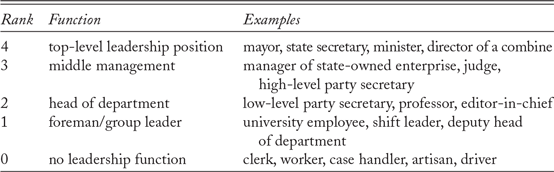
To measure career advancement, we rely on two complementary coding approaches. First, we rely on a comprehensive coding scheme for the ccdb nomenklatura variables developed by Axel Salheiser and Ronald Gebauer.Footnote 58 The scheme assigns individuals a hierarchical rank based on their job function and work sector. It allows us to assess each individual’s position in the hierarchy across all positions in the gdr. This ordinal variable rank ranges from zero to four. Second, we construct a simple binary variable that is coded as 1 in the year an individual was elevated into the official nomenklatura as captured by the ccdb. In contrast to the rank variable, which relies on manual coding, the nomenklatura variable is directly provided by the ccdb. This second measurement helps us to guard against potential measurement error in the rank variable. Table 1 describes the different ranks, based on Salheiser’s and Gebauer’s classification.
Description of Cadre Ranks

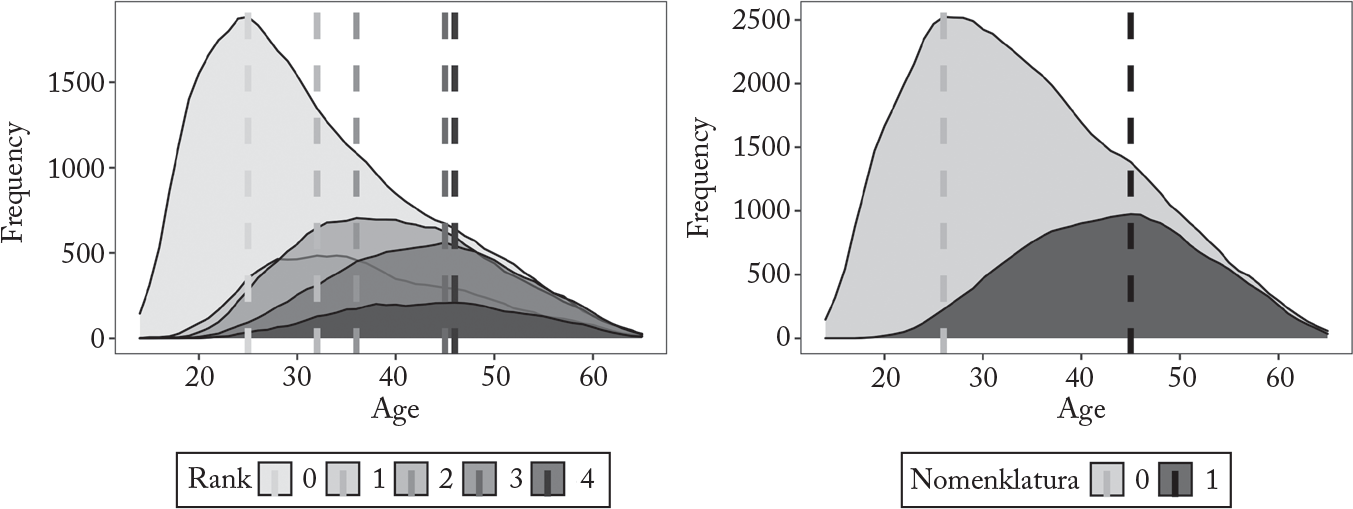
Figure 1 displays the distribution of ranks and membership in the nomenklatura by age. Vertical lines represent the modal value of person-years in the respective ranks. The left panel shows that promotions predominantly take place between the ages of thirty and forty and between forty and fifty. The right panel shows a similar distribution for the nomenklatura variable. Given that this variable is somewhat coarser than the rank variable, the modal age of forty-five reflects most strongly the group of later promotions that we see in the finer-grained rank variable (left panel).
Distribution of Age by Ranka
aVertical bars represent modal value of age distribution by rank/nomenklatura membership.

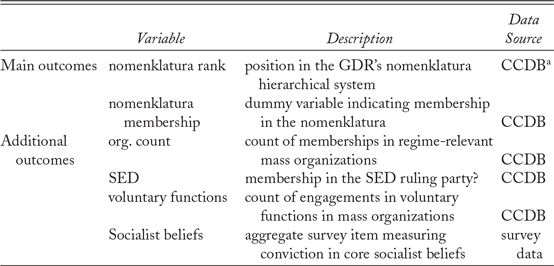
In addition to career advancement, we employ a number of additional outcome variables that plausibly represent system engagement, including membership in regime-relevant mass organizations, membership in the ruling sed party, and performing voluntary functions in mass organizations. In auxiliary analyses, we also directly measure socialist beliefs, using survey data collected before and after the collapse of the regime. See Table 2 for an overview of the different variables and their description.
Outcome Variables to Capture System Engagement

a CCDB refers to the Central Cadre Database.
Research Design
Our main analysis relies on a difference-in-differences design to estimate the effects of the conscription policy on our outcome variables. Since the ccdb allows us to track the pool of cadr es and cadre candidates over several decades, we can compare the career progression of the first affected cohorts in 1962 versus the immediate age-adjacent cohorts that were not subject to military service. This approach follows a standard difference-in-differences structure, with treatment turning on in 1962, the affected group being defined by gender and age in 1962, and the interaction term capturing the treatment effect:
 $${y_{ist}} = {{\rm{\alpha }}_i} + {{\rm{\rho }}_s} + {{\rm{\gamma }}_t} + {\rm{\delta }} \bullet {\rm{post}} - {1961_t} \bullet {\rm{affected}}{\mkern 1mu} {\rm{cohor}}{{\rm{t}}_i} + {\rm{ }}{\varepsilon _{ist}},$$
where y ist is the nomenklatura rank, the binary nomenklatura dummy, or any of the other measures listed in Table 2 of individual i (except for the measure of socialist beliefs), employed in sector s, in year t, α i represents individual-level fixed effects, ρ s represents sector fixed effects, and γ t represents year effects.
Post-1961 is a dummy variable indicating when the conscription policy became active. Affected cohort is a dummy variable that signifies an individual’s membership in the affected cohort. We run a number of specifications that vary the definition of affected cohort (for example, men ages 18–25 in 1962 or smaller subsets) and the definition of the control group (for example, men ages 26–33, all men ages >25 in 1962, similarly aged women, and the like).Footnote 59 Given the inclusion of individual and year fixed effects, coefficients for the affected cohort and post-1961 are not identified. Nonetheless, the key estimate of interest, δ, which is the difference-in-differences estimate, can be identified with our data and represents the differential of the intent to treat effect of conscripted military service across treated and control groups on career advancement.
We include individual-level fixed effects to account for observable and unobservable individual-level characteristics, such as political and social backgrounds, that potentially determine careers and might differ across cohorts. Individual-level effects also capture differences between individuals in their time-invariant exposure to other sources of indoctrination, notably during high school, where Staatsbürgerkunde (citizen education) was another indoctrination instrument of the regime.
Sector fixed effects account for differential career prospects across different parts of the East German economic and political system. Some sectors were more important for regime stability than others and thus followed different cadre policies. The sector effects capture the potential bias of an individual switching sectors.
The year effects model secular changes in the advancement system applied in the gdr. Considering these effects is particularly important due to another policy shift in 1961, the construction of the Berlin Wall. As noted above, the Wall dramatically shifted exit opportunities for citizens of the gdr and likely had substantial effects on the pro- and antiregime choices of large parts of society. The inclusion of year effects absorbs this policy shock, which applies to the whole population, and still allows us to estimate the male-specific impact of the conscription policy above and beyond any effects associated with the border policy.Footnote 60 More generally, the year effects capture changes in repression patterns, shocks in rent allocation, for instance, due to economic crises, or common changes in cadre policy and recruitment, such as when Walter Ulbricht, leader of the gdr between 1949 and 1971, switched to a more technocratic model of governance in the early 1960s.
Because we include a large number of fixed effects, we rely on ordinary least squares to estimate all models and cluster standard errors at the age-cohort level.Footnote 61
VI. Results
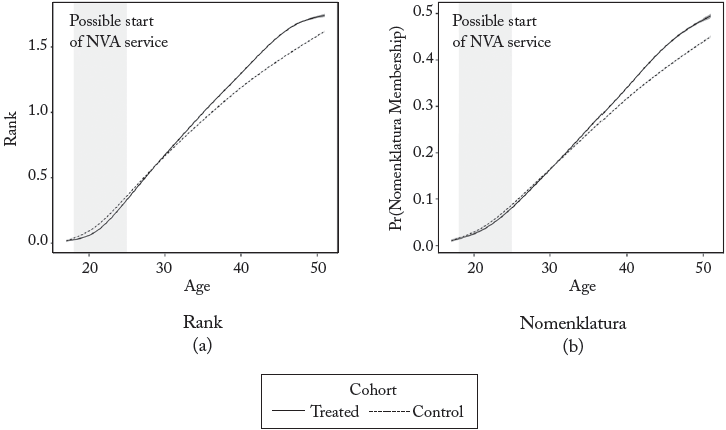
Before discussing the results of the difference-in-differences regression model below, we present Figure 2, which displays the different career trajectories of the initial male cohort subject to conscription in comparison to the age-adjacent male cohort. Technically, the law made any male eighteen- to twenty-six-years old immediately eligible for the draft, but in practice, hardly anyone who was twenty-six was actually called in for the required physical examination (see section A in the supplementary material).Footnote 62 Consequently, we consider the male cohort ages 18–25 in 1962 the broadest relevant treated cohort. We define men ages 26–33 in 1962 as the age-adjacent control cohort. Panel (a) shows the average rank of the cohort of men that were immediately eligible for the draft in 1962 over their lifetime in comparison to the control cohort at the comparable ages. For both the treated and control cohorts, average ranks are very low early in the individuals’ career lives, with the cohorts eligible for the draft even slightly lagging compared to the previous cohort.Footnote 63 Over their lifetime, though, the draft-eligible cohort starts to outpace the control cohort in terms of rank around age 30, with individuals enjoying a considerable career advantage in the prime of their careers (see Figure 1 above). This pattern is replicated in panel (b), which shows the same comparison focusing on the probability of being elevated into the nomenklatura.
Effect of Conscription on Rank and Nomenklatura

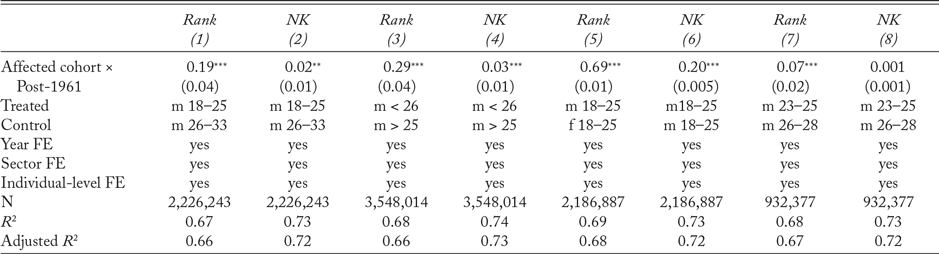
The raw data comparison suggests that the introduction of conscription meaningfully altered the career trajectories of men affected by the policy change. Table 3 reports estimates of our difference-indifferences model and confirms this pattern. Columns 1 and 2 replicate the comparison of the 18–25 versus the 26–33 age cohorts for the rank and nomenklatura variables.
Analysis of System Engagement

* significant at the 0.1 level, ** significant at the 0.05 level, *** significant at the 0.01 level; standard errors are clustered at the age-cohort level
We find that, on average, the policy-affected cohort enjoyed a lifetime increase of 0.19 points in their expected rank, statistically significant below the 0.1 percent level, equivalent to 20 percent of a standard deviation. Similarly, men subject to conscription were 2 percent more likely to be elevated to the nomenklatura, which is equivalent to a relative increase of 20 percent compared to the unconditional baseline.
The substantive size of our results becomes clearer when we compare it to age-related career benefits. Overall, age is a strong determinant of career level in our sample, as older persons are on average much more likely to have obtained a higher rank (see Figure 1). In our sample, the average rank for men ages 35–39 is 1.11 and for men ages 40–44 it is 1.35—a difference of .24 points on the rank scale. Given that the estimated effect size lies somewhere between 0.07 (model 7) and 0.69 (model 5), the differential career premium of conscripted service is comparable to the career benefits of an additional work experience of five to ten years.
Columns 3 through 8 vary the definition of treatment and control cohorts, for example, comparing all men ages < 26 in 1962 with men ages > 25, men ages 18–25 with women ages 18–25 in 1962, or men ages 23–25 with men ages 26–28 for a sharper cohort comparison. Across this range of comparisons, we find a positive and statistically significant increase in the career trajectories of draft-eligible men (with the exception of model 8, which misses statistical significance at conventional levels). Notably, the effects are substantively the largest in the comparison of women and men within the same age cohort (columns 5 and 6). Because the inclusion of individual-level fixed effects accounts for any general, time-invariant labor-market discrimination against women,Footnote 64 these effects reveal substantial career gains for men as a result of being subjected to military service.
Addressing Threats to Causal Inference
Causal identification in the difference-in-differences analysis is based on the parallel trends assumption. We assume that conditional on individual-level fixed effects, sector fixed effects, and year fixed effects, progression in rank would have been the same for conscription-affected cohorts as in their slightly older, unaffected age-adjacent cohorts in the absence of the policy change. It is worth dwelling on this assumption. To ascertain its plausibility, it would be ideal to compare trends across treated and control groups before 1962. Doing so is difficult in our setting due to the age of the individuals and the timing of treatment. For example, for the affected cohort of eighteen to twenty-five-year-old men, the eighteen-year-old individuals have just entered the sample and no additional pretreatment periods are observable. The cleanest and longest comparison we can construct for an assessment of parallel trends in the pretreatment period is the contrast of trajectories of twenty-five- and twenty-six-year-old men, revealing no discernible difference in trends before treatment begins at age twenty-five (see section C in the supplementary material). In section C, we also provide balance statistics for pretreatment covariates across treated and control cohorts to investigate the extent to which the age-adjacent cohorts are different from each other on observable characteristics.
A substantive concern about the parallel trends assumption is the possibility that the two cohorts differ on some other unobserved characteristic that produces differential effects post-1962. Specifically, older cohorts may have been more exposed to Nazi propaganda via the Hitler Youth in comparison to younger cohorts, and consequently may be more distrusted by the gdr regime. We find this to be implausible as an explanation for our main findings. For one, boys joined the Jungvolk associate organization at age ten and the Hitler Youth at age fourteen. This means that anyone age twenty-eight or younger in 1962 would have had no exposure to Nazi indoctrination as young men. In addition, our results on rank hold up for narrower cohort comparisons (23–25 versus 26–28, see Table 1, model 7). A similar concern arises with respect to the construction of the Berlin Wall in 1961.
Additionally, if there were higher rates of emigration by high-aptitude individuals prior to 1961, it could mean that later-born cohorts include a higher share of high-aptitude individuals, generating career differentials due to compositional effects. Crucially, this alternative explanation requires a series of very strong assumptions. First, our analysis does not rely on cohorts born after 1961 (which were fully affected by the Berlin Wall); neither does our treatment rely on the differentiation between cohorts born before or after 1961 (treatment status is defined by age above or below eighteen in 1962). Thus, it would have to be the case that fairly similarly aged young men in the 1950s anticipated or accidentally sorted around the specific age cutoff of the conscription law in their migration behavior, even though the law itself and the specific age cutoffs were unknown.Footnote 65 Second, it would require not only differential emigration of high-aptitude individuals, it would also require this differential to exist only for men because we also show the existence of an effect for men versus women within the same age cohort (both of which should have been subject to emigration).
To further safeguard against possible violations of the standard parallel trends assumption in the form of unobserved cohort differences, we employ additional approaches. We estimate models with sector-specific linear and flexible time trends and models that include pretreatment controls interacted with linear time trends to account for unobserved differences in trends for unbalanced pretreatment covariates.Footnote 66 We also estimate a very flexible event-study specification, interacting the treatment indicator with year effects.Footnote 67 The event-study specification is useful because it allows for flexible trend effects that differ by cohort. This model confirms the patterns in Figure 2: treated cohorts initially lag in their career progression but eventually outpace nonconscripted cohorts.
We also implement a formal regression discontinuity design (rdd) that uses different age cutoffs to define affected cohorts to construct an instrument for military service (see section E in the supplementary material). The rdd approach is another useful way to sharpen our cohort comparisons and to mitigate any possible confounding by unobserved cohort differences that generate time-varying effects on careers. The rdd approach reproduces all major findings of the difference-indifferences estimation.
To further check robustness,Footnote 68 we also estimate (1) a simple, standard difference-in-differences specification that includes only 1960 as a pretreatment period, 1989 as the posttreatment period, an indicator for the treated cohort, and the difference-in-differences interaction (without individual fixed effects); (2) models that exclude sector fixed effects due to concerns of posttreatment bias via career selection into specific sectors; and (3) alternative difference-in-differences specifications in which age is used as the key variable to determine the postperiod, which means that in this model we compare the career trajectory of the affected cohort with the trajectory of the control group of the same age, but not calendar year.Footnote 69
Another useful test is the estimation of a placebo effect. To that end, we compare the careers of women of the same age cohorts as in our main specification (see section F.4 in the supplementary material). The comparison of women reveals a small positive difference for rank and a minuscule (not significant) difference in the probability of being named to the nomenklatura. That we find a small positive difference across female cohorts for the rank variable seems concerning at first glance because it could indicate effects by broader trends and not because of conscription. It is important to note that (1) the effect is only roughly one-quarter of the effect for men, (2) we can only distinguish this effect’s size from zero due to our large sample size, and (3) the small positive effect may plausibly be driven by a spillover effect. Spillover effects may result from women of the conscription age–cohort working harder than older women due to the expectation of career rewards for conscription-affected men. Alternatively, the reduced immediate labor market competition at entry meant that women younger than twenty-five in 1962 did not have to compete immediately with similarly aged men for entry-level jobs, which allowed them to start their careers early.
VII. Mechanisms and Alternative Explanations
What mechanism links conscription to career advancement in the gdr? Our theoretical argument emphasizes the role of indoctrination. It is based on two interrelated assumptions. First, former conscripts were able to achieve higher ranks because of a specific behavioral effect of military training: it induced former recruits to show more effort and loyalty than their peers. Second, former conscripts displayed more effort and loyalty because military training made them internalize elite preferences.
Alternative explanations can challenge both assumptions. First, career advancement may have been independent of former recruits’ more pronounced effort and loyalty. Instead, military service may have fostered careers because it provided recruits with qualifications and resources that were relevant for subsequent careers in the bureaucracy. Second, even if career advancement was driven by displays of effort and loyalty, such displays may not have resulted from an actual internalization of regime preferences. Instead, military service, like similar attempts at indoctrination in other autocratic mass organizations, may have provided former conscripts with a good understanding of the expectations of the elite’s preferences. This may have put them in a better position to behave strategically according to the rules of the game.
We address the first objection with a series of additional empirical tests. We assess whether military service (1) has provided former conscripts with preferential access to education, (2) may have contributed to the formation of career-boosting personal networks, and (3) may have been interpreted by the elite as a signal of loyalty or of capacity in itself (independent of conscripts’ subsequent behavior). We present detailed results of these tests in section G of the supplementary material. Based on our findings, we cannot fully rule out that some of these factors, for example, effects on education, may have contributed to the career advancement of former conscripts. But overall, results are too weak or inconsistent to explain the career premium of military service in the gdr convincingly. Moreover, as we demonstrate below, former conscripts also differed from their nonconscripted peers in terms of their particular engagement in proregime social activities as well as in their more pronounced self-reported loyalty. These differences indicate a broader behavioral impact of conscription that goes beyond the improvement of qualification and the provision of career-specific resources. Instead, the findings are more in line with our basic assumption that military service induced former conscripts to show more effort and loyalty in their professional and social behavior.
The remainder of this section aims at assessing the plausibility of the second objection to the indoctrination mechanism sketched above. Does the observable system engagement of former recruits indicate preference falsification instead of effective norm internalization through indoctrination?
Preference Falsification in the GDR
Anecdotal evidence suggests that preference falsification may be a plausible explanation of our main findings. Preference falsification was widespread in the gdr. People falsified their preferences because they feared reprisals for themselves (“I wanted to study…. I did not want to offer resistance”)Footnote 70 or for their relatives (“I did not want my children to be burdened by a ‘politically unreliable’ father”).Footnote 71 As a historian and former gdr citizen summarized, “Opposition was the biographical exception in an environment of every-day opportunism.”Footnote 72
Several historical studies on the gdr emphasize that the system of indoctrination socialized young people to adopt opportunistic behavioral patterns. They were taught what the regime wanted them to think and they learned what could happen if they revealed their true preferences.Footnote 73 As one witness explained, “I learned something important for my life: there were things that were valid only in school. Home, the private world, was something entirely different…. What I learned was a matter of survival.”Footnote 74 Military service may have had a similar kind of effect; intense political socialization may have served as particularly effective training in preference falsification.
Access to socioeconomic benefits may have motivated individuals to falsify their preferences as means to a successful career in the bureaucracy. Such careers granted cadres access to substantial privileges: access to better-equipped hospitals, consumer goods from West Germany, higher pensions, access to free food in special restaurants, higher salaries, special vacation opportunities, better education and career prospects for children, and the right to travel to foreign countries.Footnote 75
It is difficult to identify preference falsification empirically. By definition, if preference falsification is at work, recruits’ behavior should be similar to that generated by the indoctrination mechanism. In light of this inherent challenge, the auxiliary analyses presented below should not be interpreted as hard empirical tests, but rather as assessments of the relative plausibility of the two competing mechanisms.
Variation in Types of Voluntary Engagement
We start by investigating how military service increased observable loyal behavior in terms of voluntary membership and engagement. According to the two rival mechanisms presented above, conscripted cadres should be more likely to demonstrate such social engagement in line with the ideological preference of the regime. But the two explanations would assume different motives. Cadres should display higher levels of engagement either because they actually share the underlying socialist values or because they act opportunistically.
We expect these different motives to lead to different patterns of engagement. A strategy of preference falsification would focus on signals that can effectively indicate compliance with regime expectations but that are associated with relatively low costs in terms of time and resource investment. Obviously, signals are most effective when they are costly to the sender. Thus, even preference falsifiers have to incur certain costs to signal system engagement. However, we expect them to strategically balance benefits and costs when selecting specific types of signals. Conversely, cadres who are intrinsically motivated should be less sensitive to costs.
We investigate two types of voluntary engagement to assess these observable implications. The first is membership in various socialist mass organizations. Here, we focus on membership in the ruling sed party, the number of memberships in a broad set of affiliate organizations, and the number of memberships in the core affiliate organizations, the Free German Youth (Freie Deutsche Jugend, or fdj), the Free German Trade Union Federation (Freier Deutscher Gewerkschaftsbund, or fdgb), and the Society for German-Soviet Friendship (Gesellschaft für Deutsch-Sowjetische Freundschaft, or dsf).
Membership was essential for career advancement. Citizens were not able to attend university without belonging to the fdj and were not allowed to attain higher career levels in the industrial sector without belonging to the fdgb.Footnote 76 At the same time, membership alone represented a rather cheap signal of loyalty. Cadres could easily join even a large number of mass organizations and formally claim membership without any additional substantive investment in terms of time or effort.Footnote 77
The second indicator captures a type of engagement beyond pure membership. We count the number of voluntary functions taken over by cadres in various political and social mass organizations. Functionaries, unlike regular members, held positions in the internal management and external representation of mass organizations, such as group leader in a youth organization, treasurer, or chairman of a local organization chapter. Footnote 78 This type of engagement required substantially more investment than membership alone. Anecdotal evidence suggests that such voluntary posts were often seen as bringing “more disadvantages than advantages” Footnote 79 because of the time required and because they may entail potentially sensitive tasks. For example, functions in the fdgb entailed mediation between employees and superiors.
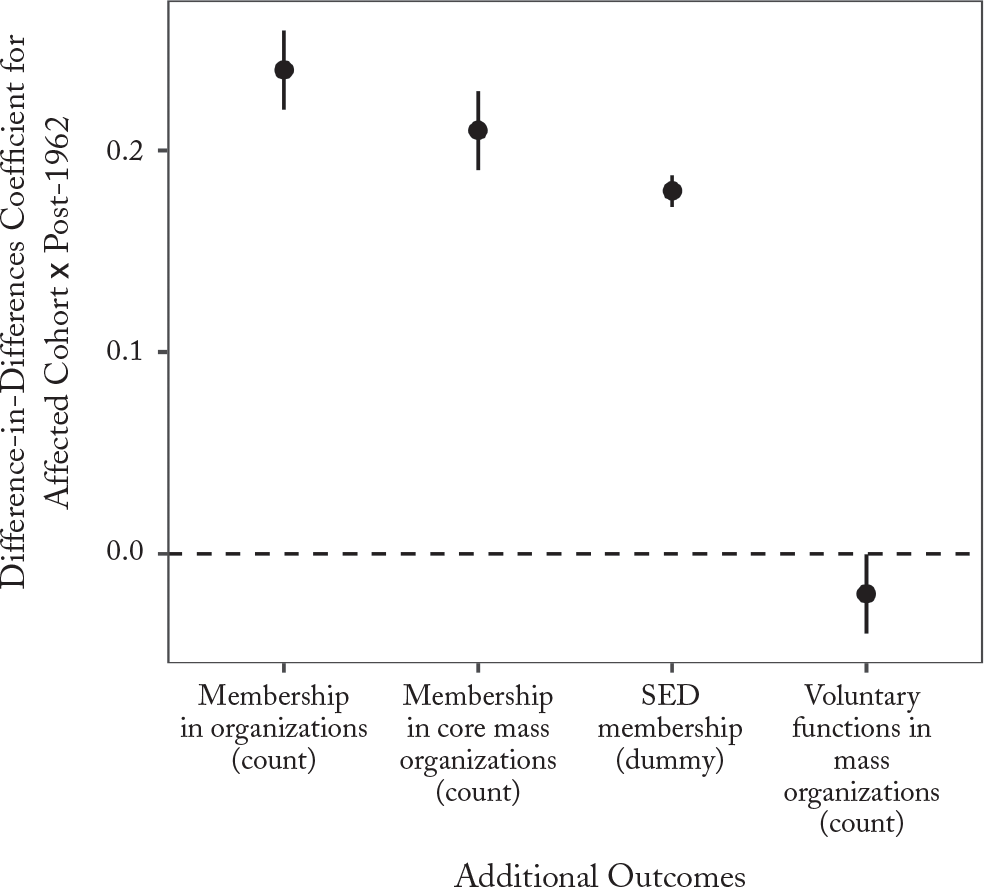
Figure 3 reports estimates for the effects of military service on different measures of voluntary engagement in mass organizations. We find that affected cohorts joined regime-affiliated organizations at higher rates. The only exception from this pattern is the count of voluntary functions (the last coefficient in Figure 3), which is negative. These results are in line with the assumption that former conscripts adapt their behavior to hide their true preferences and also try to avoid overly costly signals of loyalty.

Variation in Voluntary Engagement across Ranks
Motives for preference falsification should be strongest among individuals who fear negative career effects (or other types of reprisal) upon detection of their true preferences. We expect this fear to diminish as cadres climb the career ladder in the state bureaucracy and gain political influence and bargaining power that could shield them from potential punishments. We derive this expectation from the observation that high-level cadres generally enjoyed higher levels of regime trust. For example, high-level cadres had a certain protection from surveillance by the secret service,Footnote 80 they were allowed to consume Western media without reprisal,Footnote 81 and they were sometimes even granted the right to temporarily leave the country.Footnote 82 Whereas “true believers” can be expected to continue to behave according to the normative expectations of the regime as they progress through the hierarchy of the administration, individuals who fake their preferences will tend to reduce their investment in costly signals of loyalty as they expect a diminishing need or return for the falsification of their preferences.
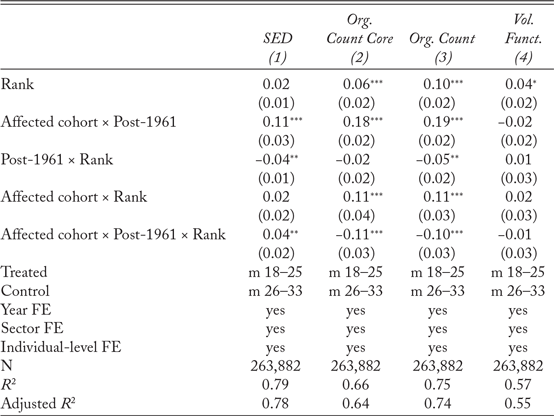
Given this expectation, we estimate our standard models with a triple interaction between the conscription-affected cohort dummy, the post-1961 dummy, and individuals’ rank in the hierarchy, using membership in the sed, other mass organizations, and volunteer functions as outcomes (See Table 4). We expect that former conscripts tend to reduce effort in terms of organizational membership as they progress through hierarchical ranks. This expectation is captured by the interaction term Affected cohort × post-1961 × rank. We find support for this. Mirroring findings presented above, we see that former conscripts show higher levels of social engagement but tend to reduce this engagement athigher levels of the hierarchy. This is not the case for sed membership, though. Membership in the party was generally seen as a requirement for all higher-level functionaries, which may have made former conscripts less cost-sensitive when it came to this kind of social engagement.
Disaggregated Analysis of System Engagement

* significant at the 0.1 level, ** significant at the 0.05 level, *** significant at the 0.01 level; standard errors are clustered at the age-cohort level
Variation in Self-Reported Socialist Preferences before or after Regime Change
As a third auxiliary test, we investigate how male gdr citizens with nva service history scored on survey questions measuring socialist preferences before and after the fall of the regime. If the preference falsification hypothesis is correct, former conscripts should display higher levels of self-reported regime loyalty only in the pre-1989 surveys, which were conducted while the sed regime was still in place. When answering a survey conducted by the regime, it’s likely that respondents were cautious not to reveal any true preference. This pressure to fake socialist preferences should disappear in the post-1989 survey, which was conducted after the fall of the regime, when repression became unlikely. If former conscripts were more likely to be true believers of socialist ideology than nonconscripts, we should observe higher levels of selfreported regime loyalty to persist even after the end of the socialist regime. Consequently, we expect a negative effect of the regime collapse on nva conscripts’ support for socialist preferences compared to nonconscripts.
We take advantage of the fact that the gdr conducted a number of surveys among its population to gauge its citizens’ ideological conviction. Specifically, we rely on surveys, carried out in 1983, 1985, and late 1988/early 1989 (well before the first protests that led to the revolution in late 1989). We combine this survey data with information from a survey conducted between 1990 and 1996, after the overthrow of the socialist regime, for a total of 4,665 respondents. See section H in the supplementary materials for details on the sources of the surveys as well as survey items used.
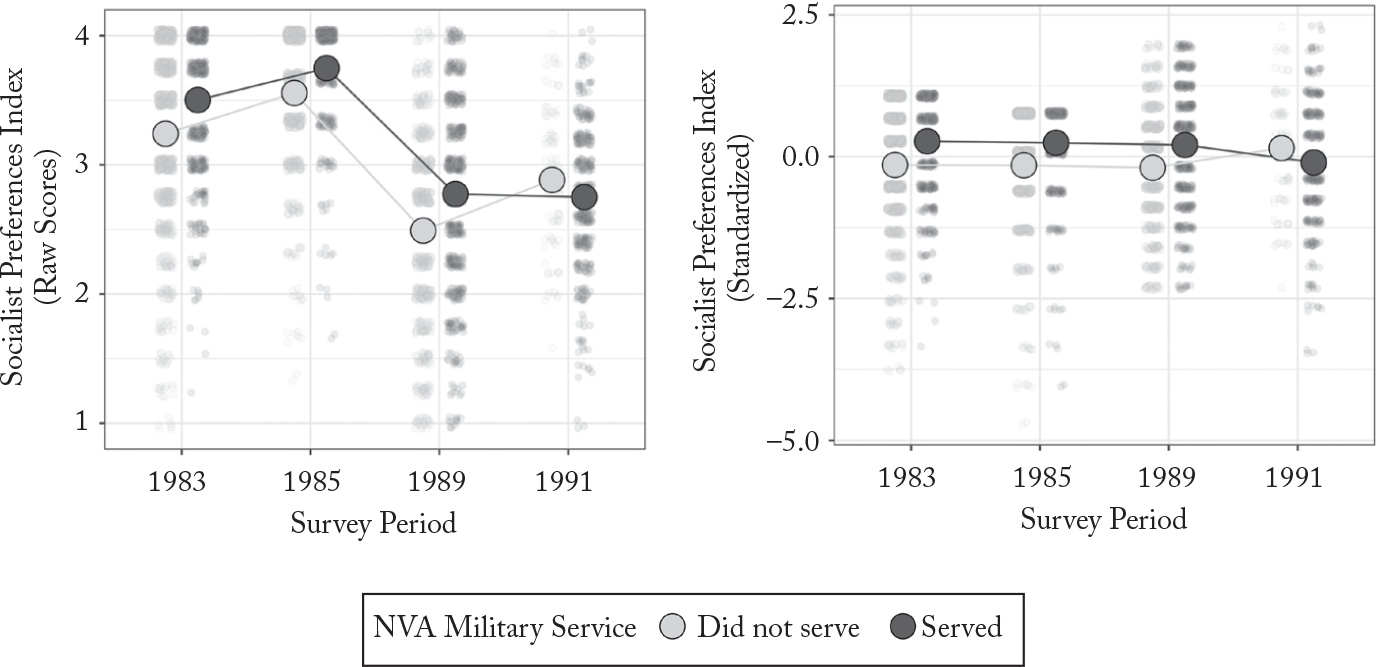
Using these surveys, we construct an index measure of socialist preferences based on survey items that plausibly capture socialist preferences. Example survey items include statements like, “I am convinced by the Marxist-Leninist worldview,” “Socialism will prevail globally” (pre-1989 surveys), or “Socialism was basically a good idea that was poorly executed” (post-1989 survey). Even though the exact wording differs across surveys, we assume that in the averaged aggregate, the questions adequately capture a respondent’s underlying socialist preferences. Since all items are measured on a four-point scale, we construct an index of socialist preferences where 4 indicates the strongest agreement with a socialist worldview. We present the socialism preference index in both raw average scores and as mean-standardized scores to account for idiosyncratic differences across surveys.
Using these data, Figure 4 demonstrates that (1) trends for nva conscripts and nonconscripts were parallel before 1989; (2) nva conscripts consistently display stronger socialist preferences than nonconscripts before 1989; and that (3) after 1989/1990, this difference disappears: conscripts do not report stronger socialist beliefs than nonconscripts in the survey taken after 1990.
Military Service and Self-Reported Socialist Preferencesa
a Large points represent group means; small transparent points display jittered individual respondent values.

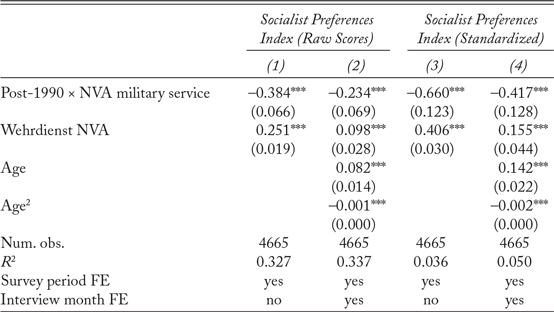
To subject these descriptive patterns to a more formal statistical test, we employ a difference-in-differences design on a combined sample of all survey respondents. Using this design, we compare socialist preferences of respondents with completed military service to those without completed military service, both before and after the revolution in 1989/1990. This strategy is particularly useful to disentangle the effects of nva service on socialist preferences from the general effects of the regime collapse in 1989 on socialist preferences. Importantly, the models also allow us to account for age as a confounding variable, since completion of military service strongly correlates with age. In addition, since field work for the post-1990 survey was conducted between September 1991 and September 1992, we include interview-month fixed effects to absorb the effects of the collapse of the Soviet Union in December 1991.
In these models, the nva service dummy represents the indicator for the treatment group and the post-1990 dummy represents the posttreatment variable. The outcome is the socialist preference index. We expect the interaction between post-1990 and nva military service to be negative, which would indicate that the difference in socialist preferences between nva conscripts and nonconscripts is reduced post-1990.
Table 5 reports the results. Across all models, the coefficient for the post-1990 × NVA military service variable is negative, statistically significant, and substantively large. The results from the mean-standardized outcome in columns 3 and 4 indicate that the difference in socialist preferences between conscripts and nonconscripts drops by about half a standard deviation after the fall of the regime.
Military Service and Self-Reported Socialist Preferences: Difference-in-Differences

* significant at the 0.1 level, ** significant at the 0.05 level, *** significant at the 0.01 level
These findings mirror those of historical studies that question the deeper normative effects of military service in the gdr. Shortly after the fall of the Berlin Wall, Mark Gose administered a survey to a small sample of roughly two hundred veterans of the nva and the German Bundeswehr as well as to civilians from both parts of Germany.Footnote 83 He found that East German veterans rejected communist political systems to a greater degree than nonveterans, concluding that “although veterans experienced more intense political socialization for communism in the military, it may have had the opposite effect on them.”Footnote 84
VIII. Conclusion
This article advances a theory of conscription as an autocrat’s instrument to instill system engagement in its bureaucratic workforce. We tested our hypothesis with an original data set that gives us unprecedented insight into the inner workings of the former gdr. By studying the introduction of conscription in 1962, we demonstrated that conscripted cohorts systematically and substantially advanced to higher ranks within the gdr bureaucracy. Auxiliary investigations of the underlying mechanism, however, cast doubt on the assumption that this effect resulted from norm internalization through indoctrination. In the light of our empirical findings, it seems more likely that military service enabled individuals to mimic the behavior required by the regime without being true ideological zealots.
Future research should assess the empirical scope of our argument. We investigated indoctrination and system engagement in a case where a number of conditions make it appear likely that we have observed an effect: the gdr was a regime with an interest in indoctrinating its population, that possessed a coherent state ideology, and that had the capacity to implement indoctrination. Nevertheless, we find that it was precisely in this most likely environment that actual preference indoctrination failed. Based on this finding, we would expect that indoctrination attempts are similarly or more difficult in less conducive contexts—for instance in predatory, personalized regimes like North Korea. Moreover, future studies could investigate the effectiveness of indoctrination attempts in other autocratic institutions. Although our findings indicate that military service may improve preference falsification, similar analyses of other mass organizations could strengthen our more general understanding of the intended and unintended consequences of indoctrination.
We believe that our findings have a number of important implications for future research on the microfoundations of autocratic rule. First, we have provided empirical evidence supporting theoretical work that emphasizes the potential failure of regime indoctrination to convince citizens of regime ideology. Footnote 85 In particular, our results indicate that a purported pillar of indoctrination, military service, is partially ineffective. Given that military service provides a most likely case for indoctrination to be successful due to the totality of the life within the institution, our findings highlight the agency of citizens in an autocratic regime to withstand indoctrination.
Second, our findings highlight the need for future research to further investigate the empirical relationship between preference falsification and autocratic stability. Based on our results and favored interpretation, conscription seems to be partially effective. On the one hand, it increases regime engagement of cadres at scale, bolstering regime stability. On the other hand, failed indoctrination via conscription introduces an information problem for autocratic elites: they do not know whether the observed agent loyalty is actually loyalty. When and how this discrepancy is revealed and when and how it is most likely to contribute to regime breakdown constitutes an exciting avenue for future research.
Supplementary Material
Supplementary material for this article can be found at https://doi.org/10.1017/S0043887121000095.
Data
Replication files for this article can be found at https://doi.org/10.7910/DVN/XKPEAN.
Acknowledgments
Authors are listed in alphabetical order. Equal authorship is implied. First and foremost, we would like to express our gratitude to Gabriele May at the German Federal Archive. Without her diligent data processing and careful documentation, this analysis would have been impossible. For valuable feedback and comments, we thank André Bank; Livia De Juan; Mark Dincecco; Anita Gohdes; Christian Glässel; Belén González; Bastian Herre; Allen Hicken; Maria Josua; Holger Kern; Anil Ramachandran; Constantin Ruhe; Axel Salheiser; Adam Scharpf; Haley Swedlund; Henry Thomson; Günes Murat Tezcür; Christian von Soest; Nils Weidmann; and Htet Thiha Zaw, as well as participants at the workshop, “Inequality in Autocracies” in Konstanz; the workshop, “Comparative Research on Political Elites” at the Hertie School in Berlin; and the Historical Political Economy workshop at the University of Michigan.
Funding
This article has been prepared in the framework of the research project “Anatomy of State Repression” funded by the German Foundation of Peace Research. Felix Haass acknowledges funding from the European Research Council (ERC) under the European Union’s Horizon 2020 research and innovation program (grant agreement no. 863486).
Authors
Alexander de Juan is a professor of comparative politics at Osnabrück University. His research focuses on the intersection between violent conflict, state-building and development. He can be reached at alexander.dejuan@uni-osnabrueck.de.
Felix Haass is a postdoctoral fellow at the University of Oslo. He studies societies after war, autocratic politics, and civil wars. He can be reached at felix.haass@stv.uio.no.
Jan Pierskalla is an associate professor of political science at Ohio State University. His research focuses on the political economy of development, violence, and state-building, with a particular interest in bureaucracies. He can be reached at pierskalla.4@osu.edu.