


Introduction
In OECD countries, there is growing interest in self-employment in later life, after age 50 (OECD 2023). In the United Kingdom (UK), self-employment has risen dramatically since the 1970s and by 2019 it represented one in seven workers (Giupponi and Xu Reference Giupponi and Xu2020). Consequently, there are increasing numbers of self-employed individuals working in later life. The vast majority, around 85 per cent, are ‘solo self-employed’, with no employees. For many, this is a continuation of what they were doing at earlier ages (Van der Horst et al. Reference Van der Horst, Lain, Vickerstaff, Clark and Baumberg Geiger2017), with most solo self-employment commencing when people are in their thirties and forties (IPSE 2024). However, those moving into self-employment after the age of 50 are of most interest to policymakers because it is seen as offering flexibility and autonomy in later stages of working lives, hence delaying retirement (OECD 2023). The UK Department for Work and Pensions (2024), for example, stated that self-employment ‘is a popular option for many older workers who want to build on past experience, develop specialist knowledge and increase control over their working lives’.
Despite its increasing prevalence, the question of why people become self-employed in later life is generally assumed in the literature rather than empirically examined, and there is a lack of research specifically looking at solo self-employment (cf. Zwier et al. Reference Zwier, Damman and Van den Heuvel2021). Self-employment in later life is sometimes assumed to result from ‘opportunity’ or ‘necessity’ (Van Solinge Reference Van Solinge2014; Moulton and Scott Reference Moulton and Scott2016), or to derive at least in part from an increased preference for autonomy related to the ageing process (Halvorsen and Morrow-howell Reference Halvorsen and Morrow-Howell2017). Alternatively, it is viewed as resulting from an aspiration or entrepreneurial orientation to run their own business (Farmer et al. Reference Farmer, Yao and Kung-Mcintyre2011) that an individual has perhaps long harboured (Soto-simeone and Kautonen Reference Soto-Simeone and Kautonen2021).
This article empirically explores why people transition into solo self-employment in later life. A theoretical model is developed based on Elder et al.’s (Reference Elder, Johnson, Crosnoe, Mortimer and Shanahan2004) theory of the lifecourse, which posits that transitions into self-employment in later life are socially embedded and influenced by events preceding the transition. Analysis is presented of 20 in-depth lifecourse interviews with people who entered solo self-employment after age 50 in the UK. This suggests that most individuals experienced ‘turning points’ related to negative work, household or health circumstances; these often increased the importance of, or desire for, work with greater autonomy. These turning points reflect a wider long-term trend to more ‘contingent’, or de-standardized/unpredictable, lifecourses (Heinz Reference Heinz, Marshall, Heinz, Krüger and Verma2001) that have to be navigated by individuals in the context of declining work-quality and security under neo-liberal capitalism (Baccaro and Howell Reference Baccaro and Howell2017; Lain et al. Reference Lain, Vickerstaff and van der Horst2022; Telford and Briggs Reference Telford and Briggs2022). The principles of ‘linked lives’ and ‘life stage’ (Elder et al. Reference Elder, Johnson, Crosnoe, Mortimer and Shanahan2004) generate the opportunity structure that enables individuals to become self-employed. This implies that self-employment is not a viable, or desirable, option for the many later-life individuals without networks or financial support/security (or the qualifications/confidence). It also does not ensure financial security, should circumstances change.
The article continues with a review of the literature on self-employment transitions in later life and the relevance of the lifecourse approach, before presenting the methodology, empirical results and discussion/conclusions.
Understanding motivations for solo self-employment in later life
Given the lack of solo self-employment research (Zwier et al. Reference Zwier, Damman and Van den Heuvel2021), we must look to the wider literature on self-employment in later life to uncover underpinning assumptions about why people enter this form of work. This is sometimes conceptualized in relation to ‘push and pull’ factors (Kautonen Reference Kautonen2008), with self-employment entry being seen as either an ‘opportunity’ or a ‘necessity’ (Van Solinge Reference Van Solinge2014; Moulton and Scott Reference Moulton and Scott2016). Neither ‘opportunity’ nor ‘necessity’ is straightforward to assess, however. The notion that self-employment is an ‘opportunity’ is sometimes assumed from the relatively advantaged characteristics of people doing this work in terms of financial and human capital (e.g. Van Solinge Reference Van Solinge2014), but this does not explain why only some relatively advantaged individuals opt for self-employment in later life.
Alternatively, Moulton and Scott (Reference Moulton and Scott2016) argue that in the United States (US) ‘opportunity’ self-employment is common in later life, but necessity can also be inferred in cases where self-employment is precipitated by job loss and entails entry into ‘less desirable’, ‘non-knowledge-based’ occupations. However, it is noteworthy that necessity was not strongly highlighted by individuals moving into self-employment following redundancy in Soto-Simeone and Kautonen’s (Reference Soto-Simeone and Kautonen2021) study. Likewise, Platts et al. (Reference Platts, Ignatowicz, Westerlund and Rasoal2023) and Niesel et al. (Reference Niesel, Buys, Nili and Miller2022) found that individuals entering non-standard jobs in later life, including non-professional self-employment, highlighted intrinsic satisfaction rather than necessity.
It is also possible that self-employment is a ‘necessity’ in the sense that it is involuntary, that is, a form of ‘bogus’, ‘gig economy’ self-employment whereby the individual works via one client without employee security (Monroe and Lopez-Andreu Reference Monroe and Lopez-Andreu2026). However, research suggests that ‘gig economy’ work is uncommon among people over 50 – it is predominantly done by younger men, disproportionately immigrants (Blundell Reference Blundell2019). It is important to note that ‘non-bogus’ self-employment offers less financial security and often lower financial returns compared with paid employment (Cohen Reference Cohen2025) and can lead to financial precarity in retirement (Hoppner Reference Höppner2021). However, the fact that self-employment can provide less financial security does not necessarily imply that ‘necessity’ was the reason the person entered into it in the first place, especially when opportunities for modestly paid work as employees do exist (Lain Reference Lain2012).
An alternative explanation from the entrepreneurship literature is that individuals have an ‘aspirational identity’ towards self-employment; they come to see themselves as having the necessary attributes of potential entrepreneurs (Farmer et al. Reference Farmer, Yao and Kung-Mcintyre2011: 245). While this may happen later in life, Soto-Simeone and Kautonen (Reference Soto-Simeone and Kautonen2021: 1687) suggest that ‘older workers might have harboured the idea of starting their own business for a long time, but not realised it until now because of perceived liquidity and family constraints in their early and mid-careers’. Interestingly, this indicates that lifecourse factors related to family and finances may influence behaviour. Consequently, personality characteristics associated with self-employment, like low risk aversion (Ekelund et al. Reference Ekelund, Johansson, Järvelin and Lichtermann2005), may be less important for transitions into self-employment in later life, if individuals have less to risk.
While ‘aspirational’ identities may be important for some, others may seek autonomy in later life. In Soto-Simeone and Kautonen’s (Reference Soto-Simeone and Kautonen2021: 1696) study of individuals starting self-employment after redundancy, the majority were categorized as ‘autonomy seekers’, wanting autonomy over work and life. Halversen and Morrow-Howell (Reference Halvorsen and Morrow-Howell2017: 316) draw on ‘socioemotional selectivity’ theory to suggest that individuals seek job autonomy from self-employment when they ‘come to understand they have less time left on this earth, [so] they focus less energy on developing peripheral relationships and instead focus their energies on rich, emotionally-fulfilling, and salient interactions’, including leaving their mark on the world (Lang and Carstensen Reference Lang and Carstensen2002).
The ‘lens’ of autonomy is potentially helpful for making sense of different potential motivations implied in the literature, beyond the common assumption that it represents ‘being your own boss’ (e.g. Benz and Frey Reference Benz and Frey2003: 1). In this regard, Queralt (Reference Queralt2023) makes a broader distinction between different forms of autonomy afforded by self-employment:
• ‘Autonomy through work’ represents the flexibility to combine work and other life activities, including caring or leisure (Simoes and Crespo Reference Simoes, Crespo and Moreira2016); this may be particularly important for ‘post-retirement’ self-employment.
• ‘Autonomy within work’ represents the desire for autonomy to decide ‘which work to perform, when to perform it, and under which conditions’ (p. 277). This may include the long-term desire ‘to be your own boss’ and to be free from following orders.
• ‘Autonomy in one’s choice of work’ links to workers’ personal goals and includes the autonomy to do work in a way that brings benefits highlighted in the literature: greater job satisfaction and meaningful work (Simoes et al. Reference Simoes, Crespo and Moreira2016; Pittcatsouphes et al. Reference Pitt-Catsouphes, McNamara, James, Halvorsen, Parry and McCarthy2017), the opportunity to help others (Meliou and Mallet Reference Meliou and Mallett2022) and self-integrity (Lindstrom et al. Reference Lindström, Ansio and Steel2022).
Recognizing autonomy’s importance does not, however, explain how, or why, some people become self-employed in later life. If autonomy generally becomes more important as people age, as per socio-emotional selectivity theory, this does not explain why only a minority become self-employed. Some argue that entrepreneurship can be discouraging in later life (Ainsworth and Hardy Reference Ainsworth and Hardy2008; Tomlinson and Colgan Reference Tomlinson and Colgan2014; Mallet and Wapshott Reference Mallett and Wapshott2015; Stypinkska Reference Stypinska2018) and that this group is less interested in self-employment on average owing to leisure priorities and having less time to develop their businesses (see Caines et al. Reference Caines, Earl and Bordia2019). This might imply that, while a minority may have aspirational identities towards being self-employed, for others changing circumstances might be influencing the desire for autonomy and the transition to self-employment in later life. This is explored in relation to lifecourse theory next.
Using lifecourse theory to explore transitions into self-employment in later life under conditions of change
Lifecourse theory builds on the work of sociologist C. Wright Mills ([1959] Reference Mills2000), who argued that individuals’ biographies should be foregrounded within historical contexts and social structures (Shanahan and Macmillan Reference Shanahan and Macmillan2008). Building on decades of research, Elder et al. (Reference Elder, Johnson, Crosnoe, Mortimer and Shanahan2004) identified ‘principles of the life course’: ‘time and place’ and ‘life span development’ can help us to ‘set the scene’ for self-employment; ‘agency’ and ‘turning points’ can provide a lens for exploring initial antecedents; and ‘linked lives’ and ‘timing’ can represent the potential opportunity structure.
Setting the scene for self-employment: ‘time and place’ and ‘lifespan development’
Research often assumes that the motivations underpinning self-employment are universally applicable to different time periods and countries. While there may be commonalities, the balance of influences and motivations may vary; as the principle of ‘time and place’ points out, ‘the life course of individuals is embedded and shaped by the historical times and places they experience over their lifetime’ (Elder et al. Reference Elder, Johnson, Crosnoe, Mortimer and Shanahan2004: 12). Today, transitions into self-employment and other forms of non-standard employment have become more common in many countries, part of what Heinz (Reference Heinz, Marshall, Heinz, Krüger and Verma2001) calls the ‘contingent life course’. As a result, employment transitions are less secure, less predictable and must be carefully navigated by the individual. This is distinct from periods in the 20th century when a ‘tripartite’ lifecourse was more common, with age-based stages of (1) education, (2) career-based organizational employment and (3) retirement, although this was never true for all workers (e.g. Moen Reference Moen2016).
In the UK and a number of other English-speaking countries, working as an employee in later life has become theoretically easier, given an abolition of mandatory retirement ages (Lain Reference Lain2016). However, transitions into self-employment may be influenced by financial pressures to work longer in the context of more precarious careers and labour markets, households and health (Lain et al. Reference Lain, Airey, Loretto and Vickerstaff2019; Grenier et al. Reference Grenier, Phillipson, Settersten, Grenier, Phillipson and Settersten2020). Austerity in the public sector (Lain et al. Reference Lain, van der Horst M and Vickerstaff2026), and a wider trend towards neo-liberalism have enhanced employer/manager discretion over how employees are managed and disposed of (Baccaro and Howell Reference Baccaro and Howell2017). This has resulted in a gradual long-term decline in employee job autonomy and satisfaction (White et al. Reference White and Smeaton2016) and involvement in decision-making, as well as increased stress, insecurity, supervision and work intensification (Telford and Briggs Reference Telford and Briggs2022; Lain et al. Reference Lain, Vickerstaff and van der Horst2022; Shah and Tomlinson Reference Shah and Tomlinson2021). In this context, phenomena such as ageism, ableism and bullying remain a feature of the labour market landscape (Cebola et al. Reference Cebola, Dos Santos and Dionísio2023; Sharma et al. Reference Sharma, Asselin, Stainton and Hole2025), with employers preferring an ‘ideal worker’ without health or caring needs (Foster Reference Foster2018; Campbell Reference Campbell2001; Foster and Scott Reference Foster and Scott2015).
The second and related lifecourse principle is that of ‘lifespan development’, namely that ‘human development and ageing are lifelong processes’ (Elder et al. Reference Elder, Johnson, Crosnoe, Mortimer and Shanahan2004: 11). This was reflected in Meliou and Mallet’s (Reference Meliou and Mallett2022: 110) finding that some older self-employed women had the desire to ‘explore learning’, and the greater tendency today is to acquire educational qualifications after typical education ages (Guillemard Reference Guillemard, Andersen, Guillemard, Jensen and Pfau-Effinger2005). This may contribute to the known higher levels of human capital held by this group, and help provide the skills and confidence to make such transitions (i.e. having the sense of self-efficacy required, as identified in Caines et al. Reference Caines, Earl and Bordia2019).
Exploring the initial antecedents of self-employment: ‘agency’ and ‘turning points’
As stated previously, some might have an ‘aspirational identity’ towards self-employment (Farmer et al. Reference Farmer, Yao and Kung-Mcintyre2011: 245) and seek out opportunities for self-employment as a result (Gielnik et al. Reference Gielnik, Zacher and Wang2018). They may have held a long-term desire for self-employment but were constrained in realizing this desire (Soto-Simeone and Kautonen Reference Soto-Simeone and Kautonen2021). For others a desire for autonomy ‘in one’s choice of work’ or ‘through’ self-employment (per Queralt Reference Queralt2023) may be important and reflect changing circumstances. This is consistent with the principle of ‘agency’ whereby ‘individuals construct their own life course through the choices and actions they take within the opportunities and constraints of history and social circumstance’ (Elder et al. Reference Elder, Johnson, Crosnoe, Mortimer and Shanahan2004: 12, our emphasis).
Drawing on such an account of agency, a ‘turning point’ can be an alternative to a longer-term planned move into self-employment. Turning points, according to Elder et al. (Reference Elder, Johnson, Crosnoe, Mortimer and Shanahan2004: 13), represent ‘a change in behaviour’, a change in ‘direction in the life course, with respect to a previously established trajectory’ (Wheaton and Gotlib Reference Wheaton, Gotlib, Gotlib and Wheaton1997: 5). A turning point may be a single event or a period when several events coalesce into a set of circumstances resulting in an unexpected change. According to Pillemer (Reference Pillemer1998: 76, our emphasis), a turning point can be ‘a specific episode or series of episodes [that] appears to alter or redirect the ongoing flow of the life course’. Moreover, from our perspective it ‘must include a self-reflective awareness of, or insight into, the significance of the change’ (Wethington et al. Reference Wethington, Cooper, Holmes, Gotlib and Wheaton1997: 217). In the context of more insecure ‘contingent’ lifecourses (Heinz Reference Heinz, Marshall, Heinz, Krüger and Verma2001), it might be related to negative changes in work or non-work domains that set the path towards self-employment, but the turning point is not the act of becoming self-employed. Instead, it may lead the individual to reflect and/or act on the need, or desire, for greater autonomy to address the (negative) circumstances caused by the turning point. Alternatively, it may spur someone to act on pre-existing dissatisfaction with the levels of autonomy in their life/work by taking a pathway towards self-employment that was unlikely before the turning point occurred.
Understanding the opportunity structure for self-employment: linked lives and timing
While agency and turning points can increase the desire/need for work/life autonomy, ‘linked-lives’ and ‘timing’ may provide the necessary opportunity structure to transition into self-employment. The principle of linked lives is that ‘lives are lived interdependently and socio-historical influences are expressed through this network of shared relationships’ (Elder et al. Reference Elder, Johnson, Crosnoe, Mortimer and Shanahan2004: 13). This may influence self-employment entry in two ways. First, linked lives may provide opportunities for self-employment. As Singh and deNoble (Reference Singh and DeNoble2003: 213) observe, individuals ‘are more likely to become self-employed if they have in place established strong networks’. These might relate to previous careers, but family, friends and acquaintances can also suggest self-employment opportunities to (dissatisfied) individuals. They can provide suggestions, advice, role models and a customer base, even ‘coaching’ (Strauss Reference Strauss1997) to navigate the transition.
Second, linked lives and ‘timing’ may de-risk the entry into self-employment, something that is important if we are to assume that ‘late’ entrants to self-employment have lower risk tolerance than those entering earlier. Financial resources from other ‘linked lives’, typically partners, may remove or reduce concerns about this risky path. This may be particularly important for married women, given that women amass fewer financial resources over the lifecourse than their male counterparts (Ginn and Foster Reference Ginn and Foster2023).
Alternatively, this process of de-risking may relate to the principle of timing, whereby the consequences of events ‘vary according to their timing in a person’s life’ (Elder et al. Reference Elder, Johnson, Crosnoe, Mortimer and Shanahan2004: 12). A particular event, such as redundancy, might be more likely to be a turning point leading to self-employment if the risk involved has been reduced by reaching a ‘life stage’ milestone, such as paying off a mortgage, receiving a pension or their children leaving home. Individuals might reach such milestones at different ages, or not at all. However, for those who reach these milestones, the transition to self-employment may be seen as less risky and more feasible.
Methodology
To investigate why people become self-employed, the research drew on a sample of 20 individuals who entered solo self-employment after age 50 (except one individual starting close to 50). This was taken from a larger sample of 47 solo self-employed individuals aged 50+, which had also included individuals starting before age 50. Interviewees were recruited by the social and market research company Roots Research. An even split between men and women was achieved, with quotas for different occupational groups, people in different age bands, non-white participants and married/single people. The UK Labour Force Survey analysis identified key occupational groups of self-employed and helped decide the numbers of individuals in each broad category (Ritchie et al. Reference Ritchie, Lewis, Elam, Tennant, Rahim, Ritchie, Lewis, McNaughton Nicholls and Ormston2014). Sample details with individuals’ pseudonyms are shown in Table 1; the skew towards higher qualifications and modest earnings, while not deliberately sampled for, reflects the situation of people starting self-employment after age 50 according to subsequent Labour Force Survey analysis. The equal split between men and women, and the balance between married and single, is important for exploring the differential impact of gender on linked lives influences. Being single is common in the cohort aged 50–64, with around a quarter in this situation (Office for National Statistics 2025).
Sample characteristics

Table 1 Long description
Participant-level characteristics for 20 self-employed people, listing name, gender, age, occupation, job classification, self-employment income, ethnicity, marital status, and highest qualification. Ages range from 52 to 82, with most participants in their fifties and sixties and one aged 82. Gender is evenly split, with 10 women and 10 men. Ethnicity is predominantly White, with three Indian participants and one each Black and Chinese. Job classifications cluster in Professional and Associate Professional roles, with smaller numbers in Elementary, Caring/Leisure/Other Service, Skilled Trades, and Process/Plant/Operative. Reported incomes span from £2k up to £50k, with several ranges (such as £20 to £25k and £40 to £50k) and multiple entries marked unclear. Marital status varies, with married and divorced most common and fewer single participants. Qualifications range from none or GCSE-level to higher education and postgraduate degrees, including Masters, PhD, MBA, and PGSE; income and qualification comparisons are limited by the small sample and unclear income entries.
Interviews typically lasted between 70 and 90 minutes with an average of 79, and adopted a narrative approach (Lieblich et al. Reference Lieblich, Tuval-Mashiach and Zilber1998; Riessman Reference Riessman2008). These started with a life-grid (Parry et al. Reference Parry, Thompson and Fowkes1999) plotting individuals’ work, family and health histories and their transition into self-employment. Open-ended questions explored why individuals moved into self-employment; the nature of their self-employment and attitudes to it; how it compares with previous employment and fits in with their wider lives; the relationship/compatibility between their mental/physical health and work; and their future work and retirement plans.
The interviews were transcribed verbatim and analysed using NVivo 15 software. A narrative categorical-content perspective was used to analyse the data (Lieblich et al. Reference Lieblich, Tuval-Mashiach and Zilber1998), following additional processes outlined in Miles et al. (Reference Miles, Huberman and Sadana2020) aimed at theory building. This approach focuses on the content of what is being said, rather than the structure of the account, which is important because more complete explanations of why individuals became self-employed became evident during the course of the interviews. It is also consistent with a transcendental realist perspective (Miles and Huberman Reference Miles and Huberman1994); this fits with our assumption that ‘real’ dynamics influence the move into self-employment and people’s subjective impressions of these should take primacy focus, while accepting that individuals are not always fully conscious of them (e.g. the influence of lifespan skills development).
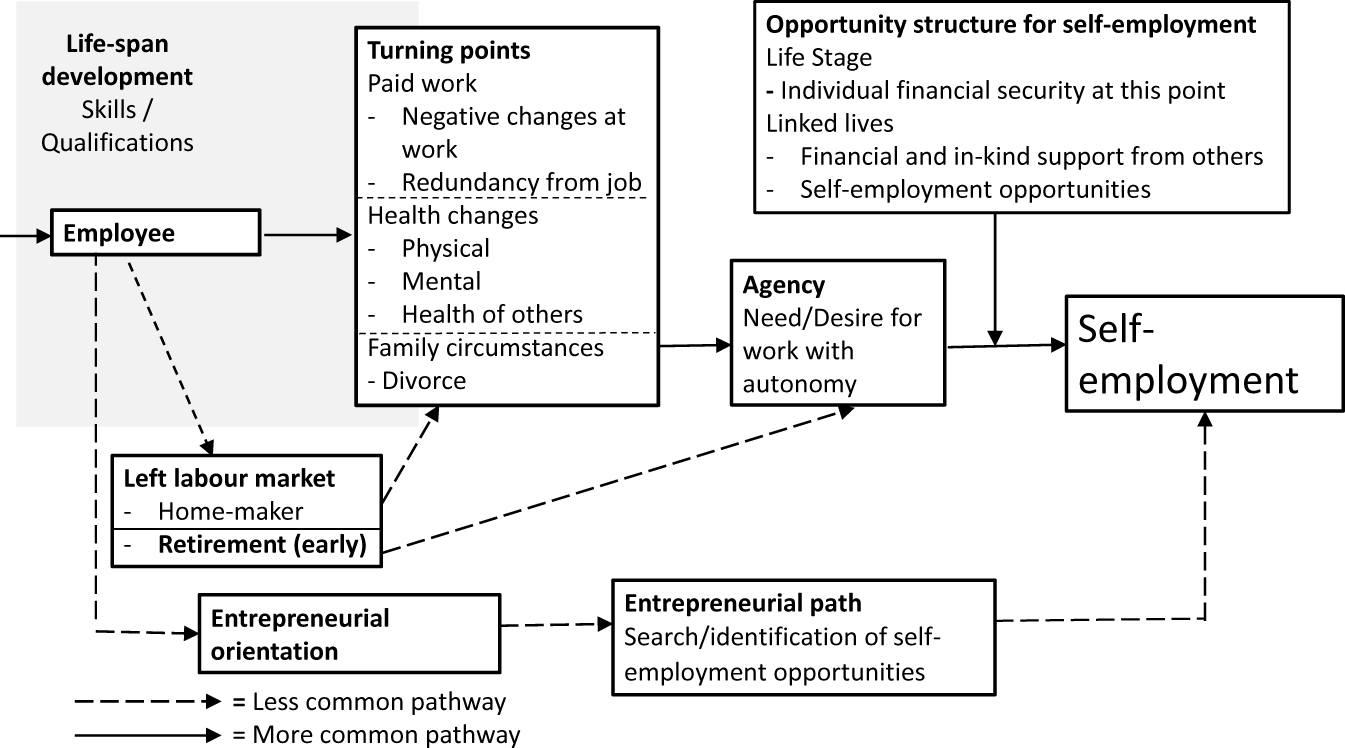
The transcripts were read through a number of times to identify ‘first cycle codes’ using inductive and deductive reasoning; these represented antecedent circumstances that influenced the move into self-employment. First cycle codes were then aggregated into second and then third order pattern codes representing meaningful categories related to the transition into self-employment (based, in part, on categories from lifecourse theory). Finally, cross-case analysis was conducted to see whether cases (i.e. individuals) fall into ‘clusters or groups that share certain patterns or configurations’ (Miles et al. Reference Miles, Huberman and Sadana2020: 97) with regard to the aggregated codes. From this analysis, three pathway groupings were identified (see Online Table A1 for the whole process): a ‘turning point’ pathway, a ‘retirement’ pathway and an ‘entrepreneurial orientation’ pathway. The different elements of first, second and third order codes were then assembled into a temporal theoretical model; this is represented as Figure 1, which is discussed in the findings section next.
Pathways to self-employment after 50.

Figure 1 Long description
Employee. Life span development Skills slash Qualifications. Turning points Paid work dash Negative changes at work Redundancy from job Health changes dash Physical dash Mental dash Health of others Family circumstances dash Divorce. Home maker. Retirement. Entrepreneurial orientation. Entrepreneurial path Search slash identification of self employment opportunities. Opportunity structure for self employment Life Stage dash Individual financial security at this point Linked lives dash Financial and in kind support from others dash Self employment opportunities. Agency Need slash Desire for work with autonomy. Self employment. Arrows and connections, left to right. Employee points to Turning points. Turning points leads to Agency. Opportunity structure for self employment points down to Agency. Agency points to Self employment. Employee has dashed arrows to Home maker, Retirement and Entrepreneurial orientation. Home maker has an arrow to Turning points. Retirement has a dashed arrow to Agency. Entrepreneurial orientation has a dashed arrow to Entrepreneurial path. Entrepreneurial path has a dashed arrow to Self employment. Self employment has a dashed arrow pointing up into it. Legend. Dashed arrow equals Less common pathway. Solid arrow equals More common pathway.
Overview of the model
Figure 1 represents three pathways to moving into self-employment after age 50: a ‘turning point’ pathway, a ‘retirement’ pathway and an ‘entrepreneurial orientation’ pathway. The turning point pathway was the most common. It involved negative changes at work, in health and/or in the family, consistent with what we would expect from more insecure ‘contingent’ lifecourses (Heinz Reference Heinz, Marshall, Heinz, Krüger and Verma2001). Turning points often appeared to generate or enhance a desire, or need, for work with autonomy that was difficult to meet through being an employee. Following the distinction made by Queralt (Reference Queralt2023), individuals’ needs for autonomy were related to autonomy ‘in choice of work’ (to meet their satisfaction, value or psychological/health needs) or autonomy ‘though work’ (enabling them to combine work with other activities or lifestyles). Crucially, the self-employment transition was facilitated by an opportunity structure that often presented employment opportunities through ‘linked lives’ networks and de-risked such a move (through ‘life stage’ financial security and financial support from other ‘linked lives’ in the household). This may help explain the relatively advantaged characteristics of those entering self-employment in later life, as others in similar circumstances without such support may have remained as employees if applicable, or perhaps settled on lower-status work as an employee (see Lain Reference Lain2012). Married women were more likely to emphasize ‘linked lives’ support from a partner in enabling self-employment.
As the grey square on the left shows, lifespan development in the form of skills and qualifications acquired after leaving education was common for those navigating turning points (but not the ‘retirement’ or ‘entrepreneurial orientation’ pathways). Some interviewees gained qualifications after age 30. Only Bahula and Camunda identified academic study in later life as influencing their transition into self-employment as it provided the basis for their new work, but in both cases other turning points preceded the move (difficulties combining work with caring and redundancy). Academic study may, therefore, have helped provide them with the socio-economic characteristics and confidence required to turn difficult events/circumstances into ‘turning points’.
For those entering self-employment after a period of retirement, turning points were not evident. Retirees desiring a job for financial or intrinsic reasons nevertheless wanted work providing the autonomy to enable other activities developed during retirement (‘autonomy through work’). The group following an ‘entrepreneurial orientation’ path sought out opportunities for self-employment, although it was not clear that this was a long-term aspiration. We look at this entrepreneurial orientation group first, before exploring the turning point and retirement pathways in depth. We present exemplar cases to illustrate how the different elements of the model come together to influence the move into self-employment, with broader discussion exploring similarities and variations with other cases.
An entrepreneurial orientation to self-employment path
Exemplar 1: orientation to self-employment
Background: Jeffrey became a self-employed tutor after a career spent teaching in schools.
Orientation to self-employment
I’ve been my own boss for a long time; even when I was in school, I was a head of a department but there was only one in the department – me – so I answered only to myself. Before that, I didn’t conform easily to regulations or requirements … I’m fairly independent, I suppose.
Search/identification of self-employment opportunities
I had already been tutoring a little bit before that, so I had been adding to my income just in the evenings sometimes. When I finished in school, I went full-time tutoring and, at that time, I was tutoring about 35 students a week.
I worked out that, financially, I would actually be better off in doing that, so I decided to move across into that.
As discussed earlier, Farmer et al. (Reference Farmer, Yao and Kung-Mcintyre2011) emphasized the importance of an aspirational entrepreneurial identity in the transition to self-employment, based on an individual’s self-assessment of their characteristics and dispositions. However, a minority talked about how their personal characteristics had influenced their transition. Alongside Jeffrey (Exemplar 1), Anita, for example, said that she became self-employed because she got ‘fed up of working for people. And I know I’m good at sales so I thought, “Well, I can do it for myself”, and that’s what I did’. Jeffrey and Anita were both single and had limited support from others; both proactively sought out self-employment opportunities following a traditional ‘entrepreneurial’ path (Gielnik et al. Reference Gielnik, Zacher and Wang2018). Both prioritized working for themselves as their own boss, rather than autonomy through work, to facilitate other activities. This was reflected by the fact that Anita worked long hours after becoming self-employed, and Jeffrey worked unsociable hours that he viewed as being detrimental to his relationships.
Among interviewees following other paths to retirement, some emphasized their suitability for self-employment, but others proactively rejected the notion that they were ‘natural’ entrepreneurs:
I’m not naturally a self-employed person. I really struggled at the beginning not to be on PAYE, because I’ve been on PAYE all my life. (Gill)
I’m not really a risk-taker, particularly. So I wouldn’t have had the bottle to do it whilst … if I still had a mortgage to pay, definitely. (Emma)
It wasn’t a conscious decision about going [into] self-employment; it was a conscious decision about being in control of my life. (Brian)
Turning point pathways to self-employment
Negative changes at work were widespread in the data, and in some instances these alone were identified as triggering the move to self-employment. In these cases, the ‘turning point’ change often resulted in individuals wanting greater autonomy in their choice of work, in order to address reduced levels of job satisfaction or compatibility with their values. This is illustrated by the case of Dawn in Exemplar 2.
Exemplar 2: turning point – negative changes at work
Background: Dawn set up as a self-employed travel agent in her late forties after the company she previously worked for was taken over.
Turning point
The company got took over by [new company] … that’s sort of when it went down. It changed, it was like a completely different company to work for. It were just all paperwork, paperwork; they didn’t care about anybody or the customers. It were just getting the sales in and just no care for staff or anything …
I absolutely hated working for the [new company] … you were just a number.
Agency – desire/need to work with autonomy
Need for autonomy in one’s choice of work
But now I wanted to offer more of a personal service. So I’ll look after my customers. If something’s not right I’ll tell them. I’ll say, ‘I’m not booking that for you. If you want to book it with Joe Bloggs down the road, and they’ll take your booking, let them take your money’.
Opportunity structure from linked lives
Self-employment opportunities from others
Because I’ve worked in travel for, like, 20-odd years total, I’ve got a lot of customers from when I were in the shops, so they’ve sort of followed me … to my company.
Financial and in-kind support from others
It [my income] really fluctuates … I don’t do, always do full-time hours … if I get a booking, I get a booking. It’s like a … because I’m the second earner in the family. My husband’s the main earner. Mine’s just sort of like the extra spending money and things like that.
A similar example is Gill, who worked as an educational professional and became a consultant. The turning point for her was when her senior manager changed, which represented a threat to her autonomy:
They got a new COO [chief operating officer] and I didn’t like her, and she didn’t like me … I’m quite values driven, really. And I could see it was going in a different direction and I just thought, ‘I can’t stay here’.
Gill therefore decided to leave her employer in order to regain autonomy in work. Linked lives helped facilitate this transition into self-employment as she had previously worked with consultants and had good networks (‘I contacted all my contacts … and I got work straight away’). Being self-employed gave her the autonomy to choose what work to take on and who to work with (‘If I don’t like someone I don’t have to be in the room with them’). Although it was not a primary reason for becoming self-employed, it also provided the flexibility, ‘autonomy through work’, to pursue gardening and grandparenting. Life stage, in the form of a pension, having a small mortgage and no dependants, made the move possible.
Other negative changes at work contributing to the move to self-employment were identified by interviewees. These included austerity and public cuts impacting on work satisfaction:
I think partly because of the cuts and partly because of the poor leadership and management, it was getting to be a situation where you couldn’t focus on what you were good at … they were shovelling more and more things towards us … you’d be made to do work you didn’t feel as though you had the ability to do. (Alan)
Others raised bullying and unsupportive colleagues and discrimination (of various sorts):
I felt bullied. And when I went to HR and said I was bullied they said that wasn’t bullying … [I] wasn’t taken seriously … The environment I couldn’t work in … It was [bad] to be an older person in that environment. (Fiona)
I did very well [in my job] but there was a lot of politics and … I was really put under a lot of pressure … I do think race was a factor. (Daniel)
In addition, disappointing career outcomes relative to younger colleagues were reported:
I didn’t get promoted twice over younger people. And you know a girl who was, like, 24 got the job that we both went for, and she ended up being my boss. And I just couldn’t cope with that at all. (Emma)
A further turning point related to work was that of redundancy. Soto-Simeone and Kautonen (Reference Soto-Simeone and Kautonen2021) found that people seeking self-employment after redundancy often emphasized autonomy, but our study identifies more clearly the mechanisms by which this can occur. For example, in the case of Hannah (Exemplar 3), the trigger of redundancy helped address an underlying desire for work autonomy by moving into self-employment. In some cases, redundancy acted as a period of re-evaluation, whereby self-employment is seen as an option to gain autonomy through work, to facilitate other activities. For example, Colin was made redundant from his job in IT and found it hard to get another one, which led to the point of reflection about deserving a less stressful work life with greater autonomy as a handyman:
Exemplar 3: turning point – redundancy
Background: Hannah became an independent consultant working on social policy-related issues in her late fifties. She was previously dissatisfied as a management consultant for a large company. However, she felt stuck in her job, and being targeted for redundancy helped her move into self-employment, a move she felt she otherwise would not have made.
Turning point
I along with some others were basically targeted for redundancy; it was shocking… because it was so unexpected …
I was kind of trapped, being honest, but I couldn’t leave either … [it] did me a favour because it pushed me into what probably I would never have taken the leap to do myself, and yet this worked so well.
Agency – desire/need to work with autonomy
Desire for autonomy in one’s choice of work
I can [now] turn work down if I don’t want to do it and also I can work when I want to work … I’m not tied to a building, I’m not tied to … a set of organizational structures and probably organizational goals that I didn’t share. I have my own goals and I work towards those.
Opportunity structure from linked lives and life stage
Self-employment opportunities from others
My colleague [name] … has been employed by [company] as an independent consultant … she said, ‘Come and do this with me’ [i.e. work with her on some projects as an independent consultant].
Life stage (financial security)
I wouldn’t go back now, not at this stage of my life anyway. I probably wish I’d done it sooner, you know. But because of how our circumstances were financially, we just couldn’t [have the] risk of me not being in a job.
I was just reflecting on my life … What should I be doing? Should I be actually still trying to get a job in IT or should I just kind of … move away? … I used to enjoy doing [DIY] for myself but [decided] to actually do that for other people. It’s definitely a lifestyle choice that I want to work less and have less pressure on me and just get a better work–life balance.
Colin was aware that his life stage enabled entry into self-employment – although a renter, he had money from the sale of an earlier house; a wife with a good pension; and the prospect of receiving his own work pension soon. He noted: ‘If I wasn’t so okay financially I think it [self-employment] would cause me a great deal of grief … I’m very fortunate … I don’t need to work 40, 50 hours a week’.
It was uncommon for people to enter into self-employment from a position of perceived financial insecurity. However, the case of another handyman, Paul, illustrated the potentially precarious nature of self-employment and the lack of financial security it can provide if circumstances change. Paul was made redundant from a professional job and became a handyman through ‘linked lives’ networks (‘I started doing favours for neighbours … and … they insisted on paying me’). Initially, owing to a redundancy payout, he felt financially secure; however, after an expensive divorce and work drying up he was in difficult financial circumstances (‘I can’t afford to stop [working] … which at 68 is a pretty depressing prospect’). He noted that self-employment is ‘much more precarious … I’d rather be employed; with the security you’d think that that brings’. This illustrates the importance of disentangling the consequences of being self-employed from the reasons for going into it.
Exemplar 4: turning point – health
Background: Despite leaving school with no qualifications, Gary had a varied career, got a degree in later life and ended up in professional roles. He became a painter and decorator after losing his job when a family tragedy in his fifties led to post-traumatic stress disorder (PTSD).
Turning point
I had a massive breakdown, absolutely huge breakdown, which … I’m missing out loads here but basically that breakdown then left me in a place where I couldn’t continue with my previous company.
Agency – desire/need to work with autonomy
Need for autonomy within work
I could do that because it was work – I was left on my own, I wasn’t having to deal with any kind of conceptual structures or expectations because the PTSD left me with the idea that every failure is catastrophic … I can’t work very closely with lots of people with structures in place.
Opportunity structure from linked lives
Self-employment opportunities from others
So, that was another thing; so, the breakdown, the PTSD, the severe depression associated with it, of course, and after the breakdown, I slowly got myself back, I met a guy, and I said, ‘I need some money’, and he said, ‘I’m painting and decorating, come and join’, so I did.
Health problems in later life also acted as turning points in the move to self-employment. This was most straightforwardly illustrated by Gary (see Exemplar 4). Despite hints that he had some past mental health issues, this had never previously prevented him from working as an employee. Gary perceived his financial circumstances as being more precarious than most other interviewees, but he was more financially secure than when out of work immediately before.
Health was an issue for some other interviewees, but this influence was combined with other workplace circumstances and changes. For example, Fiona had a history of mental health problems and had developed ‘terrible’ menopause symptoms. A turning point came when she moved into a large open-plan office. Her mainly younger male colleagues were particularly unsympathetic to her menopause symptoms (‘I’d be sitting there, my hair would be wet with sweat and the majority said … “We don’t want the window open and there’s more of us than there is you”’). This made working in the environment difficult, but it reflected a broader pattern of (gendered) ageist bullying that precipitated her leaving, with linked lives support from her husband (‘He says, “Just, if you want to, give it up.” He said, “I’ll support you and see what you want to do”’). Fiona subsequently became a self-employed IT trainer because of the autonomy within and through work that it provided:
I am the business … [no one] sitting in another corner affecting how my work days go … I’m not socially alienated because I have my clients … but I’m working on my own so I like that balance of clients and work … [and] … I’ve got a good life balance.
The examples of Fiona and Dawn (Exemplar 2, discussed earlier) illustrate that married women were more likely than their male counterparts and single women to emphasize financial support from a partner as facilitating the self-employment transition. Instead, life-stage circumstances were emphasized by divorced woman Gill (‘I just thought I’ll give it a go and if it doesn’t work then I’ll use [my pension]’) and (married) man Alan (‘I can access my local government pension, if the worst comes to the worst’).
Exemplar 5: turning point – family change – divorce
Background: Jacqueline became a ‘high-end’ self-employed cleaner after divorce in her late fifties.
Turning point
I divorced [husband] two years ago … that ties in with when I started to work for myself because I had to work, I had to create an income for myself, which I hadn’t done for quite a few years at that point.
Agency – desire/need to work with autonomy
Need for autonomy through work
Q: So, why did you settle on self-employment?
A: For flexibility because at the time … I was going to [see her mother with dementia] once a month for three or four days and also, I still wanted to be [with] my grandchildren … I wanted to be able to help my daughter so cleaning gives you the flexibility, it really does.
Need for autonomy within work
At my age, I … didn’t want to start being told what to do. That’s a hard thing to take when you know, you think you know better and somebody in their twenties is going to say, ‘Well, no, actually, we’re doing it like this’. I would find that frustrating day after day.
Contextual support for self-employment from linked lives
Financial and in-kind support from others
I’m actually quite fortunate because I got a good … divorce settlement … So, no, my finances are fine … but I do need to work … that sort of rounds it off, obviously, to make it all work … without that [self-employment income] I would struggle.
While divorce was fairly common in the sample, only one interviewee, Jacqueline (Exemplar 4), identified divorce as being the turning point leading to self-employment. Other interviewees, such as Gill, said that becoming divorced earlier in life reduced the likelihood of becoming self-employed because it increased her reliance on a secure income. Paradoxically, linked-lives financial support from her ex-husband helped facilitate this transition for Jacqueline, illustrating the importance of some degree of financial security as a common prerequisite for self-employment.
Retirement pathways to self-employment
Exemplar 6: retirement
Background: Ian retired after 30 years in the uniformed services with a pension:
That was my 30 years done, you do 30 years. You could have stayed on but that’s the minimum stint and most people retire after their 30, if you know what I mean. I retired when I was 49 … It’s a big enough job, it’s a stressful enough job for 30 years.
After a period of being full-time retired, he moved to being a taxi driver.
Turning point
As with other early retirees, there was no obvious turning point but the gradual realization that a job was required or desired.
The wife was beginning to say, ‘You need to get out and get some money in.’
Agency – desire/need to work with autonomy
Moving back to paid work was conditional on that it provided autonomy through work to fit in alongside other activities commenced in retirement:
[I went into driving] simply because I thought the hours would suit me. I was still going up and down to [place where mother with dementia lived], I was still running the football team. So, I thought the hours would suit me.
Opportunity structure from linked lives
Self-employment opportunities from others
It was one of the guys … another [former colleague] … who said to me, ‘[Name], why don’t you try the taxi?’ Quite honestly, I took to it like a duck to water.
Life stage (financial security)
I’ve got my pension; don’t get me wrong, it’s a good pension.
Only Ian and Edward became self-employed after a period of retirement, which may reflect the UK context of employees not being forced to retire on the basis of age (Lain Reference Lain2016). Ian (Exemplar 6) became self-employed because he could fit it around other activities. Edward became a self-employed writer after retirement ‘to keep my brain active’; his motivations were a desire for autonomy both within self-employment (i.e. choosing his work) and through self-employment (facilitating other activities), with little indication of financial necessity (‘it’s not driven by income, it’s driven by what I want out of it, which is interest and fitting in with my retirement activities’).
Discussion and conclusions
This article contributes to the literature by developing a dynamic theoretical model for understanding transitions into solo self-employment, the most common form of self-employment in later life. Previous assumptions that self-employment is based on ‘opportunity’ or ‘necessity’ (Van Solinge Reference Van Solinge2014; Moulton and Scott Reference Moulton and Scott2016) are intuitively appealing, but overly simplified. Instead, based on narrative lifecourse analysis of interviews with people starting self-employment after age 50, three pathways were revealed. A ‘retirement’ pathway was relatively marginal, which may reflect the fact that individuals cannot be forced to retire on the basis of age in the UK (Lain Reference Lain2016). An ‘entrepeneurial orientation’ pathway to self-employment was identified whereby individuals had an aspirational entrepreneurial identity (Farmer et al. Reference Farmer, Yao and Kung-Mcintyre2011: 245) and sought out opportunities as a result. However, this was a minority, suggesting that an ‘entrepreneurial’ path may be less common than assumed in the literature. Interviewees were more likely to distance themselves from the notion that they had strong entrepreneurial characteristics, supporting Curran and Blackburn’s (Reference Curran and Blackburn2001) argument that the general appetite for moving into self-employment is overestimated.
Drawing on Elder et al.’s (Reference Elder, Johnson, Crosnoe, Mortimer and Shanahan2004) principles of the lifecourse, the developed model suggests that the majority of people in the sample entering solo self-employment in later life experienced some kind of ‘turning point’ that appeared to generate, or enhance, a desire or need for autonomy in order to address their changed circumstances. These most often related to negative changes at work as an employee, and sometimes to health issues that made working as an employee less desirable or possible. Drawing on Queralt’s (Reference Queralt2023) distinction, for these individuals self-employment provided potential autonomy in their choice of work, allowing them to perform work that was more satisfying or in better alignment with their values, and autonomy through self-employment, enabling them to combine work with other activities.
A focus on autonomy might be interpreted as offering an optimistic individual choice approach to understanding transitions into self-employment. Here, however, drawing on lifecourse theory, the context within which individuals make choices available to them is paramount. People can enter into self-employment precisely because they have the support networks and opportunities (from ‘linked lives’ and ‘timing’), alongside the skills required (a facet of ‘lifespan development’). This implies that without such an opportunity structure such transitions would not occur, and employees would remain in dissatisfying jobs. This reminds us of the importance of households (Loretto and Vickerstaff Reference Loretto and Vickerstaff2013; Lain et al. Reference Lain, Airey, Loretto and Vickerstaff2019) and the wider political context (Lain Reference Lain2016) in influencing work and retirement decisions in later life. Likewise, ‘turning points’ were negative events at work outside individuals’ control, or wider changes in people’s lives that were incompatible with the way in which work is externally organized today. ‘Time and place’ allows us to make sense of such influences related to the more contingent lifecourses (Heinz Reference Heinz, Marshall, Heinz, Krüger and Verma2001) that individuals have to navigate in the context of declining work autonomy, job satisfaction and security under neo-liberal capitalism (Telford and Briggs 2022; Baccaro and Howell 2017; Lain et al. 2022). Their choices and attitudes were therefore strongly influenced by the ‘constraints of history and social circumstance’, following Elder et al.’s (Reference Elder, Johnson, Crosnoe, Mortimer and Shanahan2004: 12) concept of agency.
Self-employment can therefore be a ‘sticking plaster’ for deficiencies in paid employment, where unsatisfying, precarious work exists, and bullying, ageism, ableism and wider discrimination are allowed to occur; this is overlooked by overly individualistic accounts based on entrepreneurialism, or socio-emotive selectivity theory. In exchange for acquiring more autonomy, individuals have to forgo some degree of financial security afforded by being an employee. In most cases, this was not a problem in our sample because individuals had wider security from linked lives and/or life stage. However, the example of handyman Paul illustrates that when circumstances change the lack of financial security provided by self-employment is deeply problematic. It is possible to envisage policies to support the potential minority who genuinely have a long-term desire to become self-employed, including support with building networks. However, this cannot address the inherent insecurity within self-employment, and the priority is clearly to address problems within the field of paid work.
As a qualitative piece of work aimed at theory building, the model presented here can be tested further in future research. Naturally, statistical inferences cannot be drawn, but the fact that distinct patterns are observable in a dataset designed to reflect the known diversity of solo self-employment lends support to our claims about the importance of turning points, linked lives and life stage. Future research can explore how the balance between different pathways might vary to some degree in different contexts, including countries where mandatory retirement ages may encourage more ‘post-retirement’ self-employment. However, a wider trend towards neo-liberalism across countries (Baccaro and Howell 2017; Lain et al. 2022) suggests that it will have wider resonance beyond the UK.
Supplementary material
The supplementary material for this article can be found at https://doi.org/10.1017/S0144686X26100907
Acknowledgements
Thank you to those who gave so generously of their time to be interviewed. The research was conducted as part of the project Supporting Healthy Aging at Work, which was funded through the UKRI Healthy Ageing Challenge Social, Behavioral and Design Research Program (grant number ES/V016148/1).
Competing interests
The authors declare none.
Ethical standards
Level 2 approval was provided to the project team by the University of Edinburgh Business School Research Ethics Committee (REC) in July 2021.


 Open access

