Scandals have negative consequences for public evaluations of politicians (Abramowitz Reference Abramowitz1988; Reference Abramowitz1991; Groseclose and Krehbiel Reference Groseclose and Krehbiel1994; Jacobson and Dimock Reference Jacobson and Dimock1994; Peters and Welch Reference Peters and Welch1980; Welch and Hibbing Reference Welch and Hibbing1997) and the political system as a whole (e.g., Bowler and Karp Reference Bowler and Karp2004). Previous analysis finds that the magnitude of these negative responses depends on whether the scandal is “financial” (e.g., tax evasion) or “moral” (e.g., sexual misconduct). However, experimental research finds that people respond more negatively to financial scandals (Carlson, Ganiel, and Hyde Reference Carlson, Ganiel and Hyde2000; Funk Reference Funk1996), whereas observational work tends to either find no difference between the two or the reverse relationship (Brown Reference Brown2001, Reference Brown2006, Reference Brown2007; Peters and Welch Reference Peters and Welch1980; Welch and Hibbing Reference Welch and Hibbing1997). Here we use an experiment embedded in a large national survey to reexamine how people respond to the substantive dimensions of scandals. We make two contributions.
First, we examine the possibility that the divergent findings from experimental and observational research can be partly explained by an additional dimension of scandals that has not been considered in previous research: whether a scandal involves an abuse of power. Although experimental work has compared responses to moral and financial scandals that do not involve abuses of power, many of the scandals analyzed in observational research involve entanglements between the politician's personal and professional responsibilities. This distinction may be particularly important in the realm of moral scandals, as people might be reluctant to punish politicians for personal peccadilloes unless they involve additional transgressions, such as using political power to cover-up an affair. Consistent with previous experimental work, we find that people respond more negatively to financial scandals than moral ones when the scandals do not involve a clear abuse of power. However, an abuse of power substantially affects how people respond to both types of scandals. Importantly, we find that a moral scandal that involves an abuse of power affects vote intent as much as a financial scandal that does not.
Second, we examine whether people make a distinction between what a scandal reveals about a representative as a person and what it implies about the job he or she is doing. We find that people make clear distinctions between personal and job evaluations of representatives involved in scandals. Most notably, moral scandals that do not involve an abuse of power have a substantial negative effect on personal evaluations of a representative, but have only a weak effect on job evaluations. This distinction further supports our contention that the relationship between the scandalous behavior and the official's formal responsibilities plays an important role in shaping public responses to scandals.
PUBLIC RESPONSES TO DIFFERENT TYPE OF SCANDALS
Several factors—such as differences in media coverage (Puglisi and Snyder Reference Puglisi and Snyder2008) or the fact that previous experimental work has relied on convenience samples—may contribute to the difference in findings between observational and experimental studies. Here, we examine whether differential responses to scandals that involve abuses of power can help to explain this disparity. Recent examples of scandals illustrate the potential importance of this dimension. For instance, New York Congressman Vito Fossella was involved in a highly visible infidelity scandal in 2008 when it was revealed that he had fathered a child with a woman other than his spouse. However, his affair did not involve his public responsibilities. In contrast, the infidelity scandal that ended John Edwards' 2008 presidential campaign included allegations of using campaign funds to buy the silence of involved parties. Similarly, some financial scandals are essentially unrelated to politicians' official roles. The 2008 allegations that Representative Charles Rangel failed to report income from rental properties he owned were unrelated to his official responsibilities. Yet the tax evasion charges against Representative Duke Cunningham involved quid pro quo exchanges closely related to his role as a as a member of congress. Treating the Edwards and Fossella scandals as “moral” and the Rangel and Cunningham scandals as “financial” may obscure an important distinction between these scandals—whether an abuse of power is involved—that may be relevant to voters.
We know of no existing empirical evidence (observational or experimental) that addresses how abuses of power influence evaluations of representatives. Experimental work has focused on participants' responses to moral and financial scandals that do not involve abuses of power: extramarital affairs in the case of moral scandals (Carlson, Ganiel, and Hyde Reference Carlson, Ganiel and Hyde2000; Funk Reference Funk1996) and, in the case of financial scandals, tax evasion (Funk Reference Funk1996) or embezzlement of funds from a client while an attorney before running for office (Carlson, Ganiel, and Hyde Reference Carlson, Ganiel and Hyde2000). Observational research also has not typically accounted for abuses of power.Footnote 1 For instance, Brown's (Reference Brown2007) analysis of the effects of scandals on incumbents in the 2006 House elections includes three (of 18) cases of “sexual misconduct” (Mark Foley, Jim Kolbe, and Don Sherwood). In addition to their extramarital sexual behavior, Foley and Kolbe engaged in this behavior with employees, implying an abuse of official power.Footnote 2 Thus, public responses to these scandals should not be attributed solely to their moral (or sexual) content.
We also examine whether people distinguish between how they evaluate a representative as a person and how they evaluate the job a representative is doing. This analysis provides a way to further determine whether citizens draw a distinction between events that are closely related to an official's formal job function and those that are not. Moral scandals are often emotionally charged and speak to the character of a politician. Therefore, we expect moral indiscretions to have a negative influence on the personal evaluations of a representative. However, because events like extramarital affairs are peripheral to the politician's official duties, we expect that the effect of moral scandals on job evaluations will be weak. In contrast, financial scandals like tax evasion involve illegal behavior. Thus, because they imply that a representative cannot (or is unwilling to) adhere to the law, financial scandals may say more about an individual's competence as a government official (Carlson, Ganiel, and Hyde Reference Carlson, Ganiel and Hyde2000). We therefore expect this type of scandal to affect job evaluations as well as personal evaluations of a representative.
With respect to the abuse of power dimension of scandal, we expect voters to recognize the difference between scandals that involve abuse of power and those that do not. People may not see an extramarital affair as directly related to a representative's job performance. However, they may see affairs that involve abuses of power (e.g., giving the other person involved in the affair a cushy job) as reflecting on both the job the representative is doing and the kind of person he or she is. We anticipate that abuses of power will amplify the negative effects of scandals on both job and personal evaluations.
STUDY DESIGN
We administered a survey experiment as part of the 2009 Cooperative Congressional Election Study (CCES: Ansolabehere Reference Ansolabehere2010).Footnote 3 Our experiment was completed by roughly 800 participants who approximate a nationally representative sample of the US adult population. All respondents completed the survey between 10 November and 16 December 2009. Our experiment consisted of participants reviewing a brief vignette that provided a short biography of a fictitious state representative whose party affiliation was randomly assigned with equal probability to be either Democratic or Republican or left blank (i.e., no party).Footnote 4 All respondents saw this text:
{Democrat/Republican/No party} Mark Jones is a 44-year old fourth term state representative. He was first elected in 2002 and has been re-elected by wide margins in the last three elections. Mark lives with his wife, Diane, and has three children, Eric, Alex, and Brian.
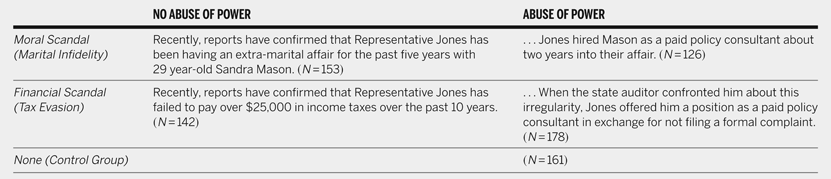
Some respondents were randomly assigned to a treatment condition in which Representative Jones was also reported to be involved in one of four scandals: moral scandal (marital infidelity) with no abuse of power, moral scandal (marital infidelity) with an abuse of power, financial scandal (tax evasion) with no abuse of power, or financial scandal (tax evasion) with an abuse of power. Table 1 displays the specific treatments that each group received.
Political Scandal Treatments
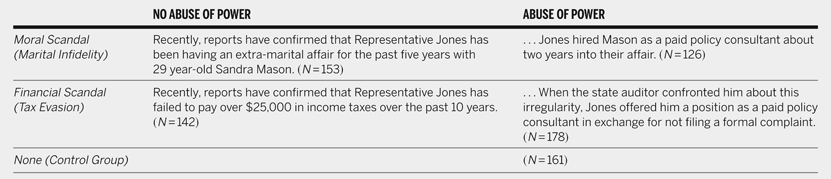
Note : Cells report text that appeared at the end of the vignette for individuals assigned to treatment conditions. The text in the Abuse of Power column was appended to the text in the No Abuse of Power column for respondents in those conditions.
After reading the vignette, respondents were asked to evaluate Representative Jones in three ways. Respondents were asked how likely they would be “to vote for him in the 2010 election” (“not very likely” to “very likely”; Vote Intent); to rate the job Representative Jones “is doing as a representative” (“poor” to “excellent”; Job Evaluation); and how they “feel about Representative Jones as a person” (“negative” to “positive”; Personal Evaluation). Responses to these three items were each recorded on a scale ranging from 0 to 100, with 0 corresponding to unfavorable ratings and 100 corresponding to favorable ratings (see the Appendix for complete question wording and coding details). To compare the effects of scandals on each of these evaluations appropriately we standardized each of these measures to have a mean of zero and standard deviation of one in the control condition.Footnote 5 This rescaling provides a way to account for any natural variability in how people form each of the three types of evaluations. We restrict our analysis to the 760 respondents who provided responses to all of the questions used in the analysis that follows.
Because we expect errors across models predicting the three outcome measures to be correlated, we estimate the effects of the scandal treatments using seemingly unrelated regression (SUR).Footnote 6 To predict each outcome measure (Vote Intent, Job Evaluation, and Personal Evaluation), we include indicators for each of the four treatments, with the control group serving as the excluded category. We also include measures of age and age-squared to account for slight imbalances on these variables across treatment conditions.Footnote 7
ESTIMATING PUBLIC RESPONSES TO SCANDALS
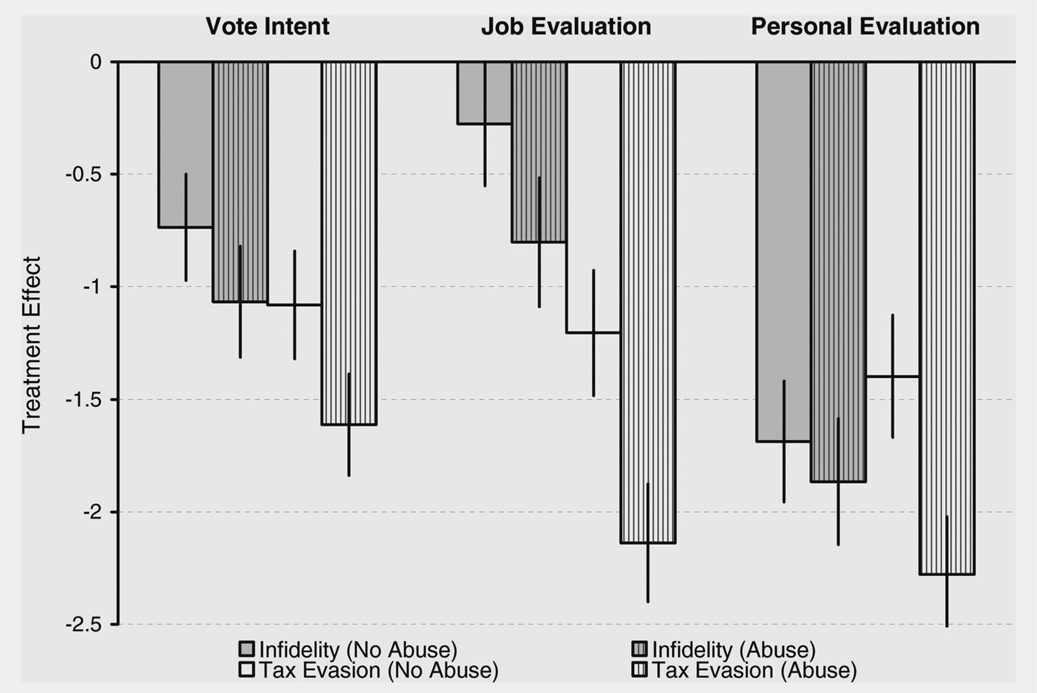
Figure 1 presents the treatment effects estimated in the SUR model described above (the full model is presented in appendix table A1). Overall, we find that people respond negatively to politicians engaged in scandal; the coefficients on each of the four treatment indicators are negative across all three models. More importantly, our analysis shows that people make clear distinctions between different types of scandals and highlights the importance of considering the role of abuses of power in shaping public responses to scandals.
Evaluations of the Representative in Response to Political Scandal (SUR Coefficients)
Note: Coefficient estimates based on seemingly unrelated regressions reported in Appendix Table A1. Outcome variables rescaled to have means of zero and standard deviations of one in the control condition. Whiskers indicate 95% confidence intervals of these coefficient estimates.
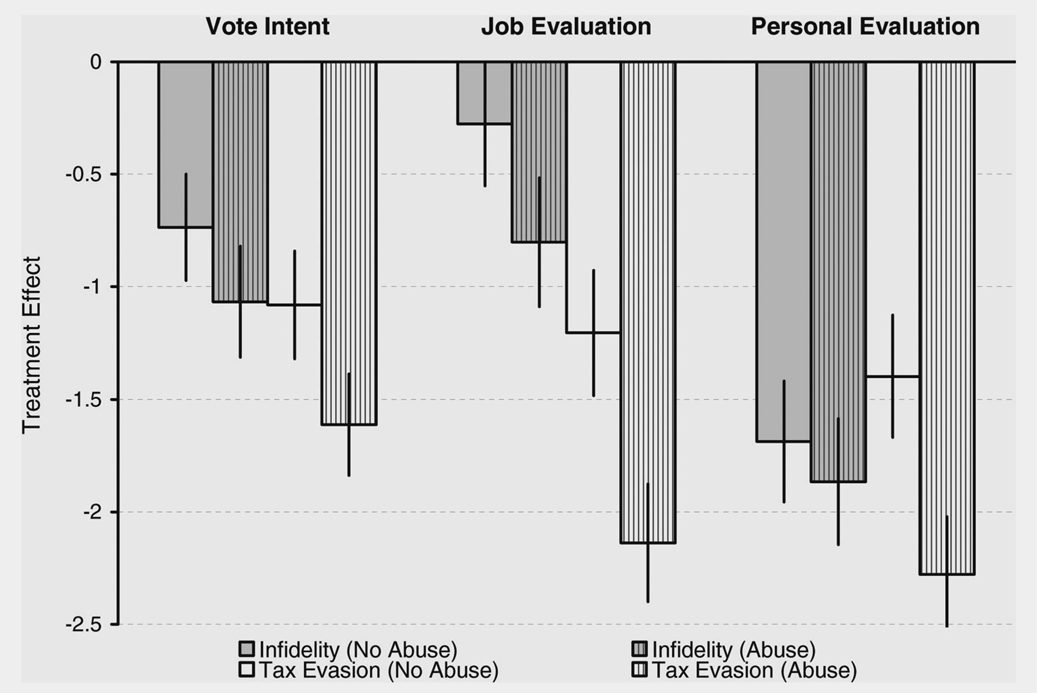
The analysis demonstrates that people respond more negatively to scandals that involve abuses of power (striped bars) than those that do not (solid bars). The amplifying negative effects of abuses of power are evident across all three evaluation outcomes. For example, participants who were told that the representative was involved in a tax evasion scandal that did not involve abuse evaluated his job performance 1.20 standard deviations less favorably than those in the control group. The negative effects of a tax evasion scandal that involved an abuse of power on job performance were substantially larger (2.14 standard deviations, p < .01 for test of the equality of the coefficients on the two financial scandal indicators in the job evaluation model).Footnote 8
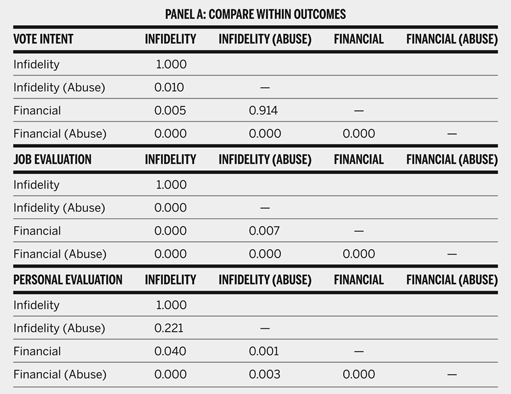
We posited that one explanation for the divergent findings reported in previous observational and experimental research is that experimental studies have only examined responses to scandals that do not involve abuses of power whereas many of the scandals used in observational studies involve abuses of power. We find support for this claim in our estimates of the effects of scandals on Vote Intent. Consistent with findings from previous experimental work, we find that people responded more negatively to the tax evasion scandal than the infidelity scandal when neither scandal involved an abuse of power (p < .01).Footnote 9 However, we find that people responded similarly to the infidelity scandal that involved an abuse of power and the tax evasion scandal that did not (p = .914).
This finding suggests that observational studies that compare the effects of moral and financial scandals may overstate the public's aversion to moral scandals. Publicized scandals that involve abuses of power may not be evenly distributed between moral and financial scandals. If abuses of power are more common in moral scandals than in financial scandals, direct comparisons between moral and financial scandals may attribute the negative consequences of abuses of power to the moral dimension of scandals.Footnote 10
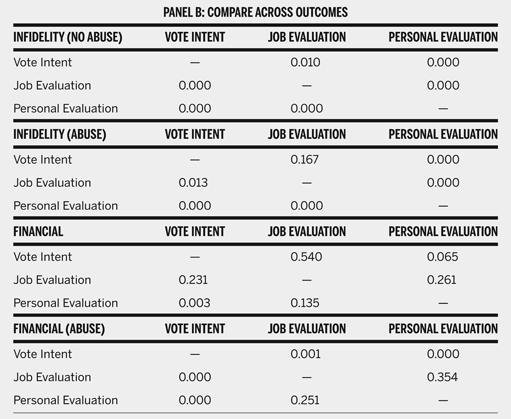
Assessing whether the various scandals used in the experiment had different effects across outcome measures is also informative. We examine this by conducting a series of tests of the equality of coefficients on each scandal treatment indicator estimated in the SUR analysis across the three outcomes.Footnote 11 The most notable finding from this analysis is that people distinguish between Job and Personal Evaluations, especially when responding to scandals involving infidelity. The infidelity scandal without an abuse of power caused a substantial 1.69 standard deviation decrease in Personal Evaluations of the representative, but it only modestly affected Job Evaluations (p < .01 for test of equality of coefficients). The effect of the infidelity scandal that did not involve an abuse of power on Job Evaluations was small (−.28 standard deviations) and barely reached conventional levels of statistical significance (p = .049). Similarly, the infidelity scandal that involved an abuse of power affected personal evaluations substantially more than job evaluations (p < .01 of test of equality of the coefficients). In contrast, the financial scandal involving an abuse of power, as well as the financial scandal that did not, affected personal and job evaluations similarly (p-values of tests of equality of coefficients = .135 and .251, respectively).
These results further underscore the importance of accounting for the relationships between scandals and the official role of the individual involved. Whereas tax evasion—that is, failing to comply with government policies (laws)—affected both Personal and Job Evaluations of the representative, respondents seemed to recognize that although infidelity may be undesirable, it says more about a representative's personal character than it does about that representative's job performance.
Heterogeneous Treatment Effects
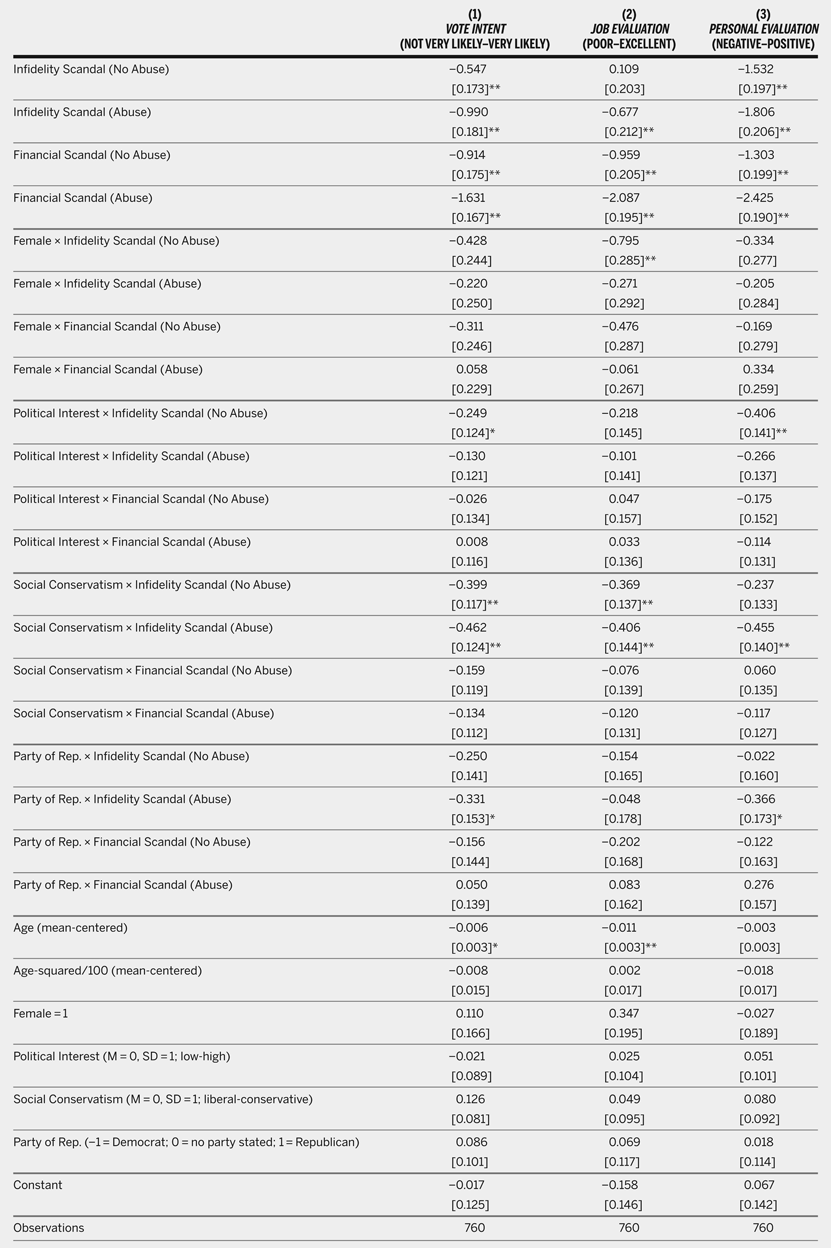
We conclude this section by describing findings from additional analysis that assessed whether the effects of the scandal treatments depended on additional factors. We focus on three individual-level characteristics that might condition responses to scandals: social conservatism (an index of attitudes about abortion and gay marriage), gender, and political interest. We expect that, first, social conservatives may see infidelity scandals as particularly problematic. Second, women may respond particularly negatively to infidelity scandals committed by the male politician in our vignette. Third, individuals who are more interested in politics may be more tolerant of scandals, seeing them as “par for the course.” We also examine whether the party identification of the representative depicted in our vignette conditioned the effects of the scandal treatments. One possibility is that Republican representatives engaged in an infidelity scandal were evaluated particularly unfavorably because this type of violation of traditional values is seen as hypocritical for a member of a party that is often associated with promoting those values. We estimate these moderating effects by adding these four variables, as well as interactions between each of these variables and each of the scandal treatment indicators to our base SUR model (12 interactions for each potential moderating variable—four for each of the three outcomes; see appendix table A3 for full results).
The moderating effects of social conservatism are substantial and in the expected direction. More socially conservative respondents evaluated representatives who engaged in infidelity scandals particularly unfavorably. The negative effects of these scandals on each of the three outcome measures were approximately .8 standard deviations stronger for individuals high on social conservatism (one SD above the mean) than for those low on social conservatism (one SD below the mean). Five of these six interactions are statistically significant at the p < .01 level (p-value = .075 for the interaction between social conservatism and the infidelity scandal, no abuse treatment for the personal evaluation outcome measure). Social conservatism did not significantly condition the effects of either of the financial scandal treatments.
We find some evidence that gender and political interest conditioned the effects of the scandal treatments. Female respondents were more inclined to see the infidelity scandal that did not involve an abuse of power and the financial scandal that did not involve an abuse of power as indicative of poor job performance (p-values on interactions = .005 and .097, respectively). Interestingly, we find that the effects of the infidelity scandal that did not involve an abuse of power on vote intent, job evaluation, and personal evaluation were stronger among individuals who reported being more politically interested (p-values on interactions = .045, .132, and .004, respectively). Finally, we find some evidence that the effects of the infidelity scandal that involved an abuse of power on vote intent and personal evaluations were particularly strong among respondents presented with a Republican representative (p-values on interactions = .030 and .035, respectively).
It is important to be cautious in interpreting these interaction effects—especially those associated with gender, political interest, and the partisanship of the representative. Examining the moderating effects of these four factors involved calculating p-values for 48 interaction terms. Although the conditioning effects of social conservatism are both strong and consistent with expectations, the same cannot be said about the moderating effects of the other three factors. Only five of the 36 coefficients associated with these three factors reach conventional levels of statistical significance. Future work should assess whether these moderating effects are meaningful or if they are simply artifacts of sampling variation.
LIMITATIONS AND DIRECTIONS FOR FUTURE RESEARCH
The results of our experiment suggest that to understand public responses to political scandals it is important to consider the role of abuses of power. We also find that people distinguish between what scandals say about a representative as a person and what they imply about the representative's job performance. For example, although people evaluated a representative involved in an infidelity scandal that did not involve an abuse of power less favorably, this type of scandal substantially affected personal evaluations of the representative, but only modestly affected evaluations of the representative's job performance. Finally, we also find some evidence that individual level characteristics—most notably social conservatism—condition responses to scandals.
The benefit of the experimental design used in this study is that it provides a clean and direct way to assess how people respond to the substance of scandals. Like all research designs, however, our experimental design has limitations. One of these limitations is that the vignettes we used provided only rudimentary information about the representative. Outside of the experimental context people are likely to have more detailed information about representatives who are accused of scandalous behavior and may also have already formed opinions about these politicians. These factors may either diminish or amplify the consequences of scandals. Future experimental designs could provide a more robust information environment by using a vignette that provided more information about the representative (e.g., the representative's policy positions). Similarly, this study only examines initial responses to scandal. Although these initial reactions are important, this design does not allow us to assess how long they endure.
It is also important to consider how to best demarcate political scandals. Here we have treated abuse of power as a dimension of scandal. However, an alternative way to conceptualize scandals would be to treat the abuse of power scandals we used in our treatments as consisting of two scandals—an initial financial or infidelity scandal plus an abuse of power scandal. Our decision to treat scandals like those used in our abuse treatments as single occurrences of scandal stems from our interpretation of how scandals are typically treated in political discourse. Additionally, it tracks with how scandals are demarcated in observational studies. For example, Brown (Reference Brown2006) codes Representative Mel Reynolds' 1994 behavior as a single sexual scandal although he was charged with abusing his power by pressuring a 16-year-old campaign worker to lie about their sexual encounter and ultimately was convicted of multiple counts of sexual assault, obstruction of justice, and solicitation of child pornography (Rudin Reference Rudin1998).
This said, to understand the mechanisms that shape responses to various types of scandals it is necessary to consider whether people's strong responses to scandals involving abuses of power are the product of a uniquely strong aversion to abuses of power or if, instead, they are simply responses to learning more repellent information about the individual involved in the scandal. Future work should consider this distinction more carefully. Evaluation of this distinction could be accomplished by comparing responses to a financial scandal that involved an abuse of power with responses to a representative who is involved in both a financial and a moral scandal—neither of which involved an abuse of power—or multiple moral scandals (e.g., multiple extramarital affairs).
Our findings also suggest a variety of additional directions for future research. Many other aspects of scandals may shape public responses to these events. For example, perceptions of hypocrisy may intensify the effects of a scandal. A representative who has previously taken a strong stance in favor of “family values” and who is later caught in an infidelity scandal may be punished particularly harshly (for observational evidence on this point see Brown Reference Brown2006; Bishin, Stevens, and Wilson Reference Bishin, Stevens and Wilson2006). Factors including the gender and race of the individual involved, whether the scandalous behavior is confirmed, and the popularity of the accused may also have important consequences. Similarly, our findings suggest that the characteristics of the observer (respondent) can shape responses to different types of scandals. However, more work is needed to improve our understanding of how the characteristics we examined, as well as other individual-level factors, affect responses to political scandals.
APPENDIX
QUESTION WORDING
Vote Intent: If you lived in Representative Jones' district, how likely do you think you would be to vote for him in the 2010 election?
RULER WIDGET: Vote Intent, Not very likely (0)—Very likely (100)
Job Evaluation: Based on what you know about Representative Jones, how would you rate the job he is doing as a representative?
RULER WIDGET: Job Evaluation, Poor (0)—Excellent (100)
Personal Evaluation: How do you feel about Representative Jones as a person?
RULER WIDGET: Personal Evaluation, Negative (0)—Positive (100)
Social Conservatism Index: Each of the two variables was rescaled to have mean = 0 and standard deviation = 1 with higher values corresponding to more conservative attitudes. Social conservatism is a mean index of these two standardized scales.
Abortion: Which one of the opinions on this page best agrees with your view on abortion?
By law, abortion should never be permitted.
The law should permit abortion only in case of rape, incest, or when the woman's life is in danger.
The law should permit abortion for reasons other than rape, incest, or danger to the woman's life, but only after the need for the abortion has been clearly established.
By law, a woman should always be able to obtain an abortion as a matter of personal choice.
Gay Marriage: Do you believe people should have the right to marry someone of the same sex? Yes No
Political Interest: Some people seem to follow what's going on in government and public affairs most of the time, whether there's an election going on or not. Others aren't that interested. Would you say you follow what's going on in government and public affairs … ? (rescaled to have mean = 0 and standard deviation = 1 with higher values corresponding to greater interest)
Most of the time
Some of the time
Only now and then
Hardly at all
Don't know (4 respondents: coded as “Hardly at all”)
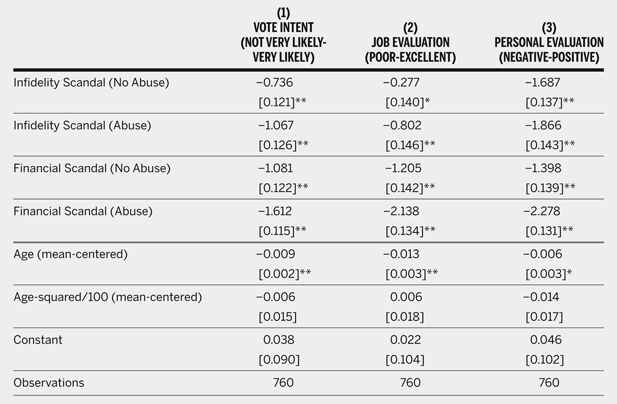
Evaluations of the Representative in Response to Political Scandal (SUR Results)
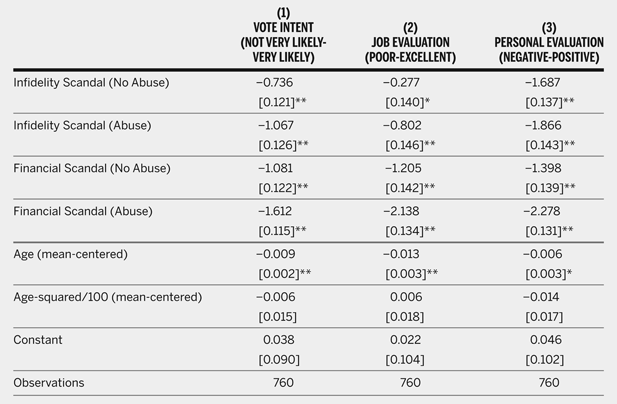
Note: Seemingly unrelated regression (SUR) coefficients with standard errors in brackets. Outcome variables rescaled to have means of zero and standard deviations of one in the control condition.
* significant at 5%;
** significant at 1%
Comparison of Equality of Scandal Treatment Coefficients Note: Cell entries are p-values from tests of the equality of coefficients on treatment indicators from SUR analysis presented in table A1. Note: Cell entries are p-values from tests of the equality of treatment effects across outcomes. P-values below the diagonal are tests of the equality of coefficients on treatment indicators from SUR analysis presented in table A1; p-values above the diagonal are from pairwise t-tests using bootstrapped means and standard errors.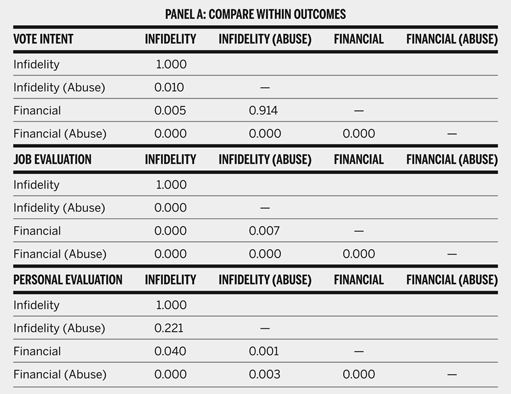
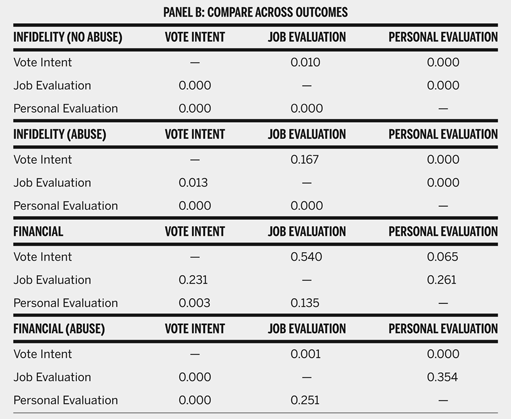
Evaluations of the Representative in Response to Political Scandal—Heterogeneous Treatment Effects (SUR Results)
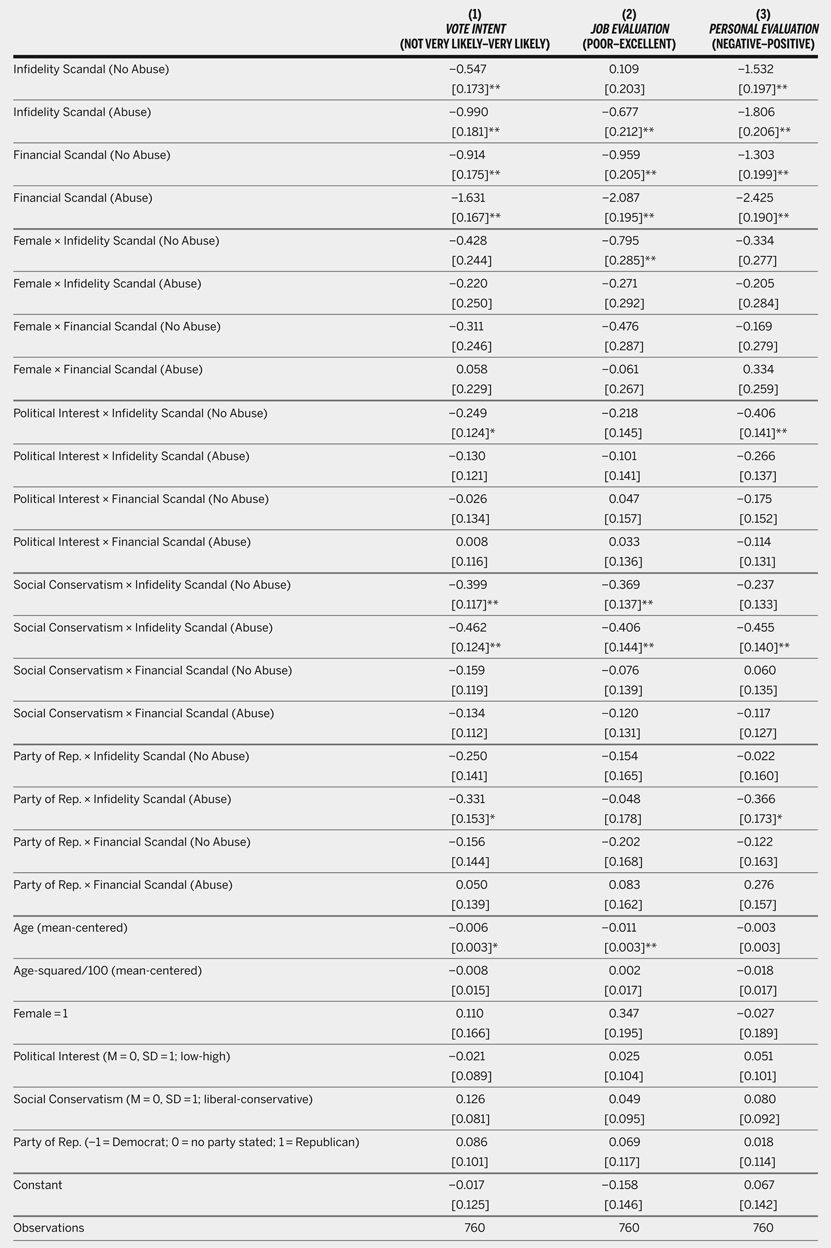
Note: Seemingly unrelated regression (SUR) coefficients with standard errors in brackets. Outcome variables rescaled to have means of zero and standard deviations of one in the control condition.
* significant at 5%;
** significant at 1%