




No CrossRef data available.
Critical Mass Theory Revisited: The Behavior and Success of Token Women in State Legislatures
Published online by Cambridge University Press: 09 September 2005
Abstract
Research on women and representation has argued that women who serve in “skewed” legislatures—that is, legislatures in which women make up less than 15% of the membership—avoid addressing women's interests and are marginalized by other legislators. I argue that women in such legislatures may actually be encouraged to develop legislative agendas that are distinct from those of their male colleagues, and that they may be as successful as their male counterparts. Analyzing data from three state legislatures in four years, I find that even in extremely skewed state legislatures, women are generally more active than men in sponsoring legislation that focuses on women's interests; indeed, in two of the three states, gender differences narrow as the legislature becomes more gender balanced. Second, I find that women are generally as successful as men in passing the legislation that they sponsor, and that in very homogeneous settings, they are sometimes more successful than men. Moreover, little evidence exists that they are less likely to be appointed to leadership positions. Finally, I find that increasing gender diversity within a legislature is accompanied by a greater overall focus on women's issues. I conclude that a “critical mass” is not necessary for substantive representation on the part of individual female state legislators, but that increased diversity may indeed bring about changes in policy outputs that reflect the interests of women.
Information
- Type
- Research Article
- Information
- Copyright
- © 2005 The Women and Politics Research Section of the American Political Science Association
In the past decade, a substantial amount of scholarly work has examined the effect of the degree of diversity within an organization upon the experience of women working in that organization. Using as a case the “Industrial Supply Corporation,” an anonymous corporation, Rosabeth Kanter (1977) argued that token women within an organization (that is, women who make up less than about 15% of an organization's membership) are subject to performance pressures, boundary heightening, and role entrapment. Token women in the Industrial Supply Corporation reported that they were more visible than men; they were “always viewed by an audience” (1977, 973). Moreover, co-workers and superiors viewed these women on the basis of gender stereotypes and evaluated their actions as evidence not only of their worth as sales personnel but also of their worth as women. Token women in the corporation were evaluated in part on the basis of their physical appearance, and they had to work harder to have their achievements noticed. Gender differences were consistently highlighted and exaggerated; furthermore, the acts of women tended to have consequences for how other women were viewed and treated. Tokens were also aware of a need to avoid placing members of the dominant group (that is, men) in a negative light. The most common response of women to their status was to minimize gender differences, keep a low profile, and let others assume leadership positions or take credit for the token's accomplishments. In general, in response to their status as token members of a group, Kanter argued, women may downplay group differences, trying to “blend unnoticeably into the predominant male culture” (1977, 973). In more equitable contexts, on the other hand, women may become less isolated and may affect group processes and the organization's culture.
Political scientists have applied Kanter's work to the political setting, examining the behavior, treatment, and success of female state legislators (e.g., Saint-Germain 1989; Thomas 1991, 1994). These scholars generally argue that gender differences in legislative agenda setting will be less pronounced in overwhelmingly male-dominated legislatures, and that women will be most successful in relatively balanced contexts. In this article, I examine distinctive agenda-setting behavior by women; I also examine gender differences in legislative success in terms of bill passage and appointment to leadership positions. I argue that women do not have an incentive to avoid focusing on women's issues, that there is a link between descriptive and substantive representation, and that this link between descriptive and substantive representation may be particularly evident in skewed legislatures.
THE COMPOSITION OF THE LEGISLATURE AND THE REPRESENTATION OF WOMEN'S INTERESTS
Several scholars have applied this work to the legislative setting, arguing that gender differences in legislative policy priorities and agendas will be minimized in homogeneous legislatures. Michelle Saint-Germain (1989) found that significant gender differences in the introduction of traditional women's interest measures were evident once the percentage of women reached approximately 15% (that is, in the last three sessions she studied); prior to this, when women served as “tokens,” gender differences in bill introduction were muted.1
Saint-Germain (1989, 958–59) suggested that women in less diverse legislatures would be more likely to propose feminist legislation, but less likely to pass that legislation. The formal hypotheses that she lists, however, make no reference to the gender composition of the legislature (959). In her discussion of her findings, she notes that “when women served in relatively few numbers they addressed traditional women's issues to no greater extent than their male colleagues; when women surpassed 15 percent of the Arizona state legislature, they increased their attention to these issues, and the gap between the importance of these issues for men and women legislators became statistically significant” (963).
What accounts for these different empirical findings? One explanation points to the different approaches that scholars have taken. Saint-Germain used sponsorship as a dependent variable and based her conclusions on five sessions of the Arizona state legislature; gender differences in sponsorship did not emerge in the first two sessions (when there were very few women in the legislature), but they did emerge in the last three sessions (when the legislature was at least 15% female). It is difficult to generalize from two sessions of the Arizona state legislature to other skewed environments, particularly given that Saint-Germain found gender differences only in the sponsorship of traditional women's interests, and not in the sponsorship of feminist measures.2
Traditional women's interest measures generally focus on policies that are broadly of interest to women, regardless of ideology, such as pregnancy. Feminist measures focus on promoting equality or battling discrimination.
A second set of explanations for the different empirical findings on critical mass stems from the problems that emerge from applying Kanter's work to the legislative behavior of women. Kanter acknowledged that tokens could respond in two possible ways to their status: Tokens could promote themselves and their achievements, or they could minimize differences with the dominant group. Kanter's assertion that the latter was the more common response (1977, 974) may be less valid in the legislative setting. It is reasonable to expect that many of the women who served in “skewed” legislatures were politically active and voluntarily entered a competitive political arena (Maxine Waters, Pat Schroeder, Corrine Brown, Patsy Mink, and Lucille Roybal-Allard come to mind).3
Maxine Waters served from 1977 to 1991 in the California legislature, and then from 1993 to the present in the U.S. House. Pat Schroeder served from 1973 through 1997 in the U.S. House. Patsy Mink served in the Hawaii legislature from 1956 to 1959, and then in 1962–64; she then served in the U.S. House from 1965 to 1977, and then from 1990 to 2002. Corrine Brown served from 1983 to 1993 in the Florida legislature, and then from 1993 to the present in the U.S. House. Lucille Roybal-Allard served from 1987 to 1992 in the California legistature, and then from 1993 to the present in the U.S. House.
The corporate setting differs markedly from the legislature in that legislators respond not only to other legislators but also to voters. Kanter argues that token women will be more visible, but additional visibility can often benefit an elected official. Little evidence suggests that voters are generally hostile to legislators—or to women in particular—who focus on either feminist interests or on traditional women's interests. Female legislators may instead be seen by voters as better able to handle traditional women's interests (Dolan 2004; Huddy and Terkildsen 1993; Sanbonmatsu 2002), and women may therefore have an electoral incentive to focus on those interests.
Finally, Kanter's work does not allow for the possibility that as women increase their presence within legislatures, they begin to influence men. If men become more likely to support women's interests, then gender differences should narrow, not widen. Thomas (1991, 962) acknowledges this alternative possibility when she hypothesizes that as the number of women increases in the legislature, “the more likely it will be that women's attitudes permeate the wider legislative atmosphere.”
Scholars applying Kanter's work to both the behavior and success of female state legislators are putting the cart before the horse: One needs to demonstrate that relevant performance pressures exist before one can argue that women respond to performance pressures. Although it is likely that discriminatory treatment does exist in the legislative setting, it is unclear that it would discourage “token” women from focusing on women's interests. Kanter argues that token women face retaliation for doing too well, and therefore find themselves in a double bind: They have to work harder than men in order to be seen as competent but then face reprisals for their success. But are token female legislators less successful than men, and do they face retaliation for emphasizing gender differences in their legislative agendas?
THE COMPOSITION OF A LEGISLATURE AND THE SUCCESS OF FEMALE LEGISLATORS
Research investigating the effect of the composition of the legislature on the success of female state legislators has produced mixed results. Saint-Germain (1989) found little association between the percentage of women in the legislature and the success of women in passing the legislation they introduced. Women were significantly more likely than men to pass women's interest legislation in the 1969, 1973, and 1985 sessions of the Arizona state legislature, when they comprised 12.2%, 13.3%, and 20% of the legislature, respectively. No significant gender differences were found in the 1977 and 1981 sessions, when women comprised 16.7% and 18.9%, respectively. Thomas (1991, 1994) found that women were most successful in passing such legislation in relatively gender-balanced legislatures. She concluded that “reduced conformity pressures and increased support for distinctive behavior were advanced in places where the proportion of women was highest” (Thomas 1994, 104). Drude Dahlerup (1988) applied Kanter's work to the Scandinavian setting, arguing that resistance to women elected officials will generally diminish as their numbers grow. At the same time, she acknowledged that there may be examples of women who were more successful because of their token status (Dahlerup 1988, 295). Cindy Simon Rosenthal (1998) and Mark Considine and Iva Ellen Deutchman (1996) argue that while token legislators may indeed be subject to increased visibility and performance pressures, the likelihood of increased influence depends on a host of factors other than the number of women in the legislature. Given the mixed results, it is likely that such factors as a sponsor's majority party status and seniority have a pronounced effect on outcomes like bill passage (Ellickson 1992; Moore and Thomas 1991), more pronounced than that of the sex of the measure's sponsor. Moreover, prior research indicates that legislative effectiveness is enhanced when legislators sponsor bills on salient policy issues (Weissert 1991); gender issues can certainly be regarded as salient in the time period under consideration.
There is little evidence that a focus on women's interests in particular makes female legislators less effective, even when they are “tokens.” Thomas (1994, p. 97), for instance, found that women generally had higher passage rates than men for legislation dealing with women, children, and family; large gaps between men and women were found both in states with relatively few women in the legislature (such as Pennsylvania) and states with a relatively high percentage of women in the legislature (such as Washington). Likewise, Rosenthal (1998) speculates that although female committee chairs exercise different styles of leadership than their male counterparts, their styles may facilitate getting their agenda enacted into policy.4
Kathlene (1994) found that women were not disadvantaged in terms of passage rates. She noted, however, that measures sponsored by women faced obstacles. Women-sponsored bills were significantly more likely to be assigned to multiple committees, were debated longer in committee, and received more hostile witness testimony. More research is needed to determine whether such obstacles are more or less evident for “women's interest” measures sponsored by women.
Indeed, Kanter (1977, 981–85) argues that token women will encounter “role entrapment.” Her own words illustrate the theory most effectively: In skewed groups, “tokens are often treated as representatives of their category, as symbols rather than individuals” (1977, 966, emphasis mine). In the corporate setting, the treatment of women as “representative of their category” may lead them to downplay gender differences. There is, after all, no obvious avenue for female sales personnel to profit from their experience on women's issues. In the legislative setting, however, women may be regarded as experts on political matters of relevance to women, and may be encouraged to focus on women's issues. Where representation is part of the job description, the treatment of women as “representative of their category” may encourage them to behave distinctively from men, to focus on legislation that is of particular interest to women. Michele Swers (2002) notes that in the U.S. Congress, Republican congresswomen are more likely to focus on women's issues than are their male counterparts, while expressing concern about being expected to be experts on traditional women's issues. If female legislators are treated as representatives of “their category,” there is little reason to expect that they would have an incentive to downplay women's issues and minimize gender differences.
Moreover, the effect of increasing numbers of women may not necessarily be positive. As Karen Beckwith (2002) observes, critical mass can also explain negative outcomes; as the number of women increase in an organization, they may be less successful in achieving their goals. Janice Yoder (1991) argues that the increased presence of a group in an organization may actually invite a backlash effect; similarly, Lyn Kathlene (1994) finds that female legislators meet with resistance in legislative committee debate, and that resistance is particularly pronounced on committees that approach gender balance. Even Kanter, in the 1993 edition of Men and Women of the Corporation, acknowledged that women and minorities may be more threatening to a dominant group when their numbers are higher. She observes that “tokenism is hard on the sole representative but poses no threat to the majority group,” and “research shows that dissatisfaction and tension are greatest in groups in which there are several women or minorities, but not enough to fully balance the numbers” (Kanter 1993, 316).
Notwithstanding the mixed empirical record, as Donley Studlar and Ian McAllister (2002) point out, the notion of a “critical mass” necessary for changes in behavior and influence has gained increasing currency in scholarly literature (e.g., Broughton and Palmieri 1999; Jaquette 1997) and even in writings designed for a broader audience (e.g., Baer 1999). 5
Political scientists have often referred to the “critical mass” thesis, and generally cite Thomas (1994) as the primary source. Dolan and Ford (1998, 77) write that “there is a variety of evidence to support the ‘critical mass’ thesis—that women act more distinctively once their numbers reach a certain threshold.” Broughton and Palmieri (1999, 29) write that critical mass theory suggests that “[o]nce women reach somewhere between 15% [Kanter 1977] and 30% [Thomas 1994] of elected politicians in effective democracies greater representation and articulation of women's interests and concerns will follow [Sapiro 1983; Phillips 1993].” Baer (1999, 9) writes that “research has shown that when the proportion of women in the legislature falls below 15%, their legislative performance is constrained.” Swers (2001, 217) notes that “scholars found that the sex differences in the policy priorities of legislators intensified as the proportion of women in the legislature approached a ‘critical mass.’ ” See also Sam Howe Verhovek, “Record for Women in Washington Legislature,” New York Times, 4 February 1999, sec. A.
DATA
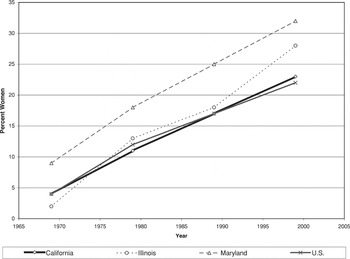
The data used in this paper were gathered for a larger project taking a historical perspective on female representation in state legislatures. Information from the lower houses of state legislatures was gathered from state legislative documents for the years 1969, 1979, 1989, and 1999 in the states of California, Illinois, and Maryland. Because of the range of female representation within these states and years, these legislatures provide an excellent opportunity to test whether women respond to their token status by altering their agendas, and to test whether an increased proportion of women facilitates women's success. The percentage of women within the legislature ranges from approximately 2% in Illinois in 1969 to approximately 32% in Maryland in 1999. Illinois and California were Republican controlled in 1969; the remaining legislatures were controlled by Democrats. In 1969, all three of the legislatures under consideration were “skewed” according to Kanter's typology; by 1999, all three had become “tilted” (that is, women composed more than 15% of the legislature). Descriptive information regarding the gender composition of the legislatures under consideration, as well as the composition of legislatures in the United States overall, is presented in Figure 1.6
As Figure 1 demonstrates, the state legislatures selected are representative in terms of the trend of increasing gender diversity. However, the state legislatures selected are not entirely representative of the nation at large in terms of the absolute percentage of women; they generally range from average to high on that dimension. They are also not entirely representative in terms of state ideology; on the basis of measures of state elite and mass ideology developed by Berry et al. (1998), Illinois is relatively “average” in ideology across the time period studied, California is somewhat liberal, and Maryland consistently ranks in the top 20% of liberal states, in terms of both mass public ideology and government ideology. The reason for this nonrepresentativeness is that only states that had at least enough women in the legislature in 1969 to conduct empirical analyses were chosen for analysis. However, data exist for Arkansas from 1969 through 1989; Arkansas is a relatively homogeneous state (it is consistently ranked among the 10 states with the lowest percentage of women in the legislature) and a relatively conservative state. The low number of women makes obtaining reliable parameter estimates in a multivariate regression difficult, particularly in 1979. However, in 1969, when there were only three women (that is, 3% of the chamber) serving in the statehouse, women sponsored significantly more women's interest legislation. In 1979, when there were still only three women in the legislature, women were not active in sponsoring women's legislation. In 1989, the number of women had increased to 8% of the chamber, and women introduced significantly more women's interest legislation than men.

Trends in gender diversity in state legislatures 1969–1999.
Each bill introduced in the lower house of these legislatures was coded according to its substantive content. Only substantive proposals for new laws were counted as bill introductions; nonbinding resolutions and memorials were excluded from the analyses. Introducer lists found in the various state legislative documents were used to match legislators with their proposals. When a distinction was made between primary and secondary sponsors, only primary sponsors were included (though bills could have multiple primary sponsors).
The focus of this study is women's interest legislation. Political scientists have defined such legislation in a variety of ways; Table 1 summarizes the recent approaches of five scholars in the field, including Thomas (1991, 1994), Beth Reingold (2000), Swers (2002), Chistina Wolbrecht (2000), and Kathleen Bratton (2002).
Recent approaches of political scientists to defining women's interests

There is a large degree of overlap among these approaches; all define as “women's issues” a core set of issues that directly and almost exclusively affect women. There are, of course, some differences across the definitions. Some scholars include in their definition of women's issues a broader set of issues with which women have traditionally been associated, such as welfare, education, and health; others focus on such issues as categories for analysis separate from the analysis of women's issues. Some scholars merge what are seen as traditional concerns of women with feminist concerns. Most but not all scholars include measures or policies that are designed to protect multiple groups (including women) from discrimination. The definition of women's issues used in this study captures the core definition reflected in these five approaches; women's interest legislation includes bills that directly address and seek to improve women's economic, political, and social status. Some specific examples are an equal pay act, a bill that provides or regulates day care services, a bill that requires insurance coverage of mammographies, and a bill establishing affirmative action programs for women. Thus, women's interest legislation is coded from a feminist perspective. It should be noted that measures placed in broader categories such as “education” or “health” were not included in the definition of women's interests, unless these measures directly focused on women, because such broader definitions, though certainly part of women's traditional interests, do not quite as obviously run counter to the “predominant male culture.”7
An example of a women's interest measure relevant to education would be a measure that banned gender discrimination in college sports. An example of a measure relevant to education that was not considered a women's interest measure would be a measure that increased funding for textbooks in public schools. Three supplementary analyses were performed on three broader categories of measures: education measures, health measures, and measures focused on poverty. No evidence was found that sex differences in sponsorship became more pronounced as the percentage of women in the legislature approached or moved beyond a “critical mass.”
METHODS
The experience of legislators is examined at two points in the legislative process: agenda setting and success. Agenda setting is measured as the sponsorship of measures involving women's interests. Success is measured in two ways: as bill passage within the chamber and as appointment to leadership positions. The agenda-setting stage of the legislative process provides an opportunity to evaluate whether women in homogeneous settings downplay gender differences in response to their token status; the passage stage of the legislative process provides an opportunity to evaluate whether the legislative success of “token” women is limited.
Legislative Agenda Setting
The unit of the sponsorship analyses is the individual legislator; the dependent variable in these analyses is the number of women's interest bills sponsored. Twelve negative binomial regression analyses (one for each state and year) are performed to test the effect of gender on the sponsorship of women's interest legislation.8
Because event-count data tend to be strongly skewed to the right (that is, legislators who introduce a women's interest bill tend to introduce only one such measure, fewer legislators introduce two, even fewer legislators introduce three, and so on), ordinary least squares is an inappropriate method to analyze such data. Negative binomial regression or Poisson regression analysis is appropriate when the dependent variable is an event count (King 1988). In this case, the negative binomial distribution is the appropriate choice, because a legislator who sponsors one women's interest measure is more likely than other legislators to sponsor other such measures. That is, negative binomial regression is appropriate in cases such as this where there is overdispersion (that is, the variance of the distribution is greater than the mean).
Legislative Success: Passage of Legislation
The unit of analysis here is the bill, and the dependent variable is coded 1 if the bill passed in the lower house, and 0 otherwise. Female legislators have the most direct influence over passage in the chamber (as opposed to passage into law). Twelve logistic regression analyses (one for each state and year) are performed to examine the effect of the gender of the sponsor on whether a bill passes in the lower house. The two independent variables of primary interest are the percentage of sponsors that are female, and whether the measure is a women's interest measure, coded as described here. Controls are included for several other likely influences on bill passage. Drawing on previous research that indicates that legislation sponsored by African American legislators is under some conditions less likely to pass (Bratton and Haynie 1999), I control for the percentage of sponsors who are black. It is likely that legislators who have served in the institution for a relatively long period of time are more adept at steering legislation toward passage; thus, I control for the average seniority of the sponsors. Sponsors in the majority party and legislative leaders are more likely to gain support for their sponsored legislation; thus, I control for the percentage of sponsors that are affiliated with the majority party, as well as the percentage of sponsors that are leaders. Leadership positions include the Speaker of the House, the floor leaders, assistant and deputy floor leaders, whips, assistant and deputy whips, and committee chairs. Drawing on previous research that indicates that fiscal measures are often more or less likely to pass (Bratton and Haynie 1999), I include controls for whether the bill is a taxation or appropriations measure.9
Taxation measures generally included those involving changes in tax levels, and the establishment of or changes in tax exemptions and credits, as well as measures regulating tax collection and protecting taxpayer rights. Appropriations measures were generally spending measures.
I expect that any effect of the percentage Black in the district and the size of the largest city in the district will be nonlinear. For instance, an increase of 5,000 in the population of the largest city will have a bigger effect if the largest city is less populated than if it is more populated. The values of these two variables are therefore logged to discount large values.
Legislative Success: Appointment to Leadership Positions
Of course, women could be very successful in terms of passing legislation—but still be very much marginalized. In a second set of analyses, I examine whether token women are less likely to hold leadership positions, particularly if they focus on women's interests. Holding a leadership position is an excellent measure of one's status within a legislature; it is the legislative analogy to promotion within the corporate setting. The unit of analysis here is the legislator; the dependent variable is coded 1 if the legislator holds a leadership position, and zero otherwise. Leadership positions included the Speaker of the House, the floor leaders, assistant and deputy floor leaders, whips, assistant and deputy whips, and committee chairs. I present two logistic regression analyses, one for relatively homogenous legislatures, and one for legislatures with a relatively balanced proportion of men and women. The independent variable of primary interest is the sex of the legislator. To examine whether individuals who focus on women's issues are particularly marginalized, I control as well for the percentage of all measures introduced by that legislator that are women's interest measures. To examine whether women who focus on women's issues are particularly marginalized, I include a variable that takes the value of the percentage of women's measures introduced if the legislator is female, and is equal to 0 for men. The parameter estimate for this variable measures the additional effect for women of a relatively heavy focus on women's issues on attainment of leadership positions. As in the passage analyses, in addition to the sex of the legislator, I control for a number of other influences on the likelihood that a legislator will hold a leadership position, including the race, seniority, and majority party status of the legislator; the district demographics of the legislative district (including, as before, the percentage Black in the district [logged] and the size of the largest city in the district [logged]). I also include dummy variables to control for year and state effects.
FINDINGS
Gender Differences in Bill Sponsorship
The results from the analyses of bill sponsorship demonstrate that women consistently focus on women's interests more than do men.
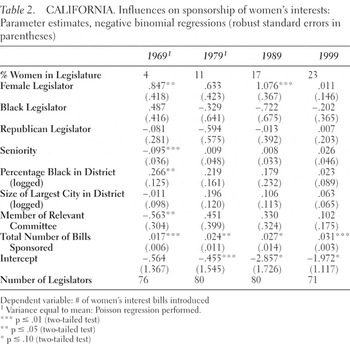
In California, women are generally more likely than men to sponsor women's interest legislation, although the differences are statistically significant only in 1969 and 1989.11
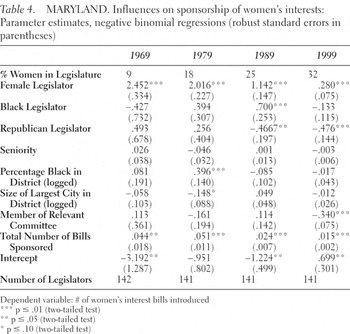
Supplementary analyses across the 12 cases indicate that there is no pattern of significant gender differences in the total number of bills sponsored. In California in 1969, women sponsored significantly fewer bills than men; in Maryland in 1979 through 1999, women sponsored significantly more bills than men.
Several scholars have recognized the importance of partisanship in the representation of women and of women's issues (Bratton 2002; Bratton and Barnello 2002; Sanbonmatsu 2002; Swers 2002). Supplementary analyses within parties indicate that gender differences are fairly consistent across Republicans and Democrats. I also performed supplementary analyses on four subsamples of legislators: those who served as tokens in the majority party, those who served in the majority party in relatively diverse chambers, those who served as tokens in the minority party, and those who served in the minority party in relatively diverse chambers. In all four contexts, there were substantial gender gaps in bill sponsorship.
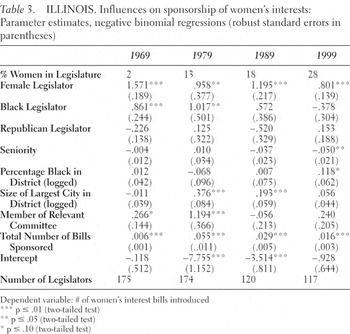
Tables 2, 3, and 4 present no evidence that women become more likely to behave distinctively as the legislature becomes more gender balanced. Indeed, gender differences in both Illinois and Maryland gradually diminish as the proportion of women in the legislature increases. One potential explanation for this narrowing is that men are sponsoring more of these measures; more research should be done to investigate to what degree and under what conditions men focus on “women's issues.”13
Some preliminary research does exist. Across six states (12 chambers) in 2001, Bratton and Barnello (2002) find that as the percentage of Republican women in a legislature increases, the likelihood that a Republican sponsoring a women's interest measure drops substantially, but no similar effect exists among Democrats. Factors such as partisanship and age had much more pronounced effects on the behavior of men than women. In fact, young, African American, married male Democratic legislators with more seniority are actually as likely as comparable women to focus on women's interests.
In their discussions of the representation of women and women's interests, both Beckwith (2002) and Childs (2001) focus on “newness” in addition to numbers. Supplementary analyses performed on the skewed legislatures in this database indicate no pattern of significant sponsorship differences between recently elected female legislators and female incumbents.
CALIFORNIA. Influences on sponsorship of women's interests: Parameter estimates, negative binomial regressions (robust standard errors in parentheses)

ILLINOIS. Influences on sponsorship of women's interests: Parameter estimates, negative binomial regressions (robust standard errors in parentheses)

MARYLAND. Influences on sponsorship of women's interests: Parameter estimates, negative binomial regressions (robust standard errors in parentheses)

The findings in these analyses support the expectation that women are perceived as “representatives of their group as a whole” (Kanter 1977, 976) and thus may be encouraged to create distinctive policy agendas. One reason that women are not constrained in their sponsorship behavior may be that even in relatively homogeneous settings, the measures that women sponsor and measures that focus on women's interests are as successful as other measures. The next set of analyses examines that question.
Gender Differences in Bill Passage
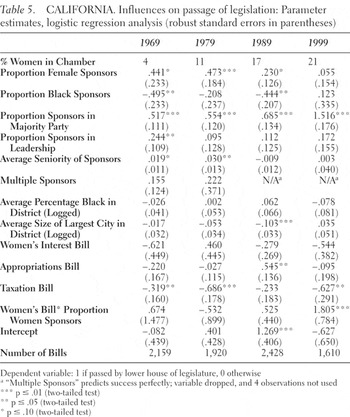
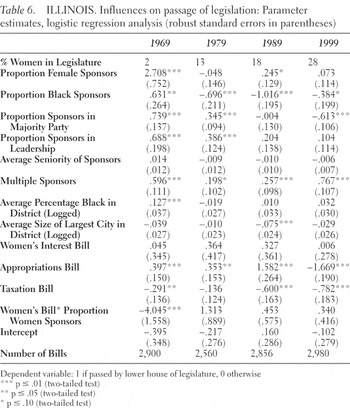
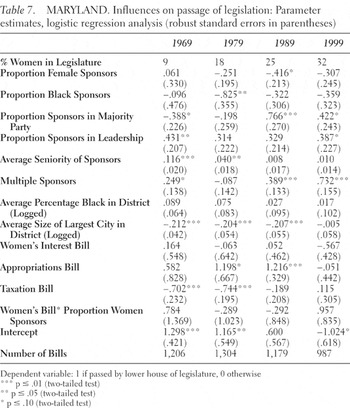
The question here is whether women and/or those who introduce women's interest measures are disadvantaged in skewed settings. That is, is there discrimination in bill passage in skewed settings that might provide an incentive for token women to downplay gender differences? The results of the logistic analyses on bill passage, presented in Tables 5, 6, and 7, offer strong evidence that “token” women do not face relatively high obstacles at the passage stage of the legislative process.
CALIFORNIA. Influences on passage of legislation: Parameter estimates, logistic regression analysis (robust standard errors in parentheses)

ILLINOIS. Influences on passage of legislation: Parameter estimates, logistic regression analysis (robust standard errors in parentheses)

MARYLAND. Influences on passage of legislation: Parameter estimates, logistic regression analysis (robust standard errors in parentheses)

Two observations are in order. First, the results suggest that women are often even more likely than men to pass the legislation that they sponsor. Second, when women are advantaged, the gender gap is most substantial in earlier years, when they comprise a smaller percentage of the institution. In California, women were significantly more likely to pass the legislation they sponsored in 1969, 1979, and 1989; this is particularly true in 1969 and 1979, when women comprised less than 15% of the legislature. In Illinois, women were most advantaged in 1969, when they comprised only 2% of the legislature. Only in Maryland in 1989, where women filled about a quarter of the legislative seats, were women significantly less likely to pass the legislation they sponsored.15
If the analysis is restricted to legislation with only female or only male sponsors, the pattern of significance and direction is generally the same with few exceptions; the substantive conclusions remain the same. Supplementary analyses were also performed regressing the vote margins of bills that reached a floor vote onto the independent variables; the findings are substantively the same as those presented in this article.
Thus no evidence is found that women are disadvantaged in bill passage by their token status—indeed, token women may even have an advantage. Some marginal support is found for increased resistance to the measures that women sponsor. As women grow in number in California and Illinois, they lose an advantage in passing legislation; this may indicate more resistance to women, although there is no evidence of a disadvantage relative to men. In Maryland, there were no significant gender differences in passage between women and men until 1989, when women comprised about 25% of the legislature; at this point, they were significantly less likely to pass legislation than were their male counterparts. In 1999, however, when women comprised about 32% of the legislature, gender differences in passage disappeared.
Interestingly, the results suggest that the sex of the legislator matters more than the content of the legislation. In each case, women's interest legislation is no more or less likely to pass than are other measures, and no trend over time is discerned. In Maryland in 1999, women's interest bills were more likely to pass if sponsored by women; in Illinois in 1969, women's interest bills were less likely to pass if sponsored by women. Generally, however, women are no more likely to achieve passage of women's interest bills than they are to achieve passage of other measures.
Gender Differences in Leadership Positions
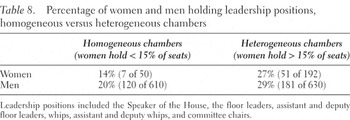
Are women in token settings less likely to hold leadership positions? The percentages presented in Table 8 suggest that this might be the case. In token settings, a moderately sized gender gap exists; only 14% of women hold leadership positions, compared to about 20% of men. This gap shrinks to only 2% in more heterogeneous settings.16
Recall that leadership positions were defined to include the Speaker of the House, the floor leaders, assistant and deputy floor leaders, whips, assistant and deputy whips, and committee chairs. When leadership was defined somewhat more narrowly, not including committee chairs, gender differences virtually disappeared; men and women were about equally likely to serve as leaders.
Percentage of women and men holding leadership positions, homogeneous versus heterogeneous chambers

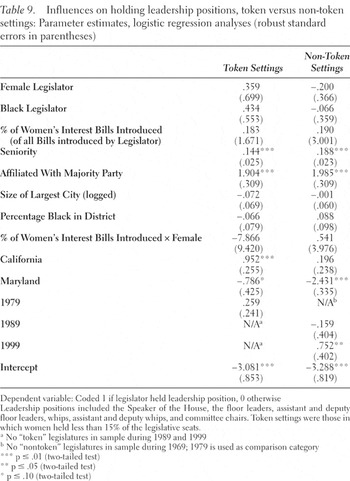
However, the results of the two logistic regression analyses (presented in Table 9) suggest that once controls are included, gender does not have a significant effect on the likelihood of holding a leadership position in either homogeneous or heterogeneous legislatures.
Influences on holding leadership positions, token versus non-token settings: Parameter estimates, logistic regression analyses (robust standard errors in parentheses)

Part of the gender difference apparent in the simple percentages (Table 8) is actually due to gender differences in seniority; in legislatures where women hold less than 15% of the seats, the average seniority for women is about 4.3 years, whereas the average seniority for men is about 6.2 years. These differences shrink markedly in the nontoken legislatures (to about 6.8 years for women, compared to about 7.2 years for men). There are also some differences in majority party affiliation that contribute to the gender gap demonstrated in Table 8; for instance, in legislatures where women hold less than 15% of the seats, about 60% of men (compared with 50% of women) are affiliated with the minority party. As the percentage of women in the legislature reaches parity, there are virtually no gender differences in majority party status.
Moreover, the results indicate that male or female legislators who sponsor a relatively high percentage of women's interest measures do not seem disadvantaged. There appears to be no incentive for women in token settings to downplay gender differences by avoiding the sponsorship of women's interest measures.
Gender Diversity and Legislative Outputs
What can we conclude from these findings? If an increase in gender balance is not accompanied by an increase in distinctive behavior, and if women are less likely relative to men to pass legislation, is there any reason to advocate increasing the percentage of women in legislatures? The answer, unequivocally, is yes. First, a legislature that closely reflects the diversity of the society that it represents provides a host of benefits: It may be seen as a sign of a legitimate government, it provides role models, and it more effectively utilizes the talents of all the citizenry (Darcy, Welch, and Clark 1987; Kelly, Saint-Germain, and Horn 1991; Mandel 1988; Mandel and Dodson 1992; Norris 1996).
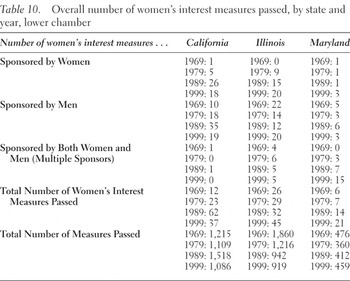
Second, it is extremely important to distinguish changes in policy outcomes from changes in the success of female legislators at the individual level. Even if the distinctive behavior and legislative success of female representatives do not depend on increasing the percentage of women within the legislature, an increase in female legislators who focus on policies relevant to women may change policy outputs. Although research regarding policy outcomes is less plentiful than that regarding individual behavior, some scholars have found evidence that increased gender diversity does have the potential to influence the day-to-day lives of female citizens. For instance, Sarah Poggione (2001) found that more gender-diverse state legislative committees were more likely to pass relatively generous welfare benefits. Jocelyn Crowley (2004) finds that tokens can make a policy difference, and the potential to make a difference increases along with their numbers. Likewise, Bratton and Leonard Ray (2002) found that increased female representation in Norway was associated with increased child-care provision. The data presented in Table 10 support this possibility.
Overall number of women's interest measures passed, by state and year, lower chamber

As the number of women in each legislature increased, the number of women's interest bills passed generally increased. The only exception to this trend is California in 1999; the number of women's interest bills that passed declined from 1989. It is interesting to note that the number of bills passed overall declined; the recently instituted term limits in California may have had some influence here. This overall trend in passage of women's interest measures appears to be due to the activity of both men and women. In both California and Illinois, as the number of women in the legislature increased, the number of women's interest bills sponsored by women increased. In California, as the number of women in the legislature increased, the number of women's interest bills sponsored by men increased. In Maryland, where cosponsorship is much more common, the increase was seen in bills sponsored by both men and women.
CONCLUSIONS
This research demonstrates that women in very homogeneous settings do not react to their token status by minimizing gender differences in agenda setting. Indeed, gender differences in agenda-setting behavior in some states narrow as the percentage of women in the legislature increases. I find as well that women are generally at least as likely as men to pass legislation even when they make up a very small minority of the institution. In two states (California and Illinois), token women are actually more successful relative to men in achieving passage of the bills they sponsor. Perhaps most intriguingly, these findings replicate what Saint-Germain (1989) found but did not call attention to: Women serving in legislatures with little gender balance are actually more successful relative to men than their counterparts in more equitable settings. Dahlerup (1988) observed that such cases did exist; these results suggest that the phenomenon may be more common than previously thought. These findings also lend credence to the notion that female legislators might respond to their status by overachievement.
There are several reasons why numbers may have little effect on the behavior of women. First, many women are interested in women's issues (hence, the name of the category), and elected officials are less likely to object to the sort of visibility that Kanter described. Second, there are a host of other factors that influence legislative agenda setting, including the mass public, institutional climate and culture, individual partisanship and ideology, and majority party status. Numbers are likely a very small part of the equation, and that may be particularly true as women's numbers increase and as multiple individuals are interested in sharing the role of representing women.
Of course, women do face discriminatory treatment in the legislative process. There is really little doubt that female legislators suffer from much of what Kanter described: loyalty tests, isolation, evaluation not only as a legislator but as a woman, exaggeration of differences, and mistaken identifications as wives or secretaries rather than as legislators. As Kathlene (1994) demonstrated, the composition of the legislature may influence the interaction between male and female legislators (as opposed to the behavior of individual women); this would be a promising avenue of future research. However, the likely response of women to discriminatory treatment is different from that of the sales personnel in Kanter's study. Women serving as tokens in a political setting are quite likely to emphasize gender differences and successfully bring a different perspective to lawmaking.
What can we expect from the future? Women in more diverse legislatures may share the role of bringing these issues to the agenda, and the number or proportion of women's interest measures sponsored by individual women may drop slightly. But given that there is little incentive to avoid these measures, and given that many female legislators have expressed interest in these issues, many women will continue, overall, representing women in substantive legislation. Men may also increase their focus on women's interests. That is, descriptive representation may make a difference not only through the distinctive behavior of female legislators but also through their impact on the behavior of their male colleagues.
In sum, the aggregate results indicate that as the number of women in a legislature grows, the potential for changes in the day-to-day lives of female citizens increases. That is, even if the individual behavior and success of women does not depend on the gender composition of the legislature (indeed, even if individual women sponsor fewer women's interest measures), an increase in the number of women legislators over time may well be accompanied by changes in the institution itself and in the policies it produces.
APPENDIX
According to Gelb and Palley (1982, 2), feminism is “a movement seeking to operationalize self-determination for women in political, economic, and social roles.” In this study, women's interest legislation is defined as legislation that would decrease discrimination or counter the effects of discrimination, or would improve the social, economic, or political status of women. These generally involved three overlapping categories: measures that addressed the health concerns of women; measures that addressed the social, educational, and economic status of women; and measures that addressed the political and personal freedom of women. Some examples of measures that addressed the health concerns of women are those focusing on pregnancy, childbirth, breast cancer, osteoporosis, and so on. Some examples of measures that addressed the social, educational, and economic status of women are those encouraging women's participation in male-dominated sports and academic programs, those establishing education programs in women's prisons, measures protecting property rights and pensions for divorcees or widows, measures establishing displaced homemaker programs, measures providing quality child care, and affirmative action measures. Some examples of measures addressing the political and personal freedom of women are measures supporting reproductive rights, measures addressing violence against women, and measures addressing sexual harassment.
References
Baer, Denise L.
1999.
“Campaign Finance Reform and the Gender Gap in Campaign
Finance Research.”
Presented at the Brennan Center for Justice Conference on Money
and the Politics of Inclusion, New York City, May 3.
Beckwith, Karen.
2002.
“The Substantive Representation of Women: Newness, Numbers,
and Models of Representation.”
Paper presented at the 2002 Annual Meeting of the American
Political Science Association, Boston.
Berry, William D.,
Evan J. Ringquist,
Richard C. Fording, and
Russell L. Hanson.
1998.
“Measuring Citizen and Government Ideology in the American
States, 1960–93.”
American Journal of Political Science
42 (1):
327–48.Google Scholar
Bratton, Kathleen A., and
Michelle Barnello.
2002.
“Bridging the Gender Gap: The Sponsorship of Women's
Interests in State Legislatures.”
Paper presented at the Second Annual Conference on State
Politics and Policy, University of Wisconsin-Milwaukee, May
24–25.
Bratton, Kathleen A.
2002.
“The Effect of Legislative Diversity on Agenda Setting:
Evidence from Six State Legislatures.”
American Politics Research
30 (2):
115–42.Google Scholar
Bratton, Kathleen A., and
Kerry L. Haynie.
1999.
“Agenda Setting and Legislative Success in State Legislatures:
The Effects of Gender and Race.”
Journal of Politics
61 (3):
658–79.Google Scholar
Bratton, Kathleen A., and
Leonard P. Ray.
2002.
“Descriptive Representation, Policy Outcomes, and Municipal
Day-Care Coverage in Norway.”
American Journal of Political Science
46 (2):
428–37.Google Scholar
Broughton, Sharon, and
Sonia Palmieri.
1999.
“Gendered Contributions to Parliamentary Debate; The Case of
Euthanasia.”
Australian Journal of Political Science
34 (1):
29–45.Google Scholar
Childs, Sarah.
2001.
“‘Attitudinally Feminist’? The New Labour Women
MPs and the Substantive Representation of Women.”
Politics
21 (3):
178–85.Google Scholar
Considine, Mark, and
Iva Ellen Deutchman.
1996.
“Instituting Gender: State Legislators in Australia and the
United States.”
Women and Politics
16 (4):
1–19.Google Scholar
Crowley, Jocelyn E.
2004.
“When Tokens Matter.”
Legislative Studies Quarterly
24 (1):
109–36.Google Scholar
Dahlerup, Drude.
1988.
“From a Small to a Large Minority: Women in Scandinavian
Politics.”
Scandinavian Political Studies
11 (2):
275–98.Google Scholar
Darcy, Robert,
Susan Welch, and
Janet Clark.
1987.
Women, Elections, and Representation.
White Plains, NY:
Longman.
Diamond, Irene.
1977.
Sex Roles in the State House.
New Haven, CT:
Yale University Press.
Dolan, Kathleen.
2004.
Voting for Women: How the Public Evaluates Women Candidates.
Boulder, CO:
Westview.
Dolan, Kathleen, and
Lynne E. Ford.
1998.
“Are All Women State Legislators Alike?” In
Women and Elective Office, eds.
Sue Thomas and
Clyde Wilcox.
New York:
Oxford University Press.
Ellickson, Mark C.
1992.
“Pathways to Legislative Success: A Path Analytic Study of the
Missouri House of Representatives.”
Legislative Studies Quarterly
17 (2):
285–302.Google Scholar
Gelb, Joyce, and
Marian Palley.
1982.
Women and Public Policies.
Princeton, NJ:
Princeton University Press.
Grey, Sandra.
2002.
“Does Size Matter? Critical Mass and New Zealand's Women
MPs.”
Parliamentary Affairs
55 (1):
19–29.Google Scholar
Herring, Mary.
1990.
“Legislative Responsiveness to Black Constituents in Three
Deep South States.”
Journal of Politics
52 (3):
740–58.Google Scholar
Hibbing, John R.
1991.
Congressional Careers: Contours of Life in the U.S. House of
Representatives.
Chapel Hill:
University of North Carolina Press.
Huddy, Leonie, and
Nayda Terkildsen.
1993.
“The Consequences of Gender Stereotypes for Women Candidates
at Different Levels and Types of Office.”
Political Research Quarterly
46 (3):
503–25.Google Scholar
Jacobsen, Gary C.
1992.
The Politics of Congressional Elections.
New York:
HarperCollins.
Jaquette, Jane S.
1997.
“Women in Power: From Tokenism to Critical Mass.”
Foreign Policy
108 (Fall):
23–37.Google Scholar
Kanter, Rosabeth.
1977.
“Some Effects of Proportions on Group Life: Skewed Sex Ratios
and Responses to Token Women.”
American Journal of Sociology
82 (5):
965–90.Google Scholar
Kanter, Rosabeth.
1993.
Men and Women of the Corporation [1993 Edition].
New York:
Basic Books.
Kathlene, Lyn.
1994.
“Power and Influence in State Legislative Policymaking: The
Interaction of Gender and Position in Committee Hearing
Debates.”
American Political Science Review
88 (3):
560–76.Google Scholar
Kelly, Rita Mae,
Michelle Saint-Germain, and
Jody D. Horn.
1991.
“Female Public Officials: A Different Voice?”
Annals of the American Academy of Political and Social
Science
515 (1):
77–87.Google Scholar
King, Gary.
1988.
“Statistical Models for Political Science Event Counts: Bias
in Conventional Procedures and Evidence for the Exponential Poisson
Regression Model.”
American Journal of Political Science
32 (3):
838–63.Google Scholar
Mandel, Ruth.
1988.
“The Political Woman.” In
The American Woman, ed.
Sara E. Rix.
New York:
W. W. Norton.
Mandel, Ruth, and
Debra Dodson.
1992.
“Do Women Officeholders Make a Difference?” In
The American Woman, ed.
Sara E. Rix.
New York:
W. W. Norton.
Moore, Michael K., and
Sue Thomas.
1991.
“Explaining Legislative Success in the U.S. Senate: The Role
of the Majority and Minority Parties.”
Western Political Quarterly
44 (4):
959–70.Google Scholar
Norris, Pippa.
1996.
“Women Politicians: Transforming Westminster?”
Parliamentary Affairs
49 (1):
89–102.Google Scholar
Poggione, Sarah.
2001.
“Legislative Organization and the Policymaking Process: The
Effect of Women State Legislators on Welfare Policy.”
Paper presented at the 2001 Annual Meeting of the American
Political Science Association, San Francisco.
Reingold, Beth.
1992.
“Concepts of Representation Among Female and Male State
Legislators.”
Legislative Studies Quarterly
17 (4):
509–37.Google Scholar
Reingold, Beth.
2000.
Representing Women: Sex, Gender, and Legislative Behavior in Arizona
and California.
Chapel Hill:
University of North Carolina Press.
Rosenthal, Cindy Simon.
1998.
When Women Lead: Integrative Leadership in State
Legislatures.
New York:
Oxford University Press.
Saint-Germain, Michelle.
1989.
“Does Their Difference Make A Difference? The Impact of Women
on Public Policy in the Arizona Legislature.”
Social Science Quarterly
70 (4):
956–68.Google Scholar
Sanbonmatsu, Kira.
2002.
“Political Parties and the Recruitment of Women to State
Legislatures.”
Journal of Politics
64 (3):
791–809.Google Scholar
Studlar, Donley, and
Ian McAllister.
2002.
“Does a Critical Mass Exist? A Comparative Analysis of
Women's Legislative Representation Since 1950.”
European Journal of Political Research
41 (2):
233–53.Google Scholar
Swers, Michele.
2001.
“Understanding the Policy Impact of Electing Women: Evidence
from Research on Congress and State Legislatures.”
PS: Political Science and Politics
34 (2):
217–20.Google Scholar
Swers, Michele.
2002.
The Difference Women Make: The Policy Impact of Women in
Congress.
Chicago:
University of Chicago Press.
Thomas, Sue.
1991.
“The Impact of Women on State Legislative
Policies.”
Journal of Politics
53 (4):
958–76.Google Scholar
Thomas, Sue.
1994.
How Women Legislate.
New York:
Oxford University Press.
Vega, Arturo, and
Juanita M. Firestone.
1995.
“The Effects of Gender on Congressional Behavior and the
Substantive Representation of Women.”
Legislative Studies Quarterly
20 (2):
213–22.Google Scholar
Weissert, Carol S.
1991.
“Issue Salience and State Legislative
Effectiveness.”
Legislative Studies Quarterly
16 (4):
509–20.Google Scholar
Welch, Susan.
1985.
“Are Women More Liberal Than Men in the U.S.
Congress?”
Legislative Studies Quarterly
10 (1):
125–34.Google Scholar
Wolbrecht, Christina.
2000.
The Politics of Women's Rights: Parties, Positions, and
Change.
Princeton, NJ:
Princeton University Press.
Yoder, Janice D.
1991.
“Rethinking Tokenism: Looking Beyond Numbers.”
Gender and Society
5 (2):
178–92.Google Scholar
Trends in gender diversity in state legislatures 1969–1999.

Recent approaches of political scientists to defining women's interests
CALIFORNIA. Influences on sponsorship of women's interests: Parameter estimates, negative binomial regressions (robust standard errors in parentheses)
ILLINOIS. Influences on sponsorship of women's interests: Parameter estimates, negative binomial regressions (robust standard errors in parentheses)
MARYLAND. Influences on sponsorship of women's interests: Parameter estimates, negative binomial regressions (robust standard errors in parentheses)
CALIFORNIA. Influences on passage of legislation: Parameter estimates, logistic regression analysis (robust standard errors in parentheses)
ILLINOIS. Influences on passage of legislation: Parameter estimates, logistic regression analysis (robust standard errors in parentheses)
MARYLAND. Influences on passage of legislation: Parameter estimates, logistic regression analysis (robust standard errors in parentheses)
Percentage of women and men holding leadership positions, homogeneous versus heterogeneous chambers
Influences on holding leadership positions, token versus non-token settings: Parameter estimates, logistic regression analyses (robust standard errors in parentheses)
Overall number of women's interest measures passed, by state and year, lower chamber
 You have
Access
- 175
- Cited by