Introduction
Non-oxidative dehydrogenation (NODH) of alcohols to produce aldehydes and ketones is considered to be an efficient and safer process as compared with its oxidative counterpart. With less propensity for catalyst deactivation,[Reference Shan, Janvelyan, Li, Liu, Egle, Ye, Biener, Biener, Friend and Flytzani-Stephanopoulos1] the process may be adapted for new applications in biorenewable transformations. NODH of ethanol to acetaldehyde was first experimented on Cu-based alloy catalysts using Cr and Co as promoters at 573 K.[Reference Church and Joshi2] Shan et al.[Reference Shan, Lucci, Liu, El-Soda, Marcinkowski, Allard, Sykes and Flytzani-Stephanopoulos3] utilized Pt along with Cu to synthesize PtCu alloys for the dehydrogenation of methanol in a non-oxidative manner at a relatively low temperature (T = 523 K). Wang et al.[Reference Wang, Hoyt, El-Soda, Madix, Kaxiras and Sykes4] have conducted experimental as well as theoretical studies to explain the increase in the activity of 1% Pt-Cu single atom alloy catalysts as compared with pure Cu for the NODH reaction. In a recent study on ethanol NODH over the bimetallic NiCu, Shan et al.[Reference Shan, Janvelyan, Li, Liu, Egle, Ye, Biener, Biener, Friend and Flytzani-Stephanopoulos1] observed a significant increase in the activity as well as stability of the Cu catalyst on adding Ni, owing to the lesser Cu sintering in the presence of Ni and lower apparent activation barrier over NiCu catalyst as compared with pure Cu. For the NODH of secondary alcohols, Kon et al.[Reference Kon, Hakim Siddiki and Shimizu5] studied dehydrogenation of 2-octenol over 11 different transition metals; Ag, Cu, Pt, Pd, Rh, Ru, Ni, Au, Re, Ir, and Co, where alumina-supported Pt metal nanoclusters were found to be the most efficient catalyst. In a similar work, an array of transition metal catalysts on different supports were tested for the dehydrogenation and coupling of 1-octanol and Pt/SnO2 exhibited the maximum activity,[Reference Moromi, Hakim Siddiki, Ali, Kon and Shimizu6] wherein SnO2 aided the activation of the carbonyl group of aldehyde for coupling. In another study, PtCo bimetallic catalyst was observed to exhibit high activity for selective dehydrogenation of cyclohexanol to cyclohexanone.[Reference Reddy and Rao7]
Density functional theoretical (DFT) studies on the NODH reaction of alcohols have attempted constructing an ab initio microkinetic model (MKM) for predicting trends in the reactivity of transition metal catalysts.[Reference Lausche, Hummelshoj, Abild-Pedersen, Studt and Norskov8, Reference Khan, Jalid and Haider9] Foremost of this was the MKM developed by Nørskov and co-workers[Reference Lausche, Hummelshoj, Abild-Pedersen, Studt and Norskov8] to study the NODH of methanol to produce formaldehyde, conducted at 823 K. At such a high temperature, the formaldehyde was expected to dissociate further to form the thermodynamically favored product, CO and H2 on most of the transition metal surfaces.[Reference Lausche, Hummelshoj, Abild-Pedersen, Studt and Norskov8] Our group followed this up to develop an ab initio MKM for studying the NODH of ethanol to produce acetaldehyde, which was carried out at a much lower temperature (423–473 K), to predict trends in the reactivity of the transition metal surfaces for the NODH reaction of alcohols in general and ethanol in particular. In that work, MKM was utilized to screen transition metal catalysts with a specific focus to design Cu-based alloys for the NODH of alcohols using ethanol as the model compound.[Reference Khan, Jalid and Haider9] In summary, from the mono-metal catalyst activity trend, Pt was observed to be the most reactive catalyst (TOF ~ at 104/s) followed by Cu (TOF ~ 103/s) at 473 K for the production of acetaldehyde from ethanol.[Reference Khan, Jalid and Haider9]
Since, Cu, although cheap, is prone to deactivation due to sintering, in this study we propose an alternative metal. Pt as compared with Cu is known to be more stable with a lesser propensity for sintering.[Reference Shan, Janvelyan, Li, Liu, Egle, Ye, Biener, Biener, Friend and Flytzani-Stephanopoulos1] Alloying Pt with cheaper metals may solve the issue around sintering, while maintaining the desired activity for the NODH reaction of alcohols. In addition, a price filter in selecting the bimetallic alloys is proposed to keep up with the economics of catalyst synthesis. The ab initio MKM was, therefore, built in this study to screen Pt-based alloys for the NODH of ethanol. The model is based on the step sites of the metal catalysts, since step sites are known to be more active.[Reference Kon, Hakim Siddiki and Shimizu5] In the MKM, the activity of the catalyst surface calculated as the turnover frequency (TOF) is plotted versus the oxygen binding energy (E O) and carbon binding energy (E C) of the surface, which serve as the descriptors. The MKM did not require the assumption of a rate-determining step and hence provided detailed insights into the reaction kinetics as it incorporated the reaction energetics of all the steps involved in the model. In general, Pt-based bimetallic alloy catalysts have been extensively employed in the NODH of alkanes.[Reference De Cola, Gläser and Weitkamp10–Reference Cortright and Dumesic12] We expect that the MKM constructed here will open up the opportunities for the experimental design of novel Pt-based bimetallic catalyst for the NODH of alcohols.
Methodology
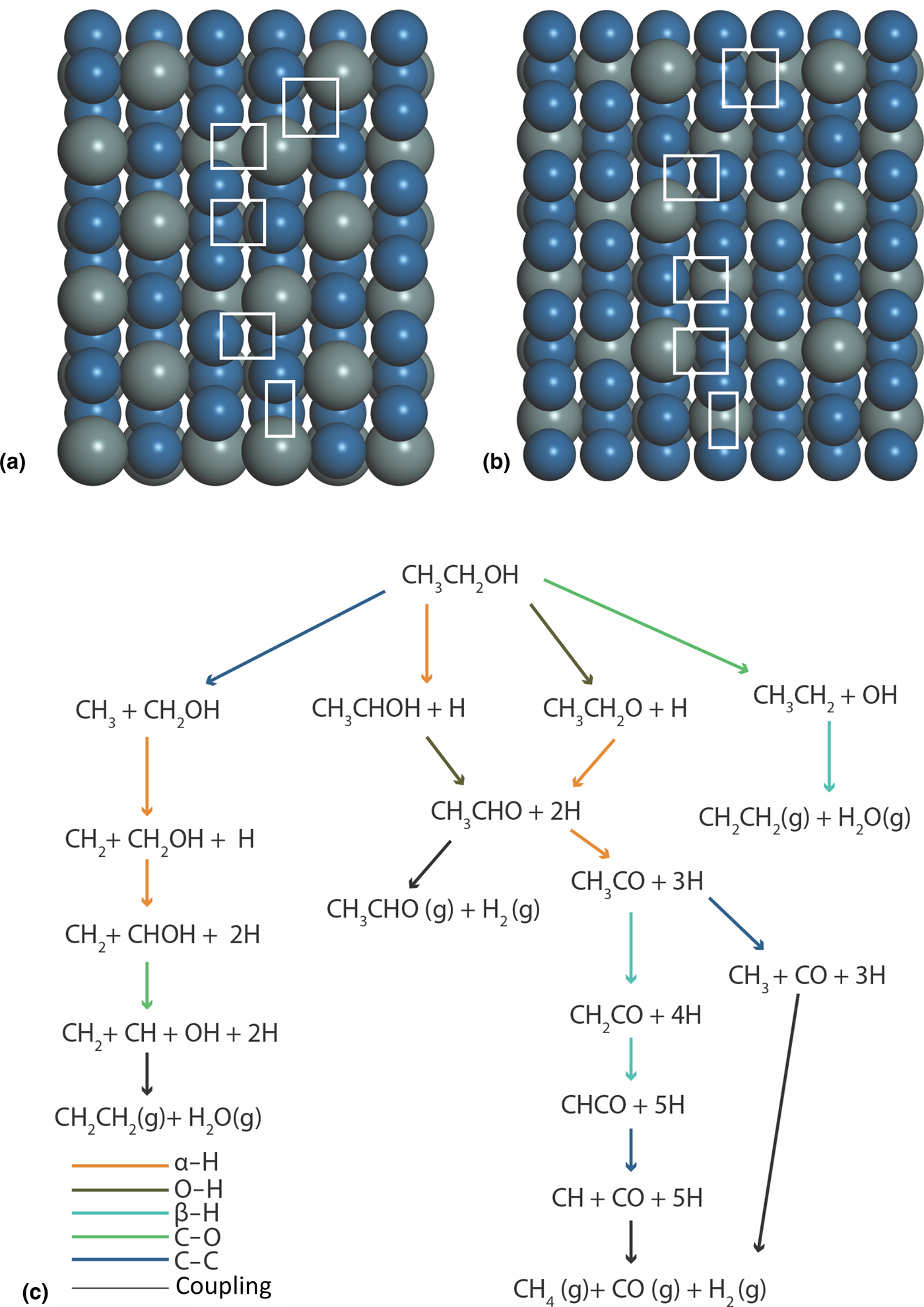
The MKM for the NODH reaction was designed for the (211) step sites and was employed to analyze the reactivity and selectivity trends observed on Pt-based alloys using CatMAP.[Reference Medford, Shi, Hoffmann, Lausche, Fitzgibbon, Bligaard and Nørskov13] Further details about the MKM are given in the Supporting Information and our previous report on the NODH of ethanol on transition metal catalysts.[Reference Khan, Jalid and Haider9] In this study, the bimetallic alloy with A3B (L12 type structure) composition has been considered. The A3B (L12) type alloy has an FCC crystal structure, with 75:25 composition of A and B metals, respectively. The (211) surfaces of Pt3B bimetallics with the AA and the AB surface termination were studied wherein Pt was alloyed with transition metals viz. Au, Ag, Cu, Pd, Rh, Ni, Co, Zn, Hf, Nb, Sc, Ta, Ti, V, Y, Zr; and p-block elements viz. Sn, Ga, Ge, Al, Pb, Sb, As, Tl, La. For AB termination, the step sites had both A and B metals in 50:50 composition, whereas, for AA termination, the step sites only had the metal A as shown in Figs. 1(a) and 1(b). The C and O adsorption energies were taken from the adsorption on different sites as given in the reports of Studt et al.[Reference Studt, Abild-pedersen, Wu, Jensen, Temel, Grunwaldt and Nørskov14] and Xu et al.[Reference Xu, Lausche, Wang, Khan, Abild-Pedersen, Studt, Nørskov and Bligaard15] The binding energies of carbon and oxygen on the Pt-based bimetallic alloys and the price of the pure metals used in the study were obtained from the study conducted by Xu et al.[Reference Xu, Lausche, Wang, Khan, Abild-Pedersen, Studt, Nørskov and Bligaard15] on in-silico screening of bimetallic alloy catalysts for methane steam reforming process.
(a) AB termination and (b) AA termination of Pt3B bimetallic alloy step surfaces showing different sites for adsorption of C and O atoms shown by white boxes. The blue color denotes Pt and gray color denotes element B of the Pt3B alloy, (c) Reaction pathways studied for the NODH of ethanol.

The solutions of the MKM were obtained for reaction conditions T = 423 K, P = 1 bar of ethanol with 0.01% reactant conversion. The MKM was built for two separate adsorption sites, one for all the adsorbates and the other for hydrogen, as hydrogen was unlikely to compete with the other adsorbates owing to its small size. An equal number of hydrogen sites and step sites were considered for the MKM. The steady-state catalytic rates obtained from the MKM were plotted as a volcano plot using E C and E O as the two descriptors. The TOF for the pure metal and bimetallic alloys was calculated as the number of product molecules formed per active site per second. Here the model captures only the activity of the step sites. The descriptor-based bimetallic-alloy screening method as proposed by Xu et al.[Reference Xu, Lausche, Wang, Khan, Abild-Pedersen, Studt, Nørskov and Bligaard15] and previously applied by us[Reference Jalid, Khan, Mir and Haider16, Reference Khan, Hussain, Anjum and Haider17] was adapted. Activity and cost filter were employed to determine Pt alloys with acetaldehyde turnover greater than that of Pt and cost 20% less than Pt, respectively.
Results and discussions
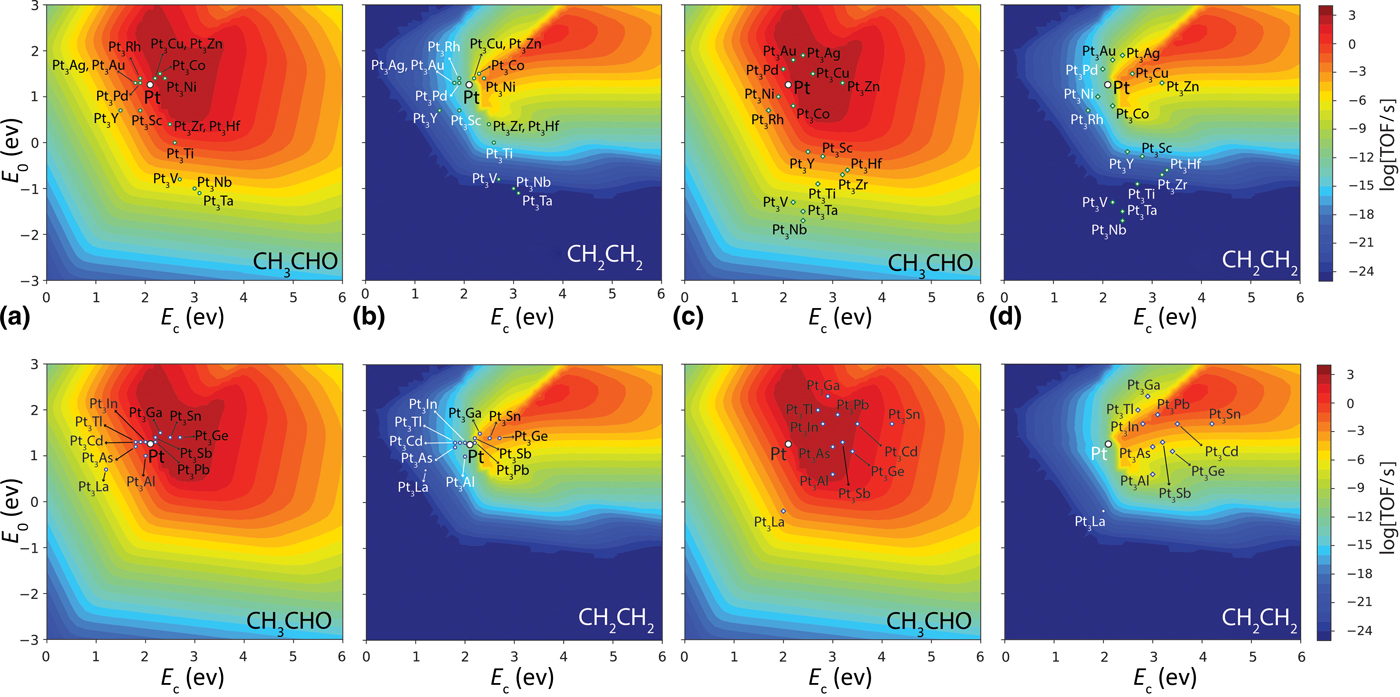
The NODH of ethanol can commence by means of initial C–H, O–H, C–O or C–C bond scission leading to the production of acetaldehyde, hydrogen, ethylene, and water. The corresponding reaction scheme is depicted in Fig. 1(c). The detailed elementary reaction scheme was based on the previous MKM study over NODH of ethanol on transition metals.[Reference Khan, Jalid and Haider9] Figures 2(a) and 2(b) shows the volcano plots for acetaldehyde and ethylene formation over AA termination transition metal-based bimetallic alloys of Pt. It is clearly visible from Fig. 2(a) that Pt3Cu, Pt3Zn, Pt3Co, and Pt3Ni exhibit a higher production rate of acetaldehyde than Pt. The TOF over these alloys was of the order of 104/s. As can be seen from Fig. 2(a), the TOF of acetaldehyde over Pt3Zr and Pt3Hf is the same as that over Pt (~103/s), followed by Pt3Rh, Pt3Au, Pt3Ag and Pt3Pd (~102/s). The volcano plots of the AB termination of transition metal-based Pt alloys are depicted in Figs. 2(c) and 2(d). Pt3Zn, Pt3Cu, Pt3Ag, and Pt3Au lie at the center of the two-dimensional volcano curve for acetaldehyde production with TOF ~104/s. The TOF over Pt3Pd was of order of magnitude smaller than these, and comparable with that of Pt. Pt3Co and Pt3Ni also exhibited high CH3CHO production rate (TOF ~ 10/s). Similar to our findings, an experimental study conducted by Reddy and Rao[Reference Reddy and Rao7] showed that the addition of Co to Pt increased the reaction turnover for vapor phase dehydrogenation of cyclohexanol to cyclohexanone. PtZn was found to be much more active than monometallic Pt by Silvestre-Albero et al.[Reference Silvestre-Albero, Serrano-Ruiz, Sepúlveda-Escribano and Rodríguez-Reinoso18] for the dehydrogenation of isobutane, exhibiting 100% selectivity towards the dehydrogenated product. PtZn alloy had shown high activity for the NODH of propane in the experiments conducted by De Cola et al.[Reference De Cola, Gläser and Weitkamp10] Experiments by Ma et al.[Reference Ma, Wu and Miller11] showed that increasing Cu loading in Cu-Pt bimetallic alloy showed an increase in the propylene selectivity during the propane dehydrogenation reaction. For the NODH of ethanol, Pt-Cu showed 100% selectivity towards acetaldehyde formation and exhibited catalytic stability.[Reference Wang, Hoyt, El-Soda, Madix, Kaxiras and Sykes4] Experimentally, PtNi and PtCo have been found to exhibit higher selectivity as opposed to Pt for propane dehydrogenation.[Reference Cai, Mu, Zha, Sun, Chen, Zhao, Li, Tian, Tang, Tao, Zeng and Gong19] From the ethylene production plots shown in Figs. 2(b) and 2(d), it can be inferred that the AA terminated Pt3Ni, Pt3Co, Pt3Cu, Pt3Zn and AB terminated Pt3Cu, Pt3Zn, and Pt3Ag also have higher TOF (10−4/s–10−7/s) for ethylene production compared with pure Pt (TOF <10−9/s) but a much lower rate than acetaldehyde production, with the ethylene TOF at least six order of magnitude smaller than that of acetaldehyde. From these observations, it can be concluded that these alloys of Pt with Ni, Co, Cu, Zn, and Ag may have enhanced dehydrogenation activity compared with Pt.
Volcano plots for the turnover of (a) CH3CHO (b) CH2CH2 over the AA termination of transition metal-based Pt3B alloys and (c) CH3CHO (d) CH2CH2 over the AB termination of transition metal-based Pt3B alloys; and (e) CH3CHO (f) CH2CH2 over the AA termination of p-block element-based Pt3B alloys and (g) CH3CHO (h) CH2CH2 over the AB termination of p-block element-based Pt3B alloys.
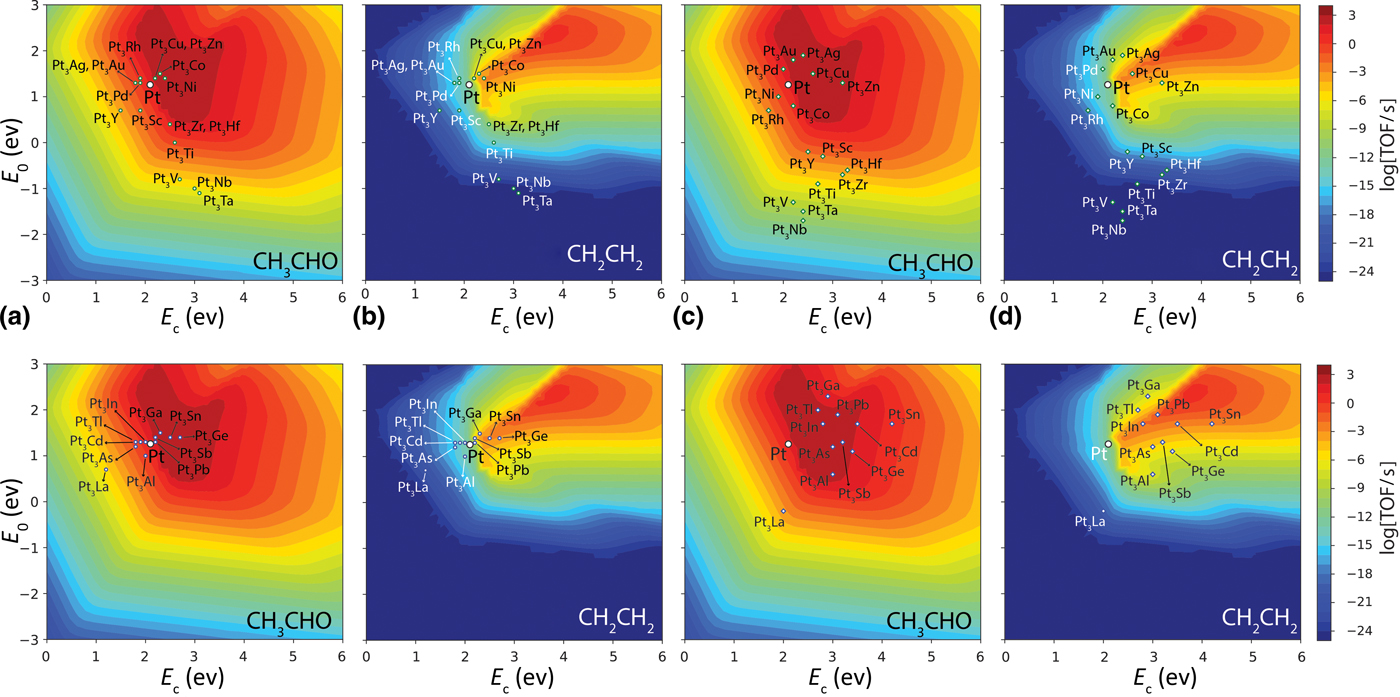
The volcano plots on alloys of Pt with p-block elements are shown in Figs. 2(e)–2(h). Figures 2(e) and 2(f) present the TOF plots of acetaldehyde and ethylene, respectively, over the AA termination p-block element-based Pt alloys. As is evident from Fig. 2(e); Pt3Sn, Pt3Ge, Pt3Ga exhibit the highest turnover of acetaldehyde, of the order of 104/s. The TOF of acetaldehyde over Pt3Sb and Pt3Pb is smaller than these alloys, however; greater than that over pure Pt. The TOF plots of acetaldehyde and ethylene over AB termination of p-block element-based Pt alloys are shown in Figs. 2(g) and 2(h), respectively. Most of these metals displayed a higher turnover of acetaldehyde than Pt [Fig. 2(g)]. These include Pt3Tl, Pt3In, Pt3As, Pt3Al, Pt3Sb, Pt3Ge, Pt3Cd, and Pt3Pb, having a turnover of 104/s. Pt3Ga exhibited the same production rate as that of pure Pt (TOF ~ 103/s). This was followed by Pt3Sn and then Pt3La. Pt-In intermetallic alloy nanoparticles were observed to show higher turnover and selectivity for ethylene in ethane hydrogenation wherein Pt3In was found to be the catalyst with the highest selectivity of 99%.[Reference Wegener, Wu, Tseng, Gallagher, Ren, Diaz, Ribeiro and Miller20] It has been experimentally observed that PtSn catalyst showed increased selectivity than Pt towards the dehydrogenation of ethanol to acetaldehyde, the turnover over PtSn being higher than the Pt catalyst.[Reference Alcalá, Shabaker, Huber, Sanchez-Castillo and Dumesic21] Kinetic studies over the dehydrogenation of iso-butane by Cortright and Dumesic had also shown that addition of Sn to Pt was increasing the selectivity towards dehydrogenated product.[Reference Cortright and Dumesic12] In a DFT study conducted over ethanol adsorption and dehydrogenation over Pt3Sn, it was found that Pt3Sn had lower energy barrier for ethoxy formation as compared with that of pure Pt and acetaldehyde had a higher probability of desorption on the bimetallic surface.[Reference Paz22] The addition of Sn to Pt was found to increase the stability of the catalyst for propane dehydrogenation, since pure Pt was susceptible to deactivation due to coking.[Reference Bariås, Holmen and Blekkan23]
The AA terminated Pt3Sn had the highest turnover of ethylene [Fig. 2(f)] of the order,10−3/s, followed by Pt3Ge (TOF ~ 10−4/s) and Pt3Ga (TOF ~ 10−5/s) whereas all the AB termination alloys of Pt with p-block element except Pt3La showed a higher ethylene turnover than Pt [Fig. 2(h)], with the maximum ethylene turnover of 10−2/s on Pt3Sn, followed by Pt3In, Pt3Cd (TOF ~ 10−3/s) and Pt3Sb (TOF ~ 10−4/s). Interestingly, the TOF for ethylene over all the alloys studied was at least seven orders of magnitude smaller than that of acetaldehyde, indicating high selectivity towards the aldehyde product. DFT study on the effect of intermetallic interaction on Pt-based alloys for the dehydrogenation of propane had shown that Pt3Ge exhibits higher activity as compared with Pt.[Reference Hauser, Horn, Head-gordon and Bell24] On comparing the AA and AB termination of these alloys, it can be deduced that the AB termination alloys showed higher ethylene turnover as opposed to the AA termination. Another noteworthy observation was that most of the AB termination alloys lied at the top of the acetaldehyde volcano plot as opposed to AA termination. The acetaldehyde selectivity plot over all the alloys screened in this study is shown in Fig. SI-1, which substantiated the observations made above. In the region with EO <1.5 eV and EC <5 eV, the alloys showed 100% selectivity towards acetaldehyde. As can be clearly seen from the plot, all the alloys of Pt showed absolute selectivity towards the formation of acetaldehyde. None of these alloys would favor the dehydration of the alcohol to alkene as observed in the NODH of ethanol. Presence of acidic support can influence the acetaldehyde selectivity by increasing the ethylene formation through dehydration reaction.[Reference Wang, Garbarino, Allard, Wilson, Busca and Flytzani-stephanopoulos25] Since the interest of this study was to understand the trend in the Pt-based bimetallic alloy reactions on ethanol dehydrogenation to obtain acetaldehyde, the MKM was based on transition metal catalysts and bimetallic alloys and the effect of support was not captured in the study.
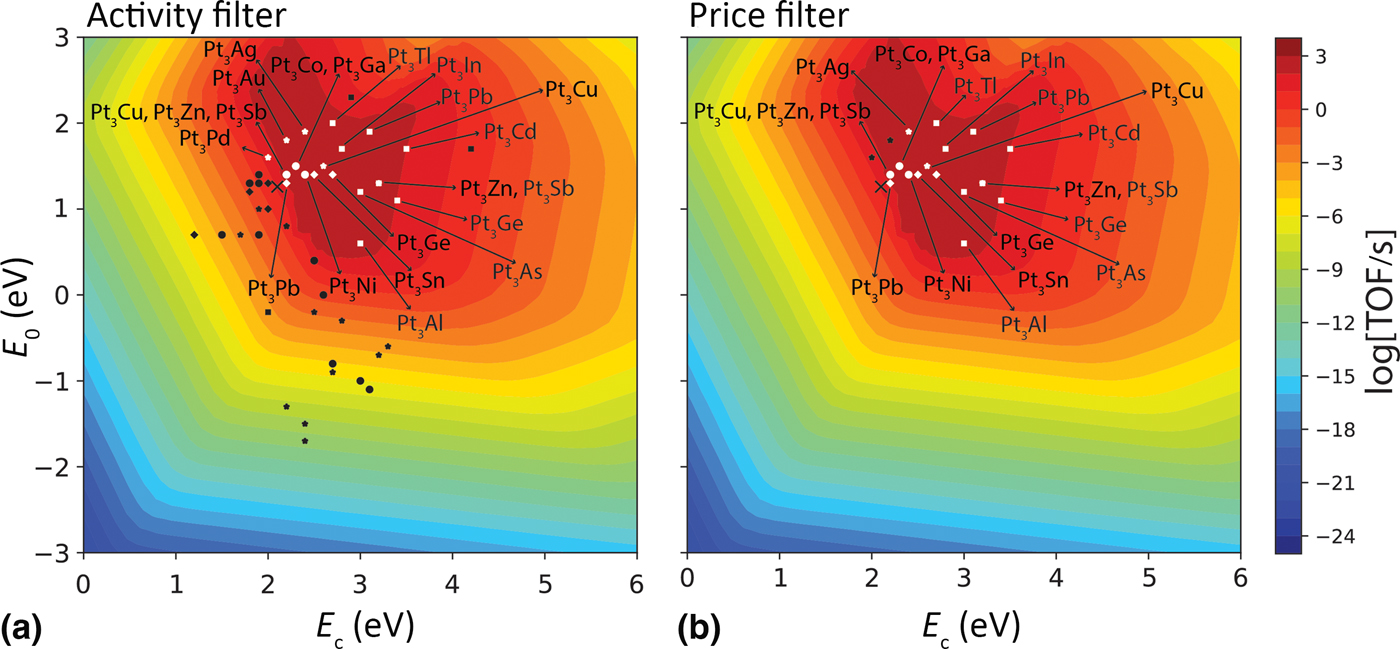
Another objective was to screen the alloys that are more active and more cost-effective than pure Pt catalyst. As shown in Fig. 3(a), alloy catalyst screening was performed on applying the activity filter for the production of acetaldehyde over the AA as well as AB type surfaces for both transition metal and p-block elements-based Pt alloys. The alloys marked in white were more than active than Pt, while those in black exhibited lower activity than that of Pt. Amongst the transition metal-based Pt alloys, the AA type; Pt3Cu, Pt3Zn, Pt3Co, and Pt3Ni, and AB type; Pt3Cu, Pt3Au, Pt3Ag, Pt3Zn and Pt3Pd showed higher turnover of acetaldehyde as compared with pure Pt. Similarly, the p-block element-based AA type alloys; Pt3Ga, Pt3Sn, Pt3Ge, Pt3Sb and Pt3Pb, and AB termination alloys; Pt3Tl, Pt3In, Pt3As, Pt3Al, Pt3Sb, Pt3Ge, Pt3Cd, Pt3Pb, and Pt3Ga were observed to be more active than pure Pt. From these results, it can be inferred that the p-block elements-based alloys were more active for the NODH reaction as compared with transition metal-based alloys, since most of the AB terminated p-block element alloys were screened to show higher activity as compared with Pt. Of all the alloys, only Pt3Cu, Pt3Zn, Pt3Ga, Pt3Ge, Pt3Sb, Pt3Pb showed higher production rate of acetaldehyde for both the AA and AB terminated surfaces, which makes them the best candidate for industrial application.
(a) Activity filter for acetaldehyde production over Pt3B alloys where white symbols denote alloys more active than Pt and (b) Price filter for acetaldehyde production over Pt3B alloys where white symbols denote alloys having price 20% less than that of Pt (diamond and square represent the AA and AB termination of p-block element-based Pt alloys, and circle and star represent the AA and AB termination of transition metal-based Pt alloys, cross represents pure Pt catalyst).
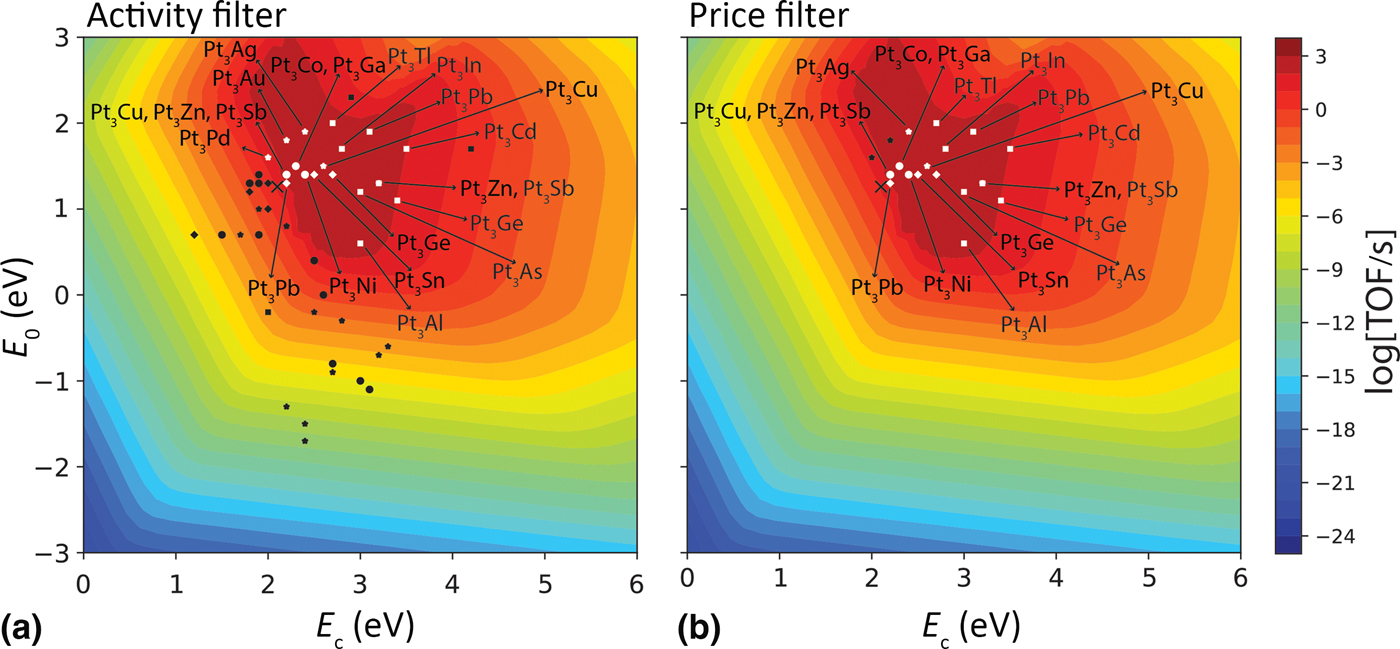
The alloys screened under the activity filter were further screened on the basis of the price. The prices of the alloys were calculated considering 3:1 ratio of Pt and other alloying metal, and are listed in Table SI-1. Figure 3(b) shows the screening based on the price of alloys for acetaldehyde production. The alloys shown in white were at least 20% cheaper than pure Pt. It was observed that most of the alloys screened using the activity filter also satisfied the cost criteria. Based on the activity filter [Fig. 3(a)] and price filter [Fig. 3(b)], it can be concluded that out of all the alloys screened in this study; Pt3Cu, Pt3Zn, Pt3Ga, Pt3Ge, Pt3Sb, Pt3Pb were the alloys for which both AA and AB terminated surfaces, exhibited higher turnover of acetaldehyde than Pt at a price 20% less than that of Pt, with 100% selectivity towards the aldehyde product, which makes them the best candidate for the NODH of alcohols. However, Sb and Pb, can be excluded from the list due to their potential adverse effect on environment.
Thermodynamic and oxidation stability of the proposed alloy candidates were analyzed as suggested by Xu et al. in the study on methane steam reforming process.[Reference Xu, Lausche, Wang, Khan, Abild-Pedersen, Studt, Nørskov and Bligaard15] The formation energy of the alloys has been enlisted in Table SI-2. The formation energies of screened alloys (Pt3Cu, Pt3Zn, Pt3Ga, Pt3Ge) was less than −0.4 eV indicating high stability. As there is no oxygen or water present in the NODH conditions, the alloys were expected to be stable against oxidation. Owing to the low temperature used in the reaction, carbide was not expected to be formed. Experimental studies have shown the formation of stable alloys of Pt3Cu,[Reference Saravanan, Khobragade, Nagar and Labhsetwar26] Pt3Ga,[Reference Sattler, Gonzalez-Jimenez, Luo, Stears, Malek, Barton, Kilos, Kaminsky, Verhoeven, Koers, Baldus and Weckhuysen27] Pt3Zn,[Reference Zhu, Zheng, Wang, Wu, Han, Lin, Xin and Wang28] and Pt3Ge[Reference Huang, Fryer, Park, Stirling and Webb29] in various catalytic and electro-catalytic applications. Thus, the selection of bimetallic alloys forms a potential list of candidates to study the NODH of alcohols for achieving high aldehyde formation.
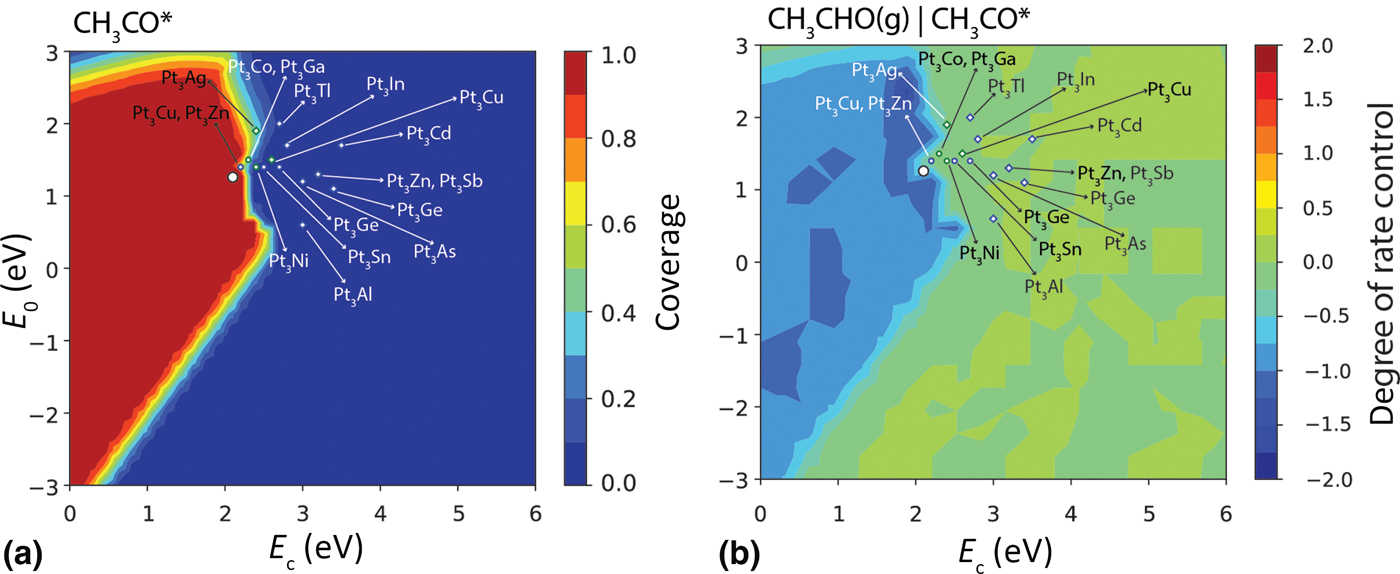
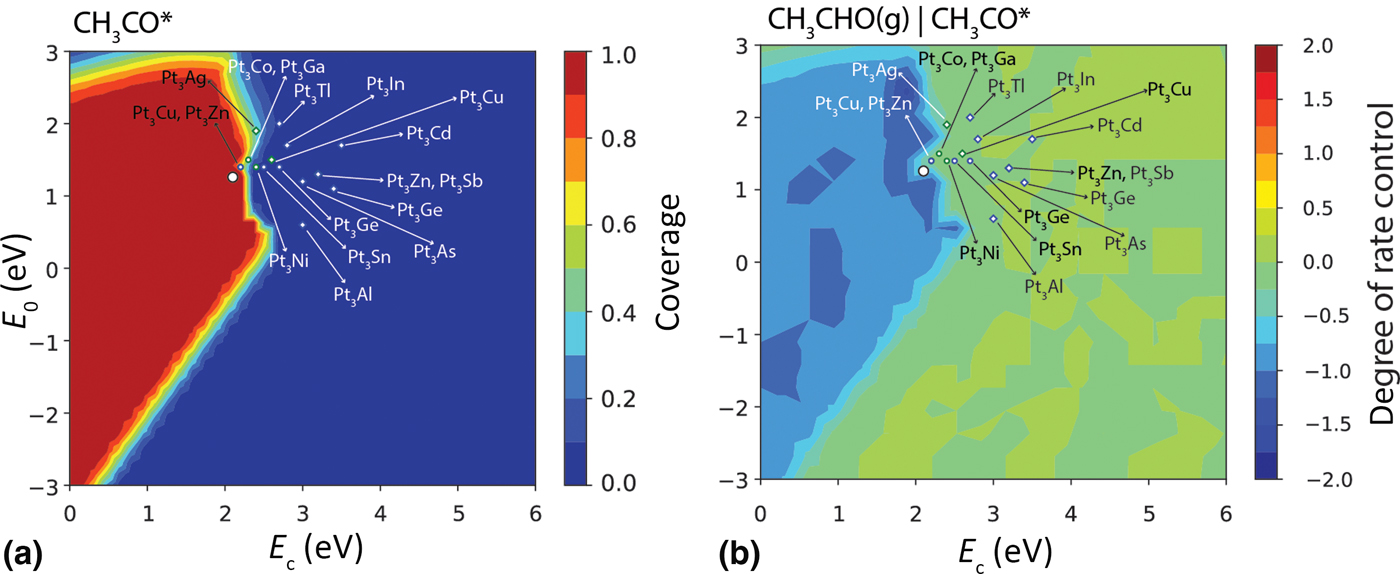
From the coverage analysis performed in our previous study, CH3CO was found to be the most abundant surface intermediate over Pt,[Reference Khan, Jalid and Haider9] which was formed from the dehydrogenation of CH3CHO species on the metal surface. High activity of Pt towards C–H bond dissociation was proposed to be the reason behind the high CH3CO coverage. Reducing the C–H bond dissociation activity of Pt by alloying could decrease the CH3CO coverage and increase the activity of the catalyst. CH3CO coverages on highly active Pt alloys are shown in Fig. 4(a). It was observed that the coverage of CH3CO over the active alloys, AA termination of Pt3Cu, Pt3Zn, Pt3Co, Pt3Ni, Pt3Sn, Pt3Ge, and Pt3Ga; and AB termination of Pt3Zn, Pt3Cu, Pt3Ag, Pt3Au, Pt3Tl, Pt3In, Pt3As, Pt3Al, Pt3Sb, Pt3Ge, Pt3Cd, and Pt3Pb, reduced significantly compared with Pt. In order to gain more insights into the increased activity of the alloys screened in this study for NODH reaction, degree of rate control (DRC) analysis was performed following the method suggested by Stegelmann et al.[Reference Stegelmann, Andreasen and Campbell30] The rate control of CH3CO intermediate binding energy on the CH3CHO production rate was found to be high over Pt metal, where an increase in the binding energy of CH3CO was causing a decrease in CH3CHO production rate, as shown in Fig. 4(b). Interestingly, an increase in the binding energy of CH3CO caused an even higher coverage of CH3CO over Pt and a significant reduction in free active site coverage, and hence a lowering of CH3CHO production rate. However, the DRC of CH3CO intermediate for the CH3CHO rate was decreased for the active alloys as can be seen in Fig. 4(b), which again points towards the negligible coverage of CH3CO over these metal alloys. From the coverage and DRC analysis, it was therefore concluded that alloying Pt with a less reactive transition metal (Au, Ag, Cu, Co, Ni, Zn, Cd) or element from p-block (Al, Ga, In, Tl, Ge, Sn, Pb, As, Sb), reduced the C–H bond dissociation of adsorbed CH3CHO of pure Pt, and hence cumulates to higher CH3CHO production rate, as observed over these bimetallic alloy catalyst.
(a) Coverage of the adsorbate CH3CO and (b) DRC of the CH3CO species binding energy on the CH3CHO production rate over the Pt3B bimetallic alloys. Blue circle and blue diamond represent the AA and AB termination of p-block element-based Pt alloys, and green circle and green diamond represent the AA and AB termination of transition metal-based Pt alloys.
Conclusion
Microkinetic modeling was utilized to plot the TOF for the NODH of ethanol to produce acetaldehyde, with respect to the carbon and oxygen binding energies of the Pt-based bimetallic surfaces. Combined with the coverage and DRC analysis, MKM provided key insights for the design of an optimum bimetallic surface for obtaining a high yield of the aldehyde product. The mechanistic consequence and rationale here were to stabilize the CH3CHO species on the catalyst surface while avoiding its subsequent dehydrogenation to form CH3CO species. The Pt-based alloys that exhibit higher activity than pure Pt catalyst are: AA termination of Pt3Cu, Pt3Zn, Pt3Co, Pt3Ni, Pt3Sn, Pt3Ge, and Pt3Ga; and AB termination of Pt3Zn, Pt3Cu, Pt3Ag, Pt3Au, Pt3Tl, Pt3In, Pt3As, Pt3Al, Pt3Sb, Pt3Ge, Pt3Cd, and Pt3Pb. Since Pt is an expensive metal, an additional filter of price less than 20% of that of pure Pt was applied towards the screening of the bimetallic alloy candidates. Finally, four specific alloys for which both the terminations were more active than Pt viz. Pt3Cu, Pt3Zn, Pt3Ga, and Pt3Ge were proposed for experimental studies.
Supplementary material
The supplementary material for this article can be found at https://doi.org/10.1557/mrc.2019.6.
Acknowledgment
The authors would like to thank the IIT Delhi HPC facility for computational resources. Financial support from the Department of Biotechnology (BT/COE/34/SP15097/2015) and FIRP Grant (MI01424) to the Renewable Energy and Chemicals research group at IIT Delhi is appreciated.