1. Introduction
Although its intellectual sources plunge long before this moment,Footnote 1 the formal birth of New Institutional Economics (NIE) can be dated from Markets and Hierarchies (1975). In introducing this expression in the first chapter of his book, Oliver Williamson, who was a reader of John Commons,Footnote 2 wanted to point out that new developments were on their way. Forty years after, we can take stock of the contributions now identified as the Williamsonian branch of NIE, but also point out some flaws and missing pieces that open the possibility of future developments.
The perspective I am adopting in what follows is restrictive, some would say biased! As it is now well-known, there are at least two parallel branches in NIE. One branch focuses on what has been tagged as the ‘institutional environment’ (Davis and North, Reference Davis and North1971: 6 sq.), that is, inclusive societal institutions such as the polity or the judiciary. ‘Institutional environment’ (or ‘institutions’, to make it short) refers to the general rules that frame and constrain the behavior and domain of action of economic entities (individuals as well as organizations). The other branch explores what Davis and North identified as ‘institutional arrangements’ and that I prefer to call ‘organizational arrangements’, such as firms, NGOs, strategic alliances, and so forth. ‘Organizational arrangements’ relate to organization theory and industrial organization: they are about how players structure their activities and operate transactions within rules defined at the broad institutional level. My paper focuses primarily on contributions from this second branch, which is very much associated to Williamson and his legacy.Footnote 3
Four decades is a very short period from the point of view of the history of economic thought, although a long one if we consider the fast turnover of fashionable theories in economics. Nevertheless, a substantial capital has already accumulated in the Williamsonian branch, which can be viewed as providing the ‘micro-analytic’ foundations of NIE and which includes landmark contributions to economic theory. This paper does not offer a review of these breakthroughs.Footnote 4 It rather takes advantage of what I consider the hardcore of NIE to point out and delineate new territories within what remains, following Lakatos (Reference Lakatos1976) terminology, a very progressive research program.
In that respect, what follows is exploratory. I intend to provide insights on possibilities opened by pushing further the Williamsonian approach in three directions, looking at: (1) the numerous organizational arrangements that fall neither under market forms nor under hierarchies and that Williamson labeled as ‘hybrids’; (2) the mechanisms through which organizational arrangements are embedded into the institutions within which they operate; and (3) the complex ways through which these arrangements interact with technologies. These are broad avenues, and I am fully aware that the directions I suggest to follow remain indicative. Nevertheless I am convinced that the issues at stake are central to the development of NIE and to the future of economics.
The arguments are organized as follows. Section 2 provides a very short and simplified overview of what we have learned from NIE with respect to organization theory, pointing out some important black holes that need being filled. Section 3 discusses how to bridge the gap between organizational arrangements and the institutions within which they are embedded, and proposes the concept of ‘meso-institutions’ to identify the mechanisms linking these two dimensions. Section 4 introduces technology, a key component long left on the back burner by transaction cost economics (TCE), and suggests ways to explore the interactions between technologies, organizational arrangements, and their institutional environment. I briefly illustrate the issue at stake with the example of network infrastructures and the critical functions that shape them. Section 5 concludes.
2. Foundations: new perspectives in organization theory
Very few specialists would deny the significant contributions TCE has made to organization theory, even when these contributions are considered controversial. In what follows, I understand ‘organizational arrangements’Footnote 5 as identifying alternative (and competing) ways of combining physical assets, human capital, and know-how (including technology) in order to deliver goods and services. From an economic perspective, which is distinct from, say, a sociological or anthropological one, these arrangements thus provide supports that make transactions possible and that differ with respect to their costs and benefits.
2.1. Key concepts: a reminder
As developed in a companion paper (Ménard and Shirley, Reference Ménard and Shirley2014), NIE has been built on three main concepts that define its theoretical core: transaction costs, property rights, and contracts. Let me contextualize briefly these concepts since their significance for organization theory is often misunderstood.Footnote 6
As repeatedly emphasized by Coase (e.g., Coase, Reference Coase1998), transactions matter so much for NIE because they play such an essential role in determining the possibilities to take advantage of division of labor and specialization. Indeed, what characterizes the organization of economic activity is less the transfer of physical objects or services through markets or other organizational arrangements than the transfer of rights to use these goods or services. There are at least two major consequences to this apparently simple idea: (1) the allocation of rights and the costs associated to their transfer are central to the organization of economic activity; (2) there are different ways to do so that define the variety of ‘organizational arrangements’ that we observe in a market economy.
Coase and his followers inherited from a long tradition of legal scholars the concept of property rights, defined as rights to use, abuse and benefit . . . under certain conditions and restrictions. What makes the concept specific to the new institutional approach is that these rights take various forms to which different organizational arrangements are attached, and that their modalities of transfer is really what economies are about. First, new institutionalists differ from most mainstream economists who tend to identify property rights to private ones, transferable through markets. As already emphasized in the pioneering paper by Alchian (Reference Alchian1965) and so well-illustrated by the contributions of Ostrom (Reference Ostrom, Ménard and Shirley2005) on common pool resources, there are many other types of property rights (private, public, collective, . . .) that command different modalities for monitoring, modifying, and transferring them. Organizational arrangements are already at stake here. Second, the importance of property rights, their characteristics, their allocation, and the different ways to transfer them point the conditions required to establish these rights (existence) and to secure them (stability).Footnote 7 This means that transactions are ‘institutionally’ embedded. Take the example of contracts, a modality for establishing and transferring rights on which new institutionalists have attracted the attention of economists early on (Williamson, Reference Williamson1971) and which is now widespread in the economic literature. What departs NIE from what has become the conventional approach to contracts is that all of them, including self-fulfilling contracts, are embedded in their institutional environment, from norms and conventions framing trust to formal enforcing institutions (e.g., courts). This is already an indication of the need to bridge the gap between organizational arrangements, to which contracts belong, and their institutional environment.
The centrality of the concept of transaction, and the need to take into account the associated costs is a key feature of NIE, so much so that NIE is often understood as isomorphic to TCE. This may be a source of confusion between the distinct objects of the two branches of NIE (for a dissenting voice, see Hodgson, Reference Hodgson2006), but it has the merit of pointing out the need to examine carefully the different ways of organizing transactions and to assess costs accordingly.
2.2. The fundamental tradeoff
Indeed, a major breakthrough due to new institutional economists is the now famous analysis of the tradeoff between ‘make’ or ‘buy’ introduced by Williamson and mentioned as central in motivating his award of the 2009 Nobel Prize. What Williamson (Reference Williamson1975, Reference Williamson1985) did was to explore and develop a testable answer to the puzzling question raised by Coase (Reference Coase1937): if markets are efficient, as is presumed in standard neoclassical models, why do we need other organizational arrangements that extend far beyond technological constraints, e.g., large firms, to process transactions?Footnote 8 To find an adequate answer, Williamson understood: (1) the need to identify and characterize alternative organizational arrangements; and (2) the need to explain the rationale behind the choice of decision makers to go one way or the other.
Retrospectively, the brilliant analytical apparatus developed by Williamson and his initial followers may look limited in that it focused attention on the two polar cases of markets and integrated organizations (‘hierarchies’). In pointing out the importance of the characteristics of these alternative arrangements and how they differ with respect to transaction costs, Williamson opened room to the analysis of the diverse mechanisms at work. Nevertheless, much remains to be done in this direction. Indeed, Williamson and his disciples (and I would consider myself as one of them) have initially devoted most of their attention to the second aspect mentioned above, that is, explaining why integration is often preferred to using the market mechanism in assembling factors needed to produce and deliver a good or a service.
This explanation is well-known and does not deserve detailed consideration here. It is rooted in the Coasian concept of transaction costs, which is extended through the idea that these costs have their source in the attributes of the transaction at stake (its frequency, the uncertainties surrounding it, and the degree of specificity of assets it requires), thus opening room for predictions. The next step was to test empirically that the resulting costs are actually crucial for understanding why one organizational arrangement, say vertical integration, is better adapted (or ‘aligned’) than another, say markets, to these attributes. The success of this paradigm has transformed the ‘make-or-buy’ tradeoff into an integral part of modern industrial organization as well as organization theory.Footnote 9 It also allowed substantiating the answer about ‘the nature of the firm’, in contrast with markets, by assessing the positive role of hierarchy as a coordination mechanism distinct from prices.
2.3. Extending the ‘heuristic’ model
However, it became rapidly apparent, thanks to numerous empirical studies, particularly on franchising (see already Rubin, Reference Rubin1978) that the arbitration between ‘markets’ and ‘hierarchies’ did not fully capture the richness of organizational arrangements that populate market economies. A next step in the development of the ‘Williamsonian’ branch of NIE was the progressive acknowledgement that there are many other ways to organize transactions. New institutional economists were neither the first nor the only ones to pay attention to these ‘non-standard’ arrangements. The comparative advantage of the Williamsonian approach has been and remains the provision of a unified theoretical framework that could be extended beyond the initial tradeoff between markets and integration to include a more diversified set of arrangements.Footnote 10 Williamson (Reference Williamson1991/1996: chap. 4) gave the initial impulse in that direction, positing ‘hybrids’ as a class of their own.
However, the qualification of hybrids as neither markets nor hierarchies, was not a satisfactory characterization of organizational arrangements that are more diversified than expected (e.g., franchising, strategic alliances, joint ventures, etc.) and have properties of their own. As early as Reference Grandori and Soda1995, Grandori and Soda challenged the capacity of TCE to take into account the variety of network arrangements prevailing in so many industries. Hodgson (Reference Hodgson2002) went a step further, with a sharp critique of the concept of ‘hybrid’. In his view, the very idea of a hybrid arrangement would dissolve the concept of the firm without any theoretical benefit. Criticizing Ménard (Reference Ménard1995) he argued that, ‘The case when “firms are interconnected by a dense web of transactions, with strong commitments to each other” is a case of relational contracting between multiple firms. Again, the “organized” character of the relationship does not imply that they [?] everything is organized within a single firm. The fact that “property rights on these firms [are] clearly maintained as distinct” does not create any taxonomic difficulty. It simply underlines the fact that multiple firms may exist within a single organizational network’ (Hodgson, Reference Hodgson2002: 51). However, in his conclusion Hodgson acknowledges the existence and significance of non-standard organizational arrangements, suggesting we stick to the concept of ‘network’. In a sense he makes it more a semantic issue than a substantial one. Although I agree that ‘In order to describe and understand such a tangled reality we need clear concepts and careful definitions to guide us’ (Id.: 57), I think that this should not mislead us, missing the point that there is a variety of ‘organizational arrangements’ out there, and that we must explain why firms often choose to not integrate while also avoiding to depend too much on the price mechanism. A nice illustration is provided by the development of complex ventures among subset of partners within existing global alliances in the airline industry (Ménard and Damergy, Reference Ménard and Damergy2014), but many other examples could be provided of interrelated firms neither merging nor integrating while not relying on markets for strategic transactions.
One way to better capture the characteristics of ‘hybrids’ while contrasting them with alternative arrangements has been proposed by Baker et al. (Reference Baker, Gibbons and Murphy2008). Emphasizing that ‘Even brief inspection of the existing governance structures in industries such as pharmaceuticals, biotechnology, medical devices, airlines, and telecommunications shows that firms have invented far more ways to work together than organizational economics has so far expressed (not to mention evaluated)’ (p. 146), they suggested to model alternative organizational arrangements by differentiating decision rights from property rights and looking at the allocation of those distinct rights among parties to a transaction.
Let us assume we have two firms, A and B with SA and SB the vectors of their respective specific assets, dA and dB their decision rights, and πA and πB the payoffs they can expect from these rights. Now, let us also assume that some specific investments, shA and siB, deliver their full benefits only when used jointly, so that subsets of decision rights dhAand diB (and possibly some associated property rights as well) gain when being shared, thus generating the joint payoff π′, while the allocation of the resulting joint benefits is not fully contractible ex ante. We can then contrast the three fundamental families of organizational arrangements as follows. In pure market arrangements, firms have an incentive to keep all rights distinct, particularly if sharing rights would involve transfer of assets or knowledge detrimental to the comparative advantage of one party, so that expected costs would exceed expected benefits; at best, coordinating the use of shA and siB would be through spot or short term contracts. At the other end of the spectrum, if benefits expected from sharing these assets become significant, the firm that invests most in these specific assets has an incentive to integrate (this is the Grossman and Hart, Reference Grossman and Hart1986 explanation to integration). A third situation, which corresponds to hybrid arrangements, develops when firms can generate a benefit π′ that exceeds the costs of sharing the specific assets shA and siB while resulting contractual hazards can be mitigated through building specific coordinating devices, e.g., a joint venture in which the otherwise competing firms put these assets and monitor the resulting payoff.Footnote 11
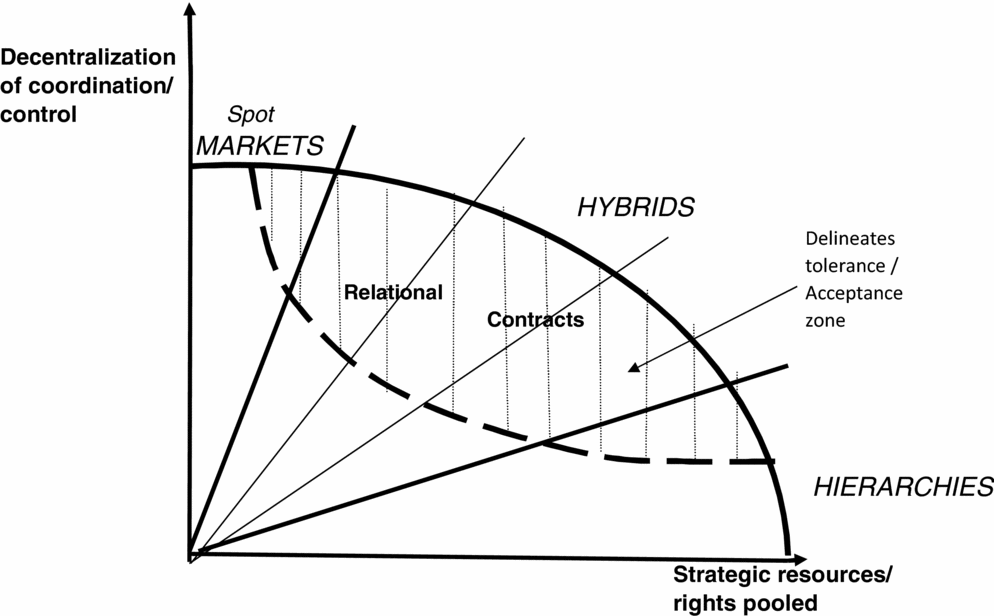
Ménard (Reference Ménard, Gibbons and Roberts2013a) pushed the reasoning further. Figure 1 provides a simplified version of the model he proposed.
Positing hybrid arrangements. Source: Ménard (Reference Ménard, Gibbons and Roberts2013a) revised (with permission from Princeton University Press).

On the horizontal axis are the strategic resources (‘specific assets’ in Williamson terminology) and the associated property rights that might be pooled. The vertical axis synthesizes a key governance feature for alternative organizational arrangements: the degree of decentralization in the coordination and control over assets in relation to the allocation of decision rights. Four points deserve particular attention in this representation and the underlying model:
(1) Hybrids are posited in a way that does not dilute the important role of markets or integrated organizations. It is the allocation of both property rights (horizontal axis) and decision rights (vertical axis) and their core characteristics (how strategic it is for the former, how decentralized it is for the latter) that determines the various organizational arrangements;
(2) The model allows differentiating types of hybrids (illustrated through the light rays from the origin) according to the intensity in sharing both types of rights, which helps capturing the variety of hybrid arrangements;
(3) The model does not assume that the different arrangements are on the optimizing frontier (upper boundary in Figure 1). It rather suggests that the strategy of parties to a transaction is to stay within a ‘lens’, leaving room for adaptation and evolution. This strategy is facilitated by the relational contracts, which are central to coordinate shared rights in hybrid arrangements. Parties may remain in that region either because they do not have all information required to fully optimize or because their bounded rationality prevents them from processing efficiently all information available;
(4) At the same time, parties are constrained by their competitive environment. Evolving beyond the lower boundary of the lens (dotted line) means that the misalignment between the combination of rights and the transaction at stake becomes such a source of inefficiencies that the arrangement cannot survive anymore (except if artificially maintained, e.g., through public subsidies!).
Beside hybrids, another puzzle has emerged in the recent literature, although already suggested incidentally by Monteverde and Teece (Reference Monteverde and Teece1982) and explicitly pointed out by Bradach and Eccles (Reference Bradach and Eccles1989), which is the coexistence of different arrangements monitored through a single organization. These so-called ‘plural forms’ designate situations in which a firm, for example, has integrated part of the transactions needed for its activity, but complements integration with different organizational arrangements (e.g., a network of suppliers connected through short-term or long-term contracts; using markets for providing some of the inputs needed; etc.).Footnote 12
To sum up, the initial insights provided by Williamson and his followers about the characteristics of transactions that could explain the existence of alternative organizational arrangements and the tradeoff among them have been considerably enriched. On the one hand we now have a much more complex representation of the organization of transactions in a market economy. On the other hand there still is a lot to do to better understand the internal characteristics of the various arrangements and the forces that push parties in one direction or the other. And we still have to explain the coexistence of different arrangements for operating similar transactions. All these issues clearly defined part of the future research agenda for NIE and beyond. In that respect one can expect increasing and beneficial interactions with other paradigms.
3. Embedding organizational arrangements into their institutional environment
The extended representation of the variety of organizational arrangements operating in a market economy and the rationale introduced to explain the tradeoffs among these arrangements cannot ignore how much this variety as well as these tradeoffs depends on the institutional environment. For example, contract laws affect differently alternative arrangements and the behavior of parties involved; regulation and competition authorities have a direct impact on market structures and the tradeoff among arrangements; fiscal regimes may affect the decision to go hybrid, etc. New Institutional Economics played and continues to play a major role in putting these issues high on the research agenda of economists and social scientists. However, NIE in general and the Williamsonian branch in particular remain poor when it comes to the analysis of the specific mechanisms through which institutions and organizational arrangements interact. In what follows, I come back to contributions that began exploring the modalities of these interactions.
3.1. Institutions as a background
Deeply rooted in the Coasian tradition, the Williamsonian approach is aware that organizational arrangements are embedded in their institutional environment. The profound impact that Williamson's experience of dealing with regulation at the US Department of Justice has had on shaping his research agenda should be reminded here. However, the picture remains quite poor when it comes to understanding the mechanisms through which institutions shape and alter organizational arrangements as well as the retroactions of these arrangements on institutions.
One could legitimately oppose this statement by pointing out the now abundant literature on institutions, largely inspired (although this is often not acknowledged) by the powerful impulse from Coase (Reference Coase1960) regarding the role of legal regimes, and from North (Reference North1981, Reference North1990) with respect to the role of the polity.Footnote 13 However, the bulk of this literature focuses on a very general and aggregated approach, looking at the global impact of institutions on growth and development as captured essentially through cross-country comparisons (for a discussion see Shirley, Reference Shirley2008). There is very little about how institutions interact with the internal characteristics of alternative organizational arrangements or how they interfere and with what impact on the choice of governance that parties to a transaction make. Although the concepts of ‘transaction costs’, ‘property rights’, ‘contracts’, now permeate the economic literature, the nature and impact of their institutional dimension often remain, at best, allusive. Illustrative is the ‘incomplete contract theory’ à la Hart, which rightly makes the allocation of property rights a central issue for understanding organizational arrangements, and particularly the decision to integrate or not, but without consideration for the institutional constraints or impulse that may shape these rights and their transferability. Even worse in that respect are comparative analysis of legal regimes that propose definitive statements on the impact of laws on growth (e.g., Shleifer et al., Reference Shleifer, Glaeser, La Porta, Lopez de Silanes and Djankov2003) without taking into account the transmission mechanisms through which, say the German regime of property rights compared to the American or Japanese ones may affect the choices made by players operating within these rules of the game.
New Institutional Economics cannot parade as exemplar in that respect. Notwithstanding the fact that both branches refer to the same key concepts, there are still few analyses about how to precisely articulate the Williamsonian contributions to our understanding of what organizational arrangements are and how one arrangement can prevail over others on the one hand; and the Northian perspective on the different dimensions characterizing institutions and on the forces driving institutional changes on the other hand. However, I would like to point out some significant efforts in this direction. Without overstating the distinction, let me indicate two different ways that have been explored and that partially correspond to the two ‘sensibilities’ within NIE.
The first approach is close to the Williamsonian contribution to organization theory. It is well-illustrated by a pioneering paper from Oxley (Reference Oxley1999), built explicitly on Williamson's model from Reference Williamson1991/1996. In that paper, Oxley explores the impact of different regimes of property rights, their implementation, and their enforcement, on the selection of a specific organizational arrangement by a business intending to transfer a new technology abroad. Similarly, Mark Roe (Reference Roe2000, Reference Roe, Ménard and Shirley2005) showed in numerous comparative analyses of different legal regimes how they shape the internal structure of large corporations, the role of the Board and of management, etc., with a strong effect on performance. More recently, Libecap (Reference Libecap, Ménard and Ghertman2009, Reference Libecap2014) has developed fascinating analyses on the impact of different regulatory mechanisms on the allocation of property rights, on the resulting arrangements and performance in the management of natural resources, and on their consequences when it comes to monitoring externalities.
A second approach is closer to the Northian branch of NIE, with a particular emphasis on the role of the polity and the judiciary. In a pioneering book (Shirley, Reference Shirley1995), Shirley substantiated with abundant empirical evidence the impact of political interferences on the performance (and counter-performance) of state-owned business. A few years later, the same author edited a collection of essays showing how successes and failures in the reform of public utilities (namely urban water systems) in several developing countries depended on institutions in which they are embedded (Shirley et al., Reference Shirley2002). These analyses comforted a previous paper by Levy and Spiller (Reference Levy and Spiller1994) on the reform of the telecom industry showing that similar reforms may have opposite effects depending on the institutional environment in which they are implemented. More controversial contributions, often hiding under the bushel their debt to institutionalists (see La Porta et al., Reference LaPorta, Lopez-de-Silvanes, Shleifer and Vishny1998), focused on the impact of legal regimes in the development of specific sectors, particularly finance. The Doing Business reports, issued by the World Bank and the International Finance Corporation, are illustrative of these efforts to better capture the impact of legal and political systems in easing or restraining business activities, notwithstanding the disputable methodology and conceptual background of the reports.Footnote 14 More modestly, and likely more to the point, Benham (Reference Benham, Ménard and Shirley2005) focused on the micro-analytics of institutions shaping transaction costs in specific industries, e.g., the costs resulting from duties and delays at custom offices and their consequences on the performance in the textile industry.
3.2. Intermediation: the key role of meso-institutionsFootnote 15
One weak or even missing aspect in the studies referenced above, as in so many others not mentioned here, is a more precise analysis of the mechanisms through which institutions permeate organizational arrangements and through which feedbacks are transmitted. A useful tool in that respect might be provided by the concept of meso-institution.Footnote 16
In our Handbook of New Institutional Economics (Ménard and Shirley, eds., Reference Ménard and Shirley2005/2008), two sections contain extensive reviews and original insights by well-established contributors on the nature and role of political and legal institutions and their impact on development and growth. In the same book, Greif (Reference Greif, Ménard and Shirley2005; see also Reference Greif2006) provides stimulating views fed by rich historical analyses on the dynamics of these institutions. However, what is still poorly understood (if at all taken into consideration) is the transmission mechanisms through which organizational arrangements and institutions interact, which is an essential link to capture not only what is actually going on in each dimension but also how this interaction translates into micro-performance that provides the foundations to development and growth.
There are important intuitions on this issue spread in different publications from North; for example, when he discusses the role of ideologies and beliefs (North, Reference North1990; North et al., Reference North, Wallis and Weingast2009). Levy and Spiller (Reference Levy and Spiller1994) also came close to explicitly analyzing these transmission mechanisms in their review of the role of courts and civil servants in the reform of the telecommunication sector. Spiller and Tommasi (Reference Spiller and Tommasi2007) went a step further in their scrutiny of the impact of inadequate institutions (particularly the judiciary) on the counter performance of the Argentinian economy through its century-long decline. At a more abstract level, these two authors (Spiller, Reference Spiller, Ménard and Ghertman2009; Spiller and Tommasi, Reference Spiller, Tommasi, Ménard and Shirley2005) as well as Estache and Martimort (Reference Estache and Martimort1999) and Laffont (Reference Laffont2005) examined carefully some fundamental characteristics of the institutional embedment of regulatory regimes, while Kunneke (Reference Kunneke2008) and Glachant et al. (Reference Glachant and Lévêque2009) explored the institutional conditions under which regulatory rules are defined and implemented in the electricity sector. Differently, while exploring what he identified as ‘organic institutions’, Greif (Reference Greif, Ménard and Shirley2005) expressed concerns about how institutions develop and interact with agents behavior and the way they organized transactions.
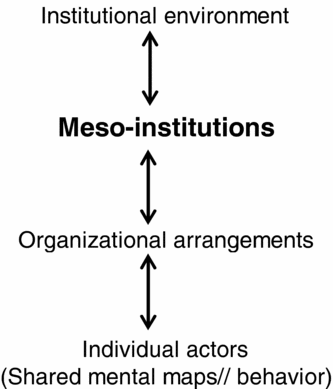
Notwithstanding these contributions and so many others, a gap remains in our theoretical framework that points the need for a general concept explicitly targeting the mechanisms at work in the interaction between the macro-institutions established at the societal level and the organizational arrangements operating within these institutions.Footnote 17 I suggest that the concept of ‘meso-institution’ can help filling this gap. By meso-institutions, I refer to these devices embedded in and legitimized by the inclusive societal institutions defined above, devices that are in charge of actually implementing the general rules of the game through their translation into rules specific to sectors and/or geographic areas, thus framing and delineating the domain of activities of actors (individuals as well as organizational arrangements) operating within these rules. Public bureaus, regulatory agencies, specialized arbitration devices provide illustrations. Figure 2 below posits this concept of ‘meso-institutions’ in relation to other levels of analysis developed in different contributions of NIE.
The key role of meso-institutions.Footnote 18
Meso-institutions differ from organizational arrangements with respect to the type of rules they implement. The former get their legitimacy from the institutions that delineate their role through general rules, as when a law is introduced to deregulate the telecom industry or to create energy markets: meso-institutions operate as intermediaries, in charge of implementing general rules through their translation into specific guidelines and providing feedback from operators having to deal with these rules.Footnote 19 By contrast, organizational arrangements may develop internal rules, codes, conventions that define the content of their governance (e.g., the internal structure of the firm); but they remain submitted to the specific rules generated by meso-institutions and grounded in the general rules defining their existence and responsibilities (e.g., public bureaus delineating the fiscal regime under which different firms fall, according to their size or other criteria). As intermediaries, the capacity of meso-institutions to produce efficient guidelines depends on the acceptance of the rules of the game by the actors, which is rooted in the mental maps that frame their behavior (whether strategic or adaptive); and on their capacity to monitor the diverse organizational arrangements (e.g., markets, inter-firm relations, etc.), which requires specific rules flexible enough to adapt to changing conditions refracted by the actors engaged in these arrangements.
Meso-institutions can be formal, as with the much explored example of regulatory agencies; or informal, as when European regulators of telecommunications or electricity meet on a regular basis to exchange information and coordinate decisions even if there is no legal basis or general rules providing legitimacy to this coordination. There are numerous examples of meso-institutions beside regulatory agencies: specialized courts in charge of implementing labor contracts; public departments in charge of monitoring specific infrastructures without being their operator (e.g., department of transportation); competition authorities in charge of supervising markets and interfering with their structure; private international arbitration. Through their diversity, they all share a common characteristic which is that they operate as subsidiaries of the macro-institutions, translating general rules into specific ones, and as go-between dealing with requests and complaints emanating from organizational arrangements and actors. This may help understanding why for similar general rules, devices in charge of their implementation (e.g., regulatory agencies, competition authorities) differ so much from one country to another or even among states in a federal regime.
To sum up, a new theoretical domain, which is about the mechanisms necessary to understand the embedment of organizational arrangements into their institutional environment, is beginning to be explored more systematically. My suggestion is to delineate this domain through the concept of ‘meso-institutions’. These intermediate mechanisms likely play a crucial role in allocating rights and in determining transaction costs. However, there is still a need to refine the concept and ground it better in the more general NIE theory, and to produce adequate datasets to substantiate the role and economic impact of these meso-institutions, for example, different regulatory regimes or different bureaucratic settings, on the performance of organizational arrangements.
4. Embedding organizational arrangements in technology
Another dimension that has been down-played so far by NIE and that requires much more attention concerns the complex interaction of institutions and organizational arrangements with technology. Not long after Williamson published The Economic Institutions of Capitalism (1985), Englander (Reference Englander1988) pointed out that TCE basically ignored technology and provocatively suggested that transactions might be summarized in the technologies needed to organize them. Although he opposed this last statement, rooted in the technological representation of the firm as a production function, Williamson (Reference Williamson1988) acknowledged that in giving priority to building an alternative representation of the firm, he has put technological concerns on the backburner.
4.1. Technology: a non-benign neglect in NIE
In a review of what we have learned from NIE, he went a step further and made the following assessment:
Finally, I should call attention to technology. As compared with technological innovation, the study of organizational innovation has been comparatively neglected. The NIE has attempted to rectify that [. . .]. Inasmuch as these two work in tandem, we need to find ways to treat technical and organizational innovation in a combined manner. (Williamson, Reference Williamson2000: 600).
Hence, the absence of concern for technology in TCE and, more generally, in NIE should not be attributed to benign neglect but rather to a research strategy. True, a major contribution of NIE has been to get away from the prevalence of the production function approach to the firm that dominates mainstream economics, with technology determining how to combine inputs so as to reach the optimal frontier, thus determining the nature and size of the firm. This technological representation is not only restrictive in that it identifies all modes of organization to the firm as the only arrangement beside markets; it also falls short of what is required to understand the nature and variety of organizational arrangements as substantiated by so many recent contributions (see surveys in Ménard, Reference Ménard, Bindsell, Haucap and Wey2006, Reference Ménard, Gibbons and Roberts2013a).
However, we must admit that if TCE succeeded in switching the attention to a non-technologically determined representation of the firm and, more generally, of all organizational arrangements, it also introduced a strong bias towards neglecting the role of technology. The difficult relationship between NIE and parallel research programs focusing on the role of technology (e.g., co-evolution and the evolutionary approach that originated in Nelson and Winter, Reference Nelson and Winter1982) is an indicator of this non-benign neglect. Introducing technological issues in a transaction cost framework should be reinstalled as a priority in our agenda. Building an integrated model of the interactions between institutions and organizational arrangements that would make room for technology is indeed a key issue for NIE, and a very challenging one.Footnote 20
4.2. A case in point: network infrastructures
In an ongoing project, weFootnote 21 are working on a framework to provide milestones in this direction. Our research program takes network infrastructures (water, electricity, railroad, air transportation, telecommunications, etc.) as a point of departure and the domain in which to check our hypotheses and control our propositions.
‘Criticality’ is a key concept in our framework, providing a way to capture the interactions between institutions, organizational arrangements, and technology in this context. Criticality refers to the fact that in order for network infrastructures to deliver the expected services with the highest possible quality at the lowest possible costs, transactions must be organized in a way that meets inescapable technical requirements. In network infrastructures, these technical requirements are: (1) the need to interconnect components and/or segments of a system, which involves determining conditions of technical compatibility (e.g., the size of pipes in urban water systems); (2) the necessity to assure interoperability, which means that the different parts of the technical system must be designed and/or equipped to fit specific standards (e.g., signaling systems in the railroad sector); (3) the need to allocate capacities of the system in such a way that production meets the actual demand (e.g., load balancing in the electricity system); (4) the necessity to implement control devices that guarantee continuity in the technical operation of the system (e.g., control over voltage and frequency in the electricity system).
The existence of such critical technical requirements and the conditions they impose on the technological architecture that go with them have a direct impact on how transactions must be organized along different nodes of the system, and on the resulting costs. In that respect, there are transactions that are critical for providing adequate support to the chosen technology (ies): they require forms of coordination that are essential to guarantee that the requirements imposed by the technical functions on the one hand fit with the rights and rules embedded in the different institutional levels on the other hand. We refer to this coordination issue as the ‘alignment’ between institutions and technology.
This ‘alignment’ issue concerns three interdependent levels (see Figure 3 below):
The interactions between technology and institutions.Footnote 24
(1) The technological architecture must be embedded in adequate institutional rules and appropriate allocation of rights. For example, when imposing the unbundling of the electricity or railroad systems, lawmakers must take into account the nature of the network at stake in order to meet its technological requirements when allocating rights (e.g., rights of access) and when designing mechanisms of coordination. For example, introducing private actors in the water sector implies conditions that differ from those in the telecoms. Defining such rules of the game involves not only economic transaction costs but also political ones;
(2) Rules specific to a sector and mechanisms of enforcement must be designed that are aligned with the specific technical characteristics of the sector: urban water systems cannot be organized along the same rules as urban transportation systems. This dimension refers to governance issues, with governance understood as the monitoring of different sectors of activities. Rules and rights must be defined, allocated, and implemented through meso-institutions that translate general rules into specific ones. Allocating slots to airlines does not respond to the same requirements than allocating rights to provide drinkable water to a city;
(3) In that respect, the choice of organizational arrangements will differ depending on the requirements of the technical operation of the system since these arrangements must be aligned with specific constraints.Footnote 22 For example, decentralized coordination through contracts among autonomous firms may not be an adequate solution to make the running of the technology efficient. The allocation and monitoring of slots in the railroad industry imposes a relatively centralized coordination while water provision is usually monitored at a much more decentralized level. This aspect of the alignment problem is the one that has attracted most of the attention of transaction costs à la Williamson.
Figure 3 provides a broad overview of the dimensions involved and of their interactions.Footnote 23
On the right hand side, we have the different levels at which property rights as well as decision rights are allocated, namely: (1) the institutions in which are determined and/or embedded the general rules of the game that determine the broad allocation of rights (e.g., public? Fully privatized? Public-private partnership? . . .) and that frame the behavior of all economic entities (individuals as well as organizational arrangements) operating within the jurisdiction of these institutions; (2) the meso-institutions which get their legitimacy from a subsidiarity principle which allows them to transform the general rules into specific ones adapted to the specific technical characteristics of the system they frame and monitor, thus providing guidelines to actors and making rules enforceable; and (3) the various organizational arrangements that actually operate within these rules, organizing actual transactions under constraints and possibilities opened by the technical system. Through these three levels, what is critical is the way rules are defined, implemented, and activated through the allocation and usage of rights among parties involved in specific network infrastructures.
On the left hand side is the technological dimension, with all levels submitted (but differently) to the critical technical functions that characterize and differentiate technological systems providing support to different network infrastructures. (1) At the most inclusive level is the architecture that defines a technology and differentiates it from alternative solutions, e.g., the architecture commanded by nuclear power contrasted with the usage of hydro-power. (2) A second level corresponds to the specific technical characteristics resulting from the adaptation of the technological architecture to specific physical circumstances, e.g., the adaptation of hydro-turbines to the flow of a river, or of water extraction to the underground properties specific to different areas. (3) Last, these technical characteristics translate into technical rules making the system operational, e.g., the selection of a specific voltage in the electricity system or in an electrified railroad system, or the technical coordination of different signaling mechanisms in the railroad industry.Footnote 25 The unifying forces on the technological side come out of the constraints imposed by the four critical functions mentioned above. The literature from system engineersFootnote 26 shows how essential it is for these functions to be performed; otherwise the technical system might break down, making related economic transactions impossible. For example, a disruption in the railway signaling system makes the possibility of new transactions conditional to the restoration of the system.
This example suggests what might be crucial for understanding the role of technology in an institutionalists perspective, which is the alignment, or misalignment, between the two ‘columns’, taking into account the interactions among the different levels in each of them. In a sense, this can be understood as the extension to our three levels of the alignment principle defined by Williamson (Reference Williamson1996: 311–12) who focused on the third level, in which to be efficient organizational arrangements must be aligned with transactions at stake. But the framework summarized above complements Williamson's analysis by making these transactions themselves conditional to their alignment with the technical characteristics of the activity they organize. And it extends his analysis to the two other levels, the alignment between the meso-institutions and the specific technical characteristics and the appropriate embedment of the rules defined through macro-institutions with the technological architecture chosen. All levels play their role in determining the coherence of the system and its capacity to meet objectives and expectations assigned to that system, as with the network infrastructures in the examples mentioned above.
The theoretical setting thus summarized does not come from Sirius. It is supported by an already abundant literature on the nature and role of institutions in delineating the domain and the rules within which organizational arrangements can operate. It is also supported by the rich contributions of what can already be considered the Williamsonian approach to organizational arrangements. And it finds numerous indications, although more dispersed, in the literature on regulatory devices, public bureaus, arbitration devices, all arrangements that I have subsumed under the concept of meso-institutions. In identifying more explicitly the different levels involved and in extending the alignment principle to the analysis of the interactions between institutions and technology, our framework provides a unified analysis subsumed under the key concepts of NIE complemented by new insights (e.g., the concepts of ‘criticality’ or ‘meso-institutions’).
I am far from suggesting that this framework provides fully adequate answers to the complex set of questions regarding the relations between institutions and organizational arrangements on the one hand, and technological systems on the other hand, not to mention the even more complex issue of the relationship between technological innovation and institutional changes. All I suggest is that this framework provides elements of a unified conceptual model to explore different avenues for better understanding these issues.
5. Conclusion
The question I had to deal with in this contribution is a challenging one: what is the future of NIE? My answers were essentially oriented towards identifying problems and puzzles to be solved and referring to a set of concepts produced from a new institutional perspective and that can help making important steps forward. In doing so, I have mostly built on the heritage of TCE.Footnote 27 I have emphasized what I see as some promising directions that the extension of this paradigm opens.
I did not intend to deliver a survey or to be exhaustive. I deliberately focused on relatively specific and underexplored issues that require an analytical approach, looking ahead rather than taking stock. Summarizing where we are has masterfully been exposed by Coase (Reference Coase1998), who pinpointed what NIE is about, and by Williamson (Reference Williamson2000) and North (Reference North2004) who both captured the essence of what we have learned so far, doing so in their own way and with their own emphasis, on TCE and on the relation between institutions and development, respectively.
Trying to outline what could come next is a risky position. We all know that knowledge does not develop linearly. The specific content of the research agenda and the few concepts that I tried to push further in this paper might not correspond to the breakthrough that will happen in the years ahead of us. However, I am convinced that the three axes I have emphasized will remain part of the future development of an adequate institutional theory, in the vein of NIE.
Digging deeper into the internal properties of markets and integrated organizations (hierarchies) in order to better understand their differences, and extending the analysis to non-standard arrangements such as networks, alliances, joint ventures, etc., so as to benefit from an integrated model, will remain high among our priorities. Exploring more intensely the relatively neglected question of the mechanisms through which institutions interact with organizational arrangements, making the later deeply embedded in their institutional environment, shall attract increasing attention. Integrating technology and its dynamics into a more general model, so as to better grasp the complex interactions between technological innovation and institutional change, will remain a long-term goal for all those concerned by the co-evolution of institutions and technology.
This is quite a demanding research program. It is also quite an exciting one, which should attract the attention and energy of newcomers to the field of institutional analysis.