




No CrossRef data available.
Article contents
Is HIV/AIDS jeopardizing biodiversity?
Published online by Cambridge University Press: 27 February 2009
Summary
The scourge of HIV/AIDS (human immunodeficiency virus/acquired immune deficiency syndrome) is most prevalent in southern Africa. South Africa has the highest number of people in the world living with HIV/AIDS and a prevalence rate of over 30 % for females presenting at antenatal clinics. There are now almost five million orphans within southern Africa, as a result of AIDS deaths of one or more or their parents. AIDS-related mortality and morbidity of care-givers may lead to increased reliance on wild sources of animal protein by surviving children. This increase in hunting pressure has unknown, but potentially important impacts on local animal populations.
Information
- Type
- Comment
- Information
- Copyright
- Copyright © Foundation for Environmental Conservation 2009
References
Albrechtsen, L., Fa, J.E., Barry, B. & MacDonald, D.W. (2006) Contrast in availability and consumption of animal protein in Bioko Island, West Africa: the role of bushmeat. Environmental Conservation 32: 340–348.CrossRefGoogle Scholar
Barany, M.E., Hammett, A.L., Sene, A. & Amichev, B. (2001) Non-timber forest benefits in sub-Saharan Africa. Journal of Forestry December 36–41.Google Scholar
Barany, M.E., Hammett, A.L., Leakey, R.R.B. & Moore, K.M. (2003) Potential income generating opportunities for smallholders affected by HIV/AIDS: linking agro-ecological changes and non-timber forest products. Journal of Management Studies 18: 97–114.Google Scholar
Byrne, R. (2002) AIDS in Zambia, the effect on subsistence farmers. Geography Review 15: 29–31.Google Scholar
de Merode, E., Homewood, K. & Cowlishaw, G. (2004) The value of bushmeat and other wild foods to rural households living in extreme poverty in Democratic Republic of Congo. Biological Conservation 118: 573–581.CrossRefGoogle Scholar
de Waal, A. & Whiteside, A. (2003) New variant famine: AIDS and food crisis in southern Africa. The Lancet 362: 1234–37.CrossRefGoogle ScholarPubMed
Frison, E., Smith, I.F., Cherfas, J., Eyzaguirre, P. & Johns, T. (2005) Using biodiversity for food, dietary diversity, better nutrition and health. South African Journal of Clinical Nutrition 18: 112–114.CrossRefGoogle Scholar
Gelman, N.B., Oglethorpe, J. & Mauambeta, D. (2005) The impact of HIV/AIDS: how can it be anticipated and managed? Parks 15: 13–224.Google Scholar
Hunter, L. M., Twine, W. & Patterson, L. (2007) ‘Locusts are our beef’: adult mortality and household dietary use of local environmental resources in rural South Africa. Scandanavian Journal of Health 35: 165–174.Google Scholar
Kaschula, S.A. (2008) Wild foods and household food security responses to AIDS: evidence from South Africa. Population and Environment 29: 162–185.CrossRefGoogle Scholar
Loibook, M., Hofer, H., Campbell, K.L.I. & East, M.L. (2002) Bushmeat hunting by communities adjacent to Serengeti National Park, Tanzania: the importance of livestock ownership and alternative sources of protein and income. Environmental Conservation 29: 391–398.CrossRefGoogle Scholar
McGarry, D.K. (2008) The impact of HIV/AIDS on rural children's reliance on biodiversity within the Eastern Cape, South Africa. M.Sc thesis, Rhodes University, Grahamstown, South Africa.Google Scholar
Morton, J. (2006) Conceptualising the links between HIV/AIDS and pastoralist livelihoods. European Journal of Development Research 18: 235–254.CrossRefGoogle Scholar
Ngwenya, B.N. & Mosepele, K. (2007) HIV/AIDS, artisanal fishing and food security in the Okavango Delta, Botswana. Physics and Chemistry of the Earth 32: 1339–1349.CrossRefGoogle Scholar
SADC FANR Vulnerability Assessment Committee (2003) Towards Identifying Impacts of HIV/AIDS on Food Insecurity in Southern Africa and Implications for Response: Findings from Malawi, Zambia and Zimbabwe. Harare, Zimbabwe: Southern African Development CommunityGoogle Scholar
Shackleton, C.M. & Shackleton, S.E. (2004) The importance of non-timber forest products in rural livelihood security and as safety-nets: evidence from South Africa. South African Journal of Science 100: 658–664.Google Scholar
Takasaki, Y., Barham, B.L. & Coomes, O.T. (2004) Risk coping strategies in tropical forests: floods, illness and resource extraction. Environment and Development Economics 9: 203–224.CrossRefGoogle Scholar
Torell, E., Tobey, J., Thaxton, M., Crawford, B., Kalanghe, B., Madulu, N., Issa, A., Makota, V. & Sallema, R. (2006) Examining the linkages between AIDS and biodiversity conservation in coastal Tanzania. Ocean and Coastal Management 49: 792–811.CrossRefGoogle Scholar
UNICEF (2006) Africa's orphaned and vulnerable generations: children affect by AIDS. Report, UNICEF, New York, USA: 42 pp.Google Scholar
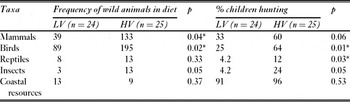
Table 1 Frequency (total count of animals) of wild animals in high vulnerability (HV) and low vulnerability (LV) children's diets over a two-week period, as well as the percentage of children hunting each taxonomic group at Coffee Bay and Mabehana. *p < 0.05.

McGarry supplementary material
Summary.doc

File
24.6 KB
 You have
Access
- 18
- Cited by
The scourge of HIV/AIDS (human immunodeficiency virus/acquired immune deficiency syndrome) is most prevalent in southern Africa. South Africa has the highest number of people in the world living with HIV/AIDS and a prevalence rate of over 30 % for females presenting at antenatal clinics (UNAIDS 2007). There are now almost five million orphans within southern Africa, as a result of AIDS deaths of one or more or their parents (UNICEF 2006). We suggest here that AIDS-related mortality and morbidity of care-givers may lead to increased reliance on wild sources of animal protein by surviving children. This increase in hunting pressure has unknown, but potentially important impacts on local animal populations.
HIV/AIDS is known to act both as a direct driver that increases household social and economic vulnerability, as well as an indirectly affecting biodiversity. The former is well known and recognized due to the prolonged illness and untimely mortality of infected people, which frequently results in loss of a breadwinner and household labour, and the sale of assets. This leaves the household vulnerable to other shocks, which threatens a descent into deeper poverty. However, the impacts of HIV/AIDS with respect to biodiversity are less direct, and until recently evidence of the impact of HIV/AIDS on the use or management of biodiversity has been scarce (Barany et al. Reference Barany, Hammett, Sene and Amichev2001). Firstly, it is having an unprecedented impact on the skills pool of environmental and resource managers and professionals through prolonged sickness and death (Gelman et al. Reference Gelman, Oglethorpe and Mauambeta2005; Torell et al. Reference Torell, Tobey, Thaxton, Crawford, Kalanghe, Madulu, Issa, Makota and Sallema2006). This also undermines institutions tasked with ecosystem management. Secondly, its effect of increasing the vulnerability of rural households can change use patterns of natural resources and landscapes. This has been reported for a range of rural livelihood sectors, ranging from agriculture (Byrne Reference Byrne2002; de Waal & Whiteside Reference de Waal and Whiteside2003), to pastoralism (Morton Reference Morton2006), coastal and inland fisheries (Torell et al. Reference Torell, Tobey, Thaxton, Crawford, Kalanghe, Madulu, Issa, Makota and Sallema2006; Ngwenya & Mosepele Reference Ngwenya and Mosepele2007) and, more recently, collection of wild resources (Hunter et al. Reference Hunter, Twine and Patterson2007; Kaschula Reference Kaschula2008; McGarry Reference McGarry2008). Our work complements this growing knowledge base by examining the links between HIV/AIDS and consumption of local fauna by vulnerable rural children at two sites in the poorest province of South Africa, the Eastern Cape.
Using a combination of guided individual interviews and participatory food diaries kept by the respondents, we were able to examine the impact of HIV/AIDS on rural children's (aged 9–18) hunting activities. Using recognized proxy indicators (SADC FANR [South African Development Community, Food, Agriculture and Natural Resources] Vulnerability Assessment Committee 2003) we were able to define the effect of AIDS within the children's household and thus differentiate the children to be either highly vulnerable (HV group, 2 or more proxies), or least vulnerable (LV, no proxies). The proxies included: (1) mortality of a family member in the past two years, (2) chronic illness prior to death, (3) presence of chronically ill care-givers within the home, (4) recent mortality of care-givers, (5) presence of orphans within the home and (6) current care-givers that are not the biological parents. Children within each of these two groups (53 LV and 55 HV) were then interviewed and supported to compile daily diaries documenting their diet over a two-week period. The frequency of occurrence of different animal groups in the HV and LV children's diets was compared using Mann-Whitney tests, and the percentage of children in LV and HV groups hunting each animal group was compared using chi-squared tests.
Over the two week period the children hunted a total of 172 mammals and 284 birds, comprising 22 mammal and 25 bird species (individual insect and reptile species were not recorded). The top five most harvested bird species were red-winged starling (Onychognathus morio), black-eyed bulbul (Pycnonotus barbatus), cape-turtle dove (Streptopelia capicola), sunbird (Nectarinia spp.) and laughing dove (Streptopelia senegalensis). The top five most harvested mammals were the rock hyrax (Procavia capensis), tree hyrax (Dendrohyrax arboreus), blue duiker (Philantomba monticola), vervet monkey (Cercopithecus aethiops) and greater red rock rabbit (Pronolagus crassicaudatus).
It is widely understood that wild foods are an extensive component of rural peoples' diets, and are a common safety net during times of hardship (Barany et al. Reference Barany, Hammett, Leakey and Moore2003; de Merode et al. Reference de Merode, Homewood and Cowlishaw2004; Shackleton & Shackleton Reference Shackleton and Shackleton2004; Takasaki et al. Reference Takasaki, Barham and Coomes2004; Frison et al. Reference Frison, Smith, Cherfas, Eyzaguirre and Johns2005). We found that consumption of wild meat is a regular activity among rural children. Wild protein in the form of seafood, riverine fish, forest mammals, birds, reptiles and insects played a significant role in children's diets. Just over 50% of the children received one domestic (i.e. from home) meat meal per month, whereas 30% were personally acquiring one wild meat meal per week. Overall, of those children who had eaten a meat meal in the 14-day period, two-thirds of their meals consisted of wild sourced protein.
HV children were observed to hunt more regularly and also consumed far more wild meat than LV children. Birds as wild meat were the most frequently consumed terrestrial vertebrate, followed by small mammals (Table 1). Similarly there was a significant difference between the proportion of HV and LV children hunting birds. Reptiles and insects were commonly considered as an undesirable wild food among the majority of the children interviewed. Generally the consumption of reptiles and insects was low, but was nonetheless markedly higher amongst HV children than LV children (Table 1). We speculate that there is a potential threshold of vulnerability to food scarcity and stress, beyond which HV children will resort to less desirable wild foods in order to cope with their hunger. There was no significant difference between HV and LV children when it came to harvesting and consumption of coastal resources. It seems that HV children engage in less reliable food acquisition activities, such as hunting mammals and birds, as they may not always get a catch, whereas collecting shellfish and fishing are less labour intensive and provide almost guaranteed yield. LV children therefore are far less likely to engage in mammal and bird hunting (other than for recreation) as their food security is not as significantly challenged as the HV children.
Frequency (total count of animals) of wild animals in high vulnerability (HV) and low vulnerability (LV) children's diets over a two-week period, as well as the percentage of children hunting each taxonomic group at Coffee Bay and Mabehana. *p < 0.05.
The impact these children are having on the local faunal populations is unclear. Most of the species are relatively common. However, two IUCN red data species were noted in the two week period, namely 11 records of the southern giant petrel (Macronectes giganteu) and two instances of the giant golden mole (Chrysospalax trevelyani). Overall, our results indicate that HV children hunt and eat a lot more protein sourced from the wild than LV children, mirroring differentials in wealth as a factor in influencing hunting practices elsewhere (see for example Loibook et al. Reference Loibook, Hofer, Campbell and East2002; Albrechtsen et al. Reference Albrechtsen, Fa, Barry and MacDonald2006). Thus, as the pandemic affects increasing numbers of households and undermines traditional coping strategies, it is conceivable that affected children will range further into forests and rangelands to source sufficient food. These results also reveal that rural children's independent use of wild foods in response to HIV/AIDS vulnerability is directly opposite to that of a household's response, as found by Kaschula (Reference Kaschula2008). With increased HIV/AIDS vulnerability there does not seem to be an increased reliance on wild animal protein at a household level (Kaschula Reference Kaschula2008), however at the scale of the individual child the opposite was found. de Waal and Whiteside (Reference de Waal and Whiteside2003) described HIV/AIDS as a variant new famine, exacerbating already strained ecological and social environments. Understanding this, we must be proactive in our response and identify the role conservation can play in supporting vulnerable households and children whilst not endangering populations of local wild species.
Acknowledgements
We thank the children and their families who participated in this sensitive research; their time, patience and knowledge are sincerely appreciated. The Rockefeller Brothers Foundation is gratefully acknowledged for their financial support.