

1. INTRODUCTION
The observations and questions in this article are rooted in personal creative practice. Like many electroacoustic composers, much of my fixed medium music has a narrative focus, and often incorporates human voice in some way. But, although the most direct application of voice in a fixed medium work is the reproduction of captured or performed vocal material, a work can certainly also include non-human sonic elements that suggest or interact with a human vocal presence. For example, my short study kune kune (2012a) combines the vocalisations of a pair of small pigs and two pre-school children, highlighting similarities between their behaviours and vocalisations, in an implied narrative of ‘parallel play’.
The presence of a human voice – overt or suggested – can be a powerful component of any creative work, and will usually resonate strongly with listeners. However, while there are certainly some consistent mechanisms affecting listener responses, the details of those responses will vary considerably according to the specifics of both the vocal material itself and the context for it.
Acknowledging some of the more readily understood mechanisms at play is therefore only a first step: the composer must also be prepared to consider widely variable factors such as audience demographic details, the physical and technical performance context, and, not least, their own created sonic setting for that vocal material.
In other words, definitive answers will likely be in short supply – but asking the ‘right’ questions is an essential part of any creative process. One of my principal goals in what follows is to raise some of the questions I have encountered on my own creative path, in the hope that they will be of some value to other composers or commentators interested in the impact of human voice in narrative electroacoustic works.
2. CONTEXTS
2.1. Narrative and story
At the outset, we should clarify how we use the term ‘narrative’ in this article – and in particular how we distinguish it from ‘story’. The online Oxford English Dictionary’s definitions include (among others), ‘an account of a series of events, facts, etc., given in order’ and ‘the part of a text, esp. a work of fiction, which represents the sequence of events’ (‘Narrative’, Oxford English Dictionary n.d.).
In his blog on contemporary media texts, writer Aram Zucker-Scharff proposed an interesting distinction between story as ‘a sequence of events’ and narrative as ‘how [emphasis in original] the events are told’ (Zucker-Scharff Reference Zucker-Scharff2011). For our purposes, adding such a distinction to our definition highlights two useful differences between ‘narrative’ and ‘story’.
First, while the events of a particular story might be told in countless different ways, and to multiple different effects, when we focus on its narrative we are considering a specific telling of that story. Second (and embracing the first, more inclusive, dictionary definition above), when we examine ‘narratives’, we do not limit ourselves to ‘stories’; rather, we expand our view to encompass a much wider range of creative works, including those that may, in fact, not have anything like an obvious ‘storyline’ at all, such as works focused on thoughts, perceptions or abstract ideas.
For clarity, then, in our present discussion, we will view a ‘narrative’ as the particular way a sequence of events or collection of ideas is presented.
Our principal focus here is on sonic narratives – narrative works delivered via sound alone – with particular (but not exclusive) interest in those presented on fixed media in an acousmatic context. Kent Stetson, a Canadian author, creative writing teacher and Governor General’s Literary Award winner, has succinctly highlighted a functional characteristic of narrative that seems particularly applicable to acousmatic works: ‘Imagination is the chief force of narrative’ (Stetson Reference Stetson2015).
Imagination is, after all, at the very core of the reception of acousmatic electroacoustic music. While some listeners may be particularly interested in formalistic attributes, such as texture, shape and structure, even those who listen relatively abstractly will likely rely on some kind of synaesthetic connection between audible and intellectual constructs to make sense of the work. And those who listen more referentially – giving in to our strong instinct to attribute a plausible source to any sound we hear – will certainly apply ‘imagination’ to their attempt to identify (and understand) the sounds that reach them, in any creative context.
2.2. Twenty-first century narratives
Before we examine the particular role of human voice in sonic narratives on fixed media, it may be useful to step back and briefly consider how the broader context for the reception of such narratives has been evolving.
Much has been written about the influence of evolving (and expanding) media upon both content inclusion and human behaviour. More than a half century ago, Marshall Reference McLuhanMcLuhan carefully outlined the social, cultural and political impacts of the invention of typography in The Gutenberg Galaxy: The Making of Typographic Man (McLuhan Reference McLuhan1969 [1962]). Soon after, he broadened his investigation considerably, to embrace ‘the personal and social consequences of any medium’ in Understanding Media: The Extensions of Man (Reference McLuhan1966 [1964]: 23).
Since then, increasingly specialised works have focused on specific media, particular demographics, or distinct social impacts. In the 1980s, Joshua Meyrowitz’s No Sense of Place: The Impact of Electronic Media on Social Behavior highlighted how electronic media (largely television at his time of writing) had ‘moved the dividing line between private and public behavior toward the private, and weakened the relationship between social situations and physical places’ (Meyrowitz Reference Meyrowitz1986: 308).
More recently, we have all witnessed the rapid growth of brief, instantly shared, personal ‘virtual narratives’ on social media – an evolution that on the one hand seems to partially reverse the tendency towards increased privacy that Meyrowitz observed in the 1980s, while at the same time further weakening the already diminishing connection between social and physical that he had also noted. In close parallel with growing personal uses of electronic media, the increasingly abbreviated output of public news media – visual, text and sonic – proliferates across broadcast and Internet spectra, quickly captivating (and often equally quickly releasing) our attention.
2.3. De-voicing
In addition to the broader evolution of narrative media, most of us have probably informally observed an interesting shift in the particular role of voice in interpersonal communications – a shift that might influence the way sonic narratives are received by some contemporary audiences.
Although current personal media seem to increasingly embrace visuals – with entire digital ‘ecosystems’ dedicated to photos (e.g. Instagram) or videos (e.g. YouTube) – text continues to be an important medium for our day-to-day interpersonal communication.
But, whether published in print or delivered electronically, ‘traditional’ public text-based media, such as books and magazines, generally continue to co-exist with their purely sonic counterparts like audio books or narrative radio programming.
In contrast, personal forms of electronic text-based communication increasingly seem to displace entire modes of interpersonal dialogue that were formerly immediate and acoustic – effectively de-voicing (in the acoustic sense of the word) those original modes. For some demographics, even casual conversation – until relatively recently the domain of direct personal encounters or one-on-one telephone calls – is carried out largely in social media or via direct text message, using mostly text modalities.
Contemporary text-based personal media have been criticised or mocked for their inability to communicate nuance well, a consequence of the absence of several factors we commonly rely upon in person-to-person (and, more recently, virtually visual) communication: visual cues (facial expressions, points of focus); acoustic cues (timing, tone); and the potential for instant adjustment of responses. To some extent, that lack of nuance is likely also a consequence of the compression of time, as evidenced by our growing expectation of immediate responses.
On the one hand, we might hope that audiences accustomed to communicating mostly in text will appreciate the increased subtleties of meaning conveyed by the presence of human voices in our sonic narratives. However, it seems equally possible that this demographic might be challenged by the type of focus or the time commitment required to experience linear, time-based media – particularly when there is ‘nothing to see’.
2.4. One-way street
A link between bi-directional text communication and narrative electroacoustic works presented to passive audiences may not seem immediately obvious. After all, a sound work on a fixed medium clearly seems ‘one way’, in that the audience for it does not normally have an opportunity to respond in a similar mode (unwelcome episodes of booing excepted). But our understanding of the mechanisms affecting the delivery and reception of an acousmatic sonic narrative may be assisted by briefly exploring the relative impact of two factors we identified earlier as playing a key role in ‘de-voicing’ in virtual text communications: visual cueing and interactivity.
Neither medium offers the recipient the same depth of visual cues about the source’s intentions as is offered by face-to-face communication. Virtual text communication does use a lexicon of accepted character combinations or symbols to help compensate for that visual absence, but the fact that new combinations and symbols are constantly being added to that lexicon suggests that the degree of subtlety possible still does not match the nuances of face-to-face dialogue. And, of course, an audience for any purely acousmatic work receives no visual cues from the work whatsoever.
Virtual text communication is certainly considerably more interactive than the resolutely mono-directional delivery of an acousmatic work on a fixed medium. However, it falls short when compared to live interpersonal communication, which permits instant adjustment, by both parties, to the perception of subtle acoustic, facial or other physical cues. And, while any acousmatic work offers a powerful mechanism for the one-way delivery of acoustic cues, there is obviously no interactive response possible, whereby both recipient and originator could equally adjust in real-time.
If we were to limit our analysis to these factors alone, we might expect our sonic narratives to have even less capacity to affect a recipient than text communication: after all, they offer absolutely no visual cueing and no interactive mechanism. Why, then, do they still have substantial power to communicate stories, ideas and concepts?
At one level, that power is certainly related to the potential of sound to harness the imagination – or, perhaps more accurately, the capacity of the human mind to create detailed mental constructs from a very broad spectrum of purely sonic materials, both referential and abstract. And when those sonic materials include the human voice, we introduce an unusually potent, yet broadly variable, layer of listener responses and possible effects. In the next section, we consider some of the factors and processes that contribute to that uniquely powerful mechanism.
3. VOICE
3.1. Voice, narrative and identity
While we can certainly construct successful implied narrative from non-human sound, our primary interest here is sonic narrative that features recorded (and invisibly reproduced) human voice. But we must also remain aware that many of the impacts of recorded voice are shared with visibly performed (or, in the case of live radio or telematic broadcast, implicitly performed) voice, including the way different delivery styles and modalities are received and understood by listeners.
We sometimes encounter casual references to an instrumental composer or literary writer’s ‘voice’, presumably in reference to a broadly identifiable ‘style’ that listeners or readers might recognise. For example, the American musical organisation Vox Novus offers an ongoing Composer’s Voice concert series, which it describes as ‘an opportunity for contemporary composers to express their aesthetic or personal “voice”’ (Composer’s Voice, n.d.).
An acousmatically presented human voice will carry its own set of unique identification factors. At a simple level (and barring extreme processing) we will usually immediately recognise human voice as the source, with the broader associations that identification brings. And listeners may even look for ways to identify with a recorded voice. But we also respond to subtler elements of delivery (pacing, pronunciation, emotive performance) and to vocal characteristics (tone, pitch, apparent gender). To complicate matters, our response will also inevitably be strongly affected by our personal experiences, knowledge, likes and dislikes.
What effect does knowledge (a priori or learned through listening) of the origin or identity of a human voice have upon the listener’s apprehension of the piece? And what happens if the composer transforms that vocal raw material? How much transformation is necessary before identifying characteristics are removed? Even if the listener is no longer consciously aware of the ‘human’ presence, is there still an unconscious perception that influences the listening experience?
These are certainly all important questions for the composer to consider when working with vocal material. But the potential interplay between acousmatic voice and listener response can go much further. For example, once we add the element of text and semantic meaning, we introduce an entirely new set of layers brought into play by language familiarity – or even by its mere recognition.
A particularly interesting example of that multidimensional interplay is Trevor Wishart’s Globalalia (2004), which incorporates syllables (as distinct from whole words) selected from 26 languages. Wishart has described the work as ‘a set of studies worked on different sets of syllables … bound together in a rondo-like structure by a thematic utterance constructed from a wide variety of syllables taken from many languages and individual speakers’ (Wishart Reference Wishart2012). On listening to this work, each listener will respond according to their personal understanding of any lingering, identifiable semantic content, or their recognition (from sonic characteristics alone, in the absence of semantic understanding) of the source language. But those individual responses will also likely be unified by more fundamental elements common to most listeners: recognising human voices as the source, and extracting tone and emotive intent from the composer’s re-construction of ‘language’ from otherwise disconnected elements.
3.2. Voice and the acousmatic
The historic concept of the acousmatic is, of course, vocally based, but its more modern resurrection in association with tape music resonates with wider possibilities:
In drawing the parallel to Pythagoras’s curtain, behind which he lectured to his followers and which gives us the unenviable term ‘acousmatic’, Pierre Schaeffer confronted that essential drive in the human psyche – already prefigured in radio art well before the birth of musique concrète – to recreate imaginary sources of what we hear but cannot see. (Emmerson Reference Emmerson2000: 2)
Since Schaeffer’s original linking of tape-based music with the idea of the acousmatic, a range of interpretations has evolved. At the extremes, practitioners may assert only the need for an invisible source or cause – or they may insist on including only sounds without identifiable source or cause. Many others choose to actively explore the artistically fertile ambiguity between the recognisable and unrecognisable.
Our enjoyment of that ambiguity seems very much related to our desire, as noted by Emmerson, to participate in the performance – to listen actively, and to create complex mental images from sound alone.
Ironically, and rather contradictorily, that tendency also potentially limits the diversity of uses of voice in an acousmatic work. As we observe in the next section, voice has remarkable persistence of identifiability, and that persistence, combined with our pre-disposition towards active listening, tends to confine voice to functioning as an invisible source, rather than an unidentifiable or ambiguous one.
Still, the diversity of potential vocal source material, the range of reception effects and the variety of presentation styles collectively appear to more than compensate for any limitations to the voice’s role as an ‘authentically acousmatic’ source.
3.3. Voice as material
‘Voice’ as sound material for a musical composition – acoustic or electroacoustic – is obviously not a homogeneous ingredient. Wishart (Wishart and Emmerson Reference Wishart and Emmerson1996) has analysed the human voice’s potential manifestations and sonic impacts in considerable detail, carefully distinguishing between human and non-human ‘utterances’ before delving into extensive analyses of both.
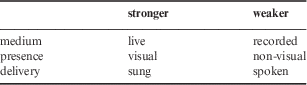
But even at a much simpler level, it will be useful to note some of the diversity of ways we might encounter human voice in an electroacoustic work. Indeed, we can immediately identify three simple sets of oppositions that frequently correspond to strength of associative effect (Table 1).
Voice: contexts and associations.

While these sets are not mutually exclusive – a musical work can certainly mix live and recorded, or sung and spoken voice – in general, the situations in the ‘stronger’ column (particularly when they are combined) are likely to bring more powerful contextual associations for many listeners than those in the ‘weaker’ one.
For example, while we tend to respond rather strongly to the sonic presence of any human voice, for many listeners a singing performer in an acousmatic work immediately attracts considerable additional strong associations with the stage and concert hall. Those additional associations would likely be further strengthened by the visual presence of the performer – and particularly strong when that visual presence is physical or ‘live’ (as distinct from an electronically transmitted visual image).
Michel Chion (Chion and Gorbman Reference Chion and Gorbman1994, Reference Chion and Gorbman1999) has written extensively about his particular conception of the acousmatic voice or acousmêtre (his invented term, meaning ‘acousmatic being’). Most of his analyses are concerned with the role of the acousmêtre in cinema, a medium that provides the opportunity for a powerful interplay between the unseen and the seen. Non-visual media such as electroacoustic music obviously cannot take advantage of that visual interplay, except implicitly through spatial and contextual placement. However, many of the fundamental characteristics of his conception are still very informative about the use of voice in purely sonic contexts.
In particular, Chion’s four-part characterisation of the acousmêtre as ubiquitous, panoptic, omniscient and omnipotent (Chion and Gorbman Reference Chion and Gorbman1999: 24), resonates strongly with the way the human voice seems to dominate an electroacoustic work. In that context, and thanks to our tendency to assign dominance to it, a human voice insistently makes its presence known within the work (ubiquitous), while also frequently occupying, in the listener’s mind, a position that seems to be able to ‘see’ everything that is implicitly happening in the piece (panoptic). With the exception of dramatic contexts where that human voice has been explicitly assigned a subservient role, its disembodied presence is generally presumed to have a circumspect, all-knowing perspective (omniscient). Similarly, unless dramatic construction has dictated otherwise, we generally tend to assign a God-like quality (or at least a secular high-status equivalent) to the presence of any disembodied voice (omnipotent).
Clearly, that domination comes from a complex series of relationships and responses. The perceptual and cognitive details are beyond our scope here, but we can certainly highlight some of the more overt or self-evident factors. We have already noted medium, presence and delivery as important factors with a range of effects, and to that list we certainly must add text and language. But we can also identify other rather more fundamental attributes which, to varying extents, will point the listener to a human origin for sound:
-
∙ formants: the resonances that help identify gender (and individual);
-
∙ pitch: the narrow band (relative to our hearing capability) of fundamental pitches in which the human voice functions;
-
∙ transient content: the identifiable manner in which transients or plosives are produced (and its sonic result);
-
∙ non-transient, non-voiced content: sounds like fff and sss, which can carry strong associations with ‘human’ presence.
This persistence of identification might even be a potential difficulty if we are trying to hide the source of our material, perhaps intending to reveal it at an opportune moment for dramatic effect. But conversely, persistence can be very useful when the composer wishes to anchor the reference to source in the face of relatively extreme processing.
Wishart’s Globalalia again provides a valuable illustration, with the ‘human’ identity of his source materials completely surviving extensive dissection and re-combination. Somewhat similarly, in my own acousmatic work I wish (Naylor 2012b), the vocal material for the entire piece (c.10 minutes) is elaborated from a few breaths, a single phrase (‘I wish’) and two words (‘never, ever’). Establishing a clear human source for the material early in the piece permitted me to engage later in substantial processing, de-construction and re-construction of the vocal materials, with reasonable confidence that the identity of that source would persist throughout.
The tendency of voice to dominate also leads us to an interesting side-question: when an electroacoustic work contains a substantial voice component, is the electroacoustic component ultimately perceived as an accompaniment to the voice? The historic relationship between voice and instrumental music would seem to predispose our listening to assign that soloist-with-accompanist relationship to what we hear, particularly if the vocal material is sung rather than spoken – a situation we will explore in more detail below.
And clearly the answer will, to a great extent, also depend on how the composer has approached the work. For example, Milton Babbitt’s classic voice and tape piece Phonemena (Babbitt 1975) appears to come from a performance tradition where the singer is supported by other musical material (an observation reinforced by the fact that the first version of the piece, in 1969, was scored for soprano and piano).
But, like the persistence of identification discussed earlier, any tendency of the listener to allocate a perceptual hierarchy amongst sonic elements will also be another opportunity for the composer to exploit, and another factor to consider when making compositional decisions.
3.4. Vocal presentation
To accept the constructed reality of a sonic narrative, the listener must maintain a ‘suspension of disbelief’. Visual performance media such as theatre, film and television require a similar suspension, of course. However, in a sonic narrative, even implicitly ‘visual’ elements must be rendered entirely by the listener’s imagination, and in response to input from a single sense – hearing.
That dependency upon sound alone makes the presentation style of voice material arguably even more critical in purely sonic narratives than it is for visual media that also include a sonic component. In the latter, the viewer-listener’s response is already partially shaped by viewing the visual material provided, while in a sound-only work, the listener must rely entirely upon sonic materials to trigger the imagination.
Vocal material might be captured – either by stealth, or with informed subjects behaving (supposedly) naturally. Or it might be deliberately performed for the work – readers, narrators, actors or singers. Captured material raises obvious questions of rights, permissions and propriety – questions that have been considered in other articles (e.g. Blackburn Reference Blackburn2011; Naylor Reference Naylor2014). But performed material attracts its own set of practical considerations for the composer. In particular, the necessary suspension of disbelief can easily be undermined by what listeners may perceive as ‘unnatural’ or ritualistic delivery, relative to everyday speech.
For example, at one extreme, we might find a stage-oriented performer, unfamiliar with (or uninterested in) the intimacy of the microphone, striving for a strong, declamatory delivery that will reach to the back of a hypothetical theatre or hall. In contrast, performers accustomed to working with microphones – or familiar with the relatively naturalistic delivery usually expected for recorded media (film, television, radio drama) – are more likely to deliver a performance that anticipates or encourages a more personal connection between acousmatic source and listener, thus helping to engage the listener’s attention and imagination.
Francis Dhomont’s Forêt profonde (Dhomont 1996) provides an interesting illustration of this potential tension and its successful resolution. The work incorporates narrative readings in seven different languages – a situation that could easily distance all but the most polyglot listener from any sense of the ‘natural’. But Dhomont’s readers combine the intimacy of the microphone with ritualistic storytelling, while the composer frames the recorded texts in a way that both highlights their performed quality and enhances their dramatic impact. The result seems to satisfy the listener’s desire for believability, while still retaining the dramatic effectiveness of a constructed reality.
3.5. Singing
When a sonic narrative includes singing, as distinct from spoken text, it raises interesting additional questions about presentation that the composer must consider. For example, in the context of an electroacoustic composition, is singing received significantly differently from spoken text? How does the presence of other (non-voiced) material influence the effect of singing? And is there a notable difference in reception if the singer is physically present, as in a mixed work? While ‘answers’ to many creative questions are best discovered through practice, it may be instructive to briefly consider two contrasting examples of works where singing plays a significant role.
David Berezan’s 2002 composition Baoding (Berezan 2008) incorporates short vocal materials from Chinese opera (both Beijing and Kun), gesturally energised by the carefully manipulated sounds of physical objects (Baoding balls). We learn from the disc notes accompanying the piece that the vocal material is derived from ‘opera’, but we also quickly become aware that what we are hearing is not conventional Western singing. For many listeners, that awareness will tend to move an identifiable human voice into a relatively abstract ‘place’ where we listen more for its sonic properties than for semantic meaning or performer identity.
These vocal sounds are further distanced from our expectations of ‘singing’ by their partnership with the manipulated sounds of the Baoding balls. In effect, Berezan has used non-vocal sounds to create a sympathetic place for his relatively unfamiliar (to many listeners) vocal materials to reside – thereby softening the impact of their otherwise very strong cultural and performative resonances. At the same time, the gestural motion of the piece, in combination with its clearly defined five-part structure, keeps it well within the realm of non-text sonic narrative.
Our next example takes us in a very different direction. Canadian composer alcides lanza (sic) has created many theatrical works that combine electroacoustic elements with the performance of actress-singer Meg Sheppard. lanza’s 1979 work, ekphonesis V (lanza 1992), is part of a series that the composer describes in the disc notes as ‘an evening of music theatre for actress-singer, electronic sounds and electronic extensions’. With its multilingual texts exploring the composer’s memories, the piece engages the listener in a search for semantic and narrative meaning.
Even with extensive real-time processing of the vocal performance, and the complex fixed medium elements that surround that performance (including some spoken texts), we are still drawn to the presence of a central performer. In part, of course, that is the intention of the piece: it is, after all, a performance work that features a specific performer. But when presented as an audio-only composition on compact disc, all sonic elements theoretically have equal opportunity to ‘compete’ for our attention. And many of those non-performed sonic elements are themselves vocally derived.
The continued domination of the vocalist in the recorded version of this work thus appears to be very closely connected to our broader tendency to pay particularly strong attention to singing, as a unique mode of vocal presentation in an electroacoustic work.
3.6. Accessibility: a personal case study
Our responses to hearing another human voice may be almost universally strong, but the details of those responses are still significantly subjective – and the resulting personalisation of the listener’s experience may not always support the composer’s intentions.
My composition The Thermal Properties of Concrete (Naylor 2012c) focuses upon three human voices. Two of those voices are from interviews with urban planning officials, which, apart from occasional layering, are presented quite naturally. The third and principal voice is a fictional character, performed by Canadian actor Jody Stevens, whose words I scripted to give a human voice (in both senses of the word) to difficult questions about urban disenfranchisement.
In my original version of this work, I filtered Jody’s speech to suggest that she was on a bad telephone line – effectively giving her both physical and psychological distance, and highlighting her character’s disempowerment. In concert performance, the distinction seemed to work well: audience members accepted Jody’s character – and on one occasion even asked me how I had managed to convince her to be interviewed. But when the time came to master the piece for its release on empreintes DIGITALes, I encountered a very different perspective.
Mastering engineer Dominique Bassal (who is fluently multilingual) advised me that he had difficulty understanding many of her character’s words in my filtered version. He also pointed out that the processing made the text of the piece (and by extension the piece itself) generally much less accessible to non-native English speakers.
In response, I decided to use a largely unfiltered version of that central voice for the disc mix. The change compromised my original artistic intention, but I believe it does indeed make the piece more accessible to a broader audience. And that experience still serves as a strong personal reminder that the impact of vocal presentation choices is seldom truly ‘universal’.
3.7. Radio voices: beyond disembodiment
Like other forms of sonic narrative on fixed media, recorded radio programming offers the double disembodiment of sound in both time and space. But in the broader context of the sonic arts, radio also (somewhat confusingly) represents both a medium of propagation and a particular kind of content known as a ‘radiophonic composition’.
A consistent definition of the radiophonic composition is difficult to find: not only is the descriptor frequently used interchangeably with ‘radio art’, but also essays in collections ‘about’ radio art also seem – perhaps wisely – to sidestep the distinction (Kahn and Whitehead Reference Kahn and Whitehead1992; Augaitis, Lander and Walter Phillips Gallery Reference Augaitis and Lander1994).
However, here we will use the term ‘radiophonic composition’ to refer to a sonic art work whose main linkage with radio is that it is largely constructed around narrative voice, but which also extends the conventional, conservative notion of radio as vocal monophony to include the creative possibilities of layerings and multiples of voice, as well as any other appropriate sound material. That definition also embraces a diverse body of work created by artists and experimenters that has only relatively recently been systematically documented (Kahn and Whitehead Reference Kahn and Whitehead1992: 2), but has long existed in a kind of parallel universe alongside commercial radio and its primary orientation towards functional information, mass entertainment and advertising sales.
To help illustrate the diversity of approaches that can be taken towards the use of voice and narrative in a radiophonic composition, let us briefly examine two larger-scale Canadian radiophonic works, created 22 years apart.
The Idea of North was created by the celebrated Canadian pianist and broadcaster Glenn Gould, and commissioned by the Canadian Broadcasting Corporation (CBC) in 1967. The piece made extensive use of contrapuntal and parallel multiple voices, a technique Gould continued in his subsequent works for radio. Gould’s strong credibility with classical music lovers as a pianist helped this work gain wider acceptance with the Canadian radio listening public than such an experimental work might otherwise enjoy.
Although the CBC re-release of The Idea of North on the CD Glenn Gould’s Solitude Trilogy (Gould 1992) described the works as both ‘sound documentaries’ and ‘oral documentaries’, Gould stated quite strongly that these made-for-radio works were music; however, he also called them ‘drama’, and ‘contrapuntal radio’, apparently with equal certainty (Payzant Reference Payzant1984).
In The Idea of North, Gould constructed his polyphonic voice textures from recordings of five interviewees, each representing a different perspective or attitude to the North. The result is at times overwhelming, but he believed that listeners should be able to follow this material no less well than they can follow polyphonic instrumental music. Note that, unlike the next two pieces of the Solitude Trilogy, North was a monophonic work, and therefore the listener is unable to apply any spatial discrimination to assist with the segmentation of the multiple auditory streams (Bregman Reference Bregman1990).
In contrast to Gould’s documentary approach, Montréal-based composer Christian Calon’s 1989 work Minuit (Calon 1990) is an overtly dramatic production, with intoned, stylised performances of scripted texts. Gould’s active, polyphonic vocal material demands focused listening to glean narrative content from his piece, while Calon creates a more immersive narrative environment that relies upon the customary suspension of disbelief of a fictionalised dramatic work to draw the listener in. Additionally, Gould’s voices are all interviewees, albeit with different perspectives to offer, while Calon’s recite his writings in several performed roles, including actor, narrator and storyteller.
Finally, in The Idea of North, Gould’s principal constructed context for his voices is an identifiable physical environment (a moving train car), while the environment for Calon’s Minuit has no clearly implied physical context for the disembodied voices we hear. Other significant differences between these two large-form radiophonic works can be attributed to the time and the context of their production: not only does the 22-year difference between their creation dates correspond to dramatic shifts in available tools for sound production, but we must also remember that Gould’s piece was specifically commissioned for radio broadcast, while Calon’s is part of a tradition of acousmatic concert music.
Taken together, the features and differences that we have identified begin to illustrate how diverse the use of both voice and narrative content in radiophonic works can be – even between compositions that both clearly place vocal narrative at the forefront.
Yet, despite their significant differences – in technical format (monophonic vs stereophonic), vertical structuring (polyphonic layering vs single voices), text content (documentary vs dramatic and fictional) and original intended audience (radio broadcast vs concert hall) – the impact of both works is largely attributable to the power of one common element: the acousmatic human voice.
4. FUTURE PATHWAYS?
As the styles, technologies and content of sonic narratives continue to evolve, so too will both our expectations and our creative responses. And it is clearly impossible to foresee the ultimate pathways of tools, practices or cultural contexts.
But, if only for amusement, let us briefly postulate two possible near-term directions – both of which, we must acknowledge, are only modest extrapolations from currently available tools and procedures:
-
∙ Collectively accessing an interactive interface, audience members fully determine the text content, sequence, spatial characteristics and signal processing of a sonic narrative in performance.
-
∙ With the continuing evolution and implementation of synthesised and/or selectively retrieved human voice, a composer constructs a ‘perfect performer’, infinitely amenable to their detailed voice requirements.
In the first hypothetical situation, the power of voice is taken for granted, with the focus upon an interactive mechanism for determining narrative content and technical characteristics. To some extent, this stance reflects the way we presently respond to acousmatic voice: its capacity to move or affect us is, for the most part, simply taken as a ‘given’, and we will likely reflect more upon the semantic meaning or narrative content received than upon the vocal qualities or the perceptual mechanisms by which that meaning or content is delivered and understood.
In the second, however, the reverse is true: we focus upon the exact qualities of voices that we believe we will need to serve our artistic ends, deliberately choosing perceptual identifiers that suggest age and gender, as well as other characteristics such as tone, pace and accent. We might even choose to have one of our virtual performers sing. Here too, the situation has parallels with current practices: composers already make very deliberate choices about qualities of acousmatic voices used in their sonic narratives (albeit from a rather more constrained palette than that offered by our hypothetical virtual performers).
This is certainly not intended to suggest that sonic narratives cannot (or will not) change. On the contrary, as artistic practices evolve in response to developments in creative and technical resources and to changes in cultural expectations and contexts, new artistic questions will inevitably arise, challenging all sonic artists – not least electroacoustic composers – to continue to be creative and adaptable in their explorations of sonic narrative.
And, as we continue to develop new technologies for presentation and new contexts for artistic expression, the disembodied human voice will continue to offer sonic creators a uniquely powerful, yet remarkably diverse, mechanism for communicating artistic ideas to listeners.