Introduction
Generalist arthropod predators are thought to be poor agents for biological control due to their broad diets and low numerical response relative to their prey (Huffaker and Messenger Reference Huffaker and Messenger1976; Debach and Rosen Reference Debach and Rosen1991). For example, generalist predators often engage in cannibalism or intraguild predation, which may actually release crop pests from predator control (Rosenheim et al. Reference Rosenheim, Wilhoit and Armer1993; Snyder and Ives Reference Snyder and Ives2001; Snyder and Wise Reference Snyder and Wise2001). However, generalists can be effective control agents in concert with specialist parasitoids (Cardinale et al. Reference Cardinale, Harvey, Gross and Ives2003; Snyder and Ives Reference Snyder and Ives2003) or with other generalist predators (Snyder and Wise Reference Snyder and Wise2001; Symondson et al. Reference Symondson, Sunderland and Greenstone2002).
The voracity of a predator towards potential prey items determines if the predator can function as a natural enemy of target pest species (Meyling et al. Reference Meyling, Enkegaard and Brødsgaard2003; Butler and O’Neil Reference Butler and O’Neil2008). Therefore, functional response experiments are often conducted to determine the impact of a predator on target prey populations. Most commonly, a Holling (Reference Holling1959a, Reference Holling1959b) type II functional is fit to experiments on predator feeding rates. However, sigmoidal type III responses may occur when the predation rate increases initially then saturates as prey density increases (Holling Reference Holling1959a). Specialist predators commonly exhibit type II functional responses, while generalist predators often exhibit type III functional responses due to prey switching with changes in prey abundance, changes in capture efficiency of the predator, or fixed and variable costs of foraging (Holling Reference Holling1959a; Anderson and Erlinge Reference Anderson and Erlinge1977; Hansson and Henttonen Reference Hansson and Henttonen1985; Mitchell and Brown Reference Mitchell and Brown1990).
Generalist predators consume several prey species, but predation rate may depend on relative prey densities or preferences for a particular prey species. Predators may exhibit prey preferences because specific prey provide fitness benefits such as increased egg production (Bilde and Toft Reference Bilde and Toft1994), survivorship to adulthood (Venzon et al. Reference Venzon, Janssen and Sabelis2002; Butler and O’Neil Reference Butler and O’Neil2008), and faster development time (Butler and O’Neil Reference Butler and O’Neil2008). If the preferred prey provides fitness benefits, it is expected that lower-quality prey will be consumed only when high-quality prey are scarce (Stephens and Krebs Reference Stephens and Krebs1986).
We determined the predation rate of generalist hemipteran predators of the genus Nabis Latreille (Hemiptera: Nabidae) on two leafhopper pests of red clover (Trifolium pratense Linnaeus; Fabaceae) and other legume forage plants. Both Agallia constricta Van Duzee (Hemiptera: Cicadellidae) and Ceratagallia agricola (Hamilton) (Hemiptera: Cicadellidae) are abundant in red clover. Previous functional response experiments using nabids have reported a type II response to insect prey (Propp Reference Propp1982; Flinn et al. Reference Flinn, Hower and Taylor1985; Ma et al. Reference Ma, Li, Keller and Ren2005). Therefore, we hypothesised that the predation rate of nabids would also increase with prey density until a saturation density was reached, resulting in a type II functional response for nabids to both leafhopper species. We also determined if Nabis species preferred to feed on one leafhopper species versus the other. There were no a priori predictions on leafhopper preferences by Nabis due to the scarcity of published literature on these two leafhopper species. Previous work at our study site, however, showed that A. constricta reaches the highest densities, by far, of any herbivore in red clover (Schroeder Reference Schroeder2007; Haynes and Crist Reference Haynes and Crist2009; Stasek Reference Stasek2009) suggesting this herbivore might be preferred if prey selection depends on prey abundance.
Materials and methods
Study species
Insects were collected from clover, soybean (Glycine max Linnaeus; Fabaceae), and goldenrod (Solidago Linnaeus Asteraceae) fields at the Miami University Ecology Research Center, Oxford, Ohio, United States of America during the summers of 2007 and 2008. Ceratagallia agricola uses red clover as its preferred host plant and develops from nymph to adult in 18–43 days (Black Reference Black1936; Watkins Reference Watkins1941; Hamilton Reference Hamilton1998). Agallia constricta is a generalist leafhopper known to consume legumes (Fabaceae) and grasses (Poacea) (LaHue Reference LaHue1936; Black Reference Black1944; Nielson Reference Nielson1968). The development time for this species is not known. Agallia constricta is most abundant in late June and July, while C. agricola is most abundant in August and September at our field site (Schroeder Reference Schroeder2007). Leafhoppers will escape from approaching predators by jumping or walking away (Larsen et al. Reference Larsen, Heady and Nault1992).
Nabis species are polyphagous predators that prey on multiple invertebrate taxa including leafhoppers, aphids (Hemiptera: Aphididae), and plant bugs (Hemiptera: Miridae) (Lattin Reference Lattin1989; Östman and Ives Reference Östman and Ives2003). Nabids are diurnal, folivorous predators that actively forage for prey using chemoreception and vibrations (Donahoe and Pitre Reference Donahoe and Pitre1977; Irwin and Shepard Reference Irwin and Shepard1980; Braman and Yeargan Reference Braman and Yeargan1989, Reference Braman and Yeargan1990; Schotzko and O’Keeffe Reference Schotzko and O’Keeffe1989; Freund and Olmstead Reference Freund and Olmstead2000). Development time from nymph to adult ranges from 24 to 31 days (Nadgauda and Pitre Reference Nadgauda and Pitre1986). Nabids are common in many types of agricultural systems such as soybean, alfalfa (Medicago sativa Linnaeus; Fabaceae), and lentils (Lens culinaris Medik; Fabaceae) (Irwin and Shepard Reference Irwin and Shepard1980; Braman and Yeargan Reference Braman and Yeargan1989, Reference Braman and Yeargan1990; Schotzko and O’Keeffe Reference Schotzko and O’Keeffe1989). Two species of nabids occurred at our study site, Nabis americoferus (Carayon) and N. roseipennis Reuter, though it was not possible to differentiate between species in the field. We randomly collected nabids of both species from the field for use in our experiments rather than using a single species of nabid. This allowed us to assess the predation rate of nabids commonly found in red clover on leafhopper pests and the possibility of nabids serving as natural enemies of leafhoppers. While it is possible there may be confounding effects of species, previous work has indicated these effects are likely negligible (see Östman and Ives Reference Östman and Ives2003).
Functional response of Nabis species and leafhopper survival
We documented the functional response of Nabis species preying on the two species of leafhoppers in experimental mesocosms during the summer of 2007. Trials were conducted outdoors at the Miami University Ecology Research Center (39.531077°N, 84.723440°W; Oxford, Ohio, United States of America). This allowed us to document the functional response of Nabis in a more natural setting than previous functional response studies of nabids (see Propp Reference Propp1982; Wiedenmann and O’Neil Reference Wiedenmann and O’Neil1990; Ma et al. Reference Ma, Li, Keller and Ren2005). Medium red clover was grown from seed in 25 cm diameter by 12 cm deep pots. Pots were placed in an open field with full sun and watered regularly. A single pot was then placed in a 31×31×31 cm wire-frame cage covered by “no-see-um” netting (BioQuip Products, Rancho Dominguez, California, United States of America).
Before the introduction of experimental insects, cages were sprayed with organic pyrethrin insecticide to eliminate any arthropods present in the top soil or clover. Cages were sprayed in an open field with full sun. Three days after spraying, leafhoppers were introduced into mesocosms. Pyrethrin insecticides degrade rapidly in sunlight and air with half-lives not exceeding three hours (Antonious Reference Antonious2004; Angioni et al. Reference Angioni, Dedola, Minelli, Barra, Cabras and Caboni2005). After three days, <0.05 μg of pesticide residue remains on 1 g of tomato and pepper plant leaves (Antonious Reference Antonious2004), while pyrethrins were undetectable one day after spraying on peach (Prunus persica (Linnaeus) Batsch; Rosaceae) fruits (Angioni et al. Reference Angioni, Dedola, Minelli, Barra, Cabras and Caboni2005). While no studies have examined the half-lives of pyrethrin insecticides on red clover, we are confident that the minimal amount of pesticide residue that remained on clover leaves did not influence our results.
Five densities of leafhoppers were used to determine the saturation point of feeding: 10, 20, 40, 60, or 80 adult leafhoppers were added to the enclosure cages. Five replicates were used per treatment. Adult nabids were fed to satiation and food-deprived for two days to standardise hunger levels (Propp Reference Propp1982; Walker and Rypstra Reference Walker and Rypstra2001, Reference Walker and Rypstra2002). One nabid was added per cage one day after the leafhoppers. After 24 hours, cages were sampled with a portable vacuum to determine the number of leafhoppers eaten. Cages were sampled for an additional two minutes after the last leafhopper was removed to ensure that we had removed all surviving leafhoppers. For A. constricta, surviving leafhoppers were returned to the cage from which they were sampled. Cages were resampled daily for an additional four days. It was not possible to conduct sampling with C. agricola after 24 hours due to heavy rain in the Oxford, Ohio area over the next several days.
Prey preference
To determine if nabids fed preferentially on one species of leafhopper, we conducted a laboratory experiment in the summer of 2008 using cylindrical mesocosms made from clear plastic bowls containing transplanted red clover and covered with “no-see-um” netting. Mesocosms were 18 cm in diameter by 24 cm high. The experiment was conducted in a room with multiple windows that provided ample natural light. No artificial lighting was used during the course of the experiment. The ratio of light:dark was 14.5:9.5 hours, and the room temperature was 22 °C with 65% relative humidity. Total leafhopper densities were the same as in the functional response experiment (10, 20, 40, 60, 80), but a 50:50 ratio of A. constricta: C. agricola was used in each mesocosm to determine preference. Nabids were food-deprived for two days, and added to the mesocosms one day after the leafhoppers. Five replicates were used at each density. Mesocosms were vacuum-sampled one day after nabids were added to determine the number of each species eaten.
Only female nabids were used in this experiment because females are more voracious than males (Lingren et al. Reference Lingren, Ridgway and Jones1968; Donahoe and Pitre Reference Donahoe and Pitre1977; Propp Reference Propp1982; Ma et al. Reference Ma, Li, Keller and Ren2005). This is likely due to the extra energy required for egg production, which has been documented in both insects (Chapman Reference Chapman1971) and spiders (Walker and Rypstra Reference Walker and Rypstra2001, Reference Walker and Rypstra2002). It is also possible that male and female nabids differ in their consumption rates to maximise fitness. Males maximise their fitness by consuming less than females in order to maximise the time spent searching for a mate, and females maximise their fitness by maximising consumption to acquire energy needed for reproduction (Schoener Reference Schoener1971). This behaviour has been observed in spiders (Givens Reference Givens1978; Walker and Rypstra Reference Walker and Rypstra2001) but is unknown in nabids.
Statistical analysis
The shapes of the functional response curves were determined using logistic regression, treating the proportion of prey consumed as a function of prey density. This is the preferred method of distinguishing between type I, II, and III functional response curves (Trexler et al. Reference Trexler, McCulloch and Travis1988; Juliano Reference Juliano2001). Polynomial logistic regression models were fit to the data using the generalised linear model (glm) function in R (R Development Core Team 2009), and the best-fitting model (type I, II, or III) was determined by likelihood ratio tests of the model parameters (Juliano Reference Juliano2001). The model with the lowest Akaike’s information criterion (AIC) was selected as the best-fitting model. Models where the Akaike’s information criterion values differed by two or less were considered competing models and equally predictive (Burnham and Anderson Reference Burnham and Anderson2002). The parameters of the best-fitting functional response model were then estimated using integrated Roger’s equations, which incorporate the effects of prey depletion using nonlinear least squares regression (Rogers Reference Rogers1972; Juliano Reference Juliano2001; PROC NLIN, SAS Institute 2003). One replicate in the 60-A. constricta/cage treatment was removed as an outlier in all analyses based on the plot of the standardised residuals against the fitted values. Following determination of type III functional responses, the response of the damsel bugs was further explored using the Roger’s type III equation. The Rogers’ type III functional response showed a linear increase in attack rate with prey density, bN 0, with intercepts (d) and asymptotes (c) in attack rates that were not significantly different from zero (Juliano Reference Juliano2001). Hence, the Rogers’ type III equation (Juliano Reference Juliano2001 eq. 10.5) simplifies to:
 $$N_{e} {\equals}N_{0} \left[ {1{\minus}e^{{\left( {bN_{0} } \right)\left( {hN_{e} {\minus}T} \right)}} } \right]$$
where N e is the number of prey eaten, N 0 the initial prey density, b the coefficient for change in attack rate a with prey density (a=bN 0), h the handling time (h), and T the duration of experiment (24 hours). As the response variable appears on both sides of the equation, the least squares estimates of parameters b and h must be obtained implicitly by iteration (Juliano Reference Juliano2001).
Prey preference was determined using the α-vector preference metric (Chesson Reference Chesson1983):
 $$\alpha {\equals}{{\ln \left[ {\left( {n_{i}{\minus}r_{i}} \right)\,/\,n_{i}} \right]} \over {\mathop{\sum}\limits_{i{\equals}1}^m {\ln \left[ {\left( {n_{j}{\minus}r_{j}} \right)\,/\,n_{j}} \right]} }}\ i{\equals}1,2,m{\equals}2$$
where α is the proportion of species i in the nabid’s diet if both leafhopper species are equally present, n i the initial number of individuals of leafhopper species i present, r i the number of leafhoppers of species i eaten by the nabids, n j the initial number of leafhopper species j present, and r j is the number of leafhopper species j eaten. This preference metric assumes leafhoppers are being depleted by the predator and are not being replaced. The difference between A. constricta and C. agricola preference metrics at each density were analysed to determine if nabids displayed a preference for a particular species of prey across prey densities using a multivariate analysis of variance (Crist and MacMahon Reference Crist and MacMahon1992; Arthur et al. Reference Arthur, Manly, McDonald and Garner1996) in the SAS GLM procedure (SAS Institute 2003). The prey preference metrics for each species at each density were the response variables. Models were run with and without density as a predictor variable to determine if a preference existed when the effect of density was removed. As in the separate prey experiments, we determined the shape of the functional response curves for both species using logistic regression (Trexler et al. Reference Trexler, McCulloch and Travis1988; Juliano Reference Juliano2001), and we estimated parameters of the best-fitting functional response models using the integrated Roger’s equations (PROC NLIN, SAS Institute 2003).
The functional response analysis was confined to a 24-hour observation period. We further examined the role of predation on A. constricta survival over the course of five days using failure-time analysis (Fox Reference Fox2001) to examine the cumulative effects of predation as prey is depleted. While we intensely sampled the mesocosms to remove all surviving leafhoppers, it is possible that a few leafhoppers may have not been removed due to finding refuge in the clover. Failure-time analysis allows for the possibility that some leafhoppers may not be recovered alive or dead at a given sampling period (right-censored data; see Kalbfleisch and Prentice Reference Kalbfleisch and Prentice1980 and Fox Reference Fox2001 for further discussion).
Leafhopper survivorship was calculated for each density using the estimated cumulative survival function (PROC LIFETEST, SAS Institute 2003). Differences in survivorship curves were analysed using the Wilcoxon statistic and covariance matrix to calculate Z-statistics for a pairwise comparison of each density (Fox Reference Fox2001).
Results
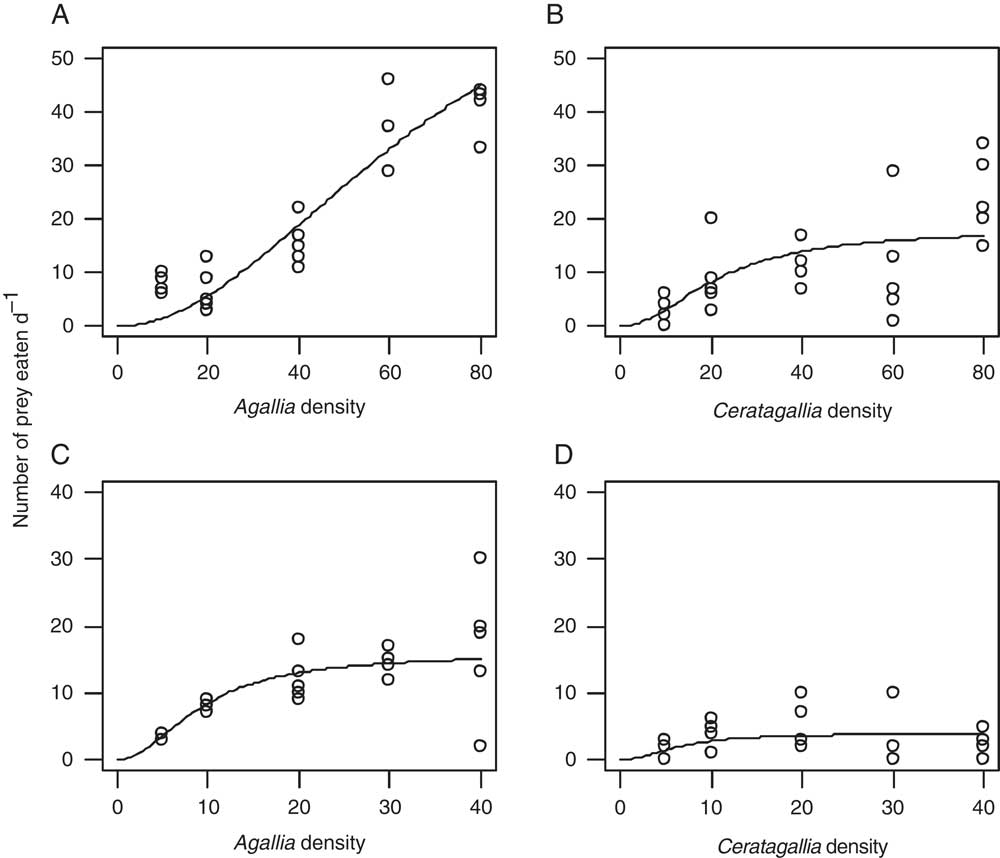
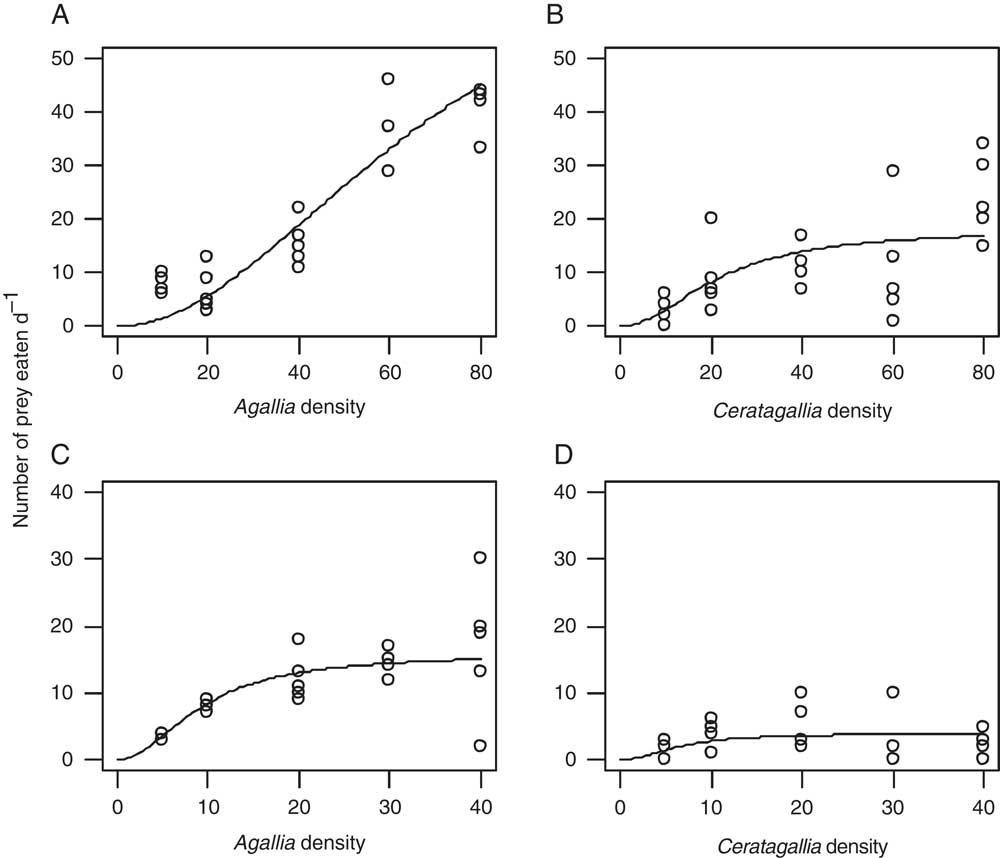
For the leafhopper A. constricta, the logistic regression analysis of the proportion of prey eaten by nabids against prey density showed that a type III functional response was the best-fitting model (AIC=1335; Table 1) compared with a type I curve (AIC=1373) and a type II curve (AIC=1369). Saturation of the type III functional response curve was not obtained over the range of densities used in the experiment (Fig. 1A). Handling time was estimated to be 0.25 hours per prey item. Nabid attack rates varied with prey density such that attack rates increased as A. constricta density increased (0.008–0.066 prey/hour). For C. agricola, logistic regression of the proportion of prey eaten also supported a type III response as the best-fitting model (AIC=1217; Fig. 1B) compared with type I (AIC=1240) and type II (AIC=1239) functional response curves. Handling time of C. agricola was estimated to be 0.73 hours per prey item. Attack rates again increased with prey density (0.005–0.038 prey/hour) but were generally lower than A. constricta.
The functional response of Nabis species to (A) Agallia constricta and (B) Ceratagallia agricola when only one prey item was present and when (C) Agallia constricta and (D) Ceratagallia agricola were present together in a 50:50 ratio.
Akaike’s information criterion values for type I, II, and III functional response models and functional response parameters of Nabis feeding on Agallia constricta and Ceratagallia agricola in single species and prey preference experiments.

The logistic regression analysis showed that a type III functional response was the best-fitting model for A. constricta in the mixed-prey experiment (AIC=701; Table 1; Fig. 1C) compared to a type I curve (AIC=728) and a type II curve (AIC=700). The type II model is a competing model with the type III model. Thus, both models are equally predictive. We selected the type III model as the best-fitting model to facilitate comparisons between the parameters of the functional response models for A. constricta and C. agricola. The handling time was estimated to be 1.43 hours, and attack rates increased with prey density (0.051–0.408 prey/hour). Saturation occurred when ~17 A. constricta were consumed. For C. agricola, logistic regression determined that nabids displayed a type III response (AIC=406; Fig. 1D) compared with a type I curve (AIC=443) and a type II curve (AIC=409). Handling time was estimated to be 6.33 hours per C. agricola, while attack rates increased with prey density (0.061–0.489 prey/hour).
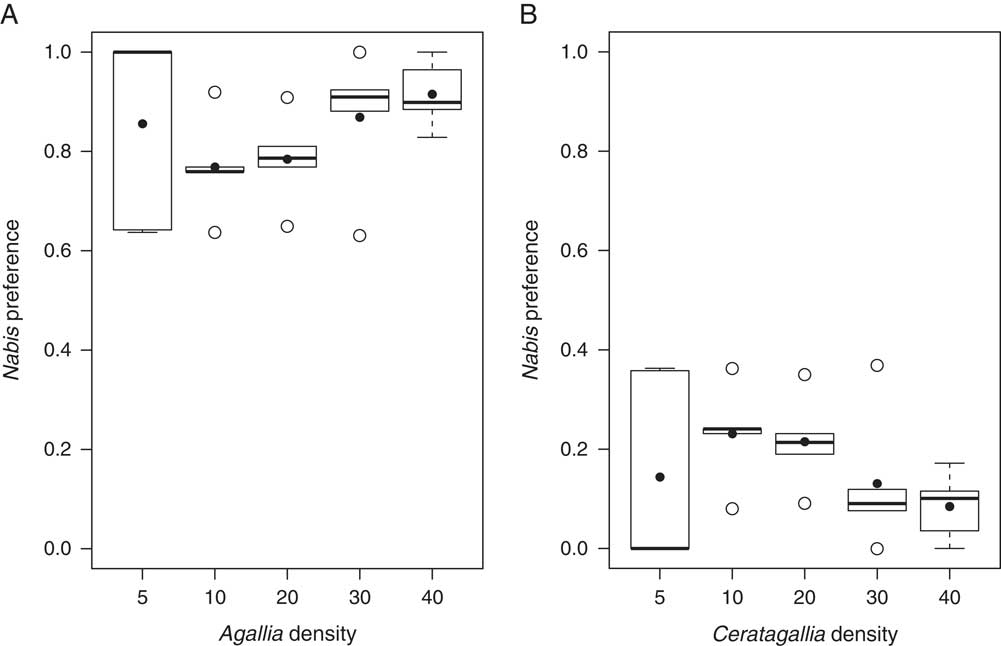
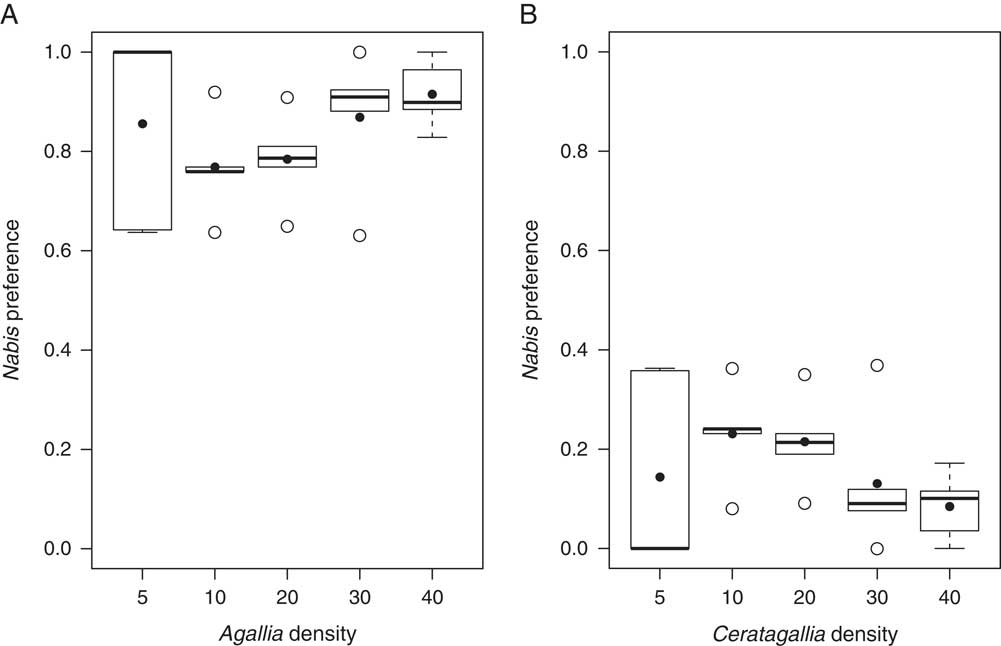
The mean α-preference metric for A. constricta was 0.78±0.24 (standard deviation), while the mean α-preference metric for C. agricola was 0.22±0.13. Multivariate analysis of the α-preference metric showed that nabids preferred A. constricta at all densities (Wilks’ λ=0.1230, df=1, P<0.0001, Fig. 2A, 2B). There was no effect of leafhopper density on nabid preference for A. constricta (Wilks’ λ=0.8148, df=1, P=0.3679).
The Chesson α-preference metric of Nabis species for (A) Agallia constricta and (B) Ceratagallia agricola at five densities (n=5). The edges of the boxes represent the 25th and 75th percentiles, the dark circle represents the mean, the dark line indicates the median, and the whiskers represent the highest and lowest preference metrics, excluding outliers.
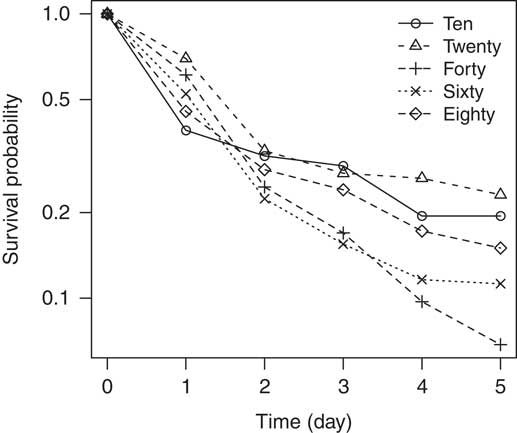
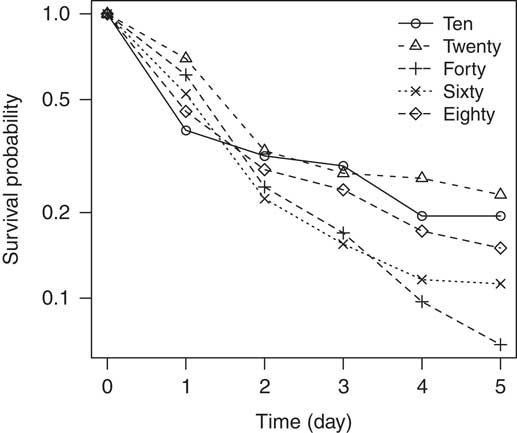
Despite a consistent preference for A. constricta over C. agricola in the short-term experiments, the survival probability of A. constricta varied across prey densities during five days (Fig. 3). The 20-A. constricta/cage treatment had a significantly higher survival probability over the course of the experiment than the 10-A. constricta/cage (Z=3.08, df=4, P=0.00103), 60-A. constricta/cage (Z=2.54, df=4, P=0.00550), and 80-A. constricta/ cage treatments (Z=3.03, df=4, P=0.00120). The 40-A. constricta/cage treatment also had a lower survival probability than the 80-A. constricta/cage treatment (Z=1.88, df=4, P=0.0300).
Survival probability of Agallia constricta exposed to one predator over a five day period. Treatments are the number of leafhoppers per mesocosm.
Discussion
The observed functional responses of nabids to both leafhopper species were contrary to our predictions. While we predicted nabids would display a type II functional response, they displayed a type III response to both species in the single-prey experiments. Previous functional response experiments using nabids have reported a type II response (Propp Reference Propp1982; Flinn et al. Reference Flinn, Hower and Taylor1985; Ma et al. Reference Ma, Li, Keller and Ren2005). However, type III responses have often been reported for generalist predators as a result of one prey type being exploited due to a higher abundance, an increased capture efficiency by the predator, or fixed and variable costs of foraging (Holling Reference Holling1959a; Anderson and Erlinge Reference Anderson and Erlinge1977; Hansson and Henttonen Reference Hansson and Henttonen1985; Mitchell and Brown Reference Mitchell and Brown1990). Our results indicate nabids have a high capture efficiency towards both leafhopper species, especially A. constricta. In the field, a density-dependent prey switching strategy may be beneficial to nabids. Agallia constricta and C. agricola peak seasonal abundances do not overlap, and both leafhoppers differ in their phenology and spatial aggregation from aphids, plant bugs, and other Hemiptera (Haynes and Crist Reference Haynes and Crist2009; Stasek Reference Stasek2009). Nabids might be consuming leafhoppers and other prey species at low densities, but as A. contricta and C. agricola populations increase, nabids may switch exclusively to the leafhoppers (see Östman and Ives Reference Östman and Ives2003). Nabids may be better able to detect these two leafhoppers species through chemical cues and having a higher capture efficiency of the leafhoppers compared with other prey.
Nabids also showed preference for A. constricta when presented with both species of prey in a 50:50 ratio. Nabids again displayed a type III response to both A. constricta and C. agricola in the preference experiment, though a type II response was a competing model for A. constricta. The handling time was lower for A. constricta compared with C. agricola in both the preference and single-species experiments. The handling times for both leafhopper species were higher in the preference experiment compared with the single-species functional response experiments. Nabids have been documented handling a prey item for more than an hour (Propp Reference Propp1982) and longer than three hours (Flinn et al. Reference Flinn, Hower and Taylor1985). However, it is unknown why there was an increase in the handling time for both species of leafhopper in the preference experiment compared with the single-species functional response experiments.
The exact mechanism for the preference of nabids to A. constricta is not known. C. agricola may be harder for nabids to manipulate once caught, as suggested by the longer handling time. Ceratagallia agricola may also be able to detect an approaching nabid sooner than A. constricta and leap or fly more quickly to escape predation, or C. agricola may release or sequester chemicals for defense. These ideas could be tested by making behavioural observations of nabids and leafhoppers in mesocosms with minimal plant material to observe leafhopper behaviour when they encounter a nabid. Detailed observations such as these were not possible given the density of red clover in our mesocosms.
Another possible reason for Nabis species preferring A. constricta is that A. constricta may be more nutritious than C. agricola. Arthropod predators select prey to correct for nutrient deficiencies (Mayntz et al. Reference Mayntz, Raubenheimer, Salomon, Toft and Simpson2005). Therefore, A. constricta may provide nabids with nutrients that are deficient in other prey species, which could result in fitness benefits to nabids such as increased egg production, survivorship to adulthood, and faster development time. If consumption of A. constricta results in higher fitness, it is expected that C. agricola and other prey items will be consumed only when A. constricta are scarce, in accordance with optimal foraging theory (Stephens and Krebs Reference Stephens and Krebs1986). This idea could be tested by determining the protein, lipid, and carbohydrate content of both species of leafhoppers as well as the nutritional deficiencies of the nabids before and after starvation.
Nabids may also have engaged in superfluous, or wasteful, killing when A. constricta was the prey item. The 60-density and 80-density treatments were higher than observed densities in the field (Stasek Reference Stasek2009). At these high prey densities, nabids may have engaged in superfluous killing and only partially consumed their prey. This behaviour is observed in a variety of taxa including spiders (Maupin and Riechert Reference Maupin and Riechert2001), zooplankton (Conover Reference Conover1966), and damselflies (Odonata) (Johnson et al. Reference Johnson, Akre and Crowley1975). Different parts of the prey item may be of differing quality with the most nutritious parts eaten first (Cook and Cockrell Reference Cook and Cockrell1978; Givens Reference Givens1978; Formanowicz Reference Formanowicz1984). The viscosity of prey parts may also increase as feeding continues. Thus, it would be more difficult for predators that engage in extra-cellular digestion of their prey, which is the feeding method used by all heteropteran predators (Cook and Cockrell Reference Cook and Cockrell1978; Pollard Reference Pollard1989; Cohen Reference Cohen2000), to feed on the same prey item for a prolonged period of time. If superfluous killing is occurring at high prey densities with only the most nutritious prey parts consumed, this may lead to a lack of saturation in feeding rate as A. constricta density increased. Superfluous killing would increase pest mortality, so if nabids are engaging in superfluous killing, it would help to further suppress leafhopper populations. These ideas could be tested using mesocosms with minimal plant material to permit more detailed observations of nabid predation rates. Given the density of red clover and the soil substrate of our mesocosms, it was not possible to find the desiccated carcasses of consumed leafhoppers.
The survival probabilities at the 60-A. constricta and 80-A. constricta/cage treatments after five days were significantly lower than the 20-A. constricta/cage treatment and were also lower than the 10-A. constricta/cage treatment, though this result was not significant. As prey abundance in all density treatments decreased over time due to predation, the searching efficiency of the nabids likely decreased as well. Therefore, it is not surprising that the two lowest density treatments had the highest survival probabilities after five days as the proportion of prey remaining in the low-density treatments was lower than in the high-density treatments. The few remaining A. constricta in the low-density treatments may have been able to find refuge among the clover and avoid being detected. Nabids search for prey using chemoreception (Freund and Olmstead Reference Freund and Olmstead2000), but at low abundances of prey, it may be difficult for nabids to detect the few surviving A. constricta in the 10-A. constricta and 20-A. constricta/cage treatments. At high A. constricta densities, nabids were able to significantly reduce A. constricta survival probabilities over the course of five days. Therefore, nabids may be able to act as biological control agents for A. constricta.
This study has broader applications to agriculture as red clover is often planted as a forage or cover crop, and both leafhopper species are common pests of red clover. Nabids are common in many agroecosystems (Irwin and Shepard Reference Irwin and Shepard1980; Lattin Reference Lattin1989), and thus may function as natural enemies of leafhoppers, possibly in concert with other predatory arthropods such as jumping spiders (Araneae: Salticidae), wolf spiders (Araneae: Lycosidae), orb-weaving spiders (Araneae: Araneidae), and carabid beetles (Coleoptera: Carabidae). Functional response experiments are often the first step in determining if an organism is a candidate for biological control (Meyling et al. Reference Meyling, Enkegaard and Brødsgaard2003). Our study has demonstrated that nabids are voracious predators of A. constricta and C. agricola, with a preference for A. constricta. However, nabids have a lower numerical response than their leafhopper prey (Nadgauda and Pitre Reference Nadgauda and Pitre1986), and nabids will also feed on other arthropods in crop fields, such as aphids (Lattin Reference Lattin1989). These two factors may potentially hinder their use as a biological control agent for leafhoppers. Nabids themselves will also be preyed upon by carabid beetles and wolf spiders (Snyder and Wise Reference Snyder and Wise2001), both of which are also common in red clover. If intraguild predation is common among predatory arthropods in red clover, it may dampen any trophic cascades that are present (Finke and Denno Reference Finke and Denno2003, Reference Finke and Denno2004, Reference Finke and Denno2005).
Establishing the voracity of nabids for leafhopper pests is the first step in incorporating nabids into biological control programmes. Further steps include assessing the impact of nabids on multiple pest populations, such as aphids and plant bugs, simultaneously. Experiments must also be conducted in the field over multiple generations to assess the ability of nabids to function as natural enemies of pest populations. Finally, it must be determined the extent to which nabids are the targets of intraguild predation. While nabids have a broad diet and low numerical response relative to pest populations (Nadgauda and Pitre Reference Nadgauda and Pitre1986), their high predation rates on A. constricta and C. agricola may be able to help control these pest populations in concert with other generalist and specialist predators.
Acknowledgements
The authors thank Ann Rypstra, Bruce Steinly, Hank Stevens, and Mike Vanni for their insightful comments and suggestions on the manuscript. They also thank Rodney Kolb and the staff of the Miami University Ecology Research Center for all of the valuable help they gave in the field. This research was funded by the Miami University Zoology Summer Field Workshop.