




No CrossRef data available.
Verb inflections and noun phrase morphology in the spontaneous speech of Spanish-speaking children with specific language impairment
Published online by Cambridge University Press: 03 May 2005
Abstract
Spanish-speaking preschoolers with specific language impairment (SLI) were compared to typically developing same-age peers (TD-A) and younger typically developing children matched for mean length of utterance (TD-MLU) in terms of their use of grammatical morphology in spontaneous speech. The children with SLI showed high levels of accuracy on present tense and past tense (preterite) verb inflections. However, their use of definite articles and direct object clitics was significantly more problematic than for either the TD-MLU or the TD-A children. Substitutions and omissions were observed, especially in contexts requiring plural articles and clitics. Many of the details of the observed Spanish SLI profile were predicted by Wexler's (Extended) Unique Checking Constraint (EUCC) proposal. Remaining details in the data could be accommodated by making additional assumptions within the same general linguistic framework as the EUCC. Some of the differences between the findings from Spanish and those from previous studies on related languages such as Italian suggest the need for clinical assessment and intervention procedures that are shaped as much by language-specific details as by the language's typology.
Information
- Type
- Articles
- Information
- Copyright
- © 2005 Cambridge University Press
In the past 5 years, there has been growing interest among researchers in the pattern of strengths and weaknesses seen in children with specific language impairment (SLI) who are acquiring Spanish. It is likely that two benefits will accrue from such attention. First, data from Spanish-speaking children with SLI will probably help shape both the clinical assessment procedures used with these children and the choice of language targets emphasized during intervention. Second, as a Romance language with certain unique characteristics, Spanish serves as an important testing ground for some of the recent proposals concerning the basis of grammatical deficits in SLI.
A recurring theme in work on the language of Spanish-speaking children is the challenge of accurately identifying children with language impairment (e.g., Anderson, 1996; Bedore & Leonard, 2001; Jacobson & Schwartz, 2002; Restrepo, 1998). In part this task is challenging because there may be a mismatch between the testing tasks and the language experiences of young Spanish-speaking children (e.g., Anderson, 1996; Peña & Quinn, 1997). Of equal importance, however, is the inclusion of content on language tests that does not effectively discriminate the skills of children with and without language impairment. Work based on the spontaneous speech characteristics of English-speaking children suggests that children can be classified with high levels of accuracy according to their use of particular grammatical morphemes, such as past -ed, third person singular -s, and copula and auxiliary is and are (e.g., Bedore & Leonard, 1998; Rice, Wexler, & Hershberger, 1998). Review of available Spanish language tests (e.g., Preschool Language Scale-4, Spanish Edition; Zimmerman, Steiner, & Pond, 2002; CELF-3 Spanish edition; Semel, Wiig, & Secord, 1997) suggests these assessments focus more heavily on vocabulary and propositional content and to a lesser extent on morphosyntax, an area likely to differentiate the language skills of children with language impairments. Thus, work that focuses on grammatical acquisition may ultimately contribute to the development of assessment protocols that include those types of items that might be especially difficult for Spanish-learning children.
A review of the literature suggests that, although much attention has been focused on general intervention issues for Spanish-speaking children, interventions focusing on morphosyntax have received minimal attention. Instead, intervention studies have emphasized the choice of the language to be used during treatment. For example, Perozzi and Sanchez (1992) explored the carryover effects of teaching pronouns and prepositions in a child's first language versus in their second language. Clearly, a more extensive database on the nature of the morphosyntactic difficulties of Spanish-speaking children with SLI will inform best practices for grammatical intervention with these children.
Data are also needed to evaluate recent theoretical accounts concerning the nature of SLI in a language such as Spanish. In this paper, we employ data from Spanish-speaking children with SLI to assess a recent proposal by Wexler (1998, 2003) that is designed to extend his original hypotheses about SLI to a wider range of languages, including Spanish.
We begin with a brief sketch of some of the relevant details of Spanish morphosyntax, followed by a review of the empirical findings from Spanish-speaking children with SLI. We then provide a description of Wexler's (1998, 2003) proposal. In the remainder of the paper, we report a study of the grammatical details of the spontaneous speech of Spanish-speaking children with SLI and interpret the results relative to previous findings as well as the predictions based on Wexler's account.
SOME DETAILS OF SPANISH MORPHOSYNTAX
Spanish is a Romance language. In Spanish, noun and verb morphology carry important information in conveying sentence meaning. It is a pro-drop language and has relatively free word order. Thus, subject noun phrases need not be overtly realized if the context is sufficiently clear. Finite and nonfinite verb forms are distinctively marked in Spanish. Verbs, marked for number and person, help make context clear. In addition, verbs are marked for tense, aspect, and mood. Nouns are marked for number and gender; determiners and adjectives agree in number and gender with the noun that they modify. Spanish also makes use of a variety of clitics including direct and indirect object clitics. Below we discuss the grammatical features of interest in the current study.
In Spanish, verbs are marked for number and person as well as for tense, aspect, and mood as can be seen in Appendix A. In Mexican Spanish, the dialect of interest, singular and plural forms are distinctly marked. In addition, Mexican Spanish makes frequent use of the familiar second person form (tú), which has a distinct verbal conjugation. Of particular interest in the current study was the present/preterite distinction. In Mexican Spanish the present tense is preferred for the description of current events whereas the preterite is used to mark complete events (Butt & Benjamin, 1998; Munguía Zatarain, Munguía Zatarain, & Rocha Romero, 1998). Given the distinctions among verb inflections in both tense and agreement, linguists studying Spanish propose that the grammar of the language possesses separate projections for the functional categories of tense (TNS) and agreement (AGR; D'Introno, 2001; Zagona, 2002).
In addition to forms marked for tense and agreement (as well as aspect and mood), Spanish makes use of a distinctive infinitive form. This form carries an -ar, -er, or -ir ending as seen in the first row of Appendix A. Infinitives are used in a number of verb constructions such as the periphrastic future (Voy a correr, I'm going to run) and in complex constructions (quiero ver la tele, I want to watch tv). The infinitive form can also be used to name an action such as correr es divertido (running is fun) and in some informal commands such as a dormir ([get] to sleep!).
Prosodically, verb marking is more salient in Spanish than in English. In all cases verbal inflections are syllabic forms (e.g., habla) or multisyllabic forms (hablamos). In the case of preterite forms the main stress of the verb falls on the inflectional marker (e.g., habló, hablaron).
Direct object clitics such as lo in lo compró (it masculine singular bought 3rd person singular preterite) are also used in Spanish. Direct object clitics are associated with the verb phrase as they originate in the predicate noun phrase and are phonologically dependent on the verb (D'Introno, 2001; Zagona, 2002). Direct object clitics are placed in preverbal position, as in the example above, when a tensed verb form is used or can occur in the postverbal position when the verb is not tensed, as in the construction with an infinitive (Quise comprarlo, [I] wanted to buy it) or with an imperative form (Cómpralo, buy it). The use of the direct objects (clitics or the full noun phrase) is only obligatory for transitive verbs (Zagona, 2002), and clitics are used when the pragmatic context permits pronominalization. Direct object clitics must agree in number and gender with the noun they replace; thus, there are four forms: lo (masculine singular), la (feminine singular), los (masculine plural), and las (feminine plural).
The noun plural marker in Spanish is an -s for words ending in vowels (e.g., carros) and an -es for words ending in consonants (e.g., panes). These forms are relatively low in salience given that an /s/ is used to mark the plural form but not, for example, as low in salience as the English forms that often result in word-final consonant clusters (e.g., trucks).
In Spanish, the elements of the noun phrase must agree in gender and number marking. Some accounts of gender agreement suggest that gender agreement and number agreement both require the addition of overt affixes whereas others indicate that only number is represented by an overt affix (Bosque & Picallo, 1996; D'Introno, 2001; Zagona, 2002). Determiners such as definite and indefinite articles must agree in number and gender with the noun that they modify. Definite articles are monosyllabic forms that are phonologically joined with the nouns they modify (or in some cases to an adjective). Generally, definite articles are used more frequently in Spanish as compared to English. For example, an utterance like “Tigers eat meat” is realized in Spanish as Los tigres comen carne (Munguía Zatarain et al., 1998; Zagona, 2002).
A REVIEW OF THE EMPIRICAL FINDINGS
In a recent study, Bedore and Leonard (2001) examined some of the details of grammatical morphology used by Spanish-speaking preschoolers with SLI using a task in which children described pictures and completed sentences that obligated the use of particular grammatical targets. Typically developing children matched for age (TD-A) and younger typically developing children matched for mean length of utterance (TD-MLU) also participated. The results indicated that the Spanish-speaking children with SLI were as accurate in using present and past tense (preterite) inflections as the younger TD-MLU children and differed from their TD-A peers on only three of the eight verb inflections examined. In contrast, the children with SLI had more difficulty than both the TD-MLU and the TD-A children in the use of direct object clitic pronouns, adjective agreement inflections, and noun plural inflections. Comparison among the three groups' use of articles revealed a significant difference between the children with SLI and the TD-A children. However, an observed numerical difference between the children with SLI and the TD-MLU children did not achieve statistical significance.
Studies of article and clitic use by Spanish-speaking children with SLI were recently reported by other investigative teams. Bosch and Serra (1997) found that school-age children with SLI were less accurate in using articles than were a group of TD-A children. Eng and O'Connor (2000) and Restrepo and Gutierrez–Clellen (2001) each reported similar findings for somewhat younger children (mean ages 3 years, 8 months [3;8] and 5;9, respectively). In the Restrepo and Gutierrez–Clellen study, differences between the groups continued to be seen when utterance length was used as a covariate. Jacobson and Schwartz (2002) examined the use of clitics by Spanish-speaking preschoolers with SLI and TD-A children. Differences favoring the latter group were found.
There are several reasons to continue this line of investigation. Some of the results are in need of replication. For example, in the Bedore and Leonard (2001) study, the Spanish-speaking children with SLI differed from TD-A peers only on select verb inflections. Close inspection of the data, however, reveals numerically higher percentages for the TD-A children for all of the verb inflections that failed to yield a statistically significant difference. Therefore, it is possible that some of these differences were nonsignificant due to insufficient statistical power. Failure to find differences between the SLI and TD-MLU groups in the same study might have been attributable in part to the fact that a formal task of sentence completion was employed. The TD-MLU children consisted of 2- and 3-year-olds, who may have had difficulties with aspects of the task. For example, for past tense (preterite) verb items, the children observed pictures of ongoing actions, yet were asked to complete sentences whose structure required a past tense form. The youngest children may have had difficulty attending to the past tense demands of the context in the face of visual information that could be described appropriately with a present tense form. Thus, the task may have underestimated the TD-MLU children's abilities.
Another aspect of the findings for verb inflections that warrants closer examination is the observation that the children with SLI, and, to a lesser extent, the TD-MLU children, occasionally produced infinitive forms in place of present or past tense inflections. This type of error is not expected, given the null-subject properties of Spanish (see Theoretical Issues section below). Again, the possibility of task factors affecting the children's responses should be explored.
The findings reported by Bedore and Leonard (2001) for articles and clitics are generally in line with those of other studies (Bosch & Serra, 1997; Restrepo & Gutierrez–Clellen, 2001; Jacobson & Schwartz, 2002). However, it is not clear whether children with SLI are as capable at using articles as TD-MLU children. In the Bedore and Leonard (2001) study, percentages of use were lower for the children with SLI than for the TD-MLU children, but this difference did not achieve statistical significance, given the high variability seen. Differences were seen between the children with SLI and the TD-A children. Restrepo and Guttierez–Clellen (2001) found a difference between children with SLI and TD-A children when MLU was used as a covariate. The differences between studies could be due to at least two factors. It could be that the task requirements were especially demanding for the younger TD-MLU group in the Bedore and Leonard (2001) study, leading to an underestimation of these children's abilities. Alternatively, it could be that the substantial differences in MLU between the children with SLI and the TD-A children in the Restrepo and Gutierrez–Clellen (2001) investigation were too large to be adequately corrected through analysis of covariance. In the present study, we employ both younger TD-MLU children and TD-A children but examine spontaneous speech, thus reducing task demands.
An additional reason to examine articles as well as clitics is that in these recent studies of Spanish, substitution errors occur almost as frequently as omissions in the SLI data. However, in a typologically similar language, Italian, omissions of articles and clitics are far more common than substitutions, whether measured in spontaneous speech or in sentence completion tasks (e.g., Bortolini, Caselli, & Leonard, 1997; Bottari, Cipriani, Chilosi, & Pfanner, 1998; Leonard & Bortolini, 1998). As in Spanish, Italian articles and clitics are distinguished according to number and gender (along with definiteness and case, respectively). Therefore, if this difference between the two languages holds after replication, the factors responsible for this unexpected crosslinguistic variation will need to be explored. The need for this kind of exploration is reinforced by findings from French, another Romance language. Paradis, Crago, and Genesee (2003) found that direct object clitic omissions, not substitutions, seemed to distinguish both monolingual and bilingual children with SLI from their typically developing peers.
A final empirical reason to pursue the study of grammatical morphology in Spanish-speaking children with SLI is that Bedore and Leonard (2001) found a significant difference between the children with SLI and the TD-MLU children in the use of noun plural inflections. Such a finding is somewhat unexpected given the typology of Spanish. In Italian, noun plural inflections are used at near mastery levels by children with SLI of the same age as the children studied by Bedore and Leonard (e.g., Bortolini et al., 1997). If differences in noun plural inflection use between Spanish-speaking SLI and TD-MLU groups can be substantiated, strong evidence will have been provided for the view that language-specific details can exert a significant influence on the profile of SLI over and beyond the influence of language typology.
THEORETICAL ISSUES: EVALUATING THE (EXTENDED) UNIQUE CHECKING CONSTRAINT (EUCC)
Along with the need to extend and clarify the existing database for SLI in Spanish, there is a need to determine whether the pattern of use seen by Spanish-speaking children with SLI can be adequately captured by current accounts of the grammatical deficits in SLI. In the present study, we examine Spanish SLI data from the perspective of the EUCC (Wexler, 1998, 2003) to determine whether the predictions of this account hold true for this language. We provide here a brief overview of this approach, and then provide the predictions that it makes for Spanish-speaking children with SLI.
It is well known that in languages such as English and German, young typically developing children proceed through a stage during which they appear to alternate between appropriately inflected lexical verb forms and nonfinite lexical verb forms (e.g., Mommy likes carrots, Mommy like carrots), and between appropriately produced auxiliary and copula forms, and utterances with missing auxiliary and copula forms (e.g., Daddy's running, Daddy running). This period has been referred to as the “optional infinite” (OI) stage (Wexler, 1994). Children with SLI acquiring these languages appear to require an extended period of time before developing out of this stage. For this reason, the term “extended optional infinitive” (EOI) stage has been applied to these children (e.g., Rice & Wexler, 1996).
Schütze and Wexler (1996) have attempted to explain this pattern of usage by proposing the Agreement/Tense Omission Model (ATOM). According to this model, children in the OI stage treat either tense or agreement as optional. For example, in contexts requiring She jumped, the child may produce She jump or Her jumped. In the first instance, tense is omitted. In the second instance, agreement appears to be omitted. Specifically, because nominative case (she) is presumably licensed by agreement and the child produced her, agreement was apparently lacking even though tense was expressed through the past tense inflection. For children with SLI, the optional use of tense or agreement seems to be extended over time (Wexler, Schütze, & Rice, 1998).
It has been recognized that the OI/EOI profile for which the ATOM was originally designed to explain does not apply to certain languages. Notably, in languages such as Spanish and Italian, children do not appear to pass through a stage of using nonfinite lexical verbs in contexts requiring verbs with tense and agreement inflections. These languages possess a rich inflectional morphology and permit “null subjects,” that is, sentences without overt subjects. Wexler's (1998, 2003) proposal of a UCC was formulated with the goal of explaining not only the deviations from adult grammar seen in children acquiring optional infinitive languages, but also those observed in children acquiring null subject languages, even though the latter may seem at first inspection to be quite unrelated to the former. An essential assumption underlying the UCC proposal is that the grammars of all children are subject to the same constraint. Although the manifestation of this constraint may take the form of optional infinitives in some languages, in other languages the constraint will be evident in other ways. As will be seen, for Spanish, the expected grammatical profile differs from the one observed in English.
Wexler's (1998, 2003) proposals fall within the minimalist framework of Chomsky (1995), with additional specifications. Wexler assumes a structure containing the functional categories TNS and subject AGR (AGRS). In languages such as English, both TNS and AGRS have a noninterpretable determiner (D) feature. Grammatical subjects are assumed to be represented as determiner phrases (DPs) that contain an interpretable D feature. The structure is illustrated in Structure 1.

Checking of noninterpretable features is obligatory. Accordingly, the D feature on TNS attracts the subject (the first DP in VP) to raise to the Specifier (Spec) position of TP for checking, and the D feature on AGRS attracts the subject to raise to the Spec position of AGRSP where checking of the D feature also occurs. Thus, in a language such as English, the D feature of DP checks against two functional categories, TNS and AGRS.
For null-subject languages such as Spanish and Italian, Wexler assumes that only TNS carries a noninterpretable D feature; AGRS has no D feature. Consequently, the subject raises to the Spec position of TP to check the D feature of TNS, but does not raise to the Spec position of AGRSP to check off a D feature. As we will see, this distinction between checking the D feature against two functional categories (as in English) or against only one (as in Spanish) leads to significantly different predictions for the two languages.
Spanish differs from English in its use of clitic pronouns, such as the direct object clitic lo in Lo abrió en la mesa (He opened it at the table). The structure involving clitics is illustrated in Structure 2. (The AGRSP projection is not shown here, only so the relevant categories can be highlighted.) The direct object clitic has its origin in the second DP of VP shown in Structure 2, either as the clitic itself or as an invisible noun phrase (designated as pro in many linguistic accounts). This element has a D feature. To account for its surface position in the sentence, Wexler (2003) assumes that the clitic/pro passes through an intermediate position, the functional category object AGR (AGRO), that contains a noninterpretable D feature that must be checked. (It is here where accusative case is assigned.) The clitic/pro then moves to its preverbal position, represented in the functional projection clitic phrase (CliticP), where checking of the noninterpretable D feature in clitic must occur. Wexler proposes that these movements constitute checking the D feature twice.

According to Wexler (1998, 2003) at an early stage of grammatical development, children's grammars deviate from those of adults because their grammars have the constraint that D features of DP can only check against one functional category. This constraint, the UCC, is responsible for several characteristics in early English and Spanish development and for the differences between the two.
For English, this constraint leads to the common profile of nonfinite lexical verb forms produced in place of verbs inflected for tense and agreement (as in the example Mommy like carrots in place of Mommy likes carrots). Presumably, children at this stage of development can check the D feature at TNS or at AGR. However, checking both violates the constraint. With one of the D features unchecked, a nonfinite form results in contexts requiring present third person singular -s in the adult grammar. Even though the D feature was checked at, say, TNS in the syntax, the inflection available to express tense (-s) also expresses agreement. If checking occurred at TNS only, the realization of the inflection is blocked. When the UCC applies and checking occurs only once, it is assumed that only AGRS or TNS is projected. The noninterpretable D feature of the projected functional category (TNS or AGRS) will be checked. Because the other functional category is not projected, there is no D feature to check.
For Spanish, the UCC does not lead to a production that deviates from adult grammar because AGRS has no D feature to check, given the null-subject property of this language. Thus, with checking of the D feature at TNS, all of the necessary checking has occurred with no violation of the constraint. Therefore, this proposal predicts that Spanish-speaking children will consistently produce lexical verbs appropriately inflected for tense and agreement.
However, as noted above, direct object clitics in Spanish are assumed to involve two checking operations. Given the UCC, checking will occur only once. According to Wexler (2003), this should result in high omission rates of clitics during this period of development.
The UCC also has implications for the use of articles. According to this account, D features on functional categories such as TNS and AGRS are noninterpretable but the D features on DPs are interpretable. Following Chomsky (1995), interpretable features can check more than once. Wexler (1998) suggests that when the UCC is in effect, children might mistakenly assume that the D feature of a DP is noninterpretable. Therefore, after it is checked at one functional category, it, like the D feature on the functional category itself, will be deleted. With no nonchecked D features on the DP, the derivation does not “crash.” Instead, the sentence proceeds, with nonfinite verb forms in the case of English or missing clitics in the case of Spanish. Articles, too, might be vulnerable given that they are represented in DPs. If the D feature of a DP is treated by the child as noninterpretable, it will check only once and be removed. Wexler speculates that if articles are licensed by their interpretable features yet are noninterpretable in the child's grammar, they might be omitted.
In the framework adopted by Wexler (1998, 2003), noun plural inflections are associated with lexical rather than functional categories and do not appear to be subject to the UCC. However, it is fair to say that Wexler and his colleagues (e.g., Rice & Wexler, 1996) have made this point explicit only in their work on English.
For typically developing children, the stage during which the UCC is operational is rather short-lived. However, for children with SLI, this period is protracted. In keeping with the name of its forerunner, the EOI account, Wexler (2003) notes that the term EUCC might be appropriate.
In summary, the EUCC predicts that Spanish-speaking children with SLI will show no special difficulties with finite verb inflections expressing tense and agreement. In contrast, these children will show less use of direct object clitics and, possibly, articles, than their typically developing peers. The problems with clitics and articles should take the form of omission. In the current formulation of the EUCC, there is no basis for expecting limitations in these children's use of noun plural inflections.
In this study, we examine the use of verb inflections, definite articles, direct object clitics, and noun plural inflections by children with SLI, TD-A children, and TD-MLU children. We examine the children's use of these morphemes in spontaneous speech in an effort to reduce or remove the influence of extraneous variables such as task difficulty on the children's morpheme accuracy. The resulting data are expected to answer some of the empirical questions that remain concerning the status of these grammatical morphemes in the speech of children with SLI. Importantly, the selection of this particular combination of morphemes provides a very appropriate test of the EUCC. To our knowledge, predictions based on the EUCC have not yet been tested on data from children with SLI who are acquiring Spanish.
METHOD
Participants
Forty-five Mexican Spanish-speaking children were recruited to participate in this study. These children had also participated in a study that required them to respond to grammatical morpheme probes (Bedore & Leonard, 2001). Their spontaneous speech has not yet been the subject of study. The children attended Head Start programs in the San Diego, California area or were recruited through a health clinic in the same community. According to parental report, all children were learning to speak Spanish as their first language and they had minimal opportunity to learn English. Furthermore, those children that attended school were in classrooms with Spanish-speaking teachers and peers. Lack of knowledge of English was further confirmed by the administration of the Pre-LAS (Duncan & DeAvila, 1986) in English. Children were required to obtain ratings of 1 (indicating that they were a non English speaker) or 2 (indicating use of isolated expressions in English such as color words or “bye”). All of the children except one scored a 1 on the test; the remaining child scored a 2.
Fifteen children (10 boys, 5 girls) of the 45 children were identified as exhibiting SLI; these children ranged in age from 3;11 to 5;6 and had an average MLU in words of 2.88 (range = 2.46–3.62) based on 100-utterance samples. (Note that the MLU word count did not include clitics as these are structurally dependent elements.) To counteract the previously discussed difficulties in identifying children with language impairment, several steps were taken to ensure that the children selected were indeed appropriately classified as SLI. First, the children with SLI and their controls were recruited from the same language community. In addition, parents and/or teachers initially identified the children with SLI as presenting language learning difficulties; in all cases these children were being referred to speech–language pathologists for assessment. This step was taken based on Restrepo's (1998) findings that parent and teacher referral was the most reliable predictor of SLI for Spanish-speaking children. Once referred to the study, children underwent testing to verify their eligibility to participate in the study and their grouping. Only one child was already receiving speech-language intervention at the time of the study but intervention goals did not include areas targeted in this study. Because MLU norms are not available for Spanish, MLU was not employed as a diagnostic indicator. However, the MLUs of the children with SLI were significantly lower than those of their age-matched peers (see below), t (28) = 4.57, p < .0002.
To document that children in this group demonstrated language skills that were significantly below the expected level for their age, the children were administered the Del Rio Language Screening Test in Spanish (referred to hereafter as the Del Rio; Toronto et al., 1975). The Del Rio consists of five subtests that are scored individually. Three of the subtests tap comprehension skills such as single-word vocabulary, comprehension of instructions, and comprehension of passages. The other two subtests are expressive in nature and require that the child repeat sentences of increasing length or complexity. These sentences included structures such as question forms, prepositional phrases, and conjoined and subordinated clauses. Children were also required to produce morphological elements as part of these sentences. These elements represented a wide range of grammatical functions (e.g., past tense forms, present progressive forms, articles, and prepositions) and were not limited to those that were of primary interest in this study. Children in the SLI group were required to obtain z scores of at least −1.25 on three or more of the five subtests. All children in this group scored lower than −1.25 on at least one comprehension subtest and one production subtest. The mean z score across the five subtests was −1.74 (range =−1.14 to −2.55). Their mean z score for the length subtest was −1.91 (SD = 0.76) and their mean z score for the complexity subtest was −3.19 (SD = 1.83).
The children also met standard exclusionary criteria for SLI. They demonstrated IQ scores within the average range (85–115) on the Leiter International Performance Scale—Revised (Leiter-R; Roid & Miller, 1996). Children passed hearing screenings at 20 dB (250, 500, 1000, 2000, 4000, and 6000 Hz) and did not have a history of otitis media in the 12 months immediately prior to the onset of the study. Children had no history of neurological dysfunction or impaired social interactions indicative of pervasive developmental delay. In addition, the children were required to achieve 80% or greater accuracy on a test of phonology that was designed to verify that the children were able to produce the phonemes, stress patterns, and multisyllabic forms necessary to produce the morphologically marked forms of interest. For example, children produced words that ended in the final consonants used in morphological markers such as /s/ in luz or the /n/ in pan. These children were also tested on words that had the stress patterns used for present and past tense. Words such as bote (SW) and café (WS) were elicted; these follow the patterns used in present tense form such as corre (SW) and preterite forms such as habló (WS). Children with SLI produced word-final consonants with 95.30% accuracy, with no individual final consonant averaging below 80%.
The remaining 30 participants were typically developing children. These children were recruited from the same programs as the children with SLI and met all of the same criteria except in the area of language skills. Parents and teachers of these children indicated that they had no concerns regarding the children's speech and language development. All of the children demonstrated performance within the average range on the Leiter-R (Roid & Miller, 1996). Like the children with SLI they were required to pass a hearing screening at 20 dB and had a negative history of otitis media in the 12 months preceding the study. The children's language characteristics are discussed below.
Fifteen of the typically developing children (8 boys, 7 girls) served as age controls (hereafter referred to as the TD-A children). These children ranged in age from age 4;0 to 5;6. Each child in this group was within 3 months of age of a child in the SLI group. Their mean z score across the five subtests of the Del Rio was .27 (range =−.25–.76); no child scored below −1.00 on more than one subtest. Their mean z scores for the length and complexity subtests were .59 (SD = 0.75) and .41 (SD = 0.81), respectively. These children's average MLU in words was 3.49 (range = 2.75–4.51). As mentioned above, their MLUs were significantly higher than those of the children in the SLI group. On the phonology task, these children demonstrated an average accuracy level for word-final consonant production of 98.60%, with no final consonant averaging below 80%.
Fifteen typically developing children (5 boys, 10 girls) served as MLU controls (hereafter, the TD-MLU children). The average MLU in words of this group was 2.85 (range = 2.24–3.64). The MLU of each child in this group was within .2 words of the MLU of a child in the SLI group. These children ranged in age from 2;4 to 3;10. The MLU-matched children's performance on the Del Rio or PLS-3 (Spanish; Zimmerman et al., 1992) confirmed that their language ability was in the average range for their age. For the children receiving the Del Rio, the average z score across the five subtests was −.04 (range =−.32–.5). Their z scores on the length subtest averaged −0.17 (SD = 0.57) and for the complexity subtest the average was −0.03 (SD = 0.32). The children receiving the PLS-3 Spanish earned scores within 1 standard deviation of the mean for both the comprehension and production subtests (mean total score = 96.50, range = 94–100). On the phonology task, these children demonstrated an average accuracy level for word-final consonant production of 94.10%. No individual final consonant averaged below 80%.
Language samples
The data set for the current study consisted of language sample data that were collected during play breaks of data collection sessions. Each child was provided with age-appropriate activities, the examiner served as a conversational partner and an observer took notes about the context and the child's utterances. Sample activities included play with a house, dolls, and furniture and other props; play with cooking props and a food set; and play with a doctor's bag and stuffed animals. All sessions were audiorecorded using a Marantz 221 audiorecorder and a Crown PZM 185 microphone. The sessions were subsequently transcribed by the examiner or the note taker. To evaluate the reliability of transcription, one language sample from each group was randomly selected and independently transcribed by a second judge. Word-by-word transcription agreement between the two judges ranged from 78% to 96% (M = 89%). The sample sizes for the SLI, TD-A, and TD-MLU children averaged 773, 590, and 496 spontaneous utterances, respectively. No child produced fewer than 100 utterances.
The transcripts were coded for the correct and incorrect use of the grammatical forms of interest using the conventions of the CHAT system and analyzed using the CHILDES software (MacWhinney, 2000). Verb inflections were among the grammatical forms coded. These were coded according to tense/aspect (e.g., present, preterite), person and number (i.e., first, second, or third person; singular or plural) and conjugation class (-ar, -er, -ir). Substitutions such as the use of a third person singular form for a third person plural form were noted as were tense substitutions such as the use of a present tense form when a preterite form was obligated by the context. Articles, direct object clitics, and noun plural forms were also coded. Omissions of any of these forms in obligatory contexts were noted as were number and/or gender substitutions of the articles and direct object clitics. The notes on context prepared by the observer assisted in the determination of obligatory contexts and specification of the type of error. For example, the child's production of a noun in singular form was judged to lack the plural inflection if the referent objects were plural. Similarly, if a direct object clitic was missing from a sentence that grammatically obligated the clitic, the judgment of the particular clitic missing, and hence its number and gender, was based on the actual referent. If a referent was plural and the child produced a noun plural inflection but an article in singular form, the article was~treated as a (singular for plural) substitution error.
To evaluate interjudge reliability for coding the children's use of the grammatical morphemes in obligatory contexts, one uncoded transcript was randomly selected from each group. These uncoded transcripts were given to an independent coder who noted the instances of correct and incorrect use of morphemes in obligatory contexts of the forms under investigation. Agreement between this coder and the original coder ranged from 93.5 to 98.5% (M = 95%).
Selecting the grammatical morphemes for statistical analysis
The grammatical morphemes selected for statistical analysis were those morphemes for which two or more obligatory contexts could be identified for at least 10 children in each group. To meet this criterion for verb inflections, it was necessary to collapse across conjugation classes. Thus, the values for preterite first person singular inflections, for example, are not distinguished according to whether the verbs represented the -ar, -er, or -ir conjugation class. For plural definite articles and plural direct object clitics, it was necessary to collapse across gender. To provide a more meaningful basis of comparison for the plural definite articles and plural direct object clitics, we also combined the data for the masculine and feminine singular definite articles and the masculine and feminine singular direct object clitics. Importantly, in all cases where data were collapsed, we found no evidence that the children treated the component elements differently, the small number of obligatory contexts notwithstanding. For example, children were uniformly accurate on preterite first person singular inflections regardless of conjugation class, and either relatively strong or relatively weak in their use of plural direct object clitics regardless of gender.
The grammatical morphemes meeting the criterion for statistical analysis are listed in Table 1, along with the number of children in each group and the mean number of obligatory contexts for each morpheme. As can be seen from this table, for the grammatical morphemes meeting the criterion, a sizable number of obligatory contexts was identified. For six of the morpheme types, all 15 children in each group showed a sufficient number of obligatory contexts. On the other hand, for preterite third person plural inflections, only 10 of the TD-MLU children met the criterion.

Percentages of use in obligatory contexts were computed for each grammatical morpheme type. For verb inflections, these percentages were calculated by dividing the number of appropriate productions of the inflection by the number of appropriate productions plus the number of instances in which the inflection was replaced by an incorrect inflection. This value was then multiplied by 100. There were several instances in which a child's production deviated from adultlike use but seemed to express the appropriate grammatical features (e.g., vinió for vino, [he/she] came). As will be seen below, these appeared to represent overregularizations of common patterns. These were removed from the data prior to computation of the percentages correct. However, they will be reported separately, to illustrate the children's ability to produce forms that cannot be attributed to the input. A similar computation was made for articles and direct object clitics, though in this case, because both omissions and substitutions occurred, the number of appropriate productions of the morpheme was divided by the number of appropriate productions plus the number of instances in which the morpheme was omitted or replaced by an inappropriate morpheme. For noun plural inflections, the number of appropriate productions was divided by the number of appropriate productions plus the number of omissions. Contexts for definite articles use were spread across subjects, direct and indirect objects, and prepositional phrases for all groups of children. Because the great majority of obligatory contexts for direct object clitics (87.76%) were contexts requiring the clitic to precede the finite verb, we included only these contexts in the analysis. Although postverbal contexts were not included in the statistical analysis, we report on the children's accuracy in these contexts in the Results.
The data were analyzed through analyses of variance (ANOVAs) with participant group (SLI, TD-MLU, TD-A) serving as a between-subjects variable and morpheme type serving as a within-subjects variable. Arc-sine transformations were applied to the percentage data for the ANOVAs. Significant main effects and interactions were followed by least significant difference (LSD) tests at the .05 level. For differences at the .05 level, the effect size d was calculated. Based on Cohen (1988), all effect sizes reported here ranged from large to very large (d = 1.06–1.51).
Because most of the ANOVAs included within-subjects comparisons, only those children in each group showing a sufficient number of obligatory contexts for all inflection types involved in the ANOVA were included in the analysis (see Table 1). For example, for the ANOVA for present tense inflections (see below), the N for the SLI group was 14 rather than 15 because one of the 15 children in this group did not show a sufficient number of obligatory contexts for present first person plural inflections. In these instances, we examined the excluded child's use of the remaining morphemes to ensure that this use was generally consistent with that of the other children. We found no instances in which excluded data were clearly or systematically different from the remaining data from the same participant group.
RESULTS
Present tense verb inflections
The three groups of children were first compared in terms of their accuracy in using verb inflections in obligatory contexts. Separate ANOVAs were calculated for present tense inflections and for preterite inflections. For present tense inflections, the inflection types were first person singular, third person singular, first person plural, and third person plural. The ANOVA revealed no difference according to participant group, F (2, 36) = 2.02, p = .147. However, a main effect was found for inflection type, F (3, 108) = 2.83, p = .042. LSD testing revealed that the children's use of present third person plural inflections was significantly less accurate than their use of the remaining present tense inflections. However, a significant interaction was also found, F (6, 108) = 2.27, p = .042. LSD testing indicated that the effect was attributable to the fact that the children with SLI had significantly more difficulty with present third person plural inflections than with the other present tense inflections, and had significantly more difficulty with this inflection than did the TD-A children (d = 1.07). A summary of the findings appears in Table 2. It can be seen that even the inflection responsible for the significant main effect and interaction (the present third person plural inflection) was used by the children with SLI in over 90% of its obligatory contexts. The few errors that occurred were substitutions of the present third person singular inflection.

There were several productions of verb forms that were correct for tense, person, and number, but seemed to involve an inflection from the wrong conjugation class. For example, one child with SLI produced coma for come ([he/she] eats). This child did not appear to be intending the subjunctive form coma because the same child produced comar in place of comer (to eat) in an infinitive context. Productions of this type appeared to be based on the more frequent -ar conjugation class.
It seemed plausible that the children with SLI showed high percentages of use of the present tense inflections because they were relying on a small number of verbs. This reliance may have led to an overestimation of their abilities. To pursue this question, we calculated the number of different verbs that each child used with each present tense inflection. As can be seen in Table 3, the children with SLI were highly similar to the TD-A children in the number of different verbs used with each inflection, and consistently used a greater number of verbs than did the TD-MLU children. However, the language samples were larger for the children with SLI than for the other groups. Therefore, for each child we computed a ratio by dividing the number of different verbs used with each inflection by the total number of times the inflection was used. We then performed single-factor ANOVAs for each inflection type, with participant group as the between-subjects variable. There was no significant difference for any present tense verb inflection. The F values (df = 2, 36) ranged from 0.15 to 3.07, with ps ranging from .859 to .059. The comparison that approached significance (.059) was for present first person plural inflections. The TD-MLU children had numerically higher ratios (.62) than the SLI (.39) and TD-A (.44) groups, but the latter two groups were very similar.

Preterite verb inflections
The preterite inflections included in the ANOVA were first person singular, third person singular, and third person plural. The ANOVA for preterite inflections produced results that were similar to those found for present tense inflections. The difference among participant groups did not achieve statistical significance, F (2, 35) = 2.57, p = .091. However, a main effect for inflection type was seen, F (2, 70) = 4.18, p = .019. LSD testing indicated that the children used the preterite third person plural inflection significantly less accurately than they used the remaining preterite inflections. The interaction did not prove significant, F (4, 70) = 2.27, p = .070. It is possible that the interaction did not reach statistical significance because of low power. An inspection of Table 2 reveals that the lowest percentage of use of preterite inflections was seen for the SLI group's use of the preterite third person plural inflection. The occasional errors that occurred involved the use of the preterite third person singular inflection in place of the preterite third person plural inflection.
Along with the high degree of accuracy in the use of preterite verb inflections, the children also produced forms that seemed to reflect over-regularizations of documented patterns. For example, some of the children with SLI produced forms such as podió for pudo ([he/she] was able) and vinió for vino ([he/she] came). These verbs are from the -er conjugation class, a class with many verbs whose preterite third person singular inflections take the form -ió, as in comió ([he/she] ate) and corrió ([he/she] ran).
There was no evidence that the children with SLI achieved accuracy on the preterite inflections by relying on a small set of verbs. As shown in Table 3, these children used as many different verbs with each inflection as did the TD-A children, and a larger number of different verbs than did the TD-MLU children. As was done for present tense inflections, we calculated ratios representing the number of different verbs used with each inflection divided by the total number of times the inflection was used. The three groups were highly similar for each preterite inflection. The F values (df = 2, 35) ranged from 0.11 to 0.97, with ps ranging from .989 to .389.
Definite articles
A summary of the findings for definite articles appears in Table 4. A mixed model ANOVA was computed with participant group (SLI, TD-MLU, TD-A) as a between-subjects variable and article number (singular, plural) as a within-subjects variable. A main effect was found for participant group, F (2, 42) = 12.62, p = .001. LSD testing revealed that the children with SLI showed significantly less accurate use of definite articles than either the TD-MLU or the TD-A children. A main effect was also found for article number, F (1, 42) = 5.31, p = .026, indicating that singular forms were more accurately produced than were plural forms. Finally, a participant group by article number interaction was seen, F (2, 42) = 7.44, p = .002. LSD testing revealed that the children with SLI were significantly less accurate with plural definite articles than were either the TD-MLU (d = 1.42) or the TD-A children (d = 1.51). Only the children with SLI had significantly more difficulty with plural articles than with singular articles (d = 1.33). The three groups did not differ in their use of singular definite articles.

The children's actual productions in contexts obligating definite articles are summarized in Table 5. This table presents data divided according to gender as well as number. As can be seen from the table, both omissions and substitutions occurred, but the latter were somewhat more frequent. This was especially true for the children with SLI in contexts obligating plural articles; in such contexts, these children were more likely to produce an article of the wrong form than omit the article. Errors in plural article contexts were not only more frequent than errors in singular article contexts, the particular errors committed in these two contexts also differed. In plural article contexts, many errors involved use of a singular form. In contrast, in singular article contexts, the children rarely produced a plural form. Thus, errors in number were largely confined to plural contexts. In singular contexts, substitution errors usually involved the production of a singular form with the wrong gender.

The majority of substitution errors could be described as errors of a single feature, either an error of gender or an error of number but usually not both. For example, in feminine plural contexts, the children with SLI usually erred by producing a feminine singular form; however, they sometimes produced the masculine plural form in these contexts. There was one clear exception to this one-feature or “near-miss” error trend. In masculine plural article contexts, productions of feminine singular articles outnumbered production of masculine singular articles. This two-feature error might have been influenced by the fact that the feminine singular article la was the most frequent substitute overall (see below). It can be seen from Table 5 that the children with SLI produced 43 forms in masculine plural contexts that were classified as “other substitutions.” These were productions of [lo]. The appropriate masculine plural form is los. Because the masculine singular article is el, it seems possible that many if not all of these substitutions were mispronunciations of los. This is somewhat surprising, given that the children showed accurate use of word-final /s/ at the outset of the study. Furthermore, as will be seen below, these same children were quite accurate in their use of noun plural inflections, a morpheme type that also requires word-final /s/. It should be noted that [lo] is phonetically identical with the masculine singular clitic pronoun lo and thus we cannot rule out the possibility that the children were producing the wrong type of morpheme (a clitic instead of an article) while retaining the correct number and gender features.
Because the definite article la was the most frequent substitute used by the children with SLI, we examined the distribution of these children's use of this article to determine whether it might have served as a default form. That is, if the appropriate article was not selected, was la the form most likely to be selected, regardless of context? In Table 6 we provide the number of productions of la in inappropriate contexts relative to the total number of substitution errors in the same contexts. The percentage of substitution errors that la constituted for each context is also provided. It can be seen from the table that the errors were not equally distributed across contexts. An errant production of la represented a much larger percentage of the substitution errors in masculine singular and feminine plural contexts than in masculine plural contexts.

Given that no article appeared to represent a default form, we attempted to quantify the degree to which the errors of the SLI group were “near miss” errors (errors of a single feature) rather than errors of two features. For this calculation, we summed all errors of gender only and number only and compared this to the sum of all errors involving both number and gender. (These numbers can be derived from the figures provided in Table 5.) It should be noted that if choice of a substitute article were random, errors of a single feature should be twice as likely to occur as errors of both features. However, the results of these calculations indicate that the distribution was more uneven than a random selection would predict. One-feature errors were over five times more likely to occur than two-feature errors. The total number of one-feature errors was 116, whereas the total number of two-feature errors was only 22.
To verify that that the patterns observed above were due to productive use of articles rather than memorized forms, the variety of nouns used with the definite articles was evaluated. The children with SLI and the TD-A children used similar numbers of different nouns with definite articles (M = 59.13, SD = 18.85, and M = 60.73, SD = 26.19, respectively). The TD-MLU children used fewer different nouns with articles (M = 37.66, SD = 15.89). The ratio of different nouns used with definite articles to total number of nouns did not differ significantly across the groups, suggesting that the patterns observed were reflective of productive knowledge, F (2, 42) = 1.66, p = .203.
Direct object clitics
Table 7 provides a summary of the children's use of direct object clitics. The ANOVA revealed a significant main effect for participant group, F (2, 34) = 8.26, p = .002. According to LSD testing, the children with SLI used direct object clitics significantly less accurately than either of the other two groups of children. A main effect was also seen for clitic number, F (1, 34) = 14.89, p = .001; singular clitics were used with greater accuracy than plural clitics. A significant participant group by clitic number interaction was also observed, F (2, 34) = 4.73, p = .015. LSD testing indicated that the children with SLI were significantly less accurate than the TD-MLU children (d = 1.06) and the TD-A children (d = 1.24) in the use of plural clitics but were comparable to these two groups in the use of singular clitics. Furthermore, only the children with SLI were significantly less accurate with plural clitics than with singular clitics (d = 1.20).

The children's productions in contexts obligating direct object clitics are summarized in Table 8. As in Table 5, the data in Table 8 are divided according to gender as well as number. Substitutions were as frequent as or more frequent than omissions in the data. This was especially true for obligatory contexts for plural clitics. The asymmetry in number substitutions seen for definite articles was seen again here; in contexts obligating plural clitics, singular clitics were sometimes produced instead. However, in contexts obligating singular clitics, it was rare to find the production of a plural clitic.

The one-feature or near-miss error pattern observed for definite articles was also found for the clitic data. For example, in feminine plural clitic contexts, the feminine singular clitic was often used, though a few masculine plural clitic productions were also seen. A few two-feature errors were observed, and these usually involved the production of a masculine singular form. Several productions of indirect object clitics were noted in direct object clitic contexts. These appear in the “Other Clitic” category in Table 8.
Although the feminine singular direct object clitic la was not as conspicuous a substitute as its definite article counterpart, it was, nevertheless, the most frequently produced replacement. For this reason, we examined its use in each inappropriate context relative to all substitution errors in the same contexts. The results can be seen in Table 9. As can be seen in this table, the clitic la was not used equally across contexts. For example, la was a more likely error in feminine plural contexts than in masculine plural contexts.

As was done with definite articles, we calculated the number of one-feature (gender only or number only) and two-feature (gender and number) errors, as derived from the figures in Table 8. One-feature errors totaled 58, whereas two-feature errors totaled only 4. Although errors involving one feature can be expected to have twice the frequency as errors involving two features, it can be seen from the results that one-feature errors were, in fact, more than 10 times as frequent as two-feature errors.
To ensure that the patterns of production of direct object clitics were reflective of productive knowledge rather than children's reliance on formulaic productions, the mean number of different verbs that were produced with direct object clitics was calculated for each group. Children with SLI used direct object clitics with 22.46 (SD = 10.52) different verbs on average. The mean for the TD-A group was 16.20 (SD = 11.41) and the mean for the TD-MLU group was 14.80 (SD = 8.94). When adjusted for the total number of verbs used by the children, the ratios for all groups were equivalent, F (2, 42) = .35, p = .703.
Although most obligatory contexts for direct object clitics were contexts requiring the clitic to appear in front of the finite verb, we also observed a small number of contexts that obligated the use of the~ clitic postverbally, that is, following an infinitive as in Quiero ponerlo ([I] want to put it [on]). Most of the contexts for clitics in this position were contexts for singular, and because the numbers were relatively small, we combined singular and plural clitic contexts in our tabulation. The children with SLI were highly accurate in the postverbal context. Of the total of 130 contexts across the SLI group, 98.21% showed the use of the appropriate clitic. By contrast, if we combine the singular and plural contexts for preverbal position (the values in Table 7 show the separate values), we find that the SLI group shows somewhat lower percentages, 78.96%. This percentage is considerably higher than was found for direct object clitic use in its common preverb position. For sake of comparison, the TD-A and TD-MLU children showed percentages of use of 95.12 and 92.14, respectively, in the postverbal contexts.
Noun plural inflections
The children's use of noun plural inflections was examined by means of a single-factor ANOVA with participant group serving as the between-subjects variable. A significant difference was observed, F (2, 42) = 9.72, p = .001. LSD testing indicated that the children with SLI made significantly less use of plural inflections than both the TD-MLU children (d = 1.15) and the TD-A children (d = 1.13). Errors took the form of singular noun productions. Although the difference was statistically significant, even the children with SLI showed high degrees of accuracy on this inflection. Mean percentages correct were 92.87 (SD = 7.38) for the children with SLI, 99.00 (SD = 1.69) for the TD-MLU children, and 98.87 (SD = 1.55) for the TD-A children.
To address the question of productivity, the ratio of different nouns pluralized to the total number of nouns pluralized were analyzed. Children with SLI and the TD-A children used a similar number of different nouns (M = 40.13, SD = 21.65, and M = 40.80, SD = 20.59, respectively). The TD-MLU group pluralized fewer different nouns (M = 25.53, SD = 11.51). However, the ratios for the groups did not differ significantly, F (2, 42) = 2.72, p = .077.
DISCUSSION
In this study, we examined the use of present and preterite verb inflections, definite articles, direct object clitics, and noun plural inflections in the spontaneous speech of Spanish-speaking children with SLI. The children with SLI used both present tense and preterite inflections with high degrees of accuracy; we found no differences between the children with SLI and the TD-MLU children for any verb inflection. The only difference found was seen between the children with SLI and the TD-A children for the use of third person plural inflections. Even these inflections were used with 90% accuracy by the children with SLI.
For definite articles and direct object clitics, the results were quite different. The children with SLI made significantly less use of these forms than did the TD-MLU and TD-A children. This effect appeared to be attributable to the fact that the children with SLI showed less accurate use of plural forms than did the comparison groups. Their use of singular forms was comparable to that of the TD-MLU and TD-A children. For noun plural inflections, the children with SLI were significantly less accurate than the TD-MLU children as well as the TD-A children. However, the accuracy levels of the children with SLI were high.
Before discussing the implications of these findings, we should consider whether they represent an overestimation of the abilities of the children with SLI, especially with regard to verb inflections. In spontaneous speech, it is the child who very often selects the lexical items to use in an utterance. This could enable the child to select words that are familiar, whose inflected forms are highly practiced. It is also possible that the child can only use these inflected forms in narrow sentence contexts and these are precisely the ones chosen by the child for spontaneous expression. Such limited control of inflected forms has been noted in the speech of young children acquiring Romance languages (Rubino & Pine, 1998). It would not be surprising to find a similar phenomenon in the speech of children with SLI who were somewhat older. Of course, this interpretation seems plausible only if it is assumed that the previously reported (Bedore & Leonard, 2001) numerical differences between the groups on a probe task failed to reach statistical significance because of low power.
However, there are two reasons to suspect that the children's use of these grammatical forms in spontaneous speech was a generally accurate reflection of their abilities. First, the children with SLI did not differ from the other children in the number of different verbs that carried each inflection. This finding suggests that if the children with SLI were relying on familiar verbs or familiar sentence contexts, they were not doing so more than the children in the comparison groups.
Second, at least some of the children with SLI produced inflected forms that are unattested in the input. For example, overregularizations of preterite forms were observed in the speech of the children with SLI. Such creative productions seem unlikely if inflections were associated only with specific verbs. It should also be noted in this regard that overregularizations were excluded from the statistical comparisons, as noted above. If they had been included as correct productions, on the basis that they were marked for the appropriate tense and agreement, the percentages of use for the children with SLI would have been even higher.
It is possible that the SLI group's use of one grammatical morpheme type (direct object clitics) was overestimated. We coded the children's apparent omission and substitution of clitics. However, there may have been instances in which the children used a noun as the direct object where a more mature speaker would have selected a clitic as the more pragmatically felicitous form. From spontaneous speech, it is somewhat difficult to identify these instances and, of course, this limitation applies to the speech samples of the TD-MLU and TD-A groups as well as to those of the children with SLI.
Empirical issues: Clarifying the data
The finding that the children with SLI were comparable to the TD-MLU children in the use of finite verb inflections in spontaneous speech is compatible with the Bedore and Leonard (2001) findings that these two groups did not differ in their use of finite verb inflections on a probe task. However, the present findings depart from the earlier findings in one respect. In the earlier study, the children with SLI produced a surprisingly high number of infinitive forms in place of finite verb forms. Such errors are not expected in a null subject language yet they constituted approximately 18% of the errors observed for this group. In the present study, these errors were quite rare, suggesting that the earlier findings may have been influenced by factors related to the task itself.
The findings for definite articles and direct object clitics confirmed earlier findings that Spanish-speaking children with SLI have special difficulties with these forms. The data also supported the earlier, unexpected finding that these children substitute these morphemes as often as they omit them. Such a high proportion of substitutions represents a striking departure from findings for Italian, a language whose article and clitic systems closely resemble those of Spanish. The contexts in which articles and clitics are used are also highly similar in Spanish and Italian. One factor that may contribute to the difference between the Spanish and Italian findings is prosody. Consistent with its traditional classification as a syllable-timed language, the duration differences between stressed and unstressed syllables in Spanish are smaller than in other languages studied (Delattre, 1966), and vocalic variability is smaller in Spanish than in French as well as in Germanic languages such as Dutch, German, and English (Grabe & Low, 2002). As a result, the durations of unstressed syllables such as definite articles and direct object clitics are not as short relative to phonetically similar stressed syllables as they are in other languages, including Italian (Farnetani & Kori, 1982). It may also be the case that articles and clitics are prosodically organized in Spanish in a manner that differs from that of other languages. Gennari and Demuth (1997) have advanced the notion that unstressed monosyllabic morphemes such as articles or clitics are attached at a higher node of the prosodic phrase than their counterparts in other languages. This higher attachment presumably makes them less vulnerable to the commonly observed constraint against nonfinal weak syllables.
Importantly, even if prosodic factors could explain why omissions are less likely in Spanish than in Italian, these factors shed no light on why inappropriate article and clitic forms were often produced instead of the appropriate ones. In our discussion of theoretical issues below, we offer some possible reasons for errors of this type.
Finally, the results for noun plural inflections were in line with the findings of Bedore and Leonard (2001) in showing lower degrees of use by the children with SLI than by TD-MLU and TD-A children. However, given that percentages of use were nevertheless quite high for the children with SLI, we are reluctant to consider this a central part of the children's problem. Instead, we suspect that the word-final consonantal nature of these inflections represented somewhat of an obstacle for these children. A few of the studies on English have also reported significantly lower percentages of use of noun plural inflections by children with SLI than by TD-MLU children, yet percentages for the children with SLI were often above 80% (e.g., Leonard, Eyer, Bedore, & Grela, 1997; Rice & Oetting, 1993). In English, too, noun plural inflections require word-final consonant use.
Theoretical issues: Evaluating the EUCC for SLI in Spanish
The findings from this study were largely consistent with the predictions of the EUCC for Spanish-speaking children with SLI. According to the EUCC, children with SLI should be as consistent as TD-MLU children in using lexical verbs inflected for tense and agreement. This proved to be the case. For both present and preterite verb inflections, the children with SLI used the appropriate forms in over 90% of their obligatory contexts, and no statistical difference was found between the SLI and TD-MLU groups. Present third person plural inflections were used less consistently by the children with SLI than by the TD-A children, but the SLI group's percentage of use of this inflection type was nevertheless quite high and within the range customarily associated with mastery. The impressive use of verb inflections by the children with SLI could not be attributed to reliance on a limited number of verbs; the children in this group were quite similar to the other groups in the range of verbs that were inflected appropriately.
The predictions of the EUCC for definite articles and direct object clitics are quite different from the predictions for verb inflections. Children with SLI would be expected to show less consistent use of these articles and clitics than the TD-MLU (and TD-A) children. The group differences were in line with this prediction; the children with SLI used both definite articles and direct object clitics with significantly lower percentages of use than either of the groups of typically developing children. The EUCC provides no basis for expecting a difference between the children with SLI and the TD-MLU children in the use of noun plural inflections, yet a difference was observed. However, given the high percentages of use of these inflections by the children with SLI (over 90%), it does not appear that this area of grammar constitutes a core component of these children's difficulties.
Although the predictions of the EUCC were generally accurate with regard to the group differences, there were details in the data that were not expected. Specifically, the children with SLI had greater difficulty with plural articles and clitics than either of the other groups. Differences among the groups of children were not seen for singular articles and clitics. In addition, deviations from the adult grammar in contexts requiring articles and clitics were not limited to omissions, as substitutions were also quite frequent.
Can these unexpected findings be incorporated by the EUCC account? One possibility would be to assume that in some instances when the EUCC prevented checking twice, the children inserted a default form instead of simply omitting the appropriate form. It should be noted in this regard that default forms have been reported elsewhere in the literature on SLI. Paradis and Crago (2001) recently reported that when French-speaking children with SLI fail to produce the finite verb forms expected in the adult grammar, they sometimes use a finite verb stem as a default rather than an infinitive or participle. However, there is one detail that casts doubt on a default article or clitic interpretation of the substitutions. An inspection of the article used most frequently as a substitute (and therefore the most likely candidate as a default form), la, revealed that even this form was distributed rather unevenly across contexts. That is, when used errantly, the article la appeared more often in contexts obligating feminine plural forms and masculine singular forms than in contexts obligating masculine plural forms. The same finding emerged for the most frequently used substitute for direct object clitics, suggesting that the notion of a default clitic is probably not applicable either.
A more promising (although speculative) approach to explaining substitution errors within the EUCC framework would be to assume that the constraint of checking at only one functional category applies not only to noninterpretable D features but to any noninterpretable feature. For example, in Romance languages, it is often assumed that there is a functional projection between D and the noun (N). According to Carstens (2000), this is the number phrase (NUMP), as illustrated in Structure 3.

Carstens (2000) proposes that D, along with NUM, may have a noninterpretable number feature. Moreover, D also possesses a noninterpretable gender feature. If checking of number occurs at NUM, then checking of number again at D should not be possible when the EUCC applies. However, if the child follows the adult grammar in knowing that the D feature in DP is interpretable, the DP projection must be retained. Retention of DP permits checking of gender at D. However, the article selected may not reflect the proper number.
Accounting for the comparable substitution error pattern for clitics would seem to require not only the assumption of separate functional projections for DP and NUMP but the assumption that the clitic is base generated in preverbal position rather than moved from postverbal position through AGRO to preverbal position. These are not unusual assumptions for clitics. For example, Carstens (2000) notes that clitics may be attached to D and thus involve feature checking (of gender and number) in a manner parallel to that of articles. The assumption of no movement seems essential. If we assume no movement, checking of gender or number (but not both) could occur as a result of the EUCC. On the other hand, if movement is assumed, then after the clitic moved to AGRO, no other checking could occur given the EUCC. Therefore, there would be no operation that could lead to a clitic appearing in preverbal position with only one feature (gender or number) checked.
It can be seen, then, that the EUCC framework was generally successful in handling much of the observed data. Specifically, it predicted the major group differences as well as the areas of similarity among groups. In addition, although a substantial number of article and clitic substitutions was not expected, a plausible account of the high prevalence of one-feature errors can be fashioned without departing from the limit of a single checking at each functional category.
It should be noted that our speculative account of the asymmetry in the particular feature that is checked deals only with the issue of gender versus number, not with the fact that singular forms were more likely to appear than plural forms. It is possible that plural articles and clitics are later developmental attainments than their singular equivalents. Although the TD-MLU group used plural forms as accurately as singular forms, these children may have mastered use of the singular forms at an earlier date and had only just achieved a high level of accuracy with the plural forms at the time of this study. Thus, the children with SLI may have been merely showing an expected developmental gap between singular and plural forms but at a point in their article and clitic development when the gap is easily detected, just after mastery of the earliest (singular) forms to develop. Studies by other investigators do not allow us to confirm or refute this possibility, as singular and plural articles (e.g., Restrepo & Gutierrez–Clellan, 2001) and clitics (e.g., Jacobson & Schwartz, 2002) were not compared. If the children with SLI in this study had not yet mastered the plural forms, an account of their greater tendency to use appropriate gender than appropriate number might be relatively straightforward. For example, problems with number could occur either because the noninterpretable number feature was not checked or because number was checked but the correct value for number (plural) was not known.
Future research must establish the plausibility of a developmental difference between singular and plural forms within the definite article and direct object clitic systems. However, a finding that children with SLI lag further behind peers in their use of plural forms than in their use of singular forms would not be incompatible with the EUCC approach. The notion that children with SLI can show a mild to moderate developmental delay in some areas of grammar and a more serious deficit in others is not only a common one in the SLI literature (Leonard, 1998) but is explicitly acknowledged within the framework adopted by Wexler and colleagues. For example, Rice (2003) has used the term “delay-within-delay” to describe the fact that children with SLI may be slow in several areas of grammar along with showing a more serious deficit as reflected in their extended optional use of tense/agreement. Indeed, it is this very recognition that has prompted researchers to include a younger group of typically developing children along with typically developing same-age peers in their studies of SLI. What needs to be determined, then, is whether a comparison of children with SLI and typically developing children somewhat younger than the TD-MLU group studied here would reveal greater accuracy with singular forms than plural forms in both groups, but a greater number of errors on the part of the children with SLI, in keeping with the EUCC.
Clinical implications
The findings appear to have implications for clinical assessment and intervention. There seems to be a special need for clinical assessment to be shaped more by the language-specific properties of Spanish than by previous findings of special weaknesses in children with SLI who speak other kinds of languages. As a case in point, extraordinary difficulty with finite verb inflections stands out as a characteristic of SLI in many languages. However, for Spanish, it appears that articles and clitics are at greater risk. Furthermore, substitutions as well as omissions of articles and clitics can be expected, unlike the case for related languages such as Italian where omissions are the dominant error type. As clinical instruments continue to be developed for Spanish, the ways in which SLI is manifested in this language in particular should probably be an important focus of attention. It is hoped that the findings of the present study prove helpful in this effort.
APPENDIX A

ACKNOWLEDGMENTS
The research reported in this paper was supported by Research Grant R01 DC00458 from the National Institute of Deafness and Other Communication Disorders of the National Institutes of Health.
References
Anderson R.
1996.
Assessing the grammar of Spanish-speaking children: A comparison of two procedures.
Speech, Language, and Hearing Services in the Schools,
27,
333–
344.Google Scholar
Bedore L., &
Leonard L.
1998.
Specific language impairment and grammatical morphology: A discriminant function analysis.
Journal of Speech, Language, and Hearing Research,
41,
965–
1220.Google Scholar
Bedore L., &
Leonard L.
2001.
Grammatical morphology deficits in Spanish-speaking children with specific language impairment.
Journal of Speech, Language, and Hearing Research,
44,
905–
924.
Bortolini U.,
Caselli M. C., &
Leonard L.
1997.
Grammatical deficits in Italian-speaking children with specific language impairment.
Journal of Speech, Language, and Hearing Research,
40,
809–
820.Google Scholar
Bosch L., &
Serra M.
1997.
Grammatical morphology deficits of Spanish-speaking children with specific language impairment.
In A. Baker,
M. Beers,
G. Bol,
J. de Jong, &
G. Leemans (Eds.),
Child language disorders in a cross-linguistic perspective: Proceedings of the Fourth Symposium of the European Group on Child Language Disorders (pp. 33–45). Amsterdam Series in Child Language Development.
Amsterdam:
University of Amsterdam, Institute for General Linguistics.
Bosque I., &
Picallo C.
1996.
Postnominal adjectives in Spanish DPs.
Journal of Linguistics,
32,
349–
385.Google Scholar
Bottari P.,
Cipriani P.,
Chilosi A., &
Pfanner L.
1998.
The determiner system in a group of Italian children with SLI.
Language Acquisition,
7,
285–
315.Google Scholar
Butt J., &
Benjamin C.
1998.
A new reference grammar of Spanish (2nd ed.).
Lincolnwood, IL:
NTC Publishing Group.
Chomsky N.
1995.
The minimalist program.
Cambridge, MA:
MIT Press.
Cohen J.
1988.
Statistical power analysis for the behavioral sciences.
Hillsdale, NJ:
Erlbaum.
Delattre P.
1966.
A comparison of syllable length conditioning among languages.
International Review of Applied Linguistics in Language Teaching,
4,
183–
198.Google Scholar
D'Introno F.
2001.
Sintaxis generativa del Español: Evolución y análisis [Generative syntax of Spanish: Evolution and analysis].
Madrid:
Cátedra.
Duncan S. E., &
DeAvila E. A.
1986.
PRE-LAS English.
San Rafael, CA:
Linguametrics.
Eng N., &
O'Connor B.
2000.
Acquisition of definite article + noun agreement of Spanish–English bilingual children with specific language impairment.
Communication Disorders Quarterly,
21,
114–
124.Google Scholar
Farnetani E., &
Kori S.
1982.
Lexical stress in spoken sentences: A study on duration and vowel formant pattern.
Quaderni del Centro di Studio per le Ricerche di Fonetica,
1,
104–
133.Google Scholar
Gennari S., &
Demuth K.
1997.
Syllable omission in the acquisition of Spanish.
In E. Hughes,
M. Hughes, &
A. Greenhill (Eds.),
Proceedings of the 21st Annual Boston University Conference on Language Development (Vol. 1, pp. 182–193).
Somerville, MA:
Cascadilla Press.
Grabe E., &
Low E. L.
2002.
Durational variability in speech and the rhythm class hypothesis.
In C. Gussenhoven &
N. Warner (Eds.),
Laboratory Phonology 7
(pp. 515–
546).
Berlin:
Mouton de Gruyter.
Jacobson P., &
Schwartz R.
2002.
Morphology in incipient bilingual Spanish-speaking preschool children with specific language impairment.
Applied Psycholinguistics,
23,
23–
41.Google Scholar
Leonard L.
1998.
Children with specific language impairment.
Cambridge, MA:
MIT Press.
Leonard L., &
Bortolini U.
1998.
Grammatical morphology and the role of weak syllables in the speech of Italian-speaking children with specific language impairment.
Journal of Speech, Language, and Hearing Research,
41,
1363–
1374.Google Scholar
Leonard L.,
Eyer J.,
Bedore L., &
Grela B.
1997.
Three accounts of the grammatical morpheme difficulties of English-speaking children with specific language impairment.
Journal of Speech, Language, and Hearing Research,
40,
741–
753.Google Scholar
MacWhinney B.
2000.
The CHILDES project: Tools for analyzing talk (3rd ed.).
Mahwah, NJ:
Erlbaum.
Munguía Zatarain I.,
Munguía Zatarain M. E., &
Rocha Romero G.
1998.
Gramática de la lengua Española [Grammar of the Spanish language].
Mexico City, Mexico:
Larousse.
Paradis J., &
Crago M.
2001.
The morphosyntax of specific language impairment in French: An extended optional default account.
Language Acquisition,
9,
269–
300.Google Scholar
Paradis J.,
Crago M., &
Genesee F.
2003.
Object clitics as a clinical marker of SLI in French: Evidence from French-English bilingual children.
In B. Beachley,
A. Brown, &
F. Conlin (Eds.),
Proceedings of the 27th Annual Boston University Conference on Language Development (Vol. 2, pp. 638–649).
Somerville, MA:
Cascadilla Press.
Peña E. D., &
Quinn R.
1997.
Task familiarity: Effects on the test performance of Puerto Rican and African American children.
Language Speech and Hearing Services in the Schools,
28,
323–
332.Google Scholar
Perozzi J. A., &
Sanchez M. L. C.
1992.
The effect of instruction in L1 on receptive acquisition of L2 for bilingual children with language delay.
Language, Speech, and Hearing Services in Schools,
23,
348–
352.Google Scholar
Restrepo A.
1998.
Identifiers of predominantly Spanish-speaking children with language impairment.
Journal of Speech, Language, and Hearing Research,
41,
1398–
1411.Google Scholar
Restrepo M. A., &
Gutierrez–Clellen V.
2001.
Article use in Spanish-speaking children with SLI.
Journal of Child Language,
28,
433–
452.Google Scholar
Rice M.
2003.
A unified model of specific and general language delay: Grammatical tense as a clinical marker of unexpected variation.
In Y. Levy &
J. Schaeffer (Eds.),
Language competence across populations: Toward a definition of specific language impairment
(pp. 63–
95).
Mahwah, NJ:
Erlbaum.
Rice M., &
Oetting J.
1993.
Morphological deficits in children with SLI: Evaluation of number marking and agreement.
Journal of Speech and Hearing Research,
36,
1249–
1257.Google Scholar
Rice M., &
Wexler K.
1996.
Toward tense as a clinical marker of specific language impairment in English-speaking children.
Journal of Speech, Language, and Hearing Research,
39,
1239–
1257.Google Scholar
Rice M.,
Wexler K., &
Hershberger S.
1998.
Tense over time: The longitudinal course of tense acquisition in children with specific language impairment.
Journal of Speech Language and Hearing Research,
41,
1412–
1431.Google Scholar
Roid G., &
Miller L.
1996.
Leiter International Performance Scale—Revised.
Dale, IL:
Stoelting.
Rubino R., &
Pine J.
1998.
Subject–verb agreement in Brazilian Portuguese: What low error rates hide.
Journal of Child Language,
25,
35–
59.Google Scholar
Schütze C., &
Wexler K.
1996.
Subject case licensing and English root infinitives.
In Stringfellow,
D. Cahana–Amitay,
E. Hughes, &
A. Zukowski (Eds.),
Proceedings of the 20th Annual Boston University Conference on Language Development (Vol. 2, pp. 670–681).
Somerville, MA:
Cascadilla Press.
Semel E.,
Wiig E., &
Secord W.
1997.
CELF—3 Spanish Edition.
San Antonio, TX:
Psychological Corporation.
Toronto A.,
Leverman D.,
Hanna C.,
Rosenzweig P., &
Maldonado A.
1975.
The Del Rio Language Screening Test.
Washington, DC:
National Educational Laboratory.
Wexler K.
1994.
Optional infinitives, head movement and the economy of derivations.
In D. Lightfoot &
N. Hornstein (Eds.),
Verb movement
(pp. 305–
350).
Cambridge:
Cambridge University Press.
Wexler K.
1998.
Very early parameter setting and the unique checking constraint: A new explanation of the optional infinitive stage.
Lingua,
106,
23–
79.Google Scholar
Wexler K.
2003.
Lenneberg's dream: Learning, normal language development, and specific language impairment.
In Y. Levy &
J. Schaeffer (Eds.),
Language competence across populations: Toward a definition of specific language impairment
(pp. 11–
61).
Mahwah, NJ:
Erlbaum.
Wexler K.,
Schütze C., &
Rice M.
1998.
Subject case in children with SLI and unaffected controls: Evidence for the Agr/Tns Omission Model.
Language Acquisition,
7,
317–
344.Google Scholar
Zagona K.
2002.
The syntax of Spanish.
Cambridge:
Cambridge University Press.
Zimmerman I.,
Steiner V., &
Pond R.
1992.
Preschool Language Scale—3, Spanish edition.
San Antonio, TX:
Psychological Corporation.
Zimmerman I.,
Steiner V., &
Pond R.
2002.
Preschool Language Scale—4, Spanish edition.
San Antonio, TX:
Psychological Corporation.
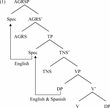
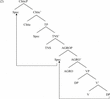
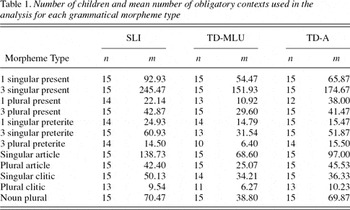
Number of children and mean number of obligatory contexts used in the analysis for each grammatical morpheme type
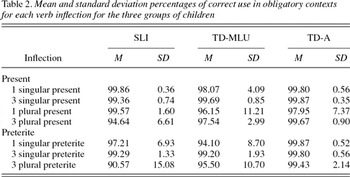
Mean and standard deviation percentages of correct use in obligatory contexts for each verb inflection for the three groups of children
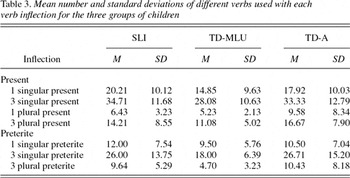
Mean number and standard deviations of different verbs used with each verb inflection for the three groups of children
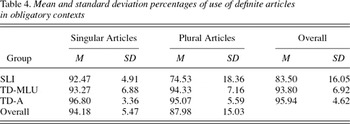
Mean and standard deviation percentages of use of definite articles in obligatory contexts
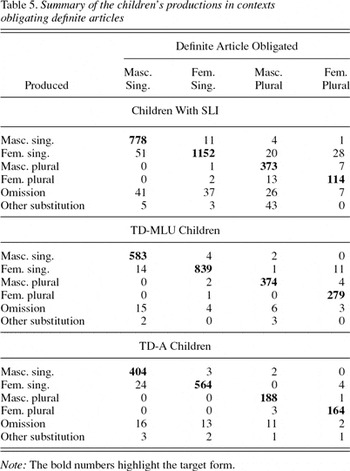
Summary of the children's productions in contexts obligating definite articles
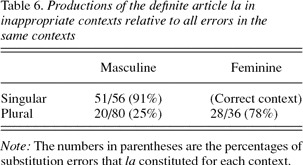
Productions of the definite article la in inappropriate contexts relative to all errors in the same contexts
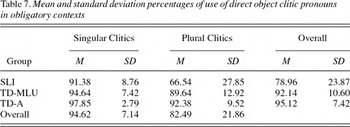
Mean and standard deviation percentages of use of direct object clitic pronouns in obligatory contexts
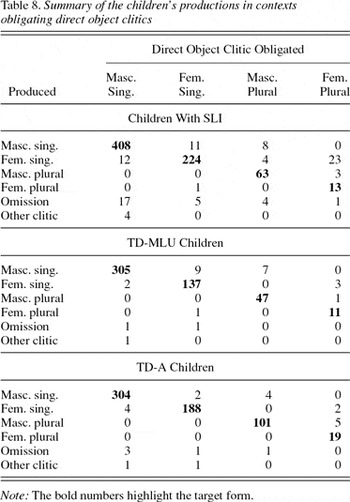
Summary of the children's productions in contexts obligating direct object clitics
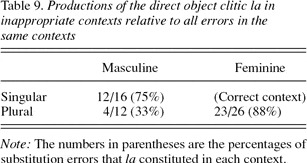
Productions of the direct object clitic la in inappropriate contexts relative to all errors in the same contexts
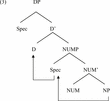
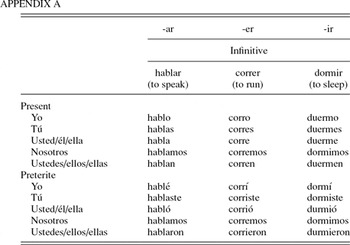
 You have
Access
- 114
- Cited by