Coronary insufficiency and critical ventricular dysfunction in the presence of ventriculocoronary fistulae is a well-described phenomenon in hypoplastic right and left hearts. These fistulae have been extensively reported in pulmonary atresia with intact ventricular septum and in the mitral stenosis/aortic atresia subtype of hypoplastic left heart syndrome. We report a rare case of d-transposition of the great arteries with mitral stenosis and pulmonary atresia, resulting in severe left ventricular hypoplasia and ventriculocoronary fistulae.
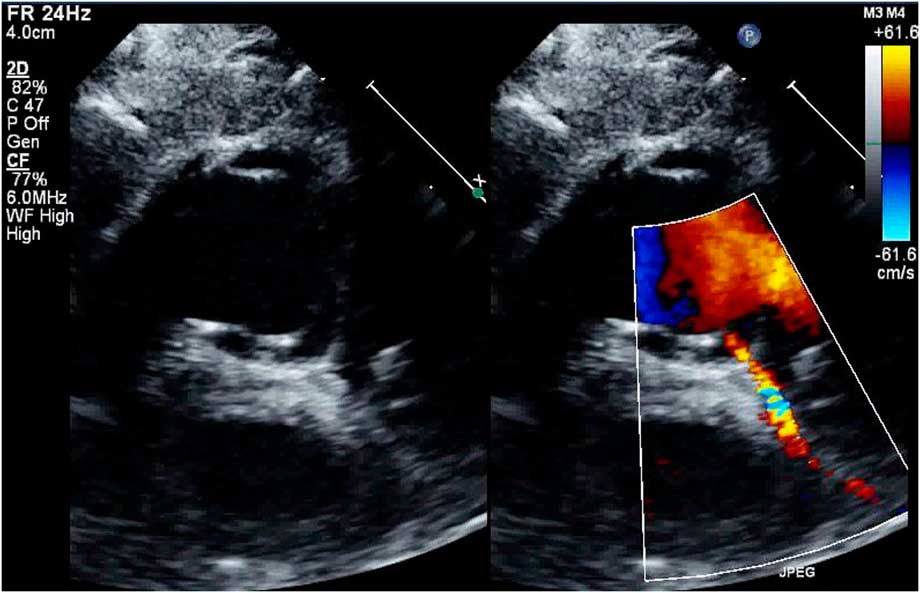
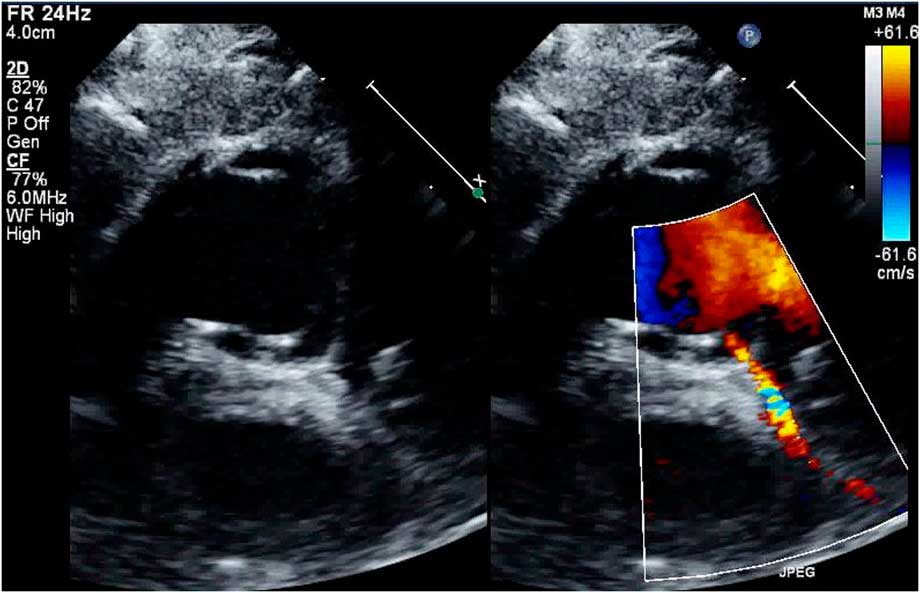
A full-term female newborn weighing 3.1 kilograms was admitted to our intensive care unit. She had an initial oxygen saturation of 75%, and a grade two systolic ejection murmur over the left sternal border. Postnatal echocardiogram confirmed a diagnosis of d-transposition, severe mitral stenosis, left ventricular hypoplasia, pulmonary atresia, and intact ventricular septum. There was unobstructed flow to the transposed aorta, normal right ventricular function, and bidirectional flow in the left main and anterior descending coronary arteries suggesting fistulous connection to the ventricular cavity (Fig 1). The electrocardiogram demonstrated non-specific ST segment abnormalities. Laboratory results were unremarkable.
Parasternal short-axis view in color-compare mode demonstrates retrograde flow from the left main coronary artery to the aorta, suggesting fistulous connection of the coronary circulation to the ventricular cavity.
The patient was maintained on prostaglandin E1 until a modified right Blalock–Taussig shunt was performed on the 6th day of life. On the second post-operative day, she developed tachypnoea, ST segment depression in the anterior leads of her electrocardiogram, and troponin elevation. Echocardiography demonstrated a dilated right ventricle with severely diminished function, moderate tricuspid regurgitation, and prominent bidirectional left coronary flow. Initiation of Dopamine resulted in transient clinical improvement.
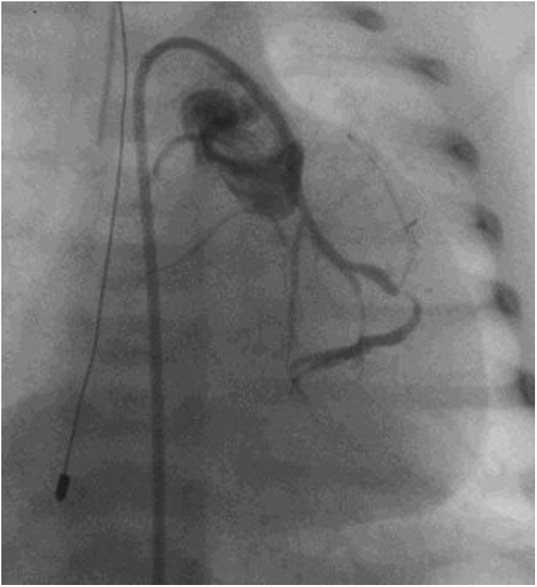
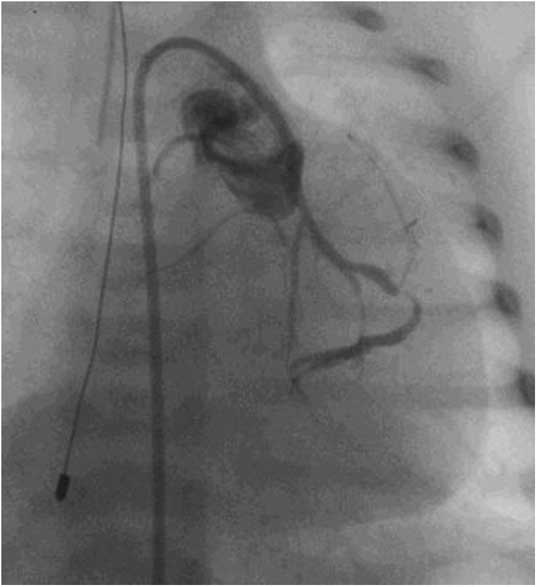
Cardiac catheterisation on the 13th post-operative day demonstrated severe right ventricular dysfunction, a diffusely small right coronary artery, and a left coronary artery with multiple areas of stenosis and fistulous communications to the left ventricular cavity (Fig 2). The patient was listed for cardiac transplant, and on the 44th day of life underwent orthotopic cardiac transplantation. Pathologic examination of the native heart revealed myocardial disarray with only mild coronary medial hyperplasia. The patient was discharged home on the 15th post-transplant day, and at the time of this writing is doing well.
Aortic root injection demonstrates a left coronary arterial system with multiple areas of stenosis and fistulous communications to the left ventricular cavity.
Comments
Communications between the coronary circulation and a hypoplastic, hypertensive ventricle with outflow tract obstruction come in two forms. Ventriculocoronary arterial connections, a term coined by Gittenberger-de Groot et al,Reference Gittenberger-de Groot, Sauer, Bindl, Babic, Essed and Buhlmeyer 1 are direct connections between the coronary arteries and the ventricular cavity and are more common in pulmonary atresia with intact septum. Coronary sinusoids, which connect indirectly through a capillary bed, are more common in hypoplastic left hearts.Reference Baffa, Chen, Guttenberg, Norwood and Weinberg 2 The embryology is not fully understood, although it is surmised that elevated intracavitary pressures maintain patent channels from the intertrabecular spaces to the myocardial “sinusoids”.Reference O'Connor, Cottrill, Johnson, Noonan and Todd 3 If these channels coalesce, they may form a single vessel from the ventricle directly to the coronary system – “ventriculocoronary arterial connection”. These terms are often used interchangeably, but clearly represent different histopathology.
In the presence of these fistulae, the myocardium is perfused during systole with retrograde, high-pressure, and, in pulmonary atresia, hypoxic blood.Reference Baffa, Chen, Guttenberg, Norwood and Weinberg 2 , Reference Freedom, Anderson and Perrin 4 The turbulence and potential “steal” result in variable pathology of the coronaries, endocardium, and myocardium that may lead to less favourable surgical options and outcomes.Reference Gittenberger-de Groot, Sauer, Bindl, Babic, Essed and Buhlmeyer 1
Ventriculocoronary connections are found in approximately 40% of patients with pulmonary atresia and intact ventricular septum.Reference Freedom, Anderson and Perrin 4 Significant coronary pathology with medial and intimal hyperplasia, fibrocellularity, and stenosis or interruption has been noted in this lesion, as has the lack of severe endocardial or myocardial abnormalities.Reference Gittenberger-de Groot, Sauer, Bindl, Babic, Essed and Buhlmeyer 1 , Reference Freedom, Anderson and Perrin 4 This is in contrast to the coronary sinusoids found in 10–15% of patients with hypoplastic left heart syndrome – 50% with the mitral stenosis/aortic atresia subtype – in which endocardial and myocardial abnormalities abound but coronary arteries are relatively spared of significant histopathology.Reference Gittenberger-de Groot, Sauer, Bindl, Babic, Essed and Buhlmeyer 1 , Reference Baffa, Chen, Guttenberg, Norwood and Weinberg 2 , Reference Sathanandam, Cui and Nguyen 5
Surgical considerations in pulmonary atresia with intact septum include the risk of coronary compromise when the hypertensive ventricle is unloaded on cardiopulmonary bypass or during surgical relief of outflow tract obstruction. These risks may influence the decision to perform a univentricular or biventricular repair, or whether to pursue cardiac transplantation.Reference Freedom, Anderson and Perrin 4 , Reference Ashburn, Blackstone and Wells 6 Concerns are similar in hypoplastic left hearts, although surgical decompression typically does not occur and techniques such as the Hybrid procedure may be employed.Reference Baffa, Chen, Guttenberg, Norwood and Weinberg 2 Regardless of the management approach, this abnormal coronary circulation has contributed to many peri-operative and late deaths among these patients. Indeed, early case reports of cardiac dysfunction, ventricular arrhythmias, and death in peri-operative patients with such fistulae provided the first evidence that these communications should be implicated in adverse outcomes.Reference Freedom, Anderson and Perrin 4
Despite their use as theoretically more protective approaches, single-ventricle palliation or Hybrid procedures in patients with fistulae must nevertheless take into account the delicate state of the coronaries. Many studies of pulmonary atresia with intact septum have concluded that it is not the mere presence of fistulae that leads to increased mortalityReference Ashburn, Blackstone and Wells 6 , Reference Calder, Peebles and Occleshaw 7 or decreased likelihood of biventricular repair,Reference Ashburn, Blackstone and Wells 6 but rather the extent to which perfusion of the left ventricle depends on flow from the affected coronaries. Studies of hypoplastic left heart syndrome with fistulae frequently conflict one another, with some demonstrating a higher risk of mortality in those with fistulaeReference Vida, Bacha and Larrazabal 8 and others showing no increased risk.Reference Sathanandam, Cui and Nguyen 5
Our patient's anatomy was unusual in that there were features of hypoplastic left heart, but the outflow tract obstruction was that of pulmonary atresia with an intact septum. Fistulae have been described in cases of congenitally corrected transposition with pulmonary atresia,Reference Freedom, Anderson and Perrin 4 , Reference Baschat, Love, Stewart, Gembruch and Harman 9 but this is the first reported case of fistulae in d-transposition with pulmonary atresia and hypoplastic left heart. This patient's critical ventricular dysfunction, which developed following cardiopulmonary bypass, is a well-recognised risk in any patient with such tenuous coronary circulation.
In conclusion, we present a unique patient with d-transposition of the great arteries, mitral stenosis, left ventricular hypoplasia, pulmonary atresia, and ventriculocoronary fistulae in whom severe right ventricular dysfunction developed post-operatively after modified Blalock–Taussig shunt, resulting in the need for cardiac transplantation. This interesting case demonstrates that any ventricle capable of generating suprasystemic intracavitary pressures may provide the substrate for development of ventriculocoronary fistulae, and emphasises the importance of evaluating coronary perfusion pre-operatively. The presence of fistulae may lead to more malignant outcomes in patients with functionally single ventricles, regardless of the anatomy that leads to their development.