The island pipefish (Anarchopterus tectus Dawson, Reference Dawson1978) ranges from Florida in the USA to Venezuela in the western North Atlantic (Dawson, Reference Dawson1978, Reference Dawson and Böhlke1982; Fritzche & Vincent, Reference Fritzche, Vincent and Carpenter2002), although some authors state that its distribution extends southwards to Argentina in the western South Atlantic (e.g. Robins & Ray, Reference Robins and Ray1986; Carvalho-Filho, Reference Carvalho-Filho1999; Froese & Pauly, Reference Froese and Pauly2008). This latter claim, however, is in error and resulted from a lapsus calami (see Dawson, Reference Dawson1978). Here we record Anarchopterus tectus from north-eastern and eastern Brazil based on museum specimens and an underwater photograph, thus extending its range considerably southwards and including this species among the reef fish fauna of the western South Atlantic.
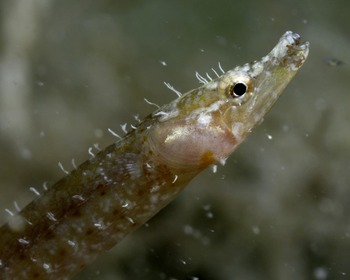
Three specimens housed in two Brazilian scientific collections, MZUSP (Museu de Zoologia da Universidade de São Paulo) and ZUEC (Museu de Zoologia da Universidade Estadual de Campinas) were examined. The northernmost specimen is MZUSP 46335, a female 99.2 mm standard length (SL), 18 + 35 rings, 11 pectoral-fin rays, collected at Fernando de Noronha Archipelago (~03°50′S 32°25′W), off north-eastern Brazil. Specimen MZUSP 64634 is a male 93.7 mm SL, 17 + 33 rings, 11 pectoral-fin rays, collected at Riacho Doce (~09°34′S 35°40′W), Alagoas, coastal north-eastern Brazil. The southernmost specimen is ZUEC 6312, a juvenile male 37.5 mm SL, 17 + 34 rings, 11 pectoral-fin rays, collected at Praia do Forte, Mata de São João (~12°35′S 38°01′W), Bahía, coastal eastern Brazil. The latter specimen was photographed alive soon after collection (Figure 1). The counts of the three specimens are within the range reported for A. tectus by Dawson (Reference Dawson and Böhlke1982). An individual with the diagnostic upwards arched short snout, and head and body cirri, was photographed underwater (Figure 2) at Abrolhos Archipelago off the Bahía coast (~17°59′S 38°40′W), a little southwards to the locality of the ZUEC specimen.
A juvenile male of the island pipefish (Anarchopterus tectus), ZUEC 6312, photographed alive in a field aquarium soon after collection. Photograph: Alfredo Carvalho-Filho.

A close-up of the head of the island pipefish (Anarchopterus tectus) in its natural habitat. Photograph: Marcelo Krause.

In addition to the three specimens housed in Brazilian collections, a specimen (UFLA 19240), identified as Anarchopterus tectus by C.E. Dawson in August 1977 and collected at ‘Isla Itaparica’ (=Ilha de Itaparica) (~13°04′S 38°46′W), Bahía, Brazil, is displayed at the FLMNH Ichthyology Master Database of the University of Florida Fish Collection, searchable at http://www.flmnh.ufl.edu/scripts/dbs/fish_pub_proc.asp. It strikes us that the UFLA specimen is not referred to in the revision of western Atlantic pipefish (Dawson, Reference Dawson and Böhlke1982), the more so as the identifier of this specimen is the author of A. tectus (Dawson, Reference Dawson1978). This specimen was apparently overlooked by other authors, and the southernmost reported record for A. tectus remained Venezuela in the western North Atlantic (Dawson, Reference Dawson1978, Reference Dawson and Böhlke1982; Fritzche & Vincent, Reference Fritzche, Vincent and Carpenter2002), the mistaken southward records notwithstanding. Our report extends the known distribution range for this reef pipefish about 4000 km southwards in a straight line and about 5500 km of coastline, and its occurrence in the western South Atlantic is substantiated by at least four museum specimens.
ACKNOWLEDGEMENTS
We thank Marcelo Krause for the superb underwater photograph; José Lima de Figueiredo and Osvaldo Oyakawa for the loan of specimens under their care (MZUSP); Otto B.F. Gadig for providing an instrumental reference; Elizabeth Ribas Bilo for help in the laboratory; and the CNPq and FAPESP for essential financial support.