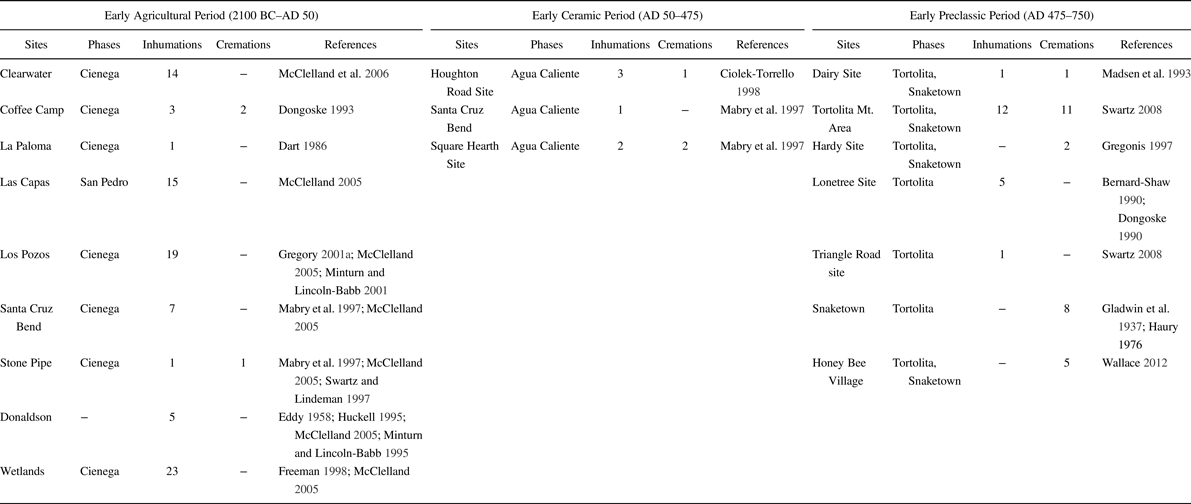
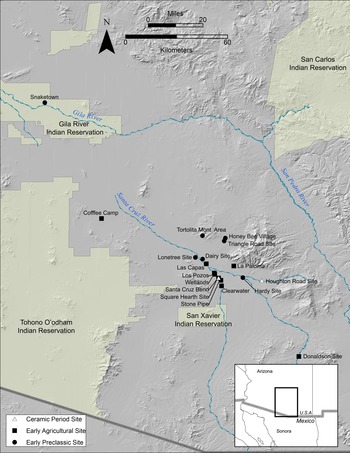
We examine the shifts between inhumation and cremation practices from the Early Agricultural (2100 BC–AD 50) through the Early Ceramic (AD 50–475) to the Early Preclassic (AD 475–750) periods in the Sonoran Desert of the American Southwest (Table 1; Figure 1). While previous studies of this transition have recognized a general shift in the dominant form of body treatment from inhumation to cremation burial (Bayman Reference Bayman2001; Mabry Reference Mabry, Doyel, Fish and Fish2000, Reference Mabry and Vierra2005, Wallace et al. Reference Wallace, Heidke and Doelle1995), many significant issues have yet to be systematically studied. This article focuses on two avenues of inquiry: (1) why the major change in funeral custom occurred from inhumation to cremation in Southern Arizona and (2) the social implications of practicing cremation as a funerary treatment with regard to attitudes about the dead, the body, and the community as a whole.
Archaeological Sites by Period and Phase.

Map of archaeological sites discussed in the text (Color online).

To this end, we characterize mortuary customs and biological traits as useful variables for exploring how and why prehispanic residents of the area altered their mortuary treatments from solely inhumations to a dramatic increase in cremations. In trying to understand what happens at various funerary stages, we examine repeated and innovative actions in mortuary customs and explore how these actions relate to ideas of transformation, remembrance, and community cohesion. The sample data consist of 146 burials from 18 archaeological sites in southern Arizona (Table 1; Figure 1). We focus on variables related to posthumous treatment of bodies, and our osteological analyses focuses on remains recovered from sites dating to the Early Agricultural, Early Ceramic, and Early Preclassic periods.
Repetitive and Innovative Acts in Funerary Customs
Funerary customs are usually composed of several stages involving ceremonies that take place just before biological death through the processing of the deceased body and after the final disposition of the deceased's remains. Classic approaches to funerary rituals focus on a three-stage system (Hertz Reference Hertz, Needham and Needham1960; Metcalf and Huntington Reference Metcalf and Huntington1991; van Gennep Reference van Gennep, Vizedom and Caffee1960 [1909]) involving rites of separation, rites of transition, and rites of incorporation (Cerezo-Román et al. Reference Cerezo-Román, Deforce, Henrotay, van Neer, Cerezo-Román, Wessman and Williams2017). These models have proven invaluable in explaining mortuary customs through time in archaeological contexts (e.g., Bloch and Parry Reference Bloch and Parry1982; Buikstra and Nystrom Reference Buikstra, Nystrom, Jeske and Charles2003; Rakita and Buikstra Reference Rakita, Buikstra, Rakita, Buikstra, Beck and Williams2005). Van Gennep's (Reference van Gennep, Vizedom and Caffee1960 [1909]) universalist theory of the rites of passage, later elaborated by Turner (Reference Turner1967), set out a tripartite model based on processes of transition from one social stage to another. The model includes transitional rites of passage such as pregnancy, childbirth, marriage, and death. These transitions are accompanied by preliminal, liminal, and postliminal rites. Van Gennep (Reference van Gennep, Vizedom and Caffee1960 [1909]) highlighted the symbolic importance of mortuary ritual performance to facilitate the rites of passage from death (preliminal) to funeral to burial (liminal) and eventually to the incorporation of the deceased into the world of the dead and the return of the mourners back to society (postliminal).
Hertz (Reference Hertz, Needham and Needham1960 [1907]) focused on parallel transitions affecting mourners, the dead, and the soul within the different stages of funeral rituals. These transitions start with the death of the individual and end in the burial, when the soul departs to the land of the dead and the mourners are relieved of the funerary duties imposed on them (Hertz Reference Hertz, Needham and Needham1960 [1907]). These models are not static and can be modified and adapted, depending on the funeral custom, the culture, and the period. Van Gennep's (Reference van Gennep, Vizedom and Caffee1960 [1909]) and Hertz's (Reference Hertz, Needham and Needham1960 [1907]) models are useful tools in deconstructing the elements of funerary customs and the sequence of those customs; however, only one stage of the funerary custom, the burial, is typically preserved in most archaeological contexts. Regardless, by focusing on the information contained in these deposits, it is possible to reconstruct some practices that occurred before burial that could relate to other stages of the funerary customs. We use these models to organize the discussion and reconstruct burial-custom sequences inferred from archaeological evidence.
We characterize funerary customs throughout the Early Agricultural period (2100 BC–AD 50) to the Early Preclassic period (AD 475–750) by analyzing repeated and innovative actions preserved in behavioral residues to understand social implications of these treatments and attitudes toward the dead, the individual body, and the community. Repeated and innovative actions or behaviors in burial customs have been studied by authors such as Jones (Reference Jones2001, Reference Jones and Williams2003), Mizoguchi (Reference Mizoguchi1993), Rebay-Salisbury (Reference Rebay-Salisbury, Cerezo-Román, Wessman and Williams2017), and Williams (Reference Williams and Williams2003, Reference Williams2006, Reference Williams, Tarlow and Stutz2013).
Mizoguchi (Reference Mizoguchi1993), for example, studied the role of time and memory reproduction by analyzing repeated actions in burial customs of the Late Neolithic and Early Bronze Age in Yorkshire. He inferred that the deceased had a wide array of social meanings for the living that represents memories of the deceased's unique life histories and that person's interactions with social groups when alive. In the funeral and subsequent disposal of the remains, the living can reaffirm these memories, transforming or even challenging them. Through the examination of how the living interact and treat the dead, it is possible to gain understanding of their social meaning and the complex relationships that existed between the living and the dead. Treatment of the dead (e.g., cremation vs. inhumation), the position of the body, and burial objects can be thought of as material residues of such acts. Mizoguchi (Reference Mizoguchi1993) placed greater emphasis on both the subjects of the actions, in this case the mourners, and the objects or recipients of those actions, such as the deceased and burial accoutrement.
Other researchers (e.g., Jones Reference Jones2001, Reference Jones and Williams2003; Williams Reference Williams and Williams2003, Reference Williams, Tarlow and Stutz2013) propose more structured analytical models to study repetitive behaviors and innovations in mortuary customs and how those relate to the creation of collective memories and remembrances. Jones (Reference Jones2001, Reference Jones and Williams2003) builds on concepts from Butler (Reference Butler1993) and Gell (Reference Gell1998) on citation, material performances, and oeuvre,Footnote 1 and they believe that repetitive behavior encapsulates previous ideas while rearticulating them in new or different ways. These repetitive behaviors are not the same as past actions, but they are a mix of actions influenced by the present and the past, offering a way to develop remembrance and collective memory.
Exploring these ideas also allows us to evaluate how mortuary rituals can transform the deceased's social identities and reconstitute them in new forms after death (Williams Reference Williams2006). The mourners remember past funerals and reproduce and reformulate them at subsequent funerals. They also engage in new and innovative ways of treating the dead by remembering the different intersecting identities of the deceased at those funerals.
By analyzing repeated and innovative actions in mortuary customs, we emphasize contexts of practices and their interactions in the analyses, which can lead to understanding the social relationships between people and communities and how individuals and collectives were distinguished through their social relations (Meskell and Preucel Reference Meskell, Preucel, Meskell and Preucel2004). The limited sample sizes prevent us from deeply examining different practices employed for age-at-death, sex, or other particular identity intersections. It is possible to address changes through time in the position of the extremities and body orientation and the types and frequencies of objects found in burials, but we do not attempt to attribute these characteristics to a particular identity intersection. In addition, we explore regional-scale identity by observing, through time, contemporaneous similarities and differences of repetitive patterns in burial custom types and how bodies were treated (inhumation vs. cremation). Emphases on actions and relationships provide a more balanced approach to understanding how people participated at different levels and scales in society (Joyce and Lopiparo Reference Joyce and Lopiparo2005; Pauketat and Alt Reference Pauketat and Alt2005).
The Early Agricultural, Ceramic, and Preclassic Periods in Southern Arizona
During the Early Agricultural period (Table 1),Footnote 2 populations in the Sonoran Desert became increasingly sedentary with a mixed subsistence economy of foraging and farming (Roth and Wellman Reference Roth and Wellman2001; Watson et al. Reference Watson, Fields and Martin2010; Wills Reference Wills, Price and Gebauer1995). The earliest (unnamed) phase in the Tucson Basin is characterized by the arrival and incorporation of cultigens in existing subsistence strategies, along with some evidence for small villages on the floodplain of the Santa Cruz River (Mabry Reference Mabry and Mabry1998). The subsequent San Pedro phase (1200–800 BC) is marked by an increase in farming of the rich lowland floodplains, the initiation of canal irrigation, the presence of small oval habitation structures and ceramic figurines, an increase in ground stone variation, and the production of shell jewelry (Copeland et al. Reference Copeland, Quade, Watson, McLaurin and Villalpando2012; Roth and Wellman Reference Roth and Wellman2001). The final phase (Cienega; 800 BC–AD 50) of the Early Agricultural period is marked by a greater dependence on agriculture, an expansion of local and long-distance trade networks, and increased sizes of villages, habitation structures, and storage pits. In addition, a greater diversity of artifacts, including the earliest ceramic vessels, also occurred (Mabry Reference Mabry, Mabry, Swartz, Wöcherl, Clark, Archer and Lindeman1997, Reference Mabry2008; Roth and Wellman Reference Roth and Wellman2001).
The presence of large communal-ceremonial structures and their spatial organization during the final Early Agricultural phase represents the development of social integration above the level of the household (Gregory Reference Gregory and Gregory2001b; Mabry Reference Mabry and Vierra2005, Reference Mabry2008). Wallace and Lindeman (Reference Wallace2012:37) suggest that the evidence remains equivocal and more likely reflects a social structure consisting of households and weak local leaders.
The Early Ceramic period (AD 50–475) is marked by a slight break in occupational continuity in some areas, possibly resulting from a period of floodplain instability and erosion (Wallace Reference Wallace, Fish and Fish2007; Waters and Haynes Reference Waters and Haynes2001). Wallace and colleagues (Reference Wallace, Heidke and Doelle1995) suggest that, along with the beginning of formal ceramic production, there were many similarities in architecture, material culture, and settlement organization between the late Cienega phase of the Early Agricultural period and the early Agua Caliente phase of the Early Ceramic period. These indicate significant population continuity and large-scale communication networks (Doyel Reference Doyel, Crown and James Judge1991; Feinman Reference Feinman and Gumerman1991; Gumerman Reference Gumerman1991; Whittlesey Reference Whittlesey1995; Wilcox Reference Wilcox, Ciolek-Torrello and Wilcox1988).
Toward the end of the Early Ceramic period, approximately AD 400, residential patterns shifted. During this time, settlements were well established, had public architecture such as plazas, and were part of a larger settlement system (Wallace and Lindeman Reference Wallace, Lindeman, Young and Herr2012). The Hohokam cultural sequence formally began with the Early Preclassic period (AD 475; the Pioneer phase). Between AD 475 and 500, village sites such as Valencia Vieja were established with residential areas formed in an arc that enclose a central plaza. Such sites display numerous rebuilding episodes. Wallace and Lindeman (Reference Wallace, Lindeman, Young and Herr2012) also suggest that the presence of a plaza signifies social cohesion and village identity and served as a stage where a community's political and religious leaders could perform, initiating the emergence of formal corporate groups. In the Early Preclassic period, particularly between AD 550 and 650, cemeteries composed of secondary deposits of cremated bone began to appear adjacent to courtyard groups.
The Hohokam are characterized by widespread production and exchange of ceramics. They also regularly built, maintained, and used ball courts, plazas, and complex canal irrigation systems. Other important aspects of early Hohokam sites include evidence for the production of mirrors, marine shell ornaments, and palettes. During the Early Preclassic period, site structures became more “formalized” (Bayman Reference Bayman2001). Groups of individual houses surrounded courtyards or plazas, and courtyard groups shared outside cooking ovens, formal refuse middens, and cemeteries. The inhabitants of several distinct groups of sites, referred to as “communities,” are thought to have interacted with each other, often sharing irrigation systems or ball courts or both (Bayman Reference Bayman2001). Cultural attributes characteristic of the Early Agricultural, Early Ceramic, and Preclassic periods represent the Formative transition in the Sonoran Desert, effectively bridging Archaic period foraging with Hohokam agricultural intensification in the region (Wallace and Lindeman Reference Wallace, Lindeman, Young and Herr2012).
Materials and Methods
Our sample consisted of 146 burials from nine Early Agricultural, three Early Ceramic, and seven Early Preclassic period sites, or components of sites, from southern Arizona (Table 1). Several types of primary and secondary data were collected. Primary data were generated directly from the human remains and field notes produced by the authors. Secondary data, recorded after skeletal remains were repatriated and no longer available for study, were collected from osteological inventory forms, archaeological reports, field notes, and analyses performed by individuals other than the authors. Dates associated with burials and site-specific chronologies were acquired from published data and site reports. Burials that could not be dated to a specific phase were placed in broader categories based on associated site dates or ceramic types or both (e.g., Wallace Reference Wallace and Abbot2001, Reference Wallace and Henderson2004). Several sites had multiple or continuous occupations from the Early Agricultural to Early Preclassic periods, and individual burials could not always be assigned specific dates. To avoid problems with chronological classification, we included only burials from publications and site reports that were explicitly assigned to time periods using criteria other than the type of mortuary custom (cremation vs. inhumation). For both primary and secondary burials, information was collected from intentional, undisturbed, or only slightly disturbed deposits. The number of burials from the Early Ceramic period is low; however, no other samples with good contextual data were available for the analysis.
Variables characterizing posthumous treatment include deposit type (inhumation vs. cremation); general orientation of the body (the side on which the body was placed, such as left, right, supine, prone, seated, or head down); position of body extremities, mainly with respect to the position of the legs (flexed, semi-flexed, and extended); and objects found associated with the remains. Only objects found in association with the remains (not in the fill), as described in field notes and archaeological reports, were included in the analysis. The only exception was fire-cracked rock. Fire-cracked rocks are commonly found in Early Agricultural sites. In field notes, they are commonly reported as part of the fill, in direct association with remains, or both. However, due to their sometimes ambiguous origin, they were not included in the analysis.
The biological data include estimations of sex and age at death, recorded using research protocols for osteological data collection based mainly on Buikstra and Ubelaker (Reference Buikstra and Ubelaker1994) and the Bioarchaeology Laboratory of the Arizona State Museum (ASM; Arizona State Museum 2018). The age categories used in this study are infant (newborn to 2 years), child (over 2 years to 12 years), adolescent (over 12 years to 18 years), and adult (over 18 years). Subadult is a category that combines some of these. It includes infants, children, and adolescents and is used to make broader comparisons for research purposes. We also used the age category of over 15 years old at death in this study. This age category is used for individuals who, in terms of size, morphology, and degree of development, are consistant with adults but could not be clearly differentiated between adolescent (over 12 to 18 years) and adult (over 18 years) because of the degree of fragmentation or thermal alteration or both. In these cases, individuals assigned to the over 15 years category were combined with the adult category for analyses, and those individuals are not duplicated in the adolescent category. Analyses were performed primarily using trait frequencies for each variable, which were calculated using a simple dichotomy (presence or absence) for use as continuous data in statistical comparisons. The statistical analysis further evaluates frequency distributions across archaeological phase or period and type of burial by means of a Pearson's chi-squared test.
Results
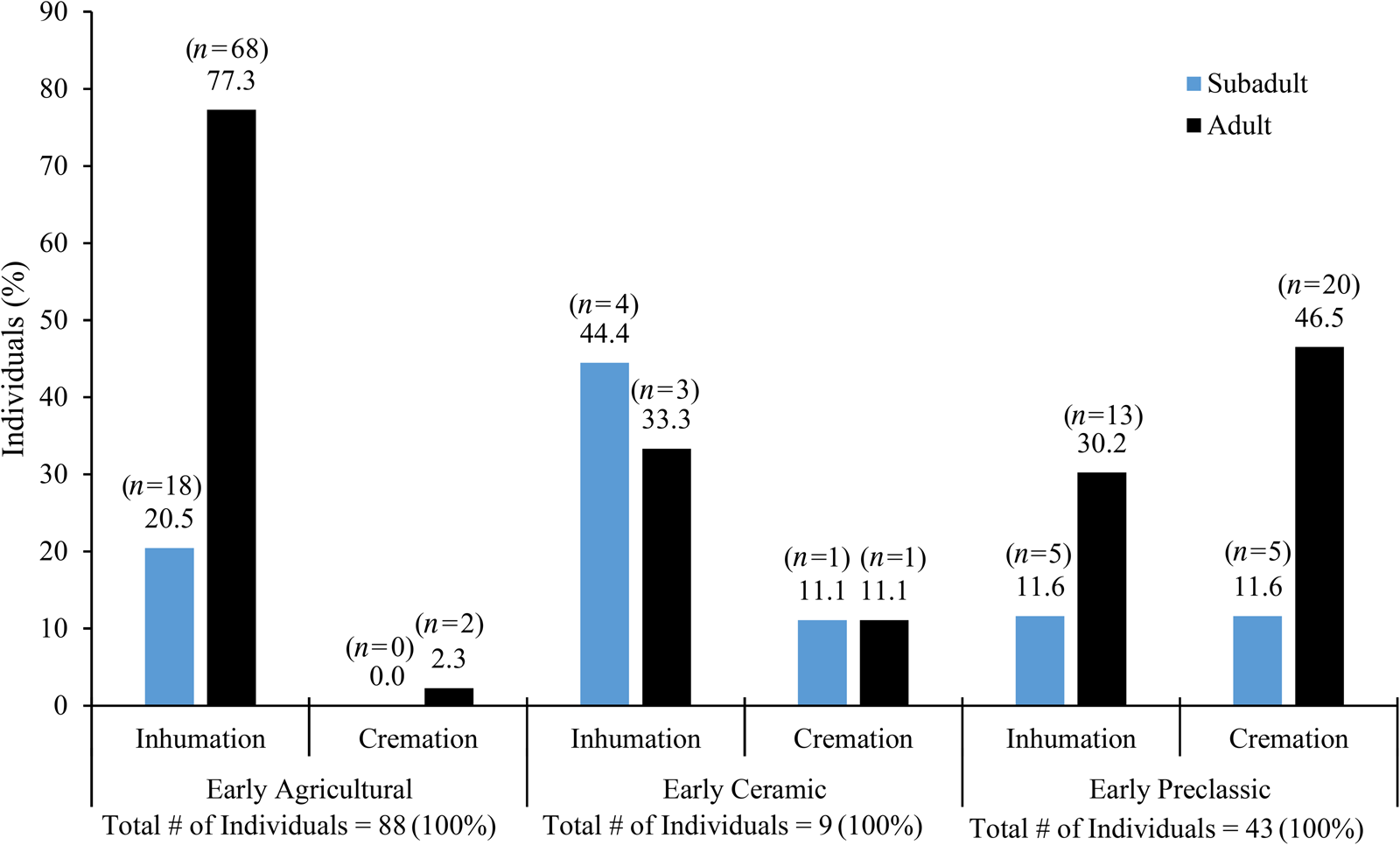
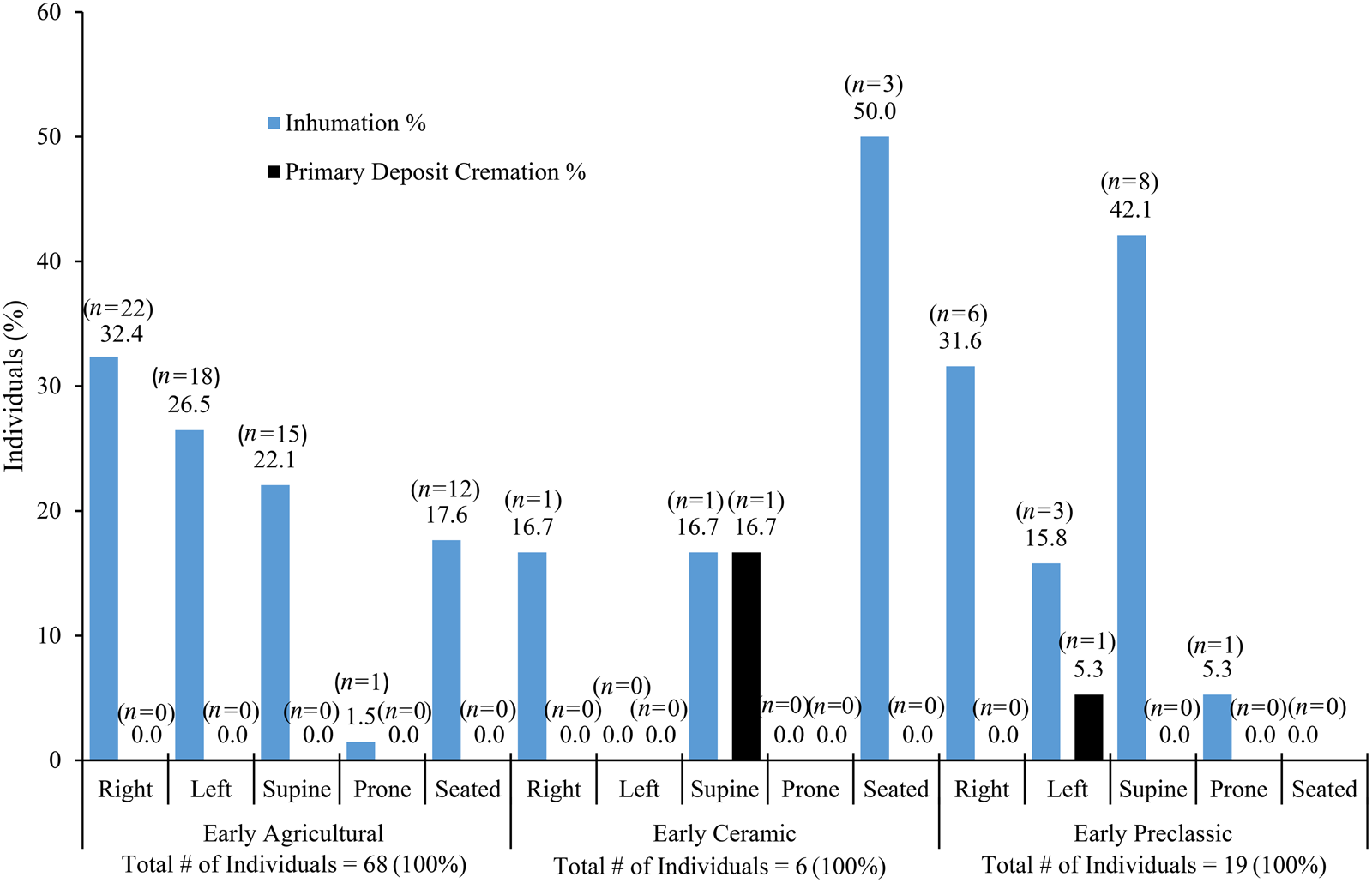
Figures 2–4 present information on the burial practice variable data tabulated for the total number of individuals within each period. Evidence that funerary customs changed over time is demonstrated by a sharp decline in inhumation burial from the Early Agricultural period, when inhumation was highest in frequency, through the Early Ceramic period, when the balance began to shift between inhumation and cremation, to the Early Preclassic period, when cremation dominated (Figure 2). The frequency of cremation did not vary much from the Early Agricultural period to the Early Ceramic period. However, in the Early Preclassic period, their frequency increased significantly (Pearson's chi-squared tests χ 2 = 66.908, df = 4, p < 0.0000000000001). During this time, cremated individuals were commonly placed in a secondary deposit.
Percentage of burials by period and age-at-death category (Color online).

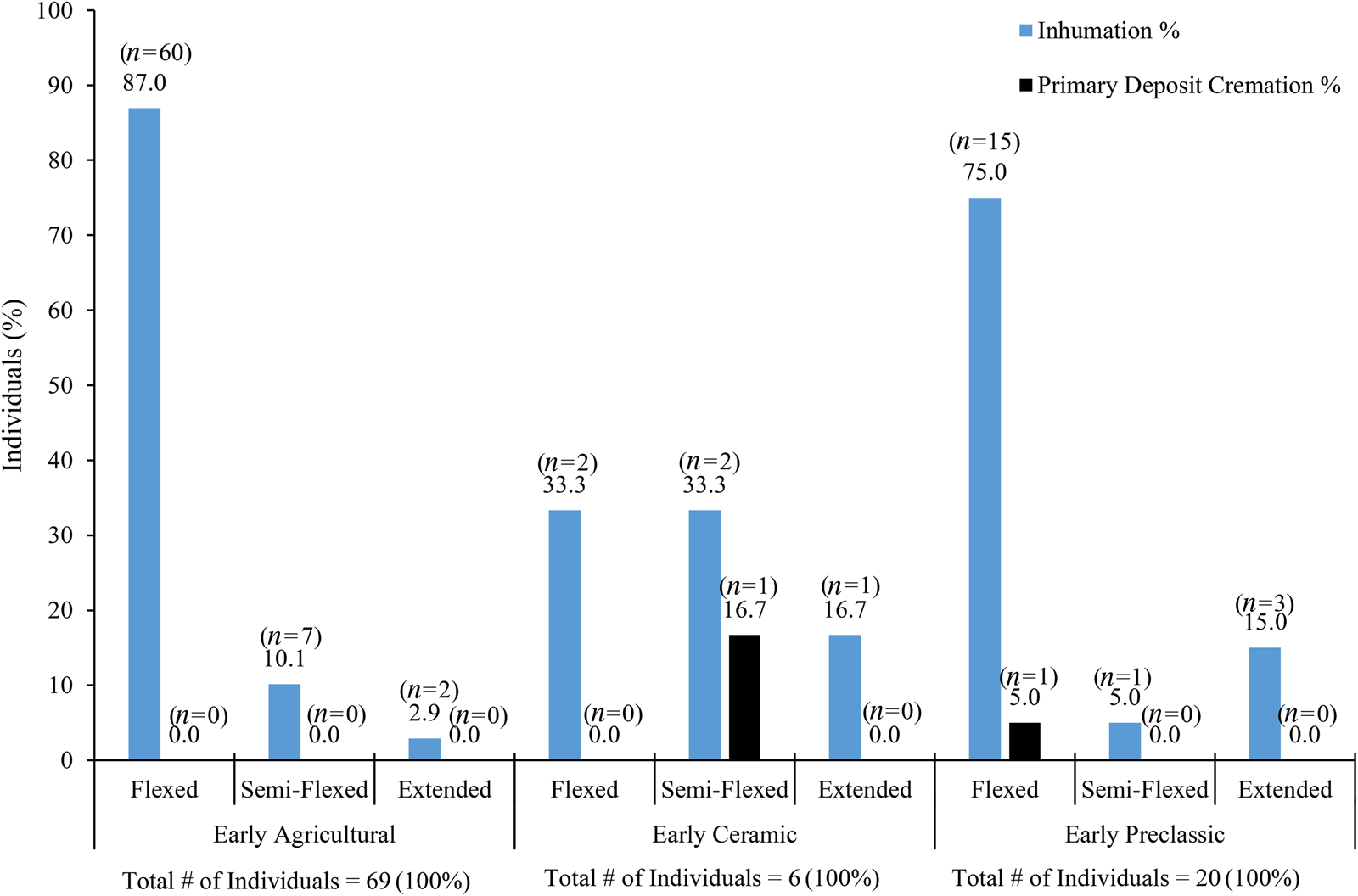
Percentage of extremities (arms and legs) by position and period (Color online).

Percentage of burials by body position by period (Color online).

There are additional changes over time in funerary treatment with regard to age and burial type. Both subadults and adults were inhumed during the Early Agricultural period, whereas only adults were cremated. By contrast, during the Early Ceramic period, both subadults and adults were cremated or inhumed, with no apparent selective treatment based on age (Figure 2). This pattern remained consistent through the Early Preclassic period, suggesting that age at death was likely not a strong variable influencing the decision to either cremate or inhume an individual after the Early Agricultural period. Sex also does not appear to have been a significant determinant in body treatment. There were minor differences in inhumations and primary cremations in placement of the extremities (e.g., arms and legs) between periods (Figure 3). During the Early Agricultural period, most individuals were placed in flexed positions. The number of inhumations in the Early Ceramic period was too low to properly evaluate. In the Early Preclassic period, variation in extremity positions was similar to that of the Early Agricultural period, although a larger proportion of other body extremity positions are apparent.
In the Early Agricultural period, considerable variation was found in the way individuals were placed or the position of bodies in burials, including on either side, supine, seated, and prone (Figure 4). Although the sample size for the Early Ceramic period was small, it demonstrated less variation in body orientation. In the Early Preclassic period (Figure 4), there may have been a slight decrease in variation; however, no differences were found for sex, age at death, and body position within periods or through time.
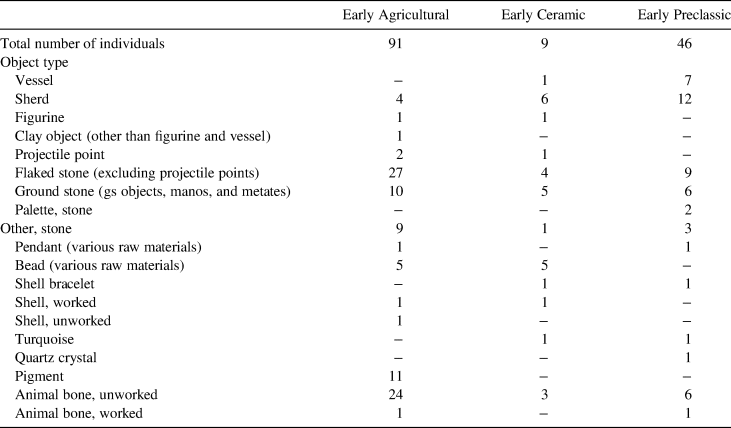
There is evidence that objects found in association with the remains may have changed through time (Table 2). During the Early Agricultural period, individuals were found with many different types of objects, dominated by flaked and ground stone objects, unworked animal bones, and pigments. By contrast, shell bracelets, turquoise, and ceramic vessels appeared in the Early Ceramic period. The presence of flaked and ground stone objects, sherds, and unworked animal bones remained fairly constant through time. The use of pigments such as red ochre disappeared after the Early Agricultural period, and the placement of ceramic vessels increased over time. There was also less variation in burial objects through time.
Number of Individuals and Burial Objects by Period.

Note: This is a presence/absence dataset organized by the number of individuals found with each type of burial object per period. Any given individual can be represented in more than one object category (for example, one individual could have both ceramic sherds and flaked stone). The counts will not add up to the total number of individuals in any given period.
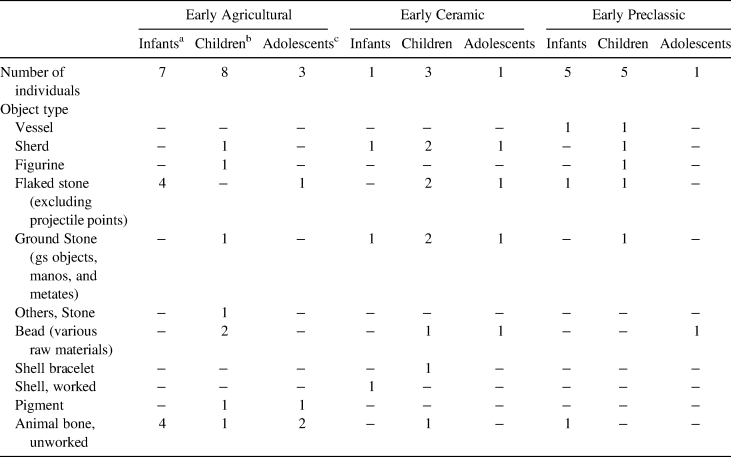
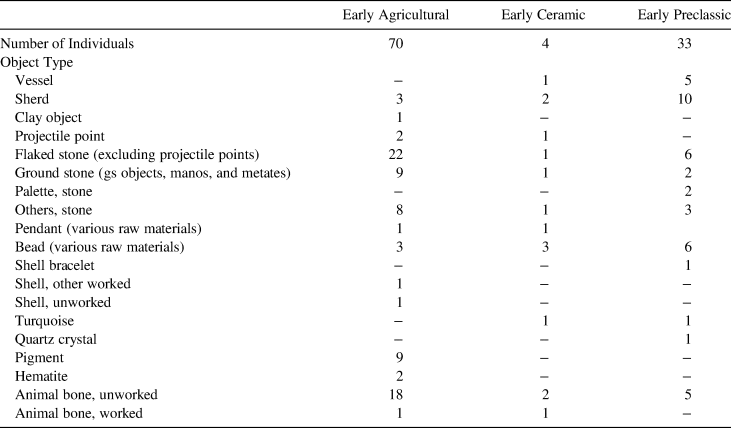
Both adult males and females had similar frequencies and types of objects over the course of the cultural sequences considered here. However, differences were observed through time in variation of objects with the age of individuals (Tables 3 and 4). Infants were found with the least variation of objects through all periods, whereas increasing numbers of objects were apparent for children, adolescents, and adults (Tables 3 and 4). Adults and individuals older than 15 years at death were found with the most object variation (Table 4). Early Agricultural period infants and adolescents were found with flaked stone and unworked animal bone, whereas adults and individuals older than 15 were found with utilitarian objects, including ground and flaked stone, sherds, and objects usually associated with personal adornments, such as beads and unworked animal bone (Tables 3 and 4). In the Early Ceramic period, the number of individuals is small, and the relationship between age and objects found with the remains could not be evaluated. In the Early Preclassic period, there was a general decrease in variability of type of objects (see Tables 3 and 4). Early Preclassic period infants were found with items such as vessels, flaked stone, and unworked animal bone (Table 3). Children (over 2 years to 12 years) were found with figurines, sherds, vessels, flaked stone and ground stone, while adolescents (over 12 years to 18 years) were found with only beads. Adults and individuals older than 15 were found with many different types of objects (Tables 3 and 4).
Burial Objects Found with Subadults by Period.

Note: This is a presence/absence dataset organized on the counts of individuals found with each type of burial object per period. Any given individual can be represented in more than one object category (for example, one individual could have both ceramic sherds and flaked stone). The counts will not add up to the total number of individuals within an age group in any given period.
aInfants are newborn to ≤2 years at death.
bChildren are >2 to ≤12 years at death.
cAdolescent are >12 to ≤18 years at death.
Burial Objects Found with Adults and Individuals over 15 by Period.

Note: This is a presence/absence dataset organized on the counts of individuals found with each type of burial object per time period. Any given individual can be represented in more than one object category (for examples, one individual could have both ceramic sherds and flaked stone). The counts will not add up to the total number of individuals in any given period.
Discussion
Mortuary customs in the Tucson Basin shifted from inhumation to cremation during the Early Agricultural, Early Ceramic, and Early Preclassic periods. Changes in mortuary rituals are usually not monocausal, and many factors influence their shift. Researchers from different parts of the world sometimes explain change from inhumation to cremation, or vice versa, as differences in attitudes toward social status (Kern et al. Reference Kern, Kowarik, Rausch and Reschreiter2008; Rebay-Salisbury Reference Rebay-Salisbury, Cerezo-Román, Wessman and Williams2017) or through a change of beliefs about the soul and the afterlife (Rebay-Salisbury Reference Rebay-Salisbury, Cerezo-Román, Wessman and Williams2017). For example, Rebay-Salisbury (Reference Rebay-Salisbury, Cerezo-Román, Wessman and Williams2017) saw a shift from cremation to inhumation in the Early Iron Age in Central Europe as indicating that people abandoned the belief that cremation was required to release the soul or spirit from the body.
The social significance of the shift from inhumation to cremation from the Early Agricultural to the Early Ceramic to the Early Preclassic period had not been examined in the Tucson Basin in detail. Mabry (Reference Mabry, Doyel, Fish and Fish2000, Reference Mabry and Vierra2005) explored ideological and social changes during these periods by looking at a variety of material-culture changes associated with ritual. Although his work does not center on mortuary ritual, he suggested that mortuary rituals were viewed as public social actions with the goal of ensuring that the dead reach the afterlife. On the other hand, to the north in the Phoenix Basin, these changes have been attributed to a shift within religious belief systems more broadly (Rice Reference Rice2016). In a wider sense, religious and spiritual beliefs certainly contributed to the way funerary practices were carried out, and they likely hold multiple and contradicting beliefs within a society. But these generalizations do not explore in detail why the major changes in funeral customs occurred or the social implications in terms of the dead, ideas about the body, and the community at a smaller scale.
Ethnohistoric accounts of Southwestern groups that practice cremation, however, shed light on the importance of cremation as a transformation ritual. Southwestern Native American groups such as the Yuman-speaking peoples regularly practiced cremation into recent history (for example, the Colorado River Yuman [the Halchidhomas, Maricopas, and Cocopas] and the Southern California Yuman [such as the Luiseños, Diegueños, Kumeyaay, and Quechans]; Cerezo-Román Reference Cerezo-Román, Kuijt, Quinn and Cooney2014). Spier (Reference Spier1933:296) notes that among the Yuman, the soul leaves the body during burning. Ethnohistoric accounts also note among the Yuman that individuals were buried to “renew” their lives, and cremated individuals can join the ancestors, or the “land of the dead” (Spier Reference Spier1933), providing a rationale for the burning of the dead. Ethnographic accounts of Southwestern cremation rituals help us interpret and understand the meanings of these practices (Cerezo-Roman Reference Cerezo-Román, Kuijt, Quinn and Cooney2014). Although determining the exact meanings of individual practices is difficult or almost impossible, understanding the nature of the changes—how actions and behaviors shift through time—and contextualizing these with archaeological data would contribute to a better understanding of why they occurred and their specific social implications. Taking this into consideration, we argue that the significant shift from inhumation to cremation over the Formative transition in the Sonoran Desert is best considered in terms of a change toward a transformative ritual and toward a community's increased investment in the mortuary ritual, which possibly fostered community cohesion and large-scale community identity. At the same time, it is possible that a shift occurred in relationships between the living and the dead that could reflect broader changes in social relationships and concepts about the body and the belief systems associated with both.
Repetitive and Innovative Mortuary Customs within and between the Early Agricultural, Early Ceramic, and Early Phases of the Preclassic Periods
During the Early Agricultural period, inhumation was the dominant burial custom, but bodies were placed in a variety of orientations. If we think about the work by Hertz (Reference Hertz, Needham and Needham1960 [1907]), van Gennep (Reference van Gennep, Vizedom and Caffee1960 [1909]), and Metcalf and Huntington (Reference Metcalf and Huntington1991) and how they relate to the mortuary customs in our study, it is possible that in the Early Agricultural period there was flexibility and innovation in what is usually associated with separation, or preliminal, and transition, or liminal, rites. Specific patterns of body positioning in the burial practice does not appear to have been codified, and there was a lot of variation on how bodies were placed in the grave, as seen in Figure 4. In general, a variety of objects were placed with individuals, but through time, the variation and quantity of objects decreased, as shown in Tables 2–4. Different types of objects found in inhumations may have been directly associated with the body or the rituals or both. Objects found with the remains entered the archaeological record in at least two ways for inhumations: as decorative ornamentation related to the clothing or accessories, possibly associated with preliminal and separation rites, and as objects accompanying the body in the burial, possibly associated with liminal and transition rites. Other objects may have entered the archaeological record in later mourning rituals, but in our sample, no evidence for burial reopening was found. The diversity of objects placed in the grave decreased significantly in the Early Ceramic and Early Preclassic periods. It is possible that these objects were selected to sustain memories of relationships between the survivors and the departed. These objects could represent multidimensional networks of reference for both the deceased and the mourners, thereby giving agency to the dead and the living. If the objects were former possessions of the deceased, they were designated as aspects or extensions of the personhood of the individual, thus becoming potent sources of memory because of the way in which object biographies are interwoven with the biography of the associated person (e.g., Gosden and Marshall Reference Gosden and Marshall1999; Hallam and Hockey Reference Hallam and Hockey2001).
There are several possible interpretations for these developments. It is possible that the minor differences within inhumations could relate to identity intersections of the deceased and the mourners. In these early Formative periods, the variations in body positions and the types and quantities of objects in inhumations suggest that the identities of the deceased and the mourners were emphasized in funerary customs. It is possible that variation in body position and burial objects could be used as a means of displaying and distinguishing the identity of each deceased and the mourners and how these individuals were distinguished through their social relations. On the other hand, the predominance of inhumation interment customs throughout the Early Agricultural and Early Ceramic periods possibly represents a repetition of actions or behaviors and a reiteration of norms observed at several sites. These patterns and repetitions of practice suggest that the earliest inhumations from the Early Agricultural period may have established precedents for subsequent burials. This type of patterning and continuity could be more than a shared way of commemorating the dead and the transition, or liminal, period. It could also be associated with the creation of collective memories and remembrances related to group identities. This “regional identity” can be seen by the longevity of the custom throughout the Early Agricultural period and into the Early Ceramic period, and it could inscribe a link to identities of Early Agricultural period populations.
Inhumation customs in the Early Preclassic period changed very little from those of the Early Agricultural and Early Ceramic periods. The custom of inhuming individuals in a flexed position persisted; however, in the Early Preclassic period, supine burials became more common, and no individuals were found in a seated orientation (Figure 4). It appears that this inhumation pattern became slightly more standardized over time, and variation of body orientation decreased. These patterns suggest a more homogeneous regional identity or at least a more homogeneous burial custom. The use or placement of red ocher also disappeared. Decrease in the placement of red ocher and variation in body orientation suggest the possibility that there was a shift in focus away from the body itself toward other aspects of the burial. For example, the type and quantity of objects found in burials can be viewed as a display of both a regional identity and the identity of the deceased.
Inhuming a body declined through time, and inhumation burials at Preclassic period Hohokam sites existed as a custom almost exclusively for infants (younger than 2 years at death) and few select adult individuals (Cerezo-Román Reference Cerezo-Román, Kuijt, Quinn and Cooney2014, Reference Cerezo-Román2015). Inhumation funerary customs were subsequently largely replaced with cremations in the Sonoran Desert of southeastern Arizona. Cremation first appeared as an innovation in burial customs during the Cienega phase of the Early Agricultural period and showed a clear increase in use that culminated during the Preclassic and Classic periods. Considering the transition from inhumation to cremation as an innovation might seem odd at first, as funeral customs are usually considered particularly resistant to change (Rebay-Salisbury Reference Rebay-Salisbury, Cerezo-Román, Wessman and Williams2017). However, funeral rituals bring people together and provide the opportunity to develop, destroy, or negotiate social relationships (Cerezo-Roman Reference Cerezo-Román, Kuijt, Quinn and Cooney2014, Reference Cerezo-Román2015). At the same time, they are the ideal venue to negotiate and mark social change. Innovation can be generated by internal and external drivers, often combining the two, but it crucially relies on the context—the network in which information flows (Conway and Steward Reference Conway and Steward2009; Rebay-Salisbury Reference Rebay-Salisbury, Cerezo-Román, Wessman and Williams2017). The social traditions in a society can play a role in the adoption and acceptance of the change, and the social status of innovators and early adopters might have been crucial in overcoming potential reluctance to accept change and adopt innovations (Rebay-Salisbury Reference Rebay-Salisbury, Cerezo-Román, Wessman and Williams2017). In the Sonoran Desert, it is uncertain whether cremation as a funerary custom began within a specific subgroup, but this custom was adopted slowly by the majority of Early Preclassic individuals (more than 2 years old at death) regardless of sex. This change in body treatment from inhumation to cremation created new dynamics between the dead and living.
Changing Relationships between the Dead, the Families, and the Community
We suggest that there are two principal elements contributing to the change in funeral treatment observed in the region. First, groups adopted cremation as a funeral custom, which is transformative by nature and has implications regarding attitudes about the dead and the body, as well as liminal and likely postliminal rites. Second, there was an increase in community investment toward the funeral ritual, which has implications for the mourners and the community as a whole. Cremation customs have been associated with a rite of separation enacted early in the funerary sequence and a “secondary rite” whereby the bodies are burned and redeposited (Cerezo-Román et al. Reference Cerezo-Román, Deforce, Henrotay, van Neer, Cerezo-Román, Wessman and Williams2017; Downes Reference Downes, Downes and Pollard1999; Metcalf and Huntington Reference Metcalf and Huntington1991; Williams Reference Williams2004). Cremation changes the physical appearance of the deceased from a whole body to multitudinous bone fragments. After bodies were burned, typically the remains were removed to secondary deposits, an act differing from inhumations, which are most often buried in primary deposits. The disposal of these cremated remains varied according to the wishes of the deceased, the mourners, the community, and other social entities, as well as how the mourners and society perceived the cremated remains. Cremation as a funeral custom does not necessarily imply a greater community investment if the remains are left in the pyre. However, when the remains are collected from the pyre and placed in a secondary deposit, there is an increase in community investment that differs from an inhumation.
The creation of a secondary burial is an extra step in the funeral ritual that requires additional effort and time devoted to the preparation and creation of these types of deposits. The use of secondary cremation burials also creates stronger social ties within communities and a distinct shared group identity not previously seen within the region. To illustrate this, we consider several key similarities and differences that open-air cremations and the subsequent secondary deposits of cremated remains have with primary inhumations.
In both funerary customs, at the moment of death, it is likely that the body was prepared by family members or persons in charge of these proceedings as part of rites of separation and subsequently taken to the funeral pyre or burial pit possibly as part of rites of transition. As events, both inhumation and cremation customs require advanced preparation. In a cremation, fuel needs to be collected and the pyre must be constructed before the remains are burned. With an inhumation, a burial pit must be excavated and prepared for deposition of the body.
Depending on whether the body is to remain intact and be inhumed or is to be cremated and then buried, the spectators and mourners will have different sensorial experiences and different ways to physically relate to the deceased body throughout the funeral rituals. Contrary to cremation, inhumation typically does not allow participants to witness the body's transformation. No evidence of secondary treatment or body alteration before burial was found in inhumed deposits, and intact bodies were placed in the ground. Taking this into consideration, it is likely that the physicality of the deceased's body, in terms of facial and body characteristics, remained fairly intact and recognizable up to the point of burial.
These physical attributes and the presence of the intact body would evoke memories that could be attributed to the deceased while still alive and the role that the deceased takes at death (Williams Reference Williams2004). Inhumation preserves that physicality and association with a specific person until the body is buried. Transformation in these cases typically occurs unobserved by mourners, as the wholeness and integration of the body is preserved until it decomposes in the grave (underground) over a long period. However, it is possible that a metaphorical transformation could occur socially in the deceased and inhumed individual as the funerary rituals take place, especially from the liminal to the postliminal stages. After the interment, other rituals also may have occurred, but no evidence was found that involved secondary burials or manipulation of the bodies of inhumed individuals.
Cremation, on the other hand, is dramatically and physically transformative. Several researchers have commented on this process in Hohokam cremation customs (Beck Reference Beck, Rakita, Buikstra, Beck and Williams2005; Cerezo-Román Reference Cerezo-Román, Kuijt, Quinn and Cooney2014, Reference Cerezo-Román2015; Rakita and Buikstra Reference Rakita, Buikstra, Rakita, Buikstra, Beck and Williams2005). Ethnohistoric accounts also emphasize the transformative aspect of the burning of the bodies and objects (e.g., Spier Reference Spier1933). The meaning of the transformation is cultural and time specific; regardless, the cremation provides a different sensorial experience for the mourners, physically transforms the body into small bone fragments, and creates a new way of dealing with remains. Once the body begins to burn, the smoke and heat associated with the fire are readily noticeable among the audience, effectively creating active participation in the performance through a variety of sensorial experiences.
Human tissue passes through various degrees of burning. The flesh is destroyed in the pyre, and the physical attributes previously recognizable by the living are permanently transformed as the entire body is converted into small fragments of bone and ash. Cremated remains recovered from sites dating to each archaeological period discussed here are mostly calcined and significantly reduced in size and weight. The bones have a different and new materiality (i.e., bone fragments) that can be seen as part person and part object and can be transported and treated very differently from a complete body (Williams Reference Williams2004, Reference Williams2011).
Cremations in southern Arizona were complex, as they usually involved secondary rituals in which the cremated bones were removed from the pyre site and redeposited in secondary locations as the final resting places. This extra step of secondary burial deposits marks an increase of community investment in the funerary custom, resulting in stronger social ties. These secondary funerary customs are highly visual social events where personal and collective identities are defined and negotiated (Kuijt Reference Kuijt2008).
Secondary mortuary customs can be defined as social acts focused on the regular and socially sanctioned removal of all or part of a deceased individual from a temporary storage area to a permanent resting place. The majority of cremation features documented from each archaeological period considered here represent secondary deposits. These deposit types and customs are an important additional and intentional stage in the funerary custom.
Among the Preclassic Hohokam, secondary burials of cremated bone are usually characterized by deposits with very low bone weights. These secondary remains were deposited within courtyard groups, plazas, and/or in other places in the site. Some researchers have suggested that most cremated remains were divided among different social networks and likely were buried in multiple secondary deposits (e.g., Cerezo-Román Reference Cerezo-Román, Kuijt, Quinn and Cooney2014, Reference Cerezo-Román2015). These new interactions between the deceased, the living, and the community could have created, reinforced, maintained, transformed, and even destroyed social relationships as individuals participated in the new customs and the secondary burials of the cremated remains.
Through the act of creating these secondary cremation deposits, the living displayed connections with the deceased, the family of the deceased, and the community. The citation and standardized patterns in placing remains into secondary deposits, usually within cemeteries, created commonalities and homogeneities among individuals, thereby maintaining certain levels of corporate similarity. This also would create shared social meaning and memory among members of the community. Such cremation customs highlight the collective identity, ultimately a shared social memory and remembrance, and not so much the deceased themselves.
The gradual shift in predominant mortuary custom from inhumation to cremation in southern Arizona indicates a significant but protracted change in perception of the dead through time. It is possible that changes in the way bodies were treated relate to broader social changes in terms of individual and group identities. It is important to note that Preclassic period sites are larger and more socially complex landscapes than sites from earlier periods, and they typically include large community integrative structures, such as plazas and ball courts. Cremation customs complemented these structures, representing expressions of more inclusive social networks and group cohesion among the Preclassic Hohokam population of the Tucson Basin. It is possible that the social triggers for changes in funerary customs reflect other larger social changes occurring in the greater region. The performative and secondary extended treatment of cremations, particularly at increasingly larger settlements with more complex social structures, inspired a wider adoption of these mortuary practices at that time.
Temporal differences in burial to nonburial feature occurrences and associations within sites and different aspects of cremation rituals, aside from inhumation, are important avenues for future research and go beyond the scope of this article. Cerezo-Román and Fenn (Reference Cerezo-Román and Fenn2016) performed a preliminary study to explore similarities and differences among pyrotechnologies and cremation rituals among the Preclassic and Classic period Hohokam. In the future, a more in-depth study is planned on how the pyrotechnologies used in burning bodies changed from the Early Agricultural to the Classic period. In particular, we hope to explore variation in the construction of the pyres, how individuals were burned, the fuels used, and body positions and their social significance, as well as how these deposits relate to other features at the sites.
Conclusions
In this article, we focus on why the funeral custom changed from inhumation to cremation and the social implications of practicing cremation as a funerary treatment regarding attitudes about the dead, the body, and the community as a whole. We analyzed this change by exploring the posthumous treatment of bodies and performing osteological analysis on remains recovered from sites dating to the Early Agricultural, Early Ceramic, and Early Preclassic periods. In particular, we examined repetitive and innovative mortuary customs and how they relate to ideas of remembrance, collective memory, and attitudes about the dead, the body, and the community.
The Early Agricultural period is characterized by the intact interment of the deceased in various positions and orientations and with a variety of associated funerary objects. This early group, characterized by small villages and a mixed subsistence economy, did not burn the bodies of their deceased during the funeral. Rather, the intact body was a medium displaying multiple intersecting identities of the deceased and the mourners. However, the predominance of inhumation interment customs throughout the Early Agricultural and Early Ceramic periods represents more than a shared commemoration of the dead and the transition/liminal period; it was also a way to create collective memories and remembrances. The patterning of these inhumation practices suggests a more homogeneous regional identity that emphasized both individual and group identity. The vehicle of displaying different identity intersections was likely not only in the body per se but also in other aspects of the funeral. As sites became larger and more socially complex in the Early Preclassic period, including increased multisite networks and public architecture, inhumation burial decreased in frequency and was practiced almost exclusively for individuals younger than two years old at death (however, a few isolated adults occurrences have been recorded). By that time, cremation had become the dominant burial custom for the remainder of the Tucson Basin Hohokam cultural sequence (Byrd et al. Reference Byrd, Watson, Fish and Fish2012; Cerezo-Román Reference Cerezo-Román, Kuijt, Quinn and Cooney2014; Cerezo-Román and McClelland Reference Cerezo-Román, McClelland, MacWilliams and Dart2009). Cremation first appeared as an innovation in funeral customs in the Early Agricultural period and then was slowly adopted, creating new dynamics between the dead and the living.
We argue that cremation physically transformed the body of the deceased, facilitated a secondary treatment of the remains, and implied a larger change in relationships between the living and the dead. Although inhumation burial continued throughout the Hohokam cultural sequence, it became far less variable and frequent and apparently was restricted to particular segments of the population. Cremation was costly in terms of resources and effort, and adding secondary customs to the funeral sequence made it symbolically powerful as a transformative agent for both the deceased and the mourners. The transformational characteristics and the increase in community investment, including the secondary mortuary customs, may have fostered, built, or reinforced stronger social ties. Secondary mortuary customs highlighting the collective identity ultimately created a shared social memory or remembrance with less emphasis on the deceased individuals themselves. The transformation and treatment of bodies subjected to cremation customs imply a different way of treating and viewing the dead by the living. The possible triggers for these changes in funerary customs through time, particularly in southern Arizona, are multicausal and complex but likely reflect strong social cohesion and group identity.
Acknowledgments
We are very grateful for the editorial feedback from Lynn H. Gamble and Hugh Radde and the comments of the reviewers on how to improve this article. We would like to thank Barbara Mills for her help, support, and advice. We also are grateful for suggestions made by Jane Buikstra, Suzanne Fish, John McClelland, Tom Sheridan, and Howard Williams. We are grateful to Thomas Fenn and Jessica Munson for their edits and comments. I would like to thank Matthew Pailes for producing the map for this article. Access to collections and documentary materials were granted by Lane Beck, Alan Ferg, the Arizona State Museum Bioarchaeology Laboratory, the library at the Arizona State Museum, and the Tohono O'odham Nation. We also are very grateful for the support of Henry Wallace and William H. Doelle at Desert Archaeology Inc. and Joe Ezzo at SWCA Environmental Consultants. This research was financially supported by the William Shirley Fulton Scholarship (School of Anthropology, University of Arizona), the Raymond H. Thompson Endowment Research Award (Arizona State Museum, University of Arizona), and a National Science Foundation Doctoral Dissertation Research Improvement Grant (1132395).
Data Availability Statement
Osteological inventories and field notes for this study are stored in the Bioarchaeology Laboratory, Department of Anthropology, University of Oklahoma, Norman, and at the Bioarchaeology Laboratory, Arizona State Museum in Tucson. All data are available from the authors upon request.