

Friendship qualities among students with autism spectrum disorder (ASD), such as acceptance and companionship, seem to be lower than those of their typically developing peers (Chamberlain, Kasari, & Rotheram-Fuller, Reference Chamberlain, Kasari and Rotheram-Fuller2007). Research suggests fewer meaningful and reciprocal peer relationships are sustained over extended periods of time for students with ASD (Petrina, Carter, Stephenson, & Sweller, Reference Petrina, Carter, Stephenson and Sweller2016). Therefore, establishing friendships can be challenging with fewer invitations to engage in social events and shared social spaces (Knott, Dunlop, & Mackay, Reference Knott, Dunlop and Mackay2006).
In educational settings, students with ASD learn best when they have positive peer relationships and supportive social interactions (Carrington et al., Reference Carrington, Campbell, Saggers, Ashburner, Vicig, Dillon-Wallace and Hwang2017). Given that students with ASD have diverse social interaction and social communication needs, support through multiple modes may be of assistance, such as through speech and image (Alvino, Reference Alvino2008; So, Wong, Lui, & Yip, Reference So, Wong, Lui and Yip2015). Although there is information about the power of nonverbal modes to communicate meaning in shared social interactions (Street, Phal, & Rowsell, Reference Street, Phal, Rowsell and Jewitt2017), there is a lack of research about the multimodal ways that online multiplayer games can support friendships of students with ASD. The multimodal potentials and constraints of online gaming for online and offline friendships of these students have currently not been addressed in research.
The researchers advance understanding of the difficulties with social interaction and social communication that students with ASD experience by examining the potentials and constraints of online gaming for virtual- and physical-world friendships from a multimodal perspective (Carrington et al., Reference Carrington, Campbell, Saggers, Ashburner, Vicig, Dillon-Wallace and Hwang2017; Mazurek & Kanne, Reference Mazurek and Kanne2010). Given the need for friendship support, there are implications that target the verbal and nonverbal modalities embodied within online multiplayer games (Vance, Reference Vance2017). According to the United Nations Committee on the Rights of Persons with Disabilities (CRPD), inclusion embodies students’ right to learning environments in which peer friendships and social interactions are recognised and understood (CRPD, 2016). Other student populations often engage in online gaming to socially interact with their friends in virtual spaces (Eklund & Roman, Reference Eklund and Roman2017). As students’ patterns and practices of play shift between physical and digital contexts, their friendships are broadened to virtual affinity spaces (Edwards, Reference Edwards2016; Gee, Reference Gee2015).
Online friendships are often connected to face-to-face affinity groups that many students consider to be a relevant aspect of their interactions (Mills, Reference Mills2010). As Ito and colleagues (Reference Ito, Horst, Bittanti, Boyd, Herr-Stephenson, Lange and Tripp2009) explain, online friendships involve connections through friendship-driven activities, such as messaging. Research into the importance of online friendships has growing applicability for young people, because friendships are no longer only supported through face-to-face interactions (Eklund & Roman, Reference Eklund and Roman2017). Understanding the importance of friendship-driven networks in digital environments is embraced in research of new literacies, such as visual, conversational, and virtual interactions, that often occur in online multiplayer games (Ito et al., Reference Ito, Horst, Bittanti, Boyd, Herr-Stephenson, Lange and Tripp2009). Drawing on the CRPD (2016), an inclusive understanding of friendships for students with ASD recognises multiple ways students engage in social communication with friends for different social purposes.
Studies (Howard, Cohn, & Orsmond; Reference Howard, Cohn and Orsmond2006; Kuo, Orsmond, Coster, & Cohn, Reference Kuo, Orsmond, Coster and Cohn2014) demonstrate students with ASD may speak about their interests in building friendships and can describe friendship characteristics. Peer friendships of students with ASD are important to their participation in school social networks and achievement of peer companionship (Calder, Hill, & Pellicano, Reference Calder, Hill and Pellicano2013). Students’ ability to form and build friendships with their peers is linked to increased social motivation for social contact and relationships with peers (Al-Ghani, Reference Al-Ghani2011).
Online multiplayer games are online video games enabling more than one gamer to participate simultaneously in a virtual environment (Bainbridge, Reference Bainbridge2010). Eklund and Roman (Reference Eklund and Roman2017) reported online multiplayer games may facilitate a broadened source of friendships for adolescents in online and offline contexts. Likewise, the technological features of online multiplayer games provide opportunities for gamers to actively seek and develop electronic friendships with other people and people they know personally (Schmierbach, Xu, Oeldorf-Hirsch, & Dardis, Reference Schmierbach, Xu, Oeldorf-Hirsch and Dardis2012).
Recent research by Sundberg (Reference Sundberg2018) revealed that although some adult online gamers with ASD have significantly more friends than those who do not play, there was no link between online gaming and the number of friends, or closeness in or quality of friendships for individuals with ASD. Students with ASD may spend approximately twice as much time per day playing video games than their typically developing peers (Mazurek & Engelhardt, Reference Mazurek and Engelhardt2013). However, research suggests that few children with ASD spend time using socially interactive video games to develop and support their friendships (Mazurek & Wenstrup, Reference Mazurek and Wenstrup2013). They may also experience more problematic video game use, such as addiction, negative social interactions, and game violence, than their peers without ASD (Mazurek & Engelhardt, Reference Mazurek and Engelhardt2013). An exploration of friendships through interviews with 16–21-year-old adolescents with ASD who engage in multiplayer online role-playing games reported participants’ difficulties with identification and perceptions of friends (Gallup, Serianni, Duff, & Gallup, Reference Gallup, Serianni, Duff and Gallup2016). Given the increase in student engagement in video gaming (Mazurek & Engelhardt, Reference Mazurek and Engelhardt2013), this paper draws attention to both constraints and potentials for online and offline friendships of 9–10-year-old students with ASD in multiplayer contexts.
Due to its popularity among primary school students, and research supporting its use in educational contexts, Minecraft was selected as the online multiplayer game observed in this research (Nebel, Schneider, & Rey, Reference Nebel, Schneider and Rey2016; Stone, Mills, & Saggers, Reference Stone, Mills and Saggers2019). In a literature review of Minecraft, Nebel et al. (Reference Nebel, Schneider and Rey2016) examine how the game’s resources may facilitate competitive play or hostility necessary to survive in the Minecraft multiplayer environment. Given that some students with ASD are increasingly engaging with video games (Mazurek & Engelhardt, Reference Mazurek and Engelhardt2013), this study provides empirical evidence about the potentials and constraints of online multiplayer games for supporting online and offline friendships of students with ASD.
Online multiplayer games are described as ‘multimodal communication systems’ that provide multiple, contextual ways for friends to socially interact within physical and virtual spaces (Stone et al., Reference Stone, Mills and Saggers2019, p. 3). Multimodal describes the combination of semiotic resources for multiple ways of meaning making and social communication, including oral, written, and visual (Kress, Reference Kress2010). Researchers have discussed that online multiplayer games permit players to use several forms of communication to support friendship formation. For example, engagement with Minecraft can provide opportunities for students in the general population to talk about digital creations in the classroom and virtual world spaces (Dezuanni, O’Mara, & Beavis, Reference Dezuanni, O’Mara and Beavis2015). Images in video games have the potential for engaging gamers in turn-taking with their friends (Richardson, Reference Richardson2015). A recent study suggests that through engagements with online multiplayer games, adolescents with ASD have opportunities to build new friendships, learn to socially interact with friends, and generalise social skills across virtual and physical world contexts (Gallup et al., Reference Gallup, Serianni, Duff and Gallup2016). Despite these studies, few researchers have examined how online multiplayer gaming positively or adversely shapes online and offline peer friendships of students with ASD during childhood in multimodal ways.
The Current Study
In the current study, qualitative datasets were used to observe the online social interactions of three students with ASD interacting with Minecraft gamers, while gaining student and teacher perspectives of online multiplayer gaming for the peer friendships of students with ASD. This paper describes how the friendships of three boys with ASD were supported through their interactions with Minecraft in multimodal ways, despite difficulties that they experienced in developing friendships in face-to-face contexts. It presents descriptions from student and teacher perspectives, focusing on the potentials and constraints of online multiplayer gaming for the friendships of students on the spectrum. Investigating and describing the engagements of students with ASD in video games can expand understandings of appropriate support for students’ online and offline friendships (Gallup et al., Reference Gallup, Serianni, Duff and Gallup2016; Mazurek & Engelhardt, Reference Mazurek and Engelhardt2013).
Method
A qualitative case study design documented the daily interactions of participants in online virtual spaces and offline in students’ homes and school (Silverman, Reference Silverman2013). This design enabled the researcher to observe, question, and describe the social interactions of students through qualitative methods of data collection, such as video observations and interviews, that document and illuminate the potentials and constraints of online multiplayer gaming for the friendships of students with ASD.
Participants
Research participants included three boys with ASD (aged 9–10 years) and their three teachers. Purposive sampling was used to guide the selection of student participants with ASD who frequently played Minecraft and other online multiplayer games (Suri, Reference Suri2011). Boys were selected because the prevalence of ASD is higher among boys than girls, and video gaming is also more prevalent among boys in their online social practices (Christensen et al., Reference Christensen, Baio, Braun, Bilder, Charles, Constantino and Yeargin-Allsopp2016; Mazurek & Engelhardt, Reference Mazurek and Engelhardt2013). Research participants included support teachers and classroom teachers at the school site. Three teachers of the students with ASD were purposefully selected as research participants (Suri, Reference Suri2011). All participant groups provided written informed and voluntary consent to participate in the research, and the research was approved by the Australian Catholic University’s Human Research Ethics Committee (Ethics Register Number: 2017-171T). Data from students and teachers provided insight into how student interactions with online multiplayer gaming contributed to the development of the students’ friendships.
Data Collection
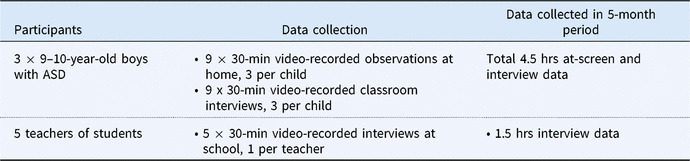
The qualitative case study involved the collection of video-recorded observations and semistructured interviews (Hammersley & Atkinson, Reference Hammersley and Atkinson2007; Pink, Reference Pink2007), which were used to gather data about students’ engagements with online multiplayer games. Data were collected in the three students’ homes through video-recorded observations of at-screen social interactions with Minecraft (Stone et al., Reference Stone, Mills and Saggers2019, p. 14). The researcher collected data at a school and three homes over five months. Table 1 illustrates the number of participants, data collection sessions, and durations of data collection.
Participants, Data Collection Sessions, and Duration of Data Collection

Two digital cameras were used to video record: one functioned to capture the gameplay footage on the screen, whereas the other captured footage of the students in the room as they played Minecraft. Enough data were gathered to reach data saturation for each recurring theme in the analysis (Fusch & Ness, Reference Fusch and Ness2015) and to enable depth of analysis (Pink, Reference Pink2007).
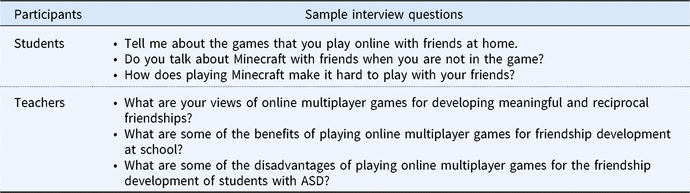
Video-recorded semistructured interviews were conducted to gain participant perspectives rather than relying exclusively on observational data. Student and teacher interviews were conducted at the school. Interview protocols were used to guide the interview process. Questions were asked about the students’ online gaming experiences and how their friendships were positively and negatively influenced in the context of their engagement with online multiplayer games. Table 2 displays an interview protocol for each of the two participant groups. Interview data were transcribed verbatim and included multimodal meanings to ensure the accuracy of participant responses (Halcomb & Davidson, Reference Halcomb and Davidson2006).
Interview Protocol on Friendships for Two Participant Groups

Data Analysis
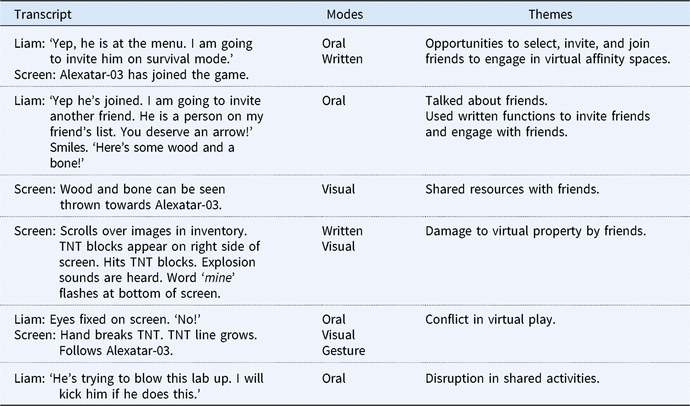
The researchers used an inductive approach to coding by applying techniques of multimodal analysis (Jewitt, Reference Jewitt and Jewitt2017). Inductive coding is a process by which relevant themes that emerge are developed from interpretation of raw data into a framework (Thomas, Reference Thomas2006). The researcher performed multiple readings and viewing of the data to rigorously and systematically identify repeated themes and to regroup related themes to organise the multiple meanings that emerged from the transcribed data (Thomas, Reference Thomas2006). The researcher transcribed the video data, attended to the verbatim statements of the participants, and recorded the relevant movements, gestures, and other nonverbal actions of the participants (Halcomb & Davidson, Reference Halcomb and Davidson2006). Inductive coding continued until no new findings emerged about the potentials and constraints to develop friendships. See Table 3 for examples of how transcripts of at-screen observation data were coded by themes informed by an inductive approach to multimodal analysis, with themes emerging from the data, rather than being predetermined (Thomas, Reference Thomas2006). The semistructured interview data were transcribed and coded in the same manner. Data saturation was reached when no new codes could be generated about how student friendships were developed or constrained in the context of their interactions with online multiplayer games (Fusch & Ness, Reference Fusch and Ness2015). In accordance with multimodal analysis (Jewitt, Reference Jewitt and Jewitt2017), modes such as oral, written, and visual were systematically addressed during the coding (see Table 3).
Multimodal Features and Themes Coded From 20-Second Sample of At-Screen Data

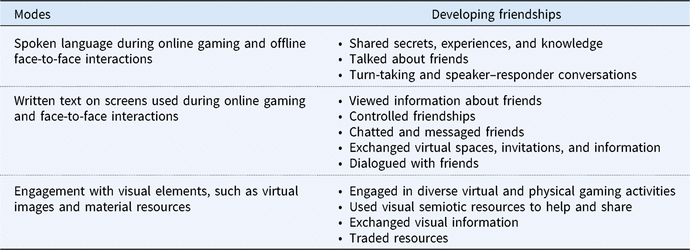
Table 4 and Table 5 synthesise multimodal features and themes that emerged through inductive coding of the datasets (Thomas, Reference Thomas2006). Table 4 illustrates how friendships were developed through oral, written, and visual forms of social communication, and within offline and online affinity spaces.
Modal Features of Positive Interactions With Friends

Modal Features of Negative Interactions With Others

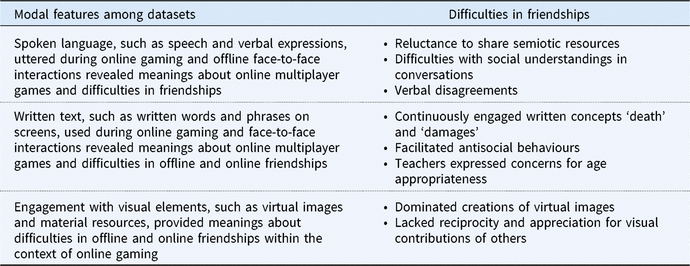
In contrast, Table 5 demonstrates the difficulties in friendship that students experienced through oral, written, and visual forms of social communication, and within offline and online affinity spaces.
Tables 4 and 5 illustrate specific multimodal features of social communication within their broader classification of oral, written, and visual modes, which were interpreted during the data analysis process and which are expanded in the description and discussion of the results.
Results
Data from the at-screen observations as well as the student and teacher semistructured interviews are described in turn to reveal how multimodal features of online multiplayer gaming supported and constrained students’ capacity to develop friendships.
Multimodal Features and Friendships: Findings From At-Screen Observations
At-screen data showed that Minecraft supported students’ initiation and sustaining of social interactions, but difficulties with online friendships also emerged. The descriptions that follow focus on how engagement with the game provided opportunities for students to develop friendships through written communication and images in the virtual environment. Unknown players are referred to as Alexatar-03.
The students shared that they wanted ‘to make friends with’ other online players. Even the term ‘friend’, in its singular and plural forms, was explicitly displayed on the screen approximately 40 times during ‘Liam’s’ (pseudonym) at-screen observations. Some online gamers were referred to by students as ‘best friend’ and ‘my friend’, and some were virtual friends whom they had never met in face-to-face contexts. There were opportunities for students to voluntarily ‘select’ and ‘invite friends’ from ‘friend lists’ to socially interact within virtual spaces. Students’ use of print text on controllers and digital text on the screens offered support to move through different spaces and locations with their friends. Furthermore, opportunities to develop friendships were implicit as students scrolled up and down through digital texts that communicated specific information about friends’ profiles, online statuses, and activities. Likewise, digital texts, such as ‘1,166 currently playing [Minecraft]’, indicated that there were many opportunities for students to make meaningful contact with others in reciprocal ways.
Student discussions and digital writing continually gave insight that they selected activities associated with discourses of ‘death’ and ‘damage’. Examples of written texts associated with the themes of death and damage included ‘was shot by a skeleton’ and ‘become infected’. A variety of written clauses were frequently displayed on the screen. Examples included, ‘remove friend’, ‘kick player’, and ‘turn off console’. These digital and other texts implied that social interactions with friends were constrained if the students with ASD did not reinvite their friends ‘to rejoin [their] servers’, and if their friends did not ‘respawn’ after the students killed their friends’ avatars. To conclude, written screen text revealed meanings about potentials to develop friendships and difficulties in friendships of students with ASD.
In addition to the use of digital text, Minecraft images provided opportunities for students to engage in collaborative and shared play with their friends. The students discussed how they got ‘help’ from their friends to build virtual images, including ‘no-man’s-land’, ships, whales, and villages. They shared that they did ‘jobs’ for their friends and that they shared resources, in particular ‘bows’ and ‘diamond swords’. Comments such as ‘you deserve an arrow!’ and ‘here’s some wood and … some bones for you!’ contributed meanings about how images were used to show levels of kindness to their friends. At times, only their friends’ avatars were ‘allowed in’ their ‘secret’ bases and hideouts where students played with, displayed, and hid ‘valuables’, such as ‘diamonds’. Reciprocal engagements with friends were demonstrated through games such as the hiding and seeking of virtual images. For example, when Liam reciprocated turn-taking in ‘Minecraft Hide and Seek’ his oral request, ‘Is it okay if I be the seeker this time?’ suggested that he wanted to share the role of hiding and seeking of avatar images with Alexatar-03.
Difficulties in friendships were revealed through analysis of the students’ interaction with virtual images. Notably, they demonstrated resistance to other peers’ virtual contributions and disapproval of them. To demonstrate, Matthew engaged with another player to create a ‘Five Nights at Freddy’s pizzeria mat’. Shortly after building began with a square black-and-white chequer pattern, Matthew complained, ‘Oh my God. He keeps on building. No more building, no more building! No more building! Is he still building? Er … he keeps building it wider’. He repeated the word ‘enough’ 18 times, as in ‘That’s enough! Okay?’. Matthew repeatedly positioned his avatar between the Five Nights at Freddy’s mat and the player. He continually destroyed the ‘black-and-white stained clay’ blocks that the player added. The findings revealed that although students communicated disapproval of other players’ visible creations, they did display visual processing biases for images that they personally created. Students revealed that online players may have become bored when the students displayed rejections of other online players’ contributions. They made comments such as, ‘None of them are helping me’ and ‘… he is just sitting there and relaxing’ when other players’ avatars sat and did not mine or build with the students’ avatars.
The students’ destruction of their online friends’ virtual properties occurred through ‘griefing’ and ‘trolling’. Students commented that, sometimes, when they committed these acts their gamer friends ran away from the spaces occupied by the students’ avatars. Their gamer friends made themselves ‘hard to find’, as well as left the Minecraft servers. Furthermore, students shared that, at times, they were ‘kicked from’ servers when they engaged in these behaviours. Alternatively, when they viewed unfriendly behaviours, such as trolls or griefers destroying their property, they kicked these gamers from their servers and made comments, including ‘Get out of my life. Bye, bye. Disappeared. Bye, bye, bye’. The students’ engagements with virtual images suggested there were potentials and constraints to developing their friendships.
Student and Teacher Perspectives of Online Multiplayer Gaming and Friendships
The students with ASD were asked during semistructured interviews to tell how online multiplayer gaming helped their friendships. Their responses indicated that they ‘got along with … a bunch of friends’ who were their online friends and school friends, and that they were ‘mostly helpful’ to their friends during online play. They took turns with their friends to play online multiplayer games at each other’s homes. Students said that they were less likely to ‘kick … a good friend’ from their server. They shared usernames as well as secrets and information about their gaming experiences with their physical-world friends.
Students listed ‘Agar.io’, ‘Ark: Survival Evolved’, ‘Need for Speed’, and ‘Portal’ as some video games that they played online in multiplayer format. Their responses revealed that during school recess times students pretended to make virtual hideouts during play with their friends. They played Minecraft games in the ‘sandpit’ and with the games’ material resources, such as ‘Minecraft toys’. Students regularly spent time drawing images that represented multimodal elements of online multiplayer games, such as virtual characters and their actions.
Findings from the student semistructured interviews extended understandings of the difficulties in friendships that the students experienced in the game. The students were asked to tell if there were any difficult things about playing Minecraft with their friends. Notably, the students explained that they spent from ‘one hour’ up to ‘two weeks’ creating their ‘best builds ever’ and works of art, such as giant fortresses and houses. Despite the potential to create, some online friends wrecked their personal virtual properties. Students were reluctant to socially interact with online friends who cheated and who they considered to be ‘mean’.
The students explained that ‘too much griefing’ and ‘hacking’ by online friends was a negative thing, which made them feel afraid and angry. Therefore, sometimes their responses during virtual conflicts were to get revenge and destroy what other players had built. Some online friends got ‘kicked’ and ‘barred’ from students’ servers when they did not follow the students’ rules. The students’ responses also revealed difficulties in friendships that were manifested within the school context. They indicated that sometimes during recess verbal disagreements occurred in physical Minecraft play with their ‘good friends’. They argued about sharing material representations of Minecraft virtual images, such as toys, and about the ownership of valuable properties, cheating acts, and host privileges. To conclude, the student interview responses gave consistent data about the support and difficulties that the students experienced in their friendships.
Teacher participants were asked to share their perspectives on the potentials of online multiplayer games for developing friendships of students with ASD. They shared that prior to their students’ play with online multiplayer games, some students had only a few friends and were once perceived as being ‘alienated’ and ‘generally isolated’. Conversely, through their ‘interests in online gaming’ the same students became friendlier as they shared their ‘ideas’ and pictorial representation of virtual images with other students. Teachers also suggested that for those students who ‘may not have any friends’ engagement through online multiplayer games may have been the ‘only form’ of interaction that was appreciated and enjoyed to develop friendships.
The teachers were asked, ‘How does playing online multiplayer games make it difficult for your students with ASD to socially interact with friends at school?’. Their responses indicated that there were ‘issues’ and ‘problems’ when students refused to ‘back down’ in arguments with their peer friends. Teachers perceived that ‘the biggest risk’ to the development of peer friendships was students’ ‘overuse’ of video gaming time. Their responses revealed that ‘a lot of’ their students preferred engagements with the games than to involve themselves socially in physical activities that were within the school settings. They suggested that this preference for online gaming seemed ‘very socially restricting’ for developing students’ friendships. Teachers suggested that students may need support to ‘decipher’ how to ‘respond’ during ‘difficult times’ as they engage with their peers online.
Discussion
The discussions that follow synthesise information collected from the at-screen observation data and student and teacher semistructured interviews, and focus on oral, textual, and visual ways for developing student friendships.
Oral Potentials for Developing Friendships
The data revealed that online multiplayer gaming supported students’ engagements in conversations about their online and offline friendships, and to share gaming secrets, experiences, and knowledge with peer friends in the physical world. Students were perceived to be friendlier in conversations across multiple settings since they began to engage with online multiplayer games. Trundle (Reference Trundle, Beavis, O’Mara and McNeice2012) has indicated that online multiplayer games afford gamers to have user-created content, such as their game levels that they can share with other players. Despite the friendship potentials associated with online multiplayer gaming, friendship difficulties included (a) a reluctance to share semiotic resources; (b) difficulties with social understandings regarding reciprocated trust, and the acceptance of friends’ contributions and perspectives in conversations and play; and (c) verbal disagreements about video gaming discourses.
These findings reflect that students with ASD require support to develop understanding of the need for two-way social interactions using the multimodal affordances of multiplayer games. Students may require support for developing social understanding and conflict management skills when there are conversations and disagreements. Reciprocity and social understanding in friendships may include the intrinsic motivation to take turns, share, and appreciate the speech, perspectives, and conversational responses of others within various contexts (Mitchell, Parsons, & Leonard, Reference Mitchell, Parsons and Leonard2007).
The data highlighted practical ways in which the games’ oral potentials may be targeted for students to develop more enjoyable and reciprocal friendships. Students should be provided with opportunities to engage in conversations about spaces in and around video games; game characters/avatars, images, written text, and events; and peer friendships that they wish to develop through online gameplay. Mutual friendships between students are often developed through personal engagement and participation, showing affection, and through sharing of secrets, mutual trust, and loyalty and collaboration (MacArthur, Higgins, & Quinlivan, Reference MacArthur, Higgins, Quinlivan, Carrington and MacArthur2012).
Written Potentials for Developing Friendships
Previous research has suggested that the prevalence of written features in online multiplayer games, such as the friend lists, stimulate the desire to interact with friends (Schmierbach et al., Reference Schmierbach, Xu, Oeldorf-Hirsch and Dardis2012). Similarly, the findings highlighted how the written texts of Minecraft stimulated students’ interest to engage with friends by reading usernames, friend lists, and friends’ gaming profiles, and by visually gathering information about their friends’ online statuses and activities. Additionally, the clicking, typing, and selecting of written texts facilitated students’ potentials and levels of control to embrace and develop friendships. Written texts afforded opportunities to invite and join friends to engage collaboratively, creatively, and competitively in virtual environments. The data suggested that written text not only supported students to connect with peer friends, and to develop offline friendships through shared online gaming participation, but also enabled them to make decisions about their initiation and sustaining of friendships. However, the students still experienced difficulties in friendships, such as the students continuously seeking activities associated with the themes death and damage. At times, they seemed to have difficulties understanding the need to use written texts for prosocial behaviours.
Students with ASD may need support to engage in prosocial online gaming with friends through written text. This is vital given that students with ASD may spend nearly twice as much time engaged with video games that are associated with problem behaviours than their peers without ASD (Mazurek & Engelhardt, Reference Mazurek and Engelhardt2013). Violence in video games may be associated with a decrease in empathic feelings and an increase in aggressive behaviours (Anderson et al., Reference Anderson, Shibuya, Ihori, Swing, Bushman, Sakamoto and Saleem2010; Schmierbach, Reference Schmierbach2010). Scaffolded support and explicit instructions for student uses of the written mode within virtual contexts may be vital also because it is common for engagements with online multiplayer games to be of a competitive or cooperative nature (Greitemeyer, Reference Greitemeyer2013).
Students’ friendship-driven activities and participation in virtual contexts need support to facilitate online connections and to extend existing friendships with peers whom they already know in their physical lives, such as through online chat to other players (Ito et al., Reference Ito, Horst, Bittanti, Boyd, Herr-Stephenson, Lange and Tripp2009). During student online gaming, educators can support peer friendships through encouraging the production of written texts in virtual signs, pages, and books in online message boxes and group chats.
Visual Potentials for Developing Friendships
In digital multiplayer games, players operate and interact with each other through the meaning potentials of images (Twining, Reference Twining2010). Attention to observed interactions with visual elements revealed that students engaged in creative, collaborative, adventurous, and competitive uses of virtual images and their material representations with their friends. They socially interacted with their school friends through shared visual interests, such as drawing, and toys associated with online multiplayer games. Students used the potential of visual semiotic resources for sharing, helping, and showing kindness to their friends, and to engage in conversations with their friends.
The results also showed that, regardless of the friendship potentials offered by interaction with virtual images and their material representations, difficulties in friendships were still evident. The students consistently had a tendency to dominate shared creations of virtual images and their material representations. At times, they rejected the contributions of online and offline friends and made negative comments about the contribution of others while they showed a visual preference for their own images. Findings suggested that their online and offline friends ceased contributing, became bored, and sought to socially interact in other spaces or with other people. The findings are significant in that the students reflected difficulties understanding the need for friends to contribute to social interactions.
The results offer implications for advancing friendships of students with ASD by targeting opportunities to share visual semiotic resources and visual contributions with online peers. Within the classroom context, visual support may benefit students on the spectrum if there is evidence that they do not understand their peer’s desires, feelings, and perspectives, and if they are unaware that their peers’ desires, feelings, and perspectives may differ from their own (Baron-Cohen, Tager-Flusberg, & Lombardo, Reference Baron-Cohen, Tager-Flusberg and Lombardo2013). If students show resistance to change and display visual processing biases, opportunities to develop friendships may be missed. Therefore, educators are encouraged to target and support students’ tendency to be helpful, supportive, and reciprocal to their peer friends through virtual images. It is proposed that educators provide opportunities for students to engage in shared activities through a common interest in virtual images and their visual representations, such as those of Minecraft. This type of support may be considered for students with ASD who display visual expertise, have a visual learning preference, and have been found to benefit from visual supports and scaffolding of social situations (Alvino, Reference Alvino2008). The relevance of shared interests and collaboration among students for developing friendships is an important aspect of inclusive education (Hornby, Reference Hornby2014).
Considering that difficulties in friendships were still evident despite the potentials for friendship development, educators should target the multimodal relationship between visual elements of video games and other multimodal elements to develop friendships. For example, students should be encouraged to create illustrated stories and written texts that convey visual information, meanings, and messages about their online gaming experiences, and to share these literacies practices with their peers. This recommendation evokes a multimodal perspective that interactions with peer friends comprise multiple social communication forms that are co-present and central to meaning making (Kress, Reference Kress2010).
Limitations
A research limitation was the use of observing student engagements with friends in the context of one type of online multiplayer game. Nonetheless, the data reflected that a variety of online multiplayer games were platforms for supporting the students’ friendship development. The researchers exercised caution in not making generalisations from at-screen Minecraft play to other online multiplayer games. As more online multiplayer games develop and attract the interest of student gamers, no specific game will retain its popularity throughout time to add new understandings about the friendships of students on the spectrum.
The limited number of modal elements that were transcribed, described, and reported is acknowledged. For example, during the at-screen observation, the students used other forms of social communication that were tactile, spatial, gestural, and sensory. For example, they used modal elements such as audio, gesture, touch, proximity, and taste during virtual social interactions. These forms of social communication have meaning-making significance for friendship and have been discussed in the existing literature (Moore, Reference Moore2015). However, due to the richness of the data and the time restrictions in which to analyse and report the findings, attention was focused on the principal modes of oral, written, and visual communication. The analysis and reporting of oral, written, and visual modes enabled new understanding of the multimodal nature of the students’ online and offline friendships.
Recommendations for Practice and Future Research
This study offers recommendations for educators, such as teachers, who are continually searching for multimodal and practical ways to support students with ASD to develop friendships, particularly with their peers. Educators are encouraged to provide online and offline affinity spaces for students to chat, connect, and freely express themselves verbally and nonverbally with their peer friends. For example, students may be allowed to play games, or with game-related materials, and encouraged to talk and write about the game with those who have a shared interest. Gee’s (Reference Gee2007) transfer principle suggests that video games afford gamers opportunities to practise social understandings across various contexts. This recommendation draws on Edwards’s (Reference Edwards2016) notions of blended play across traditional and digital contexts and the convergence of digital and analogue play. Support to develop and maintain friendships within affinity spaces and inclusive contexts may have a positive impact not only on friendships but also on social interactions, classroom climates, and learning processes (Santos, Sardinha, & Reis, Reference Santos, Sardinha and Reis2016).
Based on the findings, a related outcome is the recognition that the practices within online multiplayer gaming are a form of ‘inclusive new literacies’ that may provide multimodal support for developing friendships in online and offline affinity spaces. The conceptualisation of inclusive new literacies extends the notion of inclusive education to recognise the rights, literacies practices, and social needs of literacies learners, such as students with ASD, which has not been specifically addressed in the new literacy studies (CRPD, 2016; Street et al., Reference Street, Phal, Rowsell and Jewitt2017). Educators are encouraged to embrace the notion of inclusive new literacies if they are seeking a multimodal approach to mitigate constraints associated with online multiplayer gaming, such as difficulties in relationships. Given the growing rate of individuals diagnosed with ASD, the difficulties that students with ASD face in developing online and offline friendships, and the growth in video game play among primary school students, the provision of multimodal support may be particularly beneficial for students with ASD (Christensen et al., Reference Christensen, Baio, Braun, Bilder, Charles, Constantino and Yeargin-Allsopp2016; Dezuanni et al., Reference Dezuanni, O’Mara and Beavis2015; Kasari, Locke, Gulsrud, & Rotheram-Fuller, Reference Kasari, Locke, Gulsrud and Rotheram-Fuller2011).
Future research may investigate how engagement with Minecraft influences the ability of students with ASD to generalise friendship skills developed through Minecraft play to other social settings. Similarly, research of ASD and friendship formation should be extended to other video gaming platforms across international contexts. This research points to the benefits of attending to multimodal forms of communication to broaden understandings of students’ communication in their everyday digital worlds.
Conclusion
Social interaction difficulties experienced in friendships and other relationships across various environments constitute the characteristics of ASD (Petrina et al., Reference Petrina, Carter, Stephenson and Sweller2016). Given these relationship difficulties, many students on the spectrum will require support to learn about developing and maintaining relationships, such as friendships (Al-Ghani, Reference Al-Ghani2011). The findings have shown that semiotic resources within literacies practices of online multiplayer games provided platforms for students with ASD to develop friendships in virtual and physical environments. The findings offer implications that online multiplayer games may develop friendships of students with ASD in multimodal ways, beyond their physical worlds to their virtual ones, and may support the convergence and bridging of peer friendships across virtual and physical affinity spaces (Edwards, Reference Edwards2016; Gee, Reference Gee2015).