INTRODUCTION
The giant squid Architeuthis dux Steenstrup, 1857 is one of the largest invertebrates and is globally distributed (Sweeney & Roper, Reference Sweeney and Roper2001; Guerra et al., Reference Guerra, González, Dawe and Rocha2004, Reference Guerra, González, Pascual and Dawe2011). A recent genetic study demonstrated that A. dux was the only one species belonging to the family Architeuthidae (Winkelmann et al., Reference Winkelmann, Campos, Strugnell, Smith, Kubodera, Allcock, Kampmann, Schroeder, Guerra, Norman, Finn, Ingrao, Clarke and Gilbert2013). Many stranding and collecting records for adults and subadults of the species have been reported from around the world (e.g. Sweeney & Roper, Reference Sweeney and Roper2001; Guerra et al., Reference Guerra, González, Dawe and Rocha2004). The giant squids have been caught on the continental slope at depths of 300–600 m, mainly by bottom trawl nets (Förch, Reference Förch1998; González et al., Reference González, Guerra, Rocha and Gracia2002; Hoving et al., Reference Hoving, Roeleveld, Lipinski and Melo2004). Photographs of the live giant squid in the wild were first taken by Kubodera & Mori (Reference Kubodera and Mori2005) using a special underwater digital camera logger at a depth of 900 m, off Ogasawara Island in 2004, which provided us with valuable knowledge on their feeding habits. Recently, the first video of a live giant squid in its natural habitat was successively recorded during a research and filming project by NHK and the Discovery Channel, off Ogasawara Island in 2012 at a depth of 630–860 m (NHK & Discovery Channel, 2013). Guerra et al. (Reference Guerra, González, Pascual and Dawe2011) have suggested that the giant squid can serve as an indicator of oceanographic conditions and ocean climate change, and could assist in raising public interest and attention. The species is also expected to be of concern for the conservation of marine biodiversity and ecosystem health.
Sweeney & Roper (Reference Sweeney and Roper2001) reviewed the records of more than 600 Architeuthis specimens from published reports, but there is very little information about the juvenile and young in the early life stages of the species (e.g. Roper & Young, Reference Roper and Young1972; Tsuchiya & Mori, Reference Tsuchiya and Mori1998). In particular, there is missing information on small, young giant squid, ranging from a few hundred to 1000 mm in dorsal mantle length. Here we report three individuals of young A. dux, all of previously unrecorded sizes, caught in Japanese coastal waters during April–June 2013. This paper describes the morphology of the three specimens and provides a brief discussion associated with the reproduction and early life history of the giant squid around the Japanese coastal waters.
MATERIALS AND METHODS
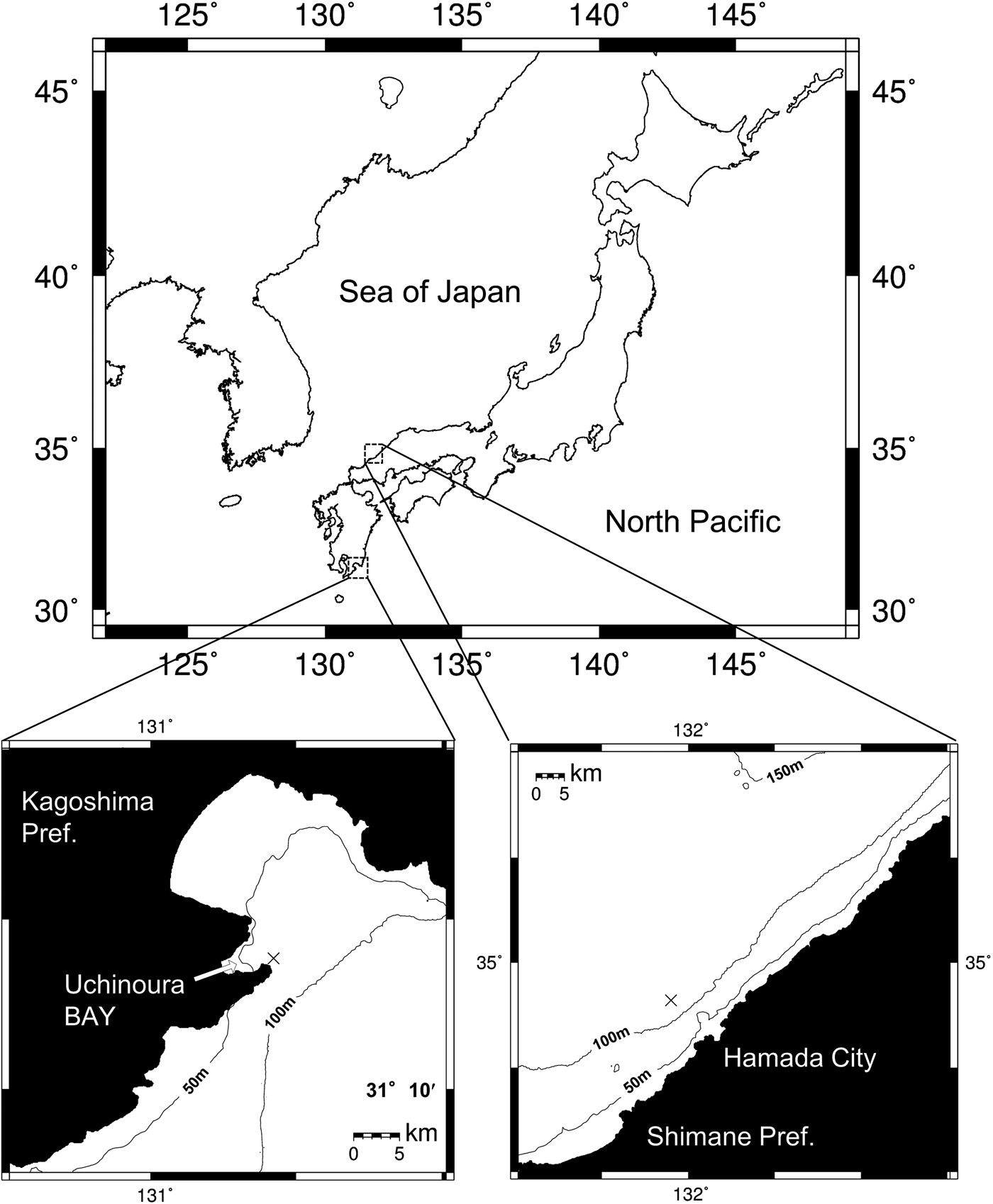
Three individuals of Architeuthis dux were obtained for the study. One was caught by a set net off Uchinoura, Kagoshima Prefecture, southern Japan (31°17′N 131°08′E) on 19 April 2013 (Figure 1). The remaining two were collected using a purse seine net at a depth of 120–130 m off Hamada, Shimane Prefecture, south-western Sea of Japan (34°56′N 131°59′E) on 14 June 2013 (Figure 1). The purse seine net enclosed the area from the surface to a depth of ~100 m. These animals were photographed on the boats immediately after capture and then maintained in freezers. The tissues for DNA extraction were sampled from specimens that had been thawed once. A 1225-bp sequence of cytochrome c oxidase subunit I (COI) from mitochondrial DNA (mtDNA) was extracted and analysed using MEGA 5.02 (Tamura et al., Reference Tamura, Peterson, Peterson, Stecher, Nei and Kumar2011) at the laboratory of the National Museum of Nature and Science, Japan. Extraction, amplification, cloning and sequencing methods follow Carlini & Graves (Reference Carlini and Graves1999) and Winkelmann et al. (Reference Winkelmann, Campos, Strugnell, Smith, Kubodera, Allcock, Kampmann, Schroeder, Guerra, Norman, Finn, Ingrao, Clarke and Gilbert2013). The resulting sequences were deposited in the DNA Data Bank of Japan (DDBJ) with accession numbers LC055429–LC055431.
Map showing the locations where three small, young giant squids Architeuthis dux were found off the Japanese coastal waters during April–June 2013. Each ‘X’ represents the collection areas of the young specimens for this study. The bathymetry data used in this map was obtained from a database in the Japan Oceanographic Data Center (http://jdoss1.jodc.go.jp/vpage/depth500_file_j.html).

Morphometric data were collected according to Roper & Voss (Reference Roper and Voss1983) in the laboratories. Beak measurements were taken based on Clarke (Reference Clarke1986) and Roeleveld (Reference Roeleveld2000). Tentacle measurements were based on Roeleveld (Reference Roeleveld2002) using a flexible band and dress pins. Detailed morphological data such as the beaks and the diameter of sucker ring for each arm were measured with a digital calliper (Mitutoyo Corp., Japan) to the nearest 0.1 mm. The beaks, radula and available sucker rings were extracted and separately preserved in 70% ethyl alcohol. All of the remaining body, including mantle and arms, were fixed in 10% formaldehyde and then transferred to 70% ethyl alcohol. Each specimen collected off Uchinoura (Kagoshima) and Hamada (Shimane) was preserved at Kagoshima Aquarium or Shimane Fishery Technological Center, respectively.
RESULTS
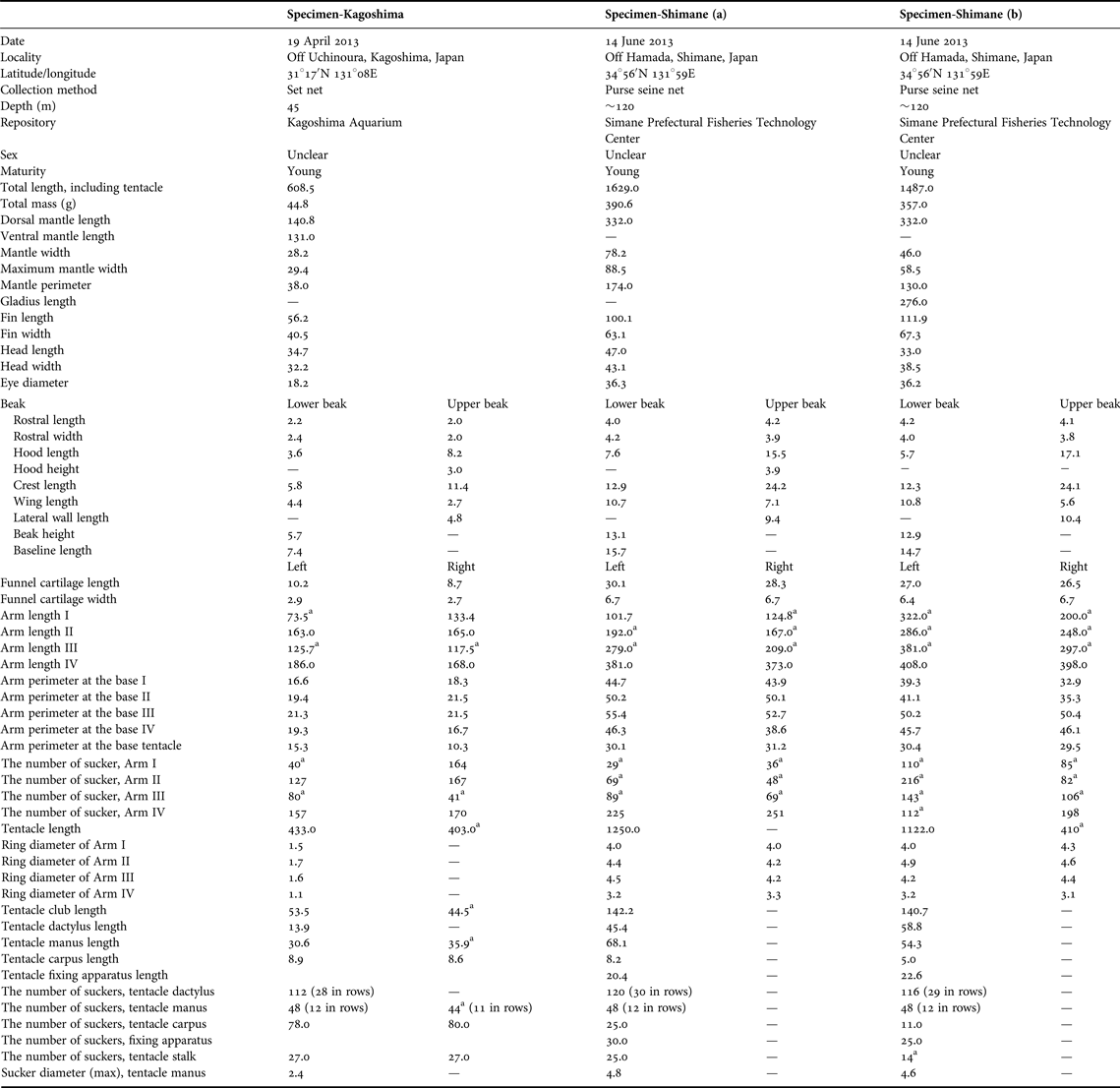
Table 1 shows the records of three specimens of Architeuthis dux, which were captured off the coasts of Kyushu Island and the Sea of Japan from April to June 2013. The first individual, caught by a set net off Uchinoura of Kagoshima, was found to be alive (Figure 2). The paired fin, mantle and arms were almost complete. The fin was oval in shape and located posteriorly. The fin length attained nearly 40% of dorsal mantle length (DML). The dorsal surface from mantle to arms was covered in reddish and fragile skin.
Young Architeuthis dux specimen (140.8 mm in dorsal mantle length) collected at 31°17′N 131°08′E (off Uchinoura, southern Kyushu Island, Japan) on 19 April 2013.
Detailed data of young giant squid Architeuthis dux found on the coasts of Kyushu Island and the south-western Sea of Japan. All linear measurements, unless otherwise specified, are given in millimetres.
a Arms incomplete or suckers missing.
The second and third individuals were caught simultaneously with a purse seine net off Hamada of Shimane (Figure 3). The fins of these two specimens were almost complete, and their length attained about 30% of DML. Several fishes, including a Trachurus japonicas of about 100 mm in total length, had entered into their mantle cavities. The mantle of one specimen had detached from its head and arms at the time of capture. For both specimens, the right tentacles and arms, except for arms IV, were missing.
Young Architeuthis dux specimens (A) collected at 34°56′N 131°59′E (off Hamada, south-western Sea of Japan) on 14 June 2013. Enlarged head and neck area (B) and fin area (C).
The tentacles of all three specimens were extremely long and narrow (Figures 2, 3A & 4A), and attained more than three times DML. The number of suckers on the tentacles was countable on the dactylus, manus, carpus, fixing apparatus and stalk parts (Table 1). The large sucker rings on the tentacle manus carried a lot of small triangular teeth along the distal margin (Figure 4B). The arm formula was IV > II > III > I or IV > III > II > I. The number of suckers for each arm is shown in Table 1. The upper beak had a short rostrum which curled downwards at the tip (Figure 5A). On the other hand, the lower beak was wider with a small hook at the tip (Figure 5B). The radula with transverse rows consisted of seven teeth and two marginal plates (Figure 6). The central teeth had a tricuspid shape and each median cusp was longer than the outer one. First lateral teeth had a bicuspid shape and the medial cusp was longer than the lateral one. Second and third lateral teeth had single cusps, which were longer than the central and first lateral teeth. Marginal plates were flat and oval in shape. Sexes for all three specimens were unclear (i.e. they were immature) because there was no development of reproductive organs.
Tentacle (A) and sucker rings (B) of tentacle manus for young Architeuthis dux found off Hamada, south-western Sea of Japan.
Upper (A) and lower (B) beaks of young Architeuthis dux found off Hamada, south-western Sea of Japan.
Radula of young Architeuthis dux found off Hamada, south-western Sea of Japan.
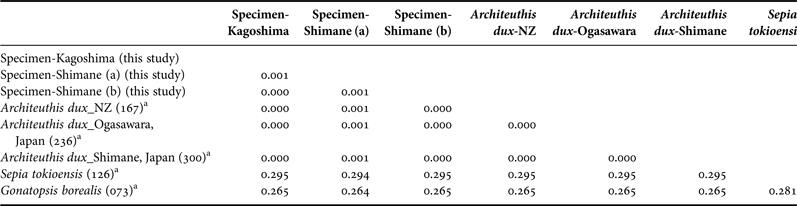
The COI sequence analysis for the mtDNA revealed that the genetic divergence between three specimens of this study and three samples of A. dux hitherto examined from New Zealand, off Ogasawara Island and off Shimane, were less than 0.001, indicating that all of them were genetically the same species (Table 2). For comparison, the genetic divergence between A. dux and two distantly related species, Sepia tokioensis (0.295) and Gonatopsis borealis (0.265), is shown in Table 2. In cephalopods, a genetic divergence of 0.03 is considered the minimum difference between species (Kaneko et al., Reference Kaneko, Kubodera and Iguchi2011).
Pairwise genetic distances (% divergence) between cytochrome c oxidase subunit I sequences (1225 bp) for the mitochondrial DNA among the three specimens of this study and the other five specimens (including three samples of Architeuthis dux) calculated using MEGA5.02.
a Three-digit number indicates museum's registration number at the National Museum of Nature and Science, Japan.
DISCUSSION
The present study revealed the presence of small, young giant squid Architeuthis dux off the Pacific coast of Kyushu Island and the Sea of Japan. Both the morphological and genetic data provided evidence that all of them were the same species. A previous study reported that one juvenile specimen (DML 19.8 mm) of the species was collected from the North-west Pacific off central Japan (Tsuchiya & Mori, Reference Tsuchiya and Mori1998). The collected depth data of the juvenile was relatively shallow (0–140 m), as was that of young individuals in this study. In particular, the smallest individual (Figure 2) of this study may normally occupy shallow water at night because it was captured alive in the upper depth of 45 m in the early morning where it may have wandered into neritic waters. Guerra et al. (Reference Guerra, Rodríguez-Navarro, González, Romanek, Álvarez-Lloret and Pierce2010) have suggested an ontogenetic shift in diet of the giant squid using stable isotope recorded in beaks. Thus, the giant squids may inhabit and migrate through different depths of the ocean depending on the development stage. Another possibility for the occurrence of the juvenile and young individuals near the coast is that they may have drifted there with warm-water currents. The coasts of Kyushu Island and the south-western Sea of Japan have been known to pass through the Kuroshio and Tsushima Warm Current, respectively (e.g. Akitomo et al., Reference Akitomo, Masuda and Awaji1997; Hase et al., Reference Hase, Yoon and Koterayama1999). It is possible that some individuals in the early life stages of this species had come into the coastal area via offshore flow and the upwelling of warm currents.
In comparison with the morphological traits of adult Architeuthis specimens shown in the previous reports (e.g. Lordan et al., Reference Lordan, Collins and Perales-Raya1998; Brunetti et al., Reference Brunetti, Ivanovic, Sakai and Pascual2002; González et al., Reference González, Guerra, Rocha and Gracia2002; Roeleveld, Reference Roeleveld2002; Cherel, Reference Cherel2003; Guerra et al., Reference Guerra, González, Dawe and Rocha2004; Martins & Perez, Reference Martins and Perez2009), the fin-to-mantle length for young specimens of this study was relatively large. By contrast, the tentacle-to-mantle length for young was shorter than that of adults. The relative sizes between beak and mantle length in this study were consistent with those estimated by Roeleveld (Reference Roeleveld2000). The radulae of young specimens resembled those of adults described by previous reports (Roper & Young, Reference Roper and Young1972; Martins & Perez, Reference Martins and Perez2009). Giant squids are pelagic and active predators (Roper & Boss, Reference Roper and Boss1982; Lordan et al., Reference Lordan, Collins and Perales-Raya1998; Kubodera & Mori, Reference Kubodera and Mori2005). Regueira et al. (Reference Regueira, Belcari and Guerra2014) have mentioned the indirect evidence of a weak relationship between the size of the tentacular club and the prey size. This study detected some slight differences for the lengths of fin and tentacle between young and adult specimens of the species, which may indicate differences in lifestyle, such as in migration and feeding.
Our results also showed that two young A. dux of almost the same size were simultaneously caught by a purse seine net. Giant squids are generally believed to be solitary migrants because they are always collected individually. To our knowledge, this is first record of a simultaneous capture of paired giant squids, except for the capture of only beaks. In the diamond squid Thysanoteuthis rhombus, their occurrence in pairs of almost the same size has often been found near the surface of the ocean (Nishimura, Reference Nishimura1966; Okutani, Reference Okutani1982; Yano et al., Reference Yano, Shimizu and Kosuge1998). However, it remains unclear as to why the pairs of T. rhombus move closely together because they include both male–female and single-sex pairs. It is highly possible that the two young giant squids had been swimming in close proximity to each other due to their collection by purse seine net at an almost-fixed point. This finding may provide a valuable insight into the migratory behaviour of large-sized oceanic squids. Moreover, the depth data may indicate that young giant squids usually inhabit relatively shallow coastal waters.
Recently, unusual mass findings (more than 20 individuals during four months) of the giant squid A. dux have been recorded in Japanese coastal waters, especially from the coast of the Sea of Japan (Kubodera et al., unpublished data). It has been reported for the many stranding records of the species that the migrations arriving in the Sea of Japan by warmer waters and would not involve their reproduction (e.g. Kubodera, Reference Kubodera2004). Although nothing is known of the spawning areas of the giant squid A. dux, the presence of juvenile or small, young individuals should be useful for the presumption of spawning grounds. The collection areas of young specimens shown in this study may imply a possibility of reproduction at the surrounding oceanic area.
Not only do giant squids receive public interest and attention from humans but also they are one of the top predators of marine ecosystem organisms, thus providing valuable information regarding our concern for oceanographic conditions and the conservation of marine biodiversity (Guerra et al., Reference Guerra, González, Pascual and Dawe2011). Therefore, more specimens, including previously unrecorded sizes of young individuals and their associated information, is required to address and understand the reproduction traits and early life history of the species.
ACKNOWLEDGEMENTS
We thank the captains and crews of the Shioji Maru at Uchinoura, Kagoshima and the Yoshikatsu Maru at Hamada, Shimane, for collecting the specimens used in this study. We are also grateful to Alexander M. Kerr of the University of Guam Marine Laboratory for kindly reviewing the manuscript, and two anonymous referees for their critical comments and helpful suggestions.