Introduction
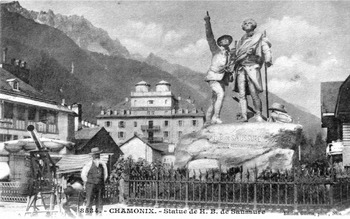
On 28 August 1887, the astrophysicist Jules Janssen, acting President of the French Academy of Sciences, was asked to give a speech in Chamonix, Savoy. The small village was undergoing rapid development due to the rising popularity of mountaineering, the establishment of several hotels, and its increasing accessibility. Above all, it was quickly becoming the base camp for climbing the highest mountain of the Alps, Mont Blanc. To celebrate their recent fame, the people of Chamonix erected a bronze monument in the central square. Sponsored in part by the French Alpine Club (FAC), it portrayed Horace-Bénédict de Saussure, most responsible for drawing attention to the scientific interest of high mountains, who had offered a reward to the first person who would find a route to the summit. Next to him stood Jacques Balmat the hometown hero, his finger pointing at the mountaintop as if to say that only local guides could show the way. In August 1786, however, it was not Saussure that Balmat had led to the summit but Gabriel Paccard, a local notable already falling into oblivion despite the wealth of scientific data he had harvested during the first ascent of Mont Blanc (Beer and Hey Reference Beer and Hey1955). In the last decades of the nineteenth century, the FAC was more thoroughly involved with science than most of its foreign counterparts (Maury Reference Maury1936; Lejeune Reference Lejeune1988). Mountain exploration, the monument in Chamonix proclaimed, relied on close collaboration of world-class scientists with local guides (fig. 1).
A postcard by Jean Giletta portraying the statues of Horace-Bénédict Saussure and Jacques Balmat erected in Chamonix in 1887. Balmat's finger as well as the public telescope at his foot are both pointing at the summit of the Mont-Blanc and at Janssen's Observatory visible thence from 1893 to 1909.

Janssen had always masterfully mobilized such collaboration for his scientific enterprises. Speaking at the monument's unveiling, Janssen fired a round of mixed metaphors at overspecialization in the sciences: “it is desirable,” he said, “that without leaving one's area of specialty one sometimes climbs to the heights reached by Saussure in order to gaze over both the plains and the relations between the various branches of science.” Janssen's own discoveries in spectral analysis lay at the intersection of physics and astronomy. They were due, he explained, to “the vistas” offered by interdisciplinarity. In front of an audience of mountaineers, the astrophysicist drank to “intellectual alpinism,” a new branch of science he promised to bring to the attention of the Academy.Footnote 1 What he ended up telling his colleagues, however, was not intellectual alpinism, but the possibility of founding a permanent observatory for “physical astronomy, terrestrial physics, and meteorology” on the top of Mont Blanc (Janssen Reference Janssen1890a, 446).
From today's point of view, it is easy to fall prey to the exoticism and idiosyncrasy of Janssen's scientific career (Launay Reference Launay2008). Nothing seems farther from our conception of science than Janssen's enthusiasm for “intellectual alpinism” and his emphasis on Humboldtian interdisciplinarity over specialization, and Saussurean adventures in the field over routine work in laboratories or observatories. In this view, the establishment of this short-lived, peculiar institution anchored in a glacier on the top of Europe would appear as little more than the last eccentricity of an odd figure in the history of French astrophysics. In this article, we would like to claim, on the contrary, that controversies and debates notwithstanding, Janssen's efforts at establishing the MBO not only fit squarely into the regime of French turn-of-the-century astrophysics, but also that they can shed light on some crucial issues concerning the respective roles of various scientific infrastructures of that regime. We will show this by considering the MBO as a hybrid space, a “heterotopic” place (Foucault Reference Foucault2001, 1574), uncomfortably situated between the field, the observatory, and sometimes even the laboratory.
After the defeat of 1870 by the Germans, French scientists and politicians agreed that science should be pursued vigorously but rigorously. Modern laboratories and observatories were established throughout the country reflecting the positivistic belief in high-precision experimentation and observation (Boistel Reference Boistel2005). By the turn of the century, each discipline was defined by its own dedicated institutions, standard instruments, investigation procedures, and specialists. Historians have only recently begun paying attention to the way in which the field sciences adapted to this new regime of disciplinary and high-precision science. As a result of the “laboratory revolution” (ca. 1840–1880), the categories of field and laboratory were arguably coinvented (Kohler Reference Kohler2002; for a recent review of laboratory histories, see Kohler Reference Kohler2009 and Gooday Reference Gooday2009). While laboratory scientists drew credibility by enhancing the “placelessness” of their working environment, that is, the capacity to erase any dependency of their results on the special places where they were produced (Gieryn Reference Gieryn2002), field scientists, for their part, had to find other strategies to bolster their credibility. As Kohler explains, they drew on the cultural trope of the adventurous explorer, strove to reproduce laboratory conditions in the field, or focused on phenomena unobservable in the laboratory (Kohler Reference Kohler2002, 10–11). Despite the dominance of laboratory science, hybrid practices between the field and the laboratory were developed. While Kohler set out to explore the cultural geography of the “field-lab border” in biology, Gieryn showed that the validity of scientific claims in urban sociology could increase by going back and forth in what he called “lab-field shuttle,” that is, by continuous shifts in the relationship established between scientists and their object of study – in his case, the city of Chicago (Gieryn Reference Gieryn2006). Alternatively considered as the contingent place where data were gathered and as the object to which theoretical considerations should apply in priority, Chicago therefore was both field and laboratory for urban sociologists of the Chicago school, and it was in the process of going from one conception to the other that the contours of their discipline took shape.
The authors of the present article have begun exploring the relationship between field, laboratory, and observatory science in the domain of astronomy and astrophysics (Aubin Reference Aubin2002; Le Gars Reference Le Gars2006 and Reference Le Gars2007), disputing for instance the claim that astrophysics hinged on letting the laboratory enter the observatory (Schaffer Reference Schaffer and Buchwald1997). In astronomy, the demarcation between open and enclosed sites of knowledge production at first sight seems less radical than in biology (Aubin, Bigg, and Sibum, forthcoming). Indeed, one could argue that the observatory occupies a middle ground between laboratory and field. Knowledge produced in observatories was “de-placed” using strategies other than those in either the field or the laboratory. Its placelessness was only relative, as it hinged on the close attention paid to the particularities of the spot on earth where it was produced: e.g., precise geodetic coordinates and an extensive study of meteorological conditions were needed to make the data universally comparable. A crucial way to de-place the observatory was to incorporate it into extensive networks of observation spots, about which a wealth of knowledge has been gathered over the years – one may for example think of the high prominence of “Paris” in the works of Parisian astronomers such as François Arago (Aubin Reference Aubin2003, 81).
Many observation spots used by astronomers however were field stations – makeshift camps, private rooms, or ships' decks. When some phenomena such as eclipses or transits of Venus could be studied only in the field, scientists strove as much as they could to reproduce observatory conditions wherever they went (Pang Reference Pang2002; Aubin Reference Aubin2006).Footnote 2 Procedures developed to combine observatory data with field observations are complex and need not concern us too much here. But one clearly sees that the borderland between field and observatory therefore seems more continuously populated than the lab-field border. Examining the social underpinnings of a scientific institution such as the Mont Blanc Observatory (MBO) helps circumscribe the perimeter of that borderland. We would like to claim that the ways the field is defined differ depending on whether it is opposed to the observatory or to the laboratory. In other words, coinventing the field together with the laboratory or with the observatory yields different outcomes. Thus, what is supposed to distinguish the MBO from a field station are not necessarily the same characteristics as those emphasized by Kuklick and Kohler (Reference Kuklick and Kohler1996). According to them, interdisciplinarity and greater social diversity for example were characteristics of the field sciences, but scientists working in observatories whose concerns often included, besides astronomy, geophysics and meteorology were hardly less interdisciplinary. People encountered on field sites might have been only slightly more varied socially than those allowed to enter the observatory: kings, navy officers, scientists, instrument makers, young assistants, amateurs, wives, and children, etc. But for astronomers, we claim, an observatory was different from a field station on at least three important counts: (1) observations in the observatory were carried out on a regular, hopefully continuous basis; (2) instruments stayed on site in the observatory: they were precisely calibrated, well-known through published descriptions and often better than portable ones; and (3) observatories were part of ever expanding networks of observation sites.
As we shall see, the MBO's status as an observatory was problematic on these three counts. At the turn of the century, to reach the summit of Mont Blanc was no longer an exploit that captured attention, but neither was it an easy stroll. The walk was trying, and remains so; it requires proper equipment, guides' support, and considerable resolve (Serviss Reference Serviss1896). Self-registering machines broke down and could not be repaired for months. Moreover, to make one's effort worthwhile, routine work never seemed sufficient. New results were required: they were a vital necessity, the only way to justify an expedition and indeed the very existence of the MBO. So, while every effort was made to transform the observatory into a standard data point in observational networks, that is, to achieve the relative placelessness that is characteristic of the observatory culture, the only way to justify this eccentricity in social and scientific terms was to bolster its character as an exceptional place that hinged on its being positioned at a very singular spot – on the top of Europe.
The Many Foundations of the Mont Blanc Observatories
Janssen was not the first to imagine that an observatory could be established on Mont Blanc. For Paccat and Saussure, it went without saying that the goal of a climb was not athletic, but rather scientific. When Mont Blanc started to draw savants' attention in the eighteenth century, it came uncluttered with myths and legends and attracted attention because “there was no other point on the Earth that provided geology, meteorology and general physics with a more fruitful field for experimentation, with a more favorable observatory” (Durier Reference Durier1877, 4). Mountains were often symbols for religious or mythological beliefs: the Mont Blanc stood for science.
In the 1890s, altogether three different observatories were set up on the mountain. At the 1887 ceremony mentioned above, FAC President Charles Durier praised the wealthy alpinist Joseph Vallot (1854–1925) for having just spent three consecutive days on Mont Blanc. Having shown it was possible to survive the night at such altitudes, Vallot immediately began planning a permanent refuge near the summit (Vallot Reference Vallot1888, 57). Independently wealthy, he had a small station carried up by his guides to a site known as the “Rocher des bosses” at about 4400 meters. Vallot's wooden cabin was divided into two: one part served as refuge and was open to everyone while the other part was the observatory proper fitted out with self-registering meteorological instruments that Vallot planned to crank up every fortnight.Footnote 3
But to Janssen the whole business had inspired more ambitious plans. After his Chamonix speech, he went up the Brévent, a mountain facing the Mont-Blanc and observed a few spectra. The thinning of the atmosphere with altitude could be used to determine whether oxygen bands in the solar spectrum were due solely to the terrestrial atmosphere or whether oxygen was also present in the solar atmosphere. On the spot, he designed a research program to settle the question by comparing measurements made in various locations (Janssen Reference Janssen1888). The following year, (he had meanwhile become FAC honorary president) he set-up a “chalet-observatoire” at the Grands-Mulets, at roughly 3000 meters above sea level, where a refuge was already standing (Janssen Reference Janssen1890a, 432; Reference Janssen1890b, 396). Finally, in 1893, Janssen inaugurated still another observatory. Solidly anchored in an ice bed at an altitude of over 4800 meters, this station was wholly different from all previous high-altitude observatories in France, where, like Vallot's, meteorology was the main purpose and astronomy never more than a sideline. In Janssen's observatory, on the contrary this hierarchy was reversed, a difference reflected in design: while Vallot's station was on the flank of the mountain and protected from the heavy gales, Janssen's observatory sat on the glacier, exposed to the elements. In the observatory, an array of scientific inquiries was conducted: nearly 25 scientists took part in about 50 expeditions between 1896 and 1906. A telescope, a siderostat, and long-running meteographs were set up in the observatory (Janssen Reference Janssen1894). Staying up to 13 days on the summit, scientists attempted to photograph the solar corona and detect solar radio-waves; they observed zodiacal light and the interior planets; they observed spectra of Jupiter and Saturn; they determined the intensity of solar radiation; and they counted red blood cells in human bodies (Malherbe Reference Malherbe1987 and Reference Malherbe1993).
At more than 4000 meters above sea level, social realities could be twisted and the single-handed effort of a wealthy adventurer was allowed to compete with the creation of an academician. Indeed, Vallot's observatory has survived to this day, while the MBO was dismantled in 1909. In fact, the MBO differed markedly from many amateur observatories established then. In the scientific literature and the international press, Janssen's observatory clearly overshadowed Vallot's. While the latter was locally conceived by a single man, the former drew on central social, practical, and epistemological networks in turn-of-the-century France. Janssen himself had an acute sense of the ways in which observatories were tied to society: “I need not say that I do not suggest moving large observatories to rebuild them on elevated sites. Large observatories must stay in intimate relation with great intellectual centers” (Janssen Reference Janssen1890b, 396 n.). Like large observatories and other scientific institutions, the MBO put various knowledge sites in relation with one another: let us see how.
The Scientific Foundations of the Mont Blanc Observatory
“The time has come when science will make a very great use of the mountain,” Janssen wrote after his first ascent (Janssen Reference Janssen1888, 3). In 1892, he again emphasized that mountain science “needed stable stations, true laboratories where one can sojourn and carry out necessary experiments” (Janssen Reference Janssen and Déherain1929–1930, vol. 2, 277). The world of mountains hardly was foreign to him (Launay Reference Launay2008). In 1858, his first attempt at mountain science had almost killed him. Intent on following in Alexander von Humboldt's footsteps, Janssen had planned to carry out magnetic observations on the Chimborazo in Ecuador. But he fell so sick, as a dysenteric fever developed into a liver infection, that he barely recovered from what his doctors termed an “almost fatal infection” before he sailed back to France.Footnote 4 Despite this unfortunate episode, Janssen never ceased to be drawn to the mountains and, by the late 1880s, he was an experienced high-altitude spectroscopist. Inspired by Gustav Kirchhoff and Robert Bunsen, he started to study “telluric lines” in the solar spectrum, that is, absorption lines produced by the terrestrial atmosphere when it filtered solar radiation (Aubin Reference Aubin2002; Le Gars Reference Le Gars2007). This work led him to the Alps where, by choosing observation stations at various altitudes, he hoped to determine which part in the daily variation of the solar spectrum was caused by the atmosphere. This was the program Janssen carried out atop Mount Faulhorn in September 1864.Footnote 5 From then on, Janssen frequently traveled to the mountainous areas of the world. Just after he settled in the Physical Astronomy Observatory established at the government's expense in Meudon, near Paris, in 1876, Janssen became the honorary president of the committee overseeing the Meteorological Observatory of the Pic du Midi, in the Pyrenees (Sanchez Reference Sanchez1999; Davoust Reference Davoust2000).
Janssen only visited this observatory more than a decade later, following his tour of the Chamonix region in the fall of 1887, taking up on this occasion the spectroscopic study of oxygen. The high altitude allowed him to observe spectral lines already observed in the laboratory but never in low-altitude solar spectra. He hoped to establish whether the sun's atmosphere contained oxygen in its standard molecular form O2 (Janssen Reference Janssen1887). In 1888, he was carried, together with his Dubosq spectroscope, up to the Grands Mulets where he measured the decrease in intensity of oxygen bands in the solar spectrum (in Fraunhofer groups A and B, as well as α). He concluded that these rays and bands were produced by the earth's atmosphere, but he did not exclude the possibility that oxygen might be present in the sun in a different state. To test this hypothesis, Janssen decided to climb even higher. On 20 August 1890, he signed the guestbook in Vallot's station. Staying inside due to bad weather conditions, the station proved too cramped for that operation. Janssen then proceeded to the very top of Mont Blanc. The observations made with his old Dubosq spectroscope confirmed those he had made at the Grands Mulets, in his Meudon laboratory, and on the Eiffel Tower. He seemed convinced that oxygen was absent from the solar photosphere: “at least oxygen so constituted that it can exert on light the same absorption phenomena it produces in our atmosphere . . .. I trust this fact to be definitively ascertained” (Janssen Reference Janssen1890a, 444).
Janssen's notebooks and letters testify to the exceptional observation conditions he found on Mont Blanc. On 15 October 1888, after his ascent to the Grands Mulets, he noted for example that around the F region of the solar spectrum, as well as between C and D (according to Fraunhofer typology), all the lines were thin. There was no trace of a “shadow,” he wrote. Later, he observed around D: “there only are sol[ar] lines properly speaking – all is clean,” meaning that no telluric lines or bands were to be seen (Janssen Papers, 4130). Around the C line, none of the telluric lines were to be seen. One of the scientific dreams of his life seemed within reach: to observe the solar spectrum directly without the disturbance caused by the terrestrial atmosphere. Of course, more precise experiments in the laboratories of Meudon as well as on Mont Blanc were needed to ascertain all this, but Janssen was convinced that there was enough scientific justification to establish a permanent observatory on top of the mountain.
Back in the lowlands, Janssen wrote several riveting accounts of his ascensions, where science and adventure mingled happily with patriotism. On 22 September 1890, Janssen reported to the Academy (Janssen Reference Janssen1890a). Like other accounts of Janssen's about his expeditions to Mont Blanc between 1888 and 1893, this report was reprinted in the Annuaire du Bureau des longitudes, the Annuaire du Club alpin français, as well as in the scientific popular press in such journals as La Nature and the Revue scientifique. The MBO was likewise mentioned several times in the newspapers. Promising nothing less than solving the problem of extraterrestrial life by demonstrating that one of the most important elements for terrestrial life – oxygen – exists on the sun and other planets, Janssen was sure to draw attention. Further, by emphasizing that it was France's duty to put a permanent station on the highest point in Europe, Janssen transformed a scientific quest for pure skies into a patriotic adventure that would mobilize a variety of actors.
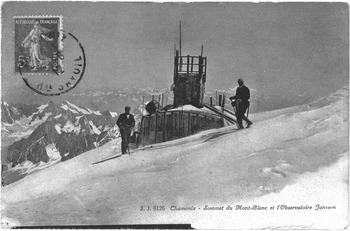
At this stage in the project, the specific character of the spot where Janssen planned to locate his observatory was absolutely central for mobilizing a wide range of contributors. Indeed, his wish to establish the observatory on the very top of Mont Blanc had to do with patriotism and publicity as much as with science. Even when he wrote that “observations made on mountain flanks are always stained with errors due to the influence of the slopes on the direction of winds, temperature, etc.” and that “only those made on the summit are beyond reproach” (Janssen Reference Janssen1900, 319), his concern for the public visibility of his observatory was never far behind. The great number of postcards and photographs that were published picturing the MBO (see fig. 2) clearly show that its setting has been carefully selected on the North side of the ice dome “a few meters below the culminating point, in a manner which, among other necessities, made it visible from Chamonix” (Vivian Reference Vivian1986, 107). Presumably, the finger of Balmat's statue on the town's central square pointed for about fifteen years to nothing else than the MBO (fig. 1).
A postcard showing the Mont Blanc Observatory with alpinists. In this late view the observatory is almost completely buried in snow. Note the tip of the telescope on the left.

The Social Foundation of the Mont Blanc Observatory
As Alex Pang (Reference Pang2002) has written, eclipse expeditions in the second half of the nineteenth century generally relied on the colonial infrastructure, even more than the infrastructure relied on the expeditions. Similarly, one could argue that the MBO was built chiefly because it now was possible. Besides, according to Janssen, “Mont Blanc is such a famous mountain” that any information about it was bound to be interesting (Janssen Reference Janssen1891, 180). To better characterize the scientific place of the MBO, it is helpful to understand the way in which various people, from the President of the French Republic to modest guides, became involved in its establishment.
On 23 August 1892, Janssen went to Fontainebleau “where and in slightly special circumstances,” he was received by President Sadi Carnot (the nephew of the famous physicist of the same name). They discussed Janssen's project and Carnot accepted an honorary membership in the Mont-Blanc Society (MBS) that Janssen was forming: “his moral support already is considerable and I will be satisfied with it” (Janssen Papers, 4133, 332). Founded the year before, the MBS became a mainstay on Janssen's social agenda (the names of its members are listed every year in his diaries). This society was composed of a few high-profile contributors, wealthy businessmen, and aristocrats. All gave large amounts of money to the enterprise. The banker Raphaël Bischoffsheim (1823–1906), who had already donated the funds for the Nice Observatory (Le Guet-Tully Reference Guet-Tully2005), gave 140,000 francs. The Prince-scientist Roland Bonaparte (1858–1924) donated 100,000 francs.Footnote 6 Baron Alphonse de Rothschild and Count Henry de Greffulhe (the inspiration for Marcel Proust's duc de Guermantes) also “spontaneously” (Janssen Reference Janssen1891, 179) offered their help.
While the very wealthy sponsored the project, the architect Gustave Eiffel, who was Janssen's personal friend, enthusiastically provided the expertise needed for studying the feasibility of the project (Carmona Reference Carmona2002, 473–476). Eiffel's workshop prepared the technical drawings for a metal structure with a rotating dome to be erected when a solid foundation was found. Taking over all expenses, he sent a team headed by the Swiss engineer Xaver Imfeld (1853–1909) to survey the glacier, who spent a trying summer digging a 50-meter long tunnel under the glacier in the vain hope of finding the bedrock (Durier Reference Durier1891). The work was more than trying for the guides, as one of them died during an outing. In a letter to Janssen, Imfeld wrote: “Our life here is miserable, and I would not stay one more day if my honor was not more or less engaged in the enterprise” (Janssen Papers 4133, 330).
But results were disappointing and Imfeld finally left the site, forcing Janssen to take over the supervision of the work (Janssen Reference Janssen1891, 574). Only ice was found and Eiffel threw in the towel. Having first declared that the observatory “necessarily needed to rest on a solid rock” (ibid., 180), the astronomer continued: “I do not consider it impossible to establish a building on the hard and permanent snow that forms the summit of Mont Blanc” (ibid., 575). The next winter, Janssen conducted full-size trials in Meudon (Tissandier Reference Tissandier1893, 289). On a one-story high hump of snow, Janssen tested the pressure it could bear using lead disks. Over the next 15 months, a second test was carried out in situ with a model (Janssen Reference Janssen1892). It is interesting to note that on that occasion the astrophysicist paid no attention whatsoever to the work in glaciology that other scientific alpinists were pursuing at the time. Although it is unclear whether this might have helped him build a more stable observatory, the exhibition of motion in glaciers should have dampened his enthusiasm somewhat (Hevly Reference Hevly1996). Clearly, Janssen's goal here was not scientific but merely practical.
Relying on funding from wealthy donors, the expertise of engineers, and the support of politicians, Janssen also needed the working power of his guides and porters. Since 1879, the Compagnie des guides of Chamonix was strictly organized. Guides were required to take turns in leading expeditions, but an exception was made for scientists, who were allowed to select their own guides (Rouseau 1879, 12). Among them, Janssen especially distinguished Frédéric Payot (Janssen Reference Janssen1890b, 399; idem 1891, 576). In his private notebook, Janssen noted the names and physical traits of all his guides. In 1888, after repeatedly slipping off his mule, Janssen had to be carried up on a chair (Jansen's Paper, 4133, 292). In 1890, and again in 1893 and 1896, he had actually been hauled on a sled by more than twenty guides, priding himself on being the first person to “reach the summit without any physical effort” (Janssen Reference Janssen1890a, 445). Earlier, the manliness of mountaineering had been associated with, e.g., the practice of mathematics among Cambridge wranglers (Warwick Reference Warwick2003, 216–217; see also Hansen Reference Hansen1995). Similarly, while in the 1870s and 1880s the laboratory was considered “a place to mold character . . . and to instil respect for painstaking manual labor,” this belief was starting to lose its force in the 1890s (Servos Reference Servos1986, 614). At the MBO, the physical and moral efforts needed to reach the observatory clearly were not the primary goal.
As Arnaud Saint-Martin (Reference Saint-Martin2008) has shown, around 1900 the professional community of astronomers working in a network of a dozen French observatories was highly structured and formed a “scientific field” (in Pierre Bourdieu's sense) characterized in particular by a “scientific-bureaucratic” regime of science production. In such observatories, work was organized in terms of “services,” that is specific tasks that astronomers qua civil servants performed regularly for the public good (the “service de l'heure” for example, supplied the official time to various users; see Bartky Reference Bartky2000). This professional community was involved in the MBO. The 33-centimeter telescope that was carried and set up in 1896 was built by Gautier, a major provider of instruments to public observatories. Gautier's technicians Lelièvre and Dandrieux had to climb to the observatory several times to set it up. The optical parts of the telescope were contributed by the Paris Observatory's Henry brothers (Janssen Reference Janssen1896, 586). A staff member of this observatory, Guillaume Bigourdan, also took part in early expeditions to the Mont Blanc observatory.
Even though Vallot dismissed the MBO as the “State observatory” (Vivian Reference Vivian1986, 108) because of the small subsidy it had received from the government, it remained a private enterprise.Footnote 7 The Meudon Observatory directed by Janssen, albeit fully funded by the government, was at the margin of the scientific field of bureaucratic astronomy.Footnote 8 Different statutes applied; its main field of inquiry (“physical astronomy”) was distinct (Le Gars Reference Le Gars2007); and its personnel were different. At Meudon, as well as at the MBO, young enthusiasts, employees of State administrations (the Army or the Post and Telegraph Office), grand amateurs, and good-willed foreigners provided much of the workforce.
Although the MBO benefited from the enthusiastic support of a great variety of people, the enterprise also faced considerable opposition. Every decision in the process encountered resistance. At first, some felt that it would be impossible to survive more than a few hours at such heights. Such reservations were reinforced by Jacottet's death during a stay at Vallot's station from a disease linked to altitude (Richalet Reference Richalet2001). Later, when Janssen decided to build his observatory on ice, Vallot himself turned skeptic: “it would be mad to try and build it on ice” (Vivian Reference Vivian1986, 90). Scientifically speaking, some were dubious about the advantages singled out by Janssen. An astrophysicist explicitly wrote that the scientific profit to be expected was perhaps not worth the trouble (Cornu Reference Cornu1890, 947). Even frequent visitors would sometimes concur, feeling that the rough conditions of observation made their hard-won results unreliable (Crova and Houdaille Reference Crova and Houdaille1896, 932). Alpinists made ironic remarks about the “costly and useless observatory on the summit of the Mont Blanc” (Lefébure Reference Lefébure1904, 148). In order to assess the scientific value of the MBO, we need to delve deeper into its activities.
The Spatial Intricacy of High-Altitude Stations
As we have seen, due to its extreme remoteness, the originality and legitimacy of the MBO lay in the possibility of performing observations or carrying out crucial experiments impossible to envision elsewhere. Remoteness, however, never meant complete isolation. On the contrary, the mountain observatory was squarely located in extensive networks that linked together various science settings and without which it would have been useless. In almost all articles written about observations carried out at the MBO, authors specified all the other sites besides Mont Blanc where they had worked – urban laboratories, small universities in the provinces, intermediary stations or refuges on the mountain itself, other summits, balloons, etc.
Following the Latourian model, one may say that by its very nature any scientific institution needs to insert itself into, and develop around itself, extensive networks of connections. But, as we argued earlier, the de-placement of knowledge produced in observatories hinged on their insertion into special kinds of networks: the interrelation of various heterogeneous observation spots where a wealth of local knowledge was available. The MBO in particular became a special reference point in sets of measurements aiming at establishing the way different phenomena varied as a function of altitude. When he conceived his project, Janssen wrote that one of the goals of comparing observations in the plains with those in a station at high altitude would be “to predict the result at the limit of the atmosphere itself” (Janssen Reference Janssen1888, 5). “The Mont Blanc massif on which there are a certain number of stations at different altitudes,” Maurice de Thierry further wrote, commenting on his attempts to determine variations in the relative concentration of ozone and carbon dioxide with respect to altitude, “provides especially favorable conditions for the studies I have undertaken” (Thierry Reference Thierry1897, 460; see also Thierry Reference Thierry1899). Similarly, the effect of altitude on a range of measured quantities was investigated, for example, the intensity of gravity by Bigourdan who compared the values he found with those he had obtained in Chamonix, Paris, and Meudon (Janssen Reference Janssen1895b, 391–392). Each time, measurements at the summit were integrated with data series from Meudon, the Paris Observatory, the Vallot station, a range of intermediary stations such as the Grands-Mulets, nearby mountains such as the Brévent, hotel rooms in Chamonix, or other laboratories (cf., e.g., Bayeux Reference Bayeux1910, 450).Footnote 9
Besides the vertical integration of sites at different altitudes, one may say that high peaks were horizontally integrated with one another. Some of the observations made by the Russian astronomer Alexis Pavlovich Ganskiy can be counted among the latter. After having worked on lunar photography, Ganskiy – whose name in French was most often transliterated as Hansky at that time – assisted Janssen at Meudon until 1905 when he was hired at Pulkovo (see Ganskiy Papers; for several interesting photographs taken by Ganskiy during his missions to the MBO, see the collection of the Russian Academy of SciencesFootnote 10). During his stay at the MBO in 1904, Ganskiy was able to measure the solar constant of radiation, that is, “the number of degrees by which one gram of water at 15° centigrade would be raised, if there should be used to heat it all the solar radiation which passes at a right angle in one minute through an opening one centimetre square, located in free space, at the earth's mean solar distance” (Abbot Reference Abbot1911, 235). Ganskiy's value was compared with the measurements obtained by Jules Violle on Mont Blanc in 1875; by Claude Pouillet at the Cape of Good Hope; by André Crova on the Mont Ventoux; by Samuel Pierpont Langley on Mount Whitney, California; Anders ångström on the Tenerife Peak; and Giovanni Batista Rizzo on Monte Rosa (Hansky Reference Hansky1905a). One of Janssen's goals was to organize an extensive network of high-altitude stations whose observations would be systematically compared with one another (Janssen Reference Janssen1895a). Commenting on the work of Annibale Riccò, director of the observatories in Catania and Etna, Janssen wrote that observations taken on the Etna “combined with those from Mont Blanc, of Monte Rosa, and those to be made later in the Aurès Mountains [Algeria], to form a collection where Etna plays a central and special part” (Janssen Reference Janssen1900, 318–319).
Far from being an isolated observation spot, the MBO therefore produced data that was immediately put in relation with data from other sites where observations and experiments were carried out. Again, while this may be a very common character of scientific investigations, we want to emphasize the central importance of this operation for the establishment of the MBO as a true observatory. Wishing to study the electric losses in a metal wire directly laid on the glacier to try and connect the observatory to Chamonix, Janssen was helped by two physicists employed by the French State Telegraph Organization, MM. Lespieau and Cauro.Footnote 11 During Bigourdan's work on the intensity of gravity, the War Ministry provided the instrument needed for the measurements (Janssen Reference Janssen1895b, 391). The MBO would also spawn collaborative work with urban meteorological observatories, such as the City Observatory in the Montsouris Park, in Paris (Thierry Reference Thierry1899, 315). Although the MBO by no means occupied the central location in the networks, they were sometimes reconfigured by the way it was positioned in relation to them. Composed of a wide variety of sites, networks moreover were – pace Latour Reference Latour2005 – not flat. They were organized vertically through a number of intermediary stations and horizontally through the occupation of other summits, and although some of the specificities of Mont Blanc as a place tended to be erased in such networks, altitude remained a crucial feature of the MBO. In other words, one should be reminded here that networks are abstract representations of spatial relations in which much, but not all, of the infinite texture of singular places is lost.
A Chain of Scientific Practices
The de-placement of the knowledge that came out of MBO is made even more problematic when one realizes that in some cases, Janssen's observatory functioned rather more like a laboratory: a laboratory where one believed “crucial experiments” could be carried out to test scientific hypotheses. Consider the field of actinometry, that is, the determination of the solar constant of radiation discussed above. It was assumed that this quantity was better determined at high altitudes where the effect of the atmosphere was attenuated. In order to take full advantage of Mont Blanc, however, special precautions had to be taken. To this end, the astronomer Ganskiy prepared his expedition up the mountain first by paying a visit to André Crova, physics professor at Montpellier. Crova had designed a pyrheliometer, an instrument working on the same principle as Langley's bolometers, that is, by measuring an electric current generated by a thermo-electric dipole. With this instrument, Crova had made a series of measurements, a year prior to Ganskiy's, in Chamonix and at the Grands Mulets. To similar ends, Ganskiy wanted to use an actinometer that he calibrated with Crova's instrument in Montpellier (Crova and Hansky Reference Crova and Hansky1897; Janssen Reference Janssen1896). Then, Ganskiy moved all his gear to the Meudon Observatory where it was submitted to a battery of tests. The same setup was used again “in Chamonix and on various points of the Mont Blanc massif” (Crova and Hansky Reference Crova and Hansky1897, 918). This operation was delicate to perform in the field, all the more so in a mountainous environment. In his attempt at sketching the full daily variations of caloric intensity of solar radiation, Ganskiy therefore relied extensively on the experience accumulated by Crova (ibid.).
Instruments used in the field were thus constantly calibrated against those used in the laboratory. Measurements taken on Mont Blanc were systematically compared to those taken elsewhere. In this sense, it is questionable whether this high-altitude observatory was designed to produce new original data about the earth and the solar system. Alternatively, could its true mission perhaps have been better understood within the scientific regime of turn-of-the-century French astrophysics as a special laboratory intended for testing, verifying, and validating existing instruments, hypotheses, and theories? To pursue this question, let us consider two further observations attempted on the Mont Blanc massif: the detection of solar radio waves and the photographic recording of the solar corona. Like most of the scientific work done at the MBO, both observations shared a common concern: the way in which the atmosphere filtered the sun's influence on the earth.
Shortly after James Clerk Maxwell's electromagnetic theories were experimentally confirmed by Heinrich Herz, scientists began wondering whether the sun emitted other types of electromagnetic radiation besides visible light, infrared and ultraviolet radiations. The physicist Hermann Ebert in 1892 suggested that the sun emitted radio waves, but Johannes Wilsing and Julius Scheiner failed to detect them in 1896 and again in 1899. Between 1900 and 1906, the young physicist Charles Nordmann attempted to detect solar radio waves. Suggested to him by Henri Perrotin of the Nice Observatory, the study of hypothetical solar radio waves could help explain a number of puzzling celestial phenomena. Admitting the validity of Maxwell's theory and using the most recent work on emission theory, Nordmann introduced new ideas into French astrophysics (Nordmann Reference Nordmann1902c, 379). According to Maxwell's theory, various electromagnetic radiations differed by “degree,” not by nature, and Nordmann therefore thought that the sun also emitted radio waves. On earth, he noted that the same hydrogen lines that were found in the solar corona could only be produced electrically. This supported the hypothesis that solar radiation was likewise caused by electric processes. He conjectured that the illumination of the corona was due to radio waves.
Nordmann's confidence in the existence of solar waves was based on theoretical considerations about the relation between matter and radiation. But it also partook in debates about the physical nature of the sun. His argument was analogical. In Ebert's experiments, electric discharges fired in tubes filled with rarefied gas conceived in such a way as to reproduce conditions found in the solar atmosphere seemed phenomenologically similar to the corona. In the earth's atmosphere, similarly, electric discharges observed in thunderstorms suggested that, in the rarefied atmosphere of the sun, electromagnetic waves were produced in the same way. After having conducted some experiments about the propagation of waves in conducting liquids (Nordmann Reference Nordmann1902a), he became convinced that high-altitude observations might succeed where Wilsing and Scheiner had failed. Not only would the terrestrial atmosphere's power of absorption be greatly reduced, but laying out his equipment on the glacier would also ensure a much better insulation from other sources of electromagnetic radiation. Nordmann used a 175-meter antenna placed on wooden stands far from Chamonix's high-voltage lines. Despite all these precautions, the observation, carried out at the Grands Mulets instead of the summit because of bad weather, also was a failure. No wave was detected.
It is interesting to look at Nordmann's interpretation of his own result. The hardships of high-altitude observations made at Mont Blanc seemed to preclude the possibility of using them as crucial experiments. In the article presented at the Academy of Sciences, he claimed that “the goal of my experiments was to investigate whether a portion of the electric oscillations emanating from the sun escapes from the absorption that the rarefied layers of the solar and terrestrial atmospheres must exert on them” (Nordmann Reference Nordmann1902b, 275). In an article that he later published in the Revue générale des sciences, however, he was much more cautious when he spoke about solar emissions: “Without doubt, this statement has, up to a certain point, the character of an hypothesis, and it will remain so until the day Hertzian radiations clearly emitted by the sun are recorded beyond doubt by sensitive instruments” (Nordmann Reference Nordmann1902c, 380). The status of the observation is therefore unclear: stating that experimental detection was necessary to transform the hypothesis into a scientific truth, he in fact refused to call its validity into question. “This hypothesis seems logically deduced from the electromagnetic theory of light and from the spectral and ocular study of the sun; no fact moreover contradicts it; lastly, . . . it throws light on a certain number of important problems in celestial physics” (ibid.). In retrospect, the Mont Blanc observation was made to appear as an argument in favor of the existence of solar radio waves, which was never questioned by Nordmann, and not as the crucial test it was supposed to provide.
Scientific activity at Mont Blanc therefore seemed caught between the simple confirmation of hypotheses elaborated and verified elsewhere and the hope for a crucial observation that was only possible there. This problem is nicely exhibited by Ganskiy's attempt to photograph the solar corona at the MBO. Like Nordmann's, this observation involved the detection of a weak signal hidden by noise, the delicate brightness of the solar corona being very weak compared to the diffused light of the sky. On the basis of existing spectroscopic maps of the corona, Ganskiy used red-colored screens and obtained twelve photographs, on 3 September 1904. Published by the French Academy of Science, they were presented, like Nordmann's results, as nothing more than the expected result: “All this confers a great probability to the supposition that the halo coming out from the sun's disk . . . truly is a photograph of the solar corona” (Hansky Reference Hansky1905b, 769). But simply to emphasize the high altitude of the MBO failed to convince some scientists of the value of the observation. In the field of solar imagery, as was pointed out by Henri Deslandres, the foremost specialist in solar physics at the time, instrumental settings had to be designed with great care and the one used by Ganskiy “was certainly not the most appropriate” (Deslandres Reference Deslandres1905, 965). With respect to the privileged position of Mont Blanc, Deslandres cunningly admitted that the choice of an elevated station lowered the intensity of the sky's diffuse light, only to note that: “it seems difficult, even at 4800 meters, to escape at our latitudes cirrus clouds and ice needles whose average height reach 9000 meters” (ibid., 970). Deslandres suggested that the high plateaus and deserts of Algeria, “access to which . . . is easier,” would probably be better suited.Footnote 12
To settle debates about the possibility of measuring the solar constant, of detecting radio waves emitted by the sun, or of taking photographic pictures of the solar corona, the specific location of the MBO was therefore completely irrelevant. Ganskiy and Nordmann both tried to produce placeless measurements from there, which would be incorporated in standard astrophysical knowledge, but ultimately failed. While Janssen had sought to create a stable, permanent observatory on the top of Mont Blanc, they had simply used the facility as a conveniently located shelter in an otherwise unwelcoming site. But the intrusion of the extreme environment in which the MBO was situated proved too hard to control, and whatever other shortcomings they might have had, their results could not escape being tainted by this fault. In the end, they were just too specific to the top of Mont Blanc, and were not universal enough.
Conclusion
Far from being an isolated site, the MBO qua observatory was conceived, experienced, and practiced via extensive social and scientific networks. In the context of specialization in which the MBO was established, while the laboratory model was quickly becoming pre-eminent, observatories retained a special place in the official and bureaucratic regime of the French Third Republic. From this point of view, however, the aims of the MBO remained ambiguous. In standard observatory practices, it was conceived as a networked, de-placing site where regular measurements were supposed to be taken, but self-registering instruments failed and the human and material cost of maintaining that effort quickly appeared too high. Alternatively, the MBO came more and more to be seen as a laboratory of the extreme, a placeless place where crucial experiments and observations could settle debates about the validity of astronomical or physical theories. Because of the uncontrolled conditions in which they were performed, experiments, as we have seen, were however always open to fatal criticism. In the end, it failed to meet both these goals. The MBO could pass neither as observatory nor as laboratory: it simply remained a field station. Of the three strategies for field scientists to adapt to the turn-of-century scientific regime singled out by Kohler (Reference Kohler2002) – adventure, replication of laboratory conditions, or exceptional observations – only the first remained. The register struck by Janssen when he first described the trials of his guides as they hauled him up on his sleigh seemed, after all, to have been the most appropriate one. One of his aides, for example, made much of his exploit when he occupied the observatory for a fortnight, at the expense of any scientific results he might have accumulated there (Millochau Reference Millochau1910, 140).
As “heterotopia,” the MBO was a juxtaposition of several mutually incompatible spaces (Foucault Reference Foucault2001, 1574). On a single spot, there was a highly symbolic observatory perched on the top of Europe, a node in the network of mountain observatories, and a laboratory designed for extreme experimentation. Like the brothel used by Foucault (ibid., 1581) as an example of heterotopia, the MBO was a “space of illusion” meant to show that adventure remained an alternative to bureaucratic science, and perhaps, more radically, to make clear that only the latter was truly illusory. The abbot-astronomer Théophile Moreux might have had in mind something similar when he sarcastically commented that “an observatory nested on the Mont Blanc, as it was attempted by Janssen,” was no more than “a myth” (Moreux Reference Moreux1924, 16).
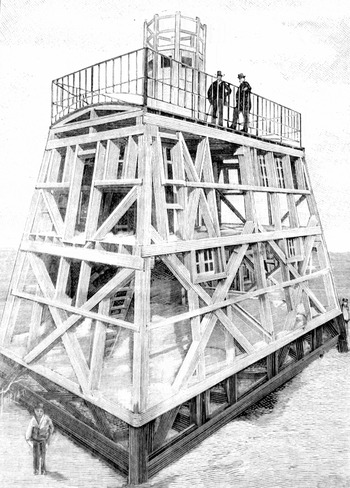
To make the MBO stable and permanent, Janssen had thought he simply needed to embed it solidly in the glacier. But this also dangerously exposed the observatory to its uncontrolled motion. To make matters worse, the social underpinnings of the MBO were, as we have seen, as fluctuant as its physical foundations. So, when after Janssen's death, in 1909, the glacier threatened to engulf it, no one thought that this field station deserved to be rescued – except for exhibiting in the local museum (see fig. 3).Footnote 13 The MBO hardly fitted the model emerging in the US. Favored by Deslandres, this model relied on mid-altitude observatories epitomized by Mount Wilson, an observatory that was much more accessible and equipped with a large telescope (for a contemporary French appraisal, see Bosler Reference Bosler1911). But the acute need to study the stars from the upper atmosphere did not go away. The MBO adventures took place concurrently, but most often conjointly, with the rise of scientific manned ballooning. After a century of hesitation, astronomers embraced this other heterotopic space where standards measurements and adventure could coexist. The French pioneers of astronomical observations on balloons involved the same social and scientific networks that we have seen at play, the same scientists (among many others, Janssen, and Ganskiy), the same wealthy explorers (Prince Roland Bonaparte for instance), and the same sporting spirit. The practice of high-mountain or of ballooning science therefore appear as an inseparable re-enactment of the seemingly obsolete scientific exploits of de Saussure and Humboldt on mountains, and of Biot and Gay-Lussac on balloons. But before the end of the nineteenth century, neither mountains nor balloons were used by scientists in a regular and systematic manner. In fin-de-siècle France, at a time when the urban laboratory was triumphing as the primary scientific locale, the revival of older practices helped shape the way in which the values of precision were transplanted in the field. Today still, spatial exploration whose scientific and symbolic goals are so intricately woven together shows that standard observation and adventure have never ceased to coexist. But this coexistence is always questioned, since the large financial and human investment required by adventurous science as well as the media coverage necessary for gaining public support cannot be satisfied by mere routine in a remote spot.
H. Thirit, The wooden frame of the Mont Blanc Observatory, engraving from a photograph taken before it was dismounted and transported to the summmit. Source: “L'Observatoire du Mont-Blanc,” La Nature 21–2 (1893), p. 289.

Abbreviations
ACAF: Annuaire du Club Alpin français.
CRAS: Comptes rendus de l'Académie des sciences.
MBO: Mont Blanc Observatory.
Archival sources
Janssen Papers. Bibliothèque de l'Institut de France, Ms. 4125 to 4137.
Arch. Miss. Sci. Archives des missions scientifiques, Archives Nationales de France. F17 2972 & F17 2977.
Ganskiy Papers. Aleksey Pavlovich Ganskiy's Papers in Honorary Member N. A. Morozov's Archive, Inventory 11, Archives of the Russian Academy of Sciences <http://www.ras.ru/namorozovarchive/12.aspx> (last accessed 22 April 2009).