INTRODUCTION
The management of head and neck cancer (HNC) addresses the primary tumour and the lymphatic drainage. The nodal status is an established prognostic factor in HNC. Moreover, there seems to be a greater risk of regional recurrence in patients as the number of cervical lymph nodes with metastatic disease increases.Reference Jones1–Reference Lim and Choi3 The administration of adjuvant postoperative radiotherapy (APR) to people with limited nodal disease is now controversial.Reference Gourin, Conger, Porubsky, Sheils, Bilodeau and Coleman4 In this context, we retrospectively reviewed our APR experience of HNC patients with a single metastasis positive node (PN1). As a secondary objective, we attempt to determine the circumstances in which APR may be indicated in this particular group of patients.
MATERIALS AND METHODS
Between 1976 and 2000, 37 individuals were identified as the subjects for this study and Louisiana State University Health Sciences Centre's institutional review board approved this study. Patients were eligible for the study if they had confirmed HNC; had undergone definitive surgery which included neck dissection; exhibited histopathologic documentation of the presence of metastatic tumour in a single cervical lymph node; and did not have known systemic spread of the disease. A patient (with a history of resection of an oral cavity cancer) who underwent contralateral salvage neck dissection for recurrent tumour was also included in this cohort. Our exclusion criteria were the presence of metastatic neoplasm in two or more cervical lymph nodes and extracapsular nodal tumour extension.
Definitive surgery consisted of wide resection of the primary carcinoma of the oral cavity (11 patients) or oropharynx (5 patients) and total laryngectomy (21 patients) with thyroid gland lobectomy (6 patients) performed for laryngo-hypopharyngeal cancers. Selective neck dissections were unilateral (29 patients) or bilateral (8 patients) in extent; the latter procedure was generally practiced in cases of primary lesions located at/close to the midline or originating from the supraglottic region.
Twenty-eight patients were postoperatively treated with radiation because of recognized risk factorsReference Brown, Blackburn, Woolgar, Lowe, Errington, Vaughan and Rogers5 such as T3–T4 neoplasms (25 patients), the presence of tumour at/close to the resection margins (2 patients), or perineural invasion (1 patient). In the remaining individuals (who did not possess such histopathologic features), APR was administered because of the staff radiation oncologist treatment preference. Radiotherapy was usually initiated within 6 weeks post-resection, and the course of treatment was not protracted. The mean total dose to the tumour bed/upper neck was 59.8 Gy (range 50–70 Gy), and to the lower neck 50 Gy (range 45–60 Gy); the total dose to the spinal cord was not allowed to exceed 45 Gy.
The diagnosis of disease relapse or progression and second primary malignancy was based on clinical (5 patients) or pathological (9 patients) findings. The median follow-up was 24 months (range 6–125 months). Patient groups (those with and without additional adverse features) were compared using the Fisher's test. Relapse-free survival rates were estimated using the product-limit method of Kaplan–Meier and the log-rank test was used to compare survival rates.
RESULTS
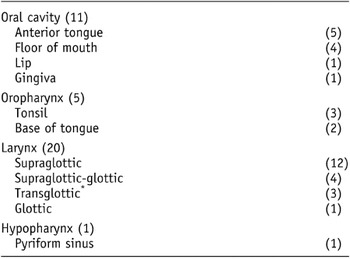
The mean age of the participants was 58 years (range 43–84 years), and 24% of the patients were elderly (≥65 years old). All patients except eight were men. The primary neoplasms originated (Table 1) in the oral cavity (30%), oropharynx (13%), larynx (54%) and hypopharynx (3%).
Primary tumour sites

*Transglottic refers to tumour involvement of the laryngeal glottis and ventricle.
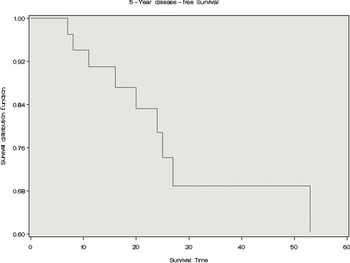
The overall relapse-free survival rate at 5 years was 60% (Figure 1). Although tumour recurrences (local and regional) after locoregional therapy were seemingly more common in individuals with additional unfavourable histopathology than in the people without such attributes (26% and 13%, respectively, p = 0.65), the difference was not statistically significant. This finding is not unexpected because of the fact that T3–4 lesions were observed in 89% (25/28) of the patients comprising the group with adverse traits. The 5-year relapse-free survival rates for the people who did not and did possess more detrimental histopathologic features were 86 and 55%, respectively; p = 0.46.
Disease-free survival of head and neck cancer patients with single positive node treated with postoperative radiotherapy.

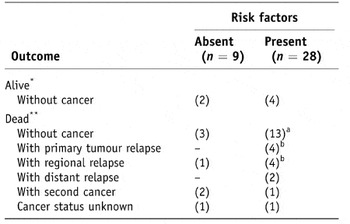
As shown in Table 2, four patients (11%) among the evaluable 35 people suffered local recurrence. There were five cases (15%) of regional relapse (which included the patient with recurrent disease at the primary site). Considered explanations for the observed relapses were: radiation doses inadequate by modern standards (4 cases); delay of greater than 6 weeks in the onset of APR (1 case); and lack of APR information (1 case). Plausible explanations for the remaining two recurrences could not be determined from the records (a constraint inherent in any retrospective study). Distant metastases were observed in two individuals (6%). Four patients (11%) subsequently developed a second primary malignant neoplasm—stage IV small cell lung cancer with brain metastases; stage I non-small cell lung cancer; stage IV oesophageal cancer with lung metastasis; and stage IV epiglottic cancer with pulmonary metastases. The interval between the diagnosis of PN1 and tumour relapses as well as the second malignancies ranged from 5 to 28 months; 12 (86%) of these neoplastic occurrences appeared within 2 years. Seven of these individuals received palliative (surgery or radiotherapy) or definitive (left upper lobectomy) treatment. Thirteen people have died with disease; one patient (who underwent curative surgery for early stage lung neoplasm) died without cancer.
Oncological outcome and compared PN1 patient groups

*Follow–up (range 25-125 months );
**Survival (range 6-76 months).
aOne patient underwent left upper lobectomy for stage I lung cancer.
bOne patient experienced both primary tumour and regional relapse.
DISCUSSION
The biologic aggressiveness of HNC is reflected in its ability to metastasize to regional lymph nodes. Patients with pathologically negative nodes are known to have a better outlook than those people with lymph node metastases. Postoperative irradiation is advocated for high-risk people with histopathologic findings such as metastatic disease in two or more cervical lymph nodes, extracapsular nodal spread, and tumour present in the resection margins. On the other hand, HNC individuals with PN1 unaccompanied by other unfavourable risk factors, by conventional wisdom, belong to the low risk patient categoryReference Cooper, Pajak, Forastiere, Jacobs, Fu, Ang, Laramore and Al-Sarraf6 and APR is avoided. We believe that there is hesitation to pursue an aggressive postoperative radiotherapeutic management attitude for PN1 cases because of justified concern about the documented ill effects (i.e., xerostomia, altered taste, impaired phonation or pharyngeal dysfunction) which can seriously affect a patient's quality of life; the theory that after the development of any metastatic disease, further tumour progression is almost inevitable (a tenet which could not be firmly verified in our patients); and insufficient evidence showing the beneficial effects of APR.
The data from some published treatment audits (and the results from the present study) demonstrate a risk of regional relapse in patients with PN1 disease ranging from 10 to 23%,Reference Olsen, Caruso, Foote, Stanley, Lewis, Buskirk, Frassica, DeSanto, O’Fallon and Hoverman2,Reference DeSanto, Beahrs, Holt and O'Fallon7 and 5-year survival rates of 50% and more.Reference Olsen, Caruso, Foote, Stanley, Lewis, Buskirk, Frassica, DeSanto, O’Fallon and Hoverman2,Reference Kalnins, Leonard, Sako, Razack and Shedd8–Reference Shingaki, Takada, Sasai, Bibi, Kobayashi, Nomura and Saito10 We noted that PN1 individuals with additional unfavourable characteristics seemingly had higher relapse (26%) and worse survival (55%) rates. Hence, our current policy, in line with current standard of care, is to offer these patients adjunctive chemotherapy in concert with APR. With respect to appropriate therapy for people with PN1 pathology, reports from the literature (mostly retrospective investigationsReference Olsen, Caruso, Foote, Stanley, Lewis, Buskirk, Frassica, DeSanto, O’Fallon and Hoverman2,Reference DeSanto, Beahrs, Holt and O'Fallon7,Reference Byers11,Reference O'Brien, Smith, Soong, Urist and Maddox12) have not shown a distinct advantage for combined therapy as opposed to surgery alone.
The retrospective design, small number of cases, lack of a control group, and presence of bias stemming from the other unfavourable pathologic features present in a majority of the assessed patients—the limitations of the present study—preclude definite conclusions and indicate that the results should be viewed with caution. This review of cases demonstrated a low incidence of locoregional recurrence and an acceptable prognosis in HNC patients with PN1 disease treated by postoperative irradiation. Data obtained from randomized clinical trials are essential for an evidence-based treatment approach for this select group of people. The sample size needed would be a total of 80 patients (40 per group) to observe a significant difference in 5-year disease-free survival rate between the two groups being compared in the study.