‘I believe that certain suppressions in the historical record current in our day will lead to a tragic failure in assessing causes. More particularly, I believe that the habit, long fostered, of forgetting and detracting from the thought and acts of the people of Africa, is not only a direct cause of our present plight, but will continue to cause trouble until we face the facts. I shall try not to exaggerate this thread of African history in the world development, but I shall insist equally that it be not ignored.’
W. E. B. DuboisFootnote 1
The democratic peace thesis, which argues that democracies are less likely to fight each other than are other polities, has garnered so much support in the quantitative literature in International Relations (IR) that it has been hailed as virtually an ‘empirical law’.Footnote 2 Its success establishes a high-water mark for quantitative analyses of IR, since it is within this methodological framework that much of the evidence for the thesis has been systematically demonstrated. But quantitative analyses have rarely disaggregated the democratic peace by region. Coupled with this is the fact that rarely have IR scholars tested their theoretical or empirical models specifically on African states. This both reflects and reinforces the view that Africa is mainly a region of terrible human suffering, worthy at times of humanitarian intervention, but with little relevance to larger theoretical concerns. This Afro-pessimistic view has been epitomized in the cover story of The Economist’s 13–19 May 2000 issue entitled: ‘Africa: The Hopeless Continent’. That it has persisted in Western popular culture as well as in academic and policy-making circles is evidenced by travelogues such as that of Richburg, an African-American journalist, who upon witnessing first-hand the ‘tribalism’, violence, squalor and corruption of several African states comes astonishingly close to praising the horrific Atlantic Slave Trade that landed his forebears in America.Footnote 3 It guides Kaplan’s ‘postcards from the edge’ treatise that generalizes from the often horrific violence, pandemic disease and stultifying poverty of West African states such as Liberia, Sierra Leone, Côte d’Ivoire and Nigeria, to the entire African continent (and in some ways, the Third World, as a whole).Footnote 4 These works largely bypass more sanguine political developments in Africa that more balanced treatments acknowledge are key to African economic growth and political stability,Footnote 5 but which might upset the perception of Africa as a ‘basket case’ primarily of its own creation.
Afro-pessimism both results from and is a reflection of the relative inattention of analysts to African political processes as a source or testing ground for IR theory. This ‘empirical neglect’ of Africa does not necessarily entail an outright exclusion of African cases from large-N analyses. Scholars usually include African observations in their analyses, but pay little attention to the particularities of African political dynamics when drawing inferences from their findings. They are rarely circumspect in proclaiming the universality of their theses even when a cursory review of their data reveals that their findings primarily reflect political processes of the Western states for which there is more accessible and reliable data. Moreover, these analyses rarely disaggregate the data by region in order to determine whether global processes do work in specific regions. Given such research designs, one cannot be sure that one’s conclusions are unaffected by ‘levels of analysis’ problems, whereby relationships at the global level are not operative at the regional level; or worse, relationships at one level are actually reversed at another. In the latter instance, policies derived from the findings of such studies intended to ameliorate conditions may actually exacerbate them.
These problems are no less evident in the case of the democratic peace thesis, which is widely viewed as a global phenomenon,Footnote 6 although empirical support for this contention has not rested on systematic analyses of the individual regions comprising the global system in which the relationship is assumed to operate. This ‘empirical neglect’ is especially evident with respect to African conflict processes. Interestingly, when we turn to Africa for IR theory, we find that one recent explanation of the continent’s armed conflicts suggests that democratic states in Africa should be more likely to fight each other, which challenges the view that the democratic peace is a universal phenomenon. The theoretical challenge to the democratic peace for African states begs the question of whether the democratic peace obtains in other regions, as well. In this way it dovetails with an earlier and largely neglected critique which argued that the democratic peace was purely a Western phenomenon and not evident in other regions.Footnote 7
Therefore, in this study I marry these convergent viewpoints and examine the extent to which the democratic peace obtains in Africa in the light of a theoretical challenge emanating from a consideration of African politics; and the extent to which the democratic peace is a universal phenomenon or simply a Western one. First, I discuss the factors contributing to the ‘empirical neglect’ of Africa in the systematic literature in IR. Secondly, I discuss the ‘political inversion’ thesis, which is a theoretical rationale that focuses on the centrality of African domestic politics in explicating international conflicts on the continent and suggests, inter alia, that African democracies should be more, not less, likely to fight each other. Thirdly, given the implicit challenge of the political inversion thesis to the assumption of the universality of the democratic peace thesis, I review the broader debate on the applicability of the democratic peace thesis to regions outside the West. Fourthly, I test the extent to which the democratic peace obtains in Africa and across all the world’s regions using rare events logit regression analyses. Fifthly, I examine the findings and discuss their implications. I conclude with a summary of my main points.
Africa and world politics: empirical neglect?
Senior Africanist Ali Mazrui notes that ‘Africa is marginal in both power and influence within the global system’ and this is no less true with respect to IR scholarship.Footnote 8 For example, in his classic Politics Among Nations, one of the most influential IR scholars of the twentieth century, Hans Morgenthau, referred to ‘the politically empty spaces of Africa and Asia’.Footnote 9 Such observations inform Stephanie Neuman’s assessment that ‘mainstream IR theory’ is ‘founded almost exclusively on what happens or happened in the West.’ ‘If the published record is any measure,’ she adds, ‘then most IR theorists believe that studying the Western experience alone is empirically sufficient to establish general laws’, while ‘few look to the third world to seek evidence for their arguments.’Footnote 10 Engel and Olsen agree that Africa has ‘had strikingly little impact on IR theory’ and note: ‘By and large, empirical research on Africa, within either IR or comparative politics, has dealt with specific problems – not general theories’.Footnote 11 This view echoes Croft’s contention that ‘much of what does exist on Africa and IR is not, in actuality, about Africa and international relations’ but is more about North–South relations.Footnote 12 He concluded that ‘Africa’s intellectual exclusion from the IR mainstream debates has meant that little of the literature on African IR has had any explicit theoretical content’.Footnote 13
Although long a testing ground for comparativists interested in studying military coups, civil wars and ‘ethnic conflicts’, the examination of Africa’s wars has been of relatively little interest to IR scholars. In the Cold War era this mainly resulted from the view that Africa’s armed conflicts – both domestic and international – were primarily the proxy wars of the superpowers. To the extent that Africa informs IR discourse in the post-Cold War era it is limited to the prevailing view of it as a site of ‘tribal’ conflict. For example, in his examination of the Rwandan genocide, in which the West largely ignored the murder of roughly 800,000 persons, Gourevitch argued that Western analysts viewed Africa as little more than the site of horrific humanitarian catastrophes but not as a region that generated ‘meaningful politics’.Footnote 14 Actually, even these ostensibly ‘ethnic conflicts’ hardly stimulated the interest of IR scholars to lead them to consider Africa’s conflicts within their theoretical frameworks; or to pose new questions to their models in the light of African conflict processes. In fact, for many IR theorists it took the warfare in the Balkans in the 1990s to elevate ‘ethnic conflict’ to a level worthy of theoretical engagement within the ‘high politics’ of IR discourse. Previously, ‘ethnic conflict’ had served as the almost exclusive catch-all nickname for Africa’s diverse conflicts that were assumed to require little theoretical reflection, with their causes viewed mainly in terms of concerns over ‘tribe’ or, as Enzensberger put it: about ‘nothing at all’.Footnote 15 However, when Europeans began their most recent fighting over ‘blood and belonging’ following the implosion of the Soviet Union, some IR scholars felt compelled to proclaim a new era of world politics marked by ‘new wars’ and/or a ‘clash of civilizations’.Footnote 16
Nevertheless, the end of the Cold War has rendered the ‘proxy-war’ argument passé; and with greater theoretical development, critical assessment and systematic analyses, the depiction of Africa’s wars as simply ‘ethnic conflicts’ has been called into question;Footnote 17 while assessments regarding the absence of a rationale for fighting are increasingly viewed as reflecting biases and limitations of the authors (or observers) more than of the participants.Footnote 18 Nevertheless, a long-term student of Africa’s military conflicts, William Foltz, has asserted that ‘state-centric neorealism has little relevance to [an African] world in which the interests served by political action are narrowly those of the leader’.Footnote 19 One might extend his point to include neoliberal theses regarding the ostensibly conflict-dampening impact of democratization, formal trade flows between states and the expansion of the domain of the rule of law, which seem similarly irrelevant in explicating conflict processes on the continent.Footnote 20 In Africa, some theorists argue, the relationship between politics and war seems more the result of the arbitrary use and abuse of power by personalist rulers engaged in what Jean Bayart calls ‘la politique du ventre’ (the politics of the belly) within ‘failed states’.Footnote 21 This view suggests that chaos reigns as warlords compete for the reins of state power that allow them to exploit marketable resources more effectively through the globalized transnational networks that permeate porous state boundaries.Footnote 22 These leaders profit from the disruption of sovereignty and the civil strife it foments, which, in turn fuels international conflict.Footnote 23
This prominent depiction of African politics seems hardly reconcilable with neorealist or neoliberal theses that take for granted Weberian notions of statehood and civil society, focusing on politico-territorial entities that have clearly defined borders, institutions that reflect and enforce the rule of law, standing armies under leaders exercising a monopoly on the legitimate use of force, and economic exchanges that operate in legitimate markets. Nevertheless, the view of African politics – and its conflicts – as simply chaos, ‘greed’ and/or warlord driven has not gone unchallenged;Footnote 24 further, such perspectives ignore the functional aspects of even problematic features of African politics.Footnote 25 Moreover, even given the apparent anomalies of African politics, some African specialists challenge Foltz’s claim and insist on the relevance of traditional realism in explicating Africa’s international politics;Footnote 26 while Third World security specialist, Mohammed Ayoob, proffers ‘subaltern realism’ as a theoretical framework to account for the foreign policies of African, and Third World, states more generally.Footnote 27 Therefore, one should not simply dismiss the relevance of (neo)realist and (neo)liberal theses in explicating African conflicts; instead, the applicability of these frameworks should be viewed as an empirical question, albeit one that has rarely been systematically examined.
The relative dearth of application of IR theory to Africa is even more apparent with respect to the systematic analyses of international conflict processes. This may reflect a specific instance of a broader problem of the irrelevance of Western notions of security to the Third World as a whole. For example, Holsti contends that ‘there is little remaining in the traditional literatures of security studies specifically and international politics more generally that has analytical value for understanding or explaining the persistence of war in weak and failed states’.Footnote 28 But scholars have attempted to apply theoretical models of IR – including those grounded in traditional literatures of security studies such as realism, neorealism and liberalism – to conflicts within ‘weak and failed states’. For example, Posen applied the security dilemma to ‘ethnic conflicts’; Benson and Kugler applied power transition theory to civil wars; and Henderson and Singer applied the democratic peace thesis to civil wars in the postcolonial world.Footnote 29 Therefore, one would think that a continent so rife with conflict would garner the attention of IR theorists focusing on conflict processes. In fact, Gurr called on scholars to apply their conflict models to Africa instead of assuming that African conflicts were unintelligible in the light of them.Footnote 30 Much of the systematic work on African conflicts by IR scholars focused less on the politics generating the conflicts, and more on the fact that their theses were inextricably tied to region (for example, analyses of conflict diffusion across regions); therefore, the importance of Africa was that it served as one of several regions in which diffusion was assumed to operate, but not as a theory generating framework.Footnote 31
Two prominent IR conflict models are among those that have been applied to Africa.Footnote 32 First, Bueno de Mesquita applied his expected utility model of war, which holds that states will only initiate war when their expected utility is positive, to sub-Saharan African states, but he admitted that there was only one interstate war observation for Africa (the Italo-Ethiopian War of 1935) in the time period he considered.Footnote 33 If the author had included colonial and imperial wars, which are also international wars, then he would have generated many more African cases. The exclusion of colonial and imperial wars has left much of the systematic analysis of international war bereft of many African cases. This renders policies emanating from such studies largely irrelevant to African conflict processes or to issues of ‘international war’ in its full meaning. Developing his model, Bueno de Mesquita and Lalman proclaimed its universal applicability, although the only empirical support for this contention was derived from analyses of 707 European state pairs (i.e. dyads).Footnote 34 When Bennett and Stam tested the universality of the model, they found that it was spatially limited and extremely difficult to apply to regions outside the West and these problems were insurmountable for estimation purposes with respect to Africa.Footnote 35 In subsequent analyses, Bennett and Stam found that in the case of Africa the result ‘is the opposite of what the theory predicts’.Footnote 36
Secondly, Lemke has applied his local hierarchies version of the power transition thesis to Africa and found that it captures important aspects of Africa’s international conflicts; however, the relative lack of interstate warfare in Africa is problematic for his model.Footnote 37 Nevertheless, Lemke investigates the factors that make Africa’s conflict processes so different. Drawing in part on Kacowicz’s view that a zone of peace obtained in West Africa, but casting it more broadly,Footnote 38 Lemke is led to propose that the continent enjoys an ‘African Peace’ wherein the level of development and the challenges of terrain and technology have largely prevented African states from waging interstate war for much of the postcolonial era. Interestingly, this is a ‘peace’ that is clearly not attributable to the prevalence of democracy – Africa is one of the most autocratic regions in the world. While not taking a sanguine view of the ‘African Peace’, Lemke, nonetheless, transforms the limitations in his model into an opportunity to explore the causal dynamics of Africa’s conflicts in a way that appreciates African agency and the prospect of the continent serving as a template for theorizing in a manner that is all too rare in systematic analyses in IR.
To some extent the ‘empirical neglect’ of Africa by quantitative IR specialists reflects the fact that in the post-colonial era, sub-Saharan Africa has experienced few interstate wars. While civil wars and coups d’état have been rampant in the region, except for the Ogaden War, the Uganda–Tanzanian War, the Ethiopia–Eritrean War, the war in the Democratic Republic of Congo and the Ethiopia–Somalia War of 2006, sub-Saharan Africa has not experienced a full-scale interstate war.Footnote 39 Mazrui appreciates the irony that, on the one hand, ‘in spite of artificial borders which have split ethnic groups, there have been very few border clashes or military confrontations between African countries’; but, on the other hand, ‘there has been insufficient tension and conflict between [s]tates’ to provide the internal cohesion necessary to check the disintegrative tendencies that lead to domestic conflict and civil war.Footnote 40 This may be why African states fought less than 2 per cent of all interstate wars in the period from 1946 to 1992 but they fought more than 30 per cent of all civil wars during that time.Footnote 41
On the face of it, the combination of low levels of interstate war and high levels of intrastate (i.e. civil) war suggests the inversion of conflict processes in Africa. That is, in Africa, international politics has been ‘domesticated’, with interstate conflicts often resolved nonviolently in the way that one would expect of domestic conflicts, while domestic politics has been ‘internationalized’, with domestic disputes often resolved violently in a manner usually reserved for interstate disputes. But even in the light of this ‘inversion’, since Africa has recorded many international conflicts short of war in the postcolonial era and the lion’s share of quantitative studies of international conflicts focuses on such militarized interstate disputes (i.e. MIDs), then the rarity of full-scale interstate war in Africa cannot provide justification for the dearth of systematic analyses of Africa’s international conflicts.
The ‘empirical neglect’ of Africa is all the more interesting in the case of the democratic peace thesis given that its most prominent advocates argue that the phenomenon is universal.Footnote 42 These universalist claims stand in contrast to theses that suggest the inversion of African political processes. For example, Herbst observes an ‘inversion’ in the relationship between war and development in Africa as contrasted with that in Europe.Footnote 43 Following Tilly, he argues that for major European states international war encouraged national development while such positive externalities of war involvement are absent in Africa. African ‘inversions’ have been particularly evident in analyses of African economic growth to such an extent that scholars have embarked on a quest to resolve the ‘Africa dummy’, which alludes to the dichotomous variable used to capture the anomalous impact of Africa’s economic growth processes that do not seem to comport with economic theory.Footnote 44 Similarly, Lemke observes an ‘inversion’ of African conflict processes and he suggests that an ‘Africa dummy’ is necessary to capture the decreased likelihood of international conflict in Africa as compared to other regions.Footnote 45 But the inversion thesis that I proffer in this article is not simply descriptive; its analytical value rests on the claim that key features of Africa’s international conflict processes are rooted in the institutional framework of its domestic politics; specifically, its neopatrimonialism.
Political inversion: neopatrimonialism and the democratic peace
The central premise of this political inversion thesis is that Africa’s international politics largely result from its domestic politics;Footnote 46 and ‘the core feature’ of African domestic politics is neopatrimonialism.Footnote 47 Neopatrimonialism describes a personalist political system in which ‘relationships of loyalty and dependence pervade a formal political and administrative system in which leaders occupy bureaucratic offices less to perform public service than to acquire personal wealth and status’.Footnote 48 Neopatrimonialism results from and is reinforced by quasi-statehood, which is a condition in which a state is legally sovereign even though it might fail to exercise effective control over its territory and/or its inhabitants.Footnote 49 Quasi-statehood emerged in Africa as a result of a tacit agreement among African states and major international actors and institutions to legitimize the colonial borders of the postcolonial states under the principle of uti possidetis. By legitimizing African state boundaries, quasi-statehood largely removed the most conflict exacerbating factor – issues related to territorial claims – from Africa’s international relations. It is not surprising, then, that with few exceptions Africa has rarely experienced full-scale interstate wars. At the same time, in legitimizing Africa’s colonial borders, quasi-statehood ossified Africa’s variegated political communities within state structures that were usually inconsistent with the precolonial forms that continued to hold sway over constituent groups, exert influence over their political preferences and garner their fealty. Their often disparate composition and poor institutionalization further undermined the domestic legitimacy of Africa’s postcolonial states by housing heterogeneous groups within states while separating homogeneous ones across their borders.
With the state’s domestic legitimacy undermined, potential insurgents were emboldened and domestic conflicts often ensued; while at the same time, with international borders viewed as inviolate, there was little likelihood of interstate conflict. In this way, quasi-statehood inverted domestic and international relations with respect to armed conflict. Jackson captures this political inversion nicely: ‘quasi-states turn Hobbes inside out: the state of nature is domestic, and civil society is international’.Footnote 50 Herbst agrees that ‘African politics were the exact opposite of traditional political science models of domestic and international politics: the politics between countries was extremely well-ordered (as opposed to the Hobbesian model of international relations) while domestic politics did not evidence many signs of stability.’Footnote 51 In effect, quasi-statehood eliminated the classic security dilemma between African states while generating an elite security dilemma within African states.
Quasi-statehood undermined domestic legitimacy in another way: it conferred international legitimacy as much on the African leaders as the African states; as long as those leaders were able to exercise control over the apparatus of the state, which usually meant that they controlled the capital city.Footnote 52 In effect, this meant that international legitimacy was often granted with little concern with how that control was effectuated, so that it eventually sanctioned a long list of long-serving African leaders who came to power through a coup d’état, assassination or civil war (or all of the above). Nevertheless, with their international status assured, their external sovereignty protected, African regimes did not ‘fear death’ from without; and, subsequently, African political elites turned their strategic focus to domestic more than international threats.Footnote 53 In this context, an ‘elite security dilemma’ emerged reflecting a tradeoff for African leaders between the pursuit of security and national development.Footnote 54 That is, African political leaders risk their political survival by pursuing national development since effective institutions may become countervailing sources of power for political rivals. Instead, leaders erect patronage networks and other neopatrimonial structures to ensure their tenure in office, and invest more in the repressive machinery of the state to prevent insurgency; however, these policies further stifle development and often result in the very insurgency they are meant to deter. The subsequent domestic conflicts often become internationalized through a process of ‘neopatrimonial balancing’, wherein neopatrimonial leaders in State A seek to extend their patronage networks across borders by providing support for rebels in neighbouring State B – especially neighbours (1) who supply resources to State A’s dissidents; (2) whose basis for statehood differs from those of State A; (3) who are viewed as hostile to – or rivals of – State A’s regime; or (4) who are experiencing civil war and might appear to be relatively easy targets of State A’s leaders seeking resources to prop-up their regimes.Footnote 55
Unlike theses that assume predation as the singular policy emanating from neopatrimonialism, my political inversion thesis suggests the prevalence of ‘neopatrimonial balancing’ and recognizes the variation in neopatrimonial regimes that affects the foreign policy practices that leaders of such regimes pursue.Footnote 56 For example, while Bratton and van de Walle assert that neopatrimonialism is ‘the core feature of politics in Africa’,Footnote 57 and ‘that virtually all African regimes could be viewed as neopatrimonial’;Footnote 58 nevertheless, they caution that this ‘should not obscure the significant variation in political institutions that evolved across different states in the region’.Footnote 59 African governments, they maintain, are ‘variants on a neopatrimonial theme’ and the prototypal neopatrimonial regime ‘embraces a variety of subsidiary regime types’.Footnote 60 One of the ‘significant variations’ in the political institutions is their varying levels of domestic political legitimacy. It is the interaction of neopatrimonialism and legitimacy within Africa’s domestic politics that encourages a broader range of foreign policy practices emanating from neopatrimonial decision making; and these have implications for African international conflict, in general, and the democratic peace thesis, in particular. For example, with their domestic legitimacy contested, neopatrimonial leaders generally demur from deploying their troops abroad out of fear that it will leave their urban centres vulnerable to insurgency in an African context wherein those who control the capital city can largely control the country. The exceptions are those states that have a greater degree of domestic legitimacy as a result of the popular perceptions of the acceptability of their rule, the moral or procedural authority of the institutions of their government or the effective performance of their regime.Footnote 61 The leaders of such legitimate states are more willing to deploy forces abroad than their less legitimate counterparts, and, therefore, are more willing to risk foreign adventures because they do not face the same degree of domestic threat. It follows, then, that African states characterized by higher levels of legitimacy are the least constrained from sending their troops abroad to fight and, therefore, are more likely to become involved in international conflicts. The assertion that more legitimate states – including some democracies – may be more inclined to fight (including fighting each other) challenges the applicability of the democratic peace thesis to African states.
This challenge to the democratic peace thesis is rooted in the way(s) that domestic political legitimacy mediates the prospects for the use of military force among Africa’s neopatrimonial regimes. The common assumption among democratic peace advocates is that personalist regimes – such as African neopatrimonial regimes – are the least constrained from fighting international wars. By contrast, democracies are widely assumed to be more constrained by their publics. For example, Russett and Oneal argue that ‘the institutions, principles, and practices of Western-style democracy provide powerful constraints on arbitrary government’, while ‘the constraints on the leaders of autocratic states are usually much weaker.’Footnote 62 Peceny et al. challenged this view and insisted that ‘personalist dictatorships are substantially more constrained than either military or single-party regimes’ [emphasis added].Footnote 63 Appreciating the deinstitutionalization that is the hallmark of neopatrimonialism, they noted that ‘the strategies pursued by dictators’ to maintain their power render their military institutions ‘incapable of doing much more than repressing unarmed civilians’ because in order ‘to construct a “coup-proof” regime, dictators must systematically weaken their armed forces’.Footnote 64 This is evocative of the elite security dilemma. They conclude that ‘personalist dictatorships that face few of the decisional constraints found in democracies are also constrained from participation in international conflict, albeit through different political institutions’.Footnote 65
On its face, Peceny et al.’s ‘autocratic peace’ thesis is consistent with Lemke’s assertion of an ‘African Peace’, which reflects the relative infrequency of international wars in Africa. However, it is important to remember that African states are not uniformly autocratic; therefore, the dearth of African interstate war cannot be due simply to the prevalence of autocracy in the region. The additional constraints that deficiencies in legitimacy exert on neopatrimonial leaders is based more in the logic of political survival as originally proposed by Migdal in his analysis of African and other Third World regimes. This centres on how weak-statehood may generate neopatrimonial rule and elite insecurity.Footnote 66 However, the logic of this argument runs counter to Bueno de Mesquita et al.’s more popular ‘political survival’ thesis on the issue of governmental constraints and, subsequently, democratic peace.Footnote 67 For example, although they avoid the assumption that democracies are more constrained than autocracies, Bueno de Mesquita et al. do not eschew the ‘greater constraint’ assumption because of its inaccuracy, but because they prefer the proposition ‘be a deductive result of a general model’ rather than an untested assumption.Footnote 68 They replace it with the even more dubious assumption that democracies ‘try harder’ in wars than autocracies.Footnote 69 Yet the result is the same as that which derives from the ‘greater constraint’ assumption; only now it is based on their supposition that autocrats ‘are more willing to gamble on war than their democratic counterparts are’.Footnote 70
But this perspective, like the ‘greater constraint’ argument that it mirrors, neglects how the lack of domestic legitimacy of many neopatrimonial leaders puts additional constraints on their ability and willingness to take their states to war. While inefficiencies make their troops more adept at internal repression than external aggression, just as important are the deficiencies in the regime’s domestic legitimacy that discourage the deployment of troops away from the capital city for fear that their absence may encourage dissidents or insurgents to seize the capital and, thus, the government. In addition, Bueno de Mesquita et al.’s ‘selectorate theory’ does not seem to consider sufficiently how obverse conditions, such as heightened levels of legitimacy, may affect the decision-making calculus of African neopatrimonial leaders.Footnote 71 Simply put, Africa’s neopatrimonial regimes have varying levels of domestic legitimacy, and those African states that enjoy higher levels of domestic legitimacy – among them, African democracies – are less constrained by the fear of insurgency prevalent among autocratic leaders and, being less constrained from deploying their troops abroad, they are more likely to become involved in international conflict.Footnote 72 Moreover, two relatively open African states – both similarly unconstrained by problems of illegitimacy – should be more likely (ceteris paribus) to become involved in MIDs as compared to two non-democratic states.Footnote 73 Therefore, the theoretical framework presented here suggests the ‘inversion’ of the democratic peace in African international relations.Footnote 74 Specifically, I propose:
Proposition 1 African democracies should be more likely to fight each other.
The assertion that the democratic peace is not applicable to Africa challenges the view that it is a universal phenomenon. That such a perspective is derived from a theoretical argument rooted in African political dynamics contributes to the study of African politics and to IR theory, more broadly (i.e. if it is borne out empirically).Footnote 75 Also, it is important to note that this challenge to the democratic peace thesis dovetails with an earlier critique which asserted that the democratic peace was at best a Western and not a universal phenomenon. It is to this discussion that we turn.
On the universality of the democratic peace thesis
By 1993, the democratic peace thesis had already received extensive support in the systematic literature in IR.Footnote 76 Shortly thereafter the thesis was subject to several critiques arguing that the finding was epiphenomenal of common interests,Footnote 77 realpolitik factors,Footnote 78 satisfaction with the status quo,Footnote 79 shared preferencesFootnote 80 or security regimesFootnote 81 or that it relied on subjective definitions of democracy.Footnote 82 One of the more compelling and largely untested critiques is Cohen’s argument that the democratic peace is only evident in the West in the post-war era.Footnote 83 He stated that although ‘democratic states in the North Atlantic/Western European area … have avoided going to war’, nevertheless, ‘the existence of a general law of behaviour that democracies as a class do not fight each other has not been demonstrated’.Footnote 84 For him, in order ‘for the absence of war between states to be of any significance three prerequisites are needed: motive, means and opportunity’.Footnote 85 So democracies should not only be more peaceful but they also should have ‘important, potentially opposing interests that come into conflict; possess a war-fighting capability; and be able to project that capability against each other’s territory, possessions or allies’.Footnote 86
Reviewing regional clusters of democratic dyads, he argued that in the Caribbean, Africa, the Eastern Mediterranean (including the Middle East), Australasia and South America ‘the absence of war’ was ‘less significant than the global statistics might suggest’.Footnote 87 He noted that the democratic states in these regions rarely have the means or opportunity to fight each other. As for their motives, he asserted that reasons more salient than democracy – such as US hegemony in North America – explained the absence of interstate warfare in these regions.Footnote 88 In addition, interstate peace in South America was evident ‘despite the preponderance of autocratic regimes’ on the continent. For Cohen, only ‘the North Atlantic/Western Europe area’ was ‘both democratic and pacific’ at the same time that ‘virtually all states’ in the region ‘possessed the means, motive and opportunity for violent conflict’; nevertheless, he attributed the absence of war between these states less to democracy than to the emergence of common interests among them.
Russett and Ray responded that Cohen’s analysis was unpersuasive and suffered from several fatal flaws: it failed to define ‘democracy’ and ‘war’ clearly and consistently; it was often ahistorical; it ignored the probabilistic nature of the democratic peace thesis; and it confused necessary and sufficient conditions.Footnote 89 The latter point refers to the fact that the democratic peace thesis suggests that joint democracy is a sufficient but not a necessary condition for peace, challenging Cohen’s assertion that the presence of an ‘illiberal pacific union in Latin America’ undermined the thesis. More to the main point of the present study, they argue that Cohen’s view that the democratic peace does not obtain outside the West rests on his allegedly inconsistent and imprecise coding of democratic states across regions and his misclassification of wars and MIDs. But for all of their counter-arguments, the authors’ evidence is largely anecdotal. This led Cohen in his rejoinder to call for studies that disaggregate the democratic peace by region.Footnote 90
The debate was joined by Maoz, who purported to provide further evidence of the universal applicability of the democratic peace thesis.Footnote 91 He argued that joint democracy had been responsible for decreasing the conflict levels of several of the most dispute-prone dyads across the major regions of the global system. Beginning with several disputatious dyads in Europe and the Americas, he asserted that ‘these dyads reduced their conflict involvement significantly when they became democratic’.Footnote 92 He added that while ‘the process of democratization [in these states] seemingly coincided with the emergence of the North Atlantic security community’, nevertheless ‘some of the changes to joint democracy took place well before the formation of the security community, and when this happened conflict levels declined substantially’.Footnote 93 For example, he noted that with respect to the dispute-prone United States–Britain and France–Britain dyads that their conflict levels declined as they became democratic. He added that ‘Turkey’s initial transition to democracy was in the mid-1920s, while Germany’s first experience with democracy occurred during the 1919–33 period’ and ‘in both cases the conflict activity of these states with their traditional rivals dropped significantly’.Footnote 94 He observed a similar relationship with respect to Turkey and Greece. To Cohen’s point that the democratic peace is only evident in the West, Maoz responded that it was ‘a global phenomenon’ and even among ‘bitter rivalries’ in Latin America (such as Peru–Ecuador, Chile–Argentina, Brazil–Argentina) and Southeast Asia (for instance, India–Pakistan), ‘the effect of democracy on conflict and war in these dyads is identical to the effect of the North Atlantic culture.’Footnote 95 Further, while India and Pakistan fought three wars, ‘none of these wars occurred when both members of these dyads were democratic’, and the relationships between ‘Chile and Peru, and Brazil and Argentina, show similar effects’.Footnote 96 He concludes that ‘no matter where we look in the world, democratization has the same [conflict-dampening] effect’.Footnote 97
But for all of its assertions, Maoz’s study, like Russett and Ray’s, relied primarily on anecdote and historical allusion to make its point regarding the universality of the democratic peace (although Maoz subjected other critiques of the thesis to quantitative analysis). Therefore, these prominent democratic peace advocates had failed to provide systematic evidence to refute Cohen’s claims. Moreover, regional specialists had also begun to challenge the applicability of the democratic peace thesis to Asia, the Middle East and Latin America.Footnote 98 In this study, I systematically examine Cohen’s claims by testing the two propositions that he addresses:
Proposition 2. The democratic peace is a universal phenomenon;
Proposition 3. The democratic peace is only a Western phenomenon.
The two propositions are not identical; Proposition 2 is accepted by a finding of a negative and significant relationship between joint democracy and international conflict for every region; and it is rejected by a finding that the negative and significant relationship is absent for any single region. Further, given that democracy and international conflict are rare events, I will only accept that Proposition 2 is rejected if I also find a positive and significant relationship between joint democracy and international conflict within a region. Proposition 3 is supported by a finding that (a) the democratic peace holds in the West, but (b) it does not hold in any region outside the West, and (c) it does not hold for cross-regional dyads; and all of these elements are necessary to show that the democratic peace is limited to the West. I will reject Proposition 3 if I fail to find all of these relationships.
So in this study I analyse the extent to which the political inversion thesis is supported for African states while also determining the extent to which the democratic peace thesis is a universal phenomenon. In this way I challenge the democratic peace thesis to demonstrate its applicability to a region in which it is assumed to operate given inferences from large-N analyses that usually ignore regional dynamics, and as a result of methodological challenges that compel us to be more cautious in our claims. With respect to the latter, Lemke has shown that ‘inclusion of at least one African state makes a dyad statistically significantly less likely to be included in analyses focusing on regime type’.Footnote 99 He adds that ‘African dyads are not randomly or insignificantly omitted’ but ‘are systematically underrepresented’ in most IR models.Footnote 100 He argues that we can overcome these methodological deficiencies by, at minimum, ‘including an Africa dummy in statistical models of war’.Footnote 101 A broader concern is raised by King and Zeng who show that the rarity of armed conflict may systematically bias estimates in the popular logistic regression models of international conflict used to analyse the democratic peace thesis.Footnote 102 Therefore, I employ rare events logit (relogit), which provides bias-corrected coefficients for our models. The use of relogit also reduces the likelihood that a non-significant or positive relationship between democracy and international conflict, which would contradict the democratic peace thesis, is the result of the rarity of observations rather than the substantive relationships of concern.Footnote 103
Research design
The spatial-temporal domain includes all dyad years in 1950–2001 (N = 498, 422) based on the expanded list of independent states (i.e. expanded from earlier system membership lists from the Correlates of War (COW) project) developed by Gleditsch and Ward.Footnote 104 The outcome variable is the onset of a MID, which COW defines as ‘a set of interactions between or among states involving threats to use military force, displays of military force, or actual uses of military force’.Footnote 105 MIDs are ‘directed towards the government, official representatives, official forces, property, or territory of another state’.Footnote 106 All interstate wars begin as MIDs, but most MIDs are not interstate wars; instead, they are disputes of varying levels of hostility and lethality that only at their highest levels are full-scale wars.Footnote 107 The observation is coded ‘1’ if the dyad experienced a MID onset in that year and ‘0’ otherwise; subsequent years of the same dispute are not included as additional cases of MID onset.Footnote 108
Since our outcome variable is dichotomous and the onset of a MID is a rare event, the distribution of the outcome variable is skewed with many more zeros than ones. When events are rare the estimated coefficients from logistic models may be biased; therefore, we utilize relogit to estimate our models, as suggested by King and Zeng. The basic method King and Zeng suggest is called ‘prior correction’, which entails correcting the estimates from a logistic regression based on external information about the fraction of l’s in the population and the observed fraction of 1’s in the sample.Footnote 109 Prior correction basically adjusts for the percentage of rare events in the sample. The interpretation of the relogit results with respect to the direction, values and significance levels of the coefficients is similar to that of standard logit coefficients. We also estimate robust standard errors and utilize Beck et al.’s diagnostic with cubic splines to address problems of autocorrelation.Footnote 110
The primary predictor variable, DemocracyLO, gauges the extent of joint democracy for the dyad by focusing on the regime score of the least democratic state in the dyad and is a common operationalization used in democratic peace research.Footnote 111 The variable assumes values from −10 (highest autocracy) to +10 (highest democracy) and is from a modified version of Polity IV data, which provides scores for the expanded population of states in our study, draws on alternative sources such as the Freedom House data for observations not in the original Polity data, and includes annual estimates for many regimes coded as transitional or absent from Polity.Footnote 112 Our analyses control for economic development, major power status, relative capability, alliance membership, geographic contiguity, distance, and trade interdependence. Given Mousseau et al.’s findings that the democratic peace is only evident in dyads with relatively higher levels of economic development, we control for Economic DevelopmentLO, measured as the lowest value of the natural log of the gross domestic product (GDP) per capita for the two states in 1996 US dollars.Footnote 113 The major power variable, Major, takes the value of 1 for dyads comprised of at least one of the major powers (United States, China, France, Britain and the Soviet Union/Russia for the entire period, and Germany and Japan after 1991) and 0 otherwise. The relative capability variable, Capability Ratio, utilizes the widely used relative capabilities index (CINC score) from the COW project, which gauges the proportional share of a state’s military, economic and demographic capabilities relative to other states in the system, and allows us to control for the effects of power preponderance.Footnote 114Capability Ratio takes the value of the natural log of the ratio of the higher to lower CINC score in the dyad. If the power preponderance argument is borne out, then the coefficient for this variable should be negative indicating that dyads in which one state is stronger than the other are less likely to experience a MID onset, while those characterized by two equally matched states are more likely to experience a MID onset.Footnote 115 The remaining variables include whether or not the states are allies (Allies); and whether or not the states are contiguous (Contiguity), meaning they shared a border or were separated by less than 150 miles of water. Since some non-contiguous states are much closer than others, we also include the natural log of distance in miles between capital cities (Distance). The trade interdependence variable (Trade RatioLO) is measured as the lower of the two states ratio of dyadic trade (imports plus exports) to GDP. Military, alliance and contiguity data are compiled from the COW project;Footnote 116 economic and distance data are from Gleditsch.Footnote 117
The designation of regions generally follows COW criteria and includes dichotomous variables for North America and Europe, Latin America, the Middle East, Asia and sub-Saharan Africa.Footnote 118 The regions are broadly consistent with those of earlier IR research that focused on Africa and more recent work.Footnote 119 Obviously, these designations leave a great deal of diversity within the designated regions, but in utilizing such a coding we are no more assuming that regions are homogeneous than we assume that the world is homogeneous when we focus on ‘all dyads’; nor are we attempting to determine the ‘true nature’ of each individual region. Instead, like Bennett and Stam, we are attempting ‘to demonstrate whether the degree of heterogeneity in the world system is sufficient to create problems for those who claim universal status’, in this case, for the democratic peace.Footnote 120
Findings
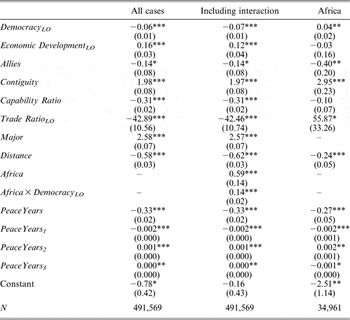
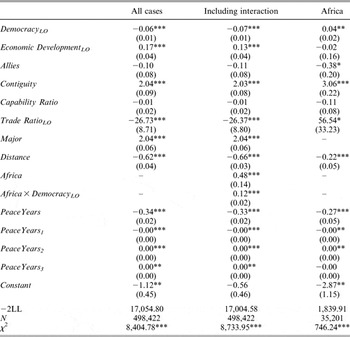
Table 1 reports results for all dyads (column 1); then using a dummy variable, Africa, which takes the value of 1 for dyads comprised only of sub-Saharan African states and 0 otherwise, and an interactive variable, Africa×DemocracyLO, which takes the value of the product of Africa and DemocracyLO (column 2); and in column 3 the equation includes only African dyads. The results for all dyads are generally consistent with previous findings. Thus, they show that richer, contiguous, non-allied, less interdependent, proximate, major power dyads are more disputatious than poorer, non-contiguous, allied, more interdependent, distant, non-major power dyads. For the key variable of interest, the findings support the democratic peace thesis, which is evident in the negative and highly significant coefficient of DemocracyLO (i.e. −0.06) in the equation for all dyads (column 1). In the second equation (column 2), which allows us to focus on sub-Saharan African states, the universalist view of the democratic peace thesis leads us to expect that African dyads will rsemble ‘all dyads’ in that democratic dyads will be less likely to fight, although the magnitude of this effect might be different in Africa. Therefore, the coefficient for DemocracyLO should be negative and significant; and the interactive variable, Africa×DemocracyLO, should also be negative, which would suggest that dyads comprised of African democracies should be less prone to conflict. While the coefficient for DemocracyLO is negative and significant, we find that the interactive variable is positive and significant, suggesting that dyads comprised of African democracies are more likely to experience international conflict.
Rare Events Logit of Democracy and MIDs, 1950–2001

Notes: STATA Version 9 does not report the −2 log likelihood values of relogit models, but these are reported in the standard logistic regression runs shown in the analyses in the Appendix tables. Robust standard errors are in parentheses below coefficients; all p-values are estimated using two-tailed tests. *p ⩽ 0.10, **p ⩽ 0.05, ***p⩽ 0.01.
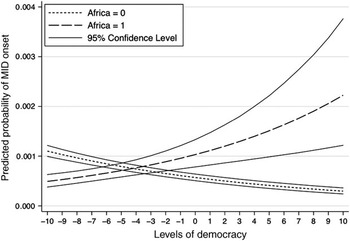
The coefficients of the variables of interest in the interaction model indicate the independent impact of Africa on the log odds of MID onset when DemocracyLO is held at the value of 0, and vice versa; but DemocracyLO = 0 in less than 10 per cent of the cases of African MIDs. A clearer substantive interpretation of the relationship between Africa and DemocracyLO on the probability of MID onset can be garnered from a graphical representation of their relationship as DemocracyLO assumes values across its entire range from −10 to +10. Figure 1 is a two dimensional graph with values of DemocracyLO as the horizontal axis and the predicted probability of a MID onset as the vertical axis. Within the space of these two axes are two trend lines, one indicating the relationship between DemocracyLO and MID onset for all non-African cases (i.e. Africa = 0) and one for all African cases (i.e. Africa = 1); and these trend lines are plotted with their 95 per cent confidence intervals around them. It is clear that the former is negatively sloped, which captures the decreasing probability of international conflict as non-African dyads become more jointly democratic (i.e. the democratic peace); however, the latter is positively sloped, which captures the increasing probability of conflict as African dyads become more jointly democratic (i.e. political inversion). What is particularly interesting is that both trend lines are statistically significantly different from 0 across their entire ranges, which indicates that these effects are quite robust. The conclusion from the interaction model is that more politically open African dyads are much more conflict prone than their non-African counterparts, which supports the ‘political inversion’ thesis of African conflict processes.Footnote 121
Effect of democracy on probability of MID onset for African and non-African dyads

An even more straightforward method for determining the extent to which the democratic peace is evident in Africa is simply to focus only on African cases, as is done in the third equation in Table 1. In this specification, the coefficient of interest is the variable, DemocracyLO, which now represents those dyads comprised of African democracies. If the democratic peace thesis holds in Africa, then we expect that this coefficient will be negative and significant; however, we find a positive and significant coefficient for DemocracyLO. Therefore, the findings using this specification mirror those using the interaction specification and demonstrate that democratic African dyads are more likely to experience international conflict. These results support the political inversion thesis and Proposition 1, and seem to contradict the democratic peace thesis. Nevertheless, it is important to note that the African dyads involved in these MIDs rarely consist of fully fledged democracies; therefore, the findings do not refute the democratic peace thesis, as such, but only show that relatively more open African regimes are more prone to fight each other. For example, during the Cold War era these conflict-prone dyads usually consisted of one democratic state and an ‘anocracy’, or two ‘anocratic’ states; and democratic peace proponents would not be surprised that these states would fight each other. These conflicts are dominated by the disputes between democratic Botswana and anocratic Rhodesia (six disputes in 1969–78, with those in 1976–78 incurring casualties), and Botswana and anocratic South Africa (five disputes in 1984–88). Botswana has been categorized as a coherent democracy (+7 or above on the Polity IV composite scale since 1969, +8 since 1987 and +9 since 1997), apartheid South Africa and Rhodesia clearly were not democracies. In the post-Cold War era, Africa developed several fully fledged democratic dyads although none with the highest level of joint democracy (+10, +10); however, there are three clearly joint democratic MIDs in the post-Cold War era including Niger (+8) and Mali (+7) in 1993, post-apartheid South Africa (+9) and Lesotho (+8) in 1994, and Botswana (+9) and Namibia (+6) in 1997.Footnote 122
Nevertheless, what we generally observe on the continent is not so much a refutation of the democratic peace thesis as much as support for the view that more politically open African states are more likely to fight each other. Beyond the impact of joint democracy on international conflict, the findings reveal a positive and significant relationship between trade interdependence and MID onset in Africa, which challenges the liberal trade thesis that greater trade interdependence reduces the probability of interstate conflict. Nevertheless, this ‘inversion’ of liberal trade processes in Africa is consistent with previous studies of trade and conflict dynamics on the continent.Footnote 123
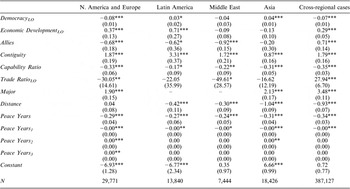
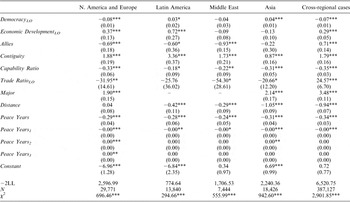
Turning to other regions, Table 2 reports the results of the original model when applied to North America and Europe, Latin America, the Middle East and Asia, respectively. The coefficients for the control variables for the Western dyads are consistent with the aggregate results in Table 1 with respect to the role of contiguity and major powers in international conflict; and the coefficients for Allies and Capability Ratio are consistent with general findings in the IR literature. With respect to the coefficient for DemocracyLO, it is clearly negative and significant for North America and European cases, just as it is for all dyads as reported in Table 1. However, this clear support for the democratic peace thesis for Western cases largely disappears once we examine non-Western cases. The findings reveal that the coefficient for DemocracyLO is not negative and significant in any region outside the West (although it is negative in the Middle East, it is not significant). In fact, as in Africa, we find a positive relationship between DemocracyLO and the probability of MIDs in Latin America and Asia, which suggests that joint democracy encourages international conflict in those regions. Also, unlike the African cases, these findings are not the result of the absence of fully fledged democracy in these regions because Latin American and Asian democracies having scores greater than or equal to +6 on the Polity scale have fought each other in the post-war era. The finding that Latin American democracies are more likely to fight each other is consistent with previous results,Footnote 124 and reminds us that armed conflicts between Ecuador and Peru, such as the Paquisha Incident of 1981 and the Cenepa War of 1995, are often viewed as contradicting the democratic peace finding. Nevertheless, the coefficient for Latin America is barely significant at the 0.10 level, although it is robust across different specifications of the basic model.Footnote 125
Rare Events Logit of Democracy and MIDs in North America and Europe, Latin America, the Middle East and Asia, 1950–2001

Notes: Robust standard errors are in parentheses below coefficients; all p-values are estimated using two-tailed tests.
*p ⩽ 0.10, **p ⩽ 0.05, ***p ⩽ 0.01.
The finding with respect to Asian democracies provides an even greater challenge to the universality claims of democratic peace advocates given that it is highly significant and robust across different specifications of the basic model. Moreover, the vast majority (75 per cent) of joint democratic MIDs in Asia have occurred in the post-Cold War era; and these jointly democratic Asian MIDs comprise about 13 per cent of the MID onsets involving dyads with DemocracyLO scores greater than or equal to +6, or 12 per cent of those with DemocracyLO scores greater than or equal to +7. To be sure, most of these MIDs rank very low in their hostility levels. For example, democratic India and democratic Bangladesh have been involved in violent MIDs in the past, but their joint democratic MIDs of 1996 and 2001 did not incur casualties; and none of their disputes have involved armed conflict since the dyad became jointly democratic in 1991. Joint democratic disputes such as these with low levels of hostility have occurred throughout Asia, such as those between the Republic of Korea and Japan in 1996 and 1999, Taiwan and Japan in 1995 and 1996, or between Indonesia and Australia in 1999 and that archipelago and New Zealand in 2001. Taiwan and the Philippines were involved in a dispute in 1994 and even the South Pacific island nations of Papua New Guinea and the Solomon Islands were involved in low level disputes in 1993 and 1996.
By contrast, some of the most ‘hostile’ MIDs have also occurred in Asia; although the positive relationship between joint democracy and MID onset for Asian dyads is no longer significant when the outcome variable is coded only for MIDs involving casualties. Nevertheless, the more hostile Asian MIDs are dominated by the conflicts involving India and Pakistan such as occurred in 1990, 1991 and 1993, when they both were coded as coherent democracies by Polity. The latter MID evolved into the major fighting that continued through 1999 when Musharraf’s military coup wrested control of the Pakistani state from the elected government in October of that year. But the armed conflict involving India and Pakistan in 1998 occurred when the two states were coded as coherent democracies (India +9, Pakistan +7), which, given its relatively high number of battle deaths, made it a case of a joint democratic interstate war based on COW criteria.Footnote 126 Reiter and Stam agree that it ‘may have been the most incontrovertible case yet of a war between democracies’; it involved roughly a thousand battle deaths ‘and both India and Pakistan [were] rated as democracies in 1998 by the latest version of the Polity data set’.Footnote 127 In sum, the results of analyses of the various regions allow us to reject Proposition 2, and provide even greater support for Cohen’s claim that the democratic peace is not a universal phenomenon.
The findings thus far demonstrate that the democratic peace is not evident in any region outside the West, which challenges the claims of democratic universalists; but, while disaggregating by region reveals limitations of the democratic peace thesis, we also find some support for the thesis. Specifically, when we turn to Proposition 3 and examine all cross-regional cases (i.e. those comprised of states from different regions), there is strong support for the democratic peace thesis. In results reported in the last column of Table 2, we find a strong negative and significant relationship between DemocracyLO and MID onset for cross-regional cases. These cross-regional cases comprise nearly 80 per cent of all dyads in the system. Given that the vast majority of democratic dyads are from the West, even these cross-regional cases are dominated by interactions involving Western states. Nevertheless, the findings do not support Proposition 3; instead, they show that democratic states across regions have been less likely to fight each other, even as within most regions they have been more likely to fight each other.
Discussion
The findings generally support the political inversion thesis that more politically open – if not necessarily full-scale democratic – African regimes are more likely to fight each other. Ironically, the absence of support for the democratic peace thesis among African dyads suggests the greater similarity of African conflict processes with those prevalent within most regions of the world, given that the democratic peace is not operative in any region of the world other than the West. In this way, the findings do not substantiate the broad claims of those who argue that African politics are inherently different from non-African politics. Moreover, ‘African peculiarity’ theses are gainsaid by the findings that the relationship between alliance membership, contiguity, distance and international conflict in Africa are similar to what we find in other regions.Footnote 128
The political inversion thesis examined herein accounts for the relationship between joint democracy and conflict in Africa by focusing on ‘African particularity’ – borne of differences in the domestic political institutions of African states, without assuming ‘African peculiarity’, rooted in dubious claims about African people. It draws inferences from this institutional framework to the decision-making orientation of Africa’s neopatrimonial leaders and in this way provides a rational explanation of African political behaviour that is often absent in analyses of Africa’s wars that reduce African conflict processes to single-factor ‘explanations’ such as ‘tribe’, ‘greed’ or a range of ‘heart of darkness’ formulations. The theoretical argument suggests, inter alia, that African democratic leaders often enjoy greater domestic legitimacy than leaders of autocratic regimes; and the latter are more likely to resist deploying troops away from the capital for fear of insurgency. Less constrained by such fears, democratic leaders should be more willing to deploy troops abroad or at least to the borders of their states to engage in international conflict. Therefore, two relatively open African states – both similarly unconstrained by problems of illegitimacy – should be more likely (ceteris paribus) to become involved in MIDs and to fight each other.
This relationship is evident in the African MIDs involving democratic Botswana and anocratic Rhodesia from 1976 to 1977. After launching Operation Thrasher in February 1976 to deal with military incursions of Mozambique-based guerrillas, Ian Smith’s government in Rhodesia turned its attention to Botswana, which had begun to provide staging camps for the rebels. The dispute escalated on 18 December 1976 into an exchange of gunfire between Rhodesian forces and Botswana police (Botswana did not have an army at the time), and two days later Botswana announced that Rhodesian forces had violated its territory over thirty times since November 1976.Footnote 129 On that day Rhodesia announced the creation of a new operational military zone that included the disputatious border area with Botswana, thus exacerbating the crisis and leading the United Nations’ (UN) Security Council to condemn Rhodesia. The Security Council also demanded the cessation of hostilities and dispatched a UN mission to Botswana.
In line with the theoretical argument stated above, the anocratic Smith regime had support from its white citizenry to prosecute the war against the rebels and their supporters, but what is instructive is that the democratic Botswana regime utilized its security – in this case, police – forces on its borders well away from its capital – in a way that was rare for an African state in the mid-1970s. The legitimacy of the Khama regime allowed it the opportunity first to expand the police mobile unit (PMU) and then to establish Botswana’s army (the Botswana Defence Force) in the face of the crises, which unlike in most African states was borne of clear foreign policy concerns and has never acted as the praetorian guard of the political leadership nor has it been a source of domestic insurgency.Footnote 130 This may be contrasted with Mobutu’s autocratic regime in Congo–Kinshasa (later Zaïre, now the Democratic Republic of the Congo, DRC), which was under the personal command of Mobutu and his Ngbani co-ethnics, who were often related to him directly or by marriage. He relied heavily on paramilitaries and approximately half of the estimated 60,000–70,000 uniformed troops in the early 1990s belonged to paramilitary forces as the former Force Publique of the Belgian era became his private army.Footnote 131 But Mobutu could hardly rely on these decrepit forces to do more than terrorize unarmed civilians. When Mobutu was faced with incursions staged from bordering states, as in the wars in Shaba province in 1977 and 1978, he relied mainly on foreign troops and mercenaries supplied by Belgium, France and Morocco, with US military transport in support, as well, while using his own paramilitaries to quash potential unrest in the capital.
If the political inversion thesis provides the context in which interstate conflict occurs in Africa, then it also provides a key challenge to the promotion of peace in the region. To be sure, democracy is a positive good for individual citizens within states; but, in Africa, it is also associated with an increased probability of conflict between states. It may be that the key to overcoming the problem highlighted by the political inversion thesis may be found in the regionalization efforts sweeping the continent since they have increasingly focused on both providing transnational initiatives to reduce intrastate instability – from peacekeeping in ongoing civil wars, to coup-proofing, to public health and development initiatives – to instituting conflict resolution strategies for interstate disputes, as well. The dual approaches appreciate the need to address both the domestic and international-level factors generating Africa’s interstate conflicts.Footnote 132 However, many analysts find it difficult to take a sanguine view of the extent to which regionalization, in particular, will prevent international conflicts in Africa given the mixed performance of African regional security institutions, such as ECOMOG (the Economic Community of West African States Cease-Fire Monitoring Group) in Liberia and Sierra Leone; the SADC’s (the South African Development Community) Organ on Politics, Defence and Security in Lesotho and the DRC; and the African Union in Sudan (i.e. Darfur).Footnote 133 Nevertheless, scholars have recently demonstrated that membership in African regional institutions significantly decreases the probability of interstate conflict for African states.Footnote 134
In Asia – particularly South Asia – it has not been the inversion of democratic peace processes that has resulted in joint democratic conflict as much as the persistence of (1) a contentious border dispute in Kashmir within a context of (2) arms racing between (3) religiously dissimilar India and Pakistan – three factors shown to significantly increase the likelihood of war.Footnote 135 The enduring rivalry between India and Pakistan has not been resolved by the establishment of democratic regimes in those countries. In fact, the leadership in these two states often invokes the ongoing rivalry in order to rally popular opinion around their candidates for political office. This was readily obvious in the ascendancy of the right-wing Bharatiya Janata Party (BJP) to power in India on a promise, among other things, to rekindle the nuclear arms race between the two countries. Not to be outdone, in the mid-1990s Pakistan’s pro-democracy Prime Minister Benazir Bhutto initially supported the Taliban in neighbouring Afghanistan, and reportedly called for a jihad against India.Footnote 136 Thus, while Maoz argues for the mollifying impact of democracy on these two disputants his assumptions seem premature, at best. Further, with respect to Weart’s argument that democracies have not and ‘will not’ fight each other, the evidence from the India–Pakistan case contradicts this claim. In fact, while Africa ‘disturbs the peace’, Asia turns the democratic peace on its head. Although a theoretical explanation of the absence of the democratic peace in regions outside of Africa is beyond the scope of this article, some suggestions may be found in the arguments of specialists who challenge the applicability of the democratic peace in their specific regions of interest.Footnote 137
Conclusion
In conclusion, it is clear that although the empirical evidence in support of the contention that democracies rarely if ever fight each other is voluminous, the democratic peace thesis has not been systematically applied to the individual regions that comprise the global system. Further, as with much recent work in world politics, the applicability of this research to Africa is not clear because IR scholars rarely test their theoretical models specifically on African states. Therefore, in this article I tested the universality of the democratic peace thesis by applying it to sub-Saharan African states. The findings support the political inversion thesis, which argues that the greater domestic legitimacy of democratic states in Africa increases their willingness to deploy troops abroad as compared to autocratic states whose greater illegitimacy compels them to keep their troops close to home in order to check potential insurgency; therefore, politically open African states should be more likely to fight each other. The findings with respect to Africa do not refute the democratic peace thesis, as such, since the disputants consisted largely of democratic–anocratic pairs and not two fully fledged democracies.
More challenging to the universalist viewpoint is our finding that the democratic peace does not hold in any region outside the West; therefore, Africa is hardly the ‘anomaly’ that it first appears, but its conflict processes seem to approximate the modal form for most of the world’s regions with respect to the democratic peace phenomenon. Moreover, the results indicate that the democratic peace is reversed in Latin America and Asia; and, unlike in the case of Africa, the disputatious democracies in these regions have often been coherent democracies involved in violent conflicts. These findings provide an unequivocal response to the universalist claims of democratic peace advocates – and on their own terms. For example, in their critique of Cohen’s work, Russett and Ray provided a clear criterion for establishing the accuracy of democratic peace claims: they stated that in statistical models that test the democratic peace thesis ‘if other variables prove significant but democracy does not, then the democratic peace hypothesis is “refuted” (or at least not supported).’Footnote 138 They added that ‘despite efforts of exactly this nature by several researchers using different measures and statistical techniques, the significance of democracy has so far proved robust’.Footnote 139 Using this clear standard we found no support for the claim that the democratic peace is a universal phenomenon.Footnote 140 The results reinforce Beck et al.’s admonition that ‘theories of international conflict that have a one-size-fits-all approach to regions and time periods should be replaced with theories that reflect the highly contingent and context-dependent nature of the phenomenon.’Footnote 141
The findings also challenge the view that the spread of democracy will occasion international peace as suggested by advocates of the democratic peace thesis as well as policy makers pursuing regime change in the prosecution of the ongoing American-led war in Iraq and the broader and apparently universal ‘war on terror’. For example, the democratic peace thesis was not only a centrepiece of former US President Clinton’s grand strategy of ‘enlargement’;Footnote 142 but current US President Bush had by no later than September 2002 – six months prior to the initiation of war against Iraq – articulated a similar policy in his national security strategy (i.e. NSS02, or the ‘Bush Doctrine’), which, inter alia, centred on extending global peace by ‘encouraging free and open societies on every continent’.Footnote 143 However, democratic peace advocates such as Bruce Russett – obviously chagrined by Bush’s expropriation of democratic peace arguments for what has become an immensely unpopular war – laments what he incorrectly asserts is Bush’s post hoc use of democratic peace claims to provide a justification for preventive war intended to democratize Iraq; and following democratic peace logic, make it more peaceful towards other democracies.Footnote 144 While there has been a degree of instrumentalism – and even hypocrisy – in Bush’s appropriation of democratic peace arguments to justify the US initiation of war against Iraq,Footnote 145 Russett’s view ignores Bush’s statements prior to the war that are grounded in democratic peace arguments.Footnote 146 In fact, another democratic peace proponent, John Owen, argues that few presidents since Wilson ‘have tied their foreign policies more explicitly to the work of social science’ as Bush has tied his Iraqi policy to democratic peace claims.Footnote 147 Moreover, the argument that Bush’s democratic peace justifications for war were simply post hoc and instrumental ignores the way in which Bush’s neoconservative strategy logically – more than instrumentally – embraced a democratic peace perspective.Footnote 148
In sum, the democratic peace thesis appears to have been a central precept – albeit not the primary one – underwriting preventive war against Iraq, which is not surprising given that the logic of the thesis is not inconsistent with the promotion of a ‘democratic crusade’ intent on imposing ‘peace’ through ‘war’. More than a decade ago, Christopher Layne warned that ‘because it links American security to the nature of other states’ internal political systems, democratic peace theory’s logic inevitably pushes the United States to adopt an interventionist strategic posture’; moreover, ‘if democracies are peaceful but non-democratic states are “troublemakers” the conclusion is inescapable: the former will be truly secure only when the latter have been transformed into democracies, too.’Footnote 149 Such an orientation placed at the service of an ill-defined ‘global war on terror’ provides a potentially universal justification for preventive war, ironically, with a pretext ostensibly rooted in democratic principles, which, nevertheless, is likely to brook little dissent given, among other things, its perceived universal applicability and the dire consequences that ‘war’ or ‘terrorism’ portends. Given the current international context (especially the application of the ‘war on terror’ to Africa),Footnote 150 the findings from this study remind us that IR scholars – like policy makers – should be circumspect in their universalist claims and the ‘global’ policies they derive from them. In practice, statespersons apply their policies to states or regions and rarely to the ‘global system’; therefore, our policy suggestions – and the research that informs them – should likewise be attentive to the diverse regions – and the diverse people within them – to which these policies are ultimately applied.
Appendix
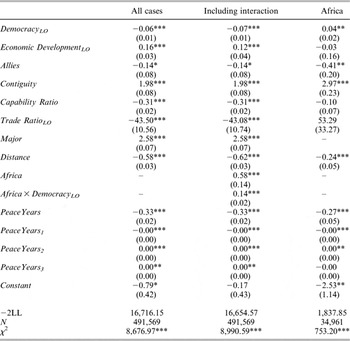
Logistic Regression of Democracy and MIDs in Africa, 1950–2001

Note: Robust standard errors are in parentheses; all p-values are estimated using two-tailed tests.
*p ⩽ 0.10, **p ⩽ 0.05 level, ***p ⩽ 0.01 level.
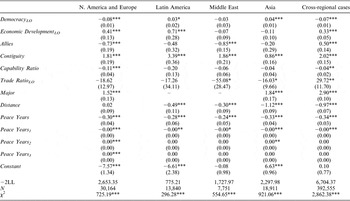
Logistic Regression of Democracy and MIDs in North America and Europe, Latin America, the Middle East, and Asia, 1950–2001

Note: Robust standard errors are in parentheses; all p-values are estimated using two-tailed tests.
*p ⩽ 0.10, **p ⩽ 0.05 level, ***p ⩽ 0.01 level.
Logistic Regression of Democracy and MIDs in Africa Using GDP as Relative Capability Measure, 1950–2001

Note: Robust standard errors are below coefficients; all p-values are estimated using two-tailed tests.
*p ⩽ 0.10, **p ⩽ 0.05 level, ***p ⩽ 0.01 level.
Logistic Regression of Democracy and MIDs in North America and Europe, Latin America, the Middle East, and Asia, Using GDP as Relative Capability Measure, 1950–2001

Note: Robust standard errors are below coefficients; all p-values are estimated using two-tailed tests.
*p ⩽ 0.10, **p ⩽ 0.05, ***p ⩽ 0.01.