Introduction
Verbascum blattaria L. (moth mullein) and V. thapsus L. (velvet mullein) belong to the family of Scrophulariaceae, which has 43 other species (USDA, Agricultural Research Service, National Plant Germplasm System, 2022). Verbascum species native to Europe were introduced in Michigan, USA in 1840 (Gross and Werner, Reference Gross and Werner1978; Telewski and Zeevaart, Reference Telewski and Zeevaart2002). In North America, V. blattaria f. albiflora (G. Don) House [International Plant Names Index (INPI 2022)] shows a white corolla and a purplish base. Sometimes, it occurs either as a pure or in mixed stands with the yellow form (Gross and Werner, Reference Gross and Werner1978) (https://gobotany.nativeplanttrust.org/species/verbascum/blattaria/; accessed on 5 January 2022).
Germination of V. blattaria seeds depends on their size; the largest seeds (>500 μm) show 30% germination, while the smallest ones (<250 μm) show 0% germination. The seeds take 8 days to complete the germination (Kivilaan and Bandurski, Reference Kivilaan and Bandurski1973). The seeds remain viable in their dormant state for at least 90 years (Kivilaan and Bandurski, Reference Kivilaan and Bandurski1973; Gross and Werner, Reference Gross and Werner1978). The seeds stored in a bottle and buried in 1879 shows 50% germination in 2000 (Telewski and Zeevaart, Reference Telewski and Zeevaart2002).
Verbascum blattaria is classified as a semi-rosette hemicryptophyte (Clapham et al., Reference Clapham, Tutin and Watburg1952). It grows up to 0.6–1.2 m at anthesis from the buds under a vegetative growth stage surviving as an overwintered rosette near or under the soil surface (https://data.kew.org/sid/plantform.html, accessed on 6 January 2022). Basal leaves of V. blattaria are long and oblanceolate and glabrous; simple with an oblong, ovate or lanceolate shape; or obtuse with an acute leaf apex and a crenate leaf margin. However, these characteristics may not persist at the flowering stage (Gross and Werner, Reference Gross and Werner1978). The flower pedicels of V. blattaria are 5–15 mm long. Its corolla is l.0–2.5 cm wide, and the capsule is depressed-globose and is 5–8 mm long (Gross and Werner, Reference Gross and Werner1978).
Verbascum blattaria is sometimes grown as an ornamental plant (United States, Agricultural Research Service, and Crops Research Division, 1960); however, no further information in relation to the use as an ornamental plant and cultivation is presented. Related information on culture is available only about ‘Southern Charm’ (V. ×hybrida) (https://www.swallowtailgardenseeds.com/perennials/verbascum/southern-charm-verbascum-seeds.html; accessed on 23 May 2022). ‘Southern Charm’ produces creamy yellow, soft lavender and peachy rose flowers on tall spikes in summer and flowers in the first year of germination from seeds and does not require seed vernalization for flowering. The wild form of V. blattaria could be used as an attractive and sturdy ornamental. However, no cultural information, such as the best time of sowing, duration of rosette growth, genetic variations and optimum temperature treatment on its growth and flowering starting from seeds, has been reported yet.
Colours in horticultural plants are measured based on colourimetric principles. Photographs are taken with a digital camera, and photographic colour measurement (PCM) is employed to record colourimetric data of the sample from the images (Kasajima, Reference Kasajima2019). Using a colourimeter of the PCM images could be useful, as it does not involve destruction of plant samples. The colourimetric data were formatted based on the CIELAB colour space, according to which the colours are classified based on the three CIE coordinates: L*a*b*; L* defines the brightness, ranging from 0 (black) to 100 (white), and a* and b* are chromatic coordinates, wherein a* ranges from −60 (green) to +60 (red) and b* ranges from −60 (blue) to +60 (yellow) (Becker, Reference Becker2016). These colourimetric data were utilized to evaluate the development and senescence of flower buds in Lilium hybrids (Burchi et al., Reference Burchi, Prisa, Ballarin and Menesatti2010).
Verbascum blattaria is widely grown in many locations in the North America. Self-pollination may occur as the flower closes, although outcrossing is also possible when styles protrude from the corolla (Gross and Werner, Reference Gross and Werner1978). However, characterization and the genetic diversity of V. blattaria has not been studied as extensively as it has been compared to other species such as in those native to Iran (Sotoodeh et al., Reference Sotoodeh, Attar, Andalo, Mirtadzadini and Civeyrel2018) and Turkey (Yilmaz and Dane, Reference Yılmaz and Dane2012). The monophyly and the first-diverging lineage between the subclades of Verbascum and Scrophularia was reported based on the analysis of the combined plastid and nuclear ribosomal ITS (nrITS) (Ghahremaninejad et al., Reference Ghahremaninejad, Riahi, Babaei, Attar, Behçet and Sonboli2015). Occurrence of hybridization of plants with a white and yellow corolla in the natural stands (https://michiganflora.net/species.aspx?id=2678) suggests that more studies are required to understand the genetic diversity of V. blattaria in North America.
The objectives of this research are (a) to study seed germination and the duration of low temperature treatment (CD) needed for flowering, (b) to describe leaf morphology at various stages of growth and development using colourimetric data from two morphologically distinct colour variants observed during the rosette growth, (c) to analyse the sequences of the nrITS and four chloroplast interspacer (cpIS) regions and (d) to investigate whether colour variants could be related to flower colour by conducting PCMs and sequence analysis of nrITS and cpIS regions.
Materials and methods
Seed, germination study and leaf morphology and colourimetric data
Seeds were collected from one plant that produced a white corolla near the creek in Ann Arbor, MI, USA, on 21 August 2021 (42.21793° N; 83.76749° W; 249 m elevation). For the germination study, 50 seeds were sown at the surface of a growing medium (Miracle Gro Moisture Control Potting Mix, Scotts Co., Marysville, Ohio, USA) in a container [15 cm (width) × 28 cm (length) × 9 cm (depth)] on 7 September in two replicates. The number of the germinated seeds was counted by removing them every 3 days for 60 days. The growing medium was carefully watered or misted after removing the germinated seeds and the trays were covered during the germination test. Another group of seeds (approximately 50) was sown on 2 September for a growth and flowering study.
After sowing the seeds, the containers were placed indoors maintained at a constant temperature of 23°C next to a window facing the south. The natural light was supplemented with two fluorescent light tubes (F48/25W/UTSL, General Electric, East Cleveland, OH, USA) from 08:00 to 18:00 h at 4.8 W/m2 irradiance [converted from a photometric foot-candle (General Electric light meter type 214) to the radiometric unit] (Thimijan and Heins, Reference Thimijan and Heins1983).
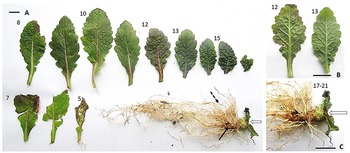
On 14 December, 104 days after sowing, one plant showing the representative size and development was selected, and photos of the whole plant, leaves and crown with roots were taken. All leaves from the 5th to 16th position counted from the crown were detached. The remaining plants comprised a tap root (solid arrow) and fibrous roots (dotted arrow) (Fig. 1, frame A), adaxial side of the 12th and 13th leaves (frame B) and an enlarged plantlet showing 17th–21st leaves and the tap root (Fig. 1, frame C). Sixteen basal leaves longer than 2 cm detached from the plants were not counted without counting the dried leaves near the crown (Fig. 1, frame A).
A Verbascum blattaria plant with all living leaves (from the 5th to 16th leaf) shown from the abaxial side, and remaining crown and the tap (solid arrow) and fibrous (dotted arrow) roots (frame A), the adaxial side of the 12th and 13th leaves (frame B), and enlarged picture of the 17th–21st leaves and the tap root (frame C). Photographs were taken on 15 December 2021 (104 days after sowing). Bar = 1 cm.

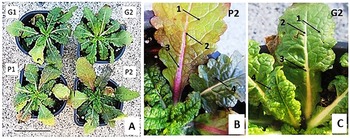
Two plants each with a brown-purple and green petiole and leaves were selected (Fig. 2, frame A) and photographed to collect colourimetric data for determining the CIE L*, a* and b* values. Data from four positions (Fig. 2, frame B and C) were recorded from a print using a portable CR-400 Chroma Meter (Konica Minolta Inc., Tokyo, Japan).
Verbascum blattaria plant showing brownish purple in leaf blade and main veins (P1 and P2) and green leaf blade and white main veins (G1 and G2) (frame A) selected for colourimetric analysis. Close-up photos of leaves selected from P2 and G2 showing the sites (1, 2, 3 and 4) for colourimetric analysis (frames B and C). Photographs were taken on 15 December 2021. Bar = 5 cm.

Genetic characterization
Polymerase chain reaction (PCR) for nrITS was performed with a universal ITS primer set (Attar et al., Reference Attar, Riahi, Daemi and Aghabeigi2011), and for cpIS, primers listed in Table S1 were constructed based on the sequence of the complete chloroplast of V. thapsus [NC 053691.1, registered at the National Center for Biotechnology Information GenBank (NCBI)] (http://www.ncbi.nlm.nih.gov/).
The reaction mixture (final volume: 25 μl) for both nrITS and cpIS consisted of 12.5 μl of Phusion Flash High-Fidelity Master Mix (Thermo Scientific Inc., Waltham, MA, USA), 1 μl of each primer (0.4 μM final concentration) and 2 μl of genomic DNA (50 ng) and 8.5 μl of water. The following PCR conditions were used for nrITS: 10 min of initial denaturation at 95°C, followed by 35 cycles of 30 s at 95°C, 30 s at 43°C and 30 s at 72°C, followed by the final extension for 5 min of 72°C. Similar conditions were used for cpIS as well, except that the extension was conducted for 1 min at 72°C for matK gene amplification. For both cpIS and nrITS, the PCR products were purified using the QIAquick PCR purification kit (QIAGEN BmbH, Hilden, Nordhein-Westfalen, Germany) according to the manufacturer's directions and used for direct sequencing by the SolGent sequencing service (SolGent, Daejeon, Korea).
All nrITS and cpIS sequences were registered at the NCBI. The similarity comparisons of the nucleotide sequences were performed using the nrITS and cpIS region nucleotide sequences from V. blattaria. The per cent identity with other Verbascum species was confirmed through homology investigation using the NCBI blast program. Sequence divergence for the nrITS and cpIS region was performed using the aligning sequences of Verbascum species by multi-Clustal W (Thompson et al., Reference Thompson, Higgins and Gibson1994).
Growth and development as influenced by low temperature treatment (CD)
On 17 October 2021, a clump of 3–5 seedlings were transplanted into a 3 × 3 × 3 cm cell pack filled with the same medium used in the seed germination test. On 24 October, 5–10 granules of 14N-6.2P-11.6 controlled-release fertilizer (Osmocote 14-14-14; Scotts Co) were applied to the surface of the medium. The temperature was maintained at 23°C. On 13 November, the seedlings were thinned out, leaving one seedling per cell, and were transplanted to a 7 cm pot. The pots were moved to non-heated indoors for low temperature treatments (CD) for 0, 20, 40 or 60 days, starting from 14 December 2021. Five plants were used for each treatment cycle. After the CD treatments, the pots were moved indoors on 14 December 2021 (treatment 1) and 4 January 2022 (treatment 2), 25 January (treatment 3) and 15 February 2022 (treatment 4) (Table S2).
The CD-treated plants were grown indoors next to a south-facing window supplemented with two fluorescent tubes, as described in the seed germination study, and leaf morphology and colourimetric data section.
From 1 March 2022, when the temperature outside was >4.5°C, the plants were moved outdoors during the day (08:00–16:00 h) and then moved back to non-heated indoors at night (16:00–0:800 h). Starting from 7 March 2022, all plants were moved outdoors during the day when the temperature was >2°C and moved back to non-heated indoors at night. The average air temperatures outdoors in Ann Arbor, MI, USA, are 2.0, 6.7 and 16.1°C in March, April and May, respectively (https://www.wunderground.com/history/daily/us/mi/ann-arbor/KARB/) with photoperiods of 11.6, 13.2 and 14.4 h (https://www.timeanddate.com/sun/usa/ann-arbor?month=1).
To analyse the macro- and micro-elements, leaf samples were collected from the plants grown in the garden of College Station (TX, USA) on 22 May 2022, and the plants grown in 7 cm pots in Ann Arbor, MI, on 27 May 2022. The leaves were dried at 21°C for 4–5 days with a fan-forced air-heating system set at 23°C. The analysis was performed at JR Peters Inc. (Allentown, PA, USA).
Statistical analysis
For colourimetric measurements, leaf samples were selected from two plants – one brown-purple and the other green (Fig. 2). There were no differences in the measurements between these two plants. Therefore, the combined means of brown-purple and green plants are presented. For CD, five plants were used for each treatment. All plants were completely randomized during the treatment and forcing. Each plant was considered a sampling unit. Data were subjected to the analysis of variance using Excel Microsoft Office program (Microsoft Excel 2019; Microsoft Corp, Redmond, Washington).
Results
Seed germination, morphology during vegetative growth and reproductive development, and colourimetric data
Seeds began to germinate 10 days and reached the near-plateau in 30 days after sowing, and a total of 19–20 seeds from 50 seeds germinated per replication in 60 days. However, delayed germination was also observed as three seeds germinated in 80 days and two in 100 days after sowing (data not presented). Sporadic germinations were noted even after 132 days when the other plants were in their flowering stage. One seed germinated after 186 days when the experiment was already completed (data not presented).
Leaves at all growth and development stages were simple and glabrous morphology. The morphology of the first two true leaves had an oblong or elliptical shape with a round-obtuse tip and entire margins. The third true leaves had a wavy wedge margin, which later became dentate. Detached leaves longer than 2 cm from the crown were simple with an acute or obtuse leaf apex and pinnatifid with lobes with incisions at the margin and a wavy edge (Fig. 1, frame A). Fibrous roots (dotted arrow) and tap root (solid arrow) are indicated (Fig. 1).
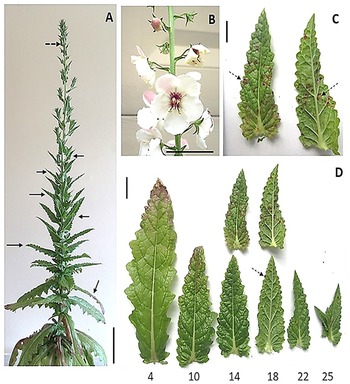
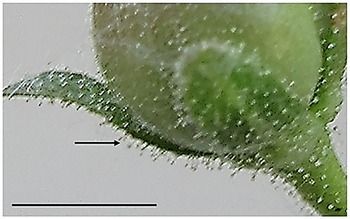
Basal leaves formed during the rosette growth were longer than the leaves formed on the flowering stem before the elongation of the shoot that received 20 CD (Fig. 3). Leaves produced on the compressed stem ready to reach anthesis were ovate or lanceolate with an obtuse or acute leaf apex (leaves 4 through 25; Fig. 3, frame D). Numerous stalked glandular trichomes protruding from the epidermis were observed in the sepal, pedicle, bracts and even in seed pods (Fig. 4).
Appearance of V. blattaria that received 20 days of low temperature (20 CD) shortly before the anthesis of the first flower (dotted arrow; frame A, bar = 7 cm), open flowers 2 days after anthesis (frame B, bar = 3 cm), leaves (14th and 18th leaves, frame D) showing brown spots as indicated by the dotted arrow in abaxial and adaxial sides (frame C, bar = 1 cm), and morphology of leaves collected from six different positions of the elongated stem (arrow; frame A) and leaves with brown spots (leaf position 18, indicated by a dotted arrow, frame D, bar = 2 cm). Axillary bud developed from leaf position 25.

Numerous stalked glandular trichomes (solid arrow) protruding from the epidermis were observed in the sepal, pedicle, bracts and even in seed pods of V. blattaria. The photograph was taken on 7 May 2022. Bar = 5 mm.

Leaf blade (position 1) and the distal end of the vein (position 2) had a significantly higher L* value than those at positions 3, 4 and 5 (Table S3, Fig. 2). The chromatic coordinates for a* in the leaf veins (positions 2 and 3) of the plant with brown-purple leaves (P1 and P2) had a positive value (7.0 and 10.6, respectively) in contrast to those (−8.4 and −4.25, respectively) of plants with green leaves (G1 and G2). The chromatic coordinates for b* in the leaf veins and leaf blade (positions 2, 3 and 4; 14.4, 18.75 and 20.6, receptively) were greater in green plants (G1 and G2) than those in brown-purple plants (P1 and P2; 7.45, −0.125 and 2.05, receptively).
Two days after anthesis, the tip of the corolla (position 1) was creamy white, with the values of 84.5, −3.6 and 0.6 for L*, a* and b*, respectively. These values could represent white, owing to a high L* value and approximately 0 values for both a* and b* (Table S4). The centre of flowers (position 3), the filament (position 4) and anthers (position 5) showed a* coordinate values of >13.1, indicating that they are reddish. The CIE L*a*b* values of the flowers of all plants grown in the 7 cm pot in Ann Arbor, MI, did not show any differences, regardless of the leaf colour (data not presented) during the rosette-growth stages (Fig. 2).
Genetic characterization
The direct sequenced PCR amplicons of the nrITS region in four plants (P1, P2, G1 and G2, Fig. 2) were not different (data not presented). For example, direct sequenced PCR amplicon for plant P1 produced 644 base pairs (bp), excluding the end of the ‘ragged’ sequence. This DNA sequence of the nrITS region contained the region of 18S rRNA (partial sequence, >1….64), ITS-1 (>65….197), 5.8s rRNA (>198….467), ITS-2 (>468….577) and 28S rRNA (partial sequence >578….689) (data not presented). The nrITS sequence of V. blattaria was the first report registered at the NCBI (OM996045).
The following sequences in the four cpIS regions were identified and registered: [trnS-trnG intergenic spacer (ON383212), trnL-trnF intergenic spacer (ON383213), psbA-trnH intergenic spacer (ON383214) and maturase K (matK) gene (ON383215)]. There were no differences in the cpIS sequences of the four plants (P1, P2, G1 and G2) (data not presented).
Growth and development as influenced by low temperature treatment (CD)
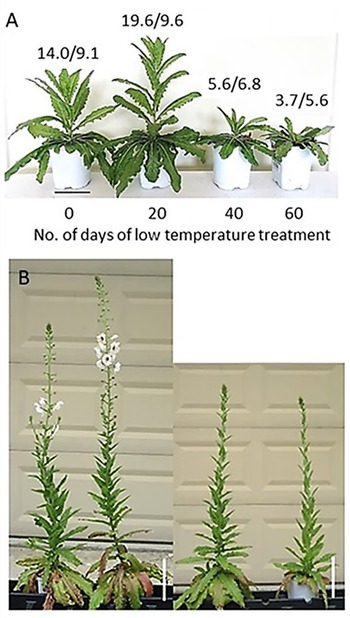
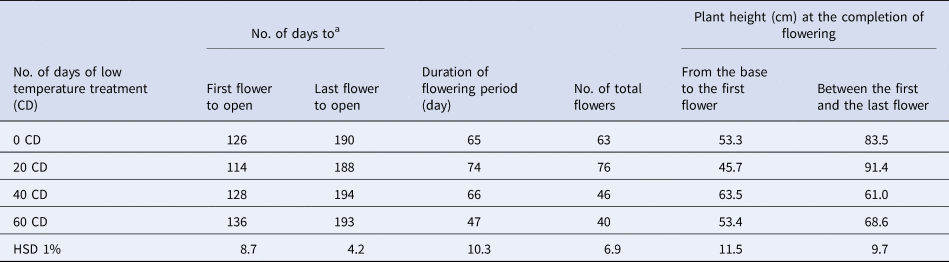
The internodes were clearly visible and the plants were taller when they received 20 days of low temperature treatment (20 CD) compared to those received 0, 40 or 60 CD on 8 March 2022 (Fig. 5). Plants that received 20 CD flowered in 131 days when counted from the beginning of the CD (Table 1, Fig. 5). The number of days between the first and last flower to flower was 74 days. The shortest plant from the growing medium to the first flower (47 cm) and the longest inflorescence between the first and last flowers (91.4 cm) were obtained with 20 CD (Table 1).
Growth and development of V. blattaria as influenced by the duration of low temperature treatment; frame A: plant height/leaf spread (cm) are indicated above the plants. Significant levels are 2.9/2.1 for plant height/spread by HSD at 1%. Appearance of V. blattaria after low temperature treatment (CD). Photographs were taken on 8 March 2022. Bar = 7 cm and frame B: starting from 14 December 2021 and moved to the non-heated indoor on 1 March 2022. Bar = 10 cm.

Growth and flowering response of Verbascum blattaria as influenced by low temperature treatments

a The number of days to flower was counted from 14 December 2021 when plants were transplanted.
Analysis of macro- and micro-elements from the leaves of the plants grown in the garden indicates that most of the elements were within the suggested range for general horticultural crops assembled by JR Peters, Inc. (Roh et al., Reference Roh, Bauchan and Huda2012; Huda and Roh, Reference Huda and Roh2014), except for sulphur (S; 0.12%) and zinc (Zn; 59.4 ppm), without showing any deficiency and toxic symptoms (Table S5).
Discussion
Seed germination, morphology during vegetative growth and reproductive development and colourimetric data
The seeds of V. blattaria germinated in 10 days after sowing. A previous study also reported that seeds germinate in 8 days (Kivilaan and Bandurski, Reference Kivilaan and Bandurski1973). However, a sporadic germination of seeds spread over a 130–180-day period was also observed, which may be attributed to that germination seeds depend on the size of seeds. Seeds buried deep in the growing medium may germinate when they get exposed to light during watering or some other cultural practices. Seeds remain viable for over 190–230 days or perhaps even longer (Kivilaan and Bandurski, Reference Kivilaan and Bandurski1973). Since seeds were collected from one plant where no other plants were observed, it is not possible to conclude that the observed sporadic germination response was influenced by environment during seed production of the mother plant (Penfield and MacGregor, Reference Penfield and MacGregor2017).
The first two true leaves upon germination were oblong or elliptical with a round-obtuse tip and entire margins not described previously (Gross and Werner, Reference Gross and Werner1978). It is not certain whether these morphological characteristics would be useful to identify V. blattaria upon germination. The morphology of the first two true leaves is different from that of the leaves formed during the rosette growth. Leaves formed on the stem after spiking from the rosette had a wavy wedge margin, which then became dentate (http://lifeofplant.blogspot.com/2011/03/leaf-margins-tips-and-bases.html, accessed on 9 June 2022).
Leaves produced on the stem following spiking from the rosette and compressed stem formed on the stem ready to reach anthesis showed an acute leaf apex. Although the size of leaves depends on the differences in culture and the position of the stem, the largest leaf (position 10) was 7.3 × 3.5 cm (length × width) (data not presented), longer than 6 cm as reported earlier (Gross and Werner, Reference Gross and Werner1978). Basal leaves formed during the rosette growth are longer than the leaves formed on the flowering stem before shoot elongation that received 20 CD (Fig. 3). The size of the flower composed of five corolla 2 days after anthesis was 3.2 × 2.6 cm, which may be similar to the 1.0–2.5 cm wide corolla reported in the literature (Gross and Werner, Reference Gross and Werner1978) (Fig. 3, frame B).
Stalked glandular trichomes protruding from the epidermis (Fig. 4) were not observed in the leaves developing during the rosette-growth stage. The leaves of V. blattaria are glabrous and free from hairs (trichomes) (Gross and Werner, Reference Gross and Werner1978). Further detailed studies using high-powered microscopy such as scanning electron microscopy would be necessary to identify whether trichomes are present in the leaves during vegetative growth and on the stem formed after spiking, whether the trichomes are branched or glandular, and they are associated with the spatial distribution of plant organs or differs based on density (Tian et al., Reference Tian, Liu, Wang, Zhang, Li and Wu2017).
Difference in the L* value of the leaf blade (position 1) and the distal end of the vein (position 2) as compared to the L* value at position 3, 4 and 5 could be due to the different level of exposure to light. Therefore, the L* value may not be appropriate to differentiate the leaf colours. However, the chromatic coordinates for a* in the brown-purple leaf veins had positive values in contrast to those of the plants with green leaves. Hence, plants with brown-purple leaves are more reddish than those with green leaves. In addition, the chromatic coordinates for b* in the leaf veins and leaf blade of green plants had positive values in contrast to those of brown-purple leaves. The chromatic coordinates for a* range from −60 (green) to +60 (red) and those for b* range from −60 (blue) to +60 (yellow) (Burchi et al., Reference Burchi, Prisa, Ballarin and Menesatti2010). This result indicates that plants with green leaves were more yellowish than those with brown-purple leaves. Therefore, the calorimetric data for a* and b* collected from the photographic images are considered useful to analyse the colour of V. blattaria leaves.
Two days after anthesis, the flowers were creamy white at the tip of the corolla, with the CIE L* coordinate of 84.5, which is close to 100 representing white (Burchi et al., Reference Burchi, Prisa, Ballarin and Menesatti2010), while the values of a* and b* are close to 0. All plants grown in the 7 cm pot in Ann Arbor, MI, did not show any difference in the CIE L*a*b* values of their flowers, regardless of the leaf colour (data not presented) during the rosette-growth stages (Fig. 2). Because no colour variation based on CIE L*a*b* coordinates and sequence analysis could be detected (discussed later in this report), the wild form evaluated in this study is taxonomically identified as V. blattaria f. albiflora, registered at the International Plant Names Index (IPNI 2022) (or f. erubescens Brügger.; https://michiganflora.net/species.aspx?id=2678; not listed in IPNI; accessed on 8 August 2022). The white corolla and purplish base sometimes occur either as a pure stand or in mixed stands with the yellow form (Gross and Werner, Reference Gross and Werner1978).
Genetic characterization
For the nrITS region, all four plants (P1, P2, G1 and G2, Fig. 2) did not show different sequences and this is the first report on V. blattaria and registered at the NCBI (OM996045). The per cent nrITS identity of V. blattaria was higher than that of V. virgatum (98%, MW546364) and V. gossypinum (97%, KP738150) (Table S6). Genetic characteristics were investigated to assess the genetic diversity as a potential factor contributing to the colour variation observed between plants with brown-purple leaves (P1 and P2) and plants with green leaves (G1 and G2). The ITS region of the nuclear ribosomal cistron is a commonly utilized DNA sequence that becomes prominent at phylogenetic comparisons below the genus level (Álvarez and Wendel, Reference Álvarez and Wendel2003).
The following sequences in the four cpIS regions were registered: [trnS-trnG intergenic spacer (ON383212), trnL-trnF intergenic spacer (ON383213), psbA-trnH intergenic spacer (ON383214) and maturase K (matK) gene (ON383215)]. There were no differences in the cpIS sequences of the four plants (P1, P2, G1 and G2) (data not presented). Based on the sequence divergence and per cent identity of V. blattaria in the cpIS regions, the taxa of V. thapsus, V. virgatum and V. kermanense were identified to have a high similarity index (>97%) (Table S7).
Another region to identify genetic diversity between plant species is the cpIS of the chloroplast genome (Li et al., Reference Li, Yang, Henry, Rossetto, Wang and Chen2015). A variety of cpIS, including matK, which contains high substitution rates within species (Selvaraj et al., Reference Selvaraj, Sarma and Sathishkumar2008), and the high variable regions (trnS-trnG, trnL-trnF and psbA-trnH, etc.) are useful for plant species identification (Liu et al., Reference Liu, Zhang, Chen, Chen, Hu, Gao, Pan, Xin, Wu, Du and Zhang2021).
Genetic diversity and gene flow among the populations of V. blattaria has not yet been understood, in contrast to that of other Verbascum species native to Iran (Sotoodeh et al., Reference Sotoodeh, Attar, Andalo, Mirtadzadini and Civeyrel2018) and Turkey (Yılmaz and Dane, Reference Yılmaz and Dane2012). Although there is interspecies specificity, the nrITS and cpIS sequences of V. blattaria were generally similar to those of other Verbascum species. Therefore, it can be suggested that the genus Verbascum and the four plants of V. blattaria have a very narrow genetic diversity, regardless of the colour of the petiole, leaf blade and vein. Although we did not investigate the pollination mechanisms, we can suggest that V. blattaria self-pollinates in nature (Gross and Werner, Reference Gross and Werner1978). The difference in leaf colour during the rosette-growth could be related the expression of phenotype interacted with environments and possibly with the different growth phase. However, differences in the leaf observed during the rosette growth were observed after spiking in V. blattaria (data not presented).
Growth and development as influenced by low temperature treatment (CD)
Plants that received 20 CD were taller than those that received 0, 40 and 60 CD, because of the formation of clearly visible internodes in the former. Plants receiving 20 CD also flowered early, in 131 days. This observation indicates that V. blattaria requires certain degrees of CD. However, it was reported that ‘Southern Charm’ does not need CD to flower in the first year after germinating from seeds (https://www.swallowtailgardenseeds.com/perennials/verbascum/southern-charm-verbascum-seeds.html; accessed on 23 May 2022).
The delay in the flowering of plants that received 40 and 60 CD could be because of an extended CD treatment before transferring the plants outdoors starting from 1 March, which were not exposed to a higher temperature at 21°C indoors. The shortest plant to first flowers (47 cm) and the longest inflorescence between the first and last flowers (91.4 cm) with 20 CD may further support that V. blattaria needs a certain duration of low temperature treatment. In V. blattaria, low temperature treatment (2.8–7.2°C) given to the vegetative rosette can, therefore, be regarded as vernalization that accelerates the transition from the vegetative rosette growth to shoot evocation, leading to early flowering. However, the low temperature treatment is not essential, as evident by the fact that the ‘Southern Charm’ hybrid produces flowers in the first year of germination from seeds. Further studies need to be conducted to investigate whether V. blattaria truly requires vernalization to flower when seeds were germinated in the spring without being exposed to low temperatures, as discussed in the reports for Eustoma grandiflorum hybrids ‘Little Belle Blue’ (Wu et al., Reference Wu, Wang and Roh2022).
An analysis of the macro- and micro-elements of the leaves, except for sulphur (S; 0.12%) and zinc (Zn; 59.4 ppm), has indicated that the data can be used to evaluate whether certain elements are within the acceptable level to produce a healthy plant (Roh et al., Reference Roh, Bauchan and Huda2012; Huda and Roh, Reference Huda and Roh2014). Because the concentration of most elements, especially that of nitrogen (N; 1.3–1.8%) was low [except for the concentration of magnesium (Mg) and iron (Fe)] when the plants were grown in 7 cm pots, regardless of the presence and absence of brown spots (Fig. 3, frame C and D), a constant supply of fertilizers is required.
Further research under different climatic conditions or a controlled temperature and photoperiod may be required to determine whether 20 CD is sufficient for floral induction, as reported in plains rough fescue (Festuca hallii [Vasey] Piper) (Palit et al., Reference Palit, Bai, Romo, Coulman and St Pierre2015). Whether low temperature treatment can be considered as vernalization, optimum temperatures and treatment durations as reported in the plains rough fescue should be investigated. Further, low temperature interacted with different photoperiods as reported in the controlled flowering responses of Lilium longiflorum Thunb. (Roh and Wilkins, Reference Roh and Wilkins1977) should be examined.
Except for the suggestion that V. blattaria can be used as an ornamental plant (United States, Agricultural Research Service, and Crops Research Division, 1960), no further information such as how to grow and on growth and flowering physiology is presented (verbascum_blattaria_20080714.pdf; accessed on 8 January 2022). The plants are suitable for landscaping rather than bedding plant in small pots, because they are tall, reaching 90–120 cm (Fig. S1, frame C) or over 130 cm even when grown in a 7 cm pot following 20 CD (Table 1).
Conclusions
This study investigated the leaf morphology and colourimetric analysis, genetic characterization and flowering responses of V. blattaria to low temperature treatments. Seeds started to germinate in 10 days and reached the plateau in 30 days after sowing. The leaves formed during the rosette-growth stage were oblanceolate; however, may change to the ovate or lanceolate shape with an obtuse or acute leaf apex at the flowering stage. Numerous trichomes were observed on the pedicels of the lateral branches, pedicel subtending flower pod and seed capsules. The colourimetric data of CIE L*a*b* coordinates in the early rosette-growth stage indicate that plants with brown-purple leaves have high a* and b* values. All plants produced a creamy white corolla with a purplish base.
Regardless of the colour of the petiole, leaf blade and vein in all four plants (P1, P2, G1 and G2), there were no differences in the nrITS sequences and trnS-trnG, trnL-trnF and psbA-trnH cpIS and plastid maturase K (matK) gene. Therefore, the genetic diversity of V. blattaria is considered very narrow, owing to possible self-pollination and because many species of the genus Verbascum are close to each other.
Verbascum blattaria showed earliest flowering (131 days) with 20 CD and produced the highest number of flowers (76) on a short stem. Low temperature treatment given to the vegetative rosette of V. blattaria could be considered as vernalization that accelerates shoot evocation and elongation, leading to early flowering. Because the plants are taller than 90–120 cm, they should be grown in the garden, not in a container. The future research with V. blattaria that are collected from the nature and with V. blattaria hybrids will be required to produce compact plants in a small container using plant growth regulators.
Supplementary material
The supplementary material for this article can be found at https://doi.org/10.1017/S1479262123000497.
Author contributions
H. M. Kim performed the laboratory experiments in genetic characterization; M. S. Roh conceived the idea and performed the forcing experiment, wrote the first draft coordinating with all authors; Y. K. Yoo performed colourimetric data analysis; K. S. Yoo cultured plants in the garden and collected leaf samples for the analysis; and Y. H. Joung supported the project by funding for genetic characterization, receiving English editing service and coordinated to submit the manuscript.
Financial support
This research was supported in part by the research grant awarded to Y. H. Joung from the New Breeding Technologies Development Program (Project No. PJ01654401) through the Rural Development Administration (RDA) and personal contributions from M. S. Roh.
Competing interest
None.
Declarations
None.