


Shocks that enable non-elite groups to organize and credibly threaten violence drive fundamental institutional change in many of the most influential theories of politics and development. The role of shocks to the organizational abilities of disenfranchised groups has long featured prominently in theories of democratization in Europe (Acemoglu and Robinson Reference Acemoglu and Robinson2000; Boix Reference Boix2003; North, Wallis, and Weingast Reference North, Wallis and Weingast2009), theories of broader political revolutions (Acemoglu and Robinson Reference Acemoglu and Robinson2005; Engels and Marx Reference Engels and Marx1848), as well as as well as explanations of progressive taxation and changes in the identity of those in power. However, measuring the effects of providing organizational skills in mobilization and violence to large numbers of de facto disenfranchised people has hitherto proven difficult.
A related puzzle is to understand the long-term effects of warfare on institutional development. Looking across countries, a range of important political and institutional changes, including democratization and progressive taxation, appear to have followed war and violent external threats (Besley and Persson Reference Besley and Persson2010; Przeworski Reference Przeworski2007; Scheve and Stasavage Reference Scheve and Stasavage2010). However, while the broad cross-country patterns suggest an important connection between war and institutional change, much less evidence is available to evaluate the mechanisms through which this may occur, whether through a change in the norms of fairness (Scheve and Stasavage Reference Scheve and Stasavage2010), a rise in common interests (Besley and Persson Reference Besley and Persson2010) or by the development of organizational skills gained in combat by non-elite groups (this article).
We argue that wars provide a common environment where previously disenfranchised groups have historically gained and continue to be likely to gain the organizational skills to engage in collective action to alter political institutions, particularly when external threats provide elites with little option but to allow such organizational skills to develop among non-elite groups. We exploit a natural experiment—the arbitrary assignment of infantry battalions to different exposure to combat in World War II—to measure the effect of skills gained in combat among non-elite groups on subsequent collective action. We focus on an environment where numerical dominance by one's own ethnic group could secure superior control of local politics and access to future public goods allocations, a common characteristic of ethnically-diverse societies (Banerjee, Iyer, and Somanathan Reference Banerjee, Iyer, Somanathan, Schultz and Strauss2008). This article analyzes a key example of this environment: the ethnically-based partition and integration of different regions and partially autonomous native states within the South Asian sub-continent into the countries that would later become India, Pakistan, and Bangladesh. We use an intuitive framework to interpret the effect of combat experience on two forms of collective action that can secure an ethnic group's regional numerical dominance: ethnic cleansing of competing groups, and the fostering of co-ethnic immigration. We then exploit the arbitrary nature of assignment of army battalions to different campaigns and lengths of combat in World War II to examine the effects of organizational skills developed in combat on subsequent ethnic homogenization, cleansing, and co-ethnic immigration in the home districts of combat units.
During World War II, the colonial Indian army mustered 2.5 million troops to fight the Axis in Africa, Europe, and Southeast Asia. At the time, this was the largest volunteer army in the history of the world, constituting close to three percent of the entire adult male population of the region. Recruitment into the army was not random; however, recruits were selected locally from specific ethnic groups following long-standing colonial policies. At the same time, the colonial Indian army, like the United States, Great Britain, Germany, Japan and Russia, placed an emphasis on creating infantry battalions that could be interchangeably replaced at the frontline according to the logistical needs of the moment and in response to enemy action.Footnote 1 This emphasis on interchangeability of infantry battalions meant that local differences in the geographic origins of particular companies within those battalions tended to be ignored in deployment. We exploit the resultant arbitrary nature of combat deployment in interaction with long-standing racial recruitment policies to estimate both the average effect of skills gained in combat on subsequent political collective action in soldiers’ home districts and heterogeneous effects depending on whether ethnic minorities were the likely beneficiaries of these skills.
Consistent with substantial qualitative evidence of quasi-random World War II combat assignments by British staff officers who took pride in the combat-readiness and interchangeability of their battalions, we show that, conditional on being deployed at the same time, there was no relation between the number of months army battalions raised from a district spent in combat roles and other district characteristics that have been considered relevant for determining migration and ethnic cleansing during the Partition. However, districts that raised army units that happened to experience one additional month of average combat experience in World War II saw a 0.77 percentage point reduction in the ratio of religious minorities in 1951—a large effect. Furthermore, additional combat experience appears to have facilitated both ethnic cleansing and co-ethnic immigration. An additional month of combat experience was associated with a 1.1 percentage point greater reduction in the minority population due to killing, conversion, or migration (equivalent to 17,000 people per district), and a 0.54 percentage point greater inflow of majority co-ethnic refugees (or 8,150 people per district). The effect of raising units with increased combat experience was particularly pronounced in districts where the target minority population approached the majority, and thus the potential gains to ethnic cleansing, both in terms of expropriation and in terms of enhanced future political control, were likely to be greatest. In fact, there appears to be a threshold of around a 35% initial minority population above which ethnic cleansing appears to be a favored strategy over encouraging co-ethnic immigration.
Our results are robust to comparing districts both within and across provinces and native states of India, matching along a battery of different measures of military recruitment, and controlling for a wide range of other factors that have been plausibly associated with Partition-era migration and violence. The results also survive a series of placebo tests. Districts that raised units with greater combat wartime experience do not reveal greater levels of prewar violence or private organization as measured by religious rioting, violent crime, murder rates, or increased recruitment into police and private security services. This provides evidence against a key potential threat to identification: that the presence of some unobserved “martial” district characteristic might have led both to greater ethnic cleansing in a district and encouraged units raised there to be assigned to more combat.
We argue that our results reflect the role of combat experience in enhancing organizational skills at credibly threatening violence and engaging in collective action aimed at altering ethnic composition to seize future political control. As is common in labor economics, we interpret experience as providing human capital. The importance of at least a few combat veterans in improving battlefield effectiveness has long been a central military doctrine, even though measuring the effects of such experience has thus far proven difficult (Muir Reference Muir2000). While combat experience parallels extended military training in some respects, such as in greater practice in weaponry and drills, it also differs in two crucial ways: the actual experience of engaging in violence, and the need to improvise in rapidly changing circumstances.
The experience of engaging in violence may provide a form of human capital that reduces the psychological costs of engaging in future violence. In fact, Vietnam veterans more exposed to wartime killing appear also more likely to engage in subsequent levels of violent behavior (Beckham, Moore, and Reynolds Reference Beckham, Moore and Reynolds2000; Maguen et al. Reference Maguen, Metzler, Litz, Seal, Knight and Marmar2009). This capital, while prized in wartime and crisis, may become a liability in peace.
But, if combat experience's only effect was to reduce the costs of violence, a number of our results would remain unexplained. Combat experience appears to encourage the provision of public goods, such as providing safe havens and investing in infrastructure for welcoming co-ethnic immigrants, that are not likely to benefit from purely reducing the costs of violence for some individuals. In the absence of the ability to organize such individuals, the increased risks posed by individuals with lower costs to engaging in violence would arguably deter, not enhance, co-ethnic immigration. Further, we show that combat experience appears to reduce ethnic cleansing in environments such as medieval ports, where communities gain economically from having both groups present, due to a history of complementary business relationships (Jha Reference Jha2008). In fact, while combat experience increases certain types of ethnic cleansing—the forced migration and conversion of minorities—we will show that in Punjab, combat experience appears to actually reduce the violent death toll relative to these other forms of ethnic cleansing.
The missing, but complementary, piece may be found in the second crucial difference between combat experience and military training—the ability to improvise and organize people in rapidly changing circumstances. Military accounts point to the ability of experienced combat units to quickly introduce new routines that improve upon existing drills and to impart such skills to new recruits. A key aspect of combat experience is to learn to rapidly divide complex battle objectives into smaller discrete tasks. Each task is then assigned to improvised, small quasi-formal hierarchical organizational structures that are often more effective (Muir Reference Muir2000; Powell Reference Powell2010). The development of these organizational skills in combat appears more consistent with our evidence. First, combat experience appears to have encouraged private provision of pure public goods, such as providing safe havens and other infrastructure that favors co-ethnic immigration, consistent with enhanced organizational capacities in private collective action aimed at political control. Further, enhanced organizational skill gained in combat appears ironically to have made population exchanges more peaceful in two ways. When the majority received the organizational skill, the threat of violent ethnic cleansing appears to have been more credible, and the actual cleansing more organized and less wasteful of life and property when it did occur. When the minority received the organizational skill, it also appears to have made them better able to leave in anticipation of violence. Thus, while minority ethnic cleansing was higher in districts with more experienced combat veterans, the population transfer was relatively more peaceful.
This article builds upon and contributes to research on the role of war and collective action in institutional change, on the security dilemma, conflict, and public goods provision in ethnically diverse societies, on the role of veterans and war-time experiences in post conflict recovery, and on the role of partitions as a means for solving some of the most pressing conflicts around the world.
Our results suggest that exposure to combat in external wars helps veterans, often from minority or non-elite groups, to develop skills at private organization and violence. However, the ability of those non-elites to organize collective action and to credibly threaten violence are likely to diminish over time as veterans age or disperse, reducing future bargaining power. These falls in bargaining power, however, are central to a range of prominent contemporary theories of democratization and institutional change (Acemoglu and Robinson Reference Acemoglu and Robinson2005), rational war (Fearon Reference Fearon1995; Powell Reference Powell2006) and the security dilemma in ethnically- diverse societies (Fearon Reference Fearon, Lake and Rothschild1998; Kaufmann Reference Kaufmann1996; Posen Reference Posen1993). The inability of elite groups or ethnic majorities to commit not to exploit a future fall in the bargaining power of disenfranchised or non-elite groups may induce pre-emptive violence by those non-elites.
Where the differences between groups stem from wealth, this temporary threat of revolutionary violence may encourage democratization by elites as a means to commit to redistribution (Acemoglu and Robinson Reference Acemoglu and Robinson2005). Thus the shock to organizational skill that combat experience brings to non-elites can explain the empirical regularity, noted by Przeworski (Reference Przeworski2007) and Boix (Reference Boix2003, 13), that democratization often follows external wars.
Where the differences between groups are ethnic, however, by temporarily changing the ability to organize violence and thus the bargaining power of different ethnic groups, our interpretation suggests that external wars may have the unintended consequence of facilitating future civil conflict and encouraging processes of ethnic cleansing and homogenization in ethnically diverse societies. In this way, combat experience can exacerbate the security dilemma.
However, our results suggest a further nuance to the security dilemma as it applies in ethnically diverse societies (Fearon Reference Fearon, Lake and Rothschild1998; Kaufmann Reference Kaufmann1996; Posen Reference Posen1993): the processes of ethnic homogenization are not inevitable and need not be violent. In environments where there is inter-ethnic complementarity, where the minority is large and where minority groups are the beneficiaries, enhanced organizational skills can actually favor the formation of safe havens or peaceful population flows.
This article also builds upon an important series of studies on post-conflict reconstruction. Studies of those exposed to conflict in Sierra Leone and Uganda reveal remarkably benign effects on their subsequent behavior, including increases in the propensity to vote and increased participation in community organizations (Bellows and Miguel Reference Bellows and Miguel2008; Blattman Reference Blattman2009; Humphreys and Weinstein Reference Humphreys and Weinstein2007). These benign effects resonate with Angrist's (Reference Angrist1990) study of life-time income among Vietnam conscripts, where he finds that income losses among conscripted veterans were small enough to be explained by the lost human capital that veterans would have received had they gone to school rather than to war.Footnote 2
This study complements these works in a number of ways. First, while the works above focus on estimating the effect of recruitment into the army on subsequent behavior, we focus instead on identifying the effect of combat experience on collective action in the home districts of those recruited. Second, it is important to note that surveys of veterans of conflicts, by their nature, tend to focus upon an extremely important but still select set of environments—those where conflicts have ceased and reconstruction has begun, and thus benign effects are more likely. Instead, we examine the role of combat experiences in a time of crisis. It is our contention that while war-time experiences may displace human capital that enable soldiers to compete in peacetime labor markets, such experiences do provide skills at private organization of defense, offense, and mobility that are particularly valuable in periods of crisis. It is these organizational skills that can also engender collective action that fosters broad institutional change.Footnote 3
Finally, our article also builds upon important works that find that societies riven by economic inequalities or social and ethnic divisions provide fewer public goods, are often more prone to conflict, and suffer diminished growth trajectories (e.g., Baldwin and Huber Reference Baldwin and Huber2010; Fearon and Laitin Reference Fearon and Laitin2003; Miguel, Satyanath, and Sergenti Reference Miguel, Satyanath and Sergenti2004), by providing evidence for a new mechanism for how societies become homogeneous or retain their diversity. In fact, partitioning ethnically diverse regions into homogeneous homelands has been often mooted as a solution to the most insuperable conflicts around the world, including in Iraq, the Holy Land, and in the Balkans (Downes Reference Downes2001; Kaufmann Reference Kaufmann1996; O'Hanlon and Joseph Reference O'Hanlon and Joseph2007). The appealing logic of fostering peace by separating contentious ethnic groups continues to be actively debated to both policymakers and academics (Alesina, Spolaore, and Wacziarg Reference Alesina, Spolaore, Wacziarg, Aghion and Durlauf2005; Chapman and Roeder Reference Chapman and Roeder2007; Kasara Reference Kasara2010; Sambanis and Schulhofer-Wohl Reference Sambanis and Schulhofer-Wohl2009).
Yet, little is known about the conditions under which what appears to be a viable political compromise devolves into a human disaster. The Partition of South Asia on religious grounds in August 1947 looms large as a cautionary tale to advocates of partition as a means for peace. Seen as an effective political solution to ethnic tension, few anticipated the scale of the violence that followed (Copland Reference Copland2002; Talbot and Singh Reference Talbot and Singh2009). Instead, the partition of the Indian subcontinent led to one of the largest forced migrations in world history, with an estimated 17.9 million people leaving their homes (Aiyar Reference Aiyar, Low and Brested1998; Bharadwaj, Khwaja, and Mian Reference Bharadwaj, Khwaja and Mian2008a), and estimates of those killed between March 1947 and January 1948 ranging from 180,000 to one million. There were 3.4 million “missing” in the 1951 census (Bharadwaj et al. Reference Bharadwaj, Khwaja and Mian2008a). Marshalling a new dataset on the political and economic determinants of ethnic cleansing and migration during the Partition, this article sheds new light on this important episode.
The next section provides relevant background on the Partition. We will then provide an intuitive theoretical framework, and present the empirical strategy and the main results. Following further tests and robustness checks, we will compare the effect of combat experience on ethnic cleansing and explicit violence in a single area: the Punjab. The penultimate section draws on qualitative historical evidence to highlight the mechanisms through which combat experience may have played a role in the Partition of South Asia, while we will conclude by discussing the broader implications.
BACKGROUND
Even before the Partition of South Asia, British rule had divided the subcontinent. The British directly administered 13 provinces, comprising two-thirds of the subcontinent's population. The remainder consisted of numerous “Native States,” ruled by Indian princes. By 1951, these 488 districts and territories would be consolidated into the 284 comparable districts that constitute our sample.Footnote 4
On August 17, 1947, two days after the official independence of India from British rule, British lawyer Sir Cyril Radcliffe declared the final boundaries of the new nations of South Asia. Prior to this, the rulers of the Native States declared their intent to join one nation or another, or their desire to remain independent.Footnote 5 While it was believed that religious demography would play an important role in shaping both the Radcliffe borders and the secession of the Native States, many perceived that changes in the “facts on the ground” might yet determine South Asia's ultimate national borders (Copland Reference Copland2002).
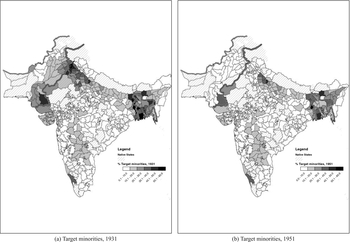
The boundaries of post-Partition South Asia were largely determined by the proportion of Muslims in a territory (Figure 1(a)). Muslims, Hindus, and Sikhs caught on the wrong side of the border found themselves “target” minorities, even in the six districts where they had previously enjoyed a slight numerical advantage.Footnote 6 Large-scale violence and population flows resulted in a remarkable religious homogenization of the districts of South Asia by 1951 (Figure 1(b)). While target minorities constituted an average of 13.8% of a district's population in 1931, this proportion declined by 34.8%, with minorities constituting only 9.0% overall, by 1951.
Partition and the Religious Homogenization of the Indian Subcontinent, 1931–1951
Source: 1931, 1951 censuses of India and Pakistan and Bharadwaj, Khwaja, and Mian (Reference Bharadwaj, Khwaja and Mian2008a). Target minorities include Hindus and Sikhs in independent Pakistan and Bangladesh, and Muslims in independent India.

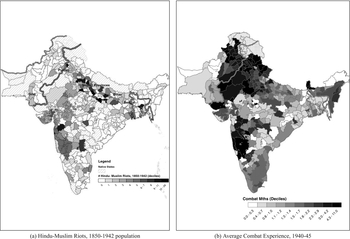
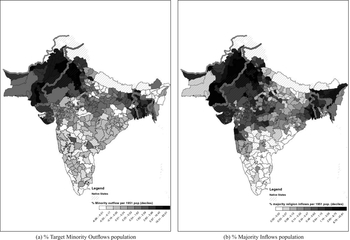
Both the unprecedented scale of the violence and population flows during the Partition and their location took policymakers by surprise (Talbot and Singh Reference Talbot and Singh2009). Field Marshal Claude Auchinleck, the Commander-in-Chief of the Indian Army, predicted in November 1945 that, “The principal danger areas are likely to lie in the United Provinces, Bihar and Bengal . . .” (Mansergh Reference Mansergh1976; Vol. 5, 576–78). Despite the long record of religious conflict in these provinces before 1947 (Figure 2(a)), these areas escaped the worst of the ethnic cleansing at Partition (Figure 3).
Prewar Violence and War-time Combat Experience
Source: (1) Based upon Wilkinson (2005) and the Times of London, 1850–1942. (2) Own calculations derived from Commonwealth War Graves Commission fatality data and the official histories of the Indian Army.

Population Transfers and Ethnic Cleansing: Target Minority Outflows and Majority Inflows
Source: Own calculations and Bharadwaj, Khwaja, and Mian (Reference Bharadwaj, Khwaja and Mian2008a), based upon 1931 and 1951 censuses of India and Pakistan

Despite its importance, both in terms of human cost and its subsequent impact on three countries with more than a fifth of the world's population, almost all the work on ethnic cleansing during the Partition has been qualitative, and almost exclusively regional in scope.Footnote 7 There has hitherto been little quantitative evidence about the political and economic determinants of the patterns of ethnic cleansing around the country that led a political compromise to devolve into a human disaster (Brass Reference Brass2003). An important new contribution is a set of works exploiting the censuses of India and Pakistan before and after Partition to document the patterns of minority outflows and majority inflows (Bharadwaj, Khwaja, and Mian Reference Bharadwaj, Khwaja and Mian2008a; Reference Bharadwaj, Khwaja and Mian2008b), which we will build upon explicitly.
EMPIRICAL STRATEGY
We will begin by informally sketching a model to clarify how the potential relationship between our outcomes—ethnic cleansing, co-ethnic immigration, and violence—changes with the minority share when there are shocks to organizational skill. We will then describe how we aim to identify one such shock to organizational skill—through the combat experience of World War II veterans.
Theoretical Framework
Consider a district with two ethnic groups, with one a minority. Both possess immoveable assets, such as land. Suppose, as seems plausible, that the total immoveable assets of a group, the probability that a group controls future public goods allocations, the relative strength in a violent confrontation, as well as the costs of organizing a group to undertake collective action, are increasing in the group's size. Further, suppose organizational skill reduces the costs of organizing groups to act collectively and such organizational skills are more beneficial for larger groups.
Suppose that first the minority leadership decides whether to stay or to leave, where leaving implies abandoning the group's immoveable assets. If the minority group stays, the majority leadership decides to do nothing or to alter the local ethnic composition in its favor by either “cleansing” the minority through violence, or investing in infrastructure to welcome co-ethnic immigration.
Both approaches at altering local ethnic composition improve the chances that future public goods will be controlled by one's own group. However, there are differences. First, violent ethnic cleansing of a politically competitive ethnic group is destructive, and success depends on the relative abilities of the majority and the minority to engage in violence, but violent ethnic cleansing also promises potential short-term private gains through the ability to seize the immovable property of the minority group. In contrast, encouraging the immigration of co-ethnics is peaceful, does not increase short term spoils, and thus approximates a “pure public good” as it raises a group's probability of control over future political public goods allocations without providing the prospect of individual gain.
In this simple set up, ethnic cleansing will occur through two means in equilibrium. First, ethnic cleansing may be “peaceful”—anticipating violence, the minority chooses to leave, and the majority engages in violent cleansing if they stay. Second, ethnic cleansing may be “violent”—the minority stays and the majority chooses to engage in ethnic cleansing. Note that the latter will only occur in equilibrium if the minority finds it too costly to move.
We can explore how behavior changes with changes in three key parameters—the minority share, and the degree of organization of either group. First, as the minority share rises, the threat that minority poses to control over future public goods also rises, and thus while the majority may prefer to do nothing if the minority is small, the majority has more incentive to engage in both ethnic cleansing and co-ethnic immigration as the minority share rises. Further, the benefits from ethnic cleansing increase relative to co-ethnic immigration as the minority share rises, for two reasons. First, the aggregate immoveable assets of a larger minority are also larger, providing more spoils. Second, for a larger initial minority share, it naturally requires even greater numbers of co-ethnic immigrants to alter the overall ethnic composition by the same proportion. Thus if there are increasing costs of attracting immigrants, then violent ethnic cleansing will become favored as a strategy as the minority share rises.
If, as we assume, organizational skill reduces the costs of acting collectively, then if the majority is organized, then the costs of organizing both co-ethnic immigration and ethnic cleansing fall, favoring these strategies over doing nothing. If the minority is organized, however, the costs of both mobilizing that minority to leave and to defend itself from violent ethnic cleansing also fall. Smaller organized minorities will provide little in terms of both spoils or political benefits from violent cleansing, and will do so at greater cost, and thus will face relatively less ethnic cleansing. Thus, co-ethnic immigration will be favored in the presence of smaller minorities.
However, since as we have discussed, large minority groups will be more likely targets of violent ethnic cleansing if they stay, and large unorganized minority groups will find it more costly to leave in anticipation of such violence, districts with unorganized minorities should experience more violent ethnic cleansing. In contrast, while large organized minorities can stay and enjoy better chances if targeted with violence, they also find it less costly to leave and thus may be more likely to do so.
To summarize, districts with very small minorities or with unorganized majorities are likely to experience little ethnic cleansing or co-ethnic immigration, those with smaller organized minority groups are more likely to exhibit co-ethnic immigration, those with larger organized minority groups are more likely to exhibit peaceful ethnic cleansing, and those with larger unorganized minority groups are more likely to exhibit violent ethnic cleansing. We will first assess these predictions using data on co-ethnic immigration and ethnic cleansing (confounding both violent and nonviolent cleansing) across South Asia, before using data on violence from the Punjab that separates the two.
Identifying the Effects of Combat Experience
In order to assess these predictions, we also need to identify the effects of our proposed shock to organizational skill—that arising from World War II combat experience. The ideal comparison would compare two districts with the same initial ethnic mixes and propensity for recruitment, the recruits from one district of which happened to be assigned to more front-line combat during World War II.
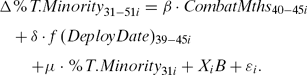
To approximate this comparison, we estimate cross-sectional regressions of the following form at the district level i:
 \begin{eqnarray}
&&\Delta{\%}T.{\hbox{\it Minority}}_{31-51i}= \beta \cdot CombatMths_{40-45i}\nonumber\\
&&\quad +\, \delta \cdot f(DeployDate)_{39-45i} \nonumber\\
&&\qquad + \mu \cdot {\%T}.{\hbox{\it Minority}}_{31i} + X_i B + \varepsilon _i .
\end{eqnarray}
We control for f(DeployDate) 39-45i, a nonlinear function of their average date of first campaign deployment. We thus aim to compare districts whose troops were deployed around the same time (and thus had initial similar propensities for deployment), but the troops from one district happened to be assigned to greater combat. We also include an extensive set of prewar controls for factors, X i, that might influence ethnic homogenization through increasing the propensity for economic migration, military recruitment, pre-demobilization violence, and private organization. We also provide separate intercepts for each native state and province, and within each province, a different intercept for the timing of British annexation, which led to different land tenure regimes and thus patterns of inequality (Banerjee and Iyer Reference Banerjee and Iyer2005). We are conservative in allowing for arbitrary correlation of ϵi within those regions.
We further decompose the change in the target ethnic minority share into the change that comes from the outflows of target minorities or from inflows of majority co-ethnics. To do so requires a counterfactual estimate of the numbers of each group that would have existed in a district in the absence of partition. We exploit the preferred method of Bharadwaj, Khwaja, and Mian (Reference Bharadwaj, Khwaja and Mian2008a) to calculate the counterfactual target minority population in 1951 had Partition not occurred ( (m 51i)):Footnote 8
 \begin{equation}
\mathbb {E}(m_{51i})= [m_{31i} \times g^{min/maj}_{21-31i} \times g^{maj}_{31-51i} ]
\end{equation}
The % Minority Outflow variable is simply the percentage difference between the actual target minority population and the counterfactual population in the post-Partition census. This measure is arguably a good measure of ethnic cleansing, as it gauges how many members of the target ethnic minority departed, were removed, were forcibly converted, as well as were killed during the Partition period. Note however, that, as discussed above, the minority outflows measure includes both “peaceful” and “violent” ethnic cleansing, a distinction we will subsequently unpack using direct measures on Partition deaths in the Punjab.
CombatMths 39–45i is our main gauge of average district combat experience. We use two novel data sources that allow us to first construct a battalion-level measure of war-time combat experience, and then use war-time data on battalion level fatalities in every district to construct this district average. We will now discuss the construction of this measure in some detail.
The operational unit of deployment in the Indian infantry was the battalion (of 667 men), which was organized into component companies (of 102–167 men each). There were 268 infantry battalions at war's end.Footnote 10 To create a combat experience measure for each battalion, we exploit the Official History of the Indian Armed Forces in the Second World War (Prasad Reference Prasad1954). The nine campaign volumes exploit original unit war diaries as well as government operational files (still under seal) to provide complete Orders of Battle and a daily description of the fighting in all campaigns.
We record all the battalions that participated in each campaign and then construct a variable for whether that battalion was involved in an exchange of fire with the enemy in each month. By summing up over the war, we can obtain each battalion's combat experience.Footnote 11
Further, to get within-district differences in combat experience by ethnicity, we exploit the fact that though the component companies within a battalion were deployed together as a single fighting unit, these component companies were mostly recruited separately, with each company recruited from particular martial ethnic grounds often in different districts.Footnote 12 Thus multiple battalions with very different combat experience levels often recruited in the same district, and similarly, the component martial ethnic groups of each district usually formed companies that were part of different battalions. This gave rise to within-district variation in the extent of combat experience of troops by ethnicity.Footnote 13
To create an average experience measure for a district, we use the fact that the component companies of each Indian battalion were recruited in a localized manner and exploit a unique dataset from the Commonwealth War Graves Commission (CWGC), an quasi-governmental organization responsible for military burials and cemeteries for soldiers from the former British Empire. These data provide the home village, town, district and battalion of Indian war fatalities.Footnote 14 We use these data to calculate average district combat experience as follows:
 \begin{equation}
CombatMths_{i} = \sum _{b}\left( {\hbox{\it CombatMths}}_b \times \frac{\chi _{bi}}{\sum _b \chi _{bi}}\right) ,
\end{equation}
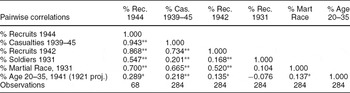
Pairwise Correlations: Recruitment Variables

Notes: Significant at *5%, **1%.
Our identification of the effect of combat experience is based on the arbitrary assignment of Indian battalions, conditional on recruitment, to different fronts and to different periods of time at the front during World War II. Once recruited, we will show that the length of assignment to the front line was unrelated to the home district characteristics of soldiers. Going through the official histories of every battalion during the Second World War allows us to assess this assumption, using both qualitative and quantitative evidence.
Recruitment into the Indian army was based upon the doctrine of the “martial races.” Precolonial India did indeed have a tradition of warrior castes. However, a major determinant of whether the British considered an ethnic group “martial”—which indicates the relatively weak basis for this designation—was that members of the group had been defeated by the sepoys of the Bengal Army in the 1840s and had not joined that force in rebeling against the British in 1857 (Streets Reference Streets2004; Wilkinson Reference Wilkinson2010).Footnote 16 Within districts and ethnicities, the reasons for designating one group “martial” and the others “nonmartial” are catalogued in the Caste Recruiting Handbooks of the Indian Army that guided recruiting officers. Many of the rules of thumb seem offensive and unscientific to the modern observer, with phrenology, “spurious origin,” and “vegetarianism” all discussed as reasons for inclusion or exclusion. For each martial religious or ethnic group in each district, officers also proffered opinions on whether each group was potentially of “good” quality for recruitment. The recruitment of units from traditional regions and particular groups within those areas appears to have become stable and entrenched over time.
While these martial districts are clearly not randomly assigned, they can be considered predetermined for the purpose of our analysis. We combine information on “good” martial castes from the Caste Recruiting Handbooks with caste data from the 1931 census volumes to construct a district level measure of the proportion of males belonging to a good martial race in a district. As Table 1 shows, the share of a district's males from martial races in 1931 is highly correlated with both the share of war-time fatalities (ρ=0.665) and peak (1944) recruitment (ρ=0.70).
Further, we can separate out the proportion of minority and majority martial races. We can thus infer whether target minority or majority recruits were the likely recipients of additional combat experience in World War II.
Regardless of where a soldier came from, the assignment of his battalion to front-line combat appears to have been arbitrary. It is useful to take the example of the component battalions of the 1st Punjab regiment, during World War II. The third battalion (3/1) was deployed to Africa in 1940, helping to restore Haile Selassie to the throne of Abyssinia. It then fought with the “Desert Rats” in North Africa and assaulted Kesselring's winter line in Italy, spending a remarkable 21 cumulative months at the front line. In contrast, the 2/1, 5/1, and 6/1, also on the verge of deployment to Africa, were re-directed to Southeast Asia due to an exogenous shock—Japan's abrupt entry into the war in December 1941. The 2/1 and 5/1 spent eight months fighting in Burma, while the 6/1 was instead dispatched to Singapore, being compelled to surrender one month later as part of the largest mass capitulation of British-led troops in history. In fact, there was considerable variation in the combat experience even of troops raised from neighboring districts (Figure 2(b)).
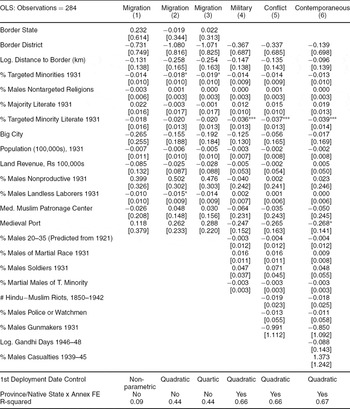
Table 3 shows determinants of our average combat months measure, controlling flexibly for the average initial overseas deployment date of battalions from a district to mimic these patterns of exogenous assignment.Footnote 17 Columns 1–3 examine the relationship between combat experience and a range of factors that have been emphasized as being related to economic migration during the Partition (e.g., Bharadwaj, Khwaja, and Mian Reference Bharadwaj, Khwaja and Mian2008a; Jha Reference Jha2008; Wilkinson Reference Wilkinson2004). Each column provides a different means to control for the timing of initial deployment, including Yatchew's (Reference Yatchew2003) nonparametric differencing estimator (Col 1), a quadratic (Col 2), and a quartic polynomial (Col 3). Note that comparing districts across states and controlling for deployment, the extent of combat experience does not appear to show any relationship with arguably the most important political, economic, and demographic factors associated with migration during this period, such as distance to the border, literacy rates, agricultural wealth (as measured by land revenue), or male poverty as measured by the share of landless agricultural labourers or Depression-era men considered “unproductive” (i.e., beggars, vagrants, prostitutes, and the unemployed). Combat experience also appears to show no robust relationship with historical factors that might influence Hindu-Muslim relations, such as the presence of a medieval port (an indicator of interethnic economic complementarity) or a patronage center (of inter-ethnic competition) (Jha Reference Jha2008) (Cols 1–6).Footnote 18 Columns 4–6 compare districts within the same province or native state, sequentially adding further controls for prewar military recruitment and proximate prewar and demobilization indicators of conflict and private organization. A consistent picture emerges. Conditional on the timing of deployment, combat experience does not appear to be related to the propensity for recruitment, the share of prime age males (age 20–35) in 1941 (as predicted from the 1921 census), the share of army recruits in 1931, the share of martial races, nor the share of martial race males that were of targeted minorities. Combat experience also does not appear related to proximate indicators of conflict, private organizational skill, or crime such as the number of predemobilization Hindu-Muslim Riots, the share of police, or of gunmakers in the population.
One concern might be that, rather than combat experience fostering organizational skill, combat experience raises the share of war-time fatalities from a district that might have independent effects on the propensity to migrate during the Partition (such as through poverty). Though war-time fatalities are endogenous to assignment to combat, we can examine the residual correlation between combat experience and the proportion of fatalities to assess whether this may be a major part of the mechanism. However, there are appears to be little relation between the two (Col 6).Footnote 19
In fact, only one variable we examined that might explain increased outflows of minorities—minority literacy rates—happens to robustly correlate with combat experience. However, combat experience correlates with lower minority literacy rates, which, as we can show, predicts less minority out-migration, not more (Table 4).
Instead, taken together, the results in Table 2 appear consistent with our identifying assumption that soldiers deployed at the same time appear to have been assigned to combat roles in a manner unrelated to the relevant characteristics of their home districts.
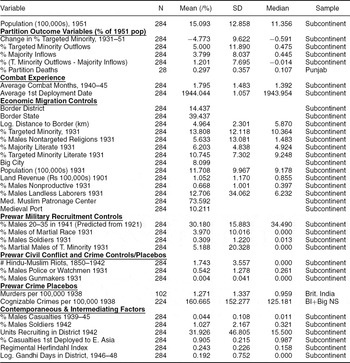
Summary Statistics

Balance Regression: Average Combat Experience

Notes: Robust standard errors in brackets, clustered at province/native state level. Significant at *10%, **5%, ***1%; separate intercepts provided within provinces based upon date of British annexation. (1) uses Yatchew's (Reference Yatchew2003) differencing estimator, with bootstrapped clustered standard errors.
In fact, the broader lack of a relationship between combat assignment and district characteristics in Table 2 also appears consistent with the qualitative historical record. The nine campaign volumes of the Official History make no mention of different Indian units being specifically deployed during the war based upon their ethnic composition (Prasad Reference Prasad1954).Footnote 20 Surviving brigade records also indicate that commanders paid no attention to unit origin and ethnicity in making decisions in combat deployments.Footnote 21 The transfer patterns of units from one theater from another also suggest that particular group or regional identities were not a factor. As we have seen, particularly with the sudden entry of Japan into the war, units designated for Africa were rapidly redeployed, either to East Asia, or to serve in the defense of India itself, which faced the threat of amphibious invasion and the reality of Japanese spearheads penetrating the Northeast. Groups of one community were often replaced by very different groups, sometimes at very short notice, without this being mentioned as in any way remarkable in secret contemporary army correspondence of or in postwar memoirs.Footnote 22
Instead, internal army correspondence appears to place particular emphasis on the need for and reality of the interchangeability of battalions, brigades, and divisions, and the fact that units from many different groups were fighting alongside each other within those units. All regular Army battalions were “armed and equipped to the same scale and standard”(Indian Army Reorganization Committee 1945, 404). In war time, recruits were reallocated to different battalions of a regiment on the basis of the casualties incurred. In fact, within each regiment, all battalions aimed at the same ethnic mix of companies, because it was argued in secret army correspondence that since each unit had similar chances of sustaining high casualties, it was the best way to assure that particular ethnicities were not relatively harder hit (Indian Army Reorganization Committee 1945). These were the considerations also highlighted in the 1923 Indianization Committee Report, which concluded, “No risks must be taken and every unit [of the Indian army] must be interchangeable and fit for war.”Footnote 23
RESULTS
We exploit the arbitrary combat experiences of units due to unit interchangeability and enemy action to estimate the effects of war-time combat experience on collective action during the crisis of the Partition two years later. Table 2 provides summary statistics, grouped by outcomes and four sets of control variables, related to migration, military recruitment, conflict, and contemporaneous factors that we will sequentially add in our analysis. On average, South Asian districts lost 4.8% of their 1951 populations to outflows of targeted minorities in this period, relative to the proportion “expected”. This is equivalent to 72,000 people in each district. However, this number masks a range of experiences of ethnic cleansing, even among neighboring districts and those of equivalent distance to the new border (Figure 3(a)). Furthermore, as Figure 3(b) documents, there was not a clear one-to-one transfer of minority populations across that border. Rather, there were important differences in the extent to which neighboring districts welcomed refugees.Footnote 24
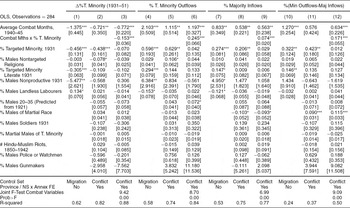
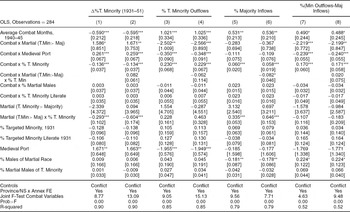
Table 4 (Cols 1–3) examines the determinants of the change in the proportion of religious minorities in 1951. Districts that raised units with an extra month of average combat experience in World War II reduced the proportion of religious minorities in their population in 1951 by around 1.38 percentage points, comparing districts across provinces (Col 1), and close to 0.72 percentage points on average, comparing districts within the same province (Cols 2 and 3). Given that the average minority population in 1951 was around nine percentage points, these are considerable effects. These results are robust to sequentially adding the control sets for migration, recruitment and predemobilization conflict and comparing districts within the same native state or province (Cols 2 and 3). In fact, and consistent with the theoretical framework, the interaction between combat experience and the initial targeted minority population is also negative, suggesting that the effect of combat experience leads to greater decreases in the minority population in districts that had an ex ante more mixed population and thus the current spoils and future political benefits from cleansing were also higher, inducing both “peaceful” and “violent” cleansing. The F statistics from joint tests of significance of the combat months variables are robust at conventional levels.Footnote 25
Regression: Religious Demographic Change, 1931–1951

Notes: Robust standard errors in brackets, clustered at province/native state level. Significant at *10%, **5%, ***1%; all regressions include quadratic controls for deployment date, and controls for border district, log. distance to border, big city, population, land revenue, medieval port, and patronage center. (1, 4, 7, 10) contain a control for border state. Interactions are presented as deviations from the mean. Separate intercepts provided within provinces based upon date of British annexation.
Columns 4–9 decompose the changes in the minority share into outflows of the target minority and the influx of members of the religious majority into a district. Notice that an additional month of combat experience increases target minority outflows—our measure of ethnic cleansing—by around 1.1 percentage points of a district's 1951 population (or close to 17,000 people), comparing districts within the same province (Cols 2 and 3). This effect is once more largest in areas that were ex ante more ethnically mixed.
However, it does not appear that it is either the potential private spoils from ethnic cleansing or the reduced costs of engaging in violence due to combat experience that entirely explain our results. Districts that raised soldiers with an additional one month of combat experience also gained 0.54 percentage points greater inflows of co-ethnics (or 8,150 people) (Cols 7–9). Once again, the effects of combat experience were greater in districts that ex ante had a more mixed population.
Notice, however, that the relative effect of combat experience on fostering co-ethnic immigration is smaller than on minority outflows. Columns 10–12 examine this asymmetry between ethnic cleansing and co-ethnic immigration further, providing results that examine the determinants of the difference between the proportion of minority outflows and majority inflows in a district. Note that combat experience also encourages target minority outflows relatively more than co-ethnic immigration as the ex ante proportion of the minority in the district increases. This is consistent with the theoretical framework—the relative gains from ethnic cleansing over co-ethnic immigration rise with the relative size of the minority population.
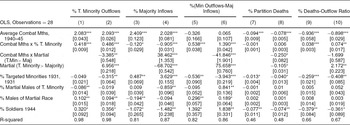
Table 5 further unpacks the differential effects of combat experience in two environments where one would expect that a positive organizational shock might actually lead to lowered ethnic cleansing on average: in districts with medieval ports, which enjoyed a historical legacy of inter ethnic complementarities in trade between Hindus and Muslims, and in the districts where the share of target minority males considered to be of “good martial race” exceeded that of the majority, and thus where the minority was relatively more likely to gain the combat experience. Observe that in both these environments, a positive combat experience shock leads to fewer minority outflows (Cols 3 and 4) leading to a preservation of the minority community (Cols 1 and 2), but have roughly similar levels of majority inflows (Cols 5 and 6). Thus in these environments, co-ethnic immigration is favored over minority outflows on average (Cols 7 and 8).Footnote 26
Regression: Ethnic Homogenization—Interactive Effects

Notes: Robust standard errors in brackets, clustered at province/native state level. Significant at *10%, **5%, ***1%; all regressions include all noncontemporaneous controls, province fixed effects, as well as a quadratic control for deployment date. Separate intercepts provided within provinces based upon date of British annexation.
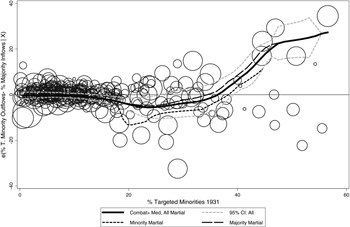
The theoretical framework suggests that as the minority share rises, the benefits to ethnic cleansing rise. Further, though organized minorities can defend themselves and are less likely to be cleansed while small, the costs of leaving also fall with organization and large organized minorities may actually be more likely to leave in anticipation of violence. Figure 4 provides a pictorial look at combat experience and the threshold at which minority outflows are favored over inflows as the initial minority population rises, plotting the residuals of a regression with all noncontemporaneous controls except combat experience against the initial target minority share. Curve fits from separate local polynomial regressions show the relationship in districts that contain martial races assigned to above median combat experience. Consistent with the theoretical framework, combat experience raises ethnic cleansing relative to co-ethnic immigration, and does so when the minority population exceeds ~35%, below which co-ethnic immigration is favored. Furthermore, even though net outflows fall and co-ethnic immigration is favored when the minority is the likely beneficiary of the combat experience, minority beneficiaries of combat experience are also more likely than unorganized groups to leave when the minority share becomes large.
Religious Demography, Combat Experience, and the Outflow-Inflow Threshold
Notes: This graph show the residuals of a regression of % Minority Outflows % Majority Inflows on the full set of noncontemporaneous controls, excluding Average Combat Mths, plotted against % T. Minorities 1931. Marker sizes proportional to combat experience. Local polynomial (Fan) regressions provided separately for martial districts with above median combat experience, as well as where targeted minority (majority) martial races exceed the majority.

The latter effect sheds light on the dilemma faced by larger organized minorities—to stay and fight, or leave in anticipation of the violence their relative size may attract. The increasing effect of a combat experience shock on net outflows in larger minority groups suggests that the choice to mobilize and evacuate appears to be more common in these data. The qualitative section provides examples of larger minorities with combat experience that initially mobilized for defense, but upon discovering themselves to be on the wrong side of the border, chose ultimately to evacuate. In both strategic decisions, military organizational skills appear to have been important.
PLACEBOS, POST-TREATMENT SELECTION, AND ROBUSTNESS
Despite the lack of a relationship between average combat experience and observable home district characteristics, a lingering concern may be that average combat experience is capturing some unobserved feature of martiality or criminal organization of the home district that is also correlated with religious tension and violence. Note that such an unobserved martial characteristic would not explain the increased effect of combat experience on majority immigration. Further, if such an unobserved feature did exist, it would suggest that our wartime combat experience variable should also predict the incidence of prewar religious violence or other indicators of martiality. In contrast, if, as we argue, combat experience is a war-time phenomenon, it naturally should have no effect prior to the war.
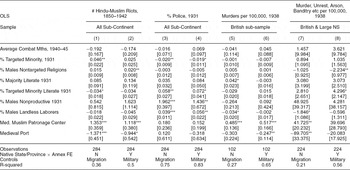
Table 6 presents the results from a battery of such placebo tests. Columns 1 and 2 predict the number of Hindu-Muslim riots reported in government records and newspaper reports in towns within a district from 1850 to 1942, looking between and within native states and provinces. Notice first that World War II combat experience has no predictive power on the number of Hindu-Muslim riots prior to demobilization. However, other factors that shape historical patterns of inter-religious economic complementarity and competition such as the presence of medieval Muslim patronage centers and medieval ports in a district, which, as Table 2 demonstrated, were uncorrelated with combat experience, do have a significant and robust effect on religious violence prior to demobilization, consistent with Jha (Reference Jha2008).
Placebo Regressions: Hindu-Muslim Riots and Violent Crime Prior to War Demobilization

Notes: Robust standard errors in brackets, clustered at province/native state level. Significant at *10%, **5%, ***1%; all regressions include quadratic controls for deployment date and controls for big city, land revenue, population, border district, and log. distance to the new border; (1), (3), (5), and (7) includes a control for border state; (2), (4), (6), and (8) include controls for prime age male share, martial race share, minority share of martial males, and army recruits 1931. Separate intercepts provided within provinces based upon date of British annexation.
Columns 3–8 provide further placebo tests based on prewar data on the extent of police or security recruitment prior to the war (Cols 3 and 4), the murder rate (Cols 5 and 6), or the number of “cognizable crimes” (serious violent crimes) for which we have disaggregated information from provincial police reports for a 1938 sub-sample of native states and British provinces. Once again, in none of these do we find any consistent effect of combat experience. Thus our measure of war-time combat experience does not appear to be related to some unobserved prewar martial characteristic of a district.
A separate concern may be that, even if the initial combat deployment appears to be as good as random, we may be concerned that the army “learns” about the martiality of certain units, and thus sends the successful units into even more combat. If it was the case that some “unobserved martial” characteristic of a district is contaminating the effects after the first deployment then we would expect to see an increasing effect of combat experience across the distribution.
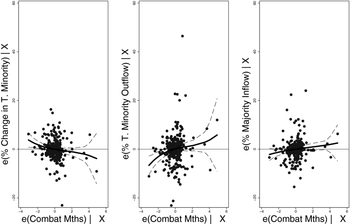
Figure 5 plots the residuals of a regression of the 1951 minority ratio, outflows, and inflows on the residuals of combat experience, holding constant the full set of noncontemporaneous controls. A cubic fit is applied to the relationship to assess whether the effect of combat experience does in fact increase nonlinearly.
Diminishing Returns to Combat Experience
Notes: This graph plots the residuals of average combat experience on the residuals of % Targeted Minority, Targeted Minority Outflows, and Majority Inflows, using all controls and provincial FE. A cubic fit and prediction errors are also provided.

Notice first that the slopes are in the expected directions: a lowered minority share with combat experience, and higher outflows and inflows. The fits do not appear to be driven by outliers, and we fail to reject a linear relationship. Further, the curvature on the effect is, if anything, in the opposite direction to the first order effect. The consistent picture that emerges is that rather than a “selection” effect, there appears to be slightly diminishing returns to the “capital” gained through combat experience. The presence of diminishing returns to combat experience as “combat fatigue” or “burnout” sets in mirrors findings from other twentieth-century wars (e.g., Muir Reference Muir2000).
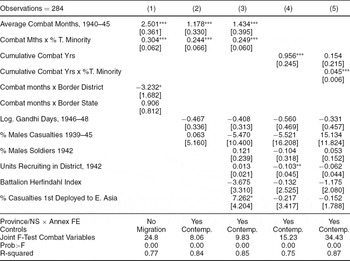
Table 7 examines alternative mechanisms and interactions and their effects on minority outflows. The combat experience effect does not appear to be driven by border states or districts (Col 1). Column 2 adds variables that capture co-determined factors: the proportion of war fatalities and the extent of Gandhi's stay in a district. Note that the effect of combat experience on minority outflows does not appear to change when we control for the fatality rate, which itself does not appear to have an independent effect (Col 2). The effect also does not appear to be coming through Gandhi's involvement, though the days spent by Gandhi in a district does appear to have an insignificant negative relation with minority outflows.Footnote 27 Columns (3–5) shows that the effect of combat is also robust to further controls, including an alternative measure of the 1942 recruitment rate and the units recruiting in the district.Footnote 28
Regression: Minority Outflows (Alternative Mechanisms).

Notes: Robust s.e. in brackets, clustered at province/native state level. Significant at *10%, **5%, ***1%; all regressions include quadratic controls for deployment date and controls for big city, population (1931), and log. distance to the new border, land revenue, % majority and minority literate, big city, population (1931), medieval port, patronage centre. (2)–(5) include all noncontemporaneous controls. Separate intercepts provided within Provinces based upon date of British annexation.
A second control assesses the extent to which different patterns of deployment to East Asia versus Africa or Europe might have engendered a separate ideological or horizon-broadening effect (Costa and Kahn Reference Costa and Kahn2005). However, the effect does not appear to be coming from the theater of war.Footnote 29
We can also unpack whether the enhanced organizational abilities of combat veterans come from the importation of existing military organization or through the development of individual organizational skills. In particular, small unit cohesion is believed to be valuable in terms of battlefield effectiveness.Footnote 30 It might be the case that these pre-existing company or battalion social networks are facilitating collective action when soldiers return home, consistent with Petersen (Reference Petersen2001), rather than individual human capital. Our data allow us to test this by constructing a battalion-level Herfindahl measure for each Indian district. This is a measure of the likelihood that fatalities in any individual district came from the same battalion. We find that neither the Herfindahl measure nor the number of battalions recruiting in a district appear to be a major driver of the combat experience effect, suggesting that it is more likely that it is the individual skills that soldiers bring back rather than the importation of unit organization and ties that are responsible for the patterns of political collective action that we observe. Finally, in Columns 4 and 5 we provide an alternative measure of combat experience that does not weight by fatalities to account for differential recruitment intensity: the cumulative combat experience in the district. The results also appear robust to this alternative measure.
UNPACKING PEACEFUL AND VIOLENT ETHNIC CLEANSING
A natural question that remains is whether the patterns of ethnic cleansing also reflect the actual violence that took place during the Partition, or whether the cleansing was conducted “peacefully,” in anticipation of violence. Unfortunately, official government records become increasingly unreliable in mid-1947 because of the breakdown of local administration in the worst-affected areas, as well as strong pressures on officials not to record crimes propagated by individuals likely to be in charge after Independence (Punjab Governor's Reports 1947). Media and telegraph reports about the massacres were also highly censored.Footnote 31
There were, however, three attempts soon after the Partition to document the extent of violence, collected by an Indian civil servant, Khosla (Reference Khan1951), Talib (Reference Talib1950) of the Sikh Shiromani Gurudwara Prabandhak Committee (SGPC), and by the Government of West Punjab, (Pakistan). But each of these efforts is arguably partisan and geographically concentrated around the Punjab. However, there is a reasonably high positive correlation between minority outflows, Khosla's arguably less biased measure (ρ=0.64), and that of the Government of West Punjab (ρ=0.43). In contrast, the SGPC measure shows no correlation (ρ=−0.02).
Table 8 assesses this relationship further, examining the effect of combat experience on the average of the three deaths measures compared to that of target minority outflows for the subsample of Punjab-area districts (including the local Native States). We also include the actual 1944 recruitment share as a control. Notice first that even confining the analysis to districts within the Punjab, we continue to find consistent and significant increases in the minority outflows and majority inflows in districts whose veterans received more combat experience (Cols 1–4), and increases in net outflows when the minority population is large (Cols 5 and 6). Once again, we find that when the minority is more likely to receive the combat experience, there are fewer minority outflows, and greater majority inflows, leading to lower net outflows. Once again, the minority receiving the shock to their organizational skill appears to be encouraging peaceful population transfers.
Regressions: Partition Deaths and Minority Outflows in the Punjab

Notes: All outcomes are expressed as % of the 1951 population. Sample includes Punjab Province and local Native States. Robust standard errors in brackets, clustered at NS/Province level. Significant at *10%, **5%, ***1%; all regressions include controls for Deployment Date (linear and quadratic), % prime age males, land revenue, log. distance to border, big city, population, % minority and majority literate, % males nonproductive 1931, direct British rule.
It is intriguing that in the Punjab, combat experience, despite fostering population transfers, appears to also reduce the rate of Partition deaths (Cols 7 and 8). In fact, an additional month of combat experience appears to reduce the percentage ratio of deaths to target minority outflows by close to one percentage point (Cols 9 and 10). These relationships appear to be strengthened when the minority is the likely beneficiary of the combat experience shock. These results appear consistent with the role of combat experience in enhancing skills at credibly threatening violence and in organizing “peaceful” ethnic cleansing, while reducing the need for wider-spread destructive violence in orchestrating population transfers.
QUALITATIVE EVIDENCE
One strength of our empirical approach is that, unlike most of the existing qualitative literature, we not only compare areas were violence was pervasive during Partition, but also areas that were relatively peaceful, despite being in disputed districts. Naturally those areas where the “dog did not bark” tend to lack qualitative evidence on why peace persisted. However, as the theoretical framework suggests, among areas experiencing population transfers, those where the majority gained combat experience would tend to be more likely to face ethnic cleansing, while those where the minority gained combat experience are likely to see less. Furthermore, if minority emigration ultimately occurs in areas where minorities gain combat experience, it is likely to be organized and large scale, and conducted in anticipation of violence. These effects, while being confirmed by the empirical work, also find substantiation in the qualitative record.
The district of Lyallpur, in modern-day Pakistan, provides a useful illustration. The role of a minority benefiting from combat experience, this time the Sikhs with 4.14 months of war combat, is evident both in the lack of disturbances they faced locally, and their rapid ability to ultimately mobilize. Prior to Independence, Lyallpur, despite possessing a Muslim majority of 62.9% in 1942, had been claimed for India in proposals by Congress and the SGPC. In May 1947, an intelligence report for the Punjab Police found,
Important Akali leaders have recently been touring to ensure that all preparations possible are complete for the waging of defensive warfare . . . Giani Kartar Singh . . . had been touring villages by car in the Lyallpur area . . . To comply with his instructions, each village must have a Jathabandi [local militia group]. Jathas must be reinforced by mounted men and ex-military and INA men equipped with firearms.Footnote 32
Following the determination of the Radcliffe boundary, however, the local Sikh leader, Giani Kartar Singh, told a government official that he “intended marching the Sikhs out of [Lyallpur], though it was quiet, and there had been practically no disturbances in it.”Footnote 33 Again, the minority group's ability to mobilize provides evidence of remarkable military organizational skills. Ian Morrison of the London Times, one of the few journalists actually reporting from the conflict zones during Partition, describes how the movement of Sikhs out of Lyallpur:
. . . orderly and well organized. The Sikhs moved in blocks of 40,000 to 60,000 and cover about 20 miles a day. It is an unforgettable sight to see one of these columns on the move. The organization is mainly entrusted to ex-servicemen and soldiers on leave who have been caught by the disturbances. Men on horseback, armed with spears or swords, provide guards in front, behind, and on the flanks. There is a regular system of bugle calls. At night a halt is called near some village where water is available, watch fires are lit, and pickets are posted. “200,000 on the move,” The Times Sept 19, 1947
Immigration of these Sikh columns was focused into a particular area: the Sikh princely states and the districts of Gurdaspur, Amritsar, Jalandhar, Hoshiarpur, Ludhiana, and Ferozepore. For the first time in history, Sikhs came to represent more than half of the total population of a contiguous area (Grewal Reference Grewal1999). Giani Kartar Singh of Lyallpur played a key role in the later secession of these districts, first as PEPSU, a state whose administration was dominated by Sikhs, and ultimately as part of a new Punjabi-speaking state (Grewal Reference Grewal1999). Thus, privately organized flows of co-ethnics was used to forge superior control over future politics.
Among the districts receiving these flows were Sikh-ruled princely states like Kapurthala, which actually had a slight pre-Partition Muslim majority (of 56.5% of the 1942 population). Kapurthala had in fact been claimed by the Muslim League for Pakistan and lay within 30 kilometers of the ultimate borderline. By 1951, however, Muslims constituted only 28% of the population. Here, Sikhs were heavily favoured as a martial race and soldiers raised in the district spent an average of 5 months in combat, above the 95th percentile of all districts. With Sikhs organized, though, with Hindus, locally in a slight minority, the encouragement of co-ethnic immigration appears to have supplemented extensive ethnic cleansing. The ruler was reported to have “given money and shelter to Sikh refugees . . . .”Footnote 34 Despite its initial Muslim majority, Kapurthala ultimately was awarded to independent India. Kapurthala was not alone in encouraging co-religionist immigration.Footnote 35
In other districts, where it was mainly the majority population that gained combat experience, a body of qualitative evidence again suggests that military organizational skills played an important role in the resultant patterns of ethnic cleansing. Recruits from Rawalpindi district received 4 months of combat experience (close to the 85th percentile), with Muslims the only martial race. The 15% minority population of local Hindus and Sikhs were attacked and more than 140,000 were killed, converted, or expelled. A Congress party report alleged that military-style organization played a vital role in the initial destruction and arson which then persuaded minorities that they should leave en masse, which they did in the few days that followed.Footnote 36
Qualitative accounts also describe the role of combat experience in disputed districts outside Punjab. In South Indian, Hindu majority, Hyderabad, where the Muslim Nizam sought to maintain his political independence, ex-soldiers from the Indian National Army trained Hindu groups to fight against the Nizam's Razakar supporters.Footnote 37 Similarly, Meerut in western UP was claimed for Pakistan by the Muslim League in 1946 on the grounds that Hindus were divided on caste lines so no one group constituted a majority. Meerut was also a major recruiting region where the recruits, mainly Hindu Jats, received above-median combat exposure (2.05 combat months). The sizeable, mainly urban Muslim minority (24%) of Meerut found itself a target of mass pogroms in the fall of 1946. Reports make it clear that the attackers were well-organized groups led by ex-soldiers from the majority community on horseback. These groups also deployed local information to reduce collateral property damage. Investigators noted that “in the case of shops belonging to Hindu landlords but tenanted by Muslim shop-keepers, the buildings were not burnt. Only the contents of the shops were looted.”Footnote 38
DISCUSSION
In this article, we provide evidence that in South Asia, the capacity of different ethnic groups to resist political change and take collective action to ethnically cleanse communities that seemed to threaten their security was augmented substantially by organizational and military skills previously acquired in combat in World War II. Ironically, our evidence suggests that military organizational skills, by making violence more credible and facilitating the mobilization of large groups, may have also rendered wider-spread violence less necessary for engendering such ethnic homogenization. In fact, military organizational skills appeared to have also fostered the creation of “safe havens” in environments where minorities were the beneficiaries or where economic inter-dependence made cleansing costly for both communities. Demonstrating how drivers of local private organizational capacities interact with local economic and political incentives for ethnic cleansing can not only shed new light on partition as a strategy for mitigating conflict, but our findings also yield broader implications for understanding risks in postconflict environments and radical institutional change.
First, our results highlight the importance of organizational skills in understanding the potential for mass violence and conflict, and the crucial importance of military service as an environment where these skills are obtained. We provide a useful counterpoint to important works on the role of veterans in postconflict environments that have found benign effects on civic engagement in environments that are undergoing reconstruction, by instead examining the role of veterans in a setting where the problem of order and security was acute, and a community's economic and political security seemed existentially threatened. In such an environment, our results suggest that the patterns of ethnic cleansing and violence may strongly correlate not just with grievance, demographic balance and threat, but also with the distribution of veterans’ organizational and military skills. The contemporary relevance of these factors was arguably brought home in Iraq in 2003, where the Iraqi army was abruptly disbanded without sufficient provision for the soldiers’ livelihoods and political futures, sending thousands of well-trained men into the arms of the Sunni insurgencies.Footnote 39
More generally, if, as we have argued, combat experiences forged in war can provide a temporary shock to the skills of non-elites at violence and private organization, then a clear link can be made between theoretical studies that emphasize the role of temporary shocks to non-elites’ ability to threaten violence and institutional change and empirical studies that find an increase in democratization following war (Acemoglu and Robinson Reference Acemoglu and Robinson2000; Boix Reference Boix2003; Przeworski Reference Przeworski2007; Scheve and Stasavage 2010). For example, our work suggests that the temporary “threat of revolution” that Acemoglu and Robinson (Reference Acemoglu and Robinson2000) credit with leading elites to accede to Britain's first major franchise expansion in 1832 may have its genesis in the organizational abilities of the 332,000 soldiers demobilized after the end of the Napoleonic wars in 1815 (Jha and Wilkinson n.d.). Indeed these soldiers created substantial public order problems over the next decade, being heavily involved in organizing the East Anglian riots of 1816 and the Pentridge rising of 1817 (Gash Reference Gash1977).Footnote 40 The role of veterans in engaging in private drilling and training prompted the government to impose a ban on these in 1819 and precipitated the famous “Peterloo massacre,” when dragoons charged a crowd of weavers, one third of whom were veterans (Gash Reference Gash1977). Similarly, a potential increase in costs to elites of repressing veterans that acquired organizational skills during the First World War dovetails as an explanation with Boix's (Reference Boix2003) account of “the sweeping and peaceful democratization of Western Europe after the First World War . . . [p. 2]”
Naturally, not all private organizational capacity, democratization or institutional change can be attributed to skills acquired by non-elites in war time. But external military threats do provide a common set of environments where elites, who might otherwise have preferred to stifle non-elite organizational capacity, may have little choice but to allow such skills to develop. As such, an intriguing possibility, currently under research, is that organizational skills acquired in war may play a more crucial role in early enfranchisements when coercive power is most concentrated among elites.
The identification approach we have used here can be applied to a range of settings where militaries train soldiers to be inter changeable—serial numbers rather than names—but temporary exigencies provide differential experiences. This may be particularly useful since the human capital both to credibly threaten violence and to organize groups also may lend itself readily to engendering broad institutional change. From the role of French veterans of America's Revolution in engendering Revolution at home (Donald Reference McDonald1951) to Civil War veterans demanding rights in the postbellum South and English soldiers agitating for enfranchisement, combat veterans may have played an important role in the institutional development of nations (Jha and Wilkinson n.d.). Understanding the value of veterans and how best to mobilize the distribution of skills they acquired in war, even if these are not as valued in times of peace, may be vital for policies aimed at both maintaining political stability and engendering institutional change.




Comments
No Comments have been published for this article.