Introduction
There is marked heterogeneity among persons with schizophrenia regarding their disease course and response to pharmacological treatment, as well as notable differences among available interventions.Reference Leucht, Cipriani and Spineli 1 Determining the optimal medication for an individual patient requires consideration of prior history of response (or lack thereof) for the array of problematic symptoms that may be present, prior history of tolerability (both subjective and objective), potential drug–drug interactions, and potential interactions between the proposed intervention and existing comorbid conditions.Reference Volavka and Citrome 2 When combining a patient risk profile with an antipsychotic adverse event profile, physicians may quickly run out of tolerable treatment options for individual patients, despite the availability of many antipsychotics, suggesting a need for additional treatment options with better tolerability and without compromising efficacy.Reference Citrome, Eramo and Francois 3
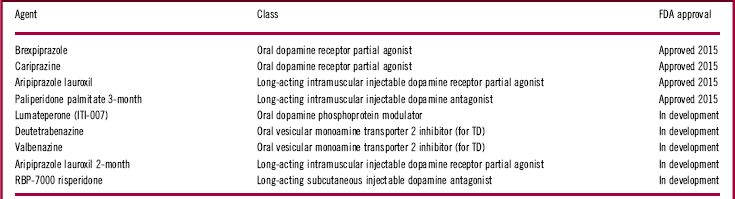
The years 2015 and 2016 have ushered in several newer options for the management of schizophrenia for both acute and maintenance treatment (Table 1). These include the oral dopamine partial agonist antipsychotics brexpiprazole and cariprazine, another formulation of long-acting injectable aripiprazole that can be administered every 6 weeks at its highest dose strength, and a new formulation of paliperidone palmitate that can be administered every 3 months in persons already stabilized on monthly paliperidone palmitate. Among new compounds in late stages of development is another formulation of long-acting injectable aripiprazole that can be administered every 8 weeks, a once-monthly long-acting formulation of risperidone that can be injected subcutaneously, a new and novel antipsychotic known as ITI-007 and recently given the name of lumateperone, and 2 options for the treatment of tardive dyskinesia that build upon the mechanism of action of tetrabenazine: deutetrabenazine and valbenazine (Table 1). This overview will survey the key points regarding each of these interventions. Not discussed are those molecules that have essentially failed their Phase III development programs—pomaglumetad methionil, bitopertin, and encenicline—agents that initially showed promise in the treatment of cognitive and/or negative symptoms seen in persons with schizophrenia but where the Phase III studies were largely unsuccessful.Reference Citrome 4 , Reference Aquila and Citrome 5
Emerging pharmacological therapies in schizophrenia: approved or in phase III of clinical development

FDA, US Food and Drug Administration; TD, tardive dyskinesia.
What’s New?
Brexpiprazole
Brexpiprazole was approved by the U.S. Food and Drug Administration (FDA) in 2015 and launched the same year for the treatment of schizophrenia and for adjunctive therapy to antidepressants for the treatment of major depressive disorder. 6 – Reference McEvoy and Citrome 8 Brexpiprazole is a “serotonin–dopamine activity modulator” in that it is a partial agonist at serotonin 5-HT1A and dopamine D2 receptors, with similar potency, and an antagonist at serotonin 5-HT2A and adrenergic alpha 1B/2C receptors.Reference Citrome, Stensbøl and Maeda 9 The recommended dose range of brexpiprazole for the treatment of schizophrenia is 2–4 mg/day once daily, with or without food. Titration is required, and the product label recommends starting with 1 mg/day and increasing to 2 mg/day on Day 5 to Day 7, then to 4 mg/day on Day 8. Brexpiprazole is metabolized by both CYP2D6 and CYP3A4. Approval for the treatment of schizophrenia was based on 2 positive, 6-week, Phase III randomized controlled trials in acute schizophrenia that demonstrated superiority of brexpiprazole over placebo on change from baseline on the Positive and Negative Syndrome Scale (PANSS) total score.Reference Correll, Skuban and Ouyang 10 , Reference Kane, Skuban and Ouyang 11 Of clinical relevance is the rate of response, as defined in these trials as achieving a change from baseline ≥30% in PANSS total score or Clinical Global Impressions–Improvement (CGI-I) score of 1 (very much improved) or 2 (much improved). Pooled responder rates were 46% for brexpiprazole 2–4 mg/day vs 31% for placebo, resulting in a number needed to treat (NNT) of 7. In a 52-week, randomized withdrawal study,Reference Fleischhacker, Hobart and Ouyang 12 significantly fewer patients relapsed in the brexpiprazole group compared with placebo (13.5% vs 38.5%), resulting in a NNT of 4. Although the most commonly encountered adverse event (incidence ≥4% and at least twice the rate of placebo) is increased weight, short-term weight gain appears modest. 6 Approximately 10% of patients receiving brexpiprazole 1–4 mg/day gained ≥7% body weight from baseline vs 4% for those randomized to placebo, resulting in a number needed to harm (NNH) of 17 in the 6-week trials. However more outliers with an increase of ≥7% of body weight were evident in open-label, 52-week safety studies,Reference Kane, Skuban and Hobart 13 with the product label noting that 20% of patients demonstrated a ≥7% increase in body weight and 10% demonstrated a ≥7% decrease in body weight. 6 Effects on glucose and lipids were generally small. Rates of akathisia as an adverse event were 5.5% for the pooled doses of brexpiprazole 1–4 mg/day vs 4.6% for placebo, yielding a NNH of 112. Minimal effects on prolactin were observed, and no clinically relevant effects on the electrocardiogram (ECG) QTc interval were evident.
Cariprazine
Cariprazine was approved by the FDA in 2015 and launched in 2016 for the treatment of schizophrenia and for the acute treatment of manic or mixed episodes associated with bipolar I disorder. 14 , Reference Citrome 15 Cariprazine is a “dopamine D3–preferring D3/D2 receptor partial agonist” in that its binding affinity is an order of magnitude higher for dopamine D3 receptors than it is for dopamine D2 receptors. Cariprazine is also a partial agonist at the serotonin 5-HT1A receptor and acts as an antagonist at 5-HT2B and 5-HT2A receptors. The recommended dose range of cariprazine for the treatment of schizophrenia is 1.5–6 mg/d; titration is thus not required, as the starting dose of 1.5 mg/d is potentially therapeutic. Cariprazine is administered once daily, with or without food. Cariprazine’s pharmacokinetic profile through the CYP3A4 enzyme system is of interest because 1 of the 2 active metabolites, didesmethyl-cariprazine, has a half-life that is substantially longer than that for cariprazine; the half-life based on time to reach steady state is approximately 2–4 days for cariprazine and approximately 1–3 weeks for didesmethyl-cariprazine. Systemic exposure to didesmethyl-cariprazine is several times higher than that for cariprazine and thus didesmethyl-cariprazine is the predominant active moiety. This long half-life allows for the possibility of increasing the dosing interval; for example, the product label recommends that for patients taking 1.5 mg daily, the dosing regimen should be adjusted to every other day when cariprazine is co-administered with a strong CYP3A4 inhibitor. There were three positive, 6-week, Phase II/III, randomized controlled trials in acute schizophrenia that demonstrated superiority of cariprazine over placebo on change from baseline on the PANSS total score.Reference Durgam, Cutler and Lu 16 – Reference Durgam, Starace and Li 18 In these studies response was defined as achieving a change from baseline ≥30% in PANSS total score, a more narrow definition that that used in the brexpiprazole trial reports. Pooled responder rates were 31% for cariprazine 1.5–6 mg/d vs 21% for placebo, resulting in a NNT of 10. In a long-term, randomized withdrawal study,Reference Durgam, Earley and Li 19 significantly fewer patients relapsed in the cariprazine group compared with placebo (24.8% vs 47.5%), resulting in a NNT of 5. The most commonly encountered adverse events (incidence ≥5% and at least twice the rate of placebo) 14 are extrapyramidal symptoms (NNH 15 for cariprazine 1.5–3 mg/d vs placebo and NNH 10 for 4.5–6 mg/d vs placebo) and akathisia (NNH 20 for 1.5–3 mg/d vs placebo and NNH 12 for 4.5–6 mg/d vs placebo). Short-term weight gain appears small (approximately 8% of patients receiving cariprazine 1.5–6 mg/d gained ≥7% body weight from baseline, compared with 5% for those randomized to placebo, resulting in an NNH of 34). Cariprazine is associated with no clinically meaningful alterations in metabolic variables, prolactin, or the ECG QTc interval.
Aripiprazole lauroxil
Aripiprazole lauroxil is N-lauroyloxymethyl aripiprazole, an N-acyloxymethyl prodrug of aripiprazole, and is supplied in prefilled syringes as an aqueous suspension, It was approved for the treatment of schizophrenia in 2015. 20 , Reference Citrome 21 Prodrugs are compounds that are inactive per se, but are transformed to active moieties in vivo. Most long-acting injectable antipsychotics are pro-drugs, such as haloperidol decanoate, fluphenazine decanoate, paliperidone palmitate, and olanzapine pamoate. There are 3 available dose strengths for aripiprazole lauroxil: 441 mg (deltoid or gluteal injection), 662 mg (gluteal injection only), and 882 mg (gluteal injection only), which correspond to 300 mg, 450 mg, and 600 mg of aripiprazole, respectively. With the addition of oral aripiprazole supplementation for 21 days at the time of the first injection, aripiprazole concentrations reach therapeutic levels within 4 days. Administration of 882 mg every 6 weeks results in plasma aripiprazole concentrations that are within the established therapeutic range for 441–882 mg monthly. Approval by the FDA was based on a study that enrolled acutely ill patients with schizophrenia and randomized them to receive aripiprazole lauroxil 441 mg, 882 mg, or placebo, monthly for 12 weeks.Reference Meltzer, Risinger and Nasrallah 22 For 21 days after the first injection, patients also received oral medications—either aripiprazole 15 mg/day or matching placebo. Reductions in the PANSS total score from baseline were statistically significantly greater for aripiprazole lauroxil at either dose compared with placebo. Improvements in both active treatment groups were demonstrated as early as week 1 and continued throughout the treatment period. Response as measured by the CGI-I showed a greater proportion of patients with a score of 1 (very much improved) or 2 (much improved) for aripiprazole lauroxil 441 and 882 mg vs placebo; responder rates at end point were 41.3%, 44.1%, and 19.9% for the aripiprazole lauroxil 441 mg, 882 mg, and placebo groups, respectively, yielding a NNT vs placebo of 5 for either dose. There is no randomized withdrawal study of aripiprazole lauroxil available for review. Overall the tolerability profile is consistent with that observed for oral aripiprazole. Rates of injection site reactions and injection site pain were low: 3.9%, 5.8%, and 1.9% for patients randomized to aripiprazole lauroxil 441 mg, aripiprazole lauroxil 882 mg, or placebo, respectively; NNH vs placebo 52 and 27, respectively. Most reports of injection site pain were associated with the first injection.
3-Month paliperidone palmitate
A 3-month formulation of paliperidone palmitate became available in 2015 and is approved by the FDA for use in people with schizophrenia who have been treated with the once-monthly formulation of paliperidone palmitate for at least 4 months. 23 Denser, and with a different particle size than the once-monthly formulation, the doses available in the prefilled syringes in aqueous solution are sufficiently small in volume that they can be administered in the deltoid muscle, although gluteal injection remains an option. Dose is determined by multiplying the once-monthly dose by 3.5. Approval in the US was based on a randomized withdrawal study,Reference Berwaerts, Liu and Gopal 24 where fewer patients randomized to 3-month paliperidone palmitate relapsed compared with placebo (at study end 9% vs 29%), resulting in a NNT of 5. Also available is a non-inferiority study comparing 3-month paliperidone palmitate with 1-month paliperidone palmitate, with no placebo control.Reference Savitz, Xu and Gopal 25 A similar percentage of patients in both groups experienced a relapse event during the double-blind phase of this long term study (8% vs 9%, for the 3-month and 1-month formulations, respectively). Adverse event rates were similar between the 2 formulations in that study.
What’s Different?
Oral dopamine receptor partial agonists
Similar to aripiprazole, brexpiprazole and cariprazine are dopamine receptor partial agonists.Reference Citrome 26 There are several key differences however. First, their pharmacodynamic profiles differ. Compared with aripiprazole, brexpiprazole has lower intrinsic activity at the dopamine D2 receptor and has an approximately 10-fold higher affinity for serotonin 5-HT1A and 5-HT2A receptors, potentially enhancing tolerability.Reference Citrome, Stensbøl and Maeda 9 When cariprazine was compared with aripiprazole in functional assays for dopamine D2 and D3 receptors, similar D2 and higher D3 antagonist–partial agonist affinity and a 3- to 10-fold greater D3 vs D2 selectivity was observed for cariprazine.Reference Kiss, Horváth and Némethy 27 Whether targeting the dopamine D3 receptor over the dopamine D2 receptor is clinically advantageous remains unknown, but theoretically, dopamine D3 preferring agents may exert procognitive effects.Reference Zimnisky, Chang, Gyertyán, Kiss, Adham and Schmauss 28 Pharmacokinetic profiles differ as well. Although all 3 medications have lengthy half-lives (range 2–4 days) compared with many other antipsychotics (usually 24 hours or less), the half-life of the predominant active metabolite of cariprazine is 1–3 weeks. The approved indications also differ. Although all 3 are approved for the treatment of schizophrenia, both aripiprazole and brexpiprazole are also approved for adjunctive treatment of major depressive disorder, and both aripiprazole and cariprazine are also approved for acute treatment of manic or mixed episodes associated with bipolar I disorder. In addition, aripiprazole is improved for a number of different disease states in the pediatric population. Regarding efficacy in the treatment of schizophrenia, both acute and maintenance treatment outcomes appear similar,Reference Citrome 26 , Reference Citrome 29 but the adverse event profiles differ.Reference Citrome 26 By indirect comparison, for the indication of schizophrenia, the rank order for propensity for weight gain ≥7% from baseline appears to be brexpiprazole (NNH vs placebo 17)>aripiprazole (NNH 21)>cariprazine (NNH 34); the propensity for somnolence, aripiprazole (NNH 20)>brexpiprazole (NNH 50)>cariprazine (NNH 100); and the propensity for akathisia, cariprazine (NNH 15)>aripiprazole (NNH 25)>brexpiprazole (NNH 112).Reference Citrome 26
Aripiprazole long-acting injectables
Aripiprazole lauroxil and aripiprazole monohydrate are 2 long-acting injectable antipsychotic formulations that result in the slow, predictable release of aripiprazole molecules from the injection site.Reference Citrome 21 Both are approved for the treatment of schizophrenia, and, depending on the dose of aripiprazole lauroxil, both can be administered in either the deltoid or gluteal muscle. Some differences include the method of preparation. Aripiprazole lauroxil is packaged in a prefilled syringe in aqueous solution, whereas aripiprazole monohydrate is a powder that is mixed with water to form an aqueous suspension. Preparation of aripiprazole monohydrate is, however, simplified when the prefilled, dual-chambered syringes are used rather than the vial kits. Other “amenities” of care differ as well. There are multiple dose strengths and flexibility in dosing intervals for aripiprazole lauroxil (6 weeks vs 4 weeks), which may be considered advantageous for some patients, whereas for aripiprazole monohydrate, the smaller needle gauge (23G vs 21G for the smallest option) and the requirement for fewer days of overlapping oral antipsychotic after the first injection (14 vs 21 days) may be important for other patients. There are also differences in the length of time between injections that may otherwise require restarting oral supplementation. For the higher doses of aripiprazole lauroxil, injections can be up to 1 month late and not trigger the need for oral medication to supplement the injection. If necessary, aripiprazole lauroxil can also be administered as early as 2 weeks following the prior injection. Because of the availability of multiple dose strengths of aripiprazole lauroxil, co-administration with a CYP3A4 inducer for greater than 14 days remains a possibility, in contrast to aripiprazole monohydrate where this cannot be done. 30 For both aripiprazole lauroxil and aripiprazole monohydrate, their overall tolerability profiles are consistent with what is known about oral aripiprazole, and in the acute, placebo-controlled clinical trials, incidence of injection site pain appeared similar and within the range of 3.9–5.8%.Reference Citrome 21 In terms of clinical trial evidence, there is far more in the scientific literature for aripiprazole monohydrate than for aripiprazole lauroxil. Although both interventions have a published acute efficacy study, aripiprazole monohydrate demonstrated superiority to placebo in delaying the time to relapse in a double-blind, randomized, maintenance study,Reference Kane, Sanchez and Perry 31 and demonstrated non-inferiority to oral aripiprazole in relapse rates in 2 double-blind, randomized, maintenance studies.Reference Fleischhacker, Sanchez and Perry 32 , Reference Ishigooka, Nakamura and Fujii 33 In addition, a head-to-head comparison with paliperidone palmitate showed superiority for aripiprazole monohydrate on a quality-of-life scale,Reference Naber, Hansen and Forray 34 and pharmacoeconomic models further establish aripiprazole monohydrate as a dominant choice vs paliperidone palmitate when higher doses of the latter are utilized.Reference Citrome, Kamat and Sapin 35
Paliperidone palmitate formulations
The 3-month formulation of paliperidone palmitate is similar to that for the 1-month formulation but with a larger particle size, which provides an extended, sustained release of paliperidone and permits the significantly extended dosing interval.Reference Ravenstijn, Remmerie and Savitz 36 As a consequence, the solution is denser and requires vigorous shaking for at least 15 seconds prior to administration of the prefilled syringe, 23 compared to the 10 seconds required for the 1-month formulation. 37 Other key differences are the instructions regarding what to do in case of delays between injections and missed maintenance doses. With the 3-month formulation, patients may be given the injection up to 2 weeks before or after the 3-month time point. 23 If more than 3.5 months (up to but less than 4 months) have elapsed since the last injection, the previously administered dose should be administered as soon as possible, then continue with the 3-month injections following this dose. 23 If 4 months up to and including 9 months have elapsed since the last injection, a re-initiation regimen involving the 1-month preparation will need to be used. 23 The product label also cautions that the 3-month formulation must be administered using only the thin wall needles that are provided in order to reduce the risk of blockage, 23 and that these needles are not interchangeable with those supplied with the 1-month formulation or with other regular, commercially available needles.
What’s Next?
Lumateperone
Lumateperone (ITI-007) is in Phase III of clinical development for the treatment of schizophrenia.Reference Lieberman, Davis and Correll 38 – 43 In contrast to currently available first-line, second-generation antipsychotics, lumateperone is a potent antagonist at the 5-HT2A receptor (Ki 0.54 nM) with 60-fold less affinity for D2 receptors (Ki 32 nM), allowing full saturation of 5-HT2A receptors, even at modest levels of dopamine receptor occupancies.Reference Lieberman, Davis and Correll 38 , Reference Snyder, Vanover and Zhu 41 Moreover, at D2 receptors, lumateperone is a presynaptic partial agonist and postsynaptic antagonist with functional mesolimbic and mesocortical selectivity. Lumateperone has also been described as a “dopamine phosphoprotein modulator.”Reference Davis, Vanover and O’Gorman 39 , 43 In addition, lumateperone increases phosphorylation of subunits of N-methyl-D-aspartate (NMDA) receptors. Lumateperone has activity at the serotonin transporter (Ki 62 nM) as well. Relatively low binding affinities are observed at histaminergic H1, serotonin 5-HT2C, and muscarinic receptors, predicting an overall favorable tolerability profile. Lumateperone is administered once daily in the morning with no titration.Reference O’Gorman, Vanover and Davis 40
In a 4-week, Phase II clinical trial of lumateperone in 335 patients with acute schizophrenia, statistically significant improvement vs placebo for the primary endpoint (change from baseline in the PANSS total score) at the dose of 60 mg/d (but not 120 mg/d) was observed. Lumateperone was well tolerated, as evidenced by low discontinuation and adverse event rates, and was associated with a benign metabolic profile, as evidenced by significantly lower levels of prolactin, fasting glucose, total cholesterol, and triglycerides than risperidone 4 mg/d, which served as an active control. In a 4-week, Phase III trial in 450 patients with acute schizophrenia, 60 mg/d (but not 40 mg/d) demonstrated efficacy, with statistically significant superiority over placebo at Day 28, as measured by the PANSS total score.Reference Davis, Vanover and O’Gorman 39 Consistent across both studies, lumateperone was well-tolerated, as evidenced by a motoric, metabolic, and cardiovascular profile similar to placebo, and no clinically significant changes in akathisia, extrapyramidal symptoms, prolactin, body weight, glucose, insulin, lipids, or the ECG QTc interval.Reference O’Gorman, Vanover and Davis 40 The most frequently encountered adverse event (incidence≥5% and at least twice the rate of placebo) was sedation/somnolence. In the reported Phase III trial, rates were 17.3% for 60 mg vs 4.0% for placebo for somnolence (mild to moderate), 12.0% for 60 mg vs 5.4% for placebo for sedation (mild), and 5.3% for 60 mg vs 1.3% for placebo for fatigue (mild to moderate),Reference O’Gorman, Vanover and Davis 40 resulting in NNH values vs placebo of 8, 16, and 25, respectively.
Enrollment in a second Phase III trial in patients with schizophrenia has been completed (NCT02469155). In addition to schizophrenia, lumateperone is being studied in Phase III trials for bipolar depression and for behavioral disturbances in patients with dementia.Reference Davis, Vanover and O’Gorman 39 , 43 A long-acting injectable formulation is also being developed. 43
Deutetrabenazine and valbenazine
Deutetrabenazine (SD-809) and valbenazine (NBI-98854) are medications in Phase III of clinical development for the treatment of tardive dyskinesia (TD). TD has not gone away with the emergence of second-generation antipsychotics,Reference Woods, Morgenstern and Saksa 44 and remains a significant treatment issue for persons on chronic antipsychotic therapy.Reference Kane 45 TD is characterized by involuntary, repetitive, purposeless movements of the tongue, jaw, lips, face, trunk, upper extremities, lower extremities, and respiratory system, and can be quite stigmatizing.Reference Margolese, Chouinard, Kolivakis, Beauclair and Miller 46 Moreover, available treatments have been generally ineffective or limited.Reference Margolese, Chouinard, Kolivakis, Beauclair, Miller and Annable 47
Tetrabenazine is an “orphan drug” for the treatment of choreiform movements associated with Huntington’s disease that is also used to treat TD “off-label.”Reference Leung and Breden 48 The mechanism of action of tetrabenazine is by inhibiting the vesicular monoamine transporter 2 (VMAT-2), resulting in depletion of synaptic dopamine. Unfortunately its pharmacokinetic profile requires frequent dosing, and 2 derivatives of the β-tetrabenazine enantiomer are antagonists at the dopamine D2 receptor and can induce sedation and parkinsonism, with adverse effects being more pronounced in the presence of CYP2D6 inhibitors.Reference Müller 49
Deutetrabenazine and valbenazine are alternatives to tetrabenazine. Both are also VMAT-2 inhibitors. Deutetrabenazine differs from tetrabenazine in that deuterium atoms (a nontoxic and nonradioactive form of hydrogen) take the place of hydrogen atoms on the molecule at the sites of primary metabolism.Reference Frank and Testa 50 – Reference Guengerich 52 Because deuterium has a greater mass relative to hydrogen, deuterium forms a stronger bond with carbon, and thus more energy is required for cleavage, thus slowing metabolism, allowing less frequent dosing, and improving tolerability.Reference Frank and Testa 50 – Reference Guengerich 52 A successful Phase II/III, randomized, double-blind, placebo-controlled, parallel-group study in patients with moderate to severe tardive dyskinesia was completed, where 117 patients with moderate to severe TD were randomized to either twice-daily deutetrabenazine or placebo for a total of 12 weeks.Reference Anderson, Factor and Hauser 53 Deutetrabenazine was statistically significantly superior to placebo on the primary efficacy endpoint [change in Abnormal Involuntary Movement Scale (AIMS) from baseline at week 12 as scored by blinded, central video raters]. For patients with a baseline AIMS score≥6, categorical improvement, as measured by a score of “very much improved” or “much improved” on either the CGI-I or the Patient Global Impression of Change, was greater for deutetrabenazine than for placebo, 52.1% vs 34.7% and 45.8% vs 28.6%, respectively, resulting in NNTs of 6 vs placebo for each measure. Treatment with deutetrabenazine did not result in any reports of depression or suicidal ideation and showed low rates of other psychiatric adverse events, such as anxiety and insomnia, which have been reported as problematic with tetrabenazine. Other trials for deutetrabenazine are in progress, including another 12-week randomized, double-blind, placebo-controlled, fixed-dose, parallel-group study of patients with moderate to severe TD (NCT02291861) and an open-label, 54-week safety study in patients with moderate to severe TD (NCT02198794).
Valbenazine is a new molecular entity that is metabolized to an active derivative (+)-α-dihydrotetrabenazine; the undesirable dihydrotetrabenazine derivatives of β-tetrabenazine are not produced.Reference Müller 49 In a randomized, 6-week, double-blind, placebo-controlled, dose-titration Phase II study, once-daily valbenazine significantly improved tardive dyskinesia and was well tolerated.Reference O’Brien, Jimenez and Hauser 54 Responder rates (defined as a ≥50% improvement in the AIMS score) were 48.9% for valbenazine vs 18.2% for placebo, resulting in a NNT of 4. CGI-I scores of “very much improved” or “much improved” were observed in 66.7% vs 15.9% of participants randomized to valbenazine and placebo, respectively, for a NNT of 2. Also available are the results of a 6-week Phase III study where valbenazine was superior to placebo on change from baseline on the AIMS total score with a large effect size (Cohen’s d=0.90); however, categorical efficacy outcomes were not reported and NNT could not be calculated.Reference Marder, Knesevich, Hauser, Liang and O’Brien 55 An open-label study to evaluate the safety and tolerability of valbenazine administered once daily for a total of 48 weeks of treatment is in progress (NCT02405091).
New long-acting injectable agents
In development is a new formulation of aripiprazole lauroxil that consists of 1064 mg administered intramuscularly every 2 months. 56
Subcutaneous injection is another potential route for administration of long-acting formulations of antipsychotics, and is being developed for risperidone (RBP-7000).Reference Gomeni, Heidbreder, Fudala and Nasser 57 – Reference Isitt, Nadipelli, Kouassi, Fava and Heidbreder 61 RBP-7000 uses a delivery system that is a sterile, polymeric solution of a biodegradable poly(DL-lactide-co-glycolide), or poly-L-lactic acid copolymer, dissolved in N-methyl-2-pyrrolidone, a water-miscible, biocompatible solvent.Reference Nasser, Henderson and Fava 60 When starting RBP-7000, oral supplementation with antipsychotics is not required. In an 8-week study in patients with acute schizophrenia, doses of subcutaneous risperidone 90 mg and 120 mg every 4 weeks were superior to placebo on changes in the PANSS total score.Reference Nasser, Henderson and Fava 60 Rates of adverse events related to the injection were similar for RBP-7000 as for placebo.
Conclusions
Incremental advances are being made in the development of second-generation antipsychotics for the treatment of schizophrenia. The major differentiators among the new and upcoming oral choices center on tolerability. Differences among new and upcoming long-acting injectable antipsychotics revolve around increasing the time interval between each injection. On the horizon are new agents for the specific indication of tardive dyskinesia, a condition that has not been eliminated by the advent of second-generation antipsychotics.
Disclosures
Leslie Citrome has the following disclosures: consultant, consulting fees from Acadia, Alkermes, Allergan, Eli Lilly, Forum, Janssen, Lundbeck, Merck, Neurocrine, Noven, Otsuka, Pfizer, Reviva, Shire, Sunovion, Takeda, Teva, and Vanda; speaker, speaker fees from Acadia, Alkermes, Allergan, Janssen, Lundbeck, Merck, Otsuka, Pfizer, Shire, Sunovion, Takeda, and Vanda; and small number of shares of common stock over 10 years ago from Bristol-Myers Squibb, Eli Lilly, J & J, Merck, and Pfizer.
Optional CME Posttest and Certificate
CME Credit Expires: November 30, 2019
CME Posttest Study Guide
NOTE: The posttest can only be submitted online. The below posttest questions have been provided solely as a study tool to prepare for your online submission. Faxed/mailed copies of the posttest cannot be processed and will be returned to the sender. If you do not have access to a computer, contact NEI customer service at 888-535-5600.
-
1. With the addition of oral aripiprazole supplementation for 21 days at the time of the first injection of aripiprazole lauroxil, aripiprazole concentrations reach therapeutic levels within:
-
A. 1 week
-
B. 1 day
-
C. 4 days
-
D. 2 weeks
-
-
2. Lumateperone (ITI - 007):
-
A. Is a potent 5-HT2A antagonist
-
B. Has high binding affinities for H1, 5-HT2C, and muscarinic receptors
-
C. Increases phosphorylation of subunits of NMDA receptors
-
D. Has an unfavorable tolerability profile
-
E. A and C
-
-
3. By indirect comparison, the rank order for propensity for weight gain appears to be:
-
A. Cariprazine > aripiprazole > brexpiprazole
-
B. Brexpiprazole > aripiprazole > cariprazine
-
C. Aripiprazole > brexpiprazole > cariprazine
-
D. Brexpiprazole > cariprazine > aripiprazole
-
Optional CME Online Posttest and Certificate Instructions
There is no posttest fee nor fee for CME credits.
-
1. Read the article.
-
2. Complete the posttest and activity evaluation, available only online at www.neiglobal.com/CME (under “CNS Spectrums”).
-
3. Print your certificate, if a score of 70% or more is achieved.
Questions? call 888-535-5600, or email CustomerService@neiglobal.com