An arrhythmia is an aberrant heart rhythm, which is either a change in the speed or pattern of the heartbeats. Symptoms commonly associated with arrhythmias include palpitations, near syncope, syncope, chest pain, and shortness of breath.Reference Horovitz 1 Childhood cardiac arrhythmias can occur as a result of cardiac channelopathies, conduction system diseases, pre-excitation syndrome, structural congenital heart disease, acquired heart diseases – for example, through bacterial and/or viral infections that damage the heart – or acquired systemic disorders.Reference Delamater and Jent 2 Arrhythmias can result in tachycardia or bradycardia, which in severe cases could lead to sudden death. Although relatively rare in the general paediatric population, about 55.1 per 100,000 patients who present to paediatric emergency rooms experience arrhthymias.Reference Sacchetti, Moyer, Baricella, Cameron and Moakes 3 The severity of cardiac arrhythmias, particularly in children, depends on the specific type and frequency of arrhythmia and any other cardiac problems that may exist.Reference Horovitz 1 Certain conditions and/or treatments may result in decreased exercise endurance and reduced oxygen uptakeReference Douard, Labbe, Barat, Broustet, Baudet and Choussat 4 , Reference Fredriksen, Ingjer, Nystad and Thaulow 5 resulting in decreased physical activity for patients, whereas other cardiac conditions and or treatments do not necessarily lead to difficulties with exercise capacity even years after undergoing treatment.Reference Meijboom, Szatmari and Utens 6 Chronic medication use is also common with certain cardiac populations.Reference Mahle, Clancy, Moss, Gerdes, Jobes and Wernovsky 7
Treatment of arrhythmias depends on severity. Mild cases may be treated solely with medications. Severe cases may require catheter ablation or surgery to eliminate the tachycardia foci or to implant a pacemaker to regulate the heartbeat. 8 In catheter ablation, several catheters are inserted into the heart through peripheral vessels to map the tachycardia. Then an ablation catheter is moved to the lesion site, with either radiofrequency energy, very high frequency radio waves are used to heat the tissue, or cryoablation energy, an extremely cold substance is used to freeze the tissue, to destroy the site.
Similar to other chronic conditions that require ongoing medical follow-up and potential medication use and behavioural restrictions, researchers have been interested in how arrhythmias affect the quality of life of these children. In order to accurately assess quality of life, reliable and valid measures are needed. Until the last few years, there were no validated measures to assess quality of life in children with heart disease, and researchers were forced to use general quality of life measures in their work.Reference Moons, Van Deyk and Budts 9 Although generic quality of life measures can be helpful in clinical and research settings, especially when comparing across various illness groups, disease-specific quality of life measures can contribute detailed information on needs relevant to a specific illness group.Reference Guyatt, Feeny and Patrick 10 The difficulty in assessing health-related quality of life measures for heart conditions can be attributed to the many different types of congenital and acquired types of heart problems, the variety of treatment options, and the spectrum of outcomes post treatment.Reference Marino, Shera and Wernovsky 11
In the last decade, four paediatric quality of life measures for children with heart conditions have been developed including the PedsQL Cardiac Module,Reference Uzark, Jones, Burwinkle and Varni 12 the Congenital Heart Adolescent and Teenager Questionnaire,Reference Kendall, Lewin and Parsons 13 the ConQOL,Reference Macran, Birks and Parsons 14 and the Pediatric Cardiac Quality of Life Inventory.Reference Marino, Shera and Wernovsky 11 Each measure has provided researchers and clinicians the opportunity to conduct disease-specific versus general quality of life assessments. The PedsQL Cardiac moduleReference Uzark, Jones, Burwinkle and Varni 12 was able to discriminate between quality of life ratings in healthy children and those with cardiac conditions, and the ConQOL and Pediatric Cardiac Quality of Life Inventory were used to document lower levels of quality of life in children with more complex levels of heart disease.Reference Marino, Shera and Wernovsky 11 , Reference Macran, Birks and Parsons 14
However, the current measures have limitations that include limiting responses to a brief time period, such as 1 week or 1 month,Reference Marino, Shera and Wernovsky 11 , Reference Macran, Birks and Parsons 14 and lack generalisability to diverse samples because of minimal numbers of ethnic minorities and families of low socio-economic status in the normative sample.Reference Marino, Shera and Wernovsky 11 – Reference Kendall, Lewin and Parsons 13 In addition, with the exception of the Pediatric Quality of Life Cardiac Module, other existing cardiac quality of life measures were created without consulting previously validated disease-specific quality of life measures. The purpose of this study was to design a new disease-specific measure of quality of life for children with arrhythmias and pilot the measure with a diverse sample. In this study, the preliminary psychometrics of this measure will be assessed. A secondary aim is to describe the psychosocial functioning of children with arrhythmias.
Materials and methods
Participants and recruitment
The current study was implemented at an outpatient paediatric cardiology clinic after receiving Institutional Review Board approval. The inclusion criteria for this study were diagnosis with any type of cardiac arrhythmia and age between 8 and 17 years. Children were excluded if they did not read and write English. In all, 50 patients and their primary caregivers signed assent and consent forms to participate in the study. Families received a $10.00 gift card for participation in the study. In all, 46 participants completed a majority of the study measures and were included in data analyses. From a random sub-sample of 16 youths, 1-week test–retest data were collected.
Participants had a mean age of 12 years (SD = 3.06), and the number of male and female participants was equal. The sample was ethnically diverse, consisting of 41% White Non-Hispanic, 22% African-American, 32% Hispanic, and 4.5% others. Of the participants’ mothers, 48% had completed high school and/or some college and 41% had a college or graduate training degree. In all, 77% of the participants’ parents were married. The average age at diagnosis was 7 years (SD = 5.22). Approximately 35% of the sample had undergone surgery related to their heart condition and 95% reported experiencing some type of restriction – that is, regarding exercise, driving, riding carnival rides – due to their medical condition. Approximately 98% of the sample had worn some type of heart monitoring device at one time, but only 5% ever had a defibrillator.
Measures
Demographic information was collected by means of a General Information Form that parents completed for the child.
Cardiac-specific quality of life
The Cardiac Arrhythmia Quality of Life for Youths is a measure created for this study (see items in Appendix 1), based on a previously published measure for quality of life in children with diabetes.Reference Ingersoll and Marrero 15 Using the diabetes quality of life measureReference Ingersoll and Marrero 15 as an example for format and scaling, items for the Cardiac Arrhythmia Quality of Life for Youths were developed by a paediatric psychologist by changing questions from diabetes-specific issues to cardiac-specific issues. Both the psychologist and a paediatric cardiologist reviewed the items to ensure face and content validity. The measure includes 60 items across four domains of quality of life including impact of illness (22 items), worries about illness (15 items), medical satisfaction (6 items), and general satisfaction (10 items). Responses are evaluated on a 5-point Likert scale ranging from never to all the time. In addition, there is one final item asking the child to rate his or her overall health: “Compared with others your age, would you say your health is: Excellent, Good, Fair, or Poor”.
General quality of life
The Total Score as reported by parent on the objective form of the Miami Pediatric Quality of Life Questionnaire Reference Armstrong, Toledano and Miloslavich 16 was used in this study. This measure has been used successfully in paediatric populationsReference Armstrong, Toledano and Miloslavich 16 , 17 and has acceptable reliability and validity. The Cronbach's alpha levels for parent-reported Total Score (0.913) in this sample was excellent.
Behavioural problems
Both the child and the parent completed behavioural rating scales. The Internalizing Problem, Externalizing Problems, and Total Problems subscales from the Youth Self-Report Reference Achenbach 18 and the Child Behavior Checklist Reference Achenbach 18 were used as measures of child-reported and parent-reported behavioural adjustment, respectively. Owing to the fact that the Youth Self-Report begins at 11 years of age, some of the participants did not complete this measure because of their young age. These standardised measures have been used widely in both clinical and research samples and have excellent reliability and validity.
Depression
The total score from the Children's Depression Inventory Reference Kovacs 19 was used to assess cognitive, affective, and behavioural symptoms of depression. This is a standardised self-report measure that is widely used in paediatric populations. The children's depression inventory has been found to have an internal consistency of 0.86 for the standardisation sample and test–retest between 0.50 and 0.83 in the literature.Reference Kovacs 19 For the current sample, the internal consistency was 0.79.
Anxiety
The Total Anxiety subscale from the Multidimensional Anxiety Scale for Children was used to assess symptoms of anxiety. The multidimensional anxiety scale for children is a standardised instrument with acceptable reliability and validity. The authors have reported internal consistency levels ranging from 0.87 to 0.89 and test–retest correlations of 0.93 for the multidimensional anxiety scale for children total Anxiety subscale.Reference March 20 The Cronbach alpha level in the current sample was 0.88.
Statistical analysis
Cronbach alpha coefficientsReference Chronbach 21 were used to test the internal consistency of the Cardiac Arrhythmia Quality of Life for Youths. Pearson product-moment correlations were used to test for convergent validity. For a randomly selected subset of the sample, test–retest correlations were conducted to determine temporal consistency of the Cardiac Arrhythmia Quality of Life for Youths scale.
Results
Internal consistency
Cronbach's alpha coefficients were run for each of the four theoretically derived subscales, based on the original diabetes quality of life measure. There were 22 items on the Impact scale (alpha = 0.80), 15 items on the Worries scale (alpha = 0.69), 6 items on the Medical Satisfaction scale (alpha = 0.77), and 10 items on the General Satisfaction scale (alpha = 0.79). Overall, the alphas were within the acceptable level for internal consistency of 0.70.Reference Cohen 22
Test–Retest reliability
A randomly selected sub-sample of 16 children completed the CAQLY scale via the mail 2 weeks after the initial administration. Test–retest correlations were run to assess the reliability of responses. Correlations were good for the Worries scale (r = 0.73, p < 0.01), but lower for the Impact scale (r = 0.58, p < 0.02) and for the Medical Satisfaction scale (r = 0.54, p < 0.03). Test–retest correlations were not statistically significant for the General Satisfaction scale (r = 0.23, p = NS).
Validity
Tests of convergent validity were conducted using standardised measures of social-emotional functioning. The Impact subscale was negatively associated with total score for the Miami Pediatric quality of life questionnaire (r = −0.36, p < 0.03). The Worries subscale was positively correlated with the youth self-report total problems (r = 0.40, p < 0.04) and externalising problems (r = 0.40, p < 0.04), yet not with the internalising subscale or the multidimensional anxiety scale for children's total score. The Medical Satisfaction and General Satisfaction subscales were both significantly inversely correlated with the children's depression inventory (r = −0.36, p < 0.03 and r = −0.53, p < 0.01). The General Satisfaction subscale was also inversely correlated with the total problems (r = −0.46, p < 0.02) and externalising (r = −0.45, p < 0.02) subscales from the youth self-report. General Satisfaction was also inversely correlated with the externalising (r = −0.40, p < 0.01) and the internalising (r = −0.39, p < 0.01) subscales from the Child Behavior Checklist.
Quality of life
Results from the Cardiac Arrhythmia Quality of Life for Youths for this sample indicated high levels of functioning. Mean scores on the Worries (M = 1.58, SD = 0.48) and Impact (M = 1.94, SD = 0.49) scales were quite low, with average response ratings somewhere between never and very seldom. On the Medical Satisfaction (M = 4.05, SD = 0.85) and General Satisfaction (M = 4.33, SD = 0.65) scales, children reported very high levels of quality of life, with average responses ranging from often to all of the time.
Differences among quality of life ratings on the Cardiac Arrhythmia Quality of Life for Youths were assessed by demographic, that is, age, gender, ethnicity, and mother's education, and medical variables, that is, whether or not the child had had surgery. For the worries about illness quality of life scale, two demographic variables indicated significant differences. Children who had undergone surgery reported higher worries than those who had not (t(36) = −2.79, p < .01), and children whose mothers had a college or graduate training degree (M = 1.37) worried less than those who did not (M = 1.70), t(39) = 2.31, p < .03. No other significant changes were noted across demographic variables for the Worries subscale or any of the other subscales on the quality of life measure.
Psychosocial functioning
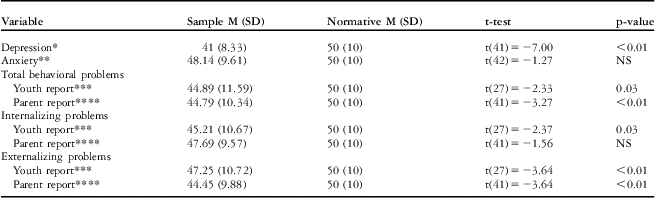
Participants in this study were compared with normative samples on symptoms of depression, anxiety, and behavioural problems. See Table 1 for mean scores. Across all scales, participants and their parents rated them as either similar to the normative sample, or in some cases as functioning better than expected compared with others their age. For example, when compared with the normative sample, participants rated themselves as experiencing less total behavioural problems (t(27) = −2.37, p < 0.03), internalising problems (t(27) = −2.37, p < 0.03), and symptoms of depression (t(41) = −7.00, p < 0.01). Their parents also rated them as experiencing less behavioural problems (t(41) = −3.27, p < 0.01) and less externalising problems (t(41) = −3.64, p < 0.01) than the average child.
Mean psychosocial ratings of the current sample compared to published norms.

*Children's Depression Inventory
**Multidimensional Anxiety Scale for Children
***Youth Self-Report
****Children's Behavioral Checklist
Discussion
Initial analyses of the Cardiac Arrhythmia Quality of Life for Youths scale indicate promise for its use as a disease-specific quality of life instrument. Internal consistency of the subscales was within the acceptable range. Test–retest correlations indicate statistically significant reliability coefficients for all of the subscales, except the General Satisfaction scale. It seems that the effect of cardiac arrhythmias on children's quality of life is more consistent than their general satisfaction with sleep, school, and appearance, even after just a 2-week period. It is also possible that the temporal stability of these types of variables in youth may not always be high. The various subscales of the cardiac arrhythmia quality of life scale were correlated with other psychosocial measures as expected, providing some evidence for the validity of the measure.
Psychosocially, children with cardiac arrhythmias and their parents report that they are functioning quite well, even better than expected across some domains. This report is supported by previous findings in the literature identifying resiliency among chronic illness populations.Reference DeMaso, Spratt and Vaughan 23 , Reference Noll, Vannatta and Koontz 24 Similar results have been documented by researchers for other cardiac populations.Reference Majnemer, Limperopoulos and Shevell 25 , Reference Brosig, Mussatto and Kuhn 26 The cardiac-specific quality of life scores reported by this sample also indicate a very high functioning across domains. In addition to the evidence of resiliency in the literature, it is possible that the high functioning nature reported by the children and parents in this study is a reflection of a sample that was well educated, mostly married, and experienced a low rate of cardiac surgery.
It is important to note that these are preliminary findings for this measure and that additional testing with larger samples will be required to conduct factor analyses and reduce the number of items. Limitations of this measure include lower reliability for the General Satisfaction subscale and the lack of relationship between the Worries subscale and general measures of worry. This may be a reflection of the different types of worries addressed by each questionnaire – general worry versus medical illness-specific worry – and the low rates of reported worry on both measures, indicating a lack of variability. Another limitation is the small sample size this measure was tested on. Future analyses of the measure should be conducted with larger samples in various locations to test for generalisability across geographic areas.
Acknowledgements
We would like to thank all the patients and families who participated in this study, as well as our research staff for making this project a success. This study was supported by funding from NIH Grant number 5T32 HD07510.
Appendix The cardiac arrhythmia quality of life for youths subscales
Impact:
-
1. How often do you feel pain associated with the treatment for your cardiac arrhythmia?
-
2. How often are you embarrassed by having to deal with your cardiac arrhythmia in public (that is, taking medication, wearing a vent or a halter)?
-
3. How often do you feel physically ill?
-
4. How often does your cardiac arrhythmia interfere with your family life?
-
5. How often do you have a bad night's sleep?
-
6. How often do you find your cardiac arrhythmia limiting your social relationships and friendships?
-
7. How often do you feel good about yourself?
-
8. How often does your cardiac arrhythmia keep you from driving a car or using a machine (for example, a computer)?
-
9. How often does your cardiac arrhythmia interfere with your exercising?
-
10. How often do you miss work, school, or household duties because of your cardiac arrhythmia?
-
11. How often do you find yourself explaining what it means to have a cardiac arrhythmia?
-
12. How often do you find that your cardiac arrhythmia interrupts your leisure-time activities or keeps you from participating in certain activities (for example, carnival rides, amusement parks, going to rock concerts)?
-
13. How often are you teased because you have a cardiac arrhythmia?
-
14. How often do you hide from others the fact that you are having an arrhythmia?
-
15. How often do you find that your cardiac arrhythmia prevents you from going out with your friend?
-
16. How often do you find that your cardiac arrhythmia prevents you from going out with your friends?
-
17. How often do you feel that your cardiac arrhythmia will limit what job you will have in the future?
-
18. How often do you find that your parents are too protective of you?
-
19. How often do you feel that your parents worry too much about your cardiac arrhythmia?
-
20. How often do you find that your parents act like the cardiac arrhythmia is their disease not yours?
-
21. How often do you find that your cardiac arrhythmia prevents you from being able to do things you may want to do (for example, body piercing, tattoos)?
-
22. How often do you find that your cardiac arrhythmia prevents you from doing things away from home (for example, staying at a friend's house, going to sleep-away camp, etc.)?
Worries:
-
1. How often do you worry about whether you will get married?
-
2. How often do you worry about whether you will have children?
-
3. How often do you worry about whether you will not get a job you want?
-
4. How often do you worry about whether you will pass out?
-
5. How often do you worry about being shocked by your defibrillator?
-
6. How often do you worry about whether you will be able to complete your education?
-
7. How often do you worry that your body looks different because you have a cardiac arrhythmia (for example, scarring from surgeries)?
-
8. How often do you worry that you will get complications from your cardiac arrhythmia?
-
9. How often do you worry about having to undergo repeated surgeries as a result of your cardiac arrhythmia?
-
10. How often do you worry about whether someone will go out with you because you have a cardiac arrhythmia?
-
11. How often do you worry that your teachers treat you differently because you have a cardiac arrhythmia?
-
12. How often do you worry about dying as a result of your cardiac arrhythmia?
-
13. How often do you worry that your cardiac arrhythmia will disrupt something you are currently doing in school (for example, acting in a school play, playing on a sports team, being in the school band)?
-
14. How often do you worry that because of your cardiac arrhythmia you are behind in terms of dating, going to parties, and keeping up with your friends?
-
15. How often do you worry about getting an infection?
Medical satisfaction:
-
1. How satisfied are you with the amount of time it takes to manage your cardiac arrhythmia?
-
2. How satisfied are you with the amount of time you spend getting checkups?
-
3. How satisfied are you with your current treatment?
-
4. How satisfied are you with the flexibility you have in your ability to engage in leisure-time activities?
-
5. How satisfied are you with the burden your cardiac arrhythmia is placing on your family?
-
6. How satisfied are you with your knowledge about your cardiac arrhythmia?
General satisfaction:
-
1. How satisfied are you with your sleep?
-
2. How satisfied are you with your social relationships and friendships?
-
3. How satisfied are you with your work, school, and household activities?
-
4. How satisfied are you with the appearance of your body?
-
5. How satisfied are you with the time you spend exercising?
-
6. How satisfied are you with your leisure time?
-
7. How satisfied are you with life in general?
-
8. How satisfied are you with your performance in school?
-
9. How satisfied are you with how your classmates treat you?
-
10. How satisfied are you with your attendance in school?
-
11. Compared with others your age, how you would you say your health is? Excellent, Good, Fair or Poor?