Purpose of study
Despite the impact of disease and endemic poverty, the number and percentage of older persons in sub-Saharan Africa is growing (Mills, Bärnighausen and Negin Reference Mills, Bärnighausen and Negin2012; Negin et al. Reference Negin, Bärnighausen, Lundgren and Mills2012). As with ageing populations around the globe, with increased age comes increasing and varied disease burdens (Murray et al. Reference Murray, Vos, Lozano, Naghavi, Flaxman, Michaud, Ezzati, Shibuya and Salomon2012). Older Africans suffer not only from diseases related to poverty, but also from HIV (Mahy et al. Reference Mahy, Autenrieth, Stanecki and Wynd2014; Negin and Cumming Reference Negin and Cumming2010) and non-communicable diseases (NCDs) such as hypertension, stroke and diabetes (Ameh et al. Reference Ameh, Gómez-Olivé, Kahn, Tollman and Klipstein-Grobusch2014). In the context of Ugandans living longer and their increasing morbidity from a range of illnesses and chronic conditions (Mathers, Fat and Boerma Reference Mathers, Fat and Boerma2008; Mayosi et al. Reference Mayosi, Flisher, Lalloo, Sitas, Tollman and Bradshaw2009), we explore the factors that cause them to delay seeking, reaching and acquiring health care. We conduct a thematic analysis of focus groups with Ugandans aged 60+ to outline factors that lead to older persons delaying health-care access.
In low- and middle-income countries, older persons’ health-care access is impacted by demographic, economic and health-status factors (Peltzer et al. Reference Peltzer, Williams, Kowal, Negin, Snodgrass, Yawson, Minicuci, Thiele, Phaswana-Mafuya, Biritwum, Naidoo and Chatterji2014). In many contexts, health-care access is lower among those who are poor, younger and male; as well as those who are less educated, have better self-rated health and have no chronic illnesses (Albanese et al. Reference Albanese, Liu, Acosta, Guerra, Huang, Jacob, Jimenez-Velazquez, Llibre Rodriguez, Salas, Sosa, Uwakwe, Williams, Borges, Jotheeswaran, Klibanski, McCrone, Ferri and Prince2011; Peltzer et al. Reference Peltzer, Williams, Kowal, Negin, Snodgrass, Yawson, Minicuci, Thiele, Phaswana-Mafuya, Biritwum, Naidoo and Chatterji2014; Vela et al. Reference Vela, Samson, Zunzunegui, Haddad, Aubin and Freeman2012). Importantly, the availability of ‘accessible, affordable and quality health care’ is also a crucial factor (Lloyd-Sherlock Reference Lloyd-Sherlock2000; Peltzer et al. Reference Peltzer, Williams, Kowal, Negin, Snodgrass, Yawson, Minicuci, Thiele, Phaswana-Mafuya, Biritwum, Naidoo and Chatterji2014). For example, out-of-pocket expenses can strain household finances and deter people from seeking care (Albanese et al. Reference Albanese, Liu, Acosta, Guerra, Huang, Jacob, Jimenez-Velazquez, Llibre Rodriguez, Salas, Sosa, Uwakwe, Williams, Borges, Jotheeswaran, Klibanski, McCrone, Ferri and Prince2011; Brinda et al. Reference Brinda, Kowal, Attermann and Enemark2015; Wong and Díaz Reference Wong and Díaz2007).
Over the past 20 years, many African public health systems have expanded from their early focus on acute infectious disease and maternal and child health to include tuberculosis and HIV (chronic infectious disease) services (Cohen et al. Reference Cohen, Li, Giese and Mancuso2013; Coovadia et al. Reference Coovadia, Jewkes, Barron, Sanders and McIntyre2009). At the same time, there has been an emerging epidemic of NCDs in older adults. During this time, appropriate care options for older adults narrowed because there was no parallel expansion in gerontological care (Mayosi et al. Reference Mayosi, Flisher, Lalloo, Sitas, Tollman and Bradshaw2009; Negin, Rozea and Martiniuk Reference Negin, Rozea and Martiniuk2014; Rabkin, Kruk and El-Sadr Reference Rabkin, Kruk and El-Sadr2012). There has been some limited research on access to care among older Ugandans living with HIV (Kuteesa et al. Reference Kuteesa, Seeley, Cumming and Negin2012; Negin et al. Reference Negin, Nyirenda, Seeley and Mutevedzi2013). In this paper, we build on that work by exploring the factors that delay older Ugandans who have a variety of health concerns from seeking, reaching and receiving the care they need (Droti Reference Droti2014).
Older Ugandans generally receive care at government-run Level III Health Centres, which provide free and accessible care at the sub-county level. Officially, these centres are equipped to provide ‘preventive, promotive and curative care’, as well as diagnostic laboratory services and maternity care (The Republic of Uganda,Ministry of Health, ND, pg 20.). However, for a variety of reasons, older Ugandans often delay accessing health services. Delays are caused by a limited willingness to seek care, restricted ability to reach care, and low expectations of receiving appropriate and adequate care (Droti Reference Droti2014; Nnko et al. Reference Nnko, Bukenya, Kavishe, Biraro, Peck, Kapiga, Grosskurth and Seeley2015). These issues are similar to those outlined in Thaddeus and Maine's ‘Three-Delay Model’ (Thaddeus and Maine Reference Thaddeus and Maine1994).
The Three-Delay Model
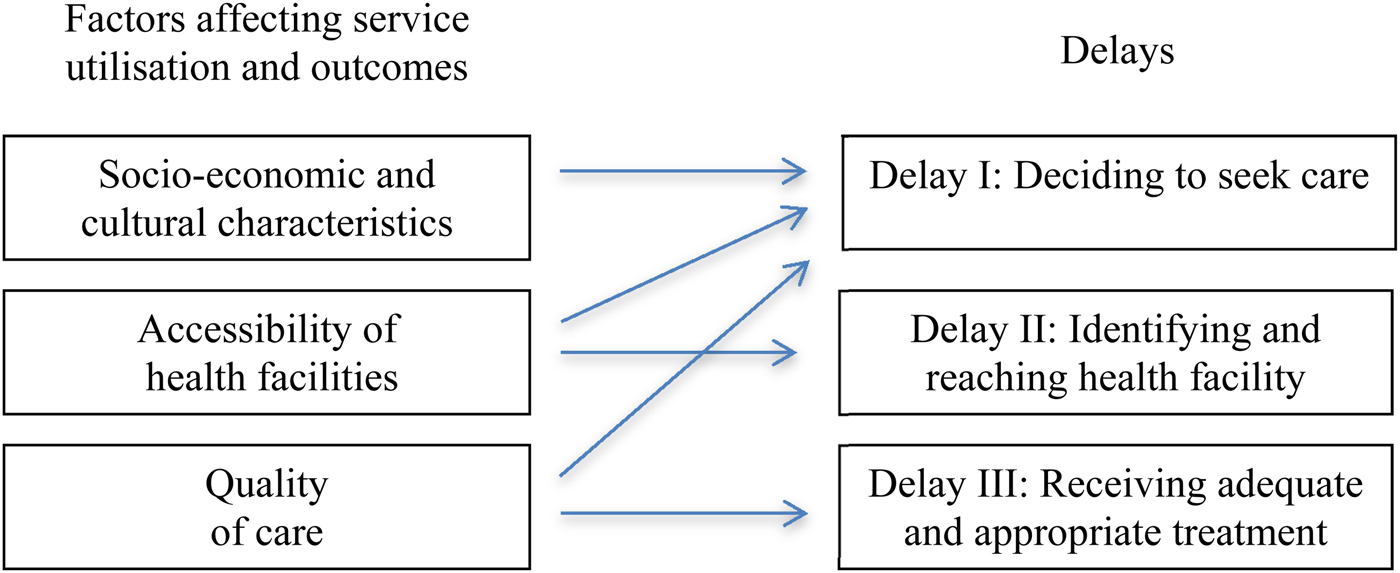
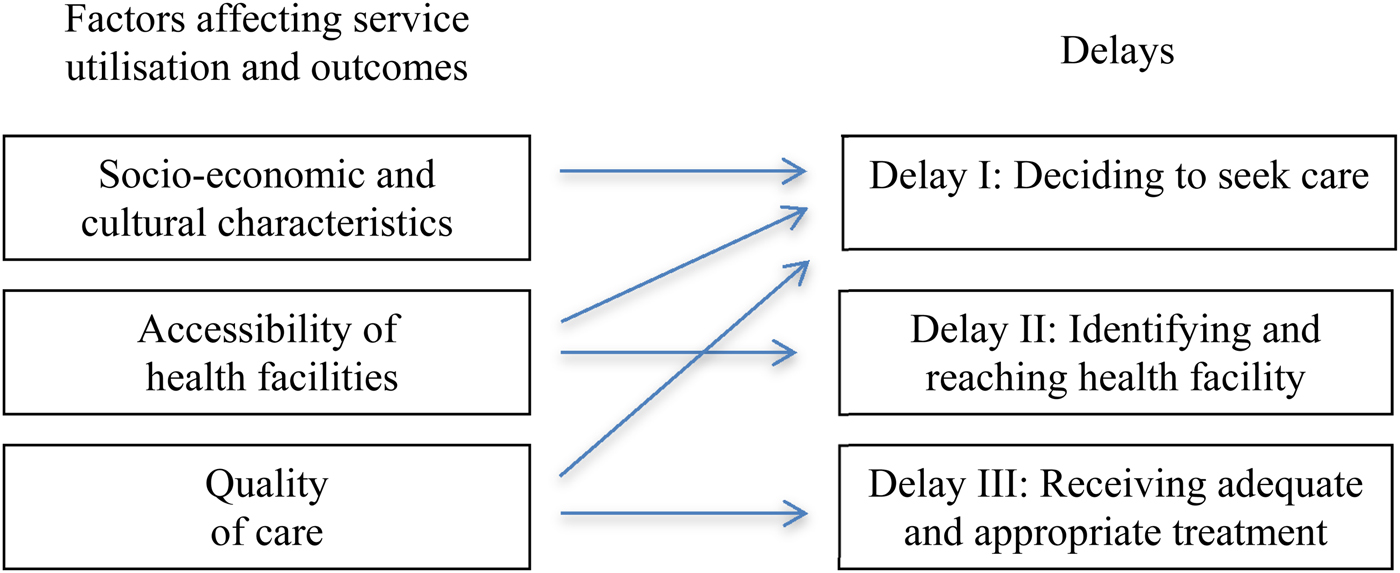
Thaddeus and Maine's (Reference Thaddeus and Maine1994) Three-Delay Model is useful here because it identifies ‘obstacles to the provision and utilisation of high quality, timely obstetric care’ in Africa by defining a chronology of barriers that result in delays to pregnant women's health-care access. In the past, the model has been adapted to emergency care (Calvello et al. Reference Calvello, Skog, Tenner, Wallis, Calvello, Skog, Tenner and Wallis2015) and used to develop interventions that reduce maternal mortality (e.g. Lalonde et al. Reference Lalonde, Okong, Mugasa and Perron2003; McCarthy et al. Reference McCarthy, Byrne-Davis, Hart, Yuill, Slattery, Jackson and Byrne2015). To the best of our knowledge, we are the first to adapt the model to analyse delays to accessing care among older Africans. As shown in Figure 1, our model outlines Three Delays: (I) deciding to seek care, (II) identifying and reaching medical facilities, and (III) receiving adequate and appropriate care. The length of delays and likelihood of a delay's impact on service utilisation and outcomes are influenced by socio-economic and cultural characteristics, accessibility of facilities and quality of care.
Three-Delay Model in gerontological care.
In other words, our model posits that older Africans’ delay in accessing health care is due not only to a lack of financial resources but also to a broader set of interconnected individual, community and health-system factors, and that these factors create feedback loops that influence future health-care decisions. With this model, we view delays to seeking, reaching and acquiring care as crucial intervention points for older persons, for whom chronic disease management (whether HIV or NCD) is essential to remain self-sufficient. ‘Community’ factors are presented as an intermediary level between the patient and the health system – both a physical place with regard to available infrastructure such as water, electricity and roads, and a social space where social support and interpersonal relationships (or lack thereof) impact older persons’ health and health decision-making.
Design and methods
The data are drawn from a qualitative study conducted in 2015 in Kalungu district in rural south-west Uganda. The area is home to the Medical Research Council/Uganda Virus Research Institute (MRC/UVRI) General Population Cohort (GPC), which was established in 1989 to study the epidemiology of HIV. In recent years, the MRC/UVRI has expanded to cover other conditions. A considerable amount of research on older persons has taken place at the site, including the SAGE (Study on Global AGEing and Adult Health) Wellbeing of Older People Study survey and a number of qualitative studies (Asiki et al. Reference Asiki, Murphy, Nakiyingi-Miiro, Seeley, Nsubuga, Karabarinde, Waswa, Biraro, Kasamba, Pomilla, Maher, Young, Kamali and Sandhu2013; Scholten et al. Reference Scholten, Mugisha, Seeley, Kinyanda, Nakubukwa, Kowal, Naidoo, Boerma, Chatterji and Grosskurth2011). The clinic serves the GPC population and offers clinical services to over 70 patients daily from the 25 study villages that form the GPC. However, most people will first visit a government or private health clinic closer to their home rather than travel to the MRC/UVRI clinic. The MRC/UVRI clinic provides inpatient care and referrals to specialists, as needed, and very occasionally provides transportation to the clinic or sends health workers into the community. Despite its limits, the presence of the MRC/UVRI clinic promotes utilisation of health care; the delays outlined below are likely more severe in places without such subsidised care.
Two local facilitators conducted nine focus group discussions (FGDs) with older Ugandans living in the area. The authors used the MRC/UVRI GPC list as a sampling frame to draw participants aged 60-plus (Asiki et al. Reference Asiki, Murphy, Nakiyingi-Miiro, Seeley, Nsubuga, Karabarinde, Waswa, Biraro, Kasamba, Pomilla, Maher, Young, Kamali and Sandhu2013). This list includes recent survey information on NCD diagnosis and HIV status. Table 1 shows the distribution of FGDs by gender and diagnosis. Each FGD had seven or eight participants and was held in a central and convenient location. Informed consent was obtained and each FGD participant received 10,000 Uganda shillings (US $3.70) as compensation. With assistance from the Project Manager (author JM), the FGD facilitators recorded and transcribed the FGDs. Transcripts omitted participants’ names and personal information. JM also conducted nine key informant interviews with health-care workers and community leaders. The following analysis focuses on the perspective of older persons about their decisions to seek care, ability to reach care and views of acquiring adequate care.
Focus group discussions by sex and diagnosis (HIV or non-communicable diseases (NCD))

Analysis
In our thematic analysis, we searched across our data-set to find ‘repeated patterns of meaning’ that reflect older Ugandans’ experiences, perceptions and beliefs about health-care barriers (Braun and Clarke Reference Braun and Clarke2006, Reference Braun and Clarke2013). First, we carefully read every FGD transcript. The lead author (ES) created memos on major themes that arose in each FGD and outlined the broader, focal themes related to participants’ financial, social and physical wellbeing. The team reviewed these memos to develop the coding tree, build consensus around the major themes, and assess their fit with the team's contextual knowledge of the site. At this stage, barriers to care emerged as a major issue, so the research team delineated the themes and codes related to ‘delays to care’.
Next, ES coded the FGD using the ‘barriers to care’ themes and developed additional lower-level codes using participants’ own language, noting outliers and areas of agreement and contestation among FGD participants. The research team used a report of all text related to barriers and delays to care to assess where themes clustered, and to delineate Three-Delays to care and their related sub-themes. In discussion of the results, themes and sub-themes were combined, split or dropped. Then, the research team defined the final model and mapped its alignment with the Three-Delay Model and the existing literature from Uganda, and noted where it extended current knowledge. Finally, the authors use the analysis to tell a fuller story of the complexities and challenges that older, rural Ugandans face when seeking, reaching and acquiring health care. In the Results section, focus groups are designated by number, gender (‘M’ for male or ‘F’ for female) and diagnosis (‘HIV’ or ‘NCD’, or ‘Any’ if no specified diagnosis).
Results
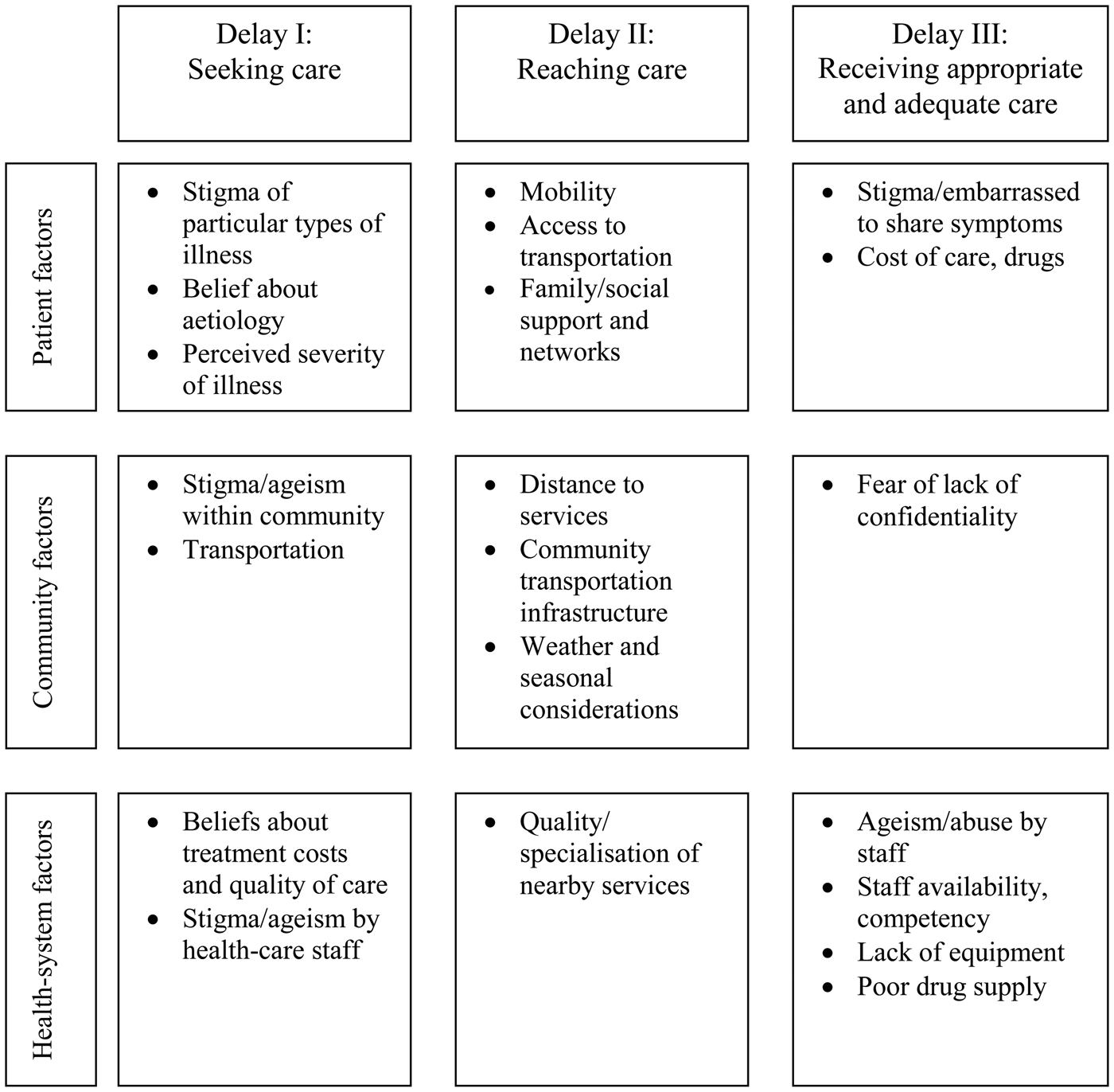
Our older Ugandan respondents were able to articulate the factors that impact their decisions to seek care and ability to do so. Most decisions about seeking health-care in this community occurred only after symptoms appeared and individuals began feeling unwell. Our respondents reported ailments ranging from ‘old age’ aches and pains to symptoms of sexually transmitted infections (STIs) and formally diagnosed illnesses like ulcers, hypertension and HIV. As men in one FGD said, ‘Lack of necessities in life and sicknesses such as malaria and pneumonia affect old people. Other sicknesses … include back ache, painful legs and poor eye sight’ (FGD9-MAny). Even though Level III health facilities aim to provide preventive care, our respondents rarely mentioned preventive care. Also, our respondents reported seeking informal medical care, such as collecting and boiling herbs, visiting traditional healers and buying over-the-counter medicines at local shops. When asked where older persons go for treatment when they are ill, the majority named local and some more distant formal health-care facilities including village clinics, the MRC/UVRI clinic, government dispensaries, Level III health centres, private clinics and hospitals. The results summarised in Figure 2 outline what delayed our respondents from seeking, reaching and obtaining health services.
Three-Delay Model for older Ugandans’ barriers to health care.

Delay I: Deciding to seek care
Deciding to seek care depends on individual conceptions about when it is appropriate to seek care, including ideas about illness such as aetiology, severity and stigma, and individual-level barriers such as mobility and financial limitations. In sub-Saharan Africa, some older persons seek informal care or traditional medicine because they believe an illness is not severe or its cause is not biological (Clausen et al. Reference Clausen, Sandberg, Ingstad and Hjortdahl2000; Mulumba et al. Reference Mulumba, Nantaba, Brolan, Ruano, Brooker and Hammonds2014; Wandera, Kwagala and Ntozi Reference Wandera, Kwagala and Ntozi2015). Even when older persons consider an illness to be severe, they often report not seeking care because of poor access to health facilities (e.g. distance or cost) or poor quality of care (Ameh et al. Reference Ameh, Gómez-Olivé, Kahn, Tollman and Klipstein-Grobusch2014; Bovet et al. Reference Bovet, Gervasoni, Mkamba, Balampama, Lengeler and Paccaud2008; Mulumba et al. Reference Mulumba, Nantaba, Brolan, Ruano, Brooker and Hammonds2014; Wandera, Kwagala and Ntozi Reference Wandera, Kwagala and Ntozi2015). In this way, decisions at Delay I are interrelated with factors related to Delays II and III, such as anticipated ability to reach services and quality of care.
Illness factors: aetiology, severity and stigma
Aetiology sometimes determined where and when participants sought care. Men in particular reported that an illness caused by witchcraft, usually as a result of jealousy among neighbours, was a reason to seek ‘local medicine’ (FGD2-MNCD) rather than formal care at government or private health clinics (Nnko et al. Reference Nnko, Bukenya, Kavishe, Biraro, Peck, Kapiga, Grosskurth and Seeley2015). In general, however, participants’ responses suggested that seeking informal or traditional medicine did not lead to good outcomes. One woman said, ‘there are some who think they have been bewitched (amayembe) then seek traditional healing and by the time they turn to health units, given tablets and injections, their lives are already wasted’ (FGD6-FHIV).
Older persons also reported delaying care until an illness was considered severe. One man in the FGD of participants with NCDs explained, ‘By the time you see an old person is sick it means he had been sick for some long period. You can tell after observing that he spent days inside his house with the door to his house closed’ (FGD2-MNCD). Aches and pains, dizziness, shortness of breath may not be deemed severe enough for older persons to seek care, and yet may portend the onset of NCDs.
Some illnesses have a stigma that led older persons to delay seeking care. Respondents reported ‘shyness’ about having HIV or STI symptoms (e.g. gonorrhea), which are perceived as ‘inappropriate’ diseases for older people. In this context, participants seemed to use gonorrhea and syphilis as catch-all terms for those diseases as well as some other, similar conditions. As one male FGD participant said, ‘Some old people are lazy to go for treatment, like those who would get gonorrhea and remain with the sickness without reporting at the health centre for treatment’ (FGD7-MAny). Others in the group concurred, ‘Some old people hide to mention that they have AIDS and this is caused by shyness … They feel shy because of their age and think that people will laugh at them’ (FGD7-MAny). Some respondents worried about fellow residents, whereas others worried about treatment by health workers. One older woman said sadly, ‘We even develop a habit of keeping silent about some illnesses … You say to yourself, “How shall I disclose such an illness to such a young health worker!”’ (FGD8-FAny). Other respondents highlighted that other symptoms may carry the stigma of ‘old age’; one male respondent with an NCD said,
When you go to the health facility and explain to basawo [health worker] the way you are feeling, it could be painful joints, they just inform you that please muzeyi [old man/elder] you are suffering from old age. You get miserable and return home annoyed. If they give you drugs you can't trust that the drugs they have given you will help to cure the problem you have presented to them because of the comment they made. (FDG2-MNCD)
Financial concerns and quality of care
Perceptions about the quality of care and financial concerns are important factors in Delays II and III, but respondents also identified both as key to their decision whether to seek care at all (Delay I). Respondents reported that although local government health centres provide free care, they sometimes decide not to seek care there because these centres can be hard to get to, the quality of care they deliver is uneven or they often do not have the necessary drugs.
Most older participants said cost affected their decision to seek care. As one respondent said, ‘Poverty sometimes results in poor treatment seeking. You are poor to the extent that you don't have what [you need] to pay at the health facility for treatment’ (FGD5-FAny). Another respondent said, ‘The distance I [go on] foot is long and I cannot afford it! However, I force myself and come!’ (FGD6-FHIV). The other participants in her FGD echoed this challenge. Even if initial care at a government health centre is free, the possibility of additional follow-up costs affected participants’ decisions. One participant said,
Someone might fall sick with a disease that can be treated and when he goes to hospital they tell him to go and buy the medicine, yet he does not have money. He just forgets all about seeking care. (FGD3-MHIV)
A number of participants complained about being asked to pay for treatment at government health centres. As men in one FGD related,
Even when you have gone to the government health facility where the services are free of charge, in actual sense when you reach in the examination room the nurse asks for money to attend to your problem … Failure to pay and s/he invites another patient and leaves you there or tells you to go away. (FGD3-MHIV)
While many of our respondents reported that they eventually seek care when their illness is sufficiently severe, factors related to costs and expectations of quality impact their willingness to seek care earlier or as a preventive measure.
Delay II: Identifying and reaching medical facilities
In our model, Delay II encompasses the ability to reach a health facility, which includes distance and travel time, the availability of transportation, how weather might affect road conditions and travel, as well as community-level health and social services and infrastructure. In a number of sub-Saharan African contexts, a key factor contributing to poor health-care access is individual and community poverty, specifically food insecurity, poor hygiene, poor sanitation and lack of safe water (Mulumba et al. Reference Mulumba, Nantaba, Brolan, Ruano, Brooker and Hammonds2014; Wandera, Kwagala and Ntozi Reference Wandera, Kwagala and Ntozi2015). These factors are clearly connected to health itself, but also can impact decisions about where, when and how to expend financial and physical resources. In addition, at older ages, physical disabilities, particularly those that restrict walking, lower one's likelihood of accessing health care (Gómez-Olivé et al. Reference Gómez-Olivé, Thorogood, Clark, Kahn and Tollman2013; Wandera, Kwagala and Ntozi Reference Wandera, Kwagala and Ntozi2015). Delay II factors capture how even once a decision is made that one should seek care, community-level factors, or the absence of community services, may impede reaching the right health facility.
Distance and transport
Despite being intentionally located close to the population they serve, the distance to government health centres is not always walkable, particularly for older persons with decreased mobility, strength and energy. Lack of motorised transportation is an even more salient concern; one participant said that, ‘older persons fail to seek treatment because of [not having money for transport]’ (FGD4-MAny). Although men and women spoke differently about transportation challenges, both related it as a concern. Women were more likely than men to report difficulty walking the distance to the health centre; one older woman said ‘[my] problem was to walk all the distance from home to the facility [about two miles] to access treatment’ (FGD5-FAny). Another complained about the difficulty to ‘just move with that [leg] pain’ even within the village to visit friends, so she ‘do[es] not seek treatment from any health unit’ (FGD8-FAny). Even when older persons knew they needed to return to the health centre for care for chronic conditions, they emphasised this issue, as one man with an NCD said,
Lack of transport to the health facility. The nurse might have told you to go back for a review but you can't go back because you might be suffering from painful legs and not able to foot to the health facility. (FDG2-MNCD)
When the distance to a health centre is too far for an older person to walk, they must hire a motorbike or minivan taxi. The average cost from someone's home to the clinic is about 1,000 Uganda shillings (about US $0.30). Given the endemic poverty in the area, this is a significant cost, so it becomes a consideration when deciding to seek care and potentially a delay to reaching care. In a FGD with older men living with HIV, the facilitator asked about challenges to accessing care. The group responded, ‘Transport’. The facilitator probed, ‘How is it a challenge?’ One group member said, ‘I might not have either a bicycle or motorcycle to carry me to the health unit’. Another added, ‘The biggest challenge is lack of money, once you have money, you can access the best treatment’ (FGD3-MHIV).
Men were more likely than women to mention using neighbours or children to facilitate a trip to the health centre. One man said,
You might fall sick but when co-operating with your neighbour. He comes to you and says; ‘Mr. S you are sick but why do you not go to the health facility?’ You then tell him, do I have means to reach there? That is when he asks his son to collaborate with your son to get a bicycle and take you to the health unit (FGD3-MHIV).
Another man said, ‘[If an older person's health deteriorates] friends come for rescue and take him to the health facility’ (FGD9-MAny). However, not all men were able to request this type of assistance. As one man noted ‘Some [older persons] say we shall take omululuuza [herbs] for the time being. This is because they do not even happen to have money to transport them to the health facility (FGD3-MHIV).
In sum, out of nine focus groups, only one (FGD7-MAny) did not mention transportation or distance to health services as a major obstacle. The MRC/UVRI is located at the centre of the 25 villages that make up the GPC, making it far from many people. When discussing transportation, study participants frequently cited MRC/UVRI's past help with transportation as a key reason for seeking care at that clinic and noted that without it, they may not seek care: ‘The challenge [is] when one does not have money or anyone to give him support and moreover the MRC clinic never gives us transport like it used to do’ (FGD4-MAny).
Delay III: Receiving adequate and appropriate care
Delay III encompasses impediments to accessing quality and appropriate care that occur once an individual has reached a facility. These issues include facility waiting times, the response and care given by health workers, and the availability and cost of appropriate equipment and medication. This is consistent with literature elsewhere in sub-Saharan Africa that identifies health workers’ ageism (Ameh et al. Reference Ameh, Gómez-Olivé, Kahn, Tollman and Klipstein-Grobusch2014; Mulumba et al. Reference Mulumba, Nantaba, Brolan, Ruano, Brooker and Hammonds2014) and the lack of adequate drugs. Although public health facilities in Uganda are required to stock and supply medicines free of charge to patients, supplies are often deficient and patients lack funds to purchase the medications elsewhere (Mulumba et al. Reference Mulumba, Nantaba, Brolan, Ruano, Brooker and Hammonds2014).
Ageism
In the present study, health workers’ perceived ageism and their general mistreatment of older persons contributed to older Ugandans’ mistrust of health facilities. ‘When a sick old person reaches the health facility he gets excited hoping musawo [health worker] is going to attend to his problem but he gets depressed when musawo looks at him with a bad face’ (FGD2-MNCD). In nearly every FGD, poor treatment was one of the most common issues raised. Respondents said health workers shouted, were rude, accused older people of wasting their time and taking medicine that should go to younger persons, and criticised older people for not hearing, understanding or acting ‘properly’.
Although the FGD respondents said that health workers did not ‘abuse’ them, stories about backbiting and shouting suggest poor treatment and possible abuse do occur. For example, several respondents said that health workers were reluctant to treat older adults because their complaints were considered illegitimate. A woman who was sickly and unable to walk reported ‘being rebuked and blamed for old age by the health worker, that the pain I was feeling was due to that!’ (FGD6-FHIV). In men's FGDs, there were similar claims. One said a health worker asked him, ‘Shall we also attend and give care for old age? That is not sickness but old age!’ (FGD4-MAny). He further explained that this made him think that health workers ‘do not regard the elderly as important and just want to give care only to young people!’ (FGD4-MAny). A participant from another FGD, ‘went back very depressed and angry’ after a health worker scolded, ‘“The number of times you have reported here, don't you get tired of walking?! We don't cure old age!”’(FGD7-MAny). These data do not reveal what presentations health workers called ‘old age’, but it is very likely that at least some of the symptoms and complaints are connected to NCDs.
A further complaint was that health workers accused older people of not being worthwhile recipients of free medication. In one FGD, the men talked about health workers’ responses to them, saying ‘You are just finishing/wasting our medicine! Your period [of survival] is over!’ (FGD3-MHIV). They explained that a comment like this ‘worries [older people] very much, they lose hope. The older person then begins to wonder if the medical staff believes that he is no longer fit to live anymore!’ (FGD3-MHIV).
Older people also spoke about being disrespected as elders and devalued as either unco-operative or unintelligent. Both men and women said that older people sometimes get scolded when they do not properly hear or follow protocol. ‘Dealing with patients is very complicated, they may call a patient's name to enter the room. Because the old person never heard so well he comes nearer and the nurse shouts at him please go away and wait for your turn. The old person gets embarrassed and neglected. That makes him hate the facility and the nurse’ (FGD9-MAny). In one FGD, a participant was asked if she ever got up to ask the health worker for help understanding what to do or when she would be called, with a frightened look she said, ‘I feared to do so!’ (FDG8-FAny).
Confidentiality and stigma
Older persons’ ability to access care was also affected by perceived stigma and fears about confidentiality, both of which interfered with the relationship between older persons and health workers. Older persons reported being reluctant to communicate their use of traditional medicine, and they often kept silent about ‘embarrassing’ symptoms. Older persons in several FGDs said they ‘do not inform the basawo about using both western and herbal medicine fearing that they may refuse to give them medicines or ask several questions or quarrel’ (FGD9-MAny). Some older adults living with HIV reported concerns about what information health workers would disclose to others. One group was asked, ‘Are there health workers that publicise one's sickness?’ They responded,
Yes they happen to be there, he [the health worker] says, ‘I have examined him and he has several illnesses!’ Even the person who would not have been aware of what you suffer from gets to know about it then he spreads the rumour about you! (FGD3-MHIV).
Perhaps owing to stigma and the related fear of disclosure or being accused of seeking care for ‘old age’, older adults sometimes hide their symptoms and illnesses from health workers. Those with NCDs, as well as those with HIV, were reluctant to share information about their ailments, as one man suffering from an NCD shared,
Old people are not open about the sickness they are suffering from. Even when they report at the health centre they hide the sickness disturbing them at the time, instead [they] talk about minor sickness and [do] not mention the serious one. (FGD2-MNCD)
While this man may have been talking about NCD symptoms, other older adults reported being uncomfortable sharing information about sexuality and STIs with young health workers, particularly those of the opposite sex. One male FGD participant explained, ‘What made me unhappy was to ask me how many sexual partners I have had in life. It was a young woman who asked me that. Why not a man to ask me such?’ (FGD7-MAny). Women made similar claims, ‘There is being asked sensitive questions and the health worker is younger when you already abstained or you are a widow! For us the elderly you feel shy to address such issues’ (FGD8-FAny). Participants also reported receiving rude responses when they did reveal such symptoms.
Staffing, equipment and drug supply
Many individuals said long waiting times at health centres deter them from accessing care. Many participants complained of waiting all day: ‘I recently went to [name] clinic and got card number 16 having arrived early at 6:00 am. The card was issued to me at 9:00 am but the most challenging experience was that I got the medicine at 4:00 pm’ (FGD8-FAny). Although the MRC/UVRI clinic is technically free, participants identified time as a costly trade-off. One woman said, ‘I fear going to MRC clinic because you go there feeling so bad, they make you wait on the line so long and by the time the musawo attends to you, you are already in a bad condition’. She went on to say if one has money, they choose another facility, ‘You go there, spend less time and return home’ (FGD1-FNCD).
Participants also identified lack of necessary drugs as a major obstacle to care at government clinics, which is a common complaint throughout sub-Saharan Africa. One male respondent said, ‘My friend was annoyed at receiving [only] two tablets, but for me I sat at the government for a day and when they reached my number they informed me that there were no drugs’ (FGD7-MAny). For poor patients, the drug supply shortage at public health facilities compounds health-care costs. A man living with HIV outlined his frustration to his FGD,
Personally what annoys me is prescribing for you three types of drugs but then they issue to you one type and tell you that go and buy the other two types from a drug shop. The health workers have that habit yet you might not have money to buy it! (FGD3-MHIV)
Several other participants said high drug costs prevent them from receiving good care; a man with an NCD said:
Another problem old people face in accessing treatment is that of money. Possibly you went to the health facility with 1,000 Uganda shillings hoping it will be enough, after examination had been done musawo tells you that treatment requires 5,000 Uganda shillings but you only have one-fifth of the required payments. Instead of a full dose they give you a quarter of the dose that will not help to cure the sickness. You go home and wait until you will die. (FGD2-MNCD)
Indeed, for many older adults, beliefs about the availability of subsidised drugs seemed to drive their choice of a health-care facility. In one of the men's FGDs, a long discussion ensued that framed long waiting times as a trade-off for free medication; there was a general consensus that this was true:
[The] majority of the older persons turn to MRC clinic because of their [older persons’] low income since here medication is free of charge. The clinic sometimes becomes full of patients then one wishes he falls sick when he has money so as to have another alternative such as going to a private health unit! (FGD4-MAny)
The MRC/UVRI has a relatively consistent drug supply and staff members have more knowledge of NCDs. The clinic is one among a limited number of non-governmental/research clinics supported by foreign donors and thus able to provide free care, in Uganda and elsewhere in sub-Saharan Africa.
Implications
In the past, the Three-Delay Model has primarily been used to analyse the health profile of pregnant women and emergency medicine. However, we find it to also be a useful analytic tool to study older Ugandans’ health-care experiences because this population experiences challenges at three points: around decisions to seek care, ability to reach care and challenges to receiving quality care. As in the original model, our Three Delays capture the temporal order of potential delays to older adults accessing care.
That said, the data in this study push the model further by demonstrating the deep and pervasive interplay that exists not only laterally between the Three Delays (across time), but also vertically between individual, community and health-system levels (across levels). Although the Three Delays were clear, durable, central themes around which respondents’ experiences grouped, respondents also repeatedly made connections between the Three Delays. In most cases, past experiences trying to access care (Delay III) were bound up with individual assessments of whether to seek care (Delay I). Specifically, when deciding whether to seek care (Delay I), older Ugandans consider cost of transportation or difficulty walking (Delay II), as well as their memories of prior poor treatment by health-care workers or shortages of drugs that make the trip not worthwhile (Delay III). In this way, older Ugandans’ own words and experiences reveal that the Three Delays exist as concrete factors and that they also operate in lived experience as feedback loops that affect one another. Within this feedback loop, our data reveal factors at the individual, community and health-system levels that impact each of the Three Delays. As discussed further below, the interactive and multi-level characteristics of our Three-Delay Model have important implications for what effective health interventions for older adults in the Ugandan context might look like.
Using the Three-Delay Model to inform effective health interventions for older adults in Uganda is important because older adults have complex care needs. The limited existing literature on older persons in sub-Saharan Africa suggests this group has low access to health-care services and thus has poorer outcomes from NCDs, disability and HIV (Bovet et al. Reference Bovet, Gervasoni, Mkamba, Balampama, Lengeler and Paccaud2008; Clausen et al. Reference Clausen, Sandberg, Ingstad and Hjortdahl2000; Droti Reference Droti2014; Gómez-Olivé et al. Reference Gómez-Olivé, Thorogood, Clark, Kahn and Tollman2013; Mulumba et al. Reference Mulumba, Nantaba, Brolan, Ruano, Brooker and Hammonds2014; Scholten et al. Reference Scholten, Seeley, Mugisha, Zalwango and Wright2011; Wandera, Kwagala and Ntozi Reference Wandera, Kwagala and Ntozi2015). Indeed, large percentages of older adults with chronic illnesses (43–67%) have not received any health care in the past year (Bovet et al. Reference Bovet, Gervasoni, Mkamba, Balampama, Lengeler and Paccaud2008; Gómez-Olivé et al. Reference Gómez-Olivé, Thorogood, Clark, Kahn and Tollman2013). As rates of both NCDs and HIV increase among older adults, we must understand better what delays older persons from accessing care in order to promote better access, diagnosis and treatment adherence (Negin and Cumming Reference Negin and Cumming2010). The model we develop in this paper identifies the factors that impact these delays at multiple levels, and perhaps most importantly, demonstrates extensive interplay among levels and delays. With this model in mind, it becomes clear why future health interventions that simultaneously address the individual, community and health system will be the most successful.
The concerns that respondents raised around Delay I reveal important barriers that interventions at the health-system level (e.g. expanding health services) will not address. Instead, Delay I concerns demonstrate the need for interventions that expand knowledge about symptoms and possible treatment, reduce stigma around particular illnesses and ageing, and increase social support so that older persons can ask for assistance when they need it. Most older persons no longer work, often owing to illness. The lack of a social welfare programme for older persons in this region of Uganda (Stewart et al. Reference Stewart, Dall'Olio, Eberhard, Borg, Bronchi, Sebudde, Morisset, Coll-Black, Magezi, Nguessa Nganou and Kibirige2014) means they lack funds to pay for private health services, necessary drugs or transportation to health facilities. Older persons report under-utilising formal care because they use informal care instead, or because they did not consider their illness or symptoms severe enough to seek care (Ameh et al. Reference Ameh, Gómez-Olivé, Kahn, Tollman and Klipstein-Grobusch2014; Bovet et al. Reference Bovet, Gervasoni, Mkamba, Balampama, Lengeler and Paccaud2008; Wandera, Kwagala and Ntozi Reference Wandera, Kwagala and Ntozi2015). We found health-system issues cross into this decision-making process. Poor infrastructure and lack of affordable transportation not only make reaching health facilities difficult at Delay III, they also affect the decision to seek care because they increase how severe symptoms or pain must be to warrant spending the money or social capital for transportation to the health centre.
Our results also highlight the importance of older Africans’ socio-cultural beliefs about the aetiology of the illness, which prior literature has also shown impacts when and where to seek treatment (Clausen et al. Reference Clausen, Sandberg, Ingstad and Hjortdahl2000; Nnko et al. Reference Nnko, Bukenya, Kavishe, Biraro, Peck, Kapiga, Grosskurth and Seeley2015). In many African settings, the symptoms of HIV are seen as similar to the effects of breaking taboos or witchcraft (Ashforth Reference Ashforth2002; Buregyeya et al. Reference Buregyeya, Kulane, Colebunders, Wajja, Kiguli, Mayanja, Musoke, Pariyo and Mitchell2011). In these communities, addressing beliefs about witchcraft and HIV stigma is necessary to improve older persons’ health-care access and treatment adherence (Kuteesa et al. Reference Kuteesa, Seeley, Cumming and Negin2012). Also, until recently, NCDs were not likely to be tested for or diagnosed because of pervasive beliefs that their biomedical aetiology was primarily ‘old age’. In this way, suffering from NCDs, perhaps even more than HIV, was seen by patients as untreatable, which was reinforced by health-care workers, and ultimately lowered care for older adults.
Turning to Delay II, the concerns that respondents raised draw attention to community infrastructure and how important it can be to improve older adults’ health. In particular, our data point to the importance of better roads, more community social services to provide information about NCD symptoms and risk factors, and linking older persons with health facilities on a more regular basis. First, investing in public infrastructure would give older persons a means of transport that does not require significant financial or social capital, and adding services in rural areas, where most older adults live, would eliminate the need for long travel (Stewart et al. Reference Stewart, Dall'Olio, Eberhard, Borg, Bronchi, Sebudde, Morisset, Coll-Black, Magezi, Nguessa Nganou and Kibirige2014). Because older Ugandans are more likely to be disabled or have limited mobility, poor roads, long travel times and unavailable or costly transport are particularly important delays to accessing health care (Wandera, Kwagala and Ntozi Reference Wandera, Kwagala and Ntozi2015). Older persons with chronic conditions (e.g. arthritis, high blood pressure and diabetes), which may both impact mobility and increase the need for regular medical care, might not be capable of walking even relatively short distances due to shortness of breath, swollen joints or tiredness. Also, whereas children may be carried to a health centre, older adults are unlikely to be carried by their care-givers. Our study also highlights an additional gender component: women may be more likely to lack the types of social network that can be tapped for help to reach health facilities. Finally, note that our model suggests that if investments are made in infrastructure, those investments would deepen their impact not only because more older Ugandans could physically or financially manage the transport, but also because they would begin to incorporate easier travel into their decisions about whether to seek care (Delay I) and perhaps begin seeking care earlier for more symptoms or types of illness.
Turning to Delay III, we see the health-system interventions that are needed to improve older persons’ access to quality care. The results of our study suggest that to improve older Ugandans’ health, the government health system must improve staff training and create more efficient drug supply systems. First, increasing health workers’ knowledge of older persons’ experiences, needs and common illnesses might not only improve communication during examinations and lead to better diagnosis and care, but also increase older persons’ desire to seek care when they need it. Our study adds new information about older adults’ fear about disclosing symptoms and illnesses to community members and health workers delaying them from seeking care. Hiding pertinent information can delay access to adequate care and reduce the quality of care older people receive (Moreira et al. Reference Moreira, Brock, Glasser, Nicolosi, Laumann, Paik, Paik, Wang and Gingell2005); this can have important negative implications for both HIV and NCD care. According to our participants, being treated badly or feeling devalued by health workers leads to older people isolating themselves, becoming discouraged and depressed, and being less likely to return for future care.
Likewise, ensuring older Ugandans could receive the medication they need at the end of their visit would not only improve medication adherence, but also improve the likelihood that they would decide to seek care in the first place. It should be noted that compared to government clinics, the MRC/UVRI clinic we studied has a more consistent supply of free drugs (Asiki et al. Reference Asiki, Murphy, Nakiyingi-Miiro, Seeley, Nsubuga, Karabarinde, Waswa, Biraro, Kasamba, Pomilla, Maher, Young, Kamali and Sandhu2013), but it also does not reach the majority of people in the GPC. Overall, we suspect the findings from our FGDs may underestimate the impact of the factors related to Delays II and III.
In sum, our results suggest that Level III government health centres may need to be retooled to appreciate and address older adults’ health concerns and meet their needs for drugs and services. Recall that Level III government health centres in Uganda were originally founded to treat maternal and child health, and their focus on HIV services is recent. Our results suggest this recent focus might exacerbate older persons’ difficulty reporting symptoms of ‘young person's diseases’ (Moreira et al. Reference Moreira, Brock, Glasser, Nicolosi, Laumann, Paik, Paik, Wang and Gingell2005) or accessing care for what is viewed as symptoms of ‘old age’. Our research confirms that older persons see some of their inability to access quality care as connected to the lack of health-care workers with geriatric specialty training, and that government health facilities do not necessarily provide the types of service, drug supply or staff trained to treat older persons’ needs (Mulumba et al. Reference Mulumba, Nantaba, Brolan, Ruano, Brooker and Hammonds2014; Wandera, Kwagala and Ntozi Reference Wandera, Kwagala and Ntozi2015).
Before concluding our discussion of issues at the health-system level, we note that at this level, other conceptual frameworks related to access become relevant, e.g. the 5A's (five dimensions of Access) of Obrist et al. (Reference Obrist, Iteba, Lengeler, Makemba, Mshana, Nathan, Alba, Dillip, Hetzel, Mayumana, Schulze and Mshinda2007). However, we find that the delays raised under Delay I of our Three-Delay Model, are inextricably bound up with care issues at Delay III. Thus, our model provides a more holistic framework for understanding not just the Availability, Accessibility, Affordability, Adequacy and Acceptability of access, but also the socio-cultural aspects around the personal decision to seek care and the ways that the community may facilitate or hamper care.
Conclusion
This research has helped to explain the key factors that interrelate across delays at three points in time and individual, community and health-system levels to shape the health care that older Ugandans ultimately receive. Understanding how older Ugandans experience the health-care system and make decisions within it is particularly important because older persons have perhaps the greatest need of any demographic group for consistent, high-quality health care so that they can monitor changes in their health, learn about preventive measures, and access medicine and treatment. For older adults with chronic conditions, particularly NCDs like hypertension and diabetes, as well as HIV and tuberculosis, retaining patients in care is key to managing their condition. Also, when multi-morbidity exists, it is extremely important to integrate services across diseases. If older persons delay seeking care, have challenges reaching care or are dissatisfied with care, they are less likely to return for follow-up appointments or plan preventive care visits. Without regular, high-quality care, older adults may be more likely to develop disabilities or be in a severe phase of an illness when they do reach care. This compounds the challenge for the health system because at the severe stages of illness, illness management becomes more difficult and treatment less beneficial (Epping-Jordan et al. Reference Epping-Jordan, Pruitt, Bengoa and Wagner2004; Goudge et al. Reference Goudge, Gilson, Russell, Gumede and Mills2009).
Overcoming the delays that prevent older persons from receiving care is important, and this research demonstrates that doing so will require integrated interventions at the individual and family level, community level and health-system level. Looking ahead, the authors will move this work forward by using the research discussed here as the basis for designing and testing a locally sustainable, multi-pronged intervention to reduce the delays in older Ugandans’ decisions to seek, reach or acquire quality care, with the ultimate aim of improving their health and wellbeing.
Acknowledgements
We would like to thank Claire Altman and Colleen Heflin for comments on earlier drafts, and Suzanne Hansford-Bowles for editing assistance. This paper was presented at the American Sociological Association meeting in Seattle, Washington, August 2016; we thank those who provided useful feedback at this roundtable. This work was supported by the University of Missouri Interdisciplinary Aging Center and the University of Missouri Research Board.