Introduction
Studies centred on predator–prey interactions involving drilling gastropods are of paramount importance for exploring both the implications of these species' interactions on evolution, and their ecological and palaeoecological role (Vermeij, Reference Vermeij1980, Reference Vermeij1987; Kitchell, Reference Kitchell, Nitecki and Kitchell1986; Kabat, Reference Kabat1990; Anderson, Reference Anderson1992; Calvet, Reference Calvet i Catà1992; Kelley & Hansen, Reference Kelley and Hansen1993, Reference Kelley, Hansen, Kelley, Kowalewski and Hansen2003; Dietl & Alexander, Reference Dietl and Alexander1995; Kowalewski et al., Reference Kowalewski, Dulai and Fürsich1998; Kowalewski, Reference Kowalewski2002; Kowalewski & Kelley, Reference Kowalewski and Kelley2002). In addition, more recent studies have begun to observe how these interactions can be affected by global climate change and ocean acidification (Miller, Reference Miller2013; Melatunan et al., Reference Melatunan, Calosi, Rundle, Widdicombe and Moody2013; Kroeker et al., Reference Kroeker, Sanford, Jellison and Gaylord2014; Sanford et al., Reference Sanford, Gaylord, Hettinger, Lenz, Meyer and Hill2014; Fortunato, Reference Fortunato2015; Duquette et al., Reference Duquette, McClintock, Amsler, Pérez-Huerta, Milazzo and Hall-Spencer2017; Watson et al., Reference Watson, Fields and Munday2017; Lord et al., Reference Lord, Harper and Barry2019).
Predation by drilling leaves characteristic drill holes on the shelled prey, which are mainly bivalves (Carriker & Yochelson, Reference Carriker and Yochelson1968), and the frequency of these drill holes is used to estimate patterns of predation through space and time (Dudley & Vermeij, Reference Dudley and Vermeij1978; Kelley & Hansen, Reference Kelley, Hansen, Bromley, Buatois, Mángano, Genise and Melchor2007; Sawyer & Zuschin, Reference Sawyer and Zuschin2010; Martinelli et al., Reference Martinelli, Gordillo and Archuby2013). It is also known that this type of predation is primarily due to Naticidae and Muricidae, and that naticids have developed alternative modes of predation, such as suffocation, that do not leave marks on their shelled prey (Frey et al., Reference Frey, Howard and Hong1986; Ansell & Morton, Reference Ansell and Morton1987; Kabat, Reference Kabat1990; Visaggi et al., Reference Visaggi, Dietl and Kelley2013). Predator snails drill holes using chemical secretions and physical rasping by the radula (Carriker, Reference Carriker1981; Kabat, Reference Kabat1990). In naticids, the feeding apparatus has been called a ‘subradula sucker’ (Shileiko, Reference Shileiko1977) and there is strong evidence that these gastropods drill the shells by mechanical rasping rather than chemical dissolving (Turner, Reference Turner1953; Alyakrinskaya, Reference Alyakrinskaya2002).
In South America, there is scant information on the ecology of naticids, and much less on predator–prey interactions. For Argentine Patagonia, this kind of predation was mentioned for San José Gulf by Borzone (Reference Borzone1988) on the basis of Ameghinomya antiqua shells with drill holes; however, the absence of a central hump in incomplete drill holes (a diagnostic element used for recognizing naticid predation) and the fact that A. antiqua inhabits sandy patches where the muricids are frequent (Gordillo & Archuby, Reference Gordillo and Archuby2014), suggests that the A. antiqua were drilled by muricids. Other previous studies on drilling predation in Patagonia and southern South America were also mainly focused on muricids (Gordillo, Reference Gordillo, Johnston and Haggart1998, Reference Gordillo2001, Reference Gordillo2013; Gordillo & Archuby, Reference Gordillo and Archuby2012, Reference Gordillo and Archuby2014; Martinelli et al., Reference Martinelli, Gordillo and Archuby2013; Archuby & Gordillo, Reference Archuby and Gordillo2018). Bioerosion structures on modern and older Quaternary shells from Buenos Aires and Uruguay (assigned to Oichnus simplex Bromley, Reference Bromley1981 and Oichnus paraboloides Bromley, Reference Bromley1981) were also mentioned by Pastorino & Ivanov (Reference Pastorino and Ivanov1996), Lorenzo & Verde (Reference Lorenzo and Verde2004) and Farinati et al. (Reference Farinati, Spagnuolo and Aliotta2006) as evidence of naticid predation, while in Patagonia, Signorelli et al. (Reference Signorelli, Pastorino and Griffin2006) analysed fossil Tertiary drill holes on a gastropod (Kaitoa patagonica (Ihering 1897)) attributed to naticids (Polinices santacruzensis Ihering 1907 and/or Natica subtenuis Ihering 1907) found in the same strata.
The understanding of geographic variation in drilling predation is an area of interest due to its involvement in evolutionary interpretations (Vermeij, Reference Vermeij1980; Vermeij et al., Reference Vermeij, Dudley and Zipser1989; Harper & Kelley, Reference Harper and Kelley2012; Visaggi & Kelley, Reference Visaggi and Kelley2015). Traces of predatory activity in the fossil record provide a vehicle for testing patterns and processes related to predation intensity through space and time. For instance, studies aimed at evaluating predation frequency from drill holes have reported different latitudinal trends, including equatorward (Alexander & Dietl, Reference Alexander and Dietl2001; Visaggi & Kelley, Reference Visaggi and Kelley2015), poleward (Vermeij et al., Reference Vermeij, Dudley and Zipser1989; Hansen & Kelley, Reference Hansen and Kelley1995; Hoffmeister & Kowalewski, Reference Hoffmeister and Kowalewski2001) and mid-latitude peaks of predation declining both to the north and the south (Kelley & Hansen, Reference Kelley, Hansen, Bromley, Buatois, Mángano, Genise and Melchor2007; Mondal et al., Reference Mondal, Chakraborty and Paul2019); while other studies have found no overall latitudinal trends in predation patterns (Das et al., Reference Das, Mondal and Bardhan2014). These studies have mainly been carried out in European and North American Cenozoic deposits (Klompmaker et al., Reference Klompmaker, Kelley, Chattopadhyay, Clements, Huntley and Kowalewski2019), and reports of predation frequency in the southern hemisphere are scarce (but see Martinelli et al., Reference Martinelli, Gordillo and Archuby2013; Das et al., Reference Das, Mondal and Bardhan2014; Visaggi & Kelley, Reference Visaggi and Kelley2015; Mondal et al., Reference Mondal, Chakraborty and Paul2019). Available data on naticids for South America include studies by Couto (Reference Couto1996), Simões et al. (Reference Simões, Rodrigues and Kowalewski2007) and more recently by Visaggi & Kelley (Reference Visaggi and Kelley2015). This background clearly indicates the general scarcity of information on naticid predation in South America, and highlights the lack of comprehensive studies along the Argentine coast. We are therefore providing the first quantitative evidence of predation by naticids on bivalves from northern Patagonia, Argentina, with direct observation of foraging tracks left by the predator during persecution of its prey in the field.
The predator–prey system
Caleta de los Loros (between 40°59′S 64°16′W and 41°2′S 64°4′W, Río Negro province) is a natural protected area located on the northern shore of the San Matías Gulf (SMG) (Figure 1), the second largest gulf in Argentine Patagonia. It consists of a continental sector of ~27 km2 and a similarly sized maritime sector of ~30 km2. The present study was carried out in the sector called Pozo Salado, located between Punta Mejillón and Caleta de Los Loros (Figure 1; Supplementary material S1), more specifically the environment of tidal flats inhabited by the gaper clam D. solenoides and the moon snail N. isabelleana, where nassarid snails (Buccinanops spp.), amphipods and different types of polychaetes have also been observed (pers. observations).
Location map. (A) Regional localization of the study area. (B) Extension of the natural reserve Caleta de los Loros–Pozo Salado-Punta Mejillón. (C) Geomorphological features of the study area (satellite image from Google Earth Pro).

Notocochlis isabelleana (d'Orbigny) is a predatory snail frequently found in sandy shallow waters (from the intertidal up to 113 m) between Río de Janeiro, Brazil and Nuevo Gulf, Valdés Peninsula, in Argentine Patagonia from 23°3′S 43°4′W to 43°0′S 64°12′W (Pastorino, Reference Pastorino2005; Pastorino et al., Reference Pastorino, Averbuj and Penchaszadeh2009). Although Patagonian coastal naticids are not rare and can be moderately abundant, they are difficult to collect because of their infaunal habitat and typically nocturnal activity (Pastorino, Reference Pastorino2005). This species is typical of the Argentinean biogeographic province (Balech & Ehrilch, Reference Balech and Ehrlich2008). The maximum size reported is 30 mm in length and its shell is smooth, with a very globose body whorl, short spire, narrow umbilicus and a completely calcified operculum. A detailed description is provided by Pastorino (Reference Pastorino2005) in a revision of the Naticidae family from Patagonia.
On the other hand, Darina solenoides (King) is a fragile, burrowing clam living in muddy and sandy intertidal zones in low energy environments. It is distributed throughout Argentine Patagonia between 38°52′S 62°04′W and 53°47′S 67°42′W. It lives from the intertidal to a depth of 20 m, with variable densities along the coast ranging from 18–2252 ind m−2 (D'Amico & Bala, Reference D'Amico and Bala2004). In tidal flats, burrowing depths often reach up to 70 mm, while larger specimens can bury even deeper (Bala, Reference Bala2008). The maximum reported size is 74 mm in length. It has a thin, fragile, aragonite, elliptical and gaped shell. A more detailed description of the D. solenoides shell is provided by Signorelli & Pastorino (Reference Signorelli and Pastorino2011) in a revision of the Mactridae family.
Materials and methods
Sampling and field observations were carried out in the intertidal sandflats at the Pozo Salado site (Río Negro Province) (Figure 1) in December 2017 and December 2019. Empty articulated D. solenoides shells and naticid shells were randomly collected during low tide for half an hour. Although this method of collecting the intact and drilled articulated prey shells is very useful for estimating predation, it could be biased due to differences in post-mortem sorting processes (Chattopadhyay et al., Reference Chattopadhyay, Rathie, Miller and Baumiller2013) and preservation. Field observations during twilight were also carried out in order to detect the predatory activity of N. isabelleana and the behaviour of D. solenoides. To this end, photographs of the foraging tracks (N = 23) were also taken for later analysis. The length and width of each foraging track were measured to calculate the area occupied in the sediment and the distance travelled in each case. Measurements were taken through photographs using the ImageJ software (Schneider et al., Reference Schneider, Rasband and Eliceiri2012). The variables obtained were statistically analysed through non-parametric analysis of variance Kruskal–Wallis and Pearson's correlation.
In the lab, the shell length of each articulated bivalve specimen was measured to the nearest millimetre using Vernier callipers. This measurement was used as an estimate of prey size and size selectivity. For each articulated specimen with a naticid drill hole, its location in the left or right valve was recorded, as was the presence of repair marks. For each drill hole, a single diameter (equivalent to the inner drill hole diameter or IDD) was taken. A second modified area around the hole (equivalent to the outer drill hole diameter or ODD of other works) is irregular, so this was not taken as a second diameter and was not measured. The IDD location was estimated using a grid and dividing the valve surface into three zones of equal size, from the anterior to the posterior sector of the valve (zones 1, 2 and 3); the number of drill holes per sector was also counted. Drilling frequency (DF) was used here to evaluate the mortality rate of the prey (but not the feeding rate, which is the ratio between the number of drilled shells and the number of living prey items).
Valve and site selectivity were evaluated using the chi-square (χ2) goodness-of-fit test with α = 0.05 in order to test the null hypothesis that there is no valve selectivity and there is a random distribution of drill holes on the prey shell. To determine whether the sizes of drilled individuals differed from the sizes of undrilled individuals, the mean lengths and distributions were compared with a Student's t-test and a Kolmogorov–Smirnov test, respectively. To assess whether there is a relationship between the sizes of the predators and their prey, a Pearson correlation was carried out between the IDD (as a proxy of predator size) and the length of the drilled prey specimens. A Shapiro–Wilk test was used for checking the assumption of normality. Statistical tests were performed with the software PAST 2.02 (Hammer et al., Reference Hammer, Harper and Ryan2001).
Results
Drill hole morphology
Drill hole sizes ranged from 1.8 to 5 mm in our samples and were circular with a clearly visible IDD (Figure 2). No incomplete, marginal or multiple drill holes were present.
Drill holes on different specimens of Darina solenoides. Scale: 2 mm.

Drilling frequency
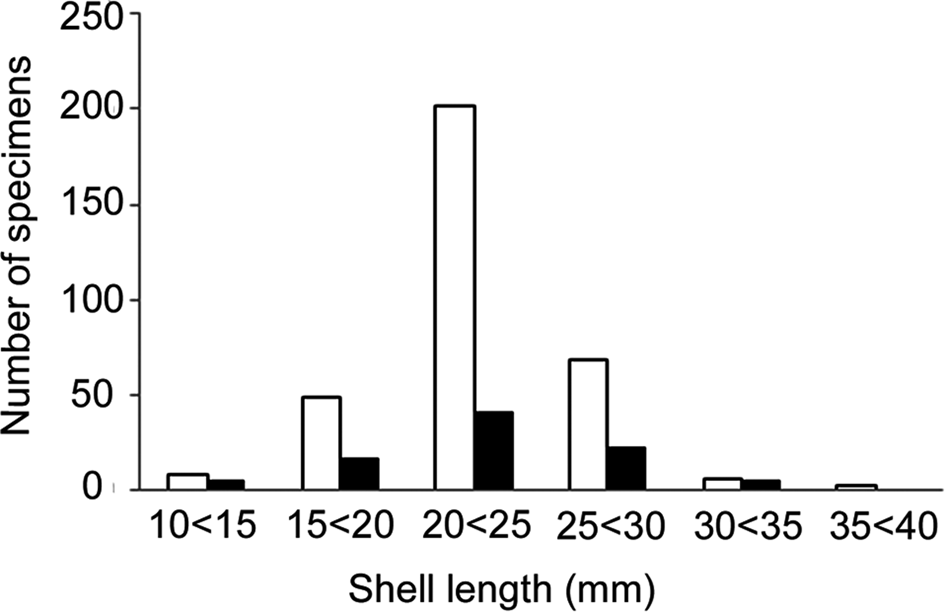
A total of 432 specimens were analysed and 94 of these were drilled, representing a DF of 21.8%. Drill holes were recorded in shell lengths ranging between 10 and 35 mm (Figure 3).
Size frequency distributions of drilled and undrilled articulated specimens of Darina solenoides. Drilled articulated specimens in black and undrilled articulated specimens in white.

Valve, site and size selectivity
There was no valve selectivity (P = 0.66) since drill holes were found on either the right (45) or left (49) valve. Average and distribution size differences between drilled and undrilled shells were also not statistically significant (t = 0.26; P = 0.79; Kolmogorov–Smirnov P = 0.51) (Table S2).
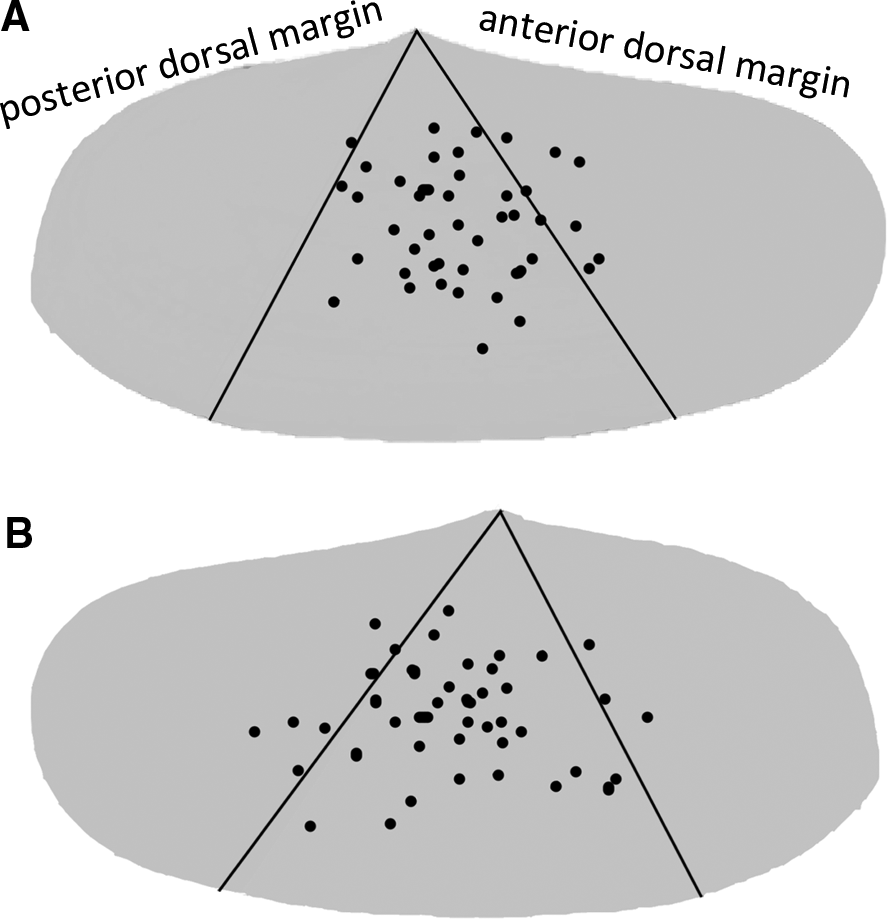
A highly site-stereotyped and concentrated pattern of drill hole distribution was revealed (P < 0.001, pooled data from both valves) since most of the drill holes were registered in the central area (zone 2) (Figure 4).
Sketch of Darina solenoides right (A) and left (B) valves showing the distribution of drill holes.

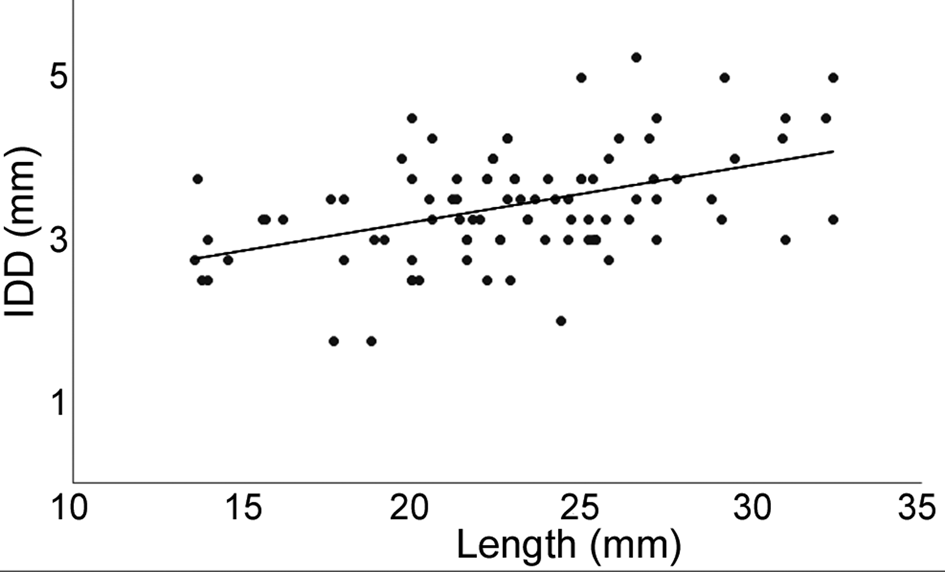
IDD (as proxy of predator size) and length of drilled prey were moderately and significantly correlated (r = 0.45; P = 0.0001) (Figure 5), indicating that larger naticids attacked larger clams, although most of the variability is not explained by this relationship. With respect to the potential size of the predator, within the sampled area 15 empty specimens of N. isabelleana were collected with lengths between 12.5 and 28.4 mm.
Relationship between inner drill hole diameter and prey size.

Field behaviour: foraging tracks and the escape of a clam from a moon snail
Other observations were made during the twilight hours and at low tide to compare the activity of naticids directly and under natural conditions. At low tide, traces left by this predator during subaerial hunting in the sand were observed (Figure 6A, B). Notocochlis isabelleana disturbed the sediments, leaving distinct trails as they ploughed through the sand by muscular contraction of their large foot. Predators exhibited hunting behaviour in poorly compacted sandy substrates with a considerable amount of water and closer to the tide line. Few traces were found in drier and more compact substrates. During the hunt, the gastropod shell was covered with wet sand (Figure 6C). Over the course of these field observations, a specimen of D. solenoides was registered travelling horizontally over the sediment and within the water film (Figure 6D, E), apparently escaping from a nearby predator (Figure 7). A video capturing this scene is provided in the supplementary material (Supplementary Video S3). The hunting of N. isabelleana followed an irregular, spiralling or undulating path along the substrate (Figure 8A, B).
Predator and prey activities in the intertidal zone. (A, B) Different trails made by naticids. (C) One naticid specimen covered with sand in a trail. (D, E) One specimen of Darina solenoides in two positions during its displacements, showing the foot and siphons.

(A–F) A sequence of photographs showing the escape of prey. Initial (A) and final (F) position of Darina solenoides (a) and a naticid specimen (b) registered during this persecution.

Foraging tracks sampled in the intertidal sand-flats at the Pozo Salado site (Río Negro Province) (A) in 2017 and (B) in 2019. Scale = 0.15 m.

The results of the measurements show that there is no difference between the 2017 and 2019 samples (area: H = 2.0, P = 0.15; track length: H = 0.64, P = 0.42) and the correlation analysis between track length and area shows a strong positive trend (r = 0.77, P < 0.001). However, although some of the paths observed are very long, they do not actually cover particularly large areas in the sediment. Of the total tracks photographed, 26% were from 0–1 m, 43.5% from 1–3 m, 21.7% from 3–5 m and 8.7% were over 5 m. On the longest trails (4–6 m), discontinued or even overlapping paths were observed.
Discussion
Signs of strategies in predator–prey interaction
Our results suggest that naticid predation on D. solenoides is stereotyped in terms of drill hole site selectivity, since the holes are non-randomly distributed over the valve surface and are concentrated in the central sector of the valves. However, they do not show a preference for the left or right valve. This behaviour coincides with that observed by other authors in both extant and fossil specimens (Kitchell et al., Reference Kitchell, Boggs, Kitchell and Rice1981; Kelley, Reference Kelley1988).
Regarding size, intermediate sizes (30–35 mm, Figure 3) are eaten by drilling which could be linked to cost–benefit and energy maximizing behaviours. Of interest is the positive size correlation between prey shell size and predator size, estimated by the drill hole diameter. Other authors (Ansell, Reference Ansell1960; Edwards & Huebner, Reference Edwards and Huebner1977; Kelley, Reference Kelley1988; Tull & Böhning-Gaese, Reference Tull and Böhning-Gaese1993; Dietl & Alexander, Reference Dietl and Alexander1995; Martinell et al., Reference Martinell, Domènech, Aymar and Kowalewski2010; Valdez & Araiza, Reference Valdez and Araiza2015; Klompmaker et al., Reference Klompmaker, Kowalewski, Huntley and Finnegan2017) have also documented this relationship in modern and fossil communities. The absence of incomplete drill holes, an indicator of failed attempts, may be due to the thin and fragile shells of Darina solenoides. A recent study of a predator–prey interaction between a naticid and a thin bivalve in the high-latitude White Sea also did not find any incomplete drill holes (Aristov & Varfolomeeva, Reference Aristov and Varfolomeeva2019). However, the direct observation of the escape of a clam during fieldwork, although unquantified, speaks of the complex mechanism that takes place in nature linked to how successful the predator may be. This escape would be a defensive strategy displayed by the prey, as would the possibility of repairing the damaged shell. In this respect, one D. solenoides specimen collected in the area (not included in the studied material) presented a repair scar of a small fracture to one of its valves, achieved with a greater deposition of carbonate in the inner part of the shell. Finally, considering the fact that burial depth is proportional to size, as observed by Ferrari et al. (Reference Ferrari, Lizarralde, Pittaluga and Albrieu2015) in this species, a larger size could also mean a third line of defence for D. solenoides, by burying deeper and making it more difficult for predators to capture them. Although burrowing depth is not available for N. isabelleana, maximum depths reported from field observations for other naticids range upwards of 15–25 cm (Visaggi et al., Reference Visaggi, Dietl and Kelley2013).
High drilling frequency values and the overall absence of incomplete and multiple drill holes, together with clear site selectivity, indicate that the naticid predator N. isabelleana was highly successful in attacking D. solenoides. However, this rate of success may be biased (underestimated, see below). Direct visual observations showed that D. solenoides is able to escape, indicating that the predator–prey interaction is a complex system which needs to be approached from various perspectives and using different types of analysis.
Mortality by moon snails and other potential predators
It is important to mention that the drilling frequency value of ~22% obtained in this study could be an underestimation, since it is widely known that among naticids, there are alternative methods of attack such as the suffocation of prey, which does not leave marks on the shells (Edwards & Huebner, Reference Edwards and Huebner1977; Frey et al., Reference Frey, Howard and Hong1986; Ansell & Morton, Reference Ansell and Morton1987; Visaggi et al., Reference Visaggi, Dietl and Kelley2013). Thus, it cannot be ruled out that the cause of death of the non-drilled articulated specimens collected in our study could have been, at least in part, attributed to these predators. As recommended by Visaggi et al. (Reference Visaggi, Dietl and Kelley2013), future work on alternative modes of predation by naticids, both in the laboratory and in the field, should focus on validating reported occurrences of such predation and identifying the different mechanisms that may be involved.
Moreover, the undamaged and articulated D. solenoides shells could be the result of the feeding activity of nassarid snails which also live in this environment. Nassarid snails are opportunistic carrion feeders that consume a wide range of dead animals (mostly crabs or other invertebrates and fish/fish spawn), but in the southern San José Gulf, Buccinanops cochlidium also predates, mainly on infaunal bivalves such as Tellina petitiana and Ensis macha (Averbuj et al., Reference Averbuj, Palomo, Brogger and Penchaszadeh2012). Other predators, such as birds, fish and crabs, generally break the valves while feeding (or ingest them whole), but among the exceptions are the oystercatchers, which can stab the shells without disarticulating the valves (Heppleston, Reference Heppleston1971).
With respect to birds, the most notable here are the migratory shorebirds which reach the northern Patagonian gulfs, and native oystercatchers. In the study area, during spring and summer there are migratory species such as Calidris canutus (red knot) and C. alba (sanderling) that nest in the northern hemisphere, and others that nest in Argentina, such as Charadrius falklandicus (two-banded plover) and Chionis alba (snowy sheathbill), which migrate in winter to the north. There is also an occasional presence of endemic Patagonian birds such as the Magellanic oystercatcher (Haematopus leucopodus). Although there are no studies on bird predation on D. solenoides for the study area, there are some data for other sites in Patagonia. Further south, for the Valdés peninsula, Musmeci et al. (Reference Musmeci, Hernández, Scolaro and Bala2013) indicate that migratory shorebirds consume specimens of D. solenoides that are 3–18 mm in length. In the Río Gallegos estuary, Argentina, Ferrari et al. (Reference Ferrari, Lizarralde, Pittaluga and Albrieu2015) studied the diet and feeding behaviour of the Magellanic oystercatcher (Haematopus leucopodus) during the post-reproductive period and concluded that the clam D. solenoides was the most consumed prey (77%), followed by the mussels Mytilus edulis platensis (16%) and polychaetes (less than 6%). This species showed a high selectivity for prey size, feeding on medium-sized bivalves (preferred size 24–36 mm within a range that varied from 2–42 mm). Bertellotti et al. (Reference Bertellotti, Pagnoni and Yorio2003) also mentions Larus dominicanus as predating on D. solenoides in the sandy intertidal of the San José Gulf; this species digs up its prey (‘foot paddling’) in the areas of the beach where the sand is covered by a thin layer of water.
With respect to fish, D. solenoides has been mentioned as a prey item in the diet of silversides (Odontesthes spp.) in the study region (Lapa, E. 2019, pers. com.). Thus, in addition to being eaten by naticids, D. solenoides also seems to be of great importance as a biological resource for other marine species including birds and fishes, indicating the need to apply suitable management strategies for its conservation.
Latitudinal gradients in drilling predation
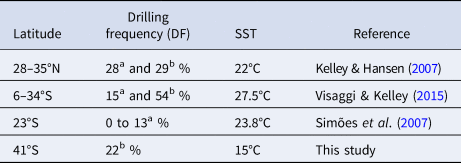
As mentioned earlier, there is very little information on latitudinal patterns of naticid predation in the southern hemisphere, and the few studies available were carried out further north (e.g. Brazil). Available information on this topic is summarized in Table 1.
Naticid drilling frequency values along the western Atlantic over the Americas

a Pooled.
b Taxon level.
It is interesting that for Brazil, from 6°–34°S, Visaggi & Kelley (Reference Visaggi and Kelley2015) found an equatorward increase in this kind of predation with maximum DF in northern Brazil (15% at ecological level and 54% at taxon level). These values contrast with other high values (28% at ecological level and 29% at taxon level) obtained by Kelley & Hansen (Reference Kelley, Hansen, Bromley, Buatois, Mángano, Genise and Melchor2007) for the Carolinian province (USA) at similar latitudes in the northern hemisphere. Temperature is known to affect metabolic rates, and therefore drilling times vary between species and latitudes; hence the drilling process can take from a couple of hours in naticids from tropical zones (Hughes, Reference Hughes1985) to more than a week in muricids in the Beagle Channel (Gordillo & Archuby, Reference Gordillo and Archuby2012) and up to 29 days (Harper & Peck, Reference Harper and Peck2003) in Antarctica. Nevertheless, drilling in the Río Grande ecoregion (29°3′S 47°47′W to 33°10′S 52°13′W) in southern Brazil is uncharacteristically low (<1%), and despite extremely warm conditions in north-eastern Brazil (28°C), drilling only peaks at 15% in that ecoregion (Visaggi & Kelley, Reference Visaggi and Kelley2015). Also in southern Brazil, Simões et al. (Reference Simões, Rodrigues and Kowalewski2007) found lower DFs (0–13%) for infaunal bivalves living at 23°S. Further south (41°S), the DF obtained in our study (22%) is invariably high if the latitudinal pattern proposed by Visaggi & Kelley (Reference Visaggi and Kelley2015) for the SW Atlantic is considered, but this average value is similar to that provided for naticid predation on the eastern coast of India (26%) by Pahari et al. (Reference Pahari, Mondal, Bardhan, Sarkar, Saha and Buragohain2016).
Biotic interactions are thought to be more important towards the tropics, whereas abiotic factors may be more influential in temperate habitats (Schemske et al., Reference Schemske, Mittelbach, Cornell, Sobel and Roy2009). Temperature fluctuates with latitude, and although a number of studies have demonstrated increased feeding with rising temperatures (e.g. Sawyer, Reference Sawyer1950; Hanks, Reference Hanks1952; Ansell, Reference Ansell1982a, Reference Ansell1982b), other variables related to seasonal or latitudinal differences in the intensity of predation by moon snails are still less understood.
In this respect, our results showed high DF at lower sea temperatures in comparison with the tropics, which raises the question about the existence of a broader latitudinal gradient beyond the coasts of Brazil. For instance, for Río Grande (Brazil, 32°S), Rios (Reference Rios2009) mentioned N. isabelleana as a predator of Tellina, while drilling by N. isabelleana is also documented for Mactra, Corbula and Glycymeris nearby in Quaternary fossil deposits of Uruguay (Lorenzo & Verde, Reference Lorenzo and Verde2004). Thus, in order to expand and improve our understanding of naticid drilling predation in the SW Atlantic, increased sampling is necessary along the coasts of Uruguay and all along the Argentine coast. Given that abiotic and biotic factors may have different impacts on the intensity of drilling along latitude, adding to the challenges of interpreting and understanding latitudinal trends (Visaggi & Kelley, Reference Visaggi and Kelley2015), it is imperative to include a wider range of variables to explain the observed patterns.
Beyond the work of Visaggi & Kelley (Reference Visaggi and Kelley2015) from Brazil and the results of this study, the SW Atlantic is still a vast, undersampled and underrepresented region, particularly Argentina, where there is no information at all on the incidence of naticid predation in coastal marine ecosystems. At the same time, latitudinal patterns in muricid drilling predation between 41°59′S 64°59′W and 47°45′S 65°47′W in Argentine Patagonia indicate that DF values were not correlated with either latitude or water temperature (Martinelli et al., Reference Martinelli, Gordillo and Archuby2013).
Local factors
Strong local environmental factors such as upwelling zones near Caleta de Los Loros and the study sector in Pozo Salado may have caused relatively high levels of predation, since highly productive areas tend to support high abundances of predators (Scott et al., Reference Scott, Sharples, Ross, Wang, Pierce and Camphuysen2010; Thompson et al., Reference Thompson, Sydeman, Santora, Black, Suryan, Calambokidis, Peterson and Bograd2012). Besides, a previous study carried out in the same region found that the muricid drilling gastropod Trophon geversianus showed larger sizes in comparison with neighbouring sites validating this area as an outlier site along a 14-degree latitudinal gradient (Malvé et al., Reference Malvé, Morán and Gordillo2020).
Further south, Martinelli et al. (Reference Martinelli, Gordillo and Archuby2013) also identify local factors that could be affecting the incidence of predation. They mention an exceptionally high value of 36% for one heavily anthropogenically impacted site (Playa Unión, 43°S), which is almost twice as high as the second highest value (19%) and more than 10 times higher than the lowest value (3%) along the study area. This leads to a reflection on the importance of local factors, which must be thoroughly analysed in each particular case.
Interestingly, the above example of Playa Unión and the case studied here both have monospecific predator–prey interactions in common, although for different reasons. In the case of Playa Unión, high DF values were attributed to anthropic pollution (Martinelli et al., Reference Martinelli, Gordillo and Archuby2013), while in our study they are related to a particular habitat, the intertidal flat, coupled with a marked oceanographic regime (Gagliardini & Rivas, Reference Gagliardini and Rivas2004). Despite these differences, in both cases only species with great adaptive capacity are able to survive. In Playa Unión, the most abundant prey species (92% of the total specimens found) was Crepidula cf. onyx, and its predator was the muricid Trophon geversianus. From this comparison it appears that monospecific relationships between predator–prey interactions may be of great importance for interpreting unusually high DF.
Turning our attention to the peculiarities of the study environment (Punta Mejillón-Pozo Salado–Caleta de Los Loros), it should be noted that this area is located at the southern limit of the Argentinean biogeographic province, extremely close to the transition zone (41–43°S) between the Argentinean and Magellan biogeographic provinces, making it difficult to delimitate since it varies seasonally (Balech & Ehrlich, Reference Balech and Ehrlich2008). The study area also lies on a 4-degree latitudinal overlap between the northern geographic distribution of Darina solenoides and the southern geographic range of N. isabelleana. Populations of D. solenoides towards the southern tip of South America, more than 1000 kilometres away from Caleta de Los Loros, are also subjected to predation by other naticid species (authors' personal observations). However, in the Magellan province the main predators of intertidal and shallow water bivalves are muricids (Gordillo, Reference Gordillo, Johnston and Haggart1998, Reference Gordillo2001; Gordillo & Archuby, Reference Gordillo and Archuby2012, Reference Gordillo and Archuby2014), while naticids probably represent a small proportion. This situation could probably be explained as a consequence of the dominance of gravel bottoms with large algae in the Magellan province (Balech & Ehrlich, Reference Balech and Ehrlich2008).
Also, much of the Atlantic coast of Argentine Patagonia is exposed to unusually harsh physical conditions and is characterized by high environmental heterogeneity (Yorio et al., Reference Yorio, Caille, Schwindt, Tagliorette, Esteves, Crespo, Arias, Harris, Zaixso and Boraso2015) coupled with an intricate coastal topography, which enable the establishment of local communities. Anyway, high environmental heterogeneity may be responsible for the great variability of intertidal communities over small spatial scales (sometimes in the order of metres) within the same area (Kelaher et al., Reference Kelaher, Castilla, Prado, York, Schwindt and Bortolus2007). Thus, the influence of striking local conditions, such as environmental variables and coastal topography, may play a crucial role in predator–prey interactions.
Foraging tracks on the sand
In relation to the Notocochlis isabelleana trails, previous studies on gastropods in other parts of the world have shown that these marks produced by the hunting behaviour of Naticidae have ecological and palaeontological significance (Fenton & Fenton, Reference Fenton and Fenton1931; Guerrero & Reyment, Reference Guerrero and Reyment1988; Savazzi & Reyment, Reference Savazzi and Reyment1989; Pahari et al., Reference Pahari, Mondal, Bardhan, Sarkar, Saha and Buragohain2016). For example, Pahari et al. (Reference Pahari, Mondal, Bardhan, Sarkar, Saha and Buragohain2016) studied the behaviour of Natica tigrina in intertidal molluscan communities on the eastern coast of India and observed a similar path to that observed for N. isabelleana in this study. They reported that naticids emerged from the sediments after the tide started receding and foraged on the sediment in random directions, searching for potential prey, perhaps by the use of chemical signals (Ziegelmeier, Reference Ziegelmeier1954 (aquarium experiments)). Savazzi & Reyment (Reference Savazzi and Reyment1989) also observed a similar forage activity in Natica gualteriana, although they noted that the capture-reaction of N. gualteriana is triggered by direct contact of the naticid with the prey's soft parts, or occasionally by contact with the shell of moving prey (never immobile prey), which suggests that chemotaxis is not involved, at least in this case. Also, through field and laboratory studies in the Bay of Panama, Hughes (Reference Hughes1985) observed that Natica unifasciata emerges from the substrate at low tide and makes tortuous search-paths oriented at random, detecting the prey either by the vibrations it makes or scent-trails.
Hunting behaviour of naticids observed in this study (and in the studies mentioned above) occurs at low tide, so foraging time is limited. Aquarium studies also suggest that naticids, like other gastropods, do not hunt during tidal submersion (Hughes, Reference Hughes1985).
Long periods of hunting during the day increase the risk of desiccation, overheating and bird predation (Hughes, Reference Hughes1985). Savazzi & Reyment (Reference Savazzi and Reyment1989) recorded field observations and noted that the foraging rate of an adult specimen of N. gualteriana was 3–5 mm s−1. If we assume the same behaviour for both species, it is possible to use these data to calculate the time taken by N. isabelleana to cover the average length track (2.5 m) observed in our study, resulting in 8.5 minutes. Pahari et al. (Reference Pahari, Mondal, Bardhan, Sarkar, Saha and Buragohain2016) described subaerial foraging for a period of 10 minutes, followed by burial in the sediment. Most of the tracks sampled in our study showed evidence that the snails were successful in hunting before or around 10 minutes. In line with this, on the longest tracks, whose length (~6 m) would indicate foraging lasting ~23–25 minutes, we observed discontinuities that would denote burial behaviour during foraging, as described by Pahari et al. (Reference Pahari, Mondal, Bardhan, Sarkar, Saha and Buragohain2016). Also, while Notocochlis isabelleana is hunting it covers itself with a considerable amount of wet sand, which adheres to the shell and possibly hinders surface locomotion, but at the same time contributes to the avoidance of high exposure conditions and hides the snail from possible predators.
Field observations suggest that it is not common for N. isabelleana to retrace or cross its own path, but in no case has any biological reason been outlined or suggested for this (Hughes, Reference Hughes1985; Savazzi & Reyment, Reference Savazzi and Reyment1989; Pahari et al., Reference Pahari, Mondal, Bardhan, Sarkar, Saha and Buragohain2016). Our photographs show some overlap of paths, and if we consider that vibration and/or olfactory stimuli are the main triggers of the hunting movement (Hughes, Reference Hughes1985), any retrace or overlapping of paths could be explained by the snail following its prey according to its movements or scent. However, new observations in the field or in aquariums would be necessary in order to explain the hunting behaviour of N. isabelleana in more detail.
Future studies
This study highlights the need to intensify ecological studies in Patagonia in order to obtain more precise information on life-history traits of native species. For this particular case, studies involving Naticidae (beyond taxonomic revisions) are practically non-existent. Added to this, other aspects of multidisciplinary interest are relevant, such as how these predator–prey interactions may be affected by oceanic acidification and climate change. For example, Miller (Reference Miller2013) provides insight into how changing seawater temperature might affect dog whelk feeding rates, and Kroeker et al. (Reference Kroeker, Sanford, Jellison and Gaylord2014) showed that a lower pH induces complex changes in chemoreception, behaviour and inducible defences, including altered cue detection and predator avoidance behaviours.
Special attention should be given to the tidal flats within this protected area, which is a zone that is often omitted from both terrestrial and marine conservation planning frameworks, despite the environmental and ecological role it plays and its contribution to energy exchange. Thus, integrated studies in connection with global climate change are also extremely important in marine protected areas, and taken together with the monitoring of this predator–prey relationship could soon provide data on how global changes may affect these communities.
Supplementary material
The supplementary material for this article can be found at https://doi.org/10.1017/S0025315420000892
Acknowledgements
The authors would like to thank Erik Lapa, Poroto, Enrique Morsán and Nestor Dieu for their help and hospitality during fieldwork. A special mention is given to Mariana Adami, who helped during sampling, and to Laura Catrin and Fernando G. Hartmann from the technical area of the Secretaría de Ambiente, Desarrollo Sustentable y Cambio Climático (SADSyCC) for their help and kindness during the process of obtaining the research permit. We are extremely grateful to María Eugenia López for kindly providing compiled information on Darina solenoides along with helpful comments and interesting discussions. We further acknowledge the editor Prof. J. Ruiz and two reviewers whose comments and suggestions improved the manuscript. This paper is dedicated to the memory of Aaron Swartz, a strong supporter of open access to academic journals, who died in the fight for making them freely available to the public.
Financial support
This study was conducted under the Protected reserve permit of the Secretaría de Ambiente, Desarrollo Sustentable y Cambio Climático (SADSyCC) of the Río Negro province (Resol. 2026-2019), and was funded by research grants from CONICET (PIP 11220170100080; PIP 11420110100238).