INTRODUCTION
Among marine ecosystems, coral reefs are particularly well known for their biodiversity, usually measured by numbers of coral and fish species (Bellwood & Hughes, Reference Bellwood and Hughes2001; Hughes et al., Reference Hughes, Bellwood and Connolly2002; Roberts et al., Reference Roberts, McClean, Veron, Hawkins, Allen, McAllister, Mittermeier, Schueler, Spalding, Wells, Vynne and Werner2002; Bellwood et al., Reference Bellwood, Hughes, Folke and Nyström2004; Hoeksema, Reference Hoeksema and Renema2007). These two prominent groups of organisms are important elements in two out of three major components of coral reef communities, i.e. suprabenthic reef fish and sessile epibenthic organisms that form the living cover and structure of reefs, such as corals, sponges and algae (Reaka-Kudla, 2007). The third component is formed by the cryptofauna, predominantly consisting of invertebrates dwelling in and on the (living) substrate, which forms the most species-rich group of coral reef communities (Austin et al., Reference Austin, Austin and Sale1980; Coles, Reference Coles1980; Gotelli & Abele, Reference Gotelli and Abele1983; Preston & Doherty, Reference Preston and Doherty1994; Reaka-Kudla, 2007; Plaisance et al., Reference Plaisance, Knowlton, Paulay and Meyer2009).
Although it is known that reef corals act as hosts for many endo- and episymbiotic organisms (Hutchings & Peurot-Clausade, 1988; Lewis & Snelgrove, Reference Lewis and Snelgrove1990; Paulay, Reference Paulay and Birkeland1997; Oigman-Pszczol & Creed, Reference Oigman-Pszczol and Creed2006; Stella et al., 2011), little information is available about how many species can be found on or in each coral host species (Nogueira, Reference Nogueira2003; Plaisance et al., Reference Plaisance, Knowlton, Paulay and Meyer2009; Stella et al., 2011). Furthermore, a coral may not only act as host when it is alive but it can also serve as substrate for some other species only when it is dead (Wilson, Reference Wilson1979; Kleemann, Reference Kleemann and Morton1990; Morton, Reference Morton and Morton1990; Hutchings et al., Reference Hutchings, Kiene, Cunningham and Donnelly1992; Moreno-Forero et al., Reference Moreno-Forero, Navas and Solano1998; Fonseca et al., Reference Fonseca, Dean and Cortés2006, López et al., Reference López, Bone, Rodríguez and Padilla2008).
Many coral reef biodiversity studies concentrate on corals, especially in the Indo-Pacific centre of maximum marine biodiversity with boundaries based on coral species numbers, which therefore is called the Coral Triangle (Hoeksema, Reference Hoeksema and Renema2007). Hence it is relevant to know how many symbiont species depend on each host species, and especially how many of these are host-specific. This implies that with the local loss of a particular coral species (e.g. Hoeksema & Koh, Reference Hoeksema and Koh2009; Van der Meij et al., Reference Van der Meij and Hoeksema2010; Hoeksema et al., Reference Hoeksema, Van der Land, Van der Meij, Van Ofwegen, Reijnen, Van Soest and De Voogd2011), a part of the associated assemblage is lost as well (Munday, Reference Munday2004). In order to get more insight in this subject, mushroom corals belonging to the Fungiidae (Scleractinia), a family of Indo-Pacific reef corals (Hoeksema, Reference Hoeksema1989), are used as a model group to study their role as hosts for other kinds of organisms, such as zooxanthellae, shrimps, crabs, copepods, barnacles, snails, bivalves, worms and so on. We present an overview of mushroom coral species and their associates as known from the literature and as observed during our own surveys. With that we analyse whether these associated species are mostly generalists or host-specific. Since the number of associated organisms may vary per host species, we want to find out if there is a relation between host morphology and the number of associated species and if there is a phylogenetic component herein. By using mushroom corals as a model group we aim to obtain more insight in the ecology and evolution of the associated biodiversity of corals.
MATERIALS AND METHODS
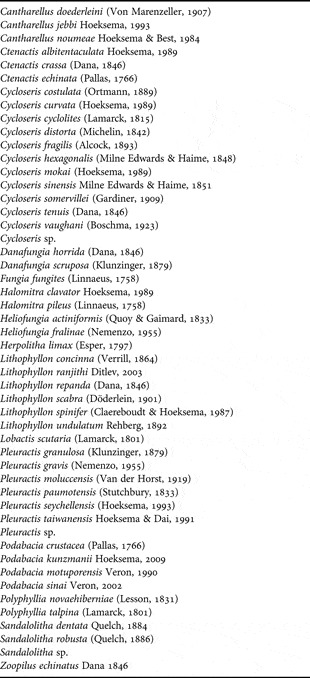
The identity of the host corals (Table 1) is based on the taxonomic revision of the Fungiidae by Hoeksema (Reference Hoeksema1989) and subsequent studies in which new mushroom coral species were described (Veron, Reference Veron1990, Reference Veron2002; Hoeksema & Dai, Reference Hoeksema and Dai1991; Hoeksema, Reference Hoeksema1993a, Reference Hoeksemab, Reference Hoeksema2009; Ditlev, Reference Ditlev2003). The classification has been adapted after a recent molecular phylogenetic study of the Fungiidae (Gittenberger et al., Reference Gittenberger, Reijnen and Hoeksema2011). The results of that study enable phylogenetic comparisons of symbiont–host associations. Coral species that may belong to the Fungiidae according to molecular studies, but which are still classified with the Siderastreidae (Benzoni et al., Reference Benzoni, Stefani, Stolarski, Pichon, Mitta and Galli2007), i.e. Psammocora explanulata Van der Horst, 1922, and Coscinaraea wellsi Veron and Pichon, 1980, have not been included as hosts in the present study because formally they do not yet belong to the Fungiidae and because insufficient information on their associated fauna is available.
Mushroom coral host species (Fungiidae, N = 50) in the revised classification based on molecular analyses (Gittenberger et al., Reference Gittenberger, Reijnen and Hoeksema2011).

The associated organisms included in this study consist of zooxanthellae (Symbiodinium spp.), crustaceans (copepods, barnacles, gall crabs and shrimps), molluscs (mytilid bivalves, epitoniid snails and coralliophilid snails) and fish. Data were obtained from the literature and from our own observations during fieldwork in the Coral Triangle countries Indonesia (South Sulawesi in 1994–1998, Ambon in 1996, Bali in 2001, East Kalimantan in 2003, Thousand Islands off Jakarta in 2005, Raja Ampat in 2007, Ternate in 2009), the Philippines (Cebu in 1999) and Malaysia (Semporna in 2010). Eventually, the numbers of the largest and most commonly represented associated taxa are plotted on a cladogram of the Fungiidae (Gittenberger et al., Reference Gittenberger, Reijnen and Hoeksema2011) in order to analyse the evolutionary and ecomorphological traits of coral hosts and their associated fauna.
RESULTS
Zooxanthellae (Symbiodinium)
Little specific information is available about zooxanthellae (symbiotic dinoflagellates (Dinophyceae) belonging to the genus Symbiodinium (Freudenthal, 1962)) that live in Fungiidae. They have been indicated as species, clades, or sub-clades (Pochon & Gates, Reference Pochon and Gates2010), although also preference is given over Symbiodinium types instead of clades (Cooper et al., Reference Cooper, Ulstrup, Dandan, Heyward, Kuhl, Muirhead, O'leary, Ziersen and Van Oppen2011). It is unclear how many species of Symbiodinium exist, although four species have been formally described based on morphological characters (Baker, Reference Baker2003). Five types have been recognized to reside in scleractinian corals, types A, B, C, D and F (Baker, Reference Baker2003; Knowlton & Rohwer, Reference Knowlton and Rohwer2003). Cycloseris vaughani and Lobactis scutaria at Hawaii are known to host Symbiodinium type C (Weiss et al., Reference Weis, Reynolds, DeBoer and Krupp2001; LaJeunesse et al., Reference LaJeunesse, Bhagooli, Hidaka, DeVantier, Done, Schmidt, Fitt and Hoegh-Guldberg2004a). In a L. scutaria population introduced in Jamaica (Caribbean) also type C has been found (LaJeunesse et al., Reference LaJeunesse, Lee, Bush and Bruno2005). Various Fungiidae from the Great Barrier Reef have also been reported with type C: Ctenactis echinata, Danafungia horrida, Fungia fungites, Heliofungia actiniformis, Herpolitha limax (recorded as H. weberi), Lithophyllon undulatum, Pleuractis granulosa, P. paumotensis, Podabacia crustacea, Polyphyllia talpina and Sandalolitha robusta (LaJeunesse et al., Reference LaJeunesse, Thornhill, Cox, Stanton, Fitt and Schmidt2004b). Compared to a locality in southern Japan two of these species, i.e. Danafungia horrida (listed as Fungia danai) and Lobactis scutaria, carry Symbiodinium type C, whereas Sandalolitha robusta has been found with types C and D (LaJeunesse et al., Reference LaJeunesse, Thornhill, Cox, Stanton, Fitt and Schmidt2004b), which is the only exception known so far. Type D in particular has been reported to be more resistant to elevated temperatures than the others (Stat & Gates, Reference Stat and Gates2011). When coral bleaching is induced by heat, a different symbiont type may be found in the coral than before the bleaching occurred (Knowlton & Rohwer, Reference Knowlton and Rohwer2003; Coffroth & Santos, Reference Coffroth and Santos2005). This may explain why some species of mushroom corals are less sensitive to bleaching than others on a particular reef and also why bleaching susceptibility may vary geographically and among reef zones within fungiid species (Hoeksema, Reference Hoeksema1991a; Hoeksema & Matthews, Reference Hoeksema and Matthews2011). Furthermore, partial bleaching in mushroom corals may also result from viruses that attack Symbiodinium in certain mushroom corals, although it is not yet clear how host-specific these viruses are (Cervino et al., Reference Cervino, Hayes, Goreau and Smith2004, Reference Cervino, Thompson, Gomez-Gil, Lorence, Goreau, Hayes, Winiarski-Cervino, Smith, Hughen and Bartels2008).
Acoel flatworms (Convolutidae)
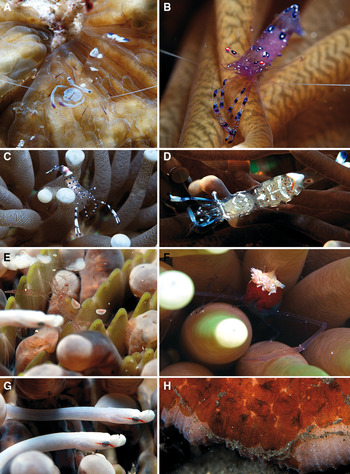
Apparently, acoel flatworms (e.g. Waminoa spp.) that live in association with stony corals (Scleractinia) and soft corals (Alcyonacea) have just recently started to become studied (Ogunlana et al., Reference Ogunlana, Hooge, Tekle, Benayahu, Barneah and Tyler2005; Haapkylä et al., 2010; Matsushima et al., Reference Matsushima, Fujiwara and Hatta2010; Rawlinson et al., Reference Rawlinson, Gillis, Billings and Borneman2011; Wijgerde et al., Reference Wijgerde, Spijkers, Verreth and Osinga2011). These flatworms themselves are host to zooxanthellae, forming a three party symbiosis with the inclusion of the coral host (Barneah et al., Reference Barneah, Brickner, Hooge, Weis, LaJeunesse and Benayahu2007a, Reference Barneah, Brickner, Hooge, Weis and Benayahub). Despite their striking appearance, virtually nothing is known about how many species exist and how host-specific they are. During recent fieldwork in Indonesia (Raja Ampat, West Papua; Ternate, northern Moluccas) and Malaysia (Semporna, eastern Malaysia) specimens of at least two Waminoa species were observed in association with Cycloseris costulata (Figure 1H), C. sinensis, Heliofungia actiniformis, Lithophyllon scabra, Pleuractis gravis and P. moluccensis.
Associated organisms on mushroom corals at Raja Ampat Islands, West Papua, Indonesia (November 2007). (A–F) Pontoniine shrimps: (A) Ancylomenes magnificus on Cycloseris costulata; (B) A. sarasvati on Heliofungia actiniformis; (C) A. venustus on H. actiniformis; (D) A. holthuisi on H. actiniformis; (E) Hamopontonia corallicola on H. actiniformis; (F) Cuapates kororensis on H. actiniformis; (G) pipefish Siokunichtys nigrolineatus on H. actiniformis; (H) acoel flatworm Waminoa sp. on C. costulata.

Copepods (Anchimolgidae)
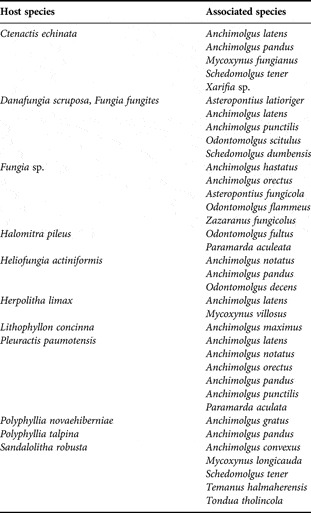
Coral-associated copepods form an important component of the cryptofauna of coral reefs (Preston & Doherty, Reference Preston and Doherty1994). They have been reported from several fungiid host species in New Caledonia (Humes, Reference Humes1973, Reference Humes1996, Reference Humes1997; Kim, Reference Kim2003), the Moluccas (Humes, Reference Humes1978, Reference Humes1979, Reference Humes1997; Humes & Dojiri, Reference Humes and Dojiri1983; Kim, Reference Kim2007) and Madagascar (Humes & Dojiri, Reference Humes and Dojiri1983; Kim Reference Kim2010). The following 26 fungiid-associated copepod species have been recorded: Anchimolgus convexus Humes, Reference Humes1978; A. gratus Humes, Reference Humes1996; A. hastatus Kim, Reference Kim2007; A. latens Humes, Reference Humes1978; A. maximus Kim, Reference Kim2003; A. notatus Humes, Reference Humes1978; A. orectus Humes, Reference Humes1978; A. pandus Humes, Reference Humes1978; A. punctilis Humes, Reference Humes1978; Asteropontius fungicola Kim, Reference Kim2007; A. latioriger Kim, Reference Kim2010; Mycoxynus fungianus Humes, Reference Humes1978; M. longicauda Humes, Reference Humes1973; M. villosus Humes Reference Humes1979; Odontomolgus decens Humes, Reference Humes1978; O. flammeus Kim, Reference Kim2007; O. fultus Humes, Reference Humes1978; O. scitulus Humes, Reference Humes1973; Paramarda aculeata Humes, Reference Humes1978; Schedomolgus dumbensis Kim, Reference Kim2003; S. tener (Humes, Reference Humes1973); Temanus halmaherensis Humes, Reference Humes1997; Tondua tholincola Humes, Reference Humes1997; Xarifia sp.; and Zazaranus fungicolus Humes & Dojiri, Reference Humes and Dojiri1983. Anchimolgus is with nine species the most species-rich genus in this list.
A list of 11 mushroom corals with their known associated copepod fauna suggests that many copepod species are host-specific (Table 2). There are two copepod species with four recognized hosts: Anchimolgus pandus and Schedomolgus tener. Four copepods have been recorded from two host species: A. notatus, A. punctilis, Paramarda aculata and Schedomolgus tener. However, the list may not be complete because only a few localities have been investigated. Of these localities, the Moluccas is the only one inside the centre of maximum species richness for mushroom corals (Hoeksema, Reference Hoeksema and Renema2007), which implies that more species and more copepod–coral associations can be discovered. Pleuractis paumotensis has the richest copepod fauna, consisting of six species, succeeded by Ctenactis echinata and Sandalolitha robusta, each with five associated copepod species (Table 2; Figure 2).
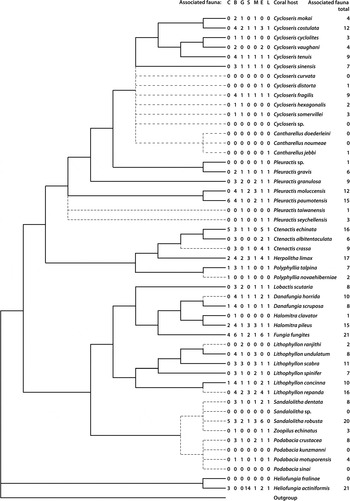
Phylogeny reconstruction of the Fungiidae (after Gittenberger et al., Reference Gittenberger, Reijnen and Hoeksema2011), with an indication of numbers of associated fauna per mushroom coral species. Only well investigated taxa are included, while taxa with low or uncertain numbers of associated species are excluded. C, copepods; B, barnacles; G, gall crabs; S, shrimps; M, mytilid bivalves; E, epitoniid snails; L, Leptoconchus snails.

Mushroom coral hosts and their associated copepods (based on references mentioned in the text).

Coral barnacles (Pyrgomatidae)
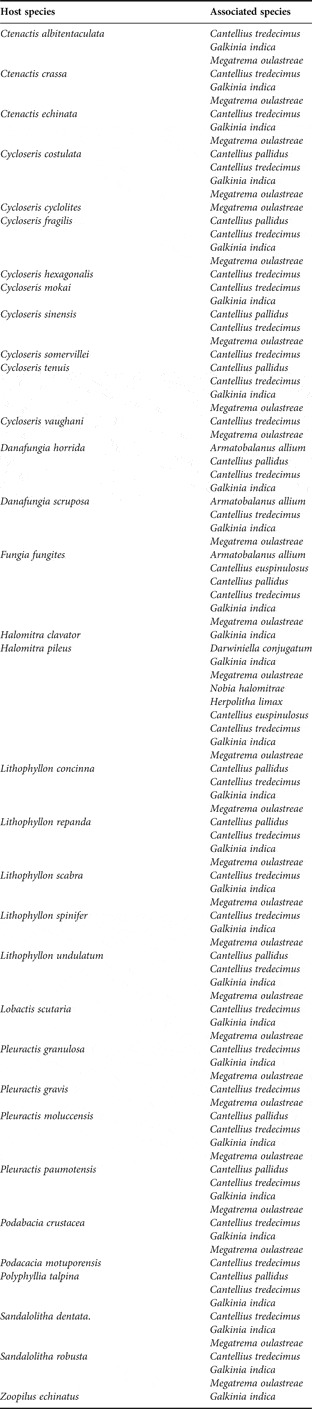
Despite earlier overview studies on coral-inhabiting barnacles belonging to the Pyrgomatidae (Hiro, Reference Hiro1938; Ross & Newman, Reference Ross and Newman1973, Reference Ross and Newman2002; Foster, Reference Foster, Morton and Tseng1980; Soong & Chang, Reference Soong and Chang1983; Anderson, Reference Anderson1992; Ogawa & Matzuki, Reference Ogawa and Matsuzaki1992), only little and scattered information is available on cirripeds in mushroom corals. Altogether, 34 mushroom coral species have been recorded as host of a total of only eight barnacles (Table 3): Armatobalanus allium (Darwin, 1854); Cantellius euspinulosus (Broch, 1931); C. pallidus (Broch, 1931); C. tredecimus (Kolosvary, 1947); Darwiniella conjugatum (Darwin, 1854); Galkinia indica (Annandale, 1924); Megatrema oulastreae (Utinomi, 1962); and Nobia halomitrae (Kolosváry, Reference Kolosváry1948).
Mushroom coral hosts and their associated barnacles (based on references mentioned in the text).

Annandale (Reference Annandale1928) reported Balanus arcuatus (= Armatobalanus allium) from Fungia fungites (as F. patella Ellis & Solander, 1786), Danafungia horrida (as F. danai Milne Edwards & Haime, 1851) and D. scruposa (as F. corona Döderlein, 1901), whereas Hiro (Reference Hiro1935) recorded Cantellius pallidus from the attached mushroom coral Lithophyllon undulatum. Furthermore, Kolosváry (Reference Kolosváry1948) described Darwiniella conjugatum (= Pyrgoma conjugatum) forma halomitrae from a juvenile Halomitra sp., which is most likely the common species H. pileus. In a review, Ogawa & Matzuki (Reference Ogawa and Matsuzaki1992) refer to Fungiidae as hosts for barnacles: Cantellius euspinulosus in Herpolitha sp., C. pallidus in Lithophyllon undulatum (as Podabacia lobata Van der Horst, 1921), Galkina indica (= Creusia indica) in Lithophyllon undulatum (as L. lobata (Van der Horst, 1921)) and Podabacia crustacea, and Nobia halomitrae in Halomitra sp., the latter referring to Kolosváry's P. conjugatum f. halomitrae, which is actually Darwiniella conjugatum.
A recent study on barnacles inhabiting mushroom corals from Indonesia (De Jong, Reference De Jong1995) concerned four cirriped species that revealed clear host preferences, including two new records of mushroom coral associates, i.e. Cantellius tredecimus and Megatrema oulastreae. Additional recent records were obtained by Poltarukha & Dautova (Reference Poltarukha, Dautova, Britayev and Pavlov2007) in Vietnam, concerning Cantellius euspinulosus from Fungia fungites and Galkinia indica from Fungiidae. According to these authors, referring to the publication in Russian by Galkin (Reference Galkin1986), C. euspinulosus has to be considered a senior synonym of C. pallidus. In general, the coral-inhabiting barnacles show little host-specificity (Table 3). Fungia fungites is recorded as host for six barnacle species, whereas other mushroom coral species are known to have at most four cirriped associates (Table 3; Figure 2).
Coral gall crabs (Cryptochiridae)
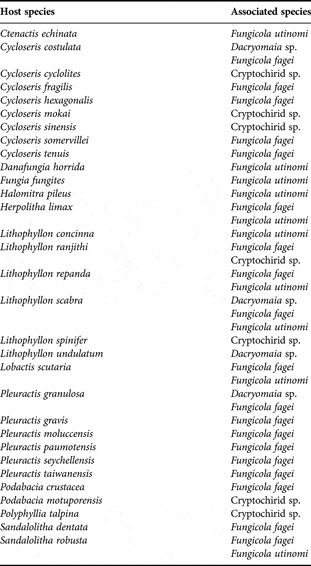
Few coral gall crab studies are available in which the mushroom coral hosts are identified at species level, i.e. the reports by Fize & Serène (Reference Fize and Serène1956, Reference Fize and Serène1957) and Takeda & Tamura (Reference Takeda and Tamura1979, Reference Takeda and Tamura1981). Takeda & Tamura (Reference Takeda and Tamura1979) recorded three gall crabs species from the Fungiidae: Fungicola fagei (Fize & Serène, Reference Fize and Serène1956), F. utinomi (Fize & Serène, Reference Fize and Serène1956) and Pseudocryptochirus ishigakiensis Takeda & Tamura, Reference Takeda and Tamura1979. The latter, which was associated with Lithophyllon repanda, became synonymized with F. utinomi by Kropp (Reference Kropp1990) who only recognized two coral gall crab associates with Fungiidae, F. fagei and F. utinomi.
Many new associations are recorded and extensively discussed by Van der Meij et al. (unpublished results), who recognize at least one other species, Dacryomaia sp. Possibly more gall crab species are associated with mushroom corals, but for now we refer to the so far unidentified material as cryptochirid sp. In general, the three gall crab species found in 31 mushroom coral species are not very host-specific (Table 4). Lithophyllon scabra has a record with a maximum of three associated gall crab species (Table 4; Figure 2).
Mushroom coral hosts and their associated gall crabs (based on references mentioned in the text).

Coral-dwelling shrimps (Hippolytidae and Palaemonidae)
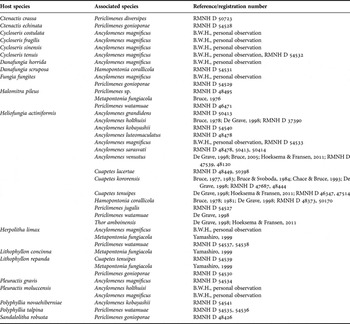
Although mushroom corals are known to host shrimp species, information on shrimp species that live in association with fungiids is still scattered. In the present study, a total of 19 mushroom coral hosts and 18 associated shrimps species has been listed (Table 5; Figure 1A–F). These include one hippolytid shrimp, the circumtropical species Thor amboinensis (De Man, 1888), which has a wide range of anthozoan hosts (Fransen, Reference Fransen1989; Guo et al., Reference Guo, Hwang and Fautin1996), and the pontoniine shrimp species Ancylomenes grandidens (Bruce, Reference Bruce2005); A. holthuisi (Bruce, 1969); A. kobayashii (Okuno & Nomura, Reference Okuno and Nomura2002); A. luteomaculatus Okuno & Bruce, Reference Okuno and Bruce2010; A. magnificus (Bruce, 1979); A. sarasvati (Okuno, 2002); A. venustus (Bruce, 1989); Cuapetes kororensis (Bruce, 1969); C. lacertae (Bruce, 1992); C. tenuipes (Borradaile, 1898); Hamopontonia corallicola Bruce, 1970; Metapontonia fungiacola Bruce, 1967; Periclimenes diversipes Kemp, 1922; P. gonioporae Bruce, 1989; P. jugalis Holthuis, 1952; P. watamuae Bruce, Reference Bruce1976; and Periclimenes sp.
Mushroom coral hosts and their associated shrimps as reported in previous works and present observations. B.W.H., B.W. Hoeksema (photographic record); RMNH, Rijksmuseum van Natuurlijke Historie (NCB Naturalis collection).

Bruce (Reference Bruce1985) and Yamashiro (Reference Yamashiro1999) report on four mushroom coral hosts for Metapontonia fungiacola, whereas De Grave (Reference De Grave1998) and Hoeksema & Fransen (Reference Hoeksema and Fransen2011) together report on seven shrimp species recorded from Heliofungia actiniformis, a mushroom coral with extremely long tentacles: Ancylomenes sarasvati, A. venustus, Cuapetes kororensis, C. tenuipes, Hamopontonia corallicola, Periclimenes watamuae and Thor amboinensis. In the present overview based on previous records and our own observations (Figure 1B–F) a total of 14 shrimp species is recorded from that host species (Table 5; Figure 2). Of the seven species presently recorded as new for the Fungiidae, Ancylomenes kobayashii was previously only recorded from Polyphyllia novaehiberniae (see Okuno & Nomura, Reference Okuno and Nomura2002). Ancylomenes holthuisi has previously also been reported from H. actiniformis (see Fransen, Reference Fransen1989) but this record has been revised and concerns A. venustus (see De Grave, Reference De Grave1998; Okuno & Bruce, Reference Okuno and Bruce2010; Figure 1C). Various additional records of shrimps that have been found in associations with mushroom corals have been reported by Fransen (Reference Fransen1989, Reference Fransen and Hoeksema2004, Reference Fransen, Hoeksema and Van der Meij2008, Reference Fransen, Hoeksema and Van der Meij2010).
Mytilid bivalves (Mytilidae)
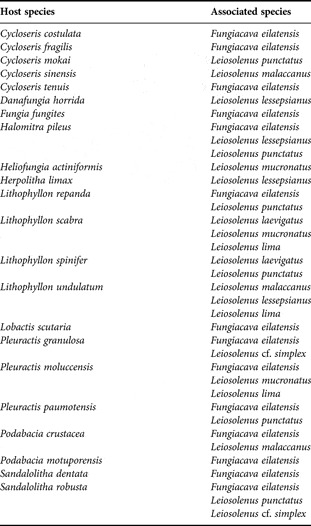
Boring mussels (Mytilidae: Lithophaginae) that live in mushroom corals belong to two genera, Fungiacava and Leiosolenus (Hoeksema & Achituv, Reference Hoeksema and Achituv1993; Hoeksema & Kleemann, Reference Hoeksema and Kleemann2002; Kleemann & Hoeksema, Reference Kleemann and Hoeksema2002; Hoeksema & Gittenberger, Reference Hoeksema and Gittenberger2008). Leiosolenus is considered a subgenus in Lithophaga in some studies (Wilson, Reference Wilson1979; Kleemann & Hoeksema, Reference Kleemann and Hoeksema2002) and a separate genus in others (e.g. Wilson, Reference Wilson1985; Owada, Reference Owada2007; Owada & Hoeksema, Reference Owada and Hoeksema2011). There is only a single species of Fungiacava, i.e. F. eilatensis Goreau et al., 1968, whereas there are at least seven Leiosolenus species living in mushroom corals: Leiosolenus laevigatus (Quoy & Gaimard, 1835); L. lessepsianus (Vaillant, 1865); L. lima (Jousseaume in Lamy, 1919); L. malaccanus (Reeve, 1857); L. mucronatus (Philippi, 1846); L. punctatus (Kleemann & Hoeksema, Reference Kleemann and Hoeksema2002); and L. cf. simplex (Iredale, 1939). Together they have been found in 22 host species (Table 6).
Mushroom coral hosts and their associated mytilid bivalves (boring mussels) (based on references mentioned in the text).

Morphologically Fungiacava is very distinct from Leiosolenus, but phylogenetically not (Owada & Hoeksema, Reference Owada and Hoeksema2011). There appears to be little host-specificity among the mytilid species found, since some species also occur in corals belonging to other scleractinian families (Kleemann, Reference Kleemann1980, Reference Kleemann and Morton1990, Reference Kleemann1994, Reference Kleemann1995; Morton, Reference Morton and Morton1990; Mokady et al., Reference Mokady, Rozenblatt, Graur and Loya1994). Only two species are known to live exclusively in mushroom corals, Fungiacava eilatensis and Leiosolenus punctatus (Hoeksema & Kleemann, Reference Hoeksema and Kleemann2002; Kleemann & Hoeksema, Reference Kleemann and Hoeksema2002). Four mushroom coral species are host for a maximum of three mytilids: Halomitra pileus, Lithophyllon scabra, Pleuractis moluccensis and Sandalolitha robusta (Table 6; Figure 2).
Wentletraps (Epitoniidae)
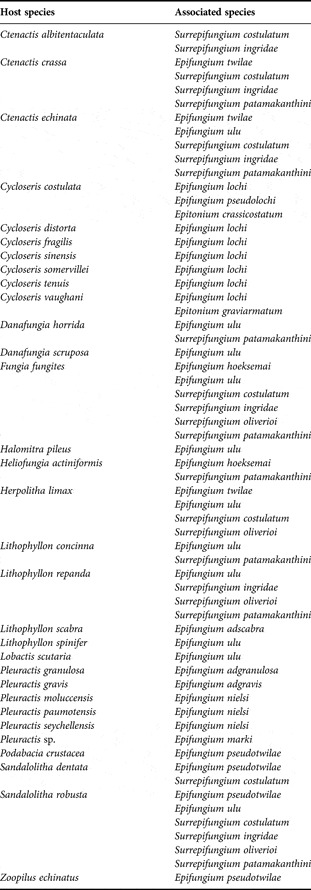
Wentletraps are epibiotic gastropods that are generally known as parasites of corals, sea anemones and other anthozoans (Gittenberger et al., Reference Gittenberger, Goud and Gittenberger2000; Gittenberger, Reference Gittenberger2003; Gittenberger & Gittenberger, Reference Gittenberger and Gittenberger2005; Kokshoorn et al., Reference Kokshoorn, Goud, Gittenberger and Gittenberger2007; Hoeksema & Gittenberger, Reference Hoeksema and Gittenberger2008). Seventeen species of wentletraps belonging to three genera have been recorded from 31 Fungiidae (Table 7): Epifungium adgranulosa Gittenberger & Gittenberger, Reference Gittenberger and Gittenberger2005; E. adgravis Gittenberger & Gittenberger, Reference Gittenberger and Gittenberger2005; E. adscabra Gittenberger & Gittenberger, Reference Gittenberger and Gittenberger2005; E. hoeksemai (Gittenberger & Goud, 2000); E. lochi (Gittenberger & Goud, 2000); E. marki Gittenberger & Gittenberger, Reference Gittenberger and Gittenberger2005; E. nielsi Gittenberger & Gittenberger, Reference Gittenberger and Gittenberger2005; E. pseudolochi Gittenberger & Gittenberger, Reference Gittenberger and Gittenberger2005; E. pseudotwilae Gittenberger & Gittenberger, Reference Gittenberger and Gittenberger2005; E. twilae (Gittenberger & Goud, 2000); E. ulu (Pilsbry, 1921); Epitonium crassicostatum Gittenberger & Gittenberger, Reference Gittenberger and Gittenberger2005; E. graviarmatum Gittenberger & Gittenberger, Reference Gittenberger and Gittenberger2005; Surrepifungium costulatum (Kiener, 1838); S. ingridae (Gittenberger & Goud, 2000); S. oliverioi (Bonfitto & Sabelli, 2001); and S. patamakanthini Gittenberger & Gittenberger, Reference Gittenberger and Gittenberger2005. No other coral family is known to have as many species of epitoniid associates. The Dendrophylliidae host four species and the Euphylliidae only one species (Gittenberger, Reference Gittenberger2003; Gittenberger & Gittenberger, Reference Gittenberger and Gittenberger2005). Eleven species of the genus Epifungium are known to live as epibiont on the underside of mushroom corals, whereas four species of Surrepifungium live on the bottom surface or buried in the sediment underneath the corals. The species of the latter genus appear less host-specific than those of the first genus. Two Epitonium species have been found in association with Fungiidae, but both were only represented by an empty shell underneath the possible host coral (Gittenberger & Gittenberger, Reference Gittenberger and Gittenberger2005). Previous records of Epitonium in association with mushroom coral hosts concern misidentifications (e.g. Yamashiro, Reference Yamashiro1990) prior to the revision by Gittenberger & Gittenberger (Reference Gittenberger and Gittenberger2005). Two fungiids are each hosting six wentletrap species, i.e. Fungia fungites and Sandalolitha robusta, whereas the other mushroom coral species have five or fewer associated species (Table 7; Figure 2).
Mushroom coral hosts and their associated epitoniid snails (wentletraps) (based on references mentioned in the text).

Coralliophilid snails (Coralliophilidae)
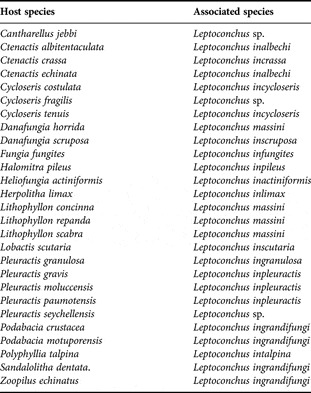
Leptoconchus snails (Coralliophilidae) are endosymbiotic gastropods dwelling inside scleractinian corals (Massin, Reference Massin1988). Their taxonomy appears difficult because the species show very few distinctive morphological characters, with shells that are generally white and very thin. The most distinct morphological characters concern the shape and position of the burrows and their openings inside the host coral (Massin, Reference Massin1988; Massin & Dupont, Reference Massin and Dupont2003). Only with the help of molecular techniques it has become easier to distinguish species and their host-specificity (Gittenberger & Gittenberger, Reference Gittenberger and Gittenberger2011). This implies that when the host species is known, the Leptoconchus species can usually also be identified. Therefore, the record of L. striatus Rüppell, 1835, from just Fungia cannot be confirmed (Bouillon et al., Reference Bouillon, Massin and Van Goethem1983). The Leptoconchus specimens encountered in Cantharellus jebbi (see Hoeksema, Reference Hoeksema1993a), in Cycloseris fragilis (see Massin & Dupont, Reference Massin and Dupont2003), and in Pleuractis seychellensis (see Hoeksema, Reference Hoeksema1993b) could not be identified because no tissue was available for molecular analysis. Each mushroom coral host has only one associated Leptoconchus species (Table 8; Figure 2).
Mushroom coral hosts and their associated coralliophilid snails (based on references mentioned in the text).

A total of 27 mushroom coral hosts has been found with 14 associated Leptoconchus species, eight of which are very host-specific and therefore named after their host (Table 8): L. inactiniformis Gittenberger & Gittenberger, Reference Gittenberger and Gittenberger2011; L. inalbechi Gittenberger & Gittenberger, Reference Gittenberger and Gittenberger2011; L. incrassa Gittenberger & Gittenberger, Reference Gittenberger and Gittenberger2011; L. incycloseris Gittenberger & Gittenberger, Reference Gittenberger and Gittenberger2011; L. infungites Gittenberger & Gittenberger, Reference Gittenberger and Gittenberger2011; L. ingrandifungi Gittenberger & Gittenberger, Reference Gittenberger and Gittenberger2011; L. ingranulosa Gittenberger & Gittenberger, Reference Gittenberger and Gittenberger2011; L. inlimax Gittenberger & Gittenberger, Reference Gittenberger and Gittenberger2011; L. inpileus Gittenberger & Gittenberger, Reference Gittenberger and Gittenberger2011; L. inpleuractis Gittenberger & Gittenberger, Reference Gittenberger and Gittenberger2011; L. inscruposa Gittenberger & Gittenberger, Reference Gittenberger and Gittenberger2011; L. inscutaria Gittenberger & Gittenberger, Reference Gittenberger and Gittenberger2011; L. intalpina Gittenberger & Gittenberger, Reference Gittenberger and Gittenberger2011; and L. massini Gittenberger & Gittenberger, Reference Gittenberger and Gittenberger2011.
Fish (Syngnathidae)
The pipefish Siokunichthys nigrolineatus Dawson, Reference Dawson1983, appears to be strictly associated with one species of mushroom coral, Heliofungia actiniformis. All records are from the Coral Triangle, mainly Indonesia, the Philippines and Papua New Guinea, which is where most of the host coral's distribution-range is located. According to its original description the fish has a black diagonal stripe at each side of its head (hence its name) and that its type material has been collected from Fungia echinata (= Ctenactis echinata) and Fungia spp. (Dawson, Reference Dawson1983). However, all specimens photographed and collected by us have red lateral stripes and occurred in between the long tentacles of H. actiniformis corals (Figure 1G). A later publication confirmed that the fish occurs on Fungia sp. (perhaps C. echinata, but its photographs clearly indicate that the host concerns H. actiniformis; see Phillips & Pullin, Reference Phillips and Pullin1987). However, no coral hosts were collected for further examination. Subsequent publications are also not specific about the host, indicating ‘mushroom corals such as Heliofungia actiniformis’ (Kuiter, Reference Kuiter2000 p. 171, Reference Kuiter2009 p. 269). A published picture of another pipefish, Corythoichthys polynatus Dawson, 1977, shows an individual situated on top of a mushroom coral, Ctenactis echinata, but other illustrated specimens of the same species appear on top of various other kinds of substrates, which indicates that there is no host-specificity (Kuiter, Reference Kuiter2000 p. 119, Reference Kuiter2009 p. 203). There are also records on pygmy seahorses that have been seen moving over fungiids (Lourie & Kuiter, Reference Lourie and Kuiter2008) but these observations are probably incidental and not based on associations (Reijnen et al., Reference Reijnen, Van der and Van Ofwegen2011). Coral-dwelling gobies are known to be host-specific, but so far no species have been recorded from Fungiidae (Munday et al., Reference Munday, Jones and Caley1997, Reference Munday, Van Herwerden and Dudgeon2004).
Other taxa
There are various taxa with species that are usually associated with scleractinians (dead or alive) about which little or no information is available with regard to mushroom corals, such as endolithic cyanobacteria imbedded in the skeleton (Kühl et al., Reference Kühl, Holst, Larkum and Ralph2008), polychaetes (Hutchings et al., Reference Hutchings, Kiene, Cunningham and Donnelly1992; Martin & Britayev, Reference Martin and Britayev1998; Ten Hove & Kupriyanova, Reference Ten Hove and Kupriyanova2009; Samimi Namin et al., Reference Samini Namin, Risk, Hoeksema, Zohari and Rezai2010), sipunculans (Rice, 1984; Hoeksema & Best, Reference Hoeksema and Best1991; Hutchings et al., Reference Hutchings, Kiene, Cunningham and Donnelly1992), ophiuroids (Starmer, Reference Starmer2003), bryozoans (Zabla et al., 1993) and boring sponges (Schönberg, Reference Schönberg2000, Reference Schönberg2001; Cruz-Barraza et al., Reference Cruz-Barraza, Carballo, Bautista-Guerrero and Nava2011).
Phylogenetic ecology of associations
By plotting species numbers of associated taxa and their totals per mushroom coral host on a phylogenetic model of the Fungiidae (Gittenberger et al., Reference Gittenberger, Reijnen and Hoeksema2011), comparisons between host species can be made from an evolutionary perspective (Figure 2). There is much variation between the 50 mushroom coral species, some of which appear to have no record of associated fauna, whereas other corals host at least 23 species when only some taxa of associated fauna are considered.
Most Cycloseris and Cantharellus species show low numbers of associates. Heliofungia actiniformis has the highest record of associated fauna (N = 21 in Figure 2 and two more), most of which consists of shrimp species, whereas its sister species, H. fralinae, has no recorded associates at all. This record does not include the pipefish that has not been found on any other mushroom coral. It also does not include any flatworm species on H. actiniformis because too little is known about the flatworm fauna on corals. Other species with relatively high records are Fungia fungites (N = 21), Sandalolitha robusta (N = 20), Herpolitha limax (N = 17), Lithophyllon repanda (N = 16), Ctenactis echinata (N = 16), Pleuractis paumotensis (N = 15), Halomitra pileus (N = 13), Pleuractis moluccensis (N = 12), and Lithophyllon scabra (N = 11). Other striking differences between sister species are shown by Sandalolitha robusta (N = 20), S. dentata (N = 8), and Zoopilus echinatus (N = 3); Halomitra pileus (N = 15) and H. clavator (N = 1); Polyphyllia talpina (N = 7) and P. novaehiberniae (N = 2). Heliofungia actiniformis is perhaps the only coral species with three recorded host-specific associates: the pipefish Siokunichthys nigrolineatus, the shrimp Cuapetes kororensis and the gastropod Leptoconchus inactiniformis.
DISCUSSION
The present report presents the first review of organisms living in association with a monophyletic scleractinian coral family. Previous studies on coral-associated fauna concern massive corals of Porites and their macro-infaunal boring communities (Hutchings & Peyrot-Clausade, Reference Hutchings and Peyrot-Clausade1988; Sammarco & Risk, Reference Sammarco and Risk1990; Hutchings et al., Reference Hutchings, Kiene, Cunningham and Donnelly1992) or epifauna living in between the branches of Pocillopora (Austin et al., Reference Austin, Austin and Sale1980; Gotelli & Abele, Reference Gotelli and Abele1983; Preston & Doherty, Reference Preston and Doherty1994). Octocorals also have been a topic of studies concerning selected taxa of their associated fauna (Reijnen et al., Reference Reijnen, Hoeksema and Gittenberger2010, Reference Reijnen, Van der and Van Ofwegen2011). Our study was initially inspired by an overview of associated organisms living with the European flat oyster, Ostrea edulis Linnaeus, 1758, which hosts many different animal species in its shell (Korringa, Reference Korringa1951; Hoeksema, Reference Hoeksema1983).
Altogether, 50 Fungiidae host at least 96 other animal species: two Waminoa spp., 26 copepods, seven barnacles, three (possibly four) gall crabs, 18 shrimps, eight mussels, 17 wentletraps, 14 Leptoconchus spp., and one pipefish. Some of them live inside the corals, others on top or below the corals, and some specifically inside the sediment underneath or in between the coral's tentacles.
Our results show that little information is available about certain taxa of coral-associated organisms, such as regarding the identity and host relations of acoel flatworms (Waminoa spp.). Species overviews concerning other taxa have become available just recently, such as coralliophiliid and epitoniid snails, or are just about to become published, such as those concerning cryptochirid crabs and pontoniine shrimps. The host specificity in the associated fauna varies remarkably. Endosymbionts (such as Leptoconchus snails; Table 8) appear to be much more host-specific than epibionts, such as Epitoniidae (Table 7). Among the latter, species living in the substrate underneath the host are less host-specific than those that live attached to the coral's undersurface (Gittenberger & Gittenberger, Reference Gittenberger and Gittenberger2005). Snails that live attached to their host, or those living inside their host, may have a more specific diet than those that are able to move around in the proximity of their host, which is probably also the case in ovulid snails that eat the octocorals on which they live (Reijnen et al., Reference Reijnen, Hoeksema and Gittenberger2010). On the other hand, boring mussels appear to be little host-specific with regard to mushroom corals (Table 6) and other coral taxa (Kleemann, Reference Kleemann and Morton1990, Reference Kleemann1995). Some species (Lithophaga spp.) live in dead corals (Wilson, Reference Wilson1979; Kleemann, Reference Kleemann and Morton1990; Owada, Reference Owada2007), which indicates that they probably use the coral only for shelter. This may explain why some Leiosolenus species appear to show little selectivity regarding which specific mushroom coral host they select, unless the host itself has developed immunity against its intruder.
In general, coral-inhabiting barnacles are considered to be host-specific above species level (Brickner et al., Reference Brickner, Simon-Blecher and Achituv2010), which agrees with the observation that coral barnacles in mushroom corals appear to be little host-specific at species level (Table 3). Coral barnacles live partly buried inside the host's skeleton while another part protrudes from the coral's surface in order to catch plankton, which is not necessarily a host-dependent activity. For the barnacle, the coral host may only function as substrate which is not able to prevent the settlement and penetration of the intruder. Likewise, copepods that live on corals also show little preference with regard to their host corals (Table 2).
The availability of a phylogeny reconstruction (Gittenberger et al., Reference Gittenberger, Reijnen and Hoeksema2011) has enabled comparisons of closely related species of mushroom corals regarding their hospitality towards other organisms. This approach is called phylogenetic ecology (Westoby, Reference Westoby2006) or historical ecology (Brooks & McLennan, Reference Brooks, McLennan, Eggleton and Vane-Wright1994). We prefer to use the term phylogenetic ecology (or phylo-ecology) over historical ecology because the latter may also refer to studies concerning changes in biota over time (e.g. Van der Meij et al., Reference Van der Meij, Moolenbeek and Hoeksema2009, Reference Van der Meij and Hoeksema2010). Thanks to this new phylogenetic approach we can see whether observed differences between closely related species can be attributed to scarcity of the host or to ecomorphological traits, such as coral dimensions (diameter or thickness), polyp shape (tentacle size), coral morphology (free-living versus attached) and substrate (sand versus rock).
Observed differences among some Fungiidae in the number of associated species (Figure 2) may indeed depend on how common and widespread the host species are. Fungia fungites (N = 21), Sandalolitha robusta (N = 20), Herpolitha limax (N = 17), Ctenactis echinata (N = 16), Lithophyllon repanda (N = 16) and Pleuractis paumotensis (N = 15) are moderately large, common and widespread species with relatively high numbers of associated fauna. Examples of little known host species with a poor associated fauna are Pleuractis taiwanensis (with one gall crab species), Lithophyllon ranjithi (with two gall crab species), and Podabacia sinai (no associates). These species have relatively large coralla that offer sufficient living space for other organisms. In contrast, Podabacia kunzmanni and species of the fungiid genera Cycloseris and Cantharellus remain relatively small (Hoeksema, Reference Hoeksema1991b; Gittenberger et al., Reference Gittenberger, Reijnen and Hoeksema2011), which may prevent the settlement of some associated organisms, especially if the corals are short-lived. Besides, as free-living species, many Cycloseris species live on sand, which may not be favourable to some associates by risking burial, especially if host corals are being moved by fish or other bottom dwellers. If they produce asexually by autotomy, they may become even smaller (Yamashiro et al., Reference Yamashiro, Hidaka, Nishihira and Poung-in1989; Yamashiro & Nishihira, Reference Yamashiro and Nishihira1998; Hoeksema & Waheed, 2011). Other species may grow very large (Halomitra clavator, Polyphyllia novaehiberniae and Zoopilus echinatus), but they show very few associates (Figure 2). Their coralla remain very thin and break easily (Hoeksema & Gittenberger, Reference Hoeksema and Gittenberger2010) in comparison to those of their sister species and therefore they may be a less favourable habitat for other organisms. There is no clear difference regarding numbers of associated fauna between common fungiid species that are free-living (Lithophyllon repanda (N = 16), L. concinna (N = 10), L. scabra (N = 11), L. spinifer (N = 7) and those that remain attached in adult phase (L. undulatum, N = 8).
Heliofungia actiniformis is a remarkable coral host. Its rich associated fauna consists predominantly of 14 shrimp species (Figure 1B–F). One of these, Cuapetes kororensis, is host-specific, like the pipefish Siokunichthys nigrolineatus, which occurs in the same host (Figure 1G). The soft tissue of this species is thick while it also owns long tentacles, like those of sea anemones that extend during day time and may be an ideal habitat for other species (De Grave, Reference De Grave1998; Hoeksema & Fransen, Reference Hoeksema and Fransen2011). This thick tissue may prevent the settlement of endosymbionts in H. actiniformis. Remarkably, its sister species, H. fralinae, has no known associated fauna at all, despite the fact that it may occur in large densities over large reef areas (Hoeksema, Reference Hoeksema2004). Its tentacles are also extended in daytime but are not as large as those of its congener and therefore this species may not offer a suitable habitat for other animals.
The 14 associated shrimp species of H. actiniformis do not only dwell in between its tentacles but also underneath and besides the corals (Hoeksema & Fransen, Reference Hoeksema and Fransen2011). Another scleractinian coral species with a remarkable associated fauna is the euphyliid bubble coral Physogyra lichtensteini Milne Edwards & Haime, 1851, with the host-specific pontoniine shrimps Vir smiti Fransen & Holthuis, Reference Fransen and Holthuis2007 and V. longidactylus Marin, Reference Marin2008. These animals dwell in between the vesicles and tentacles of the host coral, which are usually extended in daytime (Fransen & Holthuis, Reference Fransen and Holthuis2007; Marin, Reference Marin2008). Therefore, H. actiniformis is not unique among reef corals with regard to host-specific caridean associates. Considering the scattered information on coral-associated shrimp fauna and the many new shrimp species discovered (Fransen & De Grave, Reference Fransen, De Grave, Martin, Crandall and Felder2009; De Grave & Fransen, Reference De Grave and Fransen2010, Reference De Grave and Fransen2011) a review of coral-dwelling shrimps would be necessary to find out whether 14 associated shrimp species is a real record.
ACKNOWLEDGEMENTS
The field research in South Sulawesi was financed by the Netherlands Foundation for the Advancement of Tropical Research (WOTRO, grant W77-96). We want to thank Dr Suharsono, Director of the Research Centre of Oceanography, Indonesian Institute of Sciences (PPO-LIPI, Jakarta) for his continuous support of our research in Indonesia. Part of our results was obtained during the Semporna Marine Ecological Expedition (SMEE2010), which was jointly organized by WWF-Malaysia, Universiti Malaysia Sabah's Borneo Marine Research Institute, NCB Naturalis and Universiti Malaya's Institute of Biological Sciences. We are grateful to Professor Yair Achituv (Bar Ilan University, Ramat Gan) and Dr Viatcheslav N. Ivanenko (Moscow State University), who provided very valuable comments on the manuscript.