Significant outcomes
The auditory brainstem response (ABR) profiling test for schizophrenia (SZ) was positive in 5/16 patients and negative in 11/16 patients with schizoaffective disorder (SZA).
The ABR profiling test for adult attention deficit hyperactivity disorder (ADHD) was positive in 4/16 patients and negative in 12/16 patients with SZA.
Limitations
There was a limited number of study participants.
Test–retest reliability of the ABR profiling tests for SZ and ADHD have not been ascertained.
Absence of information on the ABR profiling tests in major depressive and manic episodes.
Introduction
Utilising new techniques of analysing digitised auditory brainstem response (ABR) waveforms, gender-specific ABR profiling has permitted identification of patients with schizophrenia (SZ) versus healthy controls and versus adult attention-deficit hyperactivity disorder (ADHD) patients with high sensitivity and specificity (Källstrand et al., Reference Källstrand, Holmberg, Nehlstedt and Nielzén2016). A separate study with blind evaluation of the ABR profiling methods obtained similar results (Juselius Baghdassarian et al., Reference Juselius Baghdassarian, Nilsson Markhed, Lindström, Nilsson and Lewander2018). Thus, the ABR profiling test for SZ differentiated patients with SZ versus healthy controls with an accuracy of 90.5% receiver operating characteristic curve (ROC area 0.92) and versus patients with ADHD with an accuracy of 88.0% (ROC area 0.94).
Schizoaffective disorder (SZA) is an uninterrupted period of illness during which there is a major depressive, manic or mixed episode concurrent with symptoms that meet criterion A for SZ (DSM-IV TR) (Washington, 2000). The depressive and bipolar subtypes are based on the mood component. Differential diagnoses are mood disorders with psychotic features, psychotic disorder due to general medical condition, delirium, dementia and substance-induced psychotic disorder. The nosological validity of SZA as a separate diagnosis is questioned and the diagnostic reliability is low (Jäger et al., Reference Jäger, Haack, Becker and Frasch2010; Santelmann et al., Reference Santelmann, Franklin, Bußhoff and Baethge2015). Diagnostic shift over time is common (Fusar-Poli et al., Reference Fusar-Poli, Cappucciati, Rutigliano, Heslin, Stahl, Brittenden, Caverzasi, Mc Guire and Carpenter2016; Santelmann et al., Reference Santelmann, Franklin, Bußhoff and Baethge2016). SZA may reflect the co-occurrence of SZ and a mood disorder (Abrams et al., Reference Abrams, Rojas and Arciniegas2008), whereas others suggest a dimensional approach with SZA on a continuum between SZ and bipolar disorder (Keshavan et al., Reference Keshavan, Morris, Sweeney, Pearlson, Thaker, Seidman, Eack and Tamminga2011). Lake and Hurwitz (Reference Lake and Hurwitz2006, Reference Lake and Hurwitz2007) have argued that the various subtypes of SZA are psychotic mood disorders.
The aim of the present study was to assess whether the ABR profiling method for SZ would recognise patients with SZA as SZ or not.
Methods
Male (n = 7) and female (n = 9) SZA patients, diagnosed with the Structured Clinical Interview for diagnostic and statistical manual of mental disorders (DSM) IV Disorders axis I and II (SCID-I and -II) (Klein et al., Reference Klein, Crosby Quimette, Kelly, Ferro and Riso1994; First et al., Reference First, Spitzer, Gibbon and Williams1996; First et al., Reference First, Gibbon, Spitzer, Williams and Benjamin1997; Herlofson, Reference Herlofson1999) from the psychosis unit at Uppsala (First et al., Reference First, Spitzer, Gibbon and Williams1996, Reference First, Gibbon, Spitzer, Williams and Benjamin1997; Herlofson, Reference Herlofson1999) University Hospital, were investigated between October 2009 and May 2012. In summary, surface electrodes were applied behind the participant’s left and right ear, and a ground electrode and a reference electrode placed on the vertex and forehead, respectively. A set of 13 patented sounds were presented to both ears with the stimuli in phase over the headphones. The output from each test session resulted in 26 unprocessed analogue ABR recordings (13 sounds times 2 ears) which together with information on sex, age and handedness were coded and sent to SensoDetect AB, Lund, Sweden in sequential order dependent on time of inclusion in the study intermingled with patients with SZ, ADHD and healthy controls. No clinical information on symptoms or diagnosis was provided. The proprietary gender-specific ABR profiling methods that used (Källstrand et al., Reference Källstrand, Holmberg, Nehlstedt and Nielzén2016) were the same as those described in Juselius Baghdassarian et al. (Reference Juselius Baghdassarian, Nilsson Markhed, Lindström, Nilsson and Lewander2018). The above methods had previously identified sets of 10–17 traits (markers) that characterised the SZ group versus the adult ADHD group versus no-diagnosis controls in female and male patients, respectively. Based on these traits which correspond neuroanatomically to different parts of the auditory pathways, a SZ index (0–100) and an ADHD index (0–100) were calculated for each study participant indicating percentage similarity with either of the diagnostic groups. A disease index >50 rendered the study participant an ‘ABR profiling diagnosis’ of SZ or ADHD, respectively. A disease index <50% was regarded as no such diagnosis. The results were returned to Uppsala University Hospital in a code-breaking session to match clinical data against the final ABR profiling results, that is, diagnostic indices for SZ and ADHD in males and females, respectively.
Written informed consent was obtained from the study participants prior to their inclusion in the study in accordance with the conditions for approval of the study by the Regional Ethical Review Board, University of Uppsala (2009/114).
Results
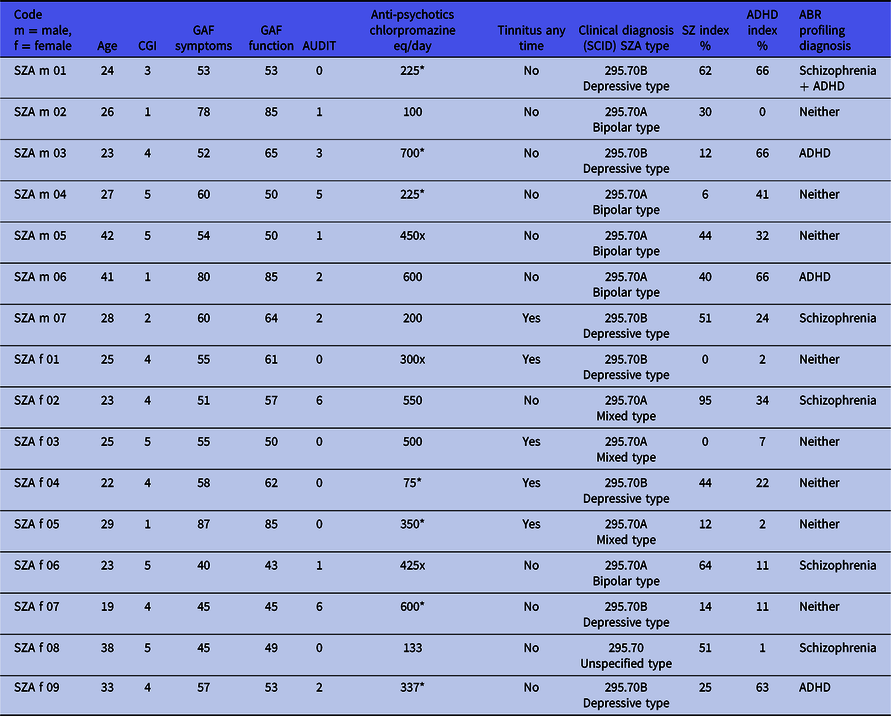
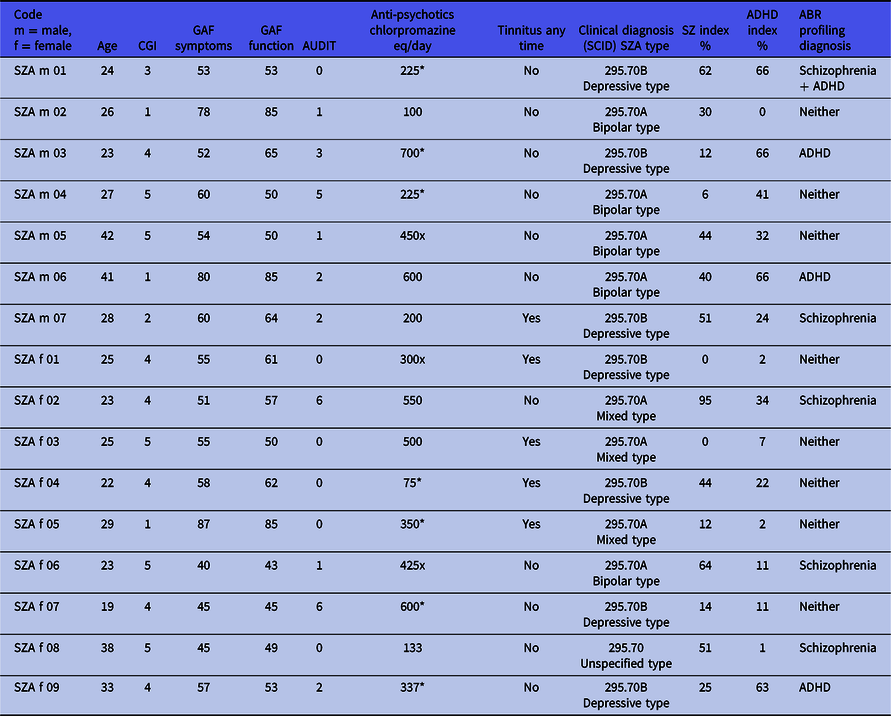
Sixteen out of 16 registrations were available for analysis. The results are shown in Table 1.
Study participants, individual data (x = plus mood stabiliser; *= plus antidepressant)
Patient characteristics
At inclusion, all SZA participants (seven males and nine females, median age 25.5 years, range 19–42 years) were on antipsychotic medication: aripiprazole (n = 1), aripiprazole+olanzapine (n = 2), clozapine (n = 6), clozapine+ quetiapine (n = 1), olanzapine+haloperidol (n = 1), paliperidon (n = 1), quetiapine(=3), ziprasidon (n = 1). The median daily dose expressed as chlorpromazine equivalents (cpz eq/d) was 343 mg. Six participants were on antipsychotics only, while seven combined with antidepressants and three with mood stabilisers. Regarding SZA subtypes, seven participants were of the depressive type, eight of the bipolar or mixed type and one unspecified type. All participants but one (f 06) were in remission regarding psychotic symptoms as characterised by clinical global impression - severity scale (CGI) severity of illness scores (Guy, Reference Guy1976) and global assessment of functioning - scale (GAF) scores (Pedersen et al., Reference Pedersen, Hagtvet and Karterud2007; Pedersen and Karterud, Reference Pedersen and Karterud2012). Two participants (f 02 and f 03) had personality disorders. The median Audit score (Saunders et al., Reference Saunders, Aasland, Babor, De La Fuente and Grant1993; Babor et al., Reference Babor, Higgins-Biddle, Saunders and Monteiro2001) was 1 (range 0–6). There were three tobacco users, one left-handed and six participants with any lifetime otology problems excluding tinnitus. The median duration of illness was 3.5 years, (range 1–18 years) which was calculated from the first psychosis diagnosis noted in medical charts.
ABR profiling results
The ABR profiling method for SZ using the disease index of ≥50% identified 5/16 (31%) as positive and 11/16 (69%) patients with SZA as negative for SZ. The ABR profiling method for ADHD using a disease index of ≥50% identified 4/16 (25%) as positive and 12/16 (75%) patients with SZA as negative for ADHD. There was no obvious relationship between ABR profiling diagnoses and subtype of SZA. Similarly, there were no obvious differences between participants with an ABR profiling diagnosis of SZ and those without in mean severity of illness as measured by CGI or GAF or dose of antipsychotic drugs. There were no differences between participants with an ABR profiling diagnosis of ADHD and those without in mean severity illness or dose of antipsychotic drugs.
Discussion
The present investigator-initiated blinded study explores the gender-specific ABR profiling methods for SZ and ADHD by Källstrand et al. (Reference Källstrand, Holmberg, Nehlstedt and Nielzén2016) in DSM IV-TR patients with SZA diagnosed with the SCID-I and SCID-II.
The major finding of the present study is that the ABR profiling test of SZ was positive for only 31% and negative for 69% in the group of patients with SZA. In contrast, the results from the previous study by Juselius Baghdassarian et al. (Reference Juselius Baghdassarian, Nilsson Markhed, Lindström, Nilsson and Lewander2018) showed that 22/26 (85%) of patients with clinical SZ were positive and 4/26 (15%) negative for SZ using ABR profiling. In a group of 58 healthy controls, 4 (7%) were false positives and 54 (93%) were true negatives for SZ, and in a group of 24 patients with ADHD, 2 (8%) were false positives and 22 (92 %) were true negatives for SZ.
A surprising finding was that 4/16 (25%) patients were positive using the ABR profiling test for ADHD. Among 58 healthy controls in the study by Juselius Baghdassarian et al. (Reference Juselius Baghdassarian, Nilsson Markhed, Lindström, Nilsson and Lewander2018), 5 (9%) were false positives and among 26 patients with SZ only 1 (4%) was a false positive.
There were no indications of ADHD symptoms in the patients with SZA disorder scoring positive for ADHD. However, no specific assessment methods for ADHD were used.
The main finding that most patients with SZA scored negative for SZ using the ABR profiling method adds to the questions regarding the validity of this diagnostic entity, that is, whether SZA should be included in studies of SZ or kept separate. However, the ABR profiling method is still in its infancy, and its exploration in a range of psychiatric disorders is warranted.
Limitations of the present study are the modest number of patients and lack of data on test–retest reliability of the ABR profiling methods. The SZ and ADHD profiling methods used have not been studied in patients with major depressive or manic episodes. We could not compare our results with the ABR waveforms from a previous study in bipolar disorder (Sköld et al., Reference Sköld, Källstrand, Nehlstedt, Nordin, Nielzen, Holmberg and Adolfsson2014) due to a different apparatus and methods being used in that investigation. Studies of patients on and off medication on ABR profiling are warranted. State versus trait issues need to be investigated.
Conclusion
With the ABR profiling test for SZ, a minority, that is, 5/16 (31%), of patients with SZA disorder tested positive. In contrast, 22/26 (85%) of patients with SZ tested positive. These preliminary results leave us ignorant whether SZA should be regarded as a SZ-like disorder or a psychotic mood disorder in congruence with previous discussions (cf Introduction). It cannot be excluded that some patients with SZA disorder are mainly SZ-like, whereas others are suffering from psychotic mood disorders.
Acknowledgements
The present investigator-initiated study was planned and performed as part of doctoral studies and funded by the Medical Faculty, Uppsala University, Uppsala, Sweden. Thanks to Lars Sjölund for assistance with data collection and Kristina Stjernlöf and Magdalena Lindborg for assistance with SCID interviews. We would also like to thank all study participants. SensoDetect AB, Lund, Sweden is acknowledged for providing access to instrumentation for ABR recordings, training of personnel at the study site, analysis of the ABR recordings using its proprietary methods and know-how related to the methods. All raw data produced during the study, including individualised digitised ABRs, have been made available to the Department of Neuroscience, Psychiatry, Uppsala University for additional analyses after completion of the study.
Authors’ contributions
The present study was part of the study on ABR profiling in SZ and adult ADHD at Uppsala University Hospital(2009–2012) and planned by the author and the co-author. First draft of the manuscript made by Eva Juselius Baghdassarian was critically revised by the co-author. Both the author and the co-author have approved the final version of the paper.
Financial support
The study was performed as part of doctoral studies and funded by the Medical Faculty, Uppsala University, Uppsala, Sweden. No other financial support was received for this article.
Conflict of interest
The authors have no conflict of interests, financial or otherwise, to disclose.
Ethical standards
The authors assert that all procedures contributing to this work comply with the ethical standards of the relevant national and institutional committees on human experimentation and with the Helsinki Declaration of 1975, as revised in 2008.