Introduction
The long-term psychological effects of the Holocaust have been examined widely in the context of post-traumatic stress and related disorders, with mixed results. Many studies have found that Jewish Holocaust survivors suffer severe and enduring psychological effects (Kuch and Cox, Reference Kuch and Cox1992; Landau and Litwin, Reference Landau and Litwin2000; Lev-Wiesel and Amir, Reference Lev-Wiesel and Amir2000; Cohen et al., Reference Cohen, Dekel, Solomon and Lavie2003; Sagi-Schwartz et al., Reference Sagi-Schwartz2003; Sharon et al., Reference Sharon, Levav, Brodsky, Shemesh and Kohn2009; Fridman et al., Reference Fridman, Bakermans-Kranenburg, Sagi-Schwartz and Van Ijzendoorn2010). Other studies, though, report that the psychological adjustment of Holocaust survivors is within the normal range (Leon et al., Reference Leon, Butcher, Kleinman, Goldberg and Almagor1981; Barel et al., Reference Barel, Ijzendoorn, Sagi-Schwartz and Bakermans-Kranenburg2010).
Alongside this literature, there is a growing body of evidence that among elderly Jewish Holocaust survivors, war-related experiences are associated with several adverse physical health outcomes (Shasha et al., Reference Shasha, Livshitz and Ohry2009), such as osteoporosis (Marcus and Menczel, Reference Marcus and Menczel2007), hip fractures (Foldes et al., Reference Foldes, Brodsky and Bentur2003), higher pain intensity levels and more sites of pain (Yaari et al., Reference Yaari, Eisenberg, Adler and Birkhan1999), fibromyalgia (Ablin et al., Reference Ablin, Cohen, Eisinger and Buskila2010), and chronic functional gastrointestinal symptoms (Stermer et al., Reference Stermer, Bar and Levy1991). Additionally, a higher incidence of malignancies was recently reported in a group of Israelis potentially exposed to the Holocaust, compared to their non-exposed counterparts (Keinan-Boker et al., Reference Keinan-Boker, Vin-Raviv, Liphshitz, Linn and Barchana2009).
In a recent, comprehensive meta-analysis, Barel et al. (Reference Barel, Ijzendoorn, Sagi-Schwartz and Bakermans-Kranenburg2010) demonstrated that while Holocaust survivors had a significantly higher rate of post-traumatic stress symptoms than their counterparts, they also exhibited remarkable resilience and displayed good physical health, cognitive functioning, and stress-related physiology. However, the results of this study also indicated that the susceptibility of Holocaust survivors varied, for example, by current country of residence; Israeli Holocaust survivors were more adapted in the psychological well-being domain than survivors residing in other countries (Barel et al., Reference Barel, Ijzendoorn, Sagi-Schwartz and Bakermans-Kranenburg2010).
Previous studies examining health outcomes have included Holocaust survivors and matched controls in their samples, but they have not focused on the nature of participants’ individual traumatic experiences, which may contribute to vulnerability (Dekel and Hobfoll, Reference Dekel and Hobfoll2007). Additionally, the variability seen in research on long-term effects may stem from methodological differences. The majority of studies on Holocaust survivors have focused on a help-seeking clinical population; perhaps, it is not surprising that the results indicate that Holocaust survivors perform worse on various outcome measures (Peretz et al., Reference Peretz, Baider, Ever-Hadani and De-Nour1994; Cohen et al., Reference Cohen, Dekel, Solomon and Lavie2003). Therefore, it is important to examine long-term psychological and physical effects in population-based samples of Holocaust survivors.
Few studies have reported an association between traumatic experiences, post-traumatic stress disorder (PTSD), and subsequent cancer (Sareen et al., Reference Sareen, Cox, Stein, Afifi, Fleet and Asmundson2007; Sledjeski et al., Reference Sledjeski, Speisman and Dierker2008; Glaesmer et al., Reference Glaesmer, Gunzelmann, Braehler, Forstmeier and Maercker2010). Glaesmer and colleagues (Reference Glaesmer, Gunzelmann, Braehler, Forstmeier and Maercker2010) investigated an elderly German sample of 1,456 individuals involved in WWII and found that subjects with current PTSD had a significantly increased risk of being diagnosed with cancer in the last five years compared to those without PTSD (OR = 3.61, 95% CI = 1.59–8.81). Few studies have examined Holocaust survivors recently diagnosed with cancer and explored their emotional adjustment to the new threat and trauma. However, it has been shown that Holocaust survivors coping with cancer present with higher levels of psychological distress than their counterparts (Baider et al., Reference Baider, Peretz and De-Nour1992; Peretz et al., Reference Peretz, Baider, Ever-Hadani and De-Nour1994; Hantman and Solomon, Reference Hantman and Solomon2007).
Jewish Holocaust survivors provide an opportunity to study the psychological and physical long-term effects of massive trauma and severe environmental stressors such as hunger and social and physical hardships (Shasha, Reference Shasha2002; Reference Shasha2004). In the current study, we also investigated the relationship between WWII-related PTSD and subsequent breast cancer (BC) risk among Jewish WWII survivors currently residing in Israel, based on their individual war experiences. The relationships between WWII-related PTSD and hunger and the common impact of both exposures on subsequent BC risk were also studied.
We first hypothesized that Holocaust survivors with BC would report more WWII-related PTSD than the comparison group. As for WWII-related hunger exposure, it has rarely been examined among Holocaust survivors as a traumatic experience. However, we have previously reported an association between WWII-related hunger exposure and BC (Vin-Raviv et al., Reference Vin-Raviv, Barchana, Linn and Keinan-Boker2012). Therefore, we also examined the relationship between WWII-related PTSD and hunger, investigating their shared impact on subsequent BC risk. Finally, based on previous findings (Davies et al., Reference Davies, Batehup and Thomas2011), we hypothesized that Holocaust survivors with BC would report poorer health behaviors (e.g. higher levels of smoking and alcohol consumption), which occasionally serve as stress relief techniques, are often associated with PTSD, and may, in themselves, increase a person's risk for BC.
Methods
Participants
The methods used in this study have been described previously, in detail (Vin-Raviv et al., Reference Vin-Raviv, Barchana, Linn and Keinan-Boker2012). Briefly, medical records were used to identify women with a histological confirmation of an in-situ or invasive malignant breast tumor in 2005–2010; they were recruited through the Oncology and Radiology departments, as well as the out-patient oncology clinics, of five Israeli medical centers (Rambam Health Care Campus, Haifa; Sourasky Medical Center, Tel-Aviv; Rivka Ziv Medical Center, Safed; Western Galilee Hospital, Nahariya; and Laniado Medical Center, Natanya). Controls were located randomly through various voluntary assistance organizations for Jewish WWII survivors, such as “Amcha,” the Kibbutz Movement, local welfare departments, retirement homes, and special hostels for WWII survivors. Inclusion criteria for the study were being a female current Jewish resident of Israel born in Europe prior to 1945 and having lived under the Nazi regime during WWII (1939–1945) for at least six months. Exclusion criteria included a previous diagnosis of primary cancer (excluding squamous and basal cell carcinoma), dementia or Alzheimer's disease, and immigration to Israel after 1989. In total, 65 BC patients and 200 controls (with a 58.6% and 55.4% response rate, respectively) took part in the study. This study was approved and supervised by the Ethical Review Board of each participating medical center.
Measures
Following a short explanation of the study and its aims, each participant was asked to sign an informed consent form. All cases and controls were interviewed in their homes by a trained interviewer.
The questionnaire collected self-reported demographic data (e.g. age, country of birth, marital and employment status, education, income, degree of religious observance), health behavior data (e.g. BMI, physical activity, smoking status, alcohol consumption), obstetrical and gynecologic data (e.g. age at menarche; menstrual patterns; number of pregnancies; number of live-born children; age at first childbirth; age at last childbirth; difficulty conceiving; use of fertility treatments; overall duration of breastfeeding; use of oral contraceptives; menopausal characteristics, such as age at menopause, use of hormone replacement therapy, and history of surgical operations or surgical menopause; and family history of breast and ovarian cancer, including BRCA1 and BRCA2 mutations). Additionally, the questionnaire contained questions related to WWII-related PTSD, additional stressful life events, and caloric restriction during WWII, as explained here.
WWII-Related PTSD
WWII-related PTSD was assessed using the PTSD Inventory, a self-report diagnostic questionnaire based on DSM-IV criteria. The PTSD Inventory assesses both the intensity (i.e. number of symptoms) and the differential symptom profile (i.e. the pattern of symptoms) of a subject's disorder, enabling a quick decision as to whether or not a person is suffering from PTSD. The questionnaire consists of 17 statements corresponding to the 17 PTSD symptoms listed in DSM-IV. In accordance with DSM-IV guidelines, the subject was diagnosed with PTSD if she experienced a traumatic event and if she endorsed one or more intrusive symptoms (items 1–4); three or more avoidance symptoms (items 5–11); and two or more arousal symptoms (items 12–17) (Solomon and Horesh, Reference Solomon and Horesh2007). In the current study, each participant was asked to indicate whether or not she had experienced each of the listed items during the past month and to rate it from 1 (“not at all”) to 4 (“usually I do”). The items were phrased specifically to assess WWII experiences, and the questionnaire was in Hebrew (Solomon and Horesh, Reference Solomon and Horesh2007). The internal consistency of the inventory in the present study was found to be high (Cronbach's α = 0.86).
Additional traumatic events
Participants were presented with a list of 13 traumatic events (e.g. “You were the victim of a sexual assault,” “. . . at danger of injury or death,” “. . . of a crime,” “. . . severe car accident,” “Did you lose a close relative?”) (Solomon, Reference Solomon1995). Each participant was asked to indicate whether or not she had experienced each of the listed items after WWII. The total score was calculated as the number of events that the participant had experienced, from the end of WWII through the present time.
Hunger exposure during WWII
A number of indices were designed to rank hunger exposure during WWII, as described in detail elsewhere (Vin-Raviv et al., Reference Vin-Raviv, Dekel, Barchana, Linn and Keinan-Boker2011; Vin-Raviv et al., Reference Vin-Raviv, Barchana, Linn and Keinan-Boker2012). Briefly, three indices were used.
Hunger exposure score:
Each participant was asked to report her living locations during WWII (e.g. ghettos, work/concentration/death camps, living under a false identity, etc.). These locations were ranked by the level of caloric restriction (CR) experienced and multiplied by the amount of time spent in each location (in months), covering the total period of WWII (September 1, 1939–May 8, 1945), then summed up across locations, yielding an individual, continuous hunger exposure score (Vin-Raviv et al., Reference Vin-Raviv, Dekel, Barchana, Linn and Keinan-Boker2011; Vin-Raviv et al., Reference Vin-Raviv, Barchana, Linn and Keinan-Boker2012). Additionally, the individual hunger score was categorized as “mild,” “moderate,” or “severe” based on the tertile distribution.
Hunger symptoms score:
Each participant was asked whether she had experienced any of 17 hunger-related symptoms and signs (e.g. weight loss, watery diarrhea, abdominal edema, edema of the feet and the hands, polyuria, vitamin deficiencies (such as scurvy, rickets, night blindness), anemia, goiter, amenorrhea or irregular menses, or hirsutism and voice change) at each of her WWII locations (Winick, Reference Winick1979). Each symptom/sign reported was counted only once, and all symptoms/signs were summed up to form a hunger symptoms score ranging from 0–17 (Vin-Raviv et al., Reference Vin-Raviv, Dekel, Barchana, Linn and Keinan-Boker2011; Vin-Raviv et al., Reference Vin-Raviv, Barchana, Linn and Keinan-Boker2012).
Self-perceived hunger score:
The participant was asked whether she experienced hunger in each of her WWII locations and was also asked to rank it. The scale ranged from 1 (not at all) to 4 (to a great extent). The score was averaged over all WWII locations to form the self-perceived hunger score (Vin-Raviv et al., Reference Vin-Raviv, Dekel, Barchana, Linn and Keinan-Boker2011; Vin-Raviv et al., Reference Vin-Raviv, Barchana, Linn and Keinan-Boker2012).
Other related data
The medical files of BC patients were abstracted in order to investigate their disease characteristics.
Statistical analysis
The frequency of categorical variables, or means and standard deviations in the case of continuous variables such as age, were computed separately for cases and controls. Frequencies were cross-tabulated, and differences between cases and controls were assessed statistically using the χ 2 test. Continuous variables were assessed statistically using independent t-tests. The association between WWII-related PTSD and hunger, as measured by the three above-mentioned indices, was also assessed using independent t-tests.
We applied logistic regression models to evaluate the association between BC risk (yes/no) and WWII-related PTSD (yes/no). Because a significant association between WWII-related PTSD and BC risk was found in an unadjusted logistic regression model, we examined the association further using multivariate logistic regression, adjusting simultaneously for age at the beginning of WWII (0–4, 5–15, or ≥15 years), individual hunger score (mild, moderate, or severe), education attained (no degree, high school, or bachelor/masters/doctoral degree), and BMI (≤25, 25–30, or ≥30 kg/m2) (Table 3, Model A). Because the association between WWII-PTSD and BC was attenuated in Model A, becoming statistically insignificant, we assessed the association further by introducing additional potential confounders (e.g. smoking, alcohol consumption, self-perceived hunger score, hunger symptoms score, and total number of traumatic life events) into the model individually. Variables were determined to be confounders if their inclusion in the model changed the parameter estimate for the association between WWII-PTSD and BC by more than 10% (Table 3, Model B). Finally, we generated a fully adjusted logistic regression model (Table 3, Model C) that included age at the beginning of WWII, individual hunger score, education attained, BMI, self-perceived hunger score (continuous, averaged over all WWII locations), alcohol consumption (never, past, or current drinker), and total number of traumatic life events (continuous, number of events). Additionally, we evaluated the interaction potential of the individual hunger score upon the estimate of association between WWII-PTSD and BC (Table 4). We also evaluated whether reproductive and gynecological characteristics, which are important predictors of BC, act as mediators in WWII-PTSD exposure pathways. The following variables were considered: number of pregnancies (continuous), difficulty conceiving (yes/no), surgical menopause (yes/no), and use of hormone replacement therapy (yes/no). All analyses were performed with SPSS 18.0.0 for Windows 7 64bit (SPSS Inc., Chicago, IL, USA).
Results
The study groups’ baseline characteristics, WWII experiences, health-related behaviors, and reproductive and gynecological characteristics have all been reported previously (Vin-Raviv et al., Reference Vin-Raviv, Barchana, Linn and Keinan-Boker2012) and will be summarized briefly here.
Baseline characteristics
The mean age at interview of BC cases (76.2 ± 5.7) was lower than that of controls (78.3 ± 5.6). Among cases, more women reported having academic degrees (32.3%), while among controls, more women reported having no academic degree (46.5%). No marked differences were observed between cases and controls with respect to monthly household income, level of religious observance, or marital status.
WWII experiences and CR
A higher percentage of cases than controls reported being younger than seven years of age at the beginning of WWII (49.2% vs. 27.0%, p < 0.01). Of the three indices used to assess CR, only the individual hunger score was significantly different between cases and controls (167.3 vs. 119.5, respectively, with a higher value representing higher exposure, p < 0.01). However, the other indices showed the same trend.
Health-related behaviors
Women in the control group were more likely to be overweight (46.7%), while women in the case group were more likely to be obese (33.9%, p = 0.01). No significant differences were observed with respect to smoking status, alcohol consumption, or current physical activity.
Reproductive and gynecological characteristics
No significant differences were observed between cases and controls regarding: age at menarche, regular menstrual pattern, number of pregnancies, number of live-born children, difficulty conceiving, age at first childbirth, age at last childbirth, mean duration between first and last childbirth, breastfeeding, age at menopause, having ever undergone gynecological surgery, surgical menopause, use of hormone replacement therapy, use of oral contraceptive pills, or use of fertility treatments.
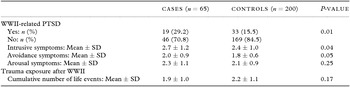
Table 1 shows the association between WWII-related PTSD, additional trauma exposure following WWII, and BC. WWII-related PTSD was significantly more prevalent among cases than controls (29.2 % vs. 15.5%, p = 0.01). Cases reported higher symptom levels for all three symptom clusters. However, a statistically significant difference was present only for intrusive symptoms (2.7 vs. 2.4 for cases vs. controls, p = 0.04). The difference between cases and controls with respect to avoidance symptoms was statistically marginal (p = 0.054). No significant differences were observed between cases and controls regarding trauma exposure after WWII.
Association between WWII-related PTSD, trauma exposure after WWII, and breast cancer

Table 2 reports the associations between WWII-related PTSD and WWII-related hunger, as measured by our three indices. There was a significant association between symptoms of WWII-related PTSD and the self-perceived hunger score (3.0 vs. 2.5, in those diagnosed with WWII-related PTSD and those not diagnosed with the disorder, respectively, p = 0.01). Similar trends were observed for the hunger exposure and hunger symptoms scores, but these differences did not reach statistical significance.
Association between WWII-related PTSD and hunger

aSample size is different due to missing data (PTSD: n = 46, No PTSD: n = 197).
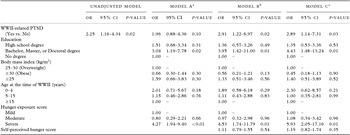
Table 3 reports the multivariate logistic regression models for WWII-related PTSD and BC. In the univariate, unadjusted model, WWII-related PTSD was significantly associated with risk of BC (OR = 2.25, 95% CI = 1.16–4.34). In a model adjusted for age at the beginning of WWII, individual hunger score, education attained, and BMI, the association was attenuated and became statistically insignificant (Model A). Then, after adjusting for self-perceived hunger score, the association became stronger and was statistically significant (OR = 2.91, 95% CI = 1.22–6.97, Model B). Following additional adjustment for smoking, alcohol consumption, hunger symptoms score, and total number of traumatic life events, the association with WWII-related PTSD remained significant (OR = 2.89, 95% CI = 1.14–7.31, Model C). We also examined the interaction potential of the individual hunger score upon the estimate of association between WWII-PTSD and BC by adding the appropriate interaction term, but the results were statistically insignificant. This was probably due to the small sample size and the fact that the models used in commercial statistical software are based on multiplicative and not additive interaction models (model not shown).
Multiple logistic regression models determining the relationship between WWII-related PTSD and breast cancer

aAdjusted for education, BMI, age at the time of WWII, and hunger exposure score.
bAdjusted for education, BMI, age at the time of WWII, hunger exposure score, and self-perceived hunger score.
cAdjusted for Education, BMI, age at the time of WWII, hunger exposure score, self-perceived hunger score, smoking, alcohol consumption, hunger symptoms score, and total number of traumatic life events.
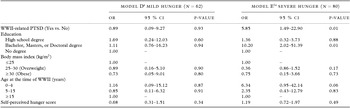
To further explore potential modification of the association between WWII-related PTSD and BC, Table 4 reports the results of a stratified logistic regression model adjusted for self-perceived hunger score, age at the beginning of WWII, education attained, and BMI, with separate analyses for women who experienced mild (Model D) and severe (Model E) hunger during WWII, based on their individual hunger scores. As Table 4 illustrates, the association between WWII-related PTSD and BC is modified by the level of WWII-related hunger experienced. The measure of association is accentuated in women exposed to severe hunger (OR = 5.85, 95% CI = 1.49–22.90) but attenuated in women exposed to mild hunger (OR = 0.89, 95% CI = 0.09–9.27).
Multiple logistic regression models determining the relationship between WWII-related PTSD and breast cancer exploring the role of potential intermediate-hunger exposure score

aAdjusted for education, BMI, age at the time of WWII, and self-perceived hunger score.
As mentioned earlier, we also examined the modification potential of several reproductive and gynecological characteristics. However, adding these variables to the multivariate models did not change parameter estimates for the association between WWII-PTSD and BC by more than 10%. Therefore, these variables were not included in the final models (data not shown).
Discussion
In this study, we examined the association between WWII-related PTSD and subsequent BC risk in female, Jewish WWII survivors, investigating whether this effect was modified by WWII-related hunger. We identified a linear, significant association between self-perceived hunger score and WWII-related PTSD: the higher the hunger score, the higher the likelihood of PTSD. We also demonstrated an association between WWII-related PTSD and BC; however, this association was modified by exposure to hunger during WWII. A strong association between WWII-related PTSD and BC was evident in women exposed to severe WWII-related hunger, but not in women exposed to mild hunger. Our results contrast with previous findings (Sagi-Schwartz et al., Reference Sagi-Schwartz2003; Barel et al., Reference Barel, Ijzendoorn, Sagi-Schwartz and Bakermans-Kranenburg2010; Fridman et al., Reference Fridman, Bakermans-Kranenburg, Sagi-Schwartz and Van Ijzendoorn2010), which suggested that although Holocaust survivors have a significantly higher rate of PTSD than comparison subjects with no Holocaust background, they present good physical health, indicating remarkable resilience.
In accordance with our first hypothesis, it appears that women who were exposed to severe and prolonged hunger are at a higher risk for WWII related-PTSD (Yehuda et al., Reference Yehuda, Bierer, Andrew, Schmeidler and Seckl2009). A strong association between WWII related-PTSD and BC was observed in women exposed to severe WWII-related hunger but not in those exposed to only mild hunger. One potential explanation for our findings involves the lower cortisol levels observed in individuals with PTSD, which may reflect a pre-existing vulnerability associated with developing the disorder after trauma exposure (Yehuda, Reference Yehuda2002). Previous studies have reported that both Holocaust survivors (Yehuda et al., Reference Yehuda, Golier and Kaufman2005) and Holocaust survivors' offspring with no PTSD themselves but exposure to parental PTSD display reduced levels of cortisol production (Yehuda et al., Reference Yehuda, Bierer, Schmeidler, Aferiat, Breslau and Dolan2000; Yehuda et al., Reference Yehuda, Halligan and Grossman2001; Yehuda et al., Reference Yehuda, Teicher, Seckl, Grossman, Morris and Bierer2007). PTSD has also been associated with autonomic dysfunction and changes in the hypothalamic-pituitary-adrenal (HPA) axis (Gill et al., Reference Gill, Vythilingam and Page2008; McFarlane, Reference McFarlane2010). Stress can alter production of adrenal androgens such as dehydroepiandrosterone (DHEA) and DHEA-Sulfate 7 (DHEA-S) (Bremner et al., Reference Bremner, Vermetten and Kelley2007). Past studies have found an association between PTSD and elevated levels of DHEA and DHEA-S (Yehuda et al., Reference Yehuda, Brand, Golier and Yang2006; Gill et al., Reference Gill, Vythilingam and Page2008; Kellner et al., Reference Kellner, Muhtz, Peter, Dunker, Wiedemann and Yassouridis2010). Higher levels of endogenous sex hormones, such as DHEA and DHEA-S, may increase BC risk in postmenopausal women (Hormones and Group, Reference Hormones and Group2002; Kaaks et al., Reference Kaaks2005). Future research should further investigate the complex association between PTSD and BC risk by identifying the underlying biological mechanisms, making use of biological specimens for PTSD biomarkers.
We were unable to find support for our second hypothesis. We did not observe significant differences between cases and controls with respect to health behaviors. It should be noted that our comparisons were based on current rather than past health behaviors, which may have been more relevant to the outcome studied. These results contrast with previous studies that have reported an association between PTSD and smoking, alcohol consumption, and lower levels of physical activity (Buckley et al., Reference Buckley, Mozley, Bedard, Dewulf and Greif2004; Zen et al., Reference Yehuda, Bierer, Andrew, Schmeidler and Seckl2012), which, in themselves, are associated with BC risk and survivorship (Davies et al., Reference Davies, Batehup and Thomas2011).
Our study has several strengths. Focusing only on WWII-exposed women did limit our ability to detect differences in hunger exposure between cases and controls, but it helped us to avoid potential selection bias. It also enabled us to study WWII-related PTSD as a BC risk factor. In addition, our study drew on a population-based sample.
Our results should be interpreted cautiously, however, because there are also some limitations. First, a growing body of evidence suggests that the experience of being diagnosed with breast cancer, a potentially life-threatening event, can, in itself, cause PTSD (Jim and Jacobsen, Reference Jim and Jacobsen2008). Thus, temporality with respect to the causal process is difficult to establish. According to the literature, the highest prevalence of PTSD is reported shortly after cancer diagnosis, with the prevalence of PTSD declining within three months of diagnosis or following treatment completion (Jim and Jacobsen, Reference Jim and Jacobsen2008). No information on cancer-related PTSD was collected in the interviews we conducted. Thus, we were unable to consider the effect it may have had on our models. However, we interviewed prevalent BC cases who had a chance to recover and in whom the stress associated with cancer diagnosis had presumably decreased; the mean time between diagnosis and the study interview was 2.36 years (SD = 1.42). Second, most of the data collected in this study were based on self-report. Consider, for example, the information regarding WWII-related hunger. These events took place 65 years ago, so the results may have been subject to recall bias. However, due to the traumatic nature of starvation during WWII, the participants found their experiences easy to remember. Additionally, this methodology has been used previously (Elias et al., Reference Elias, Peeters, Grobbee and van Noord2004), and starvation during WWII and its long-lasting consequences are well documented (Polivy et al., Reference Polivy, Zeitlin, Herman and Beal1994; Favaro et al., Reference Favaro, Rodella and Santonastaso2000). A third potential limitation is that PTSD is usually diagnosed through a clinical interview, but in the current study the assessment of WWII-related PTSD was based on a self-reported questionnaire; a trained interviewer categorized each participants as having, or not having, WWII-related PTSD using this tool. However, this methodology has been used previously and validated (Brewin, Reference Brewin2005).
In conclusion, our results suggest that WWII-related PTSD may be associated with long-term risk for BC in a susceptible population. The present study has helped define a potentially high-risk group for BC, Holocaust survivors with WWII-related PTSD who were severely exposed to hunger during the war, and may contribute information regarding the etiologic mechanism for BC as well as add to the body of scientific literature linking early life exposures to BC later in life.
Conflict of interest
None.
Description of authors’ roles
N. Vin-Raviv wrote the paper, carried out the work described in this paper, and performed the majority of the statistical analyses; L. Keinan-Boker and R. Dekel assisted N. Vin-Raviv with data analysis and writing the paper; and L. Keinan-Boker, M. Barchana, S. Linn, and R. Dekel were involved in formulating the idea for the study and its hypotheses and supervised N. Vin-Raviv's PhD dissertation, on which this paper is based.
Acknowledgments
The authors are indebted to the participants for volunteering to take part in this study. They also express their gratitude to Prof. S. Shasha for his contributions to this field of research in general and to this study in particular. The current paper is based on the PhD thesis of Neomi Vin-Raviv, which was submitted to the School of Public Health at the University of Haifa, Haifa, Israel, in partial fulfillment of the requirements for the PhD Degree. Dr. Neomi Vin-Raviv gratefully acknowledges postdoctoral fellowship funding from the University of Pittsburgh Cancer Institute and the Mailman School of Public Health, Columbia University, New York, USA.