Yet I am ashamed, and it makes My Hair stand upright, to consider how, in this Time, My People have been vexed and polled, by the vile Execution of Projects, Patents, Bills of Conformity, and such like, which, besides the Trouble of My People, have more exhausted their Purses, than Subsidies would have done.Footnote 1
James I's declaration to the Parliament of 1621 was quickly followed on March 31, 1621, by a proclamation abolishing “bills of conformity”—a remedy for insolvent debtors in the English courts of equity. MPs had raised conformity as a grievance early in the session, and debate was one-sided. James's admission, and the proclamation suppressing conformity that followed, explained that debtors exhibited the bills for “no other end or purpose, but to defeat or delay their just and honest Creditors.” Conformity was “so great an evill” that it had encouraged “wilfull Bankerupts,” caused a scarcity of money, and triggered a trade depression.Footnote 2 A statute passed in the Parliament of 1624 closed the remaining loopholes and abolished conformity.Footnote 3
The bill of conformity has been a footnote in the history of the rising tension between Parliament and the Stuart monarchs, and a minor milestone in the development of the law of insolvency.Footnote 4 Yet there is more at stake in the demise of conformity, which modern commentators have dismissed as “an abuse of the Common Law, by which a debtor could escape his full obligations by presenting a bill of complaint, and by paying a fee in Chancery for a final decree, requiring only easy composition instead of full payment.”Footnote 5 Through a reconstruction of the development of the bill of conformity and its defeat, I explain why the remedy emerged and how its expansion reflected interpretations of James's own representation of kingship and its practice. Conformity's collapse, so it is argued, revealed the underlying challenges of both an emerging credit economy and the limits of an expanding legal system. The cultural languages of charity and property, in which debates over conformity were conducted, mediated ideas of kingship with hard economic and legal realities. Fearful of the precariousness of credit relations and suspicious of the misuse of legal process by debtors, opponents of the bill of conformity insisted that the king must guarantee security of property. Meanwhile, proponents of conformity countered that the king should enforce charity and mercy through law and equitable process, and relieve debtors from the pursuit of their hard-hearted creditors. As economic conditions worsened and concerns over the expansion of equitable jurisdictions grew, the language of property became increasingly persuasive. The defeat of conformity and the charitable language that supported it exposed among parliamentarians in 1621 and 1624 a strident conservatism in attitudes toward property prior to the Civil War, and a suspicion that legal process, in this case the proceedings of the courts of equity, could too easily be used as a means of oppression by unscrupulous litigants.
Part I: The Rise and Fall of the Bill of Conformity
This analysis—synthesizing political, legal, and economic history—addresses three major historiographies.Footnote 6 First, a more thorough exploration of the development of the bill of conformity expands the history of insolvency law in England. Second, legal historians have frequently commented on the “triumph” of equity in the seventeenth century as necessary to remedy the deficiencies in the common law. The equitable courts of Chancery and Requests departed from the strict course of the common law in order to remedy injustice by exercising a more discretionary jurisprudence.Footnote 7 Yet conformity reveals the limits of the equity jurisdictions and exposes the point at which litigants were willing to accept harsh or unfair results, in return for predictability and the protection of property.Footnote 8 Finally, with an analysis of the language used to debate conformity, I explore the tension in the political thought of James I, who conceived of himself as both the guarantor of property and the wellspring of justice and charity. The historiographical debate over James's competency as a ruler has long raged, and only recently have more favorable assessments emerged.Footnote 9 The history of bills of conformity is an opportunity to trace an example of direct royal intervention in the legal process and analyze James's governance and self-representation of kingship. Importantly, it also exposes the reception of that representation among his subjects, who adopted his emphasis on the protection of property or the promotion of charity as they saw fit. In the disputes over conformity, these two languages collided to reveal the competing interests and complexities of Jacobean kingship and the legal system of the period.
The bill of conformity was a petition exhibited in a court of equity that sought to compel creditors to a composition (settlement) with a debtor. Usually exhibited after the debtor and the majority of his or her creditors had reached a composition, the bill of conformity included dissenting creditors in that agreement. Since the composition often included a protection—a time within which payments were suspended and creditors barred from proceeding at law—it was necessary to include dissenting creditors to prevent them from seizing the debtor or his property and thereby threatening the settlement. The bill of conformity allowed debtors to engage in their trade, restore their finances without danger of arrest, and begin anew with a discharge, since all their creditors were bound to a settlement.Footnote 10 The bill of conformity's application to all insolvent individuals, voluntariness on the part of the debtor, and discharge of liabilities contrasted with the draconian terms of the bankruptcy statutes then in force.
In the words of W. J. Jones, early modern bankruptcy was “something to be avoided.”Footnote 11 Until 1621 there were three statutes governing bankruptcy.Footnote 12 Bankruptcy was limited to English subjects who made their living by buying and selling (“traders”), and it was a legal status triggered by particular acts on the part of the bankrupt.Footnote 13 These acts were identified in the statutes and revealed the bankrupt's motive to withhold or delay payment of his debt.Footnote 14 For example, if a debtor “secreted” himself in his house and failed to appear publicly in places of trade or exchange, this could be taken as evidence of his “not minding to pay or restore to any [of] their creditors their debts and duties.”Footnote 15 The recourse of the creditors was to petition the chancellor to issue a commission of bankruptcy that could arrest the bankrupt and sell his or her property.Footnote 16 The commission then divided the proceeds equally among the participating creditors without discharging any remaining debts left by the distribution. Such division could destroy the debtor's ability to conduct business and recoup his losses, and expose him to imprisonment for an indefinite period. It was not until the eighteenth century that discharge of existing liabilities under bankruptcy was realized.Footnote 17 The application of bankruptcy statutes to nontraders was not achieved until 1861, leaving them exposed to a “race of diligence” among creditors to seize their assets.Footnote 18 Holdsworth's assessment seems apt that “till the reforms of the [nineteenth] century, our law of bankruptcy was a disgrace to a civilized community.”Footnote 19
Justifying the harsh terms of the bankruptcy statutes was a cultural construction of the “bankrupt” that assumed that they were responsible for their situation either through folly or greed. Sir Edward Coke described how in Latin the bankrupt was called a “decoctor … for consuming of his estate in riotous and delicate living.”Footnote 20 Coke observed that bankruptcy legislation was recent and suggested that it was precipitated “when the English Merchant had rioted in three kind [sic] of costlinesses viz. costly building, costly diet, and costly apparell, accompanied with neglect of his trade and servants, and thereby consumed his wealth.”Footnote 21 Gross consumption of goods, wealth, and property were central to the idea of the “politic bankrupt.” Thomas Dekker, in his contemporary invective against the moral sins of London, warned, “these are the Kats that eate up the provision of the people; these are the Grashoppers of Egypt; that spoyle the Corne-fields of the husbandman and the rich mans Vineyards.”Footnote 22 Jean Howard has noted an underlying cultural logic of indebtedness in her study of the representation of debtors in London theatre: “The more you owe, the more the world will take you for a great man of immense wealth and importance.” This in turn led to a cycle of borrowing and consumption until collapse.Footnote 23 The bankrupt was antithetical to property: He was its consumer.
Contemporaries were also aware that through misfortune, chance, or (in a recurring phrase) the “hand of God” individuals became insolvent.Footnote 24 Debtors frequently claimed that their penurious condition did not result directly from their own actions. Sureties pointed to the default of others, while merchants who had lost in trade lamented the misfortune that Providence had visited upon them. Remedies of a more “charitable spirit” existed outside the statutory provisions of the bankruptcy acts and were likely more frequent recourses.Footnote 25 These remedies aimed to encourage cooperation between both creditors and debtors in the pursuit of a composition that would relieve both sides. Bills of conformity emerged from these nonstatutory efforts at debt relief.
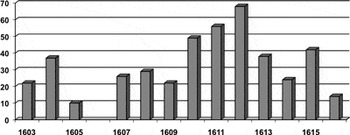
Israel Treiman, J. P. Dawson, and W. J. Jones have illuminated some of these “nonstatutory” remedies by examining the Elizabethan and Stuart Privy Council and the Chancery's work in debt arbitration. Dawson identified aid to debtors as “the largest class of litigation dealt with by the Tudor and Stuart Privy Councils.”Footnote 26 The Privy Council relieved debtors through several means, including commissions, but especially through the receipt and answer of petitions from debtors and creditors. These debtors' petitions sought protections from the king and the Privy Council against creditors pursuing them at the common law.Footnote 27 Dawson also observed that litigants sought similar protections from the king.Footnote 28 Utilizing a manuscript register in the British Library of petitions received by the king from May 1603 to June 1616, Dawson noted that many of these petitioners were referred to arbitration to obtain protections or compositions.Footnote 29 Some entries indicated that protections were granted over the dissent of creditors, but he believed that creditors seldom disobeyed.Footnote 30 The royal response to obstinacy was the issuing of more letters to the recalcitrant creditor or a reference to the judges of the King's Bench. Dawson concluded that “we are left to surmise that such orders, invested with the personal authority of the King, were promptly complied with.”Footnote 31
Chancery also provided relief through protections and later by bills of conformity.Footnote 32 Under Elizabeth, the Chancery often enforced settlement agreements after creditors later sought to escape from them, typically by enjoining dissenters from proceeding at law.Footnote 33 As early as 1584, the queen had granted a protection that was then enforced by an injunction against dissenting creditors.Footnote 34 Treiman believed, on limited evidence, that bills of conformity emerged in the Chancery in the late 1590s and that they were obtained independently of petitions to the queen.Footnote 35 However, W. J. Jones has argued that it was Francis Bacon who as chancellor first “tried to associate the impulse towards composition with conformity among creditors, and also tried to make this burgeoning system apply to situations of bankruptcy.”Footnote 36 Jones conceded that conformity had an earlier history, but he focused his study on the developments in the Chancery under Bacon and its impact on bankruptcy proceedings. Dawson and Jones analyzed the system of debt relief in pieces: the Privy Council and Chancery offered similar but disconnected remedies.Footnote 37 Their writings focused on the procedural developments that expanded bills of conformity and consequently minimized the significance of royal involvement.
Here I expand on the work of Treiman, Dawson, and Jones by reconstructing several crucial linkages between petitions to the king and Privy Council, and the bill of conformity in the Chancery. Central to the history of the bill of conformity was the Court of Requests, to which Elizabeth I and James I referred petitions for administration and enforcement.Footnote 38 The royal desire to urge subjects to charity and concord motivated these references, and the equitable courts were receptive. The development of the bill of conformity coincided with their increasing assertiveness to repair the “strict” course of the common law. These impulses, as shall be demonstrated, were undermined in James's reign when critics insisted upon the king's duty to protect his subjects' property and cited the behavior of unscrupulous debtors who manipulated the legal system to defeat their creditors. To subjects aggrieved by the use of the law's violence to seize their property, the king himself appeared to facilitate a theft.Footnote 39
Like several other features of royal government that became increasingly controversial, such as monopolies and concealments, James inherited tolerations from Elizabeth.Footnote 40 They were not an innovation of Jacobean government, and Treiman has argued that they imitated arbitration practices among merchants modeled on continental example.Footnote 41 The problem, as Treiman observed, was that such informal agreements could be overridden by unhappy creditors using formal legal process. Yet, overlooked in the reign of Elizabeth was the enforcement provided by the Court of Requests, alongside Chancery, of compositions already reached by creditors and debtors in private arbitrations.Footnote 42 Requests was an equitable court for civil causes that had emerged from the jurisdiction of the Privy Council in 1483.Footnote 43 Most of the bench and typically half of the four masterships were occupied by common lawyers. Originally tasked with the Council's jurisdiction for the relief of poor men's causes, the Masters of Requests were both receivers of petitions to the king and judges in the Court of Requests.Footnote 44 This overlapping responsibility likely facilitated the enforcement of conformity in that court. Already in the reign of Elizabeth I there is evidence that petitions were being exhibited to the Privy Council for arbitration and referred to the Court of Requests. In 1590 Thomas Cockayne complained in Requests that dissenting creditors threatened an agreement for toleration achieved by petition and arbitration with his creditors. Cockayne sought an injunction to stay his creditors suits at the common law and to prevent the defeat of the toleration.Footnote 45
Under James I, Requests was crucial in the development of conformity as his new subjects sought relief by petition from the king and his equitable courts. This willingness to entertain insolvent debtors connected to James's belief that the king was the source of justice in the kingdom along the model of the biblical judge-king Solomon.Footnote 46 This conviction occasionally led the king to judge in person or personally associate himself with interference in legal process: His letters of protection given to debtors bore his own signature.Footnote 47 Nonetheless it does not appear, at least early in the reign, that James expected petitions to the Privy Council to circumvent the ordinary course of law.Footnote 48 Yet this self-imposed limit was not always perceived by some who criticized the king's readiness to entertain petitions for redress: “It is sayd your Majestie receaves infinite number of peticons and the poore foolishe people thinke the kinge hath leasure to attend everie private mans busines, ridd your handes therfore betyme of such importunacies, and … refere them to the ordinarie course of Justice.”Footnote 49 Nor was it necessarily the case that as the petition descended to the administration of the equitable courts that the ordinary course of law would not be overridden in the interests of justice.
Testimony to the significant number of petitions that James received is found in the surviving register. Although the register is incomplete and has been reshuffled, the remaining pages suggest that soon after his accession the king received numerous requests specifically for protections against creditors and also seeking arbitrations.Footnote 50 It is, moreover, certain that the register records only part of the business of the masters and was the entry book of only one of the four.Footnote 51 A statistical tally of the number of petitions for toleration and conformity that moved through the hands of the masters and then became bills of conformity in the equity courts is impossible to compile due to the fragmentary source survival.Footnote 52 The number was probably in the very low hundreds, and set against the thousands of actions for debt in the central royal courts, the figure seems relatively small.Footnote 53 However, the impact of each petition and then bill of conformity on both the chains of credit by which the debt was held and the perception of the security of the credit system were independent of total numbers. Some of the debts conformed by equitable bills ranged into the tens of thousands of pounds and touched on dozens of creditors, who might find their investments devalued and their own credit damaged. The perception of conformity was also shaped by cultural constructions of the bankrupt and ideas of the sacrosanct nature of property. The disruption of credit relations by the proceedings of the equitable courts hazarded the basic expectation upon which money was lent: that a lawful debt properly secured was property that could not be abrogated by judicial action. As shall be seen, aggrieved creditors could conveniently interpret the bill of conformity as the triumph of the bankrupt who craftily manipulated judicial process to escape his obligations.
Petitions to the King Related to Conformity, 1603–1616.

The response to a petition to the king for a toleration was invariably a reference to a committee.Footnote 54 The early language was cautious. Until 1607 the petitioner, typically the debtor, usually asked for a protection for one year, and the response was a reference instructing the committee “charitablie to end” the cause.Footnote 55 After 1607 petitions for protections alone are sparse. Entries become formulaic—the names of the parties are recorded alongside the instruction to the committee: “[to] treate some charitable composicon.” The committee summoned the creditors, ascertained the debts, certified back how many of them were willing to allow additional time to the debtor or even to arrange a composition, and gave the names of those who were “obstinate.”Footnote 56 It is doubtful whether the granting of the protection depended upon the acquiescence of all the creditors. In one case a protection was granted despite the “obstinacy” of four creditors.Footnote 57 In two cases dissent was referred to the judges of the King's Bench to “persuade” the creditors to conformity.Footnote 58 The language of the register does not reveal that sanctions were enforced to compel conformity, though at least one instance of disobedience of a protection was referred to the chancellor “to take such order for punishment of the offender.”Footnote 59 Typically, however, the king's wishes were simply made known by his letters and commissions, and the emphasis was on persuasion.
However, the parallel story in the Court of Requests, where enforcement of the arbitrations was performed, continued into the new reign. The condition of the volumes of the court's register before 1608, many of them missing or heavily damaged by water, makes it difficult to trace cases related to debt relief comprehensively.Footnote 60 For 1608, when the register is in good condition, there are numerous entries related to conformity and its enforcement. In 1609 an order appears in the register proving the direct link between James I's receipt of petitions and the judicial work of the court. The order begins: “Whereas the kings … majestie being often troubled with manie peticons preferred by bad debtors against their creditors hath commanded … Counsall in this court to looke into the nature of the said peticons and to minister releife to the peticoners so farre as iustice will allowe.”Footnote 61
The first step in a conformity case was to petition the king.Footnote 62 The petition would then be referred to a commission that would call before them the debtor and creditors and arbitrate a composition.Footnote 63 Where recalcitrant creditors stood outside the agreement or refused a summons, the commissioners would certify their names back to the Privy Council. The debtor, joined by creditors consenting to the composition, would then exhibit a bill in the Court of Requests. The parties would be summoned before the court by writ of privy seal, and then upon a failure to answer would be enjoined against further proceedings at common law upon the debt. The injunction effectively imposed a toleration.Footnote 64 A case in 1610 is exemplary. John Cutler, a merchant of Ipswich, became insolvent through losses sustained in shipwreck and the default of his own debtors to the value of £3,000. He submitted a petition to the king, and this was referred to Sir Edmond Bowyer and Sir Thomas Grimes, who were commanded to review Cutler's estate and mediate with his creditors. They successfully persuaded several of these to a toleration of four years. The remaining creditors refused to participate in the settlement, and Cutler then exhibited a bill in the Court of Requests. The court awarded a commission, which included Robert Barker, a serjeant at the common law, and commanded that they should call before them the dissenting creditors. These creditors had already begun suit against Cutler at the common law and refused the summons of the court. An injunction was then granted suspending their suits at the common law and forcing the defendants to answer and appear before the commission.Footnote 65
Notable in Cutler's Case was the involvement of common lawyers who participated in the suspension of the defendants' suits at the common law. For example, Francis Gawdy, justice of the King's Bench, appears to have participated in numerous commissions mediating insolvencies.Footnote 66 Even when he was chief justice of the Common Pleas, Gawdy undertook the work of the court. In one case a contumacious defendant had disregarded the efforts of a commission and had the debtor imprisoned “contrary to all equity and conscience.” The court, mindful of Gawdy's “disposicon to charitable mocons,” again referred the matter to the newly elevated chief justice, though they omitted to mention any punitive actions that he might undertake against the recalcitrant creditor.Footnote 67 Mediation was also provided by Chief Justice Fleming in 1612.Footnote 68 Common lawyers themselves brought conformity proceedings: Sir Henry Finch's case in 1620 was among the sparks that ignited parliamentary interest. Their involvement suggests that conformity proceedings were not unanimously opposed by the common-law profession especially where they were limited to persuasion and arbitration, rather than compulsion. The common-law profession, it must be remembered, also stood to profit through membership in commissions and as representation in the equitable courts.
Despite such broad participation in conformity proceedings in 1609, there were already complaints about their administration in the Requests. An entry in the Order and Decrees book of the Court of Requests suggests that the bills were being manipulated by unscrupulous debtors: “And whearas diverse of the said debtors presuming upon the charitable inclynacon of his Majesty's said Counsaill have many tymes (of purpose by vexacon of sute to force theire creditors to composicon) of late obtained process … to call in their creditors from diverse remote places of this kindome in hope to get favourable composicons for the payment of theire debts … many of the said creditors being as poore or poorer then the debtors.”Footnote 69
The court laid down that no bill would be received except to obtain a commission for mediation or upon the certificate of a committee or commission identifying obstinate creditors. The debtor was required to join with the “greater number of creditors either in name or for the greater quantitie of debts” in the exhibition of the bill. This order introduced a weighting test and later petitions formulaically emphasized the participation of a majority of the creditors, usually both in number and in the amount of the debt.
This precaution was especially urgent in negotiations that reduced the amount of the principal. Early evidence of this practice is sparse, though there may be significance in the change of the Register's language in 1607. Dancer v. Hill et al. (1611) reveals the use of conformity to compel creditors to accept less than their original debts. A petition having been presented to the king and referred to a committee, the creditors were summoned together to examine the petitioner's debts and thereupon, “seriously looking into the weake estate of the said complainant and doubting that by the delay of tyme they might be in hazard to loose [sic] all seeing his estate beganne to growe worse and worse and commiserating the same[,] every of them did compound with him the said complainant to accept of him for theire severall iust debts fyve shillings in the pound and are content likewise to give him two years for payment of the same.”Footnote 70
Although sixty-eight of the creditors agreed to the composition, at least five refused to join.Footnote 71 With an injunction standing in force, the court referred the matter to a commission ordered to call the dissenting creditors before them to urge a composition.Footnote 72 This step was intended to continue the negotiations and wear down the dissenting creditors who, having no recourse at the common law to recover their debts, might be expected to consent. The participation of the majority of creditors was crucial to give these proceedings legitimacy and was required by the order of 1609.
Despite the insistence upon majority participation, resistance to conformity in the Court of Requests did not cease and instead peaked in 1614 in the case of Toft v. Capleine. John Toft's business had once flourished such that he “credited out what was credited.” Through bad debts and loss at sea he “suddenly” became insolvent and attempted to negotiate a protection with his creditors. A group of the creditors having examined his account certified the truth of Toft's losses and offered a composition of eight shillings on the pound and a repayment schedule. Other much smaller debtors, such as Capleine, who was owed fifteen pounds, refused to participate and threatened to sue Toft.Footnote 73 The court issued an injunction against the defendants to cease further suits at law. Toft's victory was short-lived: The defendants obtained a prohibition at the common law. The justification for the prohibition given by the reporter was that if such conformities were allowed, “the Statute of Bankrupts would be to little purpose.”Footnote 74
The prohibition was part of the larger campaign underway at that time by the common- law courts to limit the scope of equity.Footnote 75 Since late in Elizabeth's reign, the common-law courts had sought to prohibit proceedings in Requests.Footnote 76 Their efforts had culminated in the decision in Stepney v. Flood (1598) when the common-law judges declared that Requests “was no court that had power of judicature.”Footnote 77 Subsequently, the Common Pleas in Payne's Case (1613) ruled that prohibition lay to Requests whenever there was an adequate remedy at the common law.Footnote 78 This was likely the principle being applied, by extension, in Toft where conformity was taken to overlap with the bankruptcy statutes.
It was agreed by contemporaries that prohibitions from the King's Bench put an end to bills of conformity in the Court of Requests. Yet these same commentators also observed that litigants subsequently moved from Requests to Chancery where prohibition did not run.Footnote 79 Even before this transition, however, Chancery was participating in debt-arbitration work alongside Requests.Footnote 80 Contemporaries recalled that the first conformity case in Chancery was Sir John Wentworth's Case, though neither report nor petition for this case has been located.Footnote 81 Though few records of conformity in the Chancery are detectable prior to 1617, limited evidence suggests that the process in the Chancery operated similarly to the Court of the Requests, with two notable exceptions. The handling of dissenting creditors appears to have been harsher in Chancery than in Requests. Second, it appears that petitioners sometimes exhibited bills of conformity without an initial reference from the king: Some cases arose as a result of arbitration work in the Chancery, and some as a consequence of bankruptcy proceedings.Footnote 82
The lack of records before 1617 may be explained by contemporary recollection that Ellesmere was “verie warye in grantinge them.”Footnote 83 A Chancery order of 1614 prohibited bills seeking protections, except “where there is no willfull default or grosse negligence,” suggesting that such bills had been exhibited, but their abuse had provoked opposition.Footnote 84 Bacon's entertaining of a growing number of conformity petitions in Chancery after the death of Ellesmere in 1617 was likely a response to the demand of litigants displaced from the Court of Requests.
James I remained closely involved with conformity proceedings in Chancery. In 1617 Thomas Alporte and several of his creditors exhibited a typical bill of conformity in the Chancery, having presented their first petition to the king in June 1616.Footnote 85 The matter had then been referred to the Lord Mayor of London and other “commissioners.” Alporte's debts were enormous, totaling £11,082. The commission secured a composition with all but fifteen creditors for ten shillings on the pound.Footnote 86 One of these dissenting creditors, however, began suit at the common law and threatened to “castrate the good purpose of the willing creditors.” A bill was exhibited into the Chancery to obtain conformity and another petition addressed to the king asking that a commission might pass under the Great Seal to the Lord Mayor and other commissioners to “reduce them to conformitie or to certifie theire refusall into … [the] Court of Chancerye” where order might be given for “stay of their extremitie” and “for conforming of them.” Raphe Winwood, the king's principal secretary, wrote on the petition that James had consented and that any obstinate creditors who should “willfully refuse to agree with the others in soe generall a good for them all, then are they to bee ordered by such a course of Justice that the Petitioner … may have no further cause to complayne.”Footnote 87 Alporte's case also reveals that the debts involved in Chancery conformities were dramatically larger than those in the Court of Requests. One debtor had amounts owing of £25,400 to 110 creditors.Footnote 88
Most importantly, conformities in Chancery revealed a tendency to rougher handling of dissenting creditors for their “contempts” to the court's efforts at arranging a settlement. This happened as early as 1617 in Ryder v. Turner. All but one of the creditors had agreed to the composition—for his continued obstinacy he was ordered committed.Footnote 89 In another case the recalcitrant creditors were simply commanded to obey the agreement—presumably a threat of imprisonment for contempt lurked as a sanction.Footnote 90 Sir Baptist Hicks recounted to the Commons that by bill of conformity in the Chancery he had himself been attached.Footnote 91 Yet the Chancery does not appear to have been excessive in its committals: Harris, the warden of the Fleet, later recounted that there were no prisoners for nonconformity at the time of the proclamation of 1621.Footnote 92
The enormous defaults revealed in Chancery conformity proceedings took place in the midst of a trade depression in the early 1620s. B. E. Supple has characterized the depression as “the most acute breakdown of the English economy of the first half of the seventeenth century. Certainly if we measure an economic depression by the depth and extent of the reaction to it, then this one was unrivalled.”Footnote 93 Large losses agitated City interests, who blamed the system of references.Footnote 94 The protection of such significant defaults by conformity and the adjustment of the repayment terms threatened not only the credit of those who found their loans devalued but also brought into question the value of all debts that were open to adjustment through conformity. Prohibitions being of no avail against Chancery, opposition manifested in a petition from the City of London in 1620 protesting conformity and protections afforded to sureties.Footnote 95 The chancellor of the Duchy, the solicitor general, and the Master of the Wards later reported in Parliament that upon the news of the effect of the references in his name, the king was highly perturbed.Footnote 96 They recounted how the news made the king “very angry; [he] sent for the Maiesters of the requests, and protested that his intencion was not to extend further then to a Commendation of the Peticioners to the Conscience of the Credditor, not to the staying of suites [sic] or the dischargeing of Suereties.”Footnote 97 Having scolded the masters of requests the king declared that his references were persuasions and not compulsions.Footnote 98 Bacon, then chancellor, hurried new rules limiting conformity only to situations where three-fourths of creditors assented and urging that relief should be granted “sparingly.”Footnote 99 The order also explained that conformity should proceed “according to the equity of the Statute of Bankrupts.”Footnote 100 This attempt by Bacon to justify conformity as simply fulfilling the spirit and underlying principles of the bankruptcy statutes contrasted with the assertion in Toft v. Capleine that conformity would replace or duplicate bankruptcy as a remedy. Indeed, the remedies were quite different in action and underlying rationale: One advanced only the interest of the creditors, while the other also sought to preserve the debtor.
Bacon's legal justification fell on deaf ears, and the issue was raised again in the Parliament of 1621 by the MP Sir Baptist Hicks and Edward Coker, who were themselves involved in a case of conformity.Footnote 101 Hicks claimed that he had been attached as a result of the pursuit of a debt, and it appears that he and Coker were involved in the same suit with Serjeant Finch and John Finch.Footnote 102 Hicks was a leading moneylender and was likely hurt by the defaults in the struggling economy.Footnote 103 When the general issue of references was debated, Sir Edward Coke declared that the chancellor was unable to help upon the bonds securing many of these debts since “whosoever is bound, the Chancery cannot help him.”Footnote 104
Concern over conformity and its role in the economic depression was combined with the session's attempt to limit the jurisdiction of the court of Chancery and the overreaching power of the chancellor, who was impeached.Footnote 105 Demands were made to “pare the nayles of the chancery that scratcheth and taketh hold of every thinge.”Footnote 106 Coke, who spoke “warmly,” claimed that an injunction could follow the bill of conformity without answer or process—a claim that was untrue.Footnote 107 Yet the bill of conformity was a major grievance not simply because it represented an innovation in Chancery practice but because it violated opponents' self-interest and sense of justice.
The sharp reaction of the parliamentarians to complaints about conformity summoned the cultural image of the bankrupt, an image increasingly linked alongside conformity to anxiety over the economy. Conformity, Coke believed, backed by the chancellor's injunction, was “the cause men keepe up their mony and dare not let it out, which brings scarsity of mony. This only favours bancrotts.”Footnote 108 Earlier in the session, conformity had been linked with “the subtility of Banquerupts” as causes of the weakened economy.Footnote 109 James I later accepted that conformity was undermining the national economy.Footnote 110 The rhetorical association of the bankrupt with conformity revealed the underlying suspicion that conformity was a means to destroy all property. Conformity gave “protection of ill debtors” and was responsible for “takeinge away the Libertie and goods of the Credditors.”Footnote 111 Lionel Cranfield, claiming that conformity was a cause of the shortage of specie and the economic downturn, described how conformity “robs the subiect … And how many bills of this kinde have bene robbynge the subiect as by the highway.”Footnote 112 Conformity, he ominously declared, “strikes at the roote of every mans estate.”Footnote 113 James himself acknowledged that conformity interfered with security of property, responding to the Commons' complaint that he desired “that the traffic and justice of this kingdom may go current that every man may know his own.”Footnote 114 Opposition to conformity thus manifested around three arguments: bad debtors could use the proceedings to protect themselves, the bills disrupted credit relations and made creditors hesitant to lend, and conformity threatened security of property.
The king, having capitulated even before the opening of the session, asked the Commons the best means by which to eliminate conformity—by statute or proclamation? It was decided that the conformity would be ended “by proclamation fittest for the present, and by bill for the future.”Footnote 115 The bill that had been developing in 1621 was finally passed in the Parliament of 1624, refining the bankruptcy law and eliminating conformity by statute.Footnote 116 The drafters of the statute did so by designating any trader a bankrupt who attempted to “exhibit unto his Majestie … or unto any of the Kings Courts any Peticion … or Bill against his or her Creditor … thereby desiring … to compel … them or any of them to accept lesse then their just and principall Debts, or to procure tyme or longer daies of Payment.”Footnote 117
The failure of bills of conformity, first by prohibition and then by proclamation and statute, limited the ambition of the equity courts of Chancery and Requests.Footnote 118 Instruments of the royal mercy, they had sought to provide a broad set of equitable remedies to alleviate the strictness and deficiencies of the common law. Sir Julius Caesar, writing in defense of Requests in 1596, identified the court as “parcel of the Kings most honourable Councell” and claimed that the king “reteineth in himself and his Counsell attendant upon his person, a supereminent authority and jurisdiction over [any Court in his dominions].”Footnote 119 The jurisdiction of Requests was broad and ran to “remidie frauds, breach of trust, extremity of common lawe, or undue practises.”Footnote 120 Similarly, advocates of the Chancery embraced the medieval maxim “no one shall leave from the court of Chancery without remedy.”Footnote 121 The jurisdiction existed to “supplement and complement the common law” by resolving wrongs that arose from the common law's strictness and inflexibility.Footnote 122 Though even late in the reign of Elizabeth it was possible for legal reporters to comment that the Chancery would leave “some things to the conscience of the party himself” and not provide relief, nonetheless under Ellesmere, Chancery had grown dramatically in the volume of litigation, the sophistication of its procedure, and the scope of causes it entertained. Ellesmere claimed that the function of the Chancery was “the doeing of Right and Iustice in Cases which the Common law cannot help.”Footnote 123 He further cited a maxim reflecting the belief that the equitable courts had an intimate and exalted connection with the king's prerogative to do justice to his subjects: “Equity is the moderation of the public law from the breast of the king.”Footnote 124 Anthony Ben, in his partisan defense of Chancery jurisdiction at the height of the dispute with Coke, argued that the court administered a higher form of law in its application of justice, and he contrasted this unfavorably with the common law: “For it is not against reason and sound warrant to hold that no nationall law can continue for ever Iust or proffitable to the state, only the law of reason except, and the universall law of Justice.”Footnote 125 The history of conformity cannot be separated from the ambitions of the equitable courts to rectify wrongs produced by the inflexibility or strictness of other courts in the kingdom. This struggle culminated in the dispute between Ellesmere and Coke in 1616, when James I pronounced positively upon the broad powers of Chancery.Footnote 126
If Ellesmere's dispute with Coke in 1616 represented a triumph for equity, the bill of conformity revealed the limits of equity's capacity for redress. Moreover, outside the common- law and equity dispute, it also revealed the failure of an advanced insolvency remedy that provided for the full rehabilitation of the debtor.Footnote 127 Bankruptcy and actions for debt led to imprisonment, loss of credit or business, and the expense of litigation. All these pressures on the debtor further attenuated the recoverable debt and hindered his capacity to repay.Footnote 128 The recourse to a cruder insolvency regime by the parliamentarians demands explanation. The explanation for conformity's failure, in turn, sheds light on the political, economic, and legal assumptions of the period. Central to the problem were the contrasting languages of charity and property that were used to debate conformity and were ultimately confirmed or refuted by experience: Why did one prove more persuasive than the other?
Part II: The Languages of Charity and Property in Early Stuart England
There were practical motives supporting conformity, but the language of charity provided the central vehicle for their justification in petitions. Though law could be antithetical to charity in the period—“going to law” was often seen as a disruptive means of obtaining personal ends at the expense of community solidarity—an intertwining between law and charity in the period was also frequently invoked.Footnote 129 Coke claimed, perhaps ambiguously, that “to do justice is the greatest charity.”Footnote 130 The ideal of the intermingling between law and charity was a main component of jurisprudence in the courts of Request and Chancery. In petitions for conformity a description of the pathetic state of the petitioner and an appeal to charity are formulaic. The hopeless state of the imprisoned and impoverished debtor accused creditors undeterred by the human cost of their ruthless pursuit of property. Petitioners turned to the king, beseeching “your highness[’] most merciful clemency.” Royal mercy was necessary to thwart the stratagems of dissenting creditors through which “the good conscionable and Christian course of liberty and tyme of forebearing given unto your Subiect … is likely to bee utterlie distroyed and undone.”Footnote 131 Such forbearance was elsewhere described as a “most charitable worke much pleasing unto God.”Footnote 132 In Middleton v. Holte an imprisoned tradesman above seventy years of age who had stood surety, offered to pay a third part of the debt in return for discharge and release from prison. His creditors agreed “partly alsoe in comiseracon both of the age of the complainant and of his decaye by meanes of his imprisonment.”Footnote 133 Answers to bills of conformity in Requests and Chancery also participated in the language of charity, stressing the dissenting creditor's kindness: “the defendant [has] kindly lent without script or scrowle” or “they have very kindly and lovinglye delt with the plainetife and mercifuly above his meritt.”Footnote 134 Defendants also denied that the debtor should be an object of charity at all, utilizing the negative language associated with the bankrupt: “hee will much inrich himself by impoverishinge this defendant and others.”Footnote 135
The responsiveness of James I to petitions for toleration or conformity reflected his own desire to provide mercy and justice to his subjects. Upon hearing of the abuse of conformities, it was related that James declared “that his intencion was not to extend further then to a Commendation of the Peticioners to the Conscience of the Credditor, not to the staying of suites or the dischargeing of Suereties.”Footnote 136 This appeal to the “Conscience of the Credditor” was central to the practice of conformity as commissions exhorted creditors to a charitable and religious course. But the appeal to his subjects’ conscience was also important in James's own construction of kingship. Elsewhere, James defined conscience as “the conserver of Religion” and said that it was “nothing else, but the light of knowledge that God hath planted in man, which ever watching over all his actions, as it beareth him a ioyfull testimonie when he does right, so choppeth it him [sic] with a feeling that hee hath done wrong, when ever he committeth any sinne.”Footnote 137 Nor was the king himself immune to the apprehension of conscience and perhaps more so, for the king sat in the seat of judgment as God's lieutenant and was accountable to Him “upon the peril of his soule to procure the weale of both soules and bodies … of all them that are committed to his charge.”Footnote 138 Charged by God to do justice to his subjects, the strict operation of the king's law could yet create injustice. The king's attention to correct these injustices was an abstract operation of conscience and a practical operation of his equity courts.Footnote 139 In describing the Chancery, James in 1616 appealed to a commonplace: “It is called the dispenser of the Kings Conscience, following always the intention of Law and Iustice; not altering the Law … But in this it exceeds other Courts, mixing Mercie with Iustice, where other Courts proceed onely according to the strict rules of Law: And where the rigour of the Law in many cases will undoe a Subiect, there the Chancerie tempers the Law with equitie, and so mixeth Mercy with Iustice, as it preserves men from destruction.”Footnote 140
At stake was the very idea of moral kingship itself: “And thus … is the Kings Throne established by Mercy and Iustice.”Footnote 141 Because the intention of law, the doing of justice, might be thwarted by its application, the king should intervene by the light of his conscience by appealing to his subjects' conscience.Footnote 142 In this way mercy was combined with justice so that right might be done, and that the king's subjects should be preserved from the awesome operation of the law. The preservation of the subject, alongside the promotion of justice, lay among the greatest duties of the king.
The judges of the equitable courts readily saw the application of these principles in the case of conformity. They were aided by the vagueness of the king's references to proceed “so far as justice will allow” or to adjudicate “by such a course of Justice that the Petitioner, and his other creditors may have no further cause to complayne.”Footnote 143 Vague instructions and the indefiniteness of the jurisdictional boundaries of Chancery and Requests prompted expansive interpretations in the administration of conformity. Conformity may therefore represent an example of James's weakness in the routine and detailed administration of government.
The latitude allowed to the Chancery in its wide discretion as the king's conscience was deeply resented by some, such as Coke. He resented especially the notion of the unpredictability of the equitable judge's discretion, for he was one man prone to err. Coke declared: “I had rather live under the severest lawe then the best mens discretion.”Footnote 144 This preference for the strictness of a law that might do wrong was captured in another maxim of the common law: “a mischief is rather to be suffered than an inconvenience.”Footnote 145 It was better that individuals should suffer a mischief than the whole system be inconvenienced and thrown into confusion by uncertainty. This acknowledgement that the strict course of law was to be preferred was a profound source of divergence from the vision of the judges in the Chancery and Requests.Footnote 146
This tension was apparent in the ideology of kingship that James I himself presented to his subjects.Footnote 147 In Basilicon Doron (“Kingly Gift”) he advised, “Learne also wisely to discerne betwixt Iustice and equitie; and for pitie of the poore rob not the rich, because he may better spare it, but give the little man the larger coat if it be his; eschewing the errour of young Cyrus therein.”Footnote 148 Cyrus had approved the equity of a larger boy forcibly trading his undersized coat for a smaller child's oversized coat.Footnote 149 This forced exchange, Cyrus was corrected, was wrong, since he had failed to consider “what is just possession, whether it is to have what is taken away by force or to possess what [one has] made or purchased.”Footnote 150 The forceful acquisition of property should be rejected in favor of the pursuit of justice for “the lawful is just, and the unlawful violent.”Footnote 151 Equity, so the story taught, did not always result in justice, and its pursuit could result in the misuse of the law. As Mark Fortier has observed, James identified certain limits in the administration of equity: “James was not interested in promoting an equity that would overturn traditional property and class relations.”Footnote 152
The reason for James's conviction may have had less to do with self-interest, as Fortier suggests, and more to a fidelity to an underlying conviction that kings preserved subjects in their liberty and property. James also wrote: “And as the most part of a Kings office, standeth in deciding that question of Meum and Tuum, among his subiects; so remember when ye sit in iudgement … sway neither to the right hand nor to the left; either loving the rich, or pittying the poore. Iustice should be blinde and friendlesse.”Footnote 153 James repeated a similar message in his address to Parliament in 1604.Footnote 154 The theme emerges that in instances of meum and tuum, in cases of determining property relations, justice meant ensuring each his own. The little man should have the greater coat if it was his, since the king was responsible for the preservation of property as much as the application of mercy. The dual character of the kingship that James taught is apparent: merciful in order to preserve his subjects from the destruction wrecked by the unfair operation of law, but strict in the protection of property. Given this structure of Jacobean kingship it is unsurprising that proponents of conformity appealed to the mercifulness of the prince, while opponents simultaneously demanded that he uphold property. As the executor of the royal reference, the equitable courts pursued their mission to right wrongs and to act as the king's conscience in the preservation of subjects from imprisonment and destruction. In granting petitions for toleration, the king offered mercy to his subjects, but he was also seen to undermine his own duty to preserve property. In doing so he had become, or rather his law had become, a tool of the unscrupulous bankrupt in the destruction of property. The error of Cyrus was committed—the application of equity thwarted justice.
A brief of the bill of 1624 that closed the last loopholes that allowed for conformity reveals these sentiments expressed in the language of property.Footnote 155 The bankrupt was described in his most riotous and destructive form. First it was declared that conformity was sought only to hinder creditors so that the debtor might have time to “consume their estates” and that conformity was “to compell charity, which should be free.”Footnote 156 The idea that the law could not compel charity has already been met, but the author added another reason against conformity: “This is by pretence of a course of Law, to hinder Law.”Footnote 157 That is to say, what had been done under color of law restricted or reduced the operation of law. In this claim was the crux of the contest between the idea of the king's law colored by mercy and the king's law as defining meum and tuum. Why did the parliamentarians of 1621 and 1624 accept one vision of law, one cultural language, and one ideal of kingship over another? Three reasons combined to explain the failure of conformity: suspicion of legal proceedings, a growing dependence on legal enforcement against defaults in the expanding credit economy, and anxiety over the collapse of the economy in the depression of the 1620s.
The orders of 1608 in the Court of Requests indicated the abusive use of conformity by unscrupulous litigants.Footnote 158 A toleration obtained as a petition of mercy to the king was transformed into an instrument to strip creditors of their property and to force them by expense of law and delay into a disadvantageous settlement. Ellesmere's reluctance to involve himself in the business of conformity may have signaled his awareness of the practices to which conformity might lend itself. Writing of references for debt and their abolition, Gerard Malynes in 1622 suggested the real cause of their failure, describing how bills of conformity “are made void, because of divers great abuses committed in the defence of Bankrupts, who to shelter themselves from the rigor of the Common-lawes, did preferre their Bills of complaint in Chauncerie, which was in the nature of a Protection, and the Parties broken, became to be relieved for easie compositions with their Creditors, albeit at charges another way extraordinarie.”Footnote 159 The anonymous author of a contemporary tract criticizing relief on obligations securing debts in equity courts likewise commented: “The said Judges in those Chauncerie Courtes, do so often and ordinarilie releave such Cases, as in theas times fraudulent and craftie persons of broken estates, care neight for performing of obligations, statutes, recognizaunces, or conditions. Yf their adversaries be either quiet peaceable or poor persons, that be either unwilling or unable to abide wrangling in those Chauncery Courtes, Wherein suitors oftentimes spend more in recovering their rights, then the valewe thereof cometh to.”Footnote 160
Robert Snagg, a common lawyer with an extensive Chancery practice under Elizabeth, presciently declared that Chancery must respect limits in its application of charity: “And many things that a good conscience would will a man to doe in Charity to his Neighbour, his Lordship by his Conscience cannot compell him to do.”Footnote 161 Coke's claim that he would rather live under the strictest law than a single man's discretion revealed his cautious attitude towards legal adjudication. It was better to know the legal outcome by expecting the strictness of law than to depend upon the whim of one judge who might err, be partial, or to be part of a wider manipulation of legal process. Coke and others feared that the law could err or be made to err by unscrupulous litigants and that it might be misdirected to destroy property. This conclusion reflected the combination of cultural assumptions about the self-interested deviousness of the bankrupt with awareness of the opportunity for legal abuse. As Thomas Dekker observed, the politic bankrupt used conformity to hinder his creditors.Footnote 162 Although the problem could be limited solely to a contest between the common law and the equity courts, and indeed this would be the historiographical inclination, nevertheless conformity's demise revealed the limits of the legal system and how contemporaries would permit it to function. The preference of influential parliamentarians for a set of values focused on security of property shaped—or rather delayed—legal evolution. Concerned about the potential for manipulation and the significance to property and credit, they were unwilling in the case of conformity to permit judicial discretion a wide ambit.
The law, and the security of property that it promoted, was instead needed to maintain credit relations. Craig Muldrew has recently argued that attempts to resolve economic disputes through Christian reconciliation became increasingly difficult in the sixteenth century as the commercial system became more complex.Footnote 163 The emergence of a credit-based economy forced individuals to contract with each other more often on the basis of trust and reputation.Footnote 164 Malynes cited the Dutch proverb to underscore the importance of reputation and credit: “Goods lost, nothing lost; Credit lost, much lost.”Footnote 165 The increasing frequency of such transactions, and the development of chains of credit in which one default might spark others, led individuals to rely increasingly on the coercive resources of the law to enforce obligations:
Beginning in 1540 the growth of the market not only created much opulent wealth … but it also led to major changes in the way in which social relations were negotiated and interpreted. More transactions led to more credit, which led to more litigation, and this led to an increased emphasis on trust and contract. The cumulative effect of all of these credit relations, and the interpretation of them, was the creation of a new means of social description which redefined both political authority and social relations in extremely legalistic terms.Footnote 166
This analysis partly explains the boom in litigation beginning in the sixteenth century that Christopher Brooks and Robert Palmer have observed.Footnote 167 A new credit economy based on trust required that “the common law courts were needed to provide confidence and stability in all the transactions which linked the national economy together.”Footnote 168 The parliamentarian recourse to the strict protection of property can be seen as part of this trend, especially in a period of economic crisis. Bills of conformity introduced uncertainty into credit relations, and their opponents claimed that this confusion had caused lending to cease and the supply of specie to dry up. Apprehension at the possibility of legal abuse through the bills—forcing creditors to agree to unfavorable settlements instead of risking litigation in the equitable court—explains their insistence upon security of contract.Footnote 169 In an uncertain world where merchants placed prayers at the beginning of their account books for good fortune, the Commons placed their faith in the harsh certainty of property guaranteed by the king and his common law.Footnote 170
The economic collapse of the 1620s exacerbated these tensions. Sir Baptist Hick's experience is telling. A major moneylender, he had allegedly been imprisoned for attempting to collect his debt. Hicks found a sympathetic audience suffering through the economic downturn and aware of the image of the bankrupt they knew from stage that was confirmed in the uncertain world of litigation. These experiences gave charge to the language of property, and the parliamentarians in turn demanded protection and security from their king.
Conclusion
The failure of conformity thus illuminates the operation of kingship in the period. James claimed that he had been wronged in the granting of conformities. James's protestations have a note of authenticity. He had believed himself fulfilling his role as promoter of his subjects' conscience by granting commissions to persuade them to charity. Yet his own writings revealed his sensitivity to the ways in which the application of equity could produce injustice. The administrators of his law, with their own interests in developing equity, were less sensitive, interpreting his instructions through the lens of one aspect of the Jacobean ideology of kingship. As a reference for conformity descended lower, the royal command interacted and evolved under the influence of a broader set of interests. Creditors and debtors sought to expand the scope of legal action to achieve an effective insolvency remedy. The courts of Chancery and Requests found in the royal reference to proceed “so far as justice will allow” an opportunity to expand their jurisdiction and pursue their ideals of equity. The outcome thus differed from what James expected. Applauded by petitioners, the courts responded to “contempts” with force by way of injunctions and imprisonments.
Opponents saw conformity as a violent use of the law by bankrupts consuming property. Good will and the prompt reaction of James to parliamentary complaints combined to prevent a direct conflict between Parliament and prerogative. But an analysis of conformity reveals the complexity and fragility of Jacobean government. James could theorize law, but his weakness was a limited view of the law's practice in England. His vague statements in references to commissions and courts became justifications for the ideals of Ellesmere, Caesar, and Bacon, who viewed their courts as the forum for the expression of the king's conscience and as a means to overcome the limitations of the common law.
This interaction and the consequences that followed—unintended for James—suggest the benefits of an analysis of the process of early modern English governance. The development of conformity was an aspect of the process of government: the interactions between subject and sovereign through the “points of contact” in courts and through petitions. A disparate set of values, such as charity versus security of property, informed, directed, and constructed the results of this process. Conformity reveals the susceptibility of governmental process to these nonpolitical variables. Whereas ideals of charity and hardheaded pragmatism contributed to the development of conformity, economic transformation, suspicion of legal process, and the cultural construction of the bankrupt combined to extinguish it.
Having curbed the assertiveness of the equity courts, the parliamentarians of 1621 and 1624 turned to embrace certainty in a world that was perceived as dangerously uncertain. The vagueness of discretionary jurisprudence and meddling with property was trumped by an increasingly jealous assertion of absolute property rights that preceded the English Civil Wars.Footnote 171 If conformity teaches the historian anything, it is that this anxiety over property and its security had manifold sources other than a putative response to monarchs with absolutist ideas.