1. Radical Probabilism
Richard Jeffrey's death two years ago deprived philosophy of a highly original thinker and an exceptional human being. His writings span epistemology, the logic and philosophy of science, and both individual and social decision theory. In all of these fields he made important contributions, some widely recognized, some still waiting to be. Richard Jeffrey was a card carrying Bayesian, albeit of a somewhat heretical kind, both in epistemology and decision theory. His two most important ideas—the version of Bayesian decision theory that he developed with the help of Ethan Bolker and the theory of a probability kinematics, a generalization of Bayesian conditioning to contexts in which the evidence is ‘uncertain’—belong to these two faces of Bayesianism. It is the latter idea that is the focus of this essay, though connections to the former will be drawn. My aim is to situate the idea of a probability kinematics within Jeffrey's critique of Bayesianism and to demonstrate its fecundity by applying it to new problems, such as how to respond to evidence relevant to conditional belief and how to revise preferences.
Much of Jeffrey's work is shaped by his adherence to a variant of Bayesianism that he termed ‘Radical Probabilism’. Broadly, a probabilist is someone who views doxastic judgment as a matter of adopting a probability assignment or, more generally, classes of assignments with particular characteristics. Jeffrey's own take on Probabilism is characterized by three features. It is, in the first place, thoroughly subjectivistic in its insistence that probability assignments represent judgments; things ‘in the mind’, not agent-independent features of the world.Footnote 1 Secondly, Jeffrey takes Probabilism to be a species of pragmatism and, in particular, endorsed the view that degrees of beliefs should be understood in terms of their role as bases for, and determinants of, action.
I see the seventeenth century emergence of probability as a fission of the concept of approval into judgmental probability and judgmental desirability, with the second element coming into full view only lately, in the work of Ramsey. (Jeffrey Reference Jeffrey1992, 66)
Versions of both of these views are commonplace in Bayesianism, of course, and subject to healthy debate. But it is the third, antifoundationalist aspect of Jeffrey's thought that is of most concern here and where the departure from classical Bayesianism is most evident. For Bayesians, probabilistic judgment is a matter of drawing out the consequences of what one has learned (the informational input or evidence) in the light of one's credal commitments (the prior belief state). For rationalistic Bayesians such as Laplace, Keynes, Carnap, and Harsanyi, prior belief states are themselves subject to norms of epistemic rationality, aimed for the most part at ridding the mind of bias of one kind or another. For them, belief states are justified just in case they are achieved by valid inference from a privileged initial state and the totality of evidence yielded by experience. Subjective Bayesians, on the other hand, reject the idea of a rational prior belief state and so give up on the idea that there is a unique correct system of partial belief associated with any evidence base. The focus of attention switches to changes of belief and its drivers, analyzed as one part input of information and one part inductive logic. For subjective Bayesians the fact that you believed X to degree a and now believe it to degree b is to be justified by the fact that what you have learned together with your prior beliefs commits you to believing X to this degree.
Jeffrey's Probabilism is ‘radical’ in two ways. First, it rejects the idea that probabilistic judgment requires a bedrock of certainty and that belief change is justified only if required by the receipt of new information. Second, he rejects the idea of an inductive logic, and in particular, the claim that updating by conditioning is obligatory on the pain of irrationality. These views are most concretely expressed in Jeffrey's development and interpretation of his probability kinematics, and it is to this that we now turn.
2. Classical Conditioning
For subjective Bayesianism, the central problem of epistemology is how we should change our partial beliefs in response to new evidence, where evidence is to be thought of as information generated by interactions with the environment, e.g., from observation, experimentation, or the reliable testimony of others. Its formulation of the problem, and solution to it, is elegant and compelling. Suppose that your current degrees of belief are represented by probability measure p, defined on a Boolean algebra Ω of propositions representing all possibilities of concern to you, and that as a result of some such interaction with the environment, you learn that A. In these circumstances your new degrees of belief q, should go by your initial conditional degrees of belief given that A. In other words,
 $q(\cdot) $
should equal
 $p(\cdot \vert A) $
.
Now, as Richard Jeffrey was fond of noting, adopting
 $p(\cdot \vert A) $
as your new degrees of belief is demonstrably the correct thing to do just in case, for all propositions
 $B\in \Omega $
, both:
i. Certainty:
 $q(A) =1$
ii. Rigidity:
$q(B\vert A) =p(B\vert A) $
.


So much is just a matter of probability theory. The important question is whether and when we can expect these two conditions be satisfied. The contention of classical Bayesianism in this regard is that they will be satisfied just in case A describes all and everything that is learned by the agent as a result of the interaction with the environment. One qualification: It is commonly recognized that the Rigidity condition is liable to be violated when the manner in which the agent learns that A has some nonrational effect on the agent's attitudes; an effect that is, so to speak, independent of the propositional content of A. If, for instance, one learns of the consequences of excessive alcohol consumption by doing the drinking oneself or of the presence of a poisonous snake in the house by standing on it, there is every possibility that other beliefs (as well as one's noncredal attitudes) will be altered in the process, and in a manner not representable as a conditioning on what has been learned. So what the Bayesian model claims to describe are just the rational effects of learning something; what you are licensed by your current beliefs to infer from what you have learned.Footnote 2
This claim is typically defended by means of a dynamic Dutch Book argument, purporting to show that following the Bayesian rule of conditioning is a matter of pragmatic coherence. In the background, however, is the following intuitive argument. Suppose that A is all and everything that is learned, that all changes to the agent's partial belief are rational effects of her learning that A, but that her new degrees of belief are not her old degrees of belief conditional on A. Then her conditional degrees of belief given A must have changed. But the truth of A is not itself a reason to change one's conditional beliefs given A, so something more than A must have been learned. But that is contrary to the supposition that A is all that is learned.
This argument is not entirely convincing as it stands: It is possible, for instance, that A, together with other beliefs, will justify a change to one's conditional beliefs given A. (More on this and the Dutch Book arguments later). But even if the Bayesian contention is true, its scope is narrower than it might at first appear. People are often not aware of all that they have learned, or they fail to adequately represent it, and it is only the failure of the Rigidity condition that alerts us to this. This possibility is amply demonstrated by the Hangman or Monte Hall paradox.Footnote 3 More importantly, the cases in which the Certainty condition is met do not exhaust motivated belief change.
Example 1. I overhear a conversation in a foreign language and from the sounds of words and the mannerisms of the speakers, I conclude that they are most likely, say, Spanish, but perhaps Catalan, or even French. They seem to be assenting to each other's remarks by utterances of ‘si', but perhaps I am mishearing? Could the ‘si' be the French denial of a negated assertion? There is no hope here of producing a sentence that summarizes all and only the facts learned (and believed with probability one) in the encounter. Relevant evidence is not entirely indubitable; many of the cues never make it into consciousness (and perhaps cannot), and I don't have well-defined conditional degrees of belief for the speaker's language, given the bits of evidence that do.
The possibility that someone's degree of belief in a particular proposition may change with reason without her being sure of either its truth or falsehood was first noted by Ramsey in his criticism of Keynes’ interpretation of probability as a logical relation between propositions.
I think I perceive or remember something but am not sure; this would seem to give me some ground for believing it. … [Keynes] cannot justify a probable belief founded not on argument but on direct inspection. In our view … there is no objection to such a possibility, with which Mr. Keynes’ method of justifying probable belief solely by relation to certain knowledge is quite unable to cope. (Reference Ramsey and Mellor1926, 86)
Ramsey's observation is bad news not just for Keynes’ theory, but for any epistemology that would have our probability judgments based on certainties. For cases of uncertain evidence, as we might call them, can be accommodated by the classical conditioning model only if one's new probabilities for the proposition about what one perceived or remembered are themselves products of conditioning on some ‘deeper’ evidence proposition of which one is certain. That such a proposition must always exist is what Jeffrey called the “empiricist myth of the sensuously given data proposition” (Reference Jeffrey1992, 3). The myth has proven to be remarkably difficult to dispel, but myth it is. This is demonstrably so for cases of belief change in which we come to doubt propositions that we previously held to be certain: if A is the ‘deep’ proposition representing the sum total of what one has learned,
 $p(B) =1$
and
 $q(B) < 1$
, then clearly
 $q\neq p(\cdot \vert A) $
.Footnote 4 But our example suggests that it is true in general that
probabilistic judgment may be appropriate as a direct response to experience, underived from sure judgment that the experience is of such and such a character. (Jeffrey Reference Jeffrey1992, 45)
3. Probability Kinematics
In cases where one acquires uncertain evidence—when memory or perception motivates a change in one's partial beliefs concerning a set of possibilities without conferring certainty on any of them—Jeffrey offers a rule of conditioning that generalizes the Bayesian one. Specifically, suppose that
 $\{ A_{i}\} $
is a partition, a set of mutually exclusive and exhaustive propositions, and that as a result of interaction with the environment (or indeed reflection or deliberation), the agent's probabilities for each
 $A_{i}$
changes from
 $p(A_{i}) $
to
 $q(A_{i}) $
. Then
Definition 1. An agent is said to obtain her new degrees of belief q, by Jeffrey conditioning on the partition
 $\{ A_{i}\} $
, just in case q is related to p by the ‘kinematical’ formula:

An attractive feature of Jeffrey's kinematics is that it allows one to be a fallibilist about evidence, and yet still make use of it. An apparent sighting of one's friend across the street, for instance, can be revised subsequently when you are told that he is out of the country. A closely related feature is the order-dependence of Jeffrey conditioning: conditioning on a particular redistribution of probability over a partition
 $\{ A_{i}\} $
and then on a redistribution of probability over another partition
 $\{ B_{i}\} $
will not in general yield the same posterior probability as conditioning first on the redistribution over
 $\{ B_{i}\} $
and then on that over
 $\{ A_{i}\} $
.Footnote 5 This property, in contrast to the first, has been a matter of concern rather than of admiration; a concern for the most part based on a confusion between the experience or evidence and its effect on the mind of the agent.
Suppose, for instance, that I expect an essay from a student. I arrive at work to find an unnamed essay in my pigeonhole with familiar writing. I am 90% sure that it is from the student in question. But then I find that he left me a message the day before saying that he thinks that he may well not be able to bring me the essay in the next couple of days. In light of all that I have learned, I now lower to 30% my probability that the essay was from him. Suppose now that I got the message before the essay. The final outcome should be the same, but I will get there a different way: perhaps by my probabilities for the essay coming from him initially going to 10% and then rising to 30% on finding the essay. The important thing is this reversal of the order of experience does not produce a reversal of the order of the probabilities: I do not think it 30% likely that I will get the essay after hearing the message and then revise it to 90% after checking my pigeonhole. The same experiences have different effects on my probabilities, depending on the order in which they occur. (This is, of course, just a particular application of the rule that my posteriors depend both on the priors and the inputs). On the other hand, when we compare a situation in which the probability of X is revised to
 $x_{1}$
and then to
 $x_{2}$
, with that in which it is revised to
 $x_{2}$
and then to
 $x_{1}$
, we are generally dealing with cases where the experiences causing the probabilities to take these values must be different. So they will not be instances of order reversal of experience (see Wagner Reference Wagner2002).
What the order-dependence of Jeffrey conditioning (and the concern it causes) does reflect, is the degree to which Jeffrey's Radical Probabilism departs from the empiricism of classical Bayesianism. Although formally Jeffrey conditioning is a generalization of classical Bayesian updating, the epistemological doctrines associated with the latter are not so easily carried across. Classical conditioning is partially characterized by satisfaction of the Certainty constraint on the agent's posterior probabilities; a constraint which expresses the fact that some proposition A has been learned, i.e., that A is true and fully believed to be so. This is captured by calling A the input into the agent's belief space. In the more general case the constraint on the agent's posterior degrees of belief takes the ‘noncertain’ form
 $q(A) =x< 1$
. But although the constraint fixes the agent's new state of belief concerning A, there is no implication that it is true that the probability of A is x, and hence no implication that the agent has learned that it is so. There is not even the implication that the revision brings the agent's beliefs closer to the truth about A: The evidence concerning A may accumulate, but its probability of truth need not.
All of this renders highly problematic the sense in which one can speak of learning by Jeffrey conditioning. For what is represented by the constraint on the agent's posterior degrees of belief is what the agent takes away from experience, her judgment upon it, rather than what experience delivers to her (with attendant connotations of objectivity). Whether the agent is justified or correct in adopting the constraint that forms the basis Jeffrey conditioning is a question that is not settled by the kinematical model itself. It is for this reason that the Reflection principle and related conditions of dynamic coherence are so unconvincing.Footnote 6 One may know that one's beliefs will change as a result of an experience without having any confidence that the change will be induced by something learned. If I believe that I will come to learn that X, then I have reason to believe X right now. But if I simply believe that I will come to believe that X, then this gives me no reason to believe X (in the absence, at least, of the belief that my new belief will be justified).
Many Bayesians who accept the usefulness of Jeffrey's rule for cases of uncertain evidence find the abandonment of a notion of learning by conditioning unpalatable. It is not hard to understand why: It is the assurance that a policy of Bayesian conditioning brings one closer to the truth over time, backed by the famous convergence theorems, that makes its subjectivism consistent with confidence that growth in our knowledge of the external world is possible.Footnote 7 One way of responding to the problem, what might be called the ‘domestication strategy’, is to try and identify an input from the world that externally justifies the constraint on the agent's new degrees of belief that serves as the basis for Jeffrey conditioning. Field (Reference Field1978), for instance, starts with the familiar Bayesian thought that Bayes or odds factors represent what is learned from experience, independently of the agent's priors, and uses them to define a revision-prompting input parameter.Footnote 8 But Garber's counterexample (Reference Garber1980) to his proposal shows that this does not work: The Bayes factors must be regarded, not as inputs, but as features of the agent's response to observation or experience. It does not follow from the fact that your Bayes factors represent what you have gleaned from observation, that they have the kind of objectivity which obligates others to modify their beliefs using them as constraints on their posteriors.Footnote 9
The radical probabilist has little confidence in the domestication strategy and instead gives up on some of the foundationalist ambitions of Bayesians.
Radical Probabilism makes no attempt to analyze judgment into a purely rational component and a purely empirical component, without residue. It rejects the … picture of judgment as a coin with empirical obverse and rational reverse. (Jeffrey Reference Jeffrey1992, 3)
The value of the kinematic model lies in the fact that it provides a framework in which probabilistic judgments can be made and policed. But whether the judgments so framed are any good will depend on the judgmental skills of the agent, typically acquired not in the inductive logic class but by subject specific training.
4. Revising Conditional Belief
Jeffrey conditioning on a partition
 $\{ A_{i}\} $
is appropriate whenever redistribution of belief across
 $\{ A_{i}\} $
leaves the agent's degrees of conditional belief unchanged, i.e., when the Rigidity condition applies to all the conditional degrees of belief given
 $A_{i}$
. This is just a matter of probability theory. What requires further consideration, however, is the extent to which it can be expected that Rigidity will apply: We turn to this in the next section. The contention that I want to consider here, however, is that updating on uncertain evidence does not exhaust all cases of motivated belief change lying outside of the scope of classical Bayesianism. In particular, it is evident that not just our partial beliefs but our conditional beliefs too can change as a result of some kind of interaction with the environment. Here are some examples:
1. Observation. Testing for the sex ratios of, say, pike in some particular lake by means of random sampling of fish can lead to revisions of one's probability for a fish being a male, given that it is a pike.
2. Experimentation. I am having trouble opening a lock on the front door, but know I have the right key. After much fiddling, I conjecture that if I pull the door towards me while turning the key, the lock will open. After repeated trials, I am sure that I am basically right, even though it does not work on every attempt. My conditional probabilities for someone opening the door, given that they follow this procedure, rise near to one.
3. Testimony. I consult an oracle to find out whether I will succeed at my driving test tomorrow. The oracle tells me that if the examiner has a mustache, then I will pass. Since I trust the oracle, my conditional probability for passing given that the examiner has a mustache goes to one.
Classical Bayesians must represent such changes in conditional probabilities as consequences of learning the truth of some set of evidence propositions. This is plausible in some cases. The belief change induced by the sampling of fish to test for sex-ratios of pike, for instance, might be the result of conditioning on a data proposition believed to degree one concerning the proportion of pike in the sample that were found to be male. The other cases are less amenable to treatment of this kind, however. Although I believe the conclusion I reach about how to open the door is right in virtue of certain facts about the position of the door, the state of the lock and so on, I do not know what these facts are. There are also some facts of which I am aware, in particular those relating to my actions and their outcome, that no doubt played a role in my coming to believe that the lock will open if I pull the door while turning the key. But though my judgment is made in light of these facts, it is not necessitated by them in any apparent way.
In the third case, it might seem natural to represent my belief change as an instance of conditioning on a proposition gleaned from the oracle's testimony. The problem is identifying the right proposition to condition on. Although what the oracle tells me implies that either the examiner will not have a mustache or I will pass, my new probabilities need not equal my prior conditional probabilities, given the truth of this proposition. I might, for instance, judge that the oracle's pronouncement gives me no reason to change my beliefs about the likelihood of a mustached examiner (I form my beliefs about this from the statistics, say). Then, although my probability for getting a mustached examiner and passing is brought into line with my probability for mustached examiners, the latter remains unchanged. Perhaps the proposition we have been considering is not strong enough. Certainly I have learned other things: that the oracle has spoken, that I have heard her, etc., but it is hard to see what the relevance of these to my probabilities for mustached examiners should be.
Our testimony example belongs to a particularly interesting set of cases in which the interaction with the environment gives us cause us to change one or more of our conditional beliefs, given some possibility A, without it giving us cause to change our probabilities for A. I will call changes of belief taking this form ‘updating by Adams conditioning’, because Ernst Adams’ theory of conditionals suggests that this is an appropriate way to respond to the truth of a conditional sentence.
Definition 2. Let A and B be propositions such that
 $1> p(B\vert A) > 0$
and suppose that the agent is caused to change her conditional degrees of belief for B given A from
 $p(B\vert A) $
to
 $q(B\vert A) $
. Then, her new partial beliefs q, are said to be obtained from p by Adams conditioning on this change in conditional probabilities, just in case:

Example 2. I have arranged to meet a friend at a cafe, and I am rushing to meet him. Then I hear on the radio that there is a jam on the road he would normally take to get there, and that cars are not moving at all. My conditional belief for my friend arriving late (B), given that he takes his usual route (A), now goes to one. If I Adams condition on my new conditional beliefs, then for all prospects X,

And in particular:
 $q(B) =p(A) +p(\neg AB) $
. As
 $p(A) $
is high, I decide not to hurry.
What makes Adams conditioning salient is that, in a certain sense, it is the exact complement of Jeffrey conditioning. For note that it follows immediately from its definition that
 $q(\neg A) =p(\neg A) $
and hence
 $q(A) =p(A) $
. So in Adams conditioning it is the conditional probabilities with respect to elements of a partition that change, while the probabilities of the elements themselves remain rigid, rather than the other way round. Consequently study of this kind of revision offers the possibility of extending kinematical modeling to cases where interaction with the environment affects both the agent's conditional beliefs and her conditional ones, by representing them in terms of combinations of Jeffrey and Adams conditioning.
In another sense, however, Adams conditioning is just a special case of Jeffrey conditioning. Suppose, for instance, that your conditional probability for B given A changes, but your probability of A does not. Your new belief state is then just the one you would obtain by Jeffrey conditioning on the partition
 $\{ AB,\,A\neg B,\,\neg A\} $
, in case the sum of your new probabilities for AB and
 $A\neg B$
equals your old probability for A, i.e.,
 $q(AB) =q(B\vert A) .p(A) $
,
 $q(A\neg B) =q(\neg B\vert A) .p(A) $
, and
 $q(\neg A) =p(\neg A) $
. This follows immediately from Theorem 1 below (proof in the appendix).
Theorem 1. An agent's new degrees of belief
 $q,$
are obtained from her old degrees of belief
 $p,$
by Adams conditioning on a change in the conditional probability of B given A iff for all propositions X: (i) Independence:
 $q(A) =p(A) $
. (ii) Rigidity:
 $q(X\vert AB) =p(X\vert AB) $
,
 $q(X\vert A\neg B) =p(X\vert A\neg B) $
,
 $q(X\vert \neg A) =p(X\vert \neg A) $
.
Let us be clear about the import of this result, however. The point is not that changes in conditional beliefs are after all a kind of updating on uncertain evidence. It is rather that the kinematical model is flexible enough to represent very different kinds of effects of interaction with the environment, including the acquisition of uncertain evidence and learning conditional relationships between possibilities, as well as the outcomes of revision-inducing processes not discussed here (such as reflection or deliberation). When we talk of Jeffrey or Adams conditioning, we implicitly address ourselves to a kinematical model of belief change with a particular kind of motivation or source for the change.
Theorem 1, in fact, establishes a specific case of a general truth about the kinematical model, namely, that in marked contrast to classical conditioning, any revision of probabilities defined on a countable set of propositions can be represented as an instance of Jeffrey conditioning on some partition satisfying the Rigidity condition.Footnote 10 Important though this result may be, however, the fact that revisions can be represented in a certain kind of way does not imply either that this actually was the way the agent revised her beliefs or, more importantly, that this is the way that she should have. A representation result of this kind cannot settle the question of which partition of possibility space is the one with respect to which conditional degrees of belief should remain invariant (and so, for instance, whether or when Adams conditioning is the appropriate response to a change in conditional belief). In the final section, we address the question directly.
5. Revising Preferences
I now want to consider the question of how we should revise our preferences in the light of experience. Jeffrey's own discussion of preference change is largely confined to a small paper, “The Kinematics of Preference” (reproduced in Jeffrey Reference Jeffrey1992), penned in response to a problem set for him by Wolfgang Spohn and Ethan Bolker. But many of the tools we will require for our investigation are present in his work. Broadly speaking, changes in preference have two sorts of causes: changes in beliefs, and what might be called changes in tastes. I shall confine attention to the former and in particular, since it leads on most naturally from what we have discussed thus far, to cases where preference change is induced by a redistribution of partial belief across some particular partition of the possibility space.
To do this a bit more formally, I will make use of the decision theory developed by Richard Jeffrey (Reference Jeffrey1983) in Logic of Decision. In his framework the state of mind of a rational agent is represented by a pair of functions
 $\langle p,\,v\rangle $
, defined on a Boolean algebra of propositions Ω, and such that p is a probability measure of her degrees of belief and v a real-valued (desirability) measure of her degrees of preference, satisfying the following condition. Let
 $\{ A_{i}\} $
be any partition of Ω. Then if
 $p(X) \neq 0$
,

Suppose that an agent's initial state of mind is represented by the pair
 $\langle p,\,v\rangle $
. Suppose that as a result of interaction with the environment the agent's degrees of belief for the elements of some partition
 $\{ A_{i}\} $
change, and that after Jeffrey conditioning on these changes, her new degrees of belief are represented by the probability function q. How should the agent's preferences change as a result? To isolate the impact on her preferences of the changes in her partial belief, we will suppose that the interaction has no independent effect on her preferences other than those resulting from her changes in belief. Then, I suggest that her new degree of preference for any prospect X can be obtained from her old degrees of preference for the
 $XA_{i}$
by using her new conditional probabilities for the
 $A_{i}$
given X as the weights on her desirabilities for the
 $XA_{i}$
.
Since desirability representations of preferences are not unique, there will be more than one way of expressing this thought in terms of a numerical relation between an agent's old and new desirabilities following a change in her partial belief. I do think there is a ‘best’ expression, but the argument for it will take us too far afield. It would be more useful to demonstrate how this kind of preference change works by means of a couple of examples. The first illustrates the effect on the desirability of A of a change in the conditional probability, given A, of a prospect that matters to the agent.
Example 3. Suppose that I prefer drinking white wine to red. But then I read in the papers that drinking red wine (R), but not white (W), reduces the chances of a heart attack (H). To form my new preferences between drinking red or white wine, I recalculate the desirability of these prospects using my old degrees of desire v, for RH,
 $R\neg H$
, WH, and
 $W\neg H$
and my new conditional probabilities for a heart attack given my consumption of either kind of wine. Then I should prefer red to white just in case:

If the probability of a heart attack is sufficiently lessened by drinking red wine as opposed to white, my preferences between the two may well switch.
The second kind of belief change relevant to preference is when some prospect A becomes more or less attractive as result in a change in the probability of some other possibility B, not because of any probabilistic dependence between the two, but because the attractiveness of A depends on whether B is the case or not. To isolate this effect we consider an example in which the relevant prospect is probabilistically independent of the possibilities that condition the desirability of its consequences.
Example 4 Suppose that, in the expectation of a sunny day, I am planning a trip to the beach (B). However, after listening to the weather report, I change my mind: it now seems much more likely that it will be a rainy day (R) than a sunny day (S). To form my new preferences I take my old degrees of desire for the prospects SB, RB,
 $S\neg B$
, and
 $R\neg B$
and weight them by my new probabilities for a sunny or rainy day. Then I should take the trip if

Assuming that SB is preferred to
 $S\neg B$
and
 $R\neg B$
to RB, then I should abandon the trip if my new probabilities for rain are too high.
In both examples we have implicitly assumed that a shift in the agent's degrees of beliefs for the elements of some partition
 $\{ A_{i}\} $
does not affect her relative degrees of desire for the
 $XA_{i}$
. This assumption is in fact stronger than is required for preference change to be properly characterized as Bayesian. What matters is that the agent's conditional preferences for prospects, given the
 $A_{i}$
, should not change. Conditional preferences are judgments of preference made under the supposition that some condition is true. Thus, an agent has a conditional preference for some prospect X over another prospect Y, given that A, when having supposed that A is the case, she finds that she would prefer that X to that Y. When this judgment is unaffected by a change in her attitude to A, then we say that her conditional preference for X over Y is rigid with respect to A.
Although not always explicitly acknowledged, assumptions about the rigidity of conditional preferences (in particular conditional preferences for money) play an important role in the dynamic Dutch Book arguments standardly employed in justifying Bayesian conditioning and which are discussed in the next section. Here we show that rigidity of conditional preference is both necessary, and—jointly with the Bolker-Jeffrey axioms of preference—sufficient for the validity of Jeffrey conditioning. We will do so by making use of Bolker representation theorem for Jeffrey's decision theory, but to avoid needless complication associated with the lack of uniqueness of probability representations of preference in the Jeffrey-Bolker framework, we will assume that the agent's preferences admit only of unbounded desirability representations (we say her preferences are unbounded in this case). In this case, it follows from Bolker's theorem that subjective probabilities are uniquely determined by rational preference and desirabilities are determined up to a choice of scale (see Bolker Reference Bolker1966).
Let Ω be a Boolean algebra of prospects with the contradictory proposition F removed. Let ≥ and ≥* respectively represent the agent's preferences before and after changes in her partial beliefs regarding the
 $A_{i}$
. Let
 $\geq {}_{A_{i}}$
and
 $\geq {}^{*}_{A_{i}}$
be her corresponding conditional preferences on the supposition that
 $A_{i}$
is true. Then we postulate:
Axiom 1. Rigidity of Conditional Preference. ∀ X, Y such that
 $XA_{i}\neq F$
and
 $YA_{i}\neq F$
,

Theorem 2. Representation of Jeffrey Conditioning. Assume that ≥ and ≥* are unbounded and satisfy both the Jeffrey-Bolker axioms of preference and the axiom of Rigidity of Conditional Preference. Let
 $\langle p,\,v\rangle $
and 〈q, w〉 be pairs of probability and desirability functions that respectively represent ≥ and ≥*. Then q is obtained from p by Jeffrey conditioning on the partition
 $\{ A_{i}\} $
.
We have already discussed some of the contexts in which the Rigidity condition for conditional belief can fail, including cases where A's turning out to be true has some ‘nonrational’ effect on her attitudes. We can expect that these will be cases in which the Rigidity condition on conditional preference will fail as well, an expectation borne out by the earlier examples of learning about the effects of alcohol by drinking and of the presence of a snake by standing on it. In any case, I do not intend that the condition be thought of as rationally binding on agents. Nor should the representation theorem for Jeffrey conditioning be thought of as justifying in any kind of general way this form of belief revision. What it does do, is give a different kind of answer to the question of when is it correct to update one's degrees of belief by Jeffrey conditioning on some partition; namely, when experience motivates a change in one's attitudes to the elements of the partition, but leaves one's conditional preferences given any one of them unchanged.
Note, finally, that although sufficient, Rigidity of conditional preference is not necessary for Jeffrey conditioning. But when conditional preferences given the elements of the partition
 $\{ A_{i}\} $
change, following some redistribution of probability over the
 $A_{i}$
, then either this redistribution does not adequately represent the informational effects of experience, or some of the changes in the agent's preferences have a noninformational origin, e.g., from a change in taste. Such changes are nonrational, rather than irrational, and so fall outside the scope of Bayesianism.
6. Rigidity and Dynamic Coherence
Earlier on an intuitive argument for classical Bayesian conditioning was presented that rested on the claim that coming to believe a proposition does not in itself give one reason to change one conditional degrees of belief given its truth. An analogous argument could be given for both Jeffrey and Adams conditioning. If what one learns from an interaction with the environment is appropriately represented by a shift in one's degrees of belief for some possibility A, or by a shift in one's conditional degrees of belief for some B given A, and by nothing more and nothing less than these shifts, then the interaction has furnished no reason for a change in one's conditional degrees of belief given A, or in the other case, of one's unconditional degrees of belief for A. Else the effect of the interaction was not properly represented. More than this is needed however to support the claim that Jeffrey and Adams conditioning are universally valid forms of revision. It must also be the case that the primary change in one's probabilities (or conditional probabilities) should not serve as a basis for an inference that leads to revision of one's conditional probabilities (or unconditional ones). To put it differently, the argument for both forms of conditioning presupposes that an agent's degrees of belief in some A and her conditional degrees of belief given A are epistemically independent of one another in the sense that a change in one does not in itself motivate a change in the other, irrespective of what else the agent believes. I doubt that this is generally the case.
The informal argument for conditioning presented above leaves the notion of ‘furnishing a reason for belief change’ much too vague, and Bayesians more usually depend on dynamic Dutch Book arguments to clarify it. These arguments show that an agent who commits herself to any policy for revising her beliefs other than Bayesian conditioning is vulnerable to a sure loss from acceptance of a finite set of bets that she considers fair (relative to her degrees of belief). It follows that if she commits herself to credal changes that amount to anything more or anything less than that she has reason to (in the informal sense), she will find that she has pragmatic grounds for regretting her commitments.
Recall how this argument goes for classical conditioning.Footnote 11 Suppose that the agent has degrees of belief p and that she commits herself to a revision policy such that for some A and B,
 $p(B\vert A) -q(B) > d> 0$
, where q represents her degrees of belief after learning that A. Then a bookie can make a sure gain by selling:
i. a fair conditional bet on B, in the event of A, costing $
$p(B\vert A) $
and that pays $1 if AB, nothing if
$A\neg B$
, and which is called off (with the stake returned) if
$\neg A$
;ii. a fair bet on A costing
$\$ d.p(A) $
that pays $d if A and nothing otherwise; and in the event of A,iii. a fair bet on
$\neg B$
costing
$q(\neg B) $
and paying $1 if
$\neg B$
and nothing otherwise.


Then, in the event of A the agent loses
 $\$ (p(B\vert A) -q(B) -d) > 0$
, and in the event of
 $\neg A$
, she loses
 $\$ d.p(A) $
.
A similar defense can be given for the claim that if the effect of interaction with the environment is appropriately represented by a redistribution of the agent's degrees of belief over a partition
 $\{ A_{i}\} $
, then (on pain of the sort of incoherence that renders one vulnerable to a sure loss), the agent should update her degrees of belief by Jeffrey conditioning on the partition
 $\{ A_{i}\} $
. A number of different versions of the argument exist, but the simplest one goes as follows.Footnote 12 Suppose that an agent's degrees of beliefs are represented at time
 $t_{0}$
by probability p, and that at
 $t_{1}$
she undergoes some interaction with the environment that yields information about a partition
 $\{ A_{i}\} $
and only about this partition. Soon thereafter, at time
 $t_{2}$
, she learns the true member of the partition. Suppose that in the interval between
 $t_{0}$
and
 $t_{2}$
she learns nothing about propositions in any other partition. Let q represent her degrees of belief at
 $t_{1}$
and r her degrees of belief at
 $t_{2}$
. Now by the dynamic Dutch Book argument for classical conditioning, if the agent is dynamically coherent, then
 $r(\cdot \vert A_{i}) =p(\cdot \vert A_{i}) $
and
 $r(\cdot \vert A_{i}) =q(\cdot \vert A_{i}) $
. So
 $q(\cdot \vert A_{i}) =p(\cdot \vert A_{i}) $
; hence, q is obtained from p by Jeffrey conditioning.
What are we to make of these arguments? The dynamic Dutch Book argument for classical conditioning shows that under the assumed conditions—commitment to a belief revision policy that one is prepared to make public, a degree of self-consciousness about the changes in one's beliefs, and a readiness to accept any fair bet—failure to update by conditioning leaves one vulnerable to a sure loss. But even when these conditions hold, it does not follow that classical conditioning is the uniquely rational updating strategy. Indeed, in cases where the interaction with the environment produces uncertain evidence regarding other propositions, conditioning on the strongest proposition learned in the interaction will lead the agent into synchronic inconsistency. For instance, suppose that A is the strongest proposition learned and that this learning is accompanied by a motivated reevaluation of the probability of the elements of the partition
 $\{ B,\,\neg B\} $
, without the probability of either going to one, e.g., when having an event A recounted to her vaguely reminds the agent of some event B that she saw or heard in the past. Then, unless her new degree of belief for B happens to equal
 $p(B\vert A) $
, she cannot on pain of inconsistency condition on A. Of course, if she doesn't she will be vulnerable to a Dutch Book. But this vulnerability is not a symptom of ‘dynamic incoherence’, at least if by this is meant irrationality, but a reflection of the gross imbalance of power between the bookie and she: The bookie can pick and choose which bets to make in accordance with what she knows about the agent's beliefs and her policies for changing them. A rational agent should refuse the bookie's game and not declare a revision policy. Indeed, to have such a policy seems very unwise, given that how one should respond to the information that A depends of what other shifts in one's degrees of beliefs are motivated by the process of learning that A.
All of this is no more than is to be expected if one takes on board Jeffrey's claim about the possibility of motivated belief change not rooted in the receipt of certain information. The Bayesian who accepts this claim will treat the Dutch Book argument for classical conditioning as a special case of the argument for Jeffrey conditioning; one that applies only when the effect of experience is exhaustively characterised by the learning of some particular proposition. The Dutch Book argument for Jeffrey conditioning, on the other hand, assumes that all motivated changes in partial belief are appropriately represented by a redistribution of probability across some partition of the possibility space. The problem now is that there is a way of reading this premise which makes it so strong that it cannot fail to follow that Jeffrey conditioning is the right way to update. For suppose that the effect of interaction on the agent's beliefs is appropriately represented by a shift in probability over the partition
 $\{ A,\,\neg A\} $
. Suppose also that she does not update by Jeffrey conditioning. It follows that her conditional degrees of belief given A must have changed as a result of the interaction, and contrary to assumption, there has been some shift in probability over the partition
 $\{ AB,\,A\neg B,\,\neg A\} $
not represented by the shift over
 $\{ A,\,\neg A\} $
.
This is surely not what the Bayesian has in mind: What we want to say is that if what the agent learns from the interaction is restricted to a certain partition, or that if “she believes with probability one that the learning experience only gives information about the partition in question” (Skyrms Reference Skyrms1996, 288), then her conditional beliefs given the elements of that partition should not change. This requires that we can clearly separate the primary effect of experience (on some restricted partition) from the propagation of its implications through conditioning. But this is not without its difficulties for, as we have already seen, it is not possible to reduce the primary effect of experience to an input from the environment. The constraint on the agent's posterior degrees of belief that serves as the basis of Jeffrey conditioning is a judgment, informed by experience but also by the agent's beliefs. But then it follows from the fact that the agent's judgments are interconnected that relevance of experience cannot be isolated to a single partition and that the agent should not believe it to be so.
The best we can hope to do, I think, is to draw a rough distinction between the changes directly motivated by what the agent observes or experiences and those arrived at by inference from them (recognizing that the distinction is far from absolute). The independence claim will now read as postulating that if the direct effect of experience can be isolated to a change in the agent's probabilities over some partition, then whatever changes that are produced by inference from the primary effect should not include changes to the agent's conditional probabilities given the elements of the partition. And vice versa.
Unfortunately, this claim is false: There are cases where an agent's partial beliefs over some partition, and her conditional beliefs with respect to it are not independent of one another in this sense. The most common examples perhaps are those involving actions, when learning that the action has particular effects makes its performance more or less probable, and when learning that it is likely to be performed raises the conditional probability of it having certain effects. An increase, for instance, in the degree to which I believe that I will be late for an appointment, given that I take the bus, is liable to make it less likely that I will in fact take it and thereby to motivate a decrease in the degree to which I believe that I will take it. Likewise, if I gather that someone is going to take the bus, then I might infer that he has knowledge about the reliability of the bus that makes the probability of him being late for an appointment, given that he takes the bus, rather low (lower, anyway, than I previously believed).
There is some hope that examples like these can be accommodated by treating the final belief state of the agent as the effect of two different revisions, each performed on the assumption of one Rigidity condition or another. First the agent revises by Jeffrey or Adams conditioning (as appropriate), assuming the independence of her conditional and unconditional beliefs. Then she reevaluates the desirabilities of any possible actions in the light of her revised beliefs, using the methods described in the previous section. Finally, her beliefs are revised again in the light of her new preferences. But, although Bayesian reconstruction of examples involving actions seem plausible, such examples by no means exhaust the cases that exhibit the interdependence of conditional and unconditional belief. Here is an example of a quite different kind.
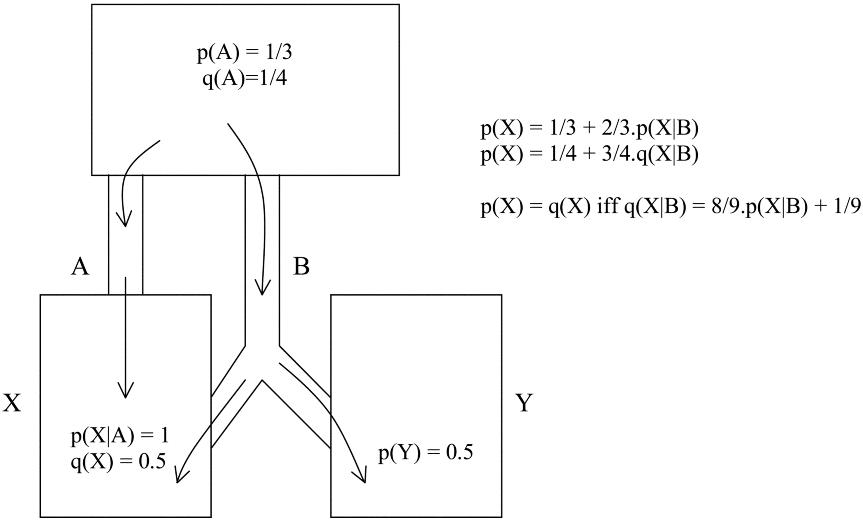
Example 5. Suppose that grain is stored in a chamber with two outflow pipes, A and B (see Figure 1). Pipe A empties into a second chamber X, while pipe B empties into both chamber X and another chamber Y. Suppose that we know the amount of grain stored in the first chamber, as well as the amount that ends up in chamber X when the outflow pipes are opened so that we are able to estimate with accuracy the probability of any piece of stored grain ending up in chamber X. Say it's one-half. We also know that any grain that goes down A ends up at chamber X, but we can only roughly estimate from the size and position of the pipes the probability that it goes down pipe A or B, and with what probability it will end up in chamber X in the event of it going down pipe B. Suppose now that sampling from the mouth of pipe B shows that we need to revise the degree to which we believe that a stored piece of grain will go down this pipe from, say, one-third to one-quarter. If our conditional degrees of belief in the grain landing up in chamber X given that it goes down B stays the same, then as a matter of consistency we should change our probability for the grain ending up in chamber X. But this would be the wrong thing to do, since we already know how much grain lands up there. So, contrary to the conditioning model, our conditional degrees of belief ought to change in response to the change in probability for the grain going down pipe B.
Grain flows.

We could treat the situation described in Example 5 as a change in the probability that the grain goes down pipe B, accompanied by a change in the conditional probability that it will land up in chamber X given that it goes down pipe B. This would make it amenable to the kind of extended kinematical modeling fleshed out above. But to do this would be to ignore the fact that the change in conditional belief occurs because of the change in belief and does not merely accompany it. Similarly we could imagine a variation on the example in which we learn something about the likelihood of grain landing up in chamber X, given that it goes down pipe B, and then updating our probabilities for it going down pipe A as a result. This variation would be indistinguishable kinematically from the first case, but intuitively is quite different.
At face value this example refutes the Bayesians’ claim that a change in someone's degrees of partial belief for some prospect does not give her reason to change her conditional degrees of belief given the truth of the prospect. Faced with a revised probability for the grain going down pipe B, we can opt to revise our degree of belief for the grain landing in chamber X or our conditional degree of belief in landing there given that it goes down pipe B or both. In general, how we choose to accommodate a change in our partial belief in prospect A depends, for each prospect B, on how entrenched (to use a term from AGM belief revision theory) our degrees of belief for B are relative to our conditional degrees of belief for B given A. Probability theory alone cannot determine how to make the accommodation: Some judgment must be made as to the epistemic standing of both our conditional and our unconditional beliefs. This is not to dismiss Bayesian conditioning, but to emphasize that it should not be thought of as a universal and mechanical rule of updating, but as a technique to be applied in the right circumstances, as a tool in what Jeffrey terms the ‘art of judgment’.
Appendix: Proofs
Proof of Theorem 1
If q is obtained from p by Adams conditioning on a change in the conditional probability of B given A, then by definition,

and

Similarly,
 $q(X\vert A\neg B) =p(X\vert A\neg B) $
,
 $q(X\vert A) =p(X\vert A) $
. So both the Independence and Rigidity conditions hold. Now suppose that the conditions hold. Then

Proof of Theorem 2
Let A be any member of
 $\{ A_{i}\} $
. Let
 $v(\cdot \vert A) ={}_{def}\, v(\cdot A) -v(A) +v(T) $
. By Theorem 5 of Bradley (Reference Bradley1999, 36),
 $\langle p(\cdot \vert A) ,\,v(\cdot \vert A) \rangle $
represents ≥A over Ω. But by the Rigidity of conditional preference,
 $X\geq {}_{A}\, Y\Leftrightarrow X\geq {}^{*}_{A}\, Y$
. So
 $\langle p(\cdot \vert A) ,\,v(\cdot \vert A) \rangle $
represents
 $\geq {}^{*}_{A}$
over Ω. Then in view of the assumption that ≥ and ≥* are unbounded it follows from Theorem 7 (Bradley Reference Bradley1999, 38), there exists a pair of probability and desirability measures, 〈q, w〉, that represents ≥* over Ω and such that
 $w(\cdot \vert A) =v(\cdot \vert A) $
, where
 $w(\cdot \vert A) ={}_{def}\, w(\cdot A) -w(A) +w(T) $
. Finally it follows from Theorem 2 (Bradley Reference Bradley1999, 33) that
 $q(\cdot \vert A) =p(\cdot \vert A) $
.
 $\blacksquare $