Introduction
Participation in physical activity is a well-known contributor to maintaining good health across the population (World Health Organization, 2010). In people with PD physical activity may positively influence cardiovascular health, bone health, cognition, fatigue, mood and response to dopamine replacement therapy (Speelman, van Nimwegen, Borm, Bloem, & Munneke, Reference Speelman, van de Warrenburg, van Nimwegen, Petzinger, Munneke and Bloem2011). Performance of physical activity may also have a neuro-protective effect (Zigmond & Smeyne, Reference Zigmond and Smeyne2014), and contribute to normalising cortical excitability in people in the early stages of the disease (Fisher et al., Reference Fisher, Wu, Salem, Song, Lin, Yip and Petzinger2008). It has been recommended that people with PD strive to achieve the recommended levels of physical activity laid out in the global recommendations on physical activity for health (Keus et al., Reference Keus, Munneke, Graziano, Paltamaa, Pelosin, Domingos and Bloem2014). These guidelines state that older adults should do at least 150 minutes of moderate-intensity, or 75 minutes of vigorous-intensity aerobic physical activity per week (World Health Organization, 2010). In addition to sport and planned exercise, physical activity can include activity performed in the context of recreation, leisure time, transport, occupation, daily, family and community activities (World Health Organization, 2010).
Physical activity participation in people with PD is low, with research suggesting that people with PD engage in approximately 30% less physical activity than age-matched healthy controls (Lord et al., Reference Lord, Godfrey, Galna, Mhiripiri, Burn and Rochester2013; van Nimwegen et al., Reference van Nimwegen, Speelman, Hofman-van Rossum, Overeem, Deeg, Borm and Munneke2011). Even newly diagnosed people with PD have been found to engage in substantially reduced amounts of ambulatory activity than their healthy counterparts (Lord et al., Reference Lord, Godfrey, Galna, Mhiripiri, Burn and Rochester2013). The amount of ambulatory or walking activity has also been shown to decline as the disease progresses, with the largest decline seen in time per day spent in moderate intensity ambulatory activity (Cavanaugh et al., Reference Cavanaugh, Ellis, Earhart, Ford, Foreman and Dibble2012). Some people with mild to moderate PD do however appear to meet the recommended levels of activity (Benka Wallen, Franzen, Nero, & Hagstromer, Reference Benka Wallen, Franzen, Nero and Hagstromer2015; Cavanaugh et al., Reference Cavanaugh, Ellis, Earhart, Ford, Foreman and Dibble2012). Furthermore, recent research has shown that under certain circumstances, physical activity levels can be increased in some people with PD (Speelman, van Nimwegen, Bloem, & Munneke, Reference Speelman, van Nimwegen, Bloem and Munneke2014).
In order to enhance activity levels across the PD population, it is important to understand what factors influence the level and intensity of activity undertaken in this population. Previous studies using questionnaire-based assessments of physical activity have indicated that factors such as age, gender, disease severity, previous falls, fear of falling, depression, anxiety, fatigue and pain (Trail, Petersen, Nelson, & Lai, Reference Trail, Petersen, Nelson and Lai2012; van Nimwegen et al., Reference van Nimwegen, Speelman, Hofman-van Rossum, Overeem, Deeg, Borm and Munneke2011) can influence physical activity levels in people with PD. While useful, the measure of physical activity in these studies was via self-report, which is known to be influenced by reporting bias and/or poor recall.
The use of accelerometers to measure activity can provide a more objective and sophisticated analysis of volume, intensity and patterns of activity. Two studies have explored the factors associated with average daily ambulatory activity (Lord et al., Reference Lord, Godfrey, Galna, Mhiripiri, Burn and Rochester2013) and energy expenditure (Dontje et al., Reference Dontje, de Greef, Speelman, van Nimwegen, Krijnen, Stolk and van der Schans2013) measured using accelerometers, in people with PD. These studies identified factors related to the person, cognitive capacity and walking capacity that were associated with both time spent in bouts of ambulatory activity >2mins and total energy expenditure. Each of these studies has however focused on a narrow population of people with PD, such as people with newly diagnosed PD (Lord et al., Reference Lord, Godfrey, Galna, Mhiripiri, Burn and Rochester2013) and people who self-identified as sedentary (Dontje et al., Reference Dontje, de Greef, Speelman, van Nimwegen, Krijnen, Stolk and van der Schans2013), which only represents a proportion of people with PD.
People with mild to moderate symptoms of PD may be at greater risk of reducing their ambulatory activity than those who are newly diagnosed; however they may not yet be defined as physically inactive. Therefore, exploring ambulatory activity using objective methods in this population is important. The aim of this study was therefore to examine the factors associated with participation in moderate and high intensity ambulatory activity in people with mild to moderate PD.
Method
This cross-sectional study is a secondary analysis of data collected at the baseline assessment of a randomised controlled trial (RCT) for which the protocol, including the full participant eligibility criteria have previously been published (Brauer et al., Reference Brauer, Woollacott, Lamont, Clewett, O’Sullivan, Silburn and Morris2011).
Participants
Community-dwelling people with idiopathic PD diagnosed by a neurologist were recruited through local movement disorders specialists, neurologists and community advertising in Brisbane, Australia. To be included participants had to have clinically evident reduction in step length or gait speed (gait hypokinesia), be able to walk independently, and score greater than 23 on the Mini-Mental State Examination (MMSE) (Folstein et al., 1975). People with neurological conditions other than PD, comorbidities that could affect walking, severe dyskinesia, or a history of neurosurgery were excluded. People who reported an allergy to adhesive tapes were unable to wear the activity monitor and were therefore excluded from this study.
The study received ethical approval from the Medical Research Ethics Committee of the University of Queensland (project # 2009000532) and the Health Research Ethics Committee of the Princess Alexandra Hospital in Queensland (project # 2009/013), Australia. Informed, written consent was obtained from all participants.
Procedure
Eligible participants attended a single assessment session at a hospital outpatient department in Queensland, Australia. The assessment session occurred during the participants’ ‘on’ phase in their usual medication cycle. For participants who did not experience motor response fluctuations the assessment was scheduled one hour after a usual dose of medication. Physical assessment was conducted first by a physiotherapist. Following a break, a cognitive assessment was completed by a neuropsychologist.
Measures
Ambulatory activity was assessed using the ActivPAL™ (PAL Laboratories, Glasgow, UK), during waking hours for three consecutive days after the clinical assessment. Participants were asked to continue their usual daily activities and take their medication as prescribed during this time. The ActivPAL™ is a small lightweight accelerometer, worn on the anterior thigh. It has demonstrated excellent accuracy measuring step count during treadmill (Feito, Bassett, & Thompson, Reference Feito, Bassett and Thompson2012; Ryan, Grant, Tigbe, & Granat, Reference Ryan, Grant, Tigbe and Granat2006) and outdoor walking, with some terrain challenges and attention demands, at a variety walking speeds in healthy young (Busse, van Deursen, & Wiles, Reference Busse, van Deursen and Wiles2009; Ryan et al., Reference Ryan, Grant, Tigbe and Granat2006) and older adults (Grant, Dall, Mitchell, & Granat, Reference Grant, Dall, Mitchell and Granat2008). The ActivPAL™ has also been used to quantify sedentary behaviour (Chastin et al., Reference Chastin, Baker, Jones, Burn, Granat and Rochester2010) and ambulatory activity (Lord, Godfrey, Galna, Burn, & Rochester, Reference Lord, Godfrey, Galna, Burn and Rochester2012; Lord et al., Reference Lord, Godfrey, Galna, Mhiripiri, Burn and Rochester2013; Rochester, Chastin, Lord, Baker, & Burn, 2012) in people with PD.
The ActivPAL™ counts the number of steps and records time spent stepping, standing and sedentary. The ActivPAL™ output presents each 24-hour period divided into 15 second epochs. Each 15 second epoch was screened and the number of steps and time spent walking during each 24-hour period of recording were extracted from the ActivPAL™ output. A minimum of one 24 hour period (midnight to midnight) of ActivPAL output, including evidence of activity across the usual waking day was required for further analysis. Participants were also asked to complete an activity diary indicating if and when they were mobile outside their home, and if they engaged in walking for exercise. Participants whose ActivPAL data did not meet the criteria above were contacted by phone to clarify their activity. Erroneous data was removed from further analysis.
The average daily ambulatory volume (minutes and total steps), frequency and intensity were calculated from all data. The dependent variables were based on measures of ambulatory activity intensity used in people with neurological conditions, and included the frequency of and time spent in ambulation bouts of low (<30 steps/minute), moderate (30–80 steps/minute) and high intensity (>80 steps/minute) ambulatory activity (Manns & Baldwin, Reference Manns and Baldwin2009). An ambulation bout was defined as any 15 second period in which 2 or more steps were recorded. The end of the activity bout was defined as any 15 second period in which less than 2 steps was recorded.
Explanatory variables represented factors related to the person, body structure and functions and activity or participation domains outlined in the World Health Organisation's classification of functioning disability and health (ICF) (World Health Organization, 2001). Personal factors included age, disease duration, past falls history, ambulatory self-efficacy and health-related quality of life (HRQOL). Ambulatory self-efficacy was measured using the Ambulatory Self Confidence Questionnaire (ASCQ) (Asano, Miller, & Eng, Reference Asano, Miller and Eng2007) which has demonstrated high test-retest reliability (ICC = 0.868) in people with PD (Brauer, Lamont, Morris, & Woollacott, Reference Brauer, Lamont, Morris and Woollacott2010). The 39 item Parkinson's disease questionnaire (PDQ-39) (Jenkinson, Fitzpatrick, Peto, Greenhall, & Hyman, Reference Jenkinson, Fitzpatrick, Peto, Greenhall and Hyman1997) was used to evaluate HRQOL. Measures of body structure and function included severity of PD, depression, attention and executive function. Severity of PD was assessed using the Movement Disorders Society revised Unified Parkinson's Disease Rating Scale (MDS-UPDRS) (Goetz et al., Reference Goetz, Tilley, Shaftman, Stebbins, Fahn, Martinez-Martin and LaPelle2008) and the Hoehn and Yahr scale (Hoehn & Yahr, Reference Hoehn and Yahr1967). The Trail Making Test (TMT) (Delis, Kaplan, & Kramer, Reference Delis, Kaplan and Kramer2001), and Hayling and Brixton (Burgess & Shallice, Reference Burgess and Shallice1997) tests were used to assess executive functions including cognitive flexibility, response inhibition and the ability to maintain and shift mental set. The Test of Everyday Attention telephone search test and telephone search with distraction tests (Robertson, Ward, Ridgeway, & Nimmo-Smith, Reference Robertson, Ward, Ridgeway and Nimmo-Smith1994) were chosen to assess selective and divided attention respectively. Where available, the raw scores on these tests were converted to scaled scores in order to accommodate the age range of the sample.
Depression was rated using the 15-item Geriatric Depression Scale (GDS-15) (Ertan, Ertan, Kiziltan, & Uyguçgil, 2005). The Freezing of Gait Questionnaire (FOG-Q) (Giladi et al., 2000; 2009), six-minute walk test (6MWT), 360 degree turn test and Timed Up and Go (TUG) test with and without secondary motor, counting and language tasks (Shumway-Cook, Brauer, & Woollacott, 2000) were used to measure walking and balance capacity, under the domain of activity. Self-selected walking speed, cadence and step length were also measured as the participant completed three trials of walking at a comfortable pace over an 8m GAITRite® mat (CIR Systems Inc, Clifton NJ 07012). The GAITRite® has been used extensively in this population (Brauer & Morris, Reference Brauer, Lamont, Morris and Woollacott2010; Lord et al., 2008) and has demonstrated strong concurrent validity (ICC = 0.99) and test retest reliability (ICC = 0.78–0.97) in measuring gait speed, cadence and stride length in healthy adults (Bilney, Morris, & Webster, 2003). Participants walked a 12m path with an 8m GAITRite® positioned in the centre of this path. Single and dual task walking conditions were measured as described above for the TUG test. The order of the gait tasks was randomised to minimise the effect of fatigue and learning.
Data Analysis
Data were screened visually for normality using histograms and statistically using the Kolmogorov-Smirnov test. The sample was described using descriptive statistics including means (SD) for continuous normally-distributed data, medians (inter-quartile range) for non-parametric data and frequencies (%) for categorical variables. The correlation between dependent and independent variables was calculated using the Pearson Product Moment (r) for normally distributed data, and Spearman's Rank Order (rho) for non-parametric data. The independent variables which were most strongly associated with the dependent variable were selected for each test domain and entered simultaneously into a multiple linear regression analysis using an enter method. Only independent variables with a statistically significant, moderate correlation coefficient r > 0.3 (Cohen, Reference Cohen1988) were considered for regression modelling. Independent variables entered into the regression analysis were examined for multi-collinearity using the criteria of correlation between variables of less than 0.7, a tolerance score of greater than 0.1 and a variance inflation factor of less than 10. Patterns of residuals were examined to test normality assumptions for the regression analysis (Pallant, 2011).
Results
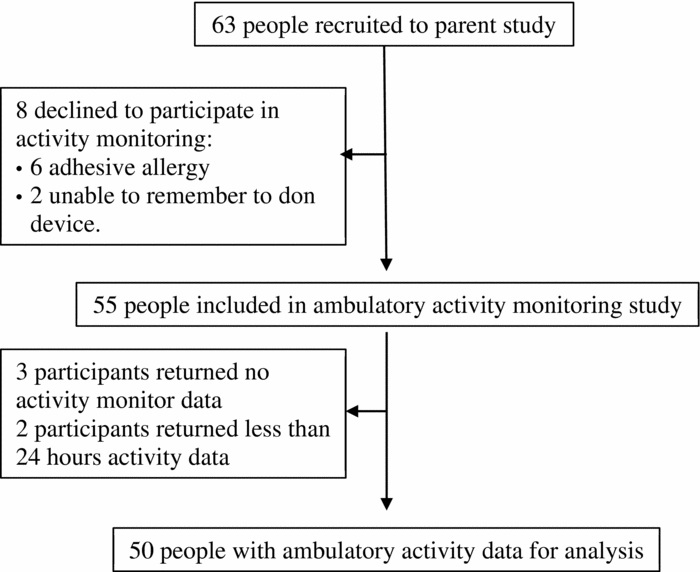
Data from a total of 50 people with mild to moderate PD were collected for this study. The flow of participants from recruitment to the parent RCT to completion of this study is shown in Figure 1.
Participant recruitment flow chart.

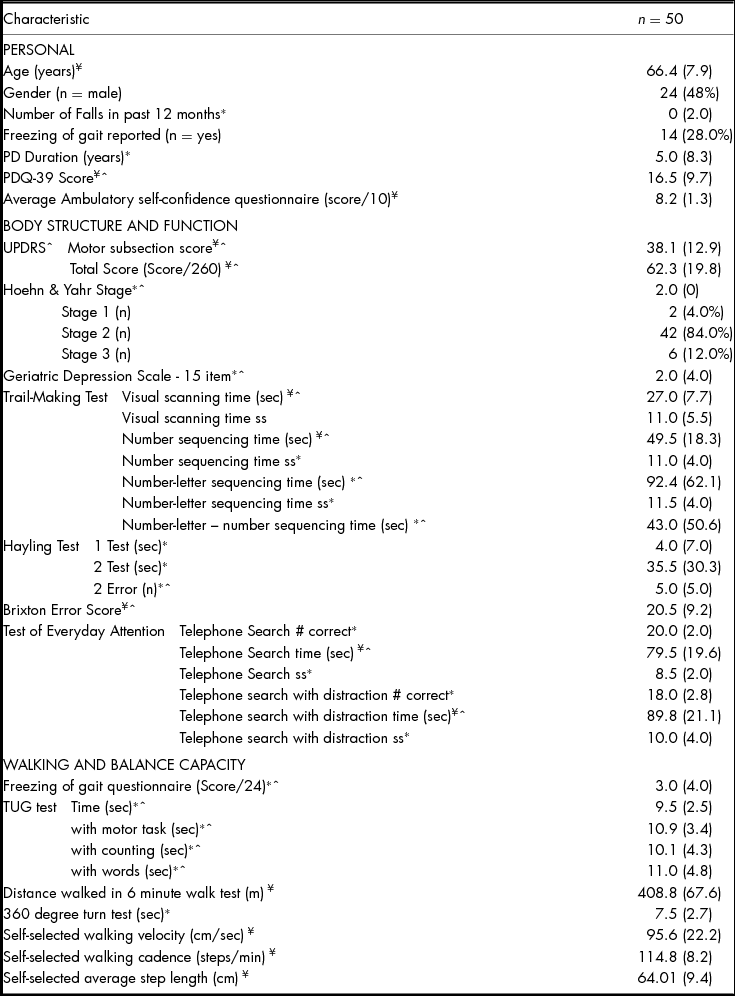
Characteristics of the participant sample are shown in Table 1. The majority of participants were female (52%), with a mean age of 66.4 (SD = 7.9) years. Participants were all assessed as having mild to moderate symptoms of PD, with the majority (84%) of participants rated at Hoehn and Yahr Stage 2. Average walking confidence was high (ASCQ μ = 8.2; SD 1.3); however 40% of participants reported having fallen at least once in the 12 months prior to the study.
Descriptive Statistics of Participant Characteristics and Explanatory Variables

¥Data normally distributed, mean (SD) reported; *data not normally distributed, median (IQR) reported SS – Scaled score. ^Higher score indicates greater impairment/lower performance.
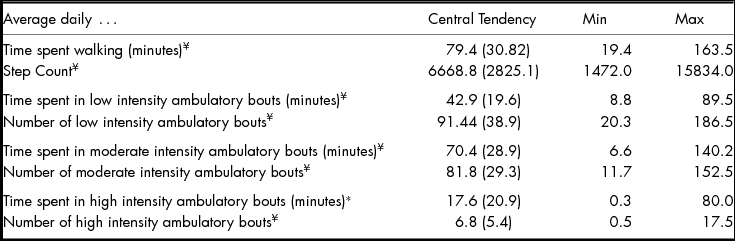
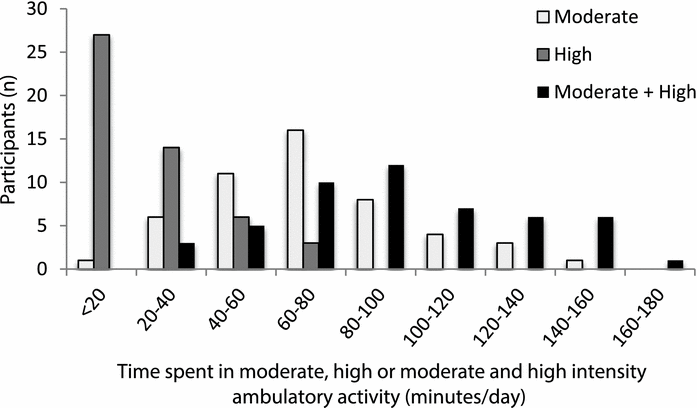
Average daily volume and intensity of ambulatory activity bouts for this sample are shown in Table 2. All individuals participated in ambulatory activity bouts at the three intensity levels. Low intensity ambulatory activity bouts were performed most frequently; however the largest amount of time per day was spent walking in moderate intensity ambulatory bouts (Table 2). Figure 2 shows the number of participants who engaged in moderate and high intensity ambulatory activity across a range of durations of time per day. For most participants (n = 27) less than 20 minutes per day was spend in high intensity ambulatory activity. When the time spent in moderate and high intensity ambulatory activity was summed together, all participants achieved at least 20 minutes per day (Figure 2).
Duration and Number of Ambulatory Bouts Per Day in Total, and for Low, Moderate and High Intensity Ambulatory Activity
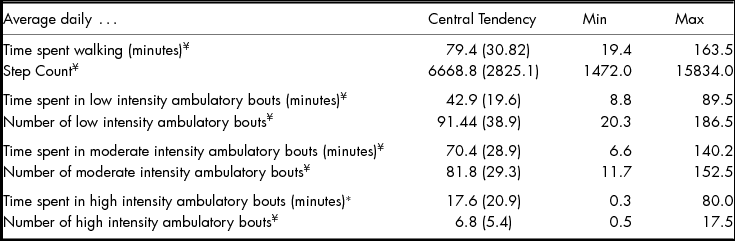
¥Data normally distributed, mean (SD) reported; *data not normally distributed, median (IQR) reported.
Number of participants to engage in moderate and/or high intensity ambulatory activity for 20, 20–40, 40–60, 60–80, 80–100, 100–120, 120–140, 140–160 and 160–180 minutes per day.
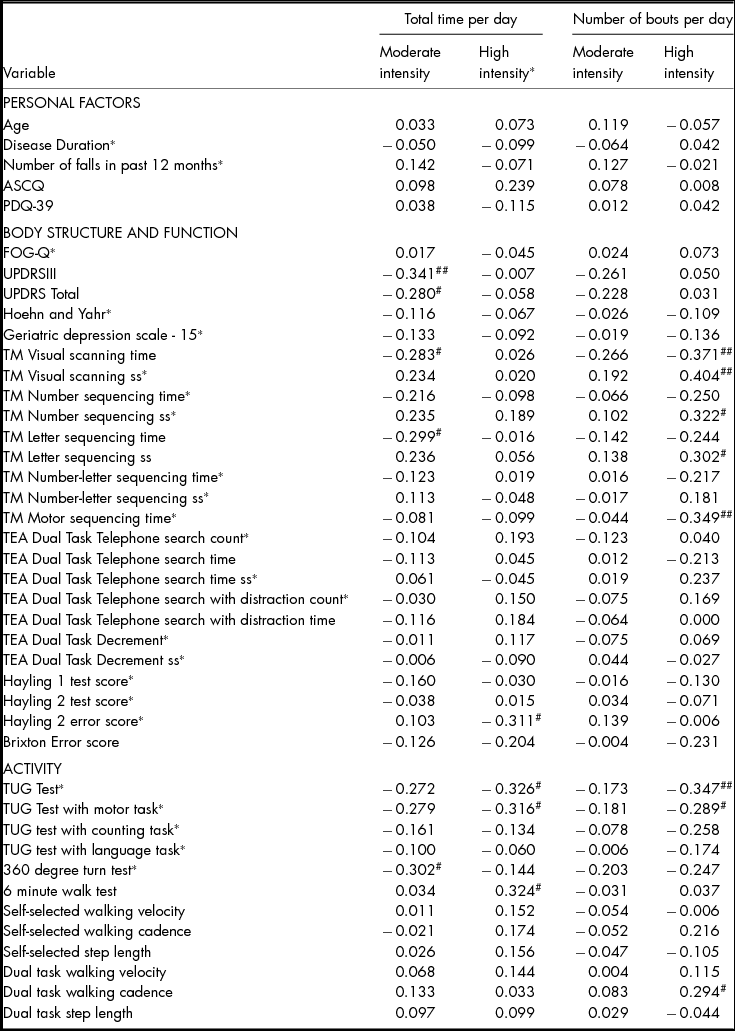
Less severe motor impairment (UPDRS III subsection score) and faster 360 degree turn test were moderately associated with greater time spent in moderate intensity ambulatory activity bouts (r = −0.341, p = .015; r = −0.302; p = .033). There were weak associations between time spent in moderate intensity ambulatory activity and less severe PD symptoms overall (UPDRS total score) and faster visual scanning and letter sequencing times (TMT) (r = 0.280, p = .049; r = −0.283, p = .049; and r = −0.299, p = .037 respectively). Better performance on the TUG test with and without added motor task was moderately associated with both, greater time spent in high intensity ambulatory activity and more frequent high intensity ambulatory activity bouts (r = 352 −0.289 to −0.347; p = .014–.044). Time spent in high intensity ambulatory activity was also moderately associated with the number of errors made during the Hayling 2 test (r = −0.311; p = .033), and the 6MWT (r = 0.324; p = 0.022). The number of high intensity ambulatory activity bouts performed each day was also moderately associated with performance on the visual scanning (r = 0.404; p = .004), number sequencing (r = 0.322; p = .024), letter sequencing (r = 0.302; p = .030) and motor sequencing (r = 0.349; p = .014) tasks of the TMT. The direction of these associations suggests that better performance on each of these tests is associated with more time spent engaged in high intensity ambulatory activity and participation in more frequent bouts of high intensity ambulatory activity.
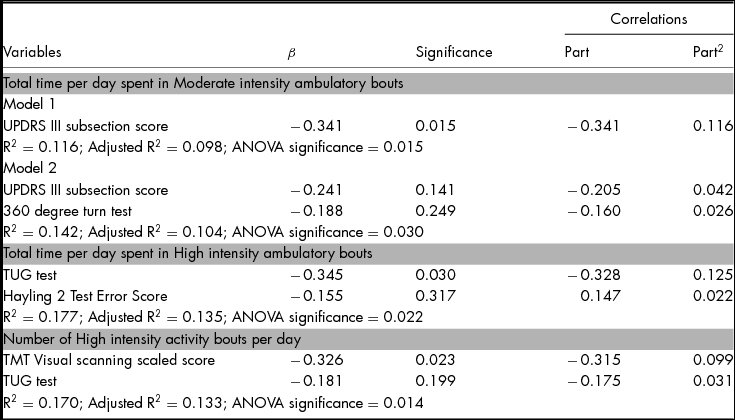
Independent variables that showed the strongest association with each of the dependent variables were entered into a linear regression model. The regression modelling is shown in Table 3. The UPDRS III subsection score and 360 degree turn test were the only independent variables sufficiently strongly associated with time per day spent in moderate intensity physical activity to be considered for the regression model. The adjusted R2 value demonstrates that the score on the UPDRS III alone explained 9.8% of variation and made a significant independent contribution (p = .015) to explaining the time per day spent performing moderate intensity ambulatory activity bouts. The 360 degree turn test also made a significant independent contribution to explaining moderate intensity ambulatory activity time (adjusted R2 = 0.081; p = .027). The UPDRS III and the 360 degree turn test were highly correlated (r = 0.529) therefore when combined into a single regression model, neither made a significant independent contribution to the model.
Association of Independent Variables to Ambulatory Activity
¥Data normally distributed, Pearson correlation coefficient used; *data not normally distributed, Spearman's rank order reported. #p <.05, ##p <.02. SS – Scaled score; TM – Trail Making; TEA – Test of Everyday Attention.
Regression Modelling for Ambulatory Activity
β = standardised Beta coefficient; ANOVA = Analysis of Variance.
The TUG test, combined with the Hayling 2 error score explained 13.5% (p = .022) of the variance in time per day spent in high intensity ambulatory activity bouts. TUG test performance made the strongest independent contribution to explaining variation in time per day spent performing high intensity ambulatory activity (p = .030). In contrast, performance on the TMT visual scanning section was the only variable to make any significant contribution to explaining the number of high activity bouts performed per day (p = .023). TUG test performance made a small and non-significant contribution (p = .199) to explanation of this variable. This model, including the TMT visual scanning scaled score and the TUG test score explained 13.3% of the frequency of high intensity bouts of ambulation (p = .014).
Discussion
To our knowledge this is the first study to explore factors related to participation in moderate and high intensity ambulatory activity in people with mild to moderate PD. The volume of ambulatory activity measured in this sample was within the range of that reported in studies in people of similar age, with similar disease severity (range from 4725 to 10,261 steps) (Cavanaugh et al., Reference Cavanaugh, Ellis, Earhart, Ford, Foreman and Dibble2012; Skidmore et al., Reference Skidmore, Mackman, Pav, Shulman, Garvan, Macko and Heilman2008), and slightly higher than that reported by Lord et al. (Reference Lord, Godfrey, Galna, Mhiripiri, Burn and Rochester2013) in their sample of people with newly diagnosed people with PD. A very promising finding is that all participants in this study were able to achieve sufficient moderate and high intensity ambulatory activity to satisfy the WHO recommendations (World Health Organization, 2010). Participants in the current study appeared to spend more time in moderate intensity physical activity than that reported previously (Cavanaugh et al., Reference Cavanaugh, Ellis, Earhart, Ford, Foreman and Dibble2012); however differences in the definitions of moderate intensity used in this study compared to that by Cavanaugh et al. (Reference Cavanaugh, Ellis, Earhart, Ford, Foreman and Dibble2012), make direct comparisons difficult.
Unmodifiable personal factors such as age and disease duration were not associated with the number of bouts or time spent walking at moderate or high intensity activity levels. This is in contrast to previous studies in which greater age has been associated with lower levels of physical or ambulatory activity in PD (Dontje et al., Reference Dontje, de Greef, Speelman, van Nimwegen, Krijnen, Stolk and van der Schans2013; Lord et al., Reference Lord, Godfrey, Galna, Mhiripiri, Burn and Rochester2013). Factors that were correlated with number of bouts or time spent walking were related to body function and walking capacity and are potentially modifiable.
Severity of motor PD symptoms was the only variable identified as a significant determinant of time spent engaged in moderate intensity ambulatory activity, with higher levels of severity associated with less time spent in moderate intensity ambulatory activity. This supports previous studies where more severe motor symptoms have been related to lower levels of physical activity (Brauer et al., Reference Brauer, Woollacott, Lamont, Clewett, O’Sullivan, Silburn and Morris2011; Cavanaugh et al., Reference Cavanaugh, Ellis, Earhart, Ford, Foreman and Dibble2012; Skidmore et al., Reference Skidmore, Mackman, Pav, Shulman, Garvan, Macko and Heilman2008). It is however important to note that the severity of motor symptoms explained less than 10% of the variation in the current study. The impact of factors other than those studied here need to be investigated. Understanding the factors associated with time spent engaging in moderate intensity activity is an important as it has been shown to decline significantly in people with mild to moderate PD over 12 months (Cavanaugh et al., Reference Cavanaugh, Ellis, Earhart, Ford, Foreman and Dibble2012).
Importantly, these results demonstrated that factors associated with engagement in moderate intensity ambulatory activity differed to those associated with engagement in high intensity activity. This likely reflects the different skills and body functions required to walk at different levels of intensity. Walking capacity as measured by the TUG test and executive function made the strongest contribution to explaining time spent in high intensity ambulatory activity. In this study, participants were asked to complete the TUG as fast as they safely could, effectively testing their ability to walk at a high intensity for a very short time frame. In contrast, the distance walked in the 6MWT did not make any significant contribution to explaining time spent in high intensity ambulatory activity, however has previously been identified as a significant determinant of mean daily energy expenditure in people with PD who were identified as sedentary (Dontje et al., Reference Dontje, de Greef, Speelman, van Nimwegen, Krijnen, Stolk and van der Schans2013). Distance walked in 6 minutes may therefore be more closely linked to overall activity or length of activity bout than high intensity activity.
No other measures of gait performance demonstrated a relationship with physical activity levels, which highlights the importance of exploring factors other than physical ability, which may contribute to physical activity levels. Better executive function was significantly associated with greater engagement in high intensity ambulatory activity. In particular, the speed of visual scanning and executive functions such as response inhibition may be important contributors to participation in high intensity ambulatory activities; these functions might be linked to the ability to plan movements and navigate in complex environments. The only other study to investigate this found a weak association between higher cognitive levels and time spent walking in bouts greater than two minutes (Lord et al., Reference Lord, Godfrey, Galna, Mhiripiri, Burn and Rochester2013). Participation in physical exercise has been associated with improvements in executive function in people with PD (Tanaka et al., Reference Tanaka, Quadros, Santos, Stella, Gobbi and Gobbi2009), and while the current study cannot suggest a causal relationship, it provides further impetus to explore this relationship.
The explanatory variables included in this model explained only a small proportion of variation in ambulatory activity behaviours. There are additional personal and social factors that were outside the scope of this study but are likely to impact strongly on activity levels. The perception of the walkability of one's environment has been shown to impact on incidental walking activity as a mode of transportation (Jack & McCormack, Reference Jack and McCormack2014). In particular, factors such as perceived personal safety, the availability of pedestrian infrastructure and the connectedness of services within the environment were found to impact on the willingness of people to walk over other forms of transport. Socio-economic factors such as work hours and income have also been identified as important determinants of participation in moderate and high intensity physical activity (Allen & Vella, Reference Allen and Vella2015). None of the explanatory variables included in this study were associated with the number of moderate intensity bouts of ambulatory activity. There a number of possible reasons for this which warrant further investigation. Possibly the frequency of moderate intensity bouts is more associated with other factors that were not explored in this study. The relatively conservative definition of moderate intensity ambulatory activity may also have influenced the ability to separate low and moderate intensity activity.
It is promising that in this study all participants engaged in at least some moderate and high intensity ambulatory bouts. This high level of engagement could suggest that the thresholds used to define moderate and high intensity bouts were too low for this population. These categories were derived from studies of subacute stroke survivors (Manns & Baldwin, Reference Manns and Baldwin2009). Indeed, Cavanaugh et al. (Reference Cavanaugh, Ellis, Earhart, Ford, Foreman and Dibble2012) used a higher cadence to define moderate intensity in people with PD than was used to define high intensity ambulatory activity in this study. In some people with PD typically with greater disease severity, cadence can be abnormally high compared to healthy controls when walking at a given walking velocity. While it needs to be considered, it is unlikely that this has affected our data as algorithms developed for accelerometers to identify and count steps, are unlikely to categorise freezing or festination as rapid stepping, but actually as standing (Moore, MacDougall, & Ondo, Reference Moore, MacDougall and Ondo2008). There is little consensus in the literature regarding the most appropriate method of evaluating and interpreting ambulatory activity data collected during free-living walking activity. Future research is needed to validate measures of walking intensity with measures of energy expenditure in populations like PD in which the overall efficiency of walking may be affected.
Decisions such as the length of activity epochs and rest periods can also impact on patterns of walking activity identified and therefore the intensity of activity measured (Ayabe, Kumahara, Morimura, & Tanaka, Reference Ayabe, Kumahara, Morimura and Tanaka2013; Edwardson & Gorely, Reference Edwardson and Gorely2010; Knarr, Roos, & Reisman, Reference Knarr, Roos and Reisman2013). In this study a relatively short epoch of 15 seconds was used under the belief that periods of walking at different intensities would be more discretely identified. The selection of 15 second epoch is also consistent with past analyses of patterns of activity and sedentary behaviours in people with PD (Chastin et al., Reference Chastin, Baker, Jones, Burn, Granat and Rochester2010; Lord et al., Reference Lord, Godfrey, Galna, Mhiripiri, Burn and Rochester2013; Rochester et al., 2012). A longer epoch would result in the step count being averaged across the entire period and therefore recorded at a lower level of intensity. Participants in this study engaged in a relatively high amount of moderate intensity ambulatory activity, however the number of moderate intensity ambulatory activity bouts was not associated with any of the explanatory variables measured. At present there is no consensus as to how long or short a rest period should be used in analysis such as this. It is important for future research to inform these decisions based on the aim of the study, and the activity patterns of the population being studied.
The results of this study were drawn from data collected as part of a RCT; therefore the method was not specifically designed for this study. As such there are some factors, such as fatigue, motivation to exercise, past participation in exercise, social support and body mass index that may impact on participation in ambulatory activity, but were not included in data collection for this study. The number of independent variables that could be included was also limited by the sample size, which was sufficient for the number of variables included in the regression models. Participants in this study represented a sample of high functioning people with PD. In addition to having only mild to moderate PD, people with comorbidities such as musculoskeletal pain and cardiovascular disease were excluded. In addition, these results are representative of a motivated sample of people with PD who volunteered to participate in research related to walking. These sampling limitations should be considered when generalising these results.
Conclusion
The results of this study demonstrate that some people with mild to moderate PD are able to participate in moderate and high intensity bouts of ambulatory activity. There are likely many factors that contribute to participation in ambulatory activity in this population, with disease severity, gait and executive function capacity making a small contribution to explaining of engagement in moderate or high intensity ambulatory activity. Additional personal and social factors are likely to impact strongly on activity levels, and warrant future investigation.
Acknowledgements
The authors would like to thank all of the participants. We would also like to acknowledge the support of Katrina Kemp, Nampech Wuthapanich and Sandy Clewett in data collection and the assistance of Professors John O’Sullivan and George Mellick in participant recruitment.
Funding
This study was supported by a National Health and Medical Research Council Project Grant (ID# 511170) and a PhD grant from Parkinson's Queensland Incorporated awarded to Robyn Lamont.
Declaration of Interest
None.