INTRODUCTION
Most of the research on voting behaviour in Africa has concentrated on what it means to vote ethnically and what other factors besides ethnicity affect vote choice. As part of the ethnicity explanation, the instrumentalist theory covers the ground in the current African political behaviour literature. It holds that ethnicity is constructed to gain political and economic benefits from ethnic members’ collective action, and that ethnic membership would not persist without that strategic purpose (Olzak Reference Olzak1992; Posner Reference Posner2005). Politicians develop clientelist links along ethnic lines to secure political support (Berman Reference Berman1998; Vicente & Wantchekon Reference Vicente and Wantchekon2009). Voters likewise organise collective support as voting for their co-ethnic leaders, expecting that goods and prestigious positions will be made available to them when their leader is in power. A non-ethnic account of voting intention is sociotropic – as in western democracies, macroeconomic issues that affect everybody's wellbeing (e.g. high levels of growth, security, anti-corruption) electorally matter, since some voters support or oppose incumbents based on their evaluations of government performance (Lindberg & Morrison Reference Lindberg and Morrison2008; Bratton et al. Reference Bratton, Bhavnani and Chen2012).
The current theories of voting behaviour in Africa, however, fail to consider economic interests, where policy preferences are collective but also exclusive, that influence the nature of partisan differences. While analysing votes in advanced democracies is implausible without knowing one's ideological preference or issue position, politics in Africa is presumed to be merely instrumentalist or sociotropic without considering personal values or policy preference. Meanwhile, economic interests often overlap ethnic divisions because people living in close proximity are likely co-ethnics and endowed with similar environmental resources and jobs (Bates Reference Bates, Rothchild and Olorunsola1983). While agriculture, mining and agro-manufacturing are the essential sectors for many African countries’ economy, these natural-resource-dependent industries, which are more geographically concentrated, may help shape an economic niche of an ethnic group.Footnote 1 Even in countries like Kenya where ethnicity is assumed to be the most efficient means to construct political coalitions, cross-cutting linkages between ethnic groups and industry groups are strong – that is, labour force or economic interest is somewhat ethnically divided. In such environments, it could be much more convenient for politicians to mobilise ethnic communities for a policy coalition, for policies implemented in the local sector improve most ethnic members’ living. In turn, political opposition is naturally the core ethnic groups who disagree with the government's policies or goals. Do both sector and ethnicity factors have their independent effects on vote choice? How do the two factors interact in influencing a vote?
This paper describes a test of the correlations between economic sectors and ethnicity as vote motives in Kenya. Kenya is an appropriate context because there has been a series of competitive elections with strong ethnic voting patterns (Ndegwa Reference Ndegwa1997; Lynch Reference Lynch2006) and also because of its ecological diversity that creates various agricultural and agro-related jobs and activities, which, thus, yield diversified policy preferences. In the past consecutive presidential elections in 2007, 2013 and 2017, Kenyan parties merged, split, formed or left coalitions to increase their electoral strength and to belong to a winning team. Throughout the series of elections, Kikuyu and Luo ethnic groups, whose policy interests are separate and distinct from each other, have forged the main axis of political competition along which the other ethnic parties have shifted their positions. The Kikuyu's incumbent coalition of export-crop farmers in the upper zones rivals the staple-crop growing lowland-based opposition led by Luos. Though the larger ethnic groups such as Kalenjin, Luhya, Kamba, as well as Kikuyu and Luo are more likely to vote with greater ethnic solidarity than some smaller groups including Kisii, Mijikenda and Turkana (Kasfir Reference Kasfir1979; Nagel Reference Nagel, Olzak and Nagel1986; Posner Reference Posner2005),Footnote 2 their leaders’ options to build a desirable coalition for a presidential race are limited by policy preferences of their ethnic members.Footnote 3 The Kalenjin ethnic group, having shifted its support from the opposition coalition to the ruling party, is adaptable to any of the two major electoral coalitions for their policy goals because they live in an agriculturally rich environment, produce diverse crops and have numerous policy interests. As Kalenjins switched to the incumbent camp for the 2013 elections, the coalition outcome of the contest had reinforced the highland dimension in the major electoral axes. On the other hand, Kamba and Luhya ethnic groups have fielded their own ethnic candidates for presidency in 2007 and 2013, respectively. But whenever they returned to form a coalition, their ally choice was always the Luo-dominated opposition party whose policy goals are similar to them.
To understand how well each factor explains voting when industrial and ethnic interests crosscut each other, I draw on the geocoded Afrobarometer survey of Kenya conducted in 2008, 2012 and 2014, combined with the Agro-Ecological Zones (AEZ) spatial data. While the AEZ data identify desirable agricultural sub-sectors in each environmental zone, the dataset makes it possible to identify one's economic interest determined by agricultural endowments, which might be highly electorally relevant. Specifically, the aim is to reveal evidence of an interaction effect of a sector-based cleavage with ethnic membership on electoral decision-making by undertaking statistical tests. Here, I use interaction terms in multiple regression to estimate the effect of the ecological economic situation conditional on ethnic affiliation. The results of this analysis of interaction effects show that residence in the key agricultural subsectors makes a significant difference in the probability of voting even among individuals who are attached to politically coherent ethnic groups.
My attempt to disentangle economic and ethnic incentives emphasises policy issues as the motive of ethnic mobilisation in electoral competition, and improves on the existing literature on ethnicity's instrumental role. First, my argument is more general than the clientelist ethnic mobilisation theories, because it is more likely to be able to account for casting ballots across ethnic groups. When a group's own leader is not running for office, how do members of the group decide whom to support? How would purely ethnic appeals give clues to non-co-ethnics about which party would better serve them? Second, it is more sophisticated than models of patronage-based coalitions, which assume that any desirable mix and match of ethnic groups is possible to form a multiethnic alliance large enough to win an election (Weingast Reference Weingast1979; Bogaards Reference Bogaards2010; Kendhammer Reference Kendhammer2010). I argue for economic voting, likely formed along ethnic cleavages, in pursuit of the voter's preferred policy, and also explain voting by those from minority ethnic groups that are not politically salient.
ETHNIC MOBILISATION AND ECONOMIC VOTING IN AFRICA
More recent electoral studies in Africa emphasise the significance of local public goods provision (e.g. electricity, roads) as an alternative mechanism for economic evaluation of incumbents (Young Reference Young2009; Banful Reference Banful2011). This attempt to attribute vote choice to vested parochial interests raises two questions. First, in a society where ethnicity is politically salient, when do voters respond to expected or improved local resource allocation? Ichino & Nathan's (Reference Ichino and Nathan2013) research in Ghana shows that voters do not necessarily support the party of their own ethnic group when they expect resource allocation to their constituency to be more likely under another party's rule. Weghorst & Lindberg (Reference Weghorst and Lindberg2013) also find that even though there is ample chance of receiving ethno-clientelistic favours, swing voters are more likely to react to targeted local goods. These results describe a tendency that voters care about realistic opportunities of winning rewards in a more systematic way.
Second, why do voters react to certain kinds of local club goods but not others? Of many government programmes, only a few have electoral effects. On this issue, Harding & Stasavage (Reference Harding and Stasavage2013) argue in their cross-national study that voters are responsive to the kinds of goods that make it easier for them to hold governments responsible for policy outcomes. They show that in the case of Kenya, abolishing tuition fees from local schools affected vote choice, but improved education quality did not, because the government is not fully accountable for the latter. This finding is consistent with Harding's (Reference Harding2015) finding that road development in Ghana as a public work attributable to the government affects voter decisions, but educational service does not.
Moreover, instrumentalist theories of ethnic voting generally suggest that co-ethnicity is not a direct motivation. Rather, ethnic identity serves as a convenient cue on which citizens build a unified coalition to win material resources, which essentially have a direct influence on voting. Therefore, co-ethnic support is likely conditioned by the leader's actions or promises to deliver goods and services to the ethnic members (Conroy-Krutz Reference Conroy-Krutz2013; Carlson Reference Carlson2015).
Largely ignored from these accounts, however, is any consideration of positional issues that ‘involve advocacy of government actions from a set of alternatives over which a distribution of voter preferences is defined’ (Stokes Reference Stokes1963: 373). Unless the issue-based coalitions, which show distinct economic policy preferences, do not hold the multiethnic supporters together, strategies of party formation and change might have been contingent on any choice politicians can make. And yet, party systems appear subject to the constraints of social and economic structures. In fact, the debate between position and valence issues underlies Bleck & Van de Walle's (Reference Bleck and Van de Walle2013) argument that from the ruling party's perspective, valence discourses are more useful and powerful than positional ones to continually make an appeal to a large number of voters in Africa. Still, from the voters’ perspective, which party is in power is crucial, provided they believe different parties result in different policy choices and beneficiaries. I suggest a non-valence economic component of voter intentions – industrial sectors that shape the basis of voter choice – and show their interaction effects with ethnic variables.
POLITICAL SALIENCE OF ECONOMIC SECTORS
Governments often offer preferential treatment to certain sectors or industries as a strategy to ensure political survival. A government chooses an industry as a means through which to target benefits to particular groups of the electorate, thereby shaping a coalition of its policy supporters (McGillivray Reference McGillivray2004; Egger & Kreickemeier Reference Egger and Kreickemeier2009; Rosenbluth & Thies Reference Rosenbluth and Thies2010). Many industrial policies – including subsidies, debt relief, trade protection or regulations – serve to favour the policy interests of the incumbent's supporters, while inducing income inequality and unemployment in certain sectors.
A renowned political economy approach to coalition formation would attribute the origin of these kinds of conflicts between sectors to the country's natural endowments. In Commerce and Coalitions, Rogowski (Reference Rogowski, Frieden and Lake1989) argues that under free trade, which benefits the relatively abundant factor of production (land, capital or labour), the patterns of political coalition fall along factor lines (abundant versus scarce). Thus, relatively labour-abundant countries will possess strong labour unions to continue exporting labour-intensive goods such as manufacturing products, while in relatively land-abundant countries, farmers and miners will expand their influence for more production and exports of primary commodities. Integrating the capital mobility concern into Rogowski's approach to trade coalitions, Frieden (Reference Frieden1991) shows that the government's leeway on exchange rate policy also has a differential impact on various sectors. The differences in policy preferences lead to the formation of four socioeconomic groups, which differ in how much they care about exchange rates and domestic prices. These groups are the producers of exports, domestic-market-based producers of tradable goods, non-tradable producers and cross-border traders and investors.Footnote 4
In the African context, Frieden's policy-coalition categorisation would involve the conflict between staple food producers and export crop producers. Their dissimilar preferences for exchange rate flexibility and trade liberalisation manifest as a sharp cleavage between the two groups. The food crop producers for the domestic market are primarily concerned about the government's management of stable price policy, which is made possible by flexible exchange rates. In contrast, export-oriented producers prefer a fixed exchange rate system that provides a stable value of the currency at the cost of weakened monetary autonomy. Likewise, there are clear sources of conflict over trade policy between the two groups. While the food crop producers for the domestic market will favour protectionist tariffs and other means of impeding import competition, the export-oriented farmers are often subject to tariffs on inputs and will not benefit from duties on exported goods. In their comparative analysis of cereal and input trade liberalisation in several African states, Jayne and his co-authors show that trade reform on grain imports has been implemented in countries such as Ghana, Mali and Tanzania where the food crop sector is small and not politically important, but Malawi, whose economy is characterised by the dominant maize-growing population, has liberalised only fertiliser imports (Jayne et al. Reference Jayne, Govereh, Mwanaumo, Nyoro and Chapoto2002).
Besides such zero-sum choices for conflicting interests, governments frequently have the discretion to implement policies to give sectors selective incentives. Governments typically want to maintain low retail food prices, which benefit the poor and urban population and therefore maintain social and political stability. But if governments want to favour producers’ interests, they could do so by purchasing crops at high prices or providing the farmers with subsidised inputs and credit. The government's agricultural services (such as marketing boards) can, and often do control producer prices, thereby either benefiting or exploiting the farming community (Kasara Reference Kasara2007). For example, Mulungu & Chilundika (Reference Mulungu and Chilundika2016) find that Zambia's Food Reserve Agency (FRA) tends to purchase more maize at higher prices around the election years. Thus, governments leverage the power of policymaking for political gain.
Lastly, topography and ethnic geography – which are distinct but mutually compatible – contribute to forming sector-based political coalitions in Africa. The topographic component, which refers to landforms, temperatures and rainfall patterns, determines the spatial distribution of economic activity and to some extent its economic value, as configured by its exogenous productivity and logistics costs. In most of Africa, economic interests often overlap ethnic boundaries, such that ethnic members are endowed with similar natural resources and jobs (Bates Reference Bates, Rothchild and Olorunsola1983). For example, in Ghana, export crops such as cocoa and oil palm are grown extensively in the regions of the Ashanti ethnic group, in contrast to the Ewe dominant areas where farmers rely mostly on staple crop production. The Ashanti constitute a free trade coalition against the Ewe who are in favour of protection (Kim Reference Kim2017). Thus, what may appear to be ethnic alliances might in fact just reflect geographically concentrated coalitions built around policy demands that happen to mirror ethnic group boundaries. Overall, the salient policy dimensions of political competition seem to centre on the key economic sectors in Africa.
Theoretical expectations
I now turn to a discussion of theoretical expectations about a voter's decision calculus influenced by the two factors – ethnicity and sector-based policy concerns. Realistically, I assume political salience of both cleavages, independent of one another, treated as a tool constructed to compete for the allocation of economic favours and to gain advantageous policy decisions.
For that to happen, the population size of an ethnic group and the importance of the industrial sectors might matter. Any larger ethnic membership would be profitable for successful coalition building to win a plurality or a majority of the vote due to their large sizes if carrying ethnic solidarity for votes (Riker Reference Riker1962). Expecting unified support from the co-ethnic electorate, some ethnic parties sometimes field their own presidential candidates alone instead of teaming up with the other parties. But this does not guarantee ethnic unity behind the stand-alone candidates whose electoral strategies are solely based on appeals they make exclusive to their own group rather than other types of groups in order to define a coalition as a channel for the group interest (Chandra Reference Chandra2011). By contrast, because a small ethnic group is not very helpful to form a presidential coalition, united support from such a group tends to occur less frequently (Carrier & Kochore Reference Carrier and Kochore2014). For political entrepreneurs formed along some major industries or their subsectors, there is an advantage over other socio-economic cleavages because of their greater demand for policy, which becomes a crucial electoral incentive to mobilise people to support a particular politician or party (e.g. Rogowski Reference Rogowski, Frieden and Lake1989).
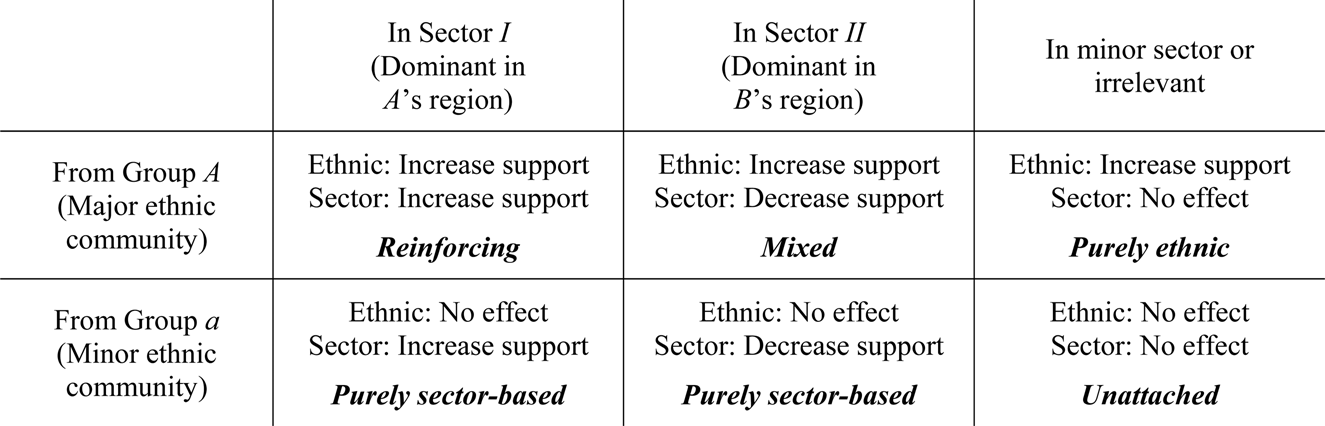
Consider an imaginary society with, among others, two major ethnic groups – A and B – who are geographically concentrated and segregated from one another, most members of which rely on a single economic sector dominant in each region – Group A on Sector I and Group B on Sector II (see Figure 1). Also, there is a minor ethnic group called Group a, for whom voting ethnically, when there is no presidential candidate from their kin, is strategically not helpful. The other economic category besides Sector I and Sector II is minor sectors (e.g. ranching) or irrelevant (i.e. barrens), which include economic/ecological dimensions of no political salience.
Individual voter's motives for choosing Candidate A (by sectoral and ethnic attachments).

In this example, consider an individual who is a member of either Group A or Group a, engaged in one of the sector categories aforementioned, such that it describes a two-by-three matrix. Assume that the voters consider their ethnic and industry-specific interests as sources of support for a presidential candidate. Coalition A represents the ethnic and economic interests of Group A while Group B has its own electoral coalition against Coalition A, for the policies Coalition A supports (for Sector I) might make Group B (benefiting from Sector II) suffer from them. According to the given electoral incentives, the likelihood of supporting Coalition A differs in each cross section. Coalition A is most preferred by people from Group A in Sector I because those are the organising features of the coalition that motivate the choice (Lieberman & McClendon Reference Lieberman and McClendon2013). Group A voters engaged in Sector II, however, create cross-party allegiances due to their cross-cutting interests. Without dominance of one factor, assume that each individual has an electoral motive for playing a mixed strategy where not everyone in this category chooses the same party while either ethnic or policy preference can be sought. For Group A members without policy preference in a specific sector, ethnicity plays a principal role in vote decision. On the other hand, because ethnic influence on voting is limited in Group a, their choice is purely based on which sector they are engaged in. But if they live in the area where the major sectors have little impact on their income or wellbeing, they are unattached voters who can be convinced by the targeting of private or club goods (Weghorst & Lindberg Reference Weghorst and Lindberg2013). Where ethnic and industrial boundaries coincide, therefore, the voters’ coalition alignment is an outcome of complex interactions among various motives and political implications of ethnic group categorisation.
Under this framework, sectoral interests reinforce the effect of ethnicity in predicting vote choice when it coincides with divisions of major ethnic groups, while they substitute for ethnicity when benefiting minority groups. To summarise the interaction effects discussed above, I suggest a hypothesis about voting in a multidimensional choice space. When candidates from major ethnic groups contest elections:
An individual, who engages in a principal industrial sector, is more likely to vote for a candidate, the majority of whose ethnic kin engage in the same industry as his, than his co-ethnic members having no association with the sector.
POLITICAL ALIGNMENTS IN KENYA
Politics in Kenya (as elsewhere in Africa) has long been regarded as the arena for ethnic representation (Bienen Reference Bienen2015). Since Kenya's independence from Britain in 1963, electoral contests have often revolved around the composition of parties’ leadership because of the strong links between voters and ethnic frontrunners, and because fixed ethnic boundaries help politicians quantify support. To survive, elites from different ethnic communities united to forge winning coalitions and to co-opt ethnic elites to splinter the loyalties of ethnic supporters across several parties. Especially after the 2002 elections, competition and coalition building have centred on the leaders of two rival ethnic groups, the Kikuyu and the Luo.
The Luo–Kikuyu rivalry is not a new phenomenon. After independence, the Kenya African National Union (KANU), led by Jomo Kenyatta from the Kikuyu, the largest ethnic group, and other leaders from larger ethnic communities became more powerful. This was due in part to the voluntary dissolution of the Kenya African Democratic Union (KADU) in 1964, after which its members subsequently joined KANU. In 1966, however, the leading Luo faction in KANU defected to form the Kenya People's Union (KPU). Although the party took the ideas of socialism and foreign policy that aligned with the Soviet Union, its ethnic identification was apparently so strong that most Kikuyu worried about a Luo succeeding Kenyatta as president (Koff Reference Koff1966). The KPU lasted until 1969 when Tom Mboya, a Luo politician considered a potential successor to Kenyatta, was assassinated, and the party was banned after the violence during Kenyatta's visit in Luoland. After the demise of the KPU, KANU became the sole political party, and its single-party rule was authorised by the constitution between 1982 and 1992.
In the 2002 elections, 10 years after multiparty elections were re-launched, the long-reigning KANU was defeated by the newly organised National Rainbow Coalition (NARC). NARC was a tentative merger between the Liberal Democratic Party (LDP), which Raila Odinga (Luo) developed from his faction in KANU before his defection, and National Alliance Kenya (NAK), which was established by an agreement among Mwai Kibaki (Kikuyu), Kijana Wamalwa (Luhya) and Charity Ngilu (Kamba). Shortly after Kibaki took over as the president of NARC, it became clear that the giant coalition had formed just to remove KANU from office. Kenyan parties once again experienced a major realignment over a constitutional referendum on defining executive power and devolved government. Odinga founded a new opposition party, the Orange Democratic Movement (ODM).
In the months leading up to the 2007 elections, the ODM was split into two, Odinga's ODM and Kalonzo Musyoka's (Kamba) ODM-Kenya. They both were defeated by Kibaki, who ran under the Party of National Unity (PNU).Footnote 5 In this election, the ODM was a team backed by Raila Odinga (Luo), Musalia Mudavadi (Luhya), Charity Nguilu (Kamba), Najib Balala (Coastal), and KANU's William Ruto (Kalenjin), while the PNU was led by non-Luo politicians including Mwai Kibaki (Kikuyu), Moody Awoi (Luhya), Nicolas Biwott (Kalenjin), Simeon Nyachae (Kisii) and Uhuru Kenyatta (Kikuyu) from KANU. The post-election clashes between Kikuyu, Luo and Kalenjin people proved the significance of mobilising ethnic ties for political purposes.
Following the violence instigated around the 2007 elections, the International Criminal Court (ICC) indicted Kenyatta and Ruto as perpetrators of the atrocities. But the ICC decision prompted a surprising result in that it brought the two accused leaders together to construct the Jubilee Alliance for the 2013 elections, as a merger between Ruto's United Republican Party (URP) and Kenyatta's The National Alliance (TNA). Kenyatta and Ruto won the 2013 elections, and ran as incumbent candidates for president and vice-president again in 2017. Meanwhile, in 2017, opposition leaders, Odinga, Mudavadi, Musyoka and Isaac Ruto (Kalenjin), were for the first time able to come together under the National Super Alliance (NASA) to compete against the Jubilee Alliance.
The structure of party competition in Kenya frequently arises as rivalry between Kikuyu and Luo, Kenya's largest and fourth largest ethnic groups, respectively. In the midst of the convoluted process of party mergers and party splits, the two ethnic groups have been the two poles in the competition that have played a pivotal role in shaping the party system.
Featuring the diverging sectoral interests between the two political coalitions, campaign rallies in each camp's strongholds are intended as events that promote its policy agenda with respect to its key agricultural subsectors. For example, the NASA rallies organised in the sugar belt area, especially in the major Luhya-dominant towns such as Kisumu and Kakamega, aimed at creating suspicion that the government's policy mismanagement and a lack of funding led to economic distress of the sugar sector, while inducing negative attitudes towards government's sugar(cane) policy but bringing unity to their electoral alliance.Footnote 6 By contrast, the incumbent's campaign message strategy across the Kalenjin districts of the Rift Valley sought to criticise Odinga's job performance as the Prime Minister in 2008–2013 related to the agricultural sector and emphasise certain sectors and issues that the Kenyatta government was better to deal with, serving many Kalenjin voters’ interests. The Jubilee campaign through Nandi County highlighted that productivity of coffee farms in the County was increased as a result of government policies that favoured the rise of coffee producer price and debt relief, for example.Footnote 7
In contrast to this strong tendency toward ethnic/economic coordination around Kikuyu and Luo, the results from national level studies reveal that constituents of minority ethnic groups are generally more likely to allow many other issues to affect their votes and to undertake vote-splitting between candidates. Bratton & Kimenyi (Reference Bratton and Kimenyi2008) find that non-ethnic voters, who prefer to identify themselves by class, occupation, gender and/or religion, voted based on some areas of the government's performance, such as enhancing living standards and combating corruption, rather than along ethnic lines (Ferree et al. Reference Ferree, Gibson and Long2014).Footnote 8 Also, addressing the non-co-ethnics’ political behaviour, which is more responsive to government performance, Long & Gibson (Reference Long and Gibson2015) show that Kisii, Mijikenda and Maasai ethnic groups in particular tend to divide their support between candidates. An effective strategy is therefore for Kenyan parties to focus their election campaigns more on persuading non-co-ethnics to support their presidential candidates than on consolidating support from co-ethnic constituencies (Horowitz Reference Horowitz2016).
Regional level studies examine voting more closely as to how non-co-ethnics choose. In their study of the 2013 election campaign in northern Kenya, Carrier & Kochore (Reference Carrier and Kochore2014) find that the pastoralist voters were quite responsive to William Ruto's appeal to his pastoralist background, leading to the electoral success of the Jubilee coalition in this potential swing region. Willis & Chome (Reference Willis and Chome2014) characterise coastal politics as non-partisan and fragmented, while the constituents of diverse racial, religious, and ethnic origins, and especially rural residents prefer Raila Odinga as a national leader, who would better understand the experience of marginalisation, even though he was not a perfect fit. Below, introducing a new economic dimension in voting – agricultural subsectors – I show that sectoral interests interact with ethnic variation in their influence on the choice of presidential candidate in Kenyan elections.
IMPACT OF INTERACTIONS BETWEEN ETHNICITY AND INDUSTRY ON VOTING: EMPIRICAL EVIDENCE
Data
The search for interaction effects of ethnicity and economic interest is based on three nationally representative surveys conducted in 2008, 2012 and 2014 merged with the geo-coded Agro-Ecological Zones (AEZ) data. The three surveys are from Afrobarometer Survey Rounds 4–6, which contain questions about respondents’ ethnic identities and vote choices in the 2007 and 2013 presidential elections. Rounds 4 and 5 cover the 2007 election and Round 6 focuses on the 2013 election. For the Kenya case, Rounds 4–6 interviewed 1,104 respondents between 29 October and 17 November in 2008; 2,399 respondents between 4 November and 29 November in 2012; and 2,397 respondents between 12 November and 5 December in 2014, respectively (see Appendix I for details about the surveys).
I define sector-based voting as voting for a party or a candidate who represents policy needs or interests of a certain sector, to improve its performance, which is often measured by the output and welfare the sector produces (Lewis Reference Lewis2013). To demonstrate how (potential) policy beneficiaries vote, I use topographic distribution for zoning crop suitability as a channel through which the voters receive policy benefits. The data of geographic information, which is shared across residents living with the same natural endowment, identify the principal agricultural subsectors contributing to the local economy. With regard to the economic effect of the key agricultural sectors at the regional level, numerous development studies maintain that farming activities, while interacting with rural non-farm activities, lead to overall local growth especially in countries where small-scale agriculture is dominant, as in most of Africa and Asia (Toulmin & Guèye Reference Toulmin and Guèye2005). The community under the influence of a certain economic sector relies heavily on it for successful economic growth and improvement in living standards. Even those who are not directly engaged as producers or investors benefit from the sector. The rise and decline of the copper industry in Zambia, for instance, immediately affect lives of most people living in the copper belt more significantly than the rest of the country.
The AEZ spatial data estimate agricultural suitability in each cross-section defined by altitude, temperature and rainfall quantities. As shown in Appendix II, the horizontal axis indicates levels of humidity from very humid (0) to very dry (7), while the vertical axis identifies different belts by temperature and elevation. The name of each zone refers to potential crop production or animal-raising/fishing that can flourish in the zone, indicating regional intensity of agricultural production. The AEZ data are also available for defining variables according to sectoral concentration – whether respondents are in ‘intense’ or ‘marginal’ farming areas. Since African economic behaviour is closely linked with agriculture in many ways, where people tend to earn agricultural income not just from their main job, but also their second job or as an investment target (Salami et al. Reference Salami, Kamara and Brixiova2010), measuring the degree to which citizens participate in a sector helps identify an individual's economic interest. These measures are useful in a context where farmers often raise multiple crops and livestock, as they do in Africa. Therefore, the AEZ capturing the sites of the vibrant agricultural sub-sector(s) allows for investigations of my hypothesis on sector-based voting by electorates in the intensive agricultural zones as merged with the geocoded Afrobarometer data on vote choice.
Who lives where and what types of agriculture do they engage in?
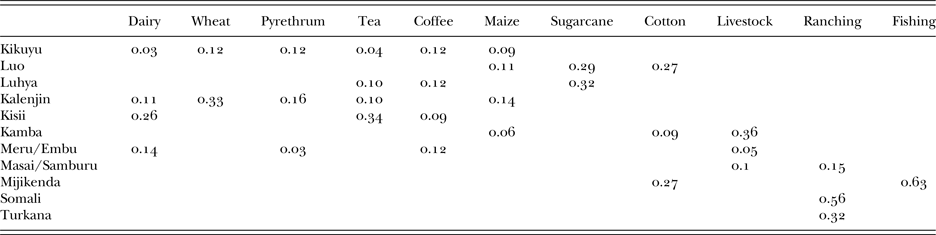
In Kenya, ethnic and industrial boundaries often coincide, so that ethnic coalitions may represent their inherent economic interests, and vice versa. Before analysing the effect of each factor on voting, I show how the agricultural and ethnic features cross-cut each other. Table I presents significant (p < 0.05) positive correlations between ethnic groups and agricultural sub-sectors, using the 2014 Afrobarometer survey merged with the AEZ data. Note that there is a conflict between Kikuyu and Luo's agricultural interests: regarding crops each group relies on, the Kikuyus, as they mostly dwell in the highlands, engage in the dairy, tea and coffee sectors, while the Luos tend to be involved in sugarcane and maize production prevalent in the lower zones. The Kalenjin people who significantly contributed to Kenyatta's victory in the 2013 elections by switching their support from Odinga to Kenyatta can be found in the zones of the several highland sectors as well as in the significant maize and other cereal-growing areas. Interestingly, the Kalenjins who switched are located in between the two camps of sugar-maize producing regions and the highland export crop zones. Meanwhile, members of the relatively small ethnic group of Kisii, which has diversified economic interests, are likely to split their votes among different parties. Kamba, which has a large population and does not have a common economic interest with the core voters of the major parties, tend to make an ethnic choice for their own party. The Kambas, engaged with some maize production (statistically significant only at the regional level), join the opposition coalition if no co-ethnic presidential candidate runs. Lake Victoria, located in Western Kenya, offers the greatest freshwater fishing opportunity to the Luo community, though the correlation between the ethnic group and the sector is not statistically significant. Mijikenda residents engaging in intensive fishing in the Indian Ocean, however, tend to team up with Luos in the presidential elections. Taken together, the Kikuyu and the Luo constitute the main axes of the competing agricultural interests – highland and lowland, respectively – and the other ethnic groups share interests with them to varying degrees.
Correlation: Agricultural Interests of Ethnic Groups.

*The table presents figures from the geocoded Afrobarometer data mapped with the AEZ areas.
*Only the statistically significant (p < 0.05) pairs are shown.
Coding variables
The dependent variable, Incumbent support, is coded 1 for respondents who support an incumbent coalition – namely, the alliance of PNU, DP, NARC-K, KANU, Safina, FORD-K, FORD-A, FORD-P, National Party of Kenya, and Shirikisho in 2008 and 2012 and that of TNA and URP in 2014 – and 0 otherwise.Footnote 9 (See Appendix III for summary statistics.) The key independent variables are agricultural subsectors, each of which is coded 1 if the matched AEZ indicates the sector is suitable in the respondent's location, and 0 otherwise. For example, Dairy is coded 1 if a respondent lives in UH1 or LH1 of the AEZ, and 0 otherwise.Footnote 10
Next, I create indicators that capture the collective effects of the important subsectors by altitude – Highland and Lowland. While the highland sectors include dairy, tea, coffee, wheat, and pyrethrum and the lowland incorporates the sugarcane, cotton and fishing sectors, each of them is coded 1 if any of its corresponding variables is computed as 1, and 0 otherwise. These aggregate-level variables have two main purposes. First, the aggregate measures reduce unnecessary multicollinearity that occurs between the sector variables and ethnic group variables or among the sector variables, and become stronger predictors of policy interests than individual sectors.Footnote 11 Second, they are useful to examine whether the aggregate effects of the sectors explain voting behaviour, reflecting political actors that might shape electoral cleavages as such. Meanwhile, maize farming and ranching are done cross-zonally, so they are included in neither of the altitude categories.
To see the different effects of production intensity levels, I create another version of the sector variables that contain wider-ranging conditions of production and income source. Under this coding rule, even marginal farming zone is considered part of one's economic interest as denoted by the number 2 attached – Sugar2, for instance.
To explore the effects of demographic features on the relationship between sector-based economic interest and vote choice, I divide voters into subgroups using ethnicity and other demographic factors. I estimate models using the five ethnic group variables – GEMA (Gikuyu, Embu, Meru Association), Luhya, Kalenjin, Luo, Kisii – as controls and also to compute their interaction effects with the sector variables, considering Kisii as a smaller group and the other four as major ethnic groups.Footnote 12 I use GEMA instead of Kikuyu to indicate their strong political partnership, which may be associated with their common economic interest. Further, I control for Urban areas, as an alternative explanation for a non-farming city life. I also control for Education, the effect of secondary school completion, Female and Muslim. Low income measures self-diagnostic economic conditions for the 2008–2014 data, coded as 1 if a respondent views her current situation as much worse or worse, and 0 otherwise.
Empirical tests
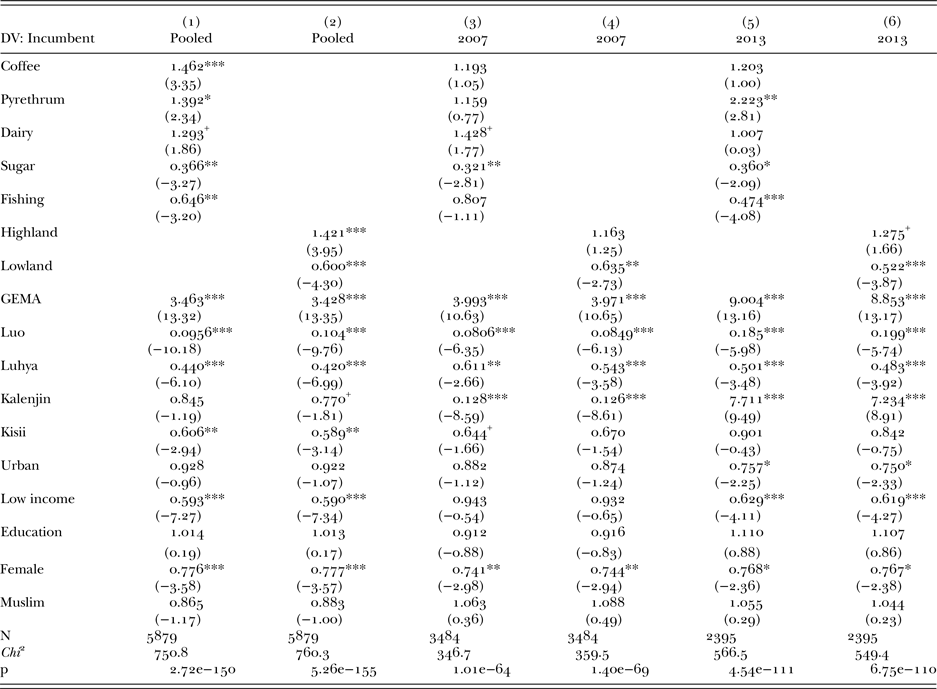
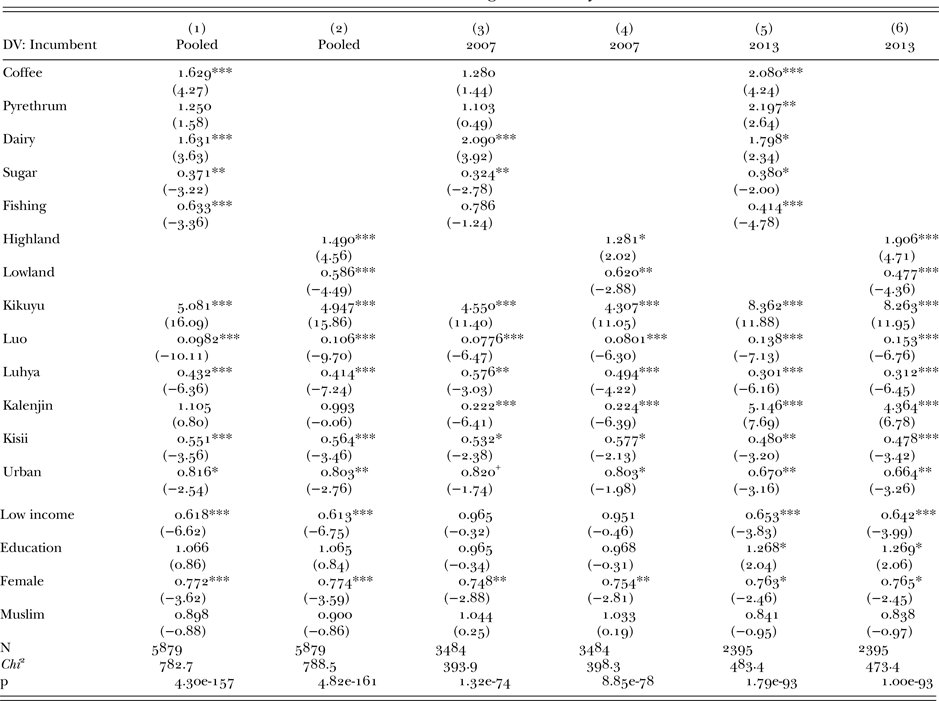
In this section, I provide tests of my prediction about the impact of sectoral interests on voting when it correlates with ethnic attributes. My analysis proceeds in two steps. First, I examine the sector effects, using logistic regression to model voting behaviour in the 2007 and 2013 Kenyan presidential elections.Footnote 13 Second, I consider the interaction of sectoral interests with ethnicity variables, testing the hypothesis that concerns the conditional effects of the interaction on voting. Table II shows coefficient estimates and standard errors of logistic regression with six specifications.Footnote 14 I estimate the effect of each economic sector on incumbent support in Columns (1), (3) and (5), while the set of covariates in Columns (2), (4) and (6) includes the aggregate measures of sectors. All the observations are pooled in Columns (1)–(2), and the other columns are disaggregated by election years. To make the interpretation straightforward, I present the odds ratio, which is a measure of the odds of one outcome happening, given an event in interest occurring, compared to the odds of the outcome happening in the absence of the event. All models contain aforesaid ethnicity identification and other demographic controls.
Effects of Economic Sectors on Voting.

Exponentiated coefficients; t statistics in parentheses.
+p < 0.1, * p < 0.05, ** p < 0.01, *** p < 0.001.
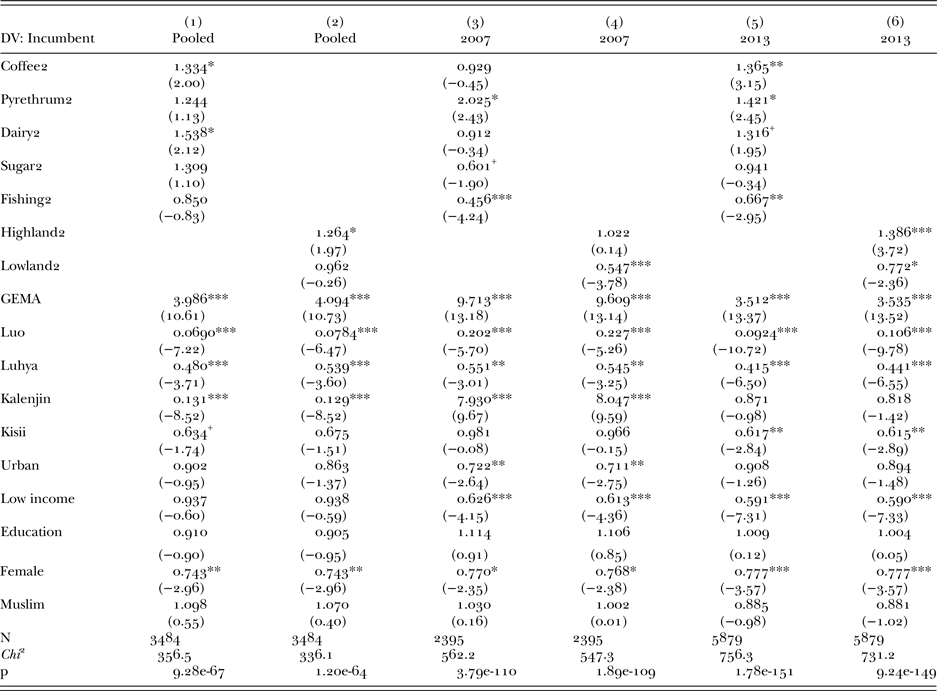
In all models, the coefficients are consistently higher or lower than 1 in the expected direction between sector variables and incumbent support: There is a positive relationship between the highland sectors, productive in the Kikuyu-Embu-Meru region, such as dairy, coffee, pyrethrum and tea, and support for the incumbent coalition, while the association between the sugarcane and fishing sectors, found in the lowlands, and incumbent support is negative. According to the odds ratios, in Column (1) the coffee sector voters, for example, are 1.5 times more likely to support the incumbent candidate than the non-coffee sector citizens, while the voters in the sugar zone (yielding an odds ratio of 0.366) are 2.7 times less likely to choose the incumbent than the people outside the zone. Similarly, in Column (2) for those whose income from the highland sectors are the key sources, incumbent support happens 1.4 times more frequently than the rest, while there is a contrary tendency where the voters rely on the lowland sectors for their income as they are 1.7 times more likely (or an odds ratio of 0.6) to choose the opposition candidate. While the models with a pooled sample in Columns (1)–(2) maintain the directions of all the subsector effects and statistical significance at 90% level, the individual election-year models in Columns (3)–(6) lose statistical significance for some of the subsector variables. Replacing GEMA with Kikuyu, however, Appendix IV/Table AI shows that the directions of almost all the subsector effects and statistical significance at 95% level are retained in all the models. Using the broadly defined independent variables, Appendix IV/Table AII presents the regression results, whose implications are essentially similar to those in Table II.
To show the influence of Kalenjin and Kikuyu leaders coalescing to form a coalition against Odinga and Musyoka for the 2013 presidential election, the highland sectors’ positive impacts and the negative impacts of Lowland and Fishing in Columns (5)–(6) become greater than the equivalents in Columns (3)–(4). For instance, the odds of voting for the incumbent if living in a high pyrethrum-producing region increases to 2.223 as shown in Column (5) from 1.159 in Column (3). Also, there is significant variation in Fishing, which has an adverse effect on the incumbent's success (odds ratios of 0.807 in Column (3) and 0.474 in Column (5)). It is because Kalenjin people who are engaged in various agricultural subsectors from maize to tea but not so much in sugarcane farming and fishing switched altogether to the Jubilee coalition during the 2013 election year. Consequently, the Kenyatta–Ruto alliance reinforced the electoral significance of the highland, sugar and fishing sectors, as the combined effects of the highlands and the lowlands slightly increase in its magnitude from an odds ratio of 1.163 to 1.275 and from 0.635 to 0.522, respectively.
The results show that controlling for ethnicity effects, the agricultural subsectors have independent significance in the presidential vote. Further, the odds of incumbent (or opposition) support within some sectors are even greater than those of the outcome given an ethnic tie: in the 2007 election model (Column (3)), for example, the sugar sector effect (0.321) is greater than the comparative odds that the Kisii back the opposition (0.644). Similarly, compare the effects of Lowland (0.6) and Kisii (0.589) in Column (2).
Self-identification of personal economic conditions (denoted as Low income) has a significant and negative impact on the party choice in the 2013 election, whereas female voters have a significant and negative impact in all the election years. The odds that a female voter supports the incumbent are about 1.5 times lower than that of male voters. Urban residency (or a non-agriculture effect) predicts less incumbent support in all years while statistically significant only in Columns (5)–(6). Education and Muslim show no statistical significance.
While both sector and ethnicity factors have independent impacts on voting, to understand the sectoral interest effect conditional on co-ethnicity, I estimate binary logit models that contain interaction terms and multiple controls. The model reporting estimated marginal effects of the interactions between Highland/Lowland and the five ethnic groups on the probability of voting for the incumbent coalition, for instance, is written as:
 $$\eqalign{& \Pr \lpar {Y_i} \rpar = G\lpar \beta _0 + \beta _1GEMA_i + \beta _2Kalenjin_i + \beta _3Luo_i + \beta _4Luhya_i \cr & \quad+ \beta _5Kisii_i + \beta _6Highland_j + \beta _7Lowland_j + \beta _8GEMA_i \times Highland_j \cr & \quad+ \beta _9GEMA_i \times Lowland_j \ldots + \mathop \sum \limits_{i = 11\comma \ldots \comma k} \beta _iX_i\rpar } $$
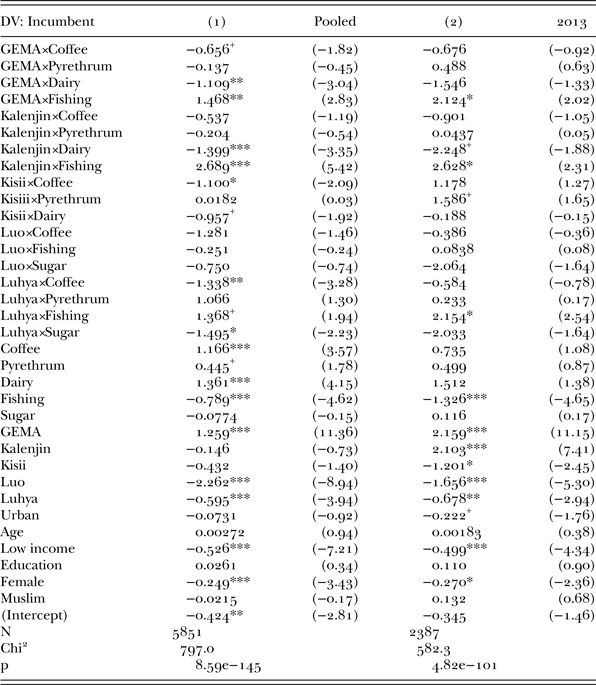
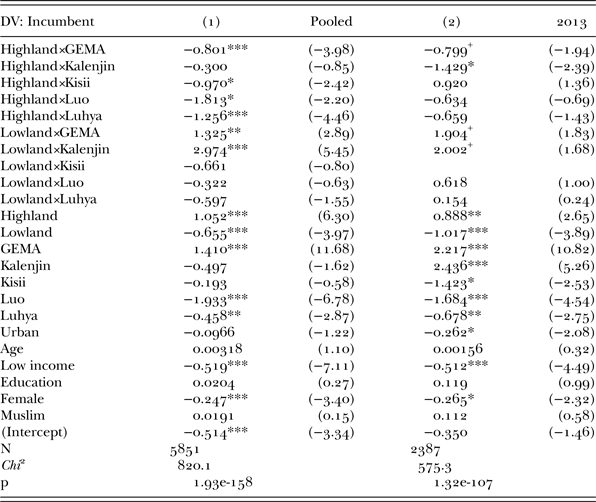
where G() is a logit function, in which i denotes individuals and j denotes the suitable areas for the agricultural sub-sectors. I develop a hypothesis about how the effect of the sector variable on Pr(Y i) should vary with the value of an 0–1 dichotomous ethnicity variable when the other variables (including X i) are fixed. All the interaction models presented in this section have the same basic specifications of variables as shown in Table II. X i is thus a matrix of all the non-ethnic demographic controls. Tables III and IV exhibit the regression results.Footnote 15
Interaction Effects of Economic Sectors with Ethnic Groups on Voting.

t statistics in parentheses.
+p < 0.1, * p < 0.05, ** p < 0.01, *** p < 0.001.
Interaction Effects of Highland/Lowland with Ethnic Groups on Voting.

t statistics in parentheses.
+p < 0.1, * p < 0.05, ** p < 0.01, *** p < 0.001.
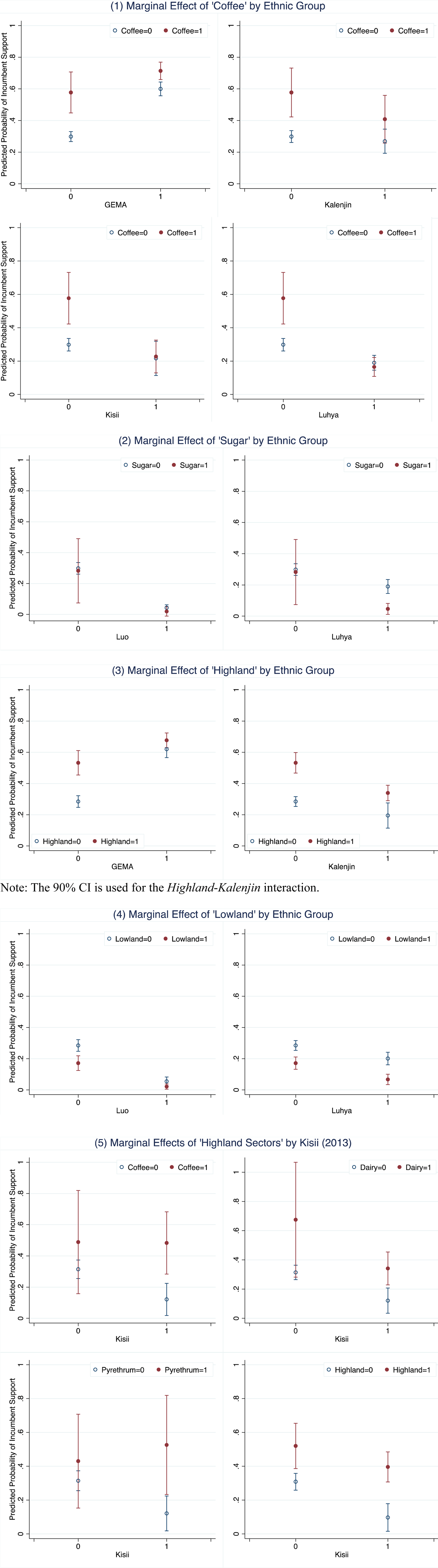
To test whether and how the sector and ethnicity variables interact in influencing Pr(Y i), in Figure 2 I use marginal effects plots for the binary agricultural subsector variables at two different values of each of GEMA, Kalenjin, Kisii, Kamba, Luo, and Luhya, 0 and 1, when the remaining variables are fixed at 0 except that Low income is set at 1 and Age at 35.Footnote 16 As Figure 2-(1), which illustrates the results from Table III-(1), shows, I find that for GEMA (at GEMA=1), there is significant probability difference in voting between coffee-sector residents and the rest in the 2007 and 2013 presidential elections: Coffee-sector GEMA voters are 11% more likely to support the incumbent candidate than the other GEMA people. The estimates of change based on the coffee sector are not considerable among the Kalenjin, the Kisii and the Luhya, whereas the coffee sector has a positive effect on incumbent support among non-Kalenjin, non-Kisii or non-Luhya communities.
Interaction effects on the probability that incumbent support occurs, using the pooled data for Plots (1)–(4) and the 2013 presidential election data for Plot (5).

In Figure 2-(2), I find the sugar sector effect predicts lower support for the incumbent party with statistical significance. Living in the sugarcane producing area decreases the probability of the incumbent support by 14% among Luhyas (at Luhya=1). Within the sugar sector (at Sugar=1), however, the ethnic effect does not exist.
In Figure 2-(3) showing the regression results in Table IV-(1), the highland factor generates a significant probability increase in electoral preference for the incumbent at GEMA=0, Kalenjin=1 or Kalenjin=0. For example, the results report that Kalenjin voters in the highland zone are about 15% more likely to vote for the incumbent candidate than the other Kalenjin people. Also, non-GEMA in a highland crop territory are approximately 25% more likely to do so than those outside of the territory. Regarding the lowland sectors in general, Figure 2-(4) shows that when respondents are from Luhya (Luhya=1) ethnic groups, the lowland variable diminishes the probability of voting for the incumbent by 13%.
To examine changes in voting behaviour between the 2007 and 2013 elections, Figure 2-(5) shows the electoral effects of the sector factors on the 2013 election results conditional on Kisii.Footnote 17 For Kisii voters (at Kisii=1), I find a significant probability increase in voting for the incumbent candidate when they live in the highland zone such as coffee, dairy-product or pyrethrum-producing areas. For example, living in the pyrethrum-growing region enhances the probability of the incumbent support by 39% among Kisii people (at Kisii=1).
In sum, there is substantial statistical evidence of interaction between sectoral interests and ethnicity in influencing the probability of voting such that when the remaining independent variables assume representative values, the effect of ethnic groups in improving (or suppressing) the probability that an individual votes for the incumbent coalition is strongest in residence at some highland (or lowland) sectors and weaker in residence outside the sectors. For the candidate-fielding major ethnic groups, namely Kikuyu (or GEMA in the analysis) and Luo, however, the reinforcing effects of the economic sectors appear smaller as the impact of their ethnicity on voting already reaches a high level. Meanwhile, the major industries have particularly powerful effects on the probability of choosing a presidential candidate among individuals from the Kisii as a minority ethnic group, which is politically not salient (See Columns (5)–(6) in Table II for no statistical significance of Kisii). Additionally, the significant Kalenjin–Highland interaction effect in the tests conducted on the pooled dataset implies that throughout the 2007 and 2013 elections both sector and ethnic motives for voting had persisted regardless of the fact that the Kalenjin leaders switched coalition partners from Luo to Kikuyu.
CONCLUSION
While the Luo ethnic group is geographically concentrated in the sugarcane-growing area located in western Kenya, the Kikuyu people develop coffee and dairy farms near Mt Kenya in the East. The Luo–Kikuyu rivalry is the most consistent in Kenyan politics, as manifested in electoral coalition formation. Ethnic leaders’ coalition choices for presidential elections also indicate policy preferences of their ethnic members: sugarcane-growing Luhyas have been forming an alliance with another sugar-farmer group, the Luo; the Kamba living in areas where livestock and maize farming form the foundation of the group's economy coalesce with the Luo; and Kalenjin people who are engaged in various agricultural subsectors from maize to dairying have critical leverage over alliance formation, and can choose whether to join grain-growing Luo or dairy-farming Kikuyu. Being aware of the strong relationship between opposition support and the sugar sector, the Kenyatta administration tried to break the link by outbidding some Luhya sugar farmers and manufacturers. The government offered billions of dollars of economic assistance to Mumias sugar company, which is the largest sugar processor in Kenya and is located in the Luhya dominant region. Although the incumbent government failed to shift the target votes to its own presidential candidate, this example reflects the significance of the interaction between policy preference and vote choice.
The empirical analysis shows that there are the independent effects of the agricultural subsectors, controlling for ethnicity, and that there is the independent effect of ethnicity, controlling for the sectors. While some ethnic groups are more likely motivated to use ethnicity as an instrument for gaining political power and economic resources, the sector-based explanation of economic voting is, in general, statistically significant and able to account for the behaviour of non-Kikuyu, non-Luo voters. Yet, my argument based on the distinctive policy interests rooted in agricultural activities expounds a powerful argument on why the two politically salient ethnic groups – the Kikuyu and the Luo – remain rivals in the first place.
By estimating logit models including product terms to specify the sector-ethnicity interactions, I find considerably meaningful interactions are present, such that the marginal effects of the economic sectors on vote choice vary with the binary response concerning ethnic affiliation. To be specific, the positive impact of the sector-related interests on the utility derived from the incumbent support becomes stronger when an individual inhabits a highland crop-growing region, while the negative impact is more powerful among individuals from the lowlands. The sectoral interest factor is also more significant in voting among those who are affiliated with minor ethnic groups whose motives for voting for a particular candidate are not ethnic.
This study is not able to account for motives of voters whose interest is hardly characterised by agriculture or agro-industry, such as big city residents and those in the sparsely populated areas where political participation is quite challenging. Nevertheless, the non-agricultural sector itself could be considered as a voting block. Because African governments have created policies that favour rural interests at the expense of urban interests to gain support from the countryside, urban residents are probably opposition supporters. In conclusion, the sector-based voting theory addresses the importance of agricultural policy, which affects the livelihood of the majority population and, at the same time, creates politically salient groups formed along economic sectors though often cross-cut by ethnic cleavage.
Appendix I. The Afrobarometer Surveys in Kenya (Rounds 4–6)
The Afrobarometer is a research project that produces scientifically reliable survey data on issues such as democracy, public affairs, and economic conditions among others in various African countries. The surveys are designed to be nationally representative of men and women aged 18 and older from over 35 countries in Africa. The survey codebook and data can be accessed at http://www.afrobarometer.org. Individual-level geocoded Afrobarometer data are also available at http://geo.aiddata.org. For the Kenya case, Rounds 4–6 interviewed 1,104 respondents between 29 October and 17 November in 2008; 2,399 respondents between 4 November and 29 November in 2012; and 2,397 respondents between 12 November and 5 December in 2014, respectively. While Round 4 was conducted 10 months after the 2007 elections held on 27 December 2007 and Round 5 was approximately 5 years after the election, data from the two rounds are merged to reflect voting behaviour in the 2007 general election. The responses of Round 6 match the 2013 election, which was held about 2 years before the survey.
The dependent variable Incumbent support was measured by two political affinity questions: (1) Do you feel close to any particular political party? Which party is that? (2) If a presidential election were held tomorrow, which party's candidate would you vote for? Although the party preference question may imply a stronger and more consistent penchant for backing incumbents than the vote choice question, combining them does not cause any error in creating the indicator it is supposed to mean, but decreases missing observations. There was no respondent who gave contradictory opinions providing one answer in favour of the incumbent and the other approving of the opposition. For the Third-party variable, however, there exist respondents whose party affinity does not match their vote choice. To avoid observations to be doubly counted as a major party supporter and a third-party supporter, I only use the question of which party's candidate to choose in a presidential election to measure Third-party. Considering parties that formed electoral coalitions and those fielding their own candidates, I classify parties as follows:

If one casts a ballot for a presidential candidate who is from a party in the ‘Others’ category, she is treated as a third-party supporter.
Appendix II. Agro-Ecological Zones (AEZs) of the Tropics

Appendix III. Summary Statistics of Dichotomous Variables for Voter Characteristics

Appendix IV. Supplementary Regression Results
Effects of Economic Sectors on Voting (with Kikuyu instead of GEMA).

Baseline Models with Sector Measures Covering Marginal Farming Areas.