Introduction
Heat stress as an environmental factor has an outstanding effect on the reproductive performance of farm animals. Reduced fertility is associated with heat stress before, on the day, and shortly after breeding (Picton et al., Reference Picton, Briggs and Gosden1998; McNatty et al., Reference McNatty, Heath, Lundy, Fidler, Quirke, Connel, Smith, Groome and Tisdall1999). During hot seasons, follicle selection is impaired and the length of follicular waves may increase. It is believed that heat stress can reduce the quality of oocytes, and disrupt follicular dynamic and steroidogenesis (Badinga et al., Reference Badinga, Thatcher, Diaz, Drost and Wolfenson1993; Roth et al., Reference Roth, Meidan, Shaham-Albalancy, Braw-Tal and Wolfenson2001; Ozawa et al., Reference Ozawa, Nakamura, Ushitani, Hirabayashi and Kanai2005; Payton et al., Reference Payton, Louisa, Saxton and Edwards2011) resulting in aberrant gene expression (Argov et al., Reference Argov, Moallem and Sklan2005).
Experimental in vitro heat shock is used to elucidate the underlying mechanism(s) of heat-induced effects on developmental potential of oocytes and embryos in mammals. For instance, alterations in shape and configuration of microtubules, microfilaments and chromatin (Tseng et al., Reference Tseng, Chen, Chou, Yeh and Ju2004; Ju et al., Reference Ju, Jiang, Tseng, Parks and Yang2005), meiotic competence (Roth & Hansen, Reference Roth and Hansen2005; Barati et al., Reference Barati, Agung, Wongsrikeao, Taniguchi, Nagai and Otoi2008; Yuan et al., Reference Yuan, Hao, Liu, Wu, Yang, Liu, Tian, Zhu and Zeng2008), cortical granules (Wang et al., Reference Wang, Sui, Miao, Liu, Zhou, Ge and Tan2009; Andreu-Vazquez et al., Reference Andreu-Vazquez, Lopez-Gatius, Garcia-Ispierto, Maya-Soriano, Hunter and Lopez-Bejar2010), zona pellucida dissolution time (Suzuki et al., Reference Suzuki, Ju, Parks and Yang1998; Payton et al., Reference Payton, Romar, Coy, Saxton, Lawrence and Edwards2004) and lipid membrane composition have been reported following heat shock in porcine and bovine oocytes (Amir & Zvi, Reference Amir and Zvi2008). The direct exposure of bovine COCs to elevated temperatures during in vitro maturation (IVM) decreased cleavage rates and the proportion of oocytes that became blastocysts (Edwards et al., Reference Edwards, Ealy, Monterroso and Hansen1997). Ju et al. (Reference Ju, Jiang, Tseng, Parks and Yang2005) reported that the cleavage rate of fertilized bovine oocytes was not affected by 4 h heat shock (42°C) during the maturation period, but blastocyst formation and total cell number per blastocyst were lower following 4 h heat shock in comparison with the control group. Elevated temperature within the physiological range (40–41°C) during the maturation period may induce DNA damage and increase apoptosis in oocytes prior to fertilization (Roth & Hansen, Reference Roth and Hansen2004). Due to the critical importance of maternal mRNA on the regulation of early embryonic development (Sirard, Reference Sirard2010; Moulavi et al., Reference Moulavi, Hosseini, Hajian, Forouzanfar, Abedi, Ostadhosseini, Asgari and Nasr-Esfahani2013), adverse effect of heat shock on oocyte competence may be mediated partly through alterations in gene expression, on which we have limited information (Payton et al., Reference Payton, Louisa, Saxton and Edwards2011; Gendelman & Roth, Reference Gendelman and Roth2012). Therefore, in this study, we evaluated the expression of genes that were related to heat response (HSP90), formation of gap junction during maturation and compaction (connexin 43), developmental competence (OCT4), cell cycle (cyclin B), stability of stored mRNA (PolA) and blastocoel formation (Na/K-ATPase). Moreover, there is species-specific sensitivity for the animal response to heat-stress conditions (Badinga et al., Reference Badinga, Collier, Thatcher and Wilcox1985). More work on cellular and molecular changes in oocytes and embryos in response to heat shock is necessary to better understand the mechanisms of thermal injuries or tolerance. Among the farm animals, sheep are known to be the major food source for humans in many countries, therefore research on sheep reproduction and breeding strategies may have important economic consequences. Global warming and a hot and dry climate can severely affect breeding of this species. To our knowledge, unlike the extensive studies in bovine, the effect of in vitro heat shock (41°C for 12 h) in ovine has not been evaluated. Therefore, this study aims to investigate the effect of heat shock during in vitro maturation on meiotic and embryo developmental competence, and gene expression in ovine oocytes.
Materials and methods
Materials
All chemical reagents were obtained from Sigma Chemical Co. (St. Louis, MO, USA) or Gibco (Grand Island, NY, USA), unless otherwise specified. The oocyte collection medium used (OCM) was HEPES Tissue Culture Medium 199 (H-TCM-199) supplemented with 10% fetal bovine serum (FBS), 25 IU/ml heparin, penicillin and streptomycin. The oocyte maturation medium used (OMM) was TCM-199 supplemented with Na pyruvate (2.5mM), l-glutamine (1 mM), penicillin (100 IU/ml), streptomycin (100 μg/ml), FBS (10%, v/v), epidermal growth factor (EGF; 100 ng), follicle stimulating hormone (FSH; 10 μg/ml), luteinizing hormone (LH;10 μg/ml), estradiol-17β (1 μg/ml), and cysteamine (0.1 mM).
Collection of oocytes and in vitro maturation
Ovine ovaries were collected from local abattoirs and stored in saline at 28–32°C during transportation. Cumulus–oocyte complexes (COCs) were aspirated from 2–6-mm follicles using 20-gauge needles attached to a vacuum pump (80 mmHg). Only COCs with uniform compact cumulus cell layers were selected and then matured in groups of 10 in 50-μl droplets of OMM overlaid with mineral oil for 22 h in an atmosphere of 5% CO2 in humidified air at 38.5°C (control) or at 41°C for first 12 h and then 38.5°C for the last 10 h of maturation (heat shock). The 12 h heat shock time period was chosen, because it has been reported that this duration of heat shock impairs oocyte competence and its subsequent development (Edwards & Hansen, Reference Edwards and Hansen1997), and that the period of elevated body temperature during heat stress can be up to 12 h per day (Rivera & Hansen, Reference Rivera and Hansen2001).
Nuclear status, microtubule organization and oocyte diameter
The assessment of nuclear status and microtubule organization was carried out as described elsewhere (Asgari et al., Reference Asgari, Hosseini, Ostadhosseini, Hajian, Azhdari and Mosaie2012). In brief, following 22 h in vitro maturation, COCs were treated with 300 IU/ml hyaluronidase to remove cumulus cells and then denuded oocytes were fixed with 4% paraformaldehyde (PF). Microtubules organization was assessed by immunostaining with anti-β-tubulin monoclonal primary antibody and fluorescein isothiocyanate (FITC)-labeled secondary antibody. Chromosomes were stained with 10 μg/ml Hoechst stain. Images of stained oocytes were captured and assessed with a high resolution digital camera at ×400 magnification (DP-72 Olympus, Japan) using DP2-BSW software. Nuclear status was classified as following: germinal vesicle (GV), germinal vesicle breakdown (GVBD), metaphase I (MI) or metaphase II (MII).
The diameters of the matured and prepared oocytes in both experimental groups (control and heat shock) were measured. The diameter of the oocytes was calculated by measuring mean length of diameters to oolemma at 4° intervals passing through the oocyte's centroid and then evaluated by the ImageJ program.
Cortical granule staining
The pattern of cortical granule (CG) distribution in the control and heat-shock oocytes was assessed as described previously by Hosseini et al (Reference Hosseini, Asgari, Ostadhosseini, Hajian, Piryaei and Najarasl2012). Briefly, zona-free oocytes were washed in phosphate-buffered saline (PBS) then were fixed with 3.7% paraformaldehyde in PBS at room temperature (RT) for 30 min. These oocytes were washed three times in PBS that contained 0.3% bovine serum albumin (BSA) and 100 mM glycine. Then, they were incubated in 0.1% Triton X-100 in PBS for 5 min, washed three times in PBS and incubated in 100 μg/ml FITC-labeled peanut agglutinin (PNA) in PBS for 30 min in dark. Oocytes were washed with PBS that contained 0.3% BSA and 0.01% Triton X-100 to remove residual unbound dyes. Consequently, oocytes were washed and mounted on glass slides and observed under an epifluorescence microscope (Olympus BX51, Japan) at ×400 magnification. The fluorescence emission of each oocyte was detected under 450–490 nm excitation by using 490 nm filter for CGs. Upon exposure, a digital image of each oocyte was provided using a high sensitive camera (DP-72 Olympus, Japan) operated with the DP2-BSW software.
Alteration of zona pellucida after heat shock
The degree of zona pellucida (ZP) sensitivity to pronase, an indirect measure of ZP dissolution time, was used to evaluate the effect of heat shock on changes in the ZP. For this purpose, in vitro-matured denuded oocytes (DOS) were incubated with 0.5% pronase to solubilize the ZP. Zona pellucida dissolution time for each oocyte was recorded as the time at which the samples were placed in the pronase solution until the ZP became invisible under the microscope. The average time needed for dissolution of the ZP was recorded.
Parthenogenetic activation of oocytes
For parthenogenetic activation of ovine oocytes, they were first exposed to 5 μM ionomycin for 5 min and then incubated with 2 mM 6-dimethylaminopurine (6-DMAP), for 2 h. Then, oocytes were washed in modified synthetic oviductal fluid (mSOF), cultured in groups of six oocytes in 20-μl droplets of mSOF without serum and glucose for 3 days and subsequently in the presence of serum (5%) and glucose (1.5 mM) for 5 days.
Embryo development
The competence of embryos to cleave and develop to either morula, early, expanded or hatched blastocyst was determined at 3, 5, 6, 8 and 8 days after parthenogenetic activation, respectively. In order to determine total cell number (TCN) and individual numbers of cells allocated in the sites of inner cell mass (ICM) and trophectoderm (TE), hatched blastocysts in both groups were assigned to differential staining as described elsewhere. In brief, hatched blastocyst were washed in HTCM + 5 mg/ml BSA, then blastocysts were exposed to 0.5% Triton X-100 and subsequently to 30 μg/ml propidium iodide (PI) in medium for 1 min, respectively. Consequently, embryos were fixed in the cold (4°C) and counter-stained with Hoechst stain (10 μg/ml) in ethanol solution for 15 min. Subsequently blastocysts were mounted and examined using a fluorescence microscope (Hosseini et al., Reference Hosseini, Hajian, Asgari, Forozanfar, Abedi and Nasr-Esfahani2007).
Measurement of oestrogen and progesterone concentrations
Culture media from the groups were collected and stored at –20°C for hormone assay as described elsewhere (Esmaielzadeh et al., Reference Esmaielzadeh, Hosseini, Nasiri, Hajian, Chamani and Nasr-Esfahani2012). Briefly, steroid hormones were assessed using an enzyme immunoassay kit (Roche, Germany); the lowest amounts detectable for estradiol-17β and progesterone were 5 pg/ml and 0.03 ng/ml, respectively.
Gene expression
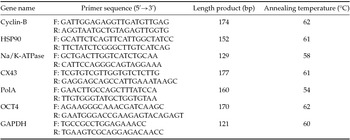
After IVM procedures, oocytes were stored in microtubules containing RLT buffer at –70°C until mRNA isolation. RNA was extracted from matured oocytes using the RNeasy Micro Kit (Qiagen). cDNA synthesis was carried out using a RevertAid™ First Strand cDNA Synthesis Kit (Fermentas). Transcript abundances of HSP90, OCT4, PolA, cyclin-B, Na/K-ATPase, connexin 43 (CX43) and GAPDH (as housekeeping) genes were analysed using quantitative real-time polymerase chain reaction (PCR). Real-time PCR was carried out using 25 ng of cDNA, 10 μl of SYBR Green (TaKaRa, Japan) and 5 pmol of the forward and reverse primers. The cDNA synthesis quality was normalized to the GAPDH gene. Primer sequences and annealing temperatures are shown in Table 1.
Primer sequences

Statistical analysis
The data for embryo development, gene expression, hormone concentration, oocyte diameter and time needed for ZP dissolution were analysed by the one-way analysis of variance (ANOVA) model of SPSS V 15. The nuclear maturation data were analysed by chi-squared test. Results are presented as mean ± standard error of the mean (SEM).
Results
Oocyte maturation and cortical granule pattern
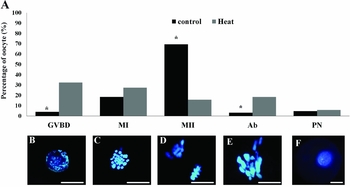
Results showed that temperature affects aspects of ovine oocytes maturation (Fig. 1). The percentage of oocytes that were arrested at GVBD stage was significantly higher (P<0.05) in 12 h heat shocking compared with the control. The heat-shock group had a higher percentage of oocytes at metaphase I (MI) than that of the control group (27.5 versus 18.5%), however the difference was not significant. The control group had a higher percentage of oocytes (P<0.05) that reached metaphase II (MII) stage compared with 12 h heat shock. The percentage of oocytes with aberrant chromosomal alignment on meiotic spindles was significantly higher in the heat-shock group (P<0.05) compared with the control. There was no difference between the two groups for percentage of oocytes at the pronuclear (PN) stage.
(A) Nuclear configuration of ovine oocytes matured at 38.5°C or 41°C during the first 12 h of maturation. (B) GVBD. (C) MI. (D) MII. (E) Ab. (F) PN. Ab, aberrant chromosomal alignment; GVBD, germinal vesicle breakdown; MI, metaphase I; MII, metaphase II; PN, pronuclear stage. Asterisk shows significant difference between control and treatment at P<0.05. Scale bar, 50 μm.

Immunofluorescence study of oocytes for CGs showed that heat-shocked oocytes had an uneven distribution pattern of CGs under the plasma membrane. In contrast, in the majority of oocytes in the control group, CGs were located marginally and linearly under the plasma membrane but the data were not quantified due to the inaccessibility of a confocal microscope.
Oocyte diameter and zona pellucid dissolution time
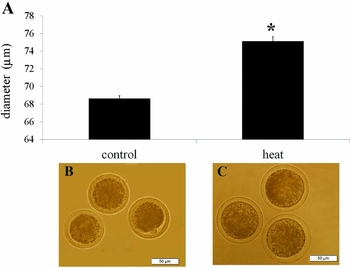
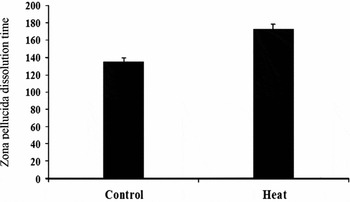
The data for oocyte's diameter and time required for ZP dissolution are presented in (Figs. 2 and 3). Analysed data generated by the ImageJ program showed that a 12 h heat shock increased the average diameter of matured oocytes when compared with the control group [75.13 μm versus 68.62 μm, (P<0.05) respectively)]. The heat-shock group need more time than the control group for ZP dissolution by enzyme [172.93 versus 135.17 s, (P<0.05) respectively].
(A) Diameter of ovine oocytes that matured at 38.5°C or 41°C during the first 12 h of maturation. (B) Oocytes in control group. (C) Oocytes in heat-shocked group. Asterisk shows significant difference between control and heat-shocked group at P<0.05. Scale bar, 50 μm.

Zona pellucida digestion in ovine oocytes that matured at 38.5°C or 41°C during the first 12 h of maturation. No significant difference was observed between the control and the treatment group.

Embryo development after parthenogenetic activation
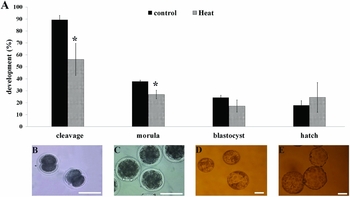
The developmental competences of parthenogenetically activated oocytes in two experimental groups are summarized in Fig. 4. Results showed that a 12 h heat shock in the maturation period reduced the cleavage rate and the percentage of embryos that developed to compacted morula stage (P<0.05). However there was no significant effect on the percentage of blastocyst formation and the percentage of hatched blastocysts (P<0.05).
Developmental competence of parthenogenetic activated ovine oocytes matured at 38.5°C or 41°C. (A) During the first 12 h of maturation. (B) Cleavage stage. (C) Morula stage. (D) Expanded blastocyst. (E) Hatched blastocyst. Asterisk shows significant differences at P<0.05 between the control and the heat-shocked group. Scale bar, 100 μm.

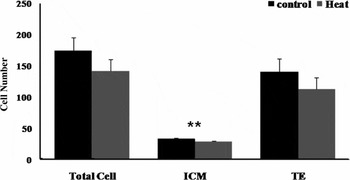
Differential staining showed that the mean number of ICM of blastocysts decreased significantly (P<0.05) in the heat-shocked group compared with the control. But, the TCN of blastocysts and TE cells was not affected by elevated temperature during oocyte maturation (Fig. 5).
Comparison of total cell number of blastocyst, inner cell mass (ICM) and trophectoderm (TE) between the parthenogenetic activated embryos derived from ovine oocytes matured at 38.5°C or 41°C during the first 12 h of maturation, asterisk shows significant differences at P<0.01 between control and the heat-shocked group.

Heat shock had no effect on oestrogen and progesterone concentrations in the culture medium (Table 2). Progesterone concentration in the culture medium was 0.4 ng/ml.
Effect of heat shock (41°C, 12 h) on oestrogen and progesterone concentrations in culture media

aNo significant difference was observed between the two groups.
Gene expression
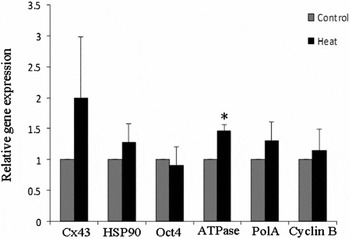
mRNA was harvested from two groups of in vitro-matured oocytes and used for analysis by quantitative real-time PCR. The relative abundance of transcripts for HSP90, ATPase, cyclin B, PolA, CX43 and Na/K-ATPase was higher in heat-shock oocytes compared with the control group. However, this difference was only significant for ATPase at P<0.05. Unlike these genes, the relative abundance for Oct 4 was non-significantly lower in the heat-shock oocytes compared with the control group at P<0.05. (Fig. 6).
Comparison of relative mRNA expression of connexin 43 (Cx43), heat-shock protein 90 (HSP90), Oct4, Na/K-ATPase, poly A polymerase (PolA) and cyclin B genes between ovine oocytes matured at 38.5°C or 41°C during the first 12 h of maturation. Asterisk shows significant difference at P<0.05 between control and the heat-shocked group.

Discussion
Heat shock disturbs nuclear and cytoplasmic maturation
Exposure of oocytes at the GV stage, during early stages of maturation, to elevated temperatures interferes with processes of oocyte maturation and thereby can reduce the developmental capacity of resultant embryos. Heat shock during IVM may directly affect the oocyte or indirectly affect oocytes via cumulus cells (CCs). During IVM, the oocyte and its surrounding CCs maintain a close association through gap junctions, thereby facilitating transfer of nutrients and molecular signals between oocytes and CCs (Gilchrist, Reference Gilchrist2010). Cumulus cells are considered to be crucially important to oocyte maturation, through their effects on maintenance of meiotic arrest at prophase I, induction of meiotic resumption, and cytoplasmic maturation. Mechanistically, the second messenger cyclic adenosine mono-phosphate (cAMP), which is produced mainly by CCs and transferred to the oocyte via gap junctions, plays a pivotal role in GV arrest or inhibition of meiosis resumption (Conti et al., Reference Conti, Andersen, Richard, Mehats, Chun and Horner2002). The first point highlighted in this study was that, in the short term, in vitro heat shock greatly disturbed GVBD and thereby the percentage of oocytes that reached the MII stage was decreased. In the present study, a significant difference was observed in the percentage of oocyte arrested at GVBD and, therefore, the percentage of oocyte at the MII stage significantly decreased in the treatment group. These results were in agreement with the current study by Roth & Hansen (Reference Roth and Hansen2005), who reported that heat stress at 41°C during bovine oocyte maturation reduced progression from MI to MII. This reduction can be attributed to heat-shock-induced apoptosis in oocytes and CCs and is aggravated by depletion of the antioxidant content of oocytes, by glutathione (GSH), which is mainly synthesized by cumulus cells and is transferred to the oocyte. In addition, our results also show not only that the rate of oocytes reaching MII is decreased, but that a significant percentage of these oocytes present aberrant meiotic chromosomal alignment. This finding is in accordance with the literature showing that the stability of microtubules is heat sensitive and chromosomes of matured oocytes under heat-shock condition were more aberrant and separated (Tseng et al., Reference Tseng, Chen, Chou, Yeh and Ju2004; Ju et al., Reference Ju, Jiang, Tseng, Parks and Yang2005). These investigators attributed this effect to altered microtubule and microfilament distribution. Disruption of the cytoskeleton may result in a flattening of the oocyte (Coticchio et al., Reference Coticchio, Guglielmo, Canto, Fadini, Renzini, Ponti, Brambillasca and Albertini2013) and thereby may account for increased diameter of oocytes in the heat-shock group.
Cytoplasmic maturation includes a series of processes that are necessary for oocytes to acquire the capacity for embryonic development. The complex process of cytoplasmic maturation, which includes drastic changes in organization of organelles and extensive protein synthesis, requires much more time (Szöllösi et al., Reference Szöllösi, Desmedt, Crozet and Brender1988) and, therefore, improper maturation or interference with maturation can effect the distribution of organelles, especially the distribution of CGs (Romar et al., Reference Romar, Coy and Rath2012). In this study, we also showed that heat stress alters the normal distribution of CGs but this alteration was not quantified due to inaccessibility to a confocal microscope.
Heat shock disturbs developmental competence of activated oocytes
A study of the literature showed that exposure to heat shock reduces the cleavage rate (Edwards et al., Reference Edwards, Ealy, Monterroso and Hansen1997). In the present study, presumptive cleavage rate was also decreased compared with the control group. In farm animals, pronuclei are not observable and the presumptive cleavage rate is taken as number of oocytes that have divided and not as the true cleavage rate (number of cleaved embryos/number of fertilized or 2PN zygotes). Two major underlying mechanisms may account for the reported reduced cleavage rate: (1) reduced sperm penetration rate; and (2) non-competence of oocyte to becomes activated and remodel sperm (Nasr-Esfahani et al., Reference Nasr-Esfahani, Deemeh and Tavalaee2010). To shed light on this ambiguity, we assessed the ZP dissolution time for each oocytes by enzymatic test. Results showed that heat-shocked oocytes needed more time for ZP digestion and may account for the former possibility. But, in this study, as we used similar parthenogenetic activation for both groups and observed lower cleavage rate in the heat-shock group; this situation, this suggests that the latter hypothesis may also account for the reduced cleavage rate and, therefore, both possibilities may account for reduced fecundity during natural heat stress.
It has been documented that in vitro heat shock disrupts plasma membranes (Hildebrandt et al., Reference Hildebrandt, Wust, Ahlers, Dieing, Sreenivasa, Kerner, Felix and Riess2002), reduces their integrity, changes lipid cellular membrane composition (Amir & Zvi, Reference Amir and Zvi2008) and may disrupt calcium in-flow (Tseng & Ju, Reference Tseng and Ju2009). Tatemoto & Terada (Reference Tatemoto and Terada1999) reported that increased intracellular calcium may result in early release of CGs and thereby increased ZP dissolution time and this situation may account for the reported reduced cleavage. Therefore, heat stress, which is known to increase intracellular calcium availability, may have induced the non-significant increased time for ZP dissolution. In this study we also assessed embryo development to blastocyst stage. Despite a significant reduction at the morula stage in the heat-shock group compared with the control, no significant difference was observed in the rate of blastocyst formation, a finding that is in contrast with the bovine or porcine literature, which reported significant drop in blastocyst formation after heat-shock treatment of oocytes. A few explanations can be provided for this controversy: (1) species difference; (2) embryos in this study were derived by parthenogenetic activation and input that oocyte have to transform the condensed sperm head to form the male pronucleus, may have been used by oocyte to counterbalance the heat stress (i.e. GSH used for sperm decondensation) (Sekhavati et al., Reference Sekhavati, Shadanloo, Hosseini, Tahmoorespur, Nasiri, Hajian and Nasr-Esfahani2013); and (3) early insemination or activation of heat-stressed oocyte may overcome reduced blastocyst formation (Edwards et al., Reference Edwards, Saxton, Lawrence, Payton and Dunlap2005). However, despite similar blastocyst rates in the two groups, in this study by assessment of the number cells in the ICM, in accordance with previous studies we observed a reduction in quality of blastocyst derived from the heat-shock group compared with control (Fig. 5). Many studies have shown that proper expression of Oct-4 during follicular development and possibility during oocyte maturation has an important effect on developmental competency of oocyte (Virant-Klun et al., Reference Virant-Klun, Knez, Tomazevic and Skutella2013). In this study the expression level of all the assessed genes increased in the heat-shock group except for Oct-4, in which the change was not significant. This finding may suggest that heat shock does not affect this marker of pluripotency.
Heat stress does not affect relative expression of the candidate genes except for Na/K-ATPase
It was important to know how heat shock may affect relative abundances of developmentally important mRNAs. Our results showed that 12 h heat shock had no significant effect on the relative expression of HSP90, a marker related to heat stress with chaperone activity. Payton et al. (Reference Payton, Louisa, Saxton and Edwards2011) showed that HSP70 transcripts were increased in CCs of heat-stressed oocytes at 12 h IVM. The difference observed between our results and that of Payton et al. (Reference Payton, Louisa, Saxton and Edwards2011) is very likely related to difference between the transcriptional activities of the two cells (cumulus versus oocyte). In this regard, similar results were observed for PolA, OCT4, CX43, and cyclin B expression. But, the expression of Na/K-ATPase was significantly higher in the heat-shocked group. It is well known that ion pumping Na/K-ATPase is important for maintaining intracellular homeostasis. This process is one of the most energy (ATP) consuming within the cells and, therefore, we may speculate that increase in expression may be related to increase energy consumption phenomenon which requires future experimentation and validation. With respect to cyclin B expression, background studies have shown that heat stress can disturb the maturation procedure via altering maturation-promoting factor (MPF) activity (Rispoli et al., Reference Rispoli, Lawrence, Payton, Saxton, Schrock, Schrick, Middlebrooks, Dunlap, Parrish and Edwards2011). But our results, at least at the transcriptional level, showed that heat stress does not alter the expression of cyclin B relative to the control.
In conclusion, our results show that heat stress during early phase of maturation, severely affected oocyte maturation and meiotic apparatus of the oocyte which may have importance consequences on pre- and post-implantation development. Furthermore, heat stress increased ZP dissolution time which may be related to premature CGs exocytosis. We observed no significant reduction in rate of blastocyst formation following heat stress but the quality of blastocyst was reduced. Assessment of relative abundance of maternal transcripts in oocytes revealed no general significant difference between the two groups.
Acknowledgements
The study was carried out using a grant from the Royan Institute of the Islamic Republic of Iran.
Authors’ contribution
Conceived and designed the manuscript: OS, HSM, and NEMH. Performed the experiments: GZ, RA, OS, HSM, HM. Wrote draft and final manuscript: OS, HSM, NEMH.