INTRODUCTION
The Neolithic reached the northeast of the Iberian Peninsula about the middle of the sixth millennium cal BC. At that time, an economy based on domestic species, including both crops (wheat, barley and pulses) and livestock (sheep, goats and cattle), was introduced and consolidated. The highest early density of sites is found in coastal and pre-littoral areas, but the Neolithic occupations soon reached the Pyrenean valleys (Gibaja and Clop Reference Gibaja and Clop2012; Oms et al. Reference Oms, Petit, Morales and García2012; Mazzucco Reference Mazzucco2014).
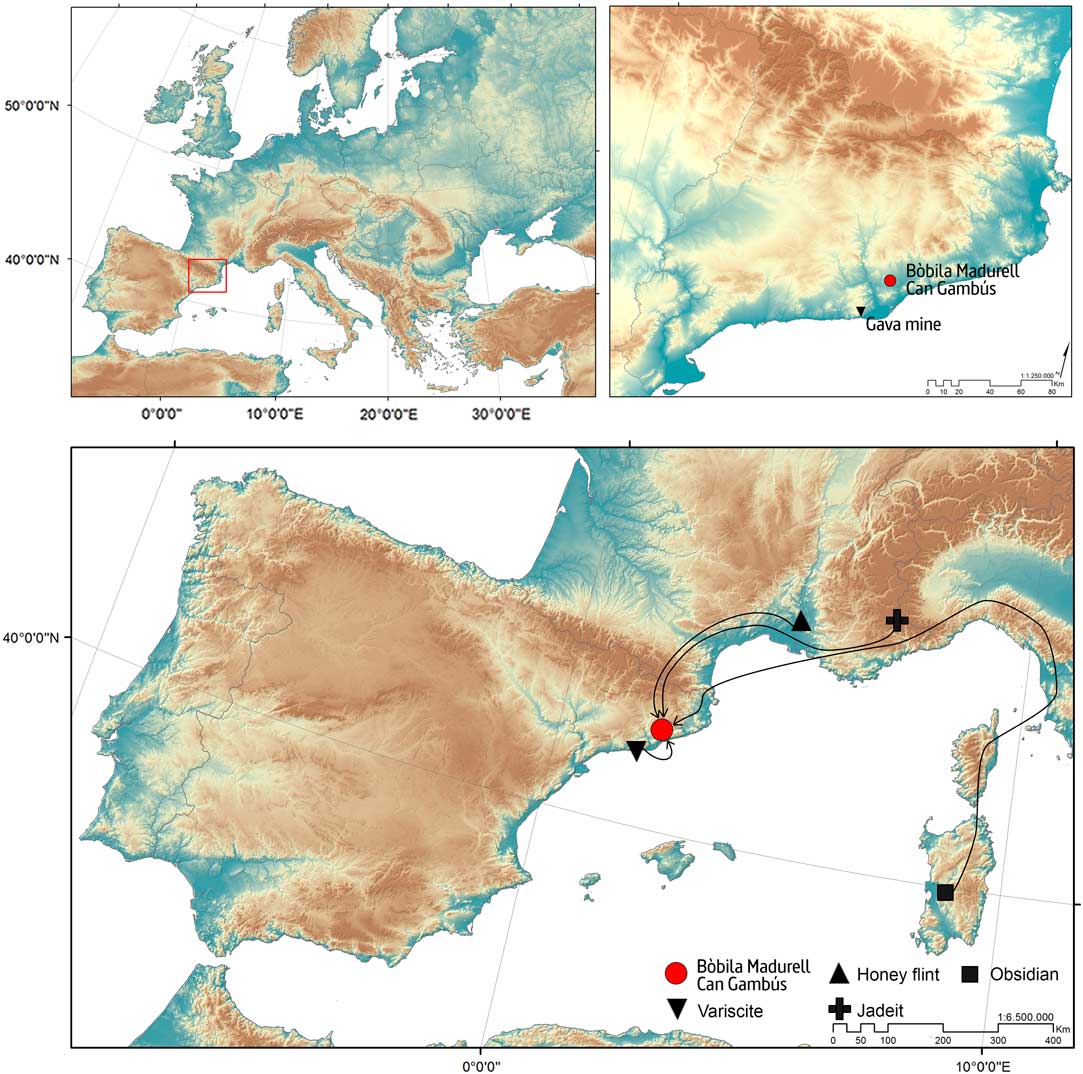
Little evidence of funerary practices has been found and dated for the first millennium of the Neolithic in northeast Iberia. Only a few examples of collective burials in caves and individual inhumations in pits are known (Bosch and Tarrús 1991; Blasco et al. Reference Blasco, Edo, Villalba and Saña2005; González et al. Reference González, Hadzerbacher and Molist2011). However, the situation changes radically in the late 5th millennium and during the first half of the 4th millennium cal BC. At this time, Neolithic societies began to systematically bury their deceased in pit or cist graves. These are generally individual burials, though occasionally double examples are found, with the more or less recurrent appearance of raw materials whose extraction involved a significant investment in labor and, in some cases, whose origin was exogenous. To be precise, the raw materials usually found are honey flint, probably from the southeast of France, jadeite, amphibolite, eclogite and nephrite from the Alps or the Pyrenees, variscite extracted from mines on the northeastern coast of the Iberian Peninsula and even obsidian from Sardinia (Terradas and Gibaja Reference Terradas and Gibaja2002; Molist et al. Reference Molist, Bofill, Borrell, Bosch, Buxó, Chambon, Clop, Gibaja, Gómez, Nadal, Oliva, Ortiz, Saña and Vicente2012; Vaquer et al. Reference Vaquer, Martín, Pétrequin and Errera2012; Gibaja et al. Reference Gibaja, Léa, Lugliè, Bosch, Gassin and Terradas2013, Reference Gibaja, González, Martín, Palomo, Petit, Plasencia, Remolins and Terradas2014; Terradas et al. Reference Terradas, Gratuze, Bosch, Enrich, Esteve, Oms and Ribé2014).
This specific funerary pattern was termed the Pit Burials cultural horizon and this recurrence has also been documented in other European funerary practices in the same period, such as the Chasséen cultural horizon in the center and south of France, the Cortaillod in Switzerland, and the Square-Mouthed Pottery cultural horizon in Italy. Traditionally, the literature has postulated long-distance relationships between these communities as an explanation (Tarrús Reference Tarrús2002; Moinat and Chambon Reference Moinat and Chambon2007; Zemour Reference Zemour2013; Vaquer Reference Vaquer2014; Schmitt Reference Schmitt2015). However, until now the chronology of Pit Burials has not been fully defined, so it was difficult to describe and explain the development of these networks.
This work aims to be a first step to fill this gap. The Neolithic necropolis of Bòbila Madurell-Can Gambús is the most significant cemetery in this cultural horizon, with a total of 179 documented burials (Allièse Reference Allièse2016). However, it is suspected that this number may be an underestimate. Post-Neolithic human occupations, the numerous agricultural and industrial works, and the many roads and railways built before the 1980s have affected areas of the site where there might have been graves.
Geographical location of Bòbila Madurell-Can Gambús necropolis (unpublished map personally ceded by Gerard Remolins).

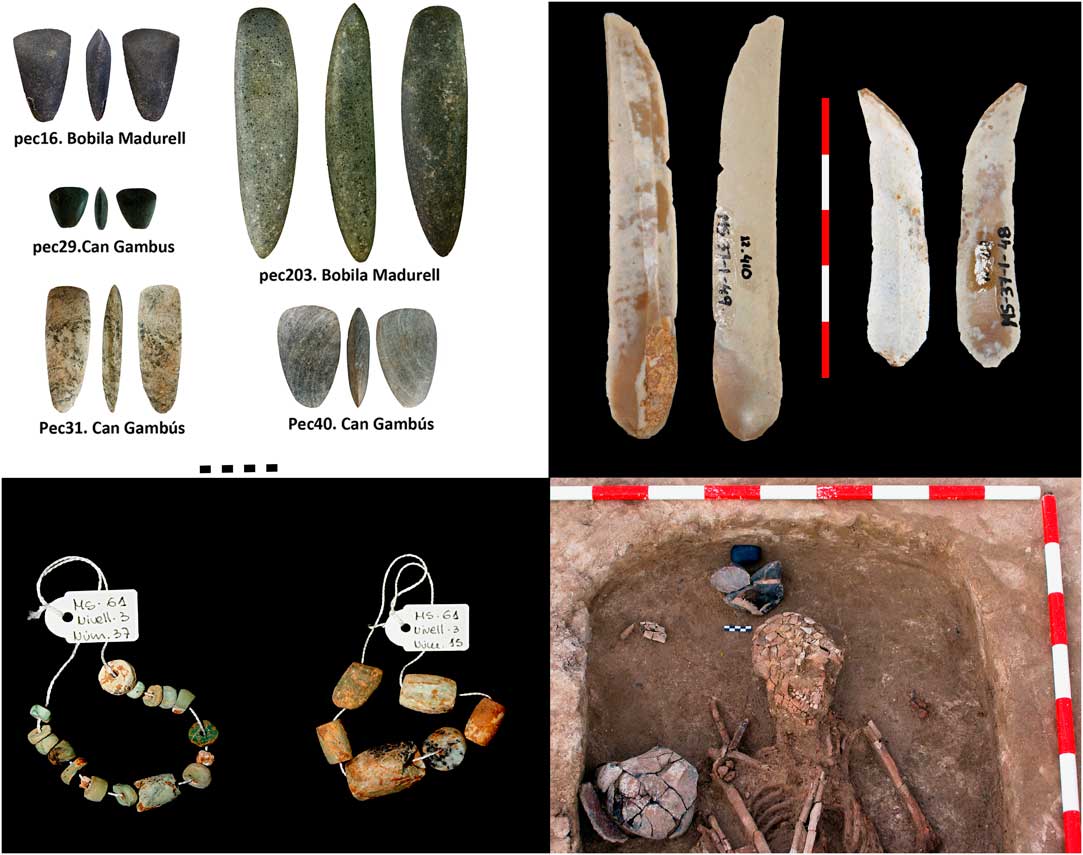
From top to bottom and left to right: different axes and adzes (unpublished photo personally ceded by Alba Masclans Latorre), honey flint blades (unpublished photos personally ceded by Juan Francisco Gibaja Bao), variscite beads (unpublished photo personally ceded by SAP archive), and burial with obsidian cores (unpublished photo personally ceded by SAP archive) documented in Bòbila Madurell-Can Gambús necropolis grave goods.

The temporal dynamics of the necropolis are addressed here, not only regarding its use, but also in relation to the presence and absence of these particular exogenous raw materials. The chronology regarding their presence and absence allows us to propose hypotheses about when and up to when these exchange networks operated in the necropolis.
To solve these questions, on one hand, a systematic review has been performed with the classification of the pit burials and their associated artifacts in a dataset, through revision of old excavation monographs and the materials deposited in Sabadell Museum (Allièse Reference Allièse2016; Duboscq Reference Duboscq2017). On the other hand, the origin of the raw materials in the grave goods has been identified in a detailed analysis (Gibaja Reference Gibaja2003; Masclans et al. Reference Masclans, Palomo, Gibaja, Remolins and Gómez2017; Masclans Reference Masclans2017). Finally, a set of new 14C dates has been carried out and they have been analyzed through different statistical tests and Bayesian modeling, which will be discussed below.
As mentioned above, Bòbila Madurell-Can Gambús is the most emblematic cemetery in the Pit Burials cultural horizon, due to the uniqueness of its archaeological record. There is no similar Neolithic site in Western Mediterranean Europe with so many graves. Small cemeteries not exceeding 25 graves are typical although occasionally some of them reach about 50 burials. However, as yet, no other Neolithic necropolis like Bòbila Madurell-Can Gambús has been documented. Thus, the new data presented in this paper not only provide new research clues about the temporal dynamics of the site, but also about the Pit Burials cultural horizon in general and the raw-materials exchange networks associated with this funerary phenomenon.
NECROPOLIS OF BÒBILA MADURELL-CAN GAMBÚS
Bòbila Madurell-Can Gambús (UTM31N-ETRS89; X=424051.54; Y=4598257.27; Z=162′83–213′44 m) cemetery is located within the valley called Fossa Tectònica del Vallés-Penedés, which separates the coastal and Prelittoral mountain ranges. The area of the necropolis is formed geologically in Quaternary sediments covering conglomerates and clay facies of the Upper Miocene. Most of the site is occupied by detrital material from the pre-littoral range, which is composed of red Quaternary clay.
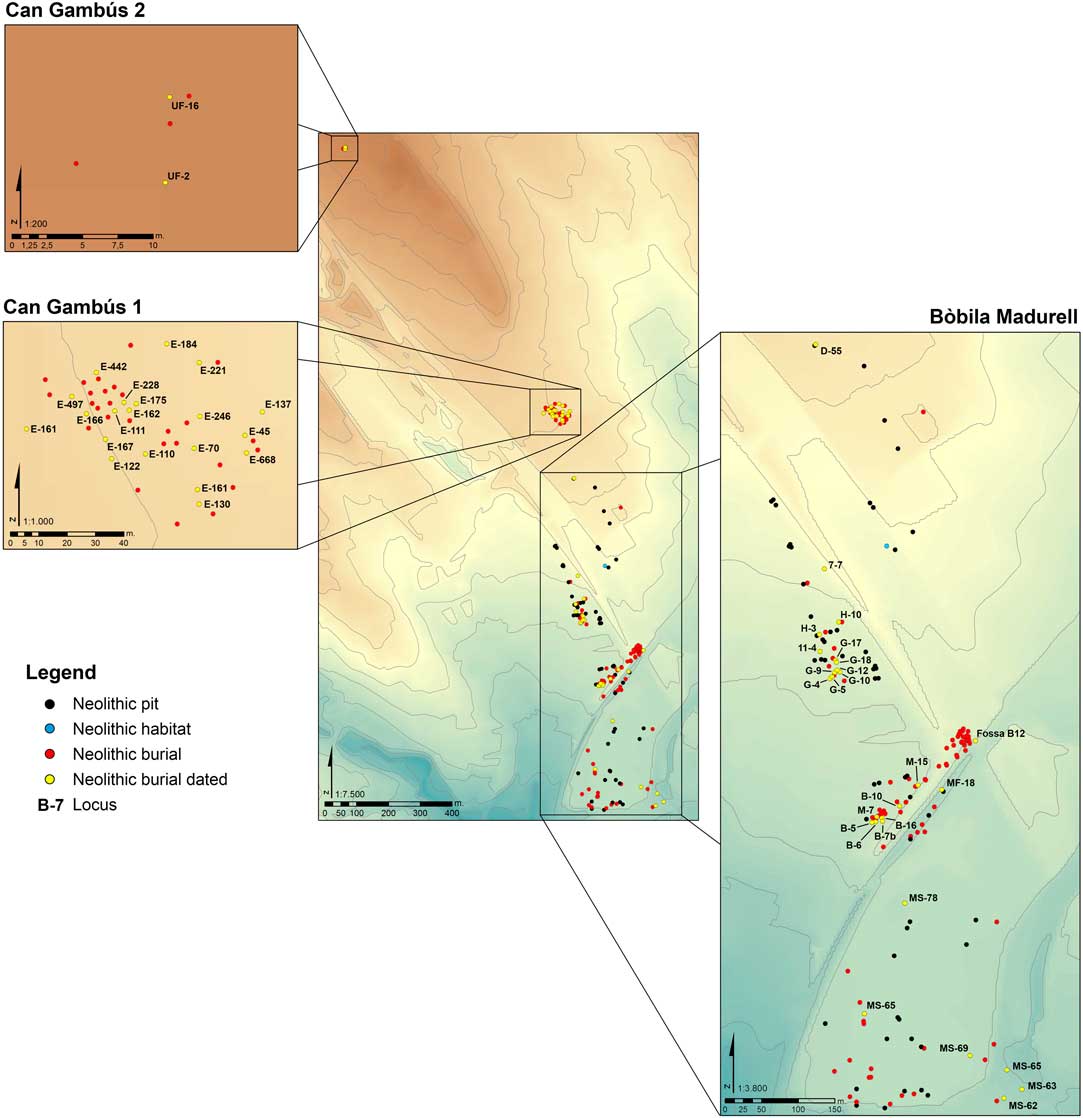
The site has been excavated intermittently in different field seasons since the early 20th century and many publications and references have been devoted to it (Martín et al. 1988; Martín et al. in press; Martín and Casas in press; Roig and Coll Reference Roig and Coll2010; Roig et al. Reference Roig, Coll, Gibaja, Chambon, Villar, Ruiz, Terradas and Subirà2010). As mentioned above, a total of 179 pit burials have been documented in the cemetery (Allièses Reference Allièse2016). A highway cut the site in half and two sectors can be differentiated: Bòbila-Madurell (southern part) and Can Gambús (northern part). Bòbila Madurell differs from Can Gambús because there are not only funerary structures, but also domestic structures, such as refuse pits and silos. On the other hand, Can Gambús is located in the upper part of a slope (Z=189′94–213′44 m) where only adult individuals were buried, while in Bòbila Madurell, at a lower altitude (Z=162′83–186′92 m), both adults and immature individuals were documented. As Figure 3 shows, two areas are differentiated in Can Gambús (Can Gambús I and Can Gambús II). This distinction was used in the excavation reports to differentiate four burials (located in Can Gambús II, Z=212′41–213′44 m) that are slightly removed from Can Gambús I (Z=189′94–191′02 m).
Plan of Bòbila Madurell-Can Gambús necropolis. Dated and undated burials are distinguished.

Multiple excavations were conducted in various parts of Bòbila Madurell from the 1930s to the latest fieldwork in 1992, while Can Gambús is the most recently excavated sector (between 2003 and 2006) (Muñoz Reference Muñoz1965; Martín et al. Reference Martín, Miret, Blanch, Aliaga, Enrich, Colomer, Albizuri and Bosch1988; Alaminos et al. Reference Alaminos, Blanch and Lázaro1991; Bordas et al. Reference Bordas, Díaz, Pou, Parpal and Martín1994; Roig and Coll Reference Roig and Coll2010; Martín et al. in press). The differences between the sectors pose the question of whether or not they were part of the same phase of activity.
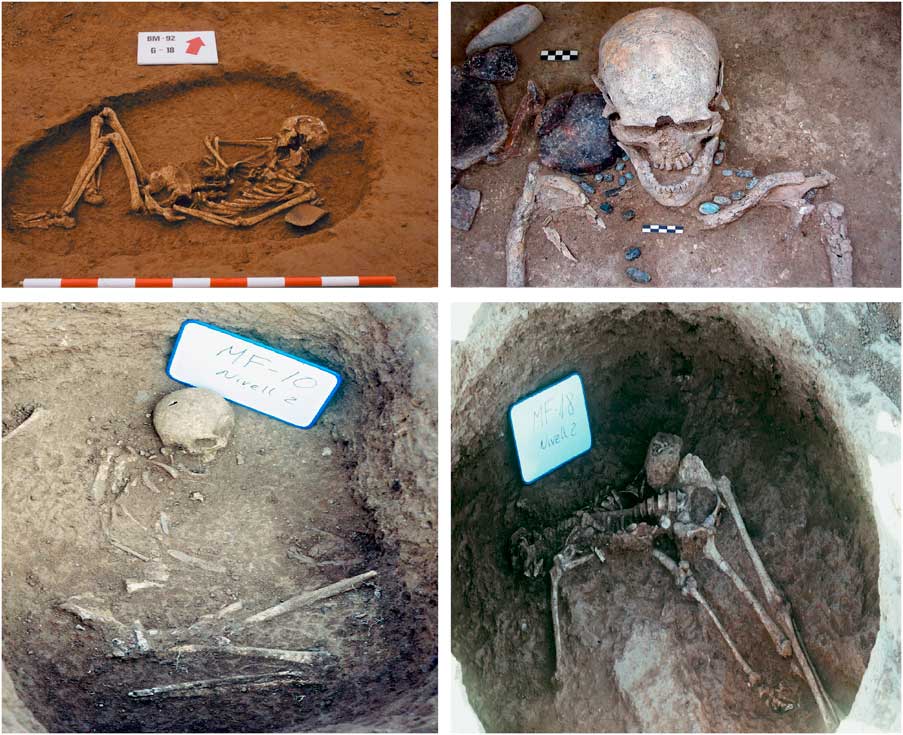
The funerary pattern is more or less homogeneous in terms of the type of burial and the grave goods, and also in the way in which the bodies are deposited. The burials are usually in individual pits, in some cases double. Very sporadically, there are also graves with three or more buried individuals. Men, women and children are buried. The architecture of the pits is rectangular, circular or oval. The buried were placed in a supine position with flexed arms and legs, although sometimes they are fully stretched or in lateral decubitus position with the arms and legs also folded. However, in certain graves, disarticulated burials or those with only partial connections were also found, and even bodies of individuals who were moved to the side of the grave in order to make space for the last inhumed. The latest funerary taphonomic study (Allièse Reference Allièse2016) has observed that these buried individuals were not simply deposited on the bottom of the funerary structure, but sometimes in rigid boxes, probably made of wood, or in sacks.
Pit burials documented in the necropolis of Bòbila Madurell-Can Gambús (unpublished photo personally ceded by SAP archive).

Different kinds of artifacts have been found accompanying the dead. Lithic artifacts are usually cores and various flint implements, especially blades, microliths, and points (Terradas and Gibaja Reference Terradas and Gibaja2002; Gibaja Reference Gibaja2003; Gibaja and Terradas Reference Gibaja and Terradas2012). It also common to find coarse lithic tools, especially polished and bevelled artifacts, such as axes and adzes (Vaquer et al. Reference Vaquer, Martín, Pétrequin and Errera2012; Masclans et al. Reference Masclans, Palomo, Gibaja, Remolins and Gómez2017; Masclans Reference Masclans2017). Pottery vessels are characterized by a variety of shapes and sizes. The most common are the spherical, sub-spherical and the “square mouth” types, which are usually undecorated (Masvidal et al. Reference Masvidal, González and Mora2003; Roig and Coll Reference Roig and Coll2010). Other common elements in the graves are body ornaments. Although necklaces and bracelets made with variscite beads are the most representative, sometimes rock, shell, faunal teeth and bone beads are also found (Oliva Reference Oliva2015). Certain skeletal parts of animals are also found and sometimes the whole animal is left. However, an entire skeleton of an animal has never been documented stratigraphically associated with the dead. They have never appeared at the grave levels, but at subsequent levels, so it is not reliable to consider them as grave goods (Martín and Casas in press). Mostly they are remains of domestic species (98%); wild species, such as deer, wild boar or small carnivore, are rarely found (2%). Finally, charred cereal remains were also documented inside some graves (Antolín Reference Antolín2016). However, the documentation of these archaeobotanical remains is very scarce, so it is not possible to determine whether their presence was intentional. Moreover, most of the excavation work did not perform this kind of in-situ analysis, so unfortunately much of this information was lost.
As mentioned above, in some of the burials, artifacts made with exogenous raw materials were found. These materials are honey flint probably from the southeast of France (Binder Reference Binder1998; Léa Reference Léa2005; Gibaja and Terradas Reference Gibaja and Terradas2012; Gibaja et al. Reference Gibaja, Léa, Lugliè, Bosch, Gassin and Terradas2013); various rocks used for making polished axes and adzes from the Alps and the Pyrenees such as jadeite, amphibolite, eclogite, and nephrite (Pétrequin et al. Reference Pétrequin, Errera, Martín, Fabregas and Vaquer2012; Vaquer et al. Reference Vaquer, Martín, Pétrequin and Errera2012); blades made of obsidian originally from Monte Arci in Sardinia (Gibaja et al. Reference Gibaja, González, Martín, Palomo, Petit, Plasencia, Remolins and Terradas2014; Terradas et al. Reference Terradas, Gratuze, Bosch, Enrich, Esteve, Oms and Ribé2014 ); and variscite beads extracted from Gava Mine Complex, close to the northeast coast of the Iberian Peninsula (Villalba et al. Reference Villalba, Bañolas, Arenas and Alonso1986; Bosch and Borrell Reference Bosch and Borrell2009).
MATERIALS AND METHODS
Materials
Review of Archaeological Context and Associated Artifacts
Firstly, after a thorough study of the published archaeological information and excavation reports, the best-preserved burials (primary inhumations with articulated bones whose structure and grave goods were perfectly recognizable) were selected to be dated. Finally, this first selection depended on the state of preservation of the skeletal remains deposited in the museum. In this regard, we discarded those graves whose bones were badly damaged (Gibaja Reference Gibaja2003; Roig and Coll Reference Roig and Coll2010; Duboscq Reference Duboscq2017). On the basis of these criteria, it was also ensured that the number of dated burials was as equitable as possible between the sectors.
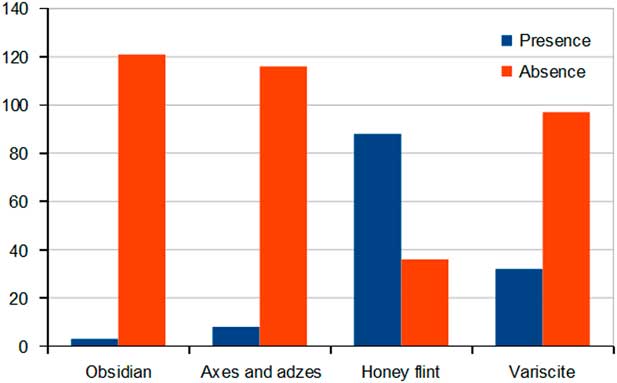
Figure 5 represents the presence and the absence of the exogenous raw materials in 124 of the total of 179 documented burials in the necropolis. These 124 are the total of burials that we consider reliable, since they are primary inhumations, with articulated bones and a good level of preservation. Three obsidian remains are present in two burials (two fragments of blade in one of them and an entire blade in the other one), jadeite, amphibolite, eclogite, and nephrite in eight burials, honey silex flint in 88, and variscite in 32.
Plot graph of the presence and absence of exogenous raw materials at Bòbila Madurell-Can Gambús.

Set of Published and New Unpublished 14C Dates
One of the most important parts of the research was to obtain a new set of 14C dates. Within the framework of the research project, a total of 46 new dates were obtained, 27 from the Bòbila Madurell sector and 19 from the Can Gambús sector. As far as possible, it was attempted to keep the number of new dates more or less equal between the two sectors. These, added to the three available old 14C dates (one from Bòbila Madurell sector and two from Can Gambús sector) have allowed us to carry out this study with a total of 49 14C dates.
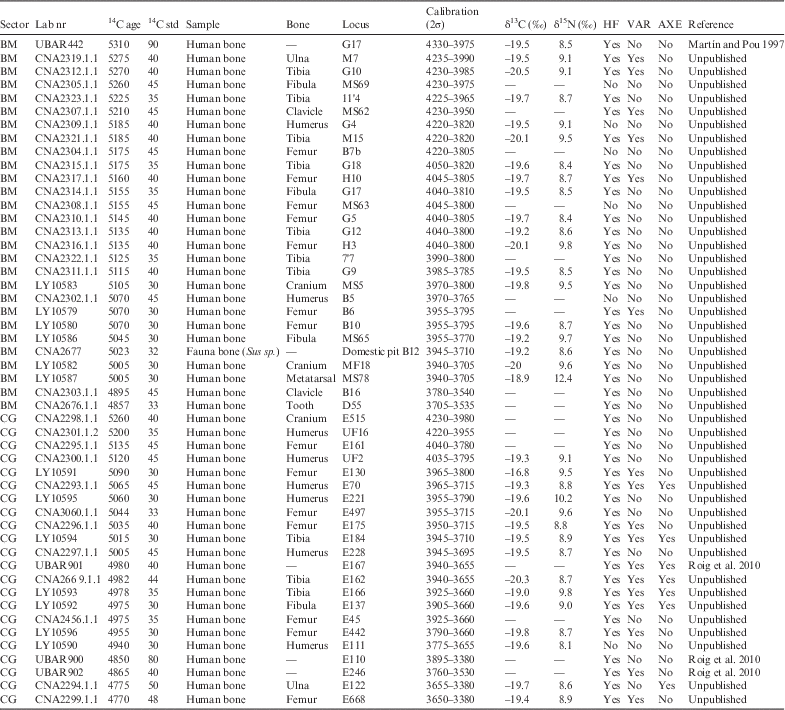
Table 1 lists the entire set of 14C dates used for this study. All dates have been calibrated to 2σ using OxCal v4.2 software (Bronk Ramsey Reference Bronk Ramsey2009) with the IntCal13 curve (Reimer et al. Reference Reimer, Bard, Bayliss, Beck, Blackwell, Bronk Ramsey, Buck, Cheng, Edwards, Friedrich, Grootes, Guil- derson, Haflidason, Hajdas, Hatté, Heaton, Hoffmann, Hogg, Hughen, Kaiser, Kromer, Manning, Niu, Reimer, Richards, Scott, Southon, Staff, CSM and van der Plicht2013). In addition, the association of each 14C date with the presence or absence of the raw materials whose chronological differences were being analyzed is also specified. They are as follows: honey flint tools, variscite beads and jadeite, amphibolite, eclogite and nephrite axes and adzes. Obsidian was not considered because only one of the two burials where the three remains were documented has been dated. This, coupled with the fact that it is not a recurrently documented raw material in Bòbila Madurell-Can Gambús, means that there is not enough empirical basis to consider obsidian as a chronological indicator of the exchange networks of the necropolis.
List of all 14C dates used for the analysis. The presence or absence of honey flint (HF), variscite (VAR) or jadeite, amphibolite, eclogite and nephrite axes and adzes (AXE) in each of their contexts is also specified. Stable carbon (δ13C) and nitrogen (δ15N) values obtained for human samples were provided by Maria Fontanals Coll (Fontanals 2014).

The sample selection criterion was that they should be human bone samples from reliable structures. This meant that all samples should come from primary inhumations, with articulated bones and a good level of preservation and none from secondary deposits. We must neverthless note that the 14C date from the B12 structure was an exception. It is a domestic pit, and dating this structure was considered interesting to know if it was chronologically related or not with the rest of the necropolis. However, this has not been integrated into the analyses that we present below, because it had a different functionality than the other structures.
Two old determinations were not selected for our analysis because they are charcoal samples found in the literature and we are not sure if they come from the same level of the burial or from the overlying levels. However, they are listed in Table 2 out of interest. On the other hand, it is important to note that stable isotope studies on the diet of these populations (also carried out within the framework of our research project) determined that marine resources were not consumed (Fontanals Reference Fontanals2015), and therefore the dates will not be affected by the reservoir effect.
14C dates of Bòbila Madurell-Can Gambús from charcoal samples. They were not used in this analysis.

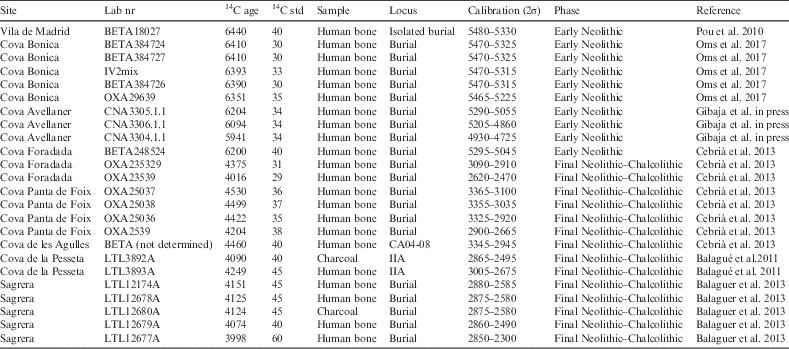
Finally, a dataset on published 14C dates from Early Neolithic and Final Neolithic-Chalcolithic burials of the northeast of the Iberian peninsula was also provided (Table 3). These data were collected so that we could specify the temporal limits of Bòbila Madurell-Can Gambús through Bayesian modeling, while taking into account the phases of the Pit Burials cultural horizon. The data from these contexts have been selected from the available bibliography following the same criteria as in the 14C dates of the necropolis: all samples should come from earlier and later primary inhumations, with articulated bones and a good level of preservation and none from secondary deposits. They should be human bone samples and, in the case of charcoals, they must surely come from the same level of the burial and with less than ±80 standard deviations.
14C dates used in this analysis from the Early Neolithic and Final Neolithic-Chalcolithic burials from the northeast Iberian Peninsula.

Methods
New 14C Dates: Data Acquisition and Sample Selection Protocols
The accelerator mass spectrometry (AMS) 14C dating was performed at the Centro Nacional de Aceleradores (CNA) in Seville, Spain. Samples were selected from compact bone with no diagenetic alterations nor with consolidants or adhesive substances. Wherever possible, the lower limb was chosen because of the greater bone density and consequently greater possibility of preserved collagen. Bone samples were first pretreated in the laboratory (Unitat d’Antropologia Biològica, Universitat Autònoma de Barcelona) in order to clean them of soil and other adhered substances using water and mechanical elements. Once cleaned, the following steps were taken to extract and purify the collagen in the bone, since this fraction is thought to give the most reliable results. The mineral part of the bone is more subject to contamination due to interaction with the surrounding environment. The whole process includes several steps detailed in other publications (Brock et al. Reference Brock, Bronk Ramsey and Higham2007; Hajdas et al. Reference Hajdas, Michczynski, Bonani, Wacker and Furrer2010; Van Strydonck et al. Reference Van Strydonck, Boudin and Mulder2010), and basically consists of the demineralization of the bone and subsequent purification steps to extract the collagen. After demineralization of the bone, gelatin was neutralized and a solution of NaOH 0.1M was added at room temperature for 15 min in order to remove potential humic contaminants. Gelatin was neutralized and solubilised in HCl at pH=3 overnight at 80ºC. Remnants were eliminated by centrifugation and the solution was dried to obtain the final collagen. The collagen was then transformed into graphite for AMS measurement using an AGE apparatus (Wacker et al. Reference Wacker, Nemeç and Bourquin2010a).
Samples for 14C dating can be measured at two different facilities at CNA. SARA (Spanish Accelerator for Radionuclide Analysis) (Chamizo et al. Reference Chamizo, Santos, López, Padilla, García, Heinemeier, Schnabel and Scognamiglio2015) has been in use since 2006, while a MICADAS (MIni CArbon DAting System) (Wacker et al. Reference Wacker, Bonani, Friedrich, Hadjas, Kromer, Nemec, Ruff, Suter, Synal and Vockenhuber2010b) was installed in 2012, and is currently used as the default facility for 14C dating. Both systems follow the same AMS principles. Graphite samples were sputtered by a caesium beam to obtain a negative ion beam from the sample, and several kinematic filters were used to eliminate undesired components of the beam. To achieve the necessary sensitivity, molecules were broken in the stripper tube at the high-voltage terminal.
Statistical Analyses and Bayesian Modeling of 14C Data
The spatial discontinuity and the topographic difference between the sectors, as well as the fact that only adult indviduals have been documented in Can Gambús, while immature indviduals (from 0 to 14 years according to Allièse Reference Allièse2016) and domestic structures have also been found in the Bòbila Madurell sector, suggest the possibility of different phases of activity. Specifically, the horizontal stratigraphy and the higher concentration of the oldest radiocarbon (14C) dates in Bòbila Madurell and the earliest in Can Gambús could indicate that the first one started earlier than the other one. On the other hand, the fact that most of the grave goods without exogenous raw materials have been documented in the Bòbila Madurell sector, suggests that the exchange networks perhaps did not operate throughout the entire period of use of the necropolis.
Different statistical analyses and Bayesian modeling were carried out to prove the statistical consistency of these hypotheses based on the available 14C data. All of them have been performed with OxCal v.4.2 software with the IntCal13 curve.
First of all, the degree of synchronicity of the full set of burials and also between the spatially differentiated necropolis sectors have been explored using the chi-square test (Ward and Wilson Reference Ward and Wilson1978), through the Combine function of the OxCal software. Then, the prior hypotheses regarding the burials and/or grave goods chronological sequence have specifically been tested using different Bayesian models. Specifically, the Contiguous Phases Bayesian Model and the Overlapping Phases Bayesian Model have been used (Bronk Ramsey Reference Bronk Ramsey2009; Lee and Bronk Ramsey Reference Lee and Bronk Ramsey2012). In the case of those dates from the same sample, they have been combined prior to their calibration previously, through the chi-square test using the R_Combine function of the OxCal software (Bronk Ramsey Reference Bronk Ramsey2009), to avoid possible redundancies that might interfere with the results of the analysis.
The former is a simple uniform distribution model in which all dates have the same probability within a specific period defined by the oldest and the newest estimate. In our case, the hypothesis to test is whether the deaths of all the buried individuals in the two sectors have the same likelihood of occurring at any time between the oldest and the most recent existing dates. If this model presents a high consistency with the data, we would infer the lack of chronological discontinuity between both sectors of the cemetery; if not, different phases of activity might be interpreted.
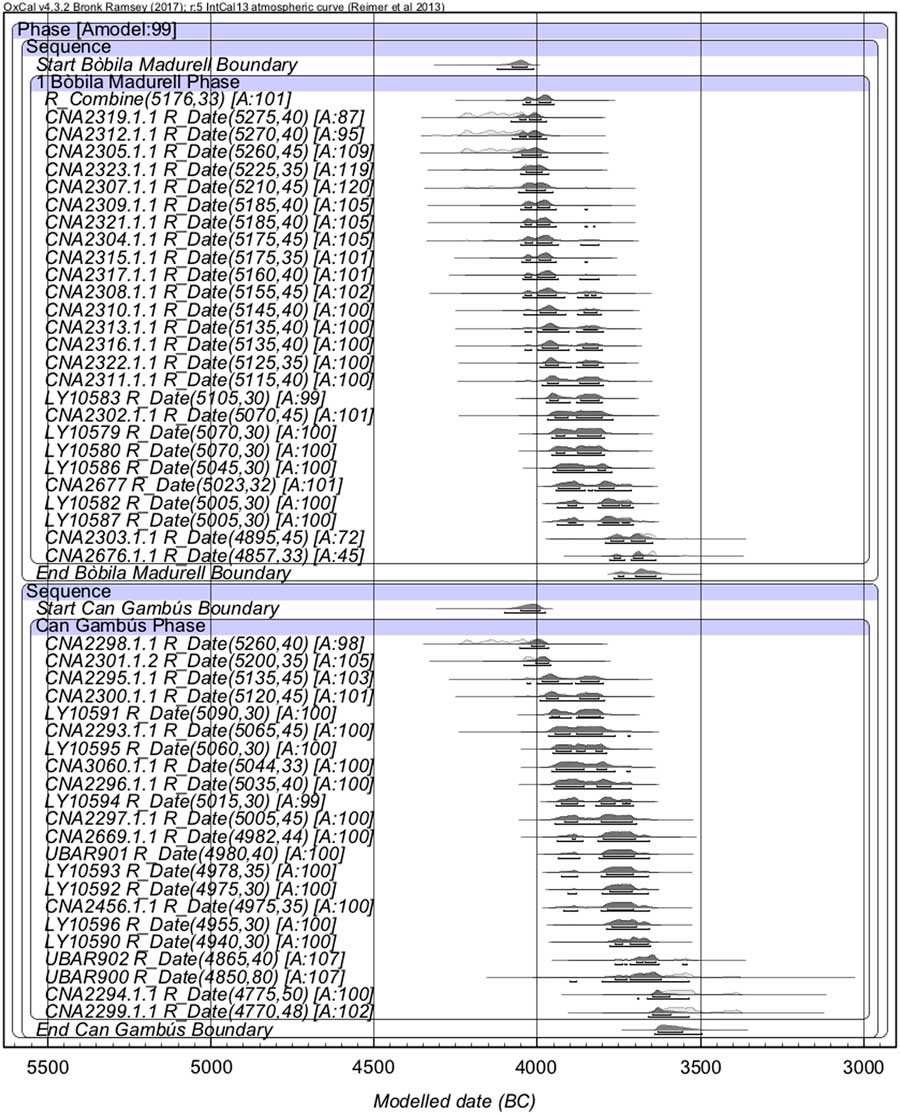
Although the Overlapping Phases Bayesian Model is similar to the previous one, the start and end events are not simply determined by the oldest and the most recent existing dates. It is assumed that the transition between the end boundary of a phase and the start event of the next phase is not sharp, but there is some overlap in which the oldest phase begins to decrease while the latest one starts to grow. This model has been used to prove the hypothesis that, although the two sectors are part of the same phase, the burials of Bòbila Madurell would constitute the beginning of the phase and those of Can Gambús the end. Moreover, between the temporal distribution of both sectors, a moment of overlapping between the most recent burials of Bòbila Madurell and the oldest of Can Gambús could have existed (Figure 7, Table 4, and Annex 2 in supplemental materials).
Two Overlapping Phases Bayesian Model results of Bòbila Madurell (Phase 1) and Can Gambús (Phase 2) shown in Figure 7 (Amodel index: 97 with 95.4% probability).

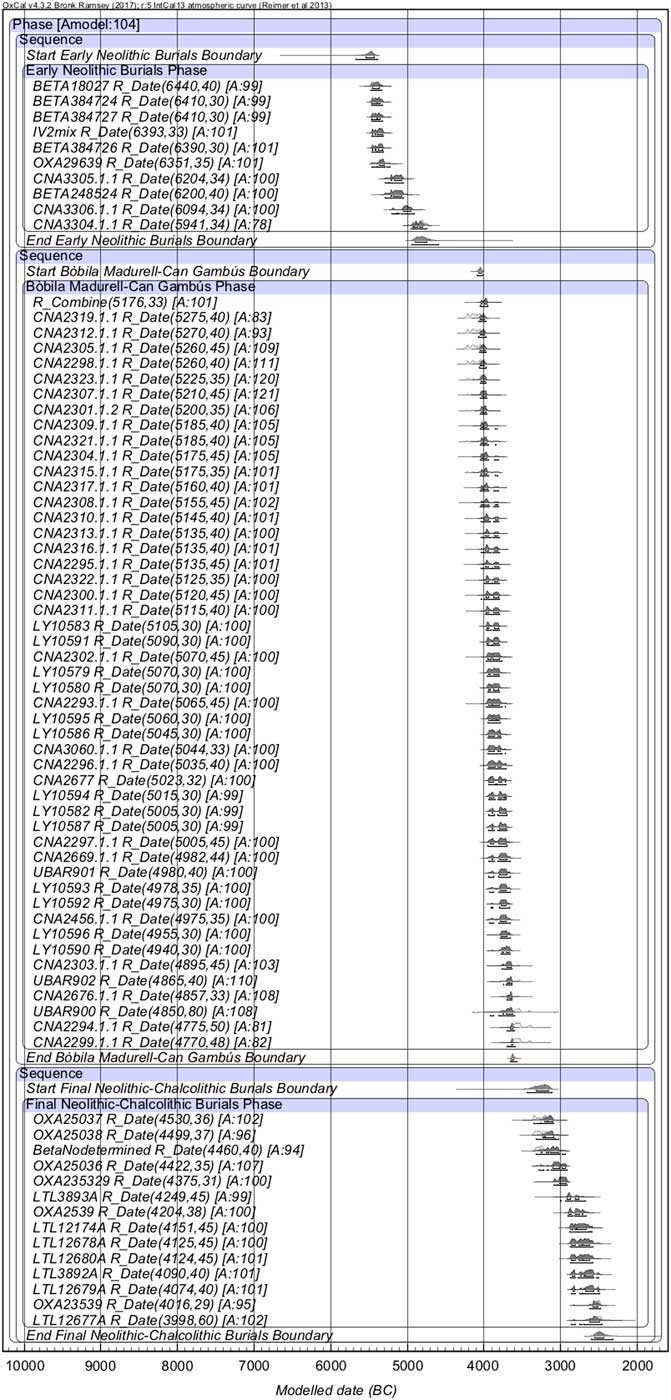
On the other hand, as mentioned in the introduction of this paper, before the beginning of the Pit Burials cultural horizon, few burial examples are known—only occasional collective burials in caves and individual inhumations in pits. After the Pit Burials cultural horizon, in contrast, Neolithic communities in the northeast of Iberia changed their funerary practices and started to bury their dead in collective burials, inside megalithic structures and with grave goods made from other kinds of raw materials. Most of these were locally sourced, and therefore the exchange networks developed during the Pit Burials cultural horizon broke down. Beyond the possible chronological differences between the two sectors, we have considered that all burials in the Bòbila Madurell-Can Gambús necropolis belong to the same historical phenomenon (the Pit Burials cultural horizon). To test this scenario we have compared the 14C dates of the necropolis with the available 14C dates from the Early Neolithic and Final Neolithic-Chalcolithic funerary evidences (Figure 8, Table 5, and Annex 3 in supplemental materials). This model has tested that the transition between one type of funeray practice and the other one was a gradual overlappping process between them.
Three Overlapping Phases Bayesian Model results for Early (Phase 1), Bòbila Madurell-Can Gambús (Phase 2), and Final Neolithic-Chalcolithic burials of the northeast of the Iberian Peninsula shown in Figure 8 (Amodel index: 104.1 with 95.4% probability).

Finally, regarding the presence/absence of the exogenous raw materials, different Sum of Probabilities Distributions have been performed. We have taken into account the probably biased extremes of the extended period recorded by this statistical test (Weninger et al. Reference Weninger, Edinborough, Clare and Jöris2011; Williams Reference Williams2012) and it has not been used to calculate the span of the chronological distribution of these raw materials, but just to obtain a preliminary visualization of the possible hiatus, temporal overlap and discontinuities in their chronological distribution to set out possible chronological hypotheses.
This test was carried out with CalPal software 2016 version (Jöris and Weninger Reference Jöris and Weninger2016) and also with the IntCal13 curve, because it allows for overlaying different graphics on the same diagram and scaling, which facilitates their observation and interpretation.
RESULTS
Chronological Sequence of the Necropolis: Do Both Sectors Belong to the Same Phase of Activity?
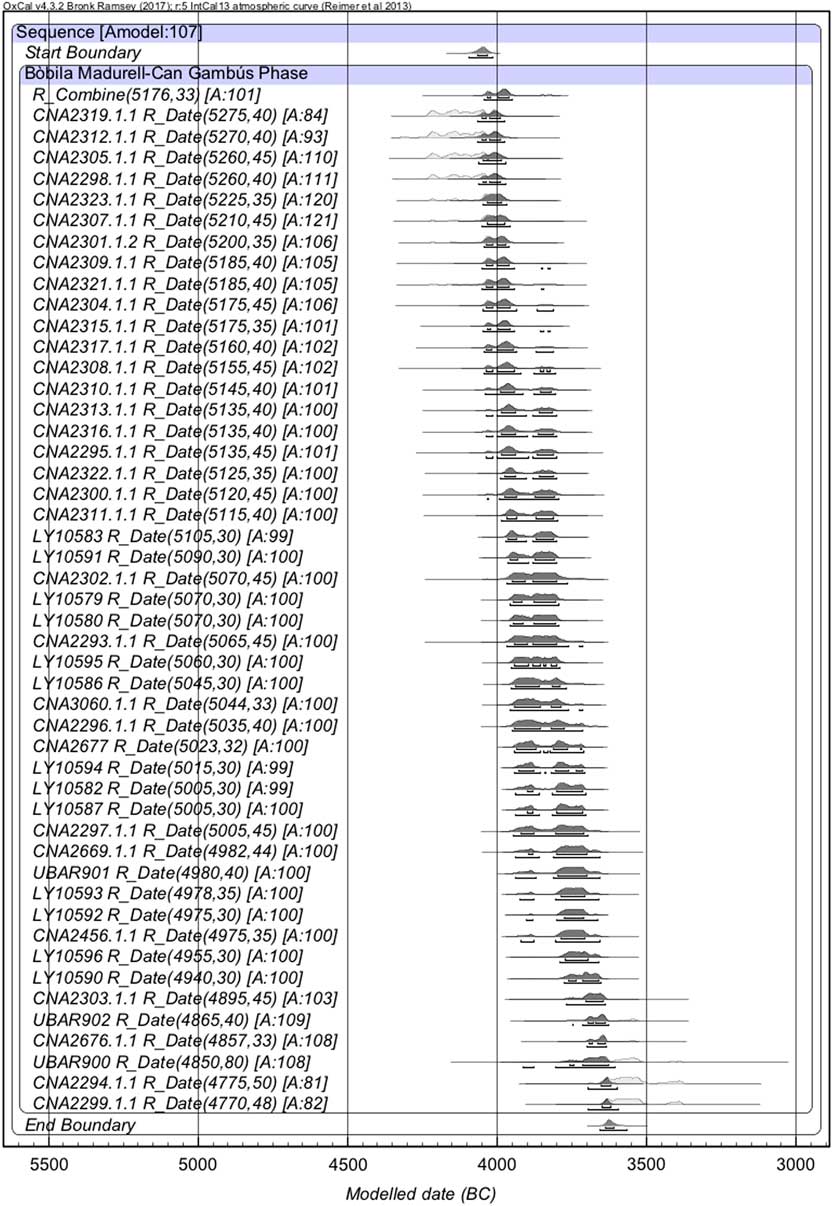
The One Contiguous Phase Bayesian Model (Bronk Ramsey Reference Bronk Ramsey2009) (Figure 6 and Annex 1 in the supplemental materials) has very high concordance with analyzed data (Amodel index: 107.3), and it suggests that there are no temporal discontinuities between the Bòbila Madurell and Can Gambús sectors, and their ocupation span is about 365–465 yr (95.4%) (4090–4010/3655–3575 cal BC 95.4%). However, the chi-square test rejected the synchronicity of all the burials, so we cannot affirm that all burials from both sectors were contemporaneous within a hypothetical period of 50 yr (this is the maximum standard deviation of the analyzed 14C dates).
One Contiguous Phase Bayesian Model of Bòbila Madurell-Can Gambús necropolis. As shown in the graph, the model suggests that there are no temporal discontinuities between Bòbila Madurell and Can Gambús sectors in their phases of activity (4090–4010/3655–3575 cal BC and around 365–465 years of span (Amodel index: 107.3 with a 95.4% probability).

Within such a long period, we have tested whether the Bòbila Madurell sector was earlier that the Can Gambús sector, although partially overlapping. The Two Overlapping Phases Bayesian Model (Lee and Bronk Ramsey Reference Lee and Bronk Ramsey2012) (Figure 7, Table 4, and Annex 2 in the supplemental materials) has also very good agreement with available 14C estimates (Amodel index: 97). We can therefore suggest that individuals began to be buried in the Bòbila Madurell sector a little before (4125–4010 cal BC 95.4%) than in the Can Gambús sector, which was used until later (3640–3500 cal BC 95.4%). On the other hand, according to the available data, the span of Bòbila Madurell was around 290–405 yr and the span of Can Gambús about 340–495 yr (95.4%).
Two Overlapping Phases Bayesian Model of Bòbila Madurell (Phase 1) and Can Gambús (Phase 2). According to the model, the Bòbila Madurell sector started a little before (4125–4010 cal BC) that of Can Gambús, which was used until later (3640–3490 cal BC). The span of Bòbila Madurell was around 290–405 years and the span of Can Gambús about 340–500 years (Amodel index: 97 with a 95.4% probability: see the results of the model in Table 4).

It is important to point out that the model differentiates one of the Bòbila Madurell sector burials as clearly later than the rest of the burials in the same sector. Its estimated 14C date appears to be an outlier (CNA2676.11 4857±33). However, if we had modeled the raw data without this date, the agreement would have been notably higher (Amodel index: 110). This differentiated burial (D55) was found in an area separated from the sector that was excavated during the 1930s, and the bones are difficult to attribute to well-defined funerary structures. This reinforces the strong temporal continuity and lack of chronological differentiation in the majority of the Bòbila Madurell sector.
Thus, although slightly non-contemporaneous, both sectors display chronological continuity and therefore we can conclude they belong to the same historical phenomenon. This hypothesis is corroborated by the results of a Three Overlapping Phases Bayesian Model (Lee and Bronk Ramsey Reference Lee and Bronk Ramsey2012) as fitted to archaeological data from Early, Middle, and Late Neolithic burials in the northeastern Iberian Peninsula (Amodel index: 104.1). According to this model (Figure 8, Table 5, and Annex 3 in the supplemental materials), the estimated duration of the complete cemetery would coincide with the results of previous models: 4090–4010/3655–3565 cal BC with a span about 365–470 yr (95.4%). Thus, according to our data, the hypothesis about considering both sectors as a single cemetery with a long phase of activity is statistically consistent.
Three Overlapping Phases Bayesian Model of Early Neolithic (Phase 1), Middle Neolithic (Bòbila Madurell-Can Gambús) (Phase 2), and Final Neolithic-Chalcolithic (Phase 3) burials (NE Iberian Peninsula). The results are shown in Table 5 (Amodel index: 104.1 with a 95.4% probability).

Chronological Distribution of Raw Materials in Bòbila Madurell-Can Gambús Grave Goods
The oldest burial in the Bòbila Madurell sector has grave goods made of exogenous raw materials. Consequently, we conclude that the long-range exchange networks were functioning from the very beginning of this site: 4180 cal BC. Figures 9 and 10 show the apparent chronological continuity of this phenomenon, so that the presence of these kinds of artifacts extended until 3540 cal BC (95.4%), given their presence in the latest documented burial (in the Can Gambús sector). There are no statistical differences in the frequency of burials with variscite, honey flint and jadeite, amphibolite, eclogite and nephrite axes and adzes between both sectors (Probability of No Association below 0.000 using Fisher’s exact test).
Sum of Probabilities Distribution graph showing the presence (4180–3540 cal BC) and absence (4210–3660 cal BC) of exogenous raw materials in Bòbila Madurell-Can Gambús grave goods.

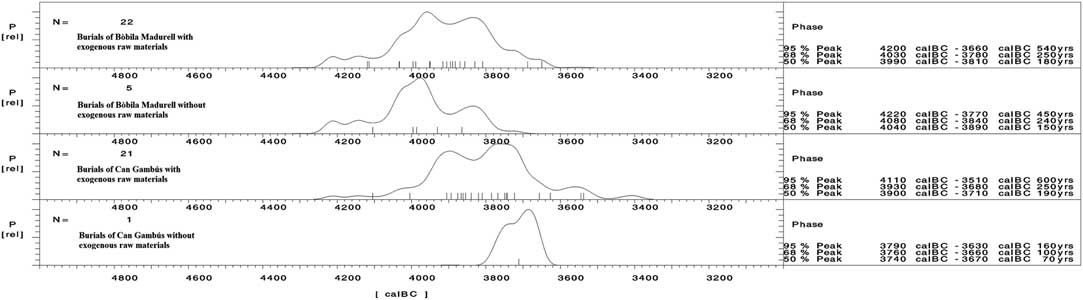
Sum of Probabilities Distribution graph showing the presence and absence of exogenous materials, differentiating the two sectors.

However, a closer look at the Sum of Probabilities Distribution graph suggests that most burials with exogenous raw materials are concentrated in a shorter period (4000–3800 cal BC with a 95.4% probability): the largest number of burials with these materials should correspond to the time when the quantity of exchanged material was also the largest. This kind of material would have been more infrequent after 3700 cal BC (95.4%), when those long-range exchange networks began to fail. Given the slightly later chronology of the Can Gambús sector, the lack of variscite, honey flint and jadeite, amphibolite, eclogite and nephrite axes and adzes among its later burials is more noticeable than in the earlier sector.
A working hypothesis would be that Bòbila Madurell burials without exogenous raw materials were the oldest burials in the cemetery (Phase 1). Those early remains from a first phase would have been followed by burials in both sectors where the presence of exogenous raw materials has been documented (Phase 2), and would belong to the period of maximum long-range exchange. Finally, a late burial from the Can Gambús sector, without any grave goods made from foreign raw materials, would have belonged to the latest moments of the cemetery (Phase 3).
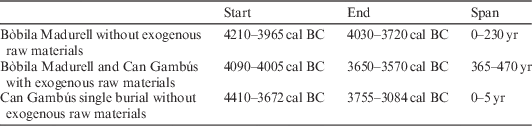
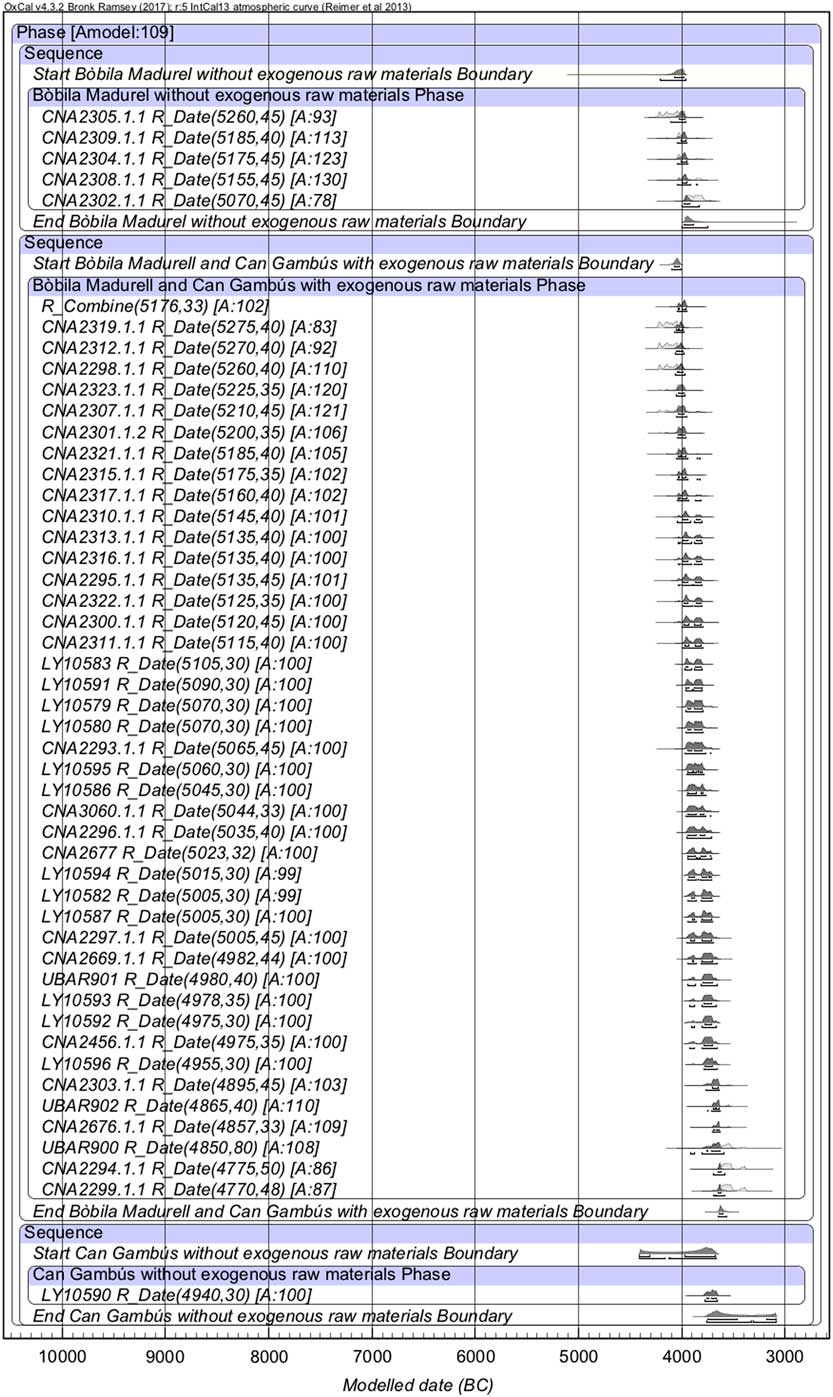
We have used Three Overlapping Phases Bayesian Modeling (Lee and Bronk Ramsey Reference Lee and Bronk Ramsey2012) to test this hypothesis (Table 6, Figure 12, and Annex 4 in supplemental materials). This model has a very high concordance with the known 14C dates of burials (Amodel index: 108.3). We can suggest then, that the beginning of long-range exchange networks would have been later than the first phase of activity. Their effects would have increased until reaching their peak around 4100–4005 cal BC (95.4%), and the quantity of exogenous material would have begun to decrease around 3655–3550 cal BC (95.4%) onward.
Three Overlapping Phases Bayesian Model results of Bòbila Madurell burials without exogenous raw materials (Phase 1), with exogenous raw materials in Bòbila Madurell and Can Gambús sectors (Phase 2) and the single burial from Can Gambús sector without exogenous raw materials (Phase 3) shown in Figure 12 (Amodel index: 104.1 with 95.4% probability).

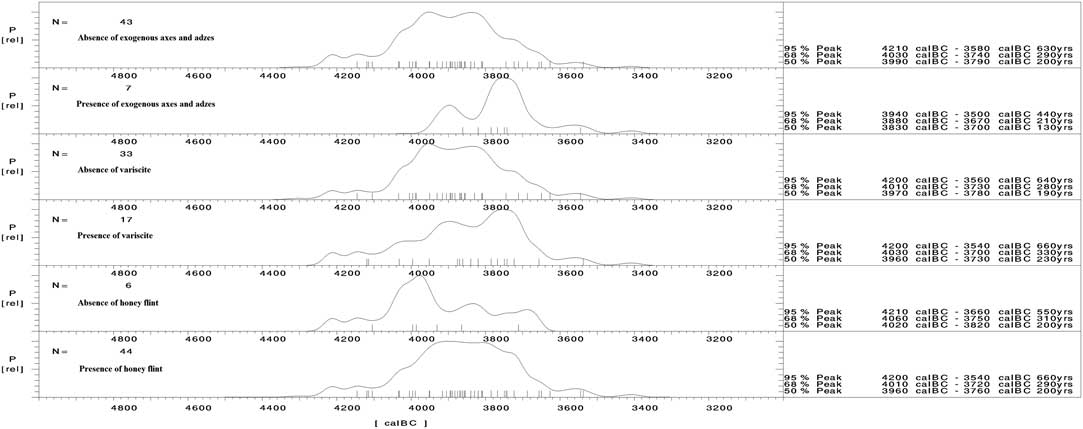
In any case, “foreign material” is a generic class of items. We have depicted the Sum of Probabilities Distribution for each kind of foreign material (Figure 11). There is a clear chronological overlapping between burials without jadeite, amphibolite, eclogite and nephrite axes and adzes, variscite body ornaments and honey flint tools, which, according to the test, are older than burials with those materials. The first appearance of variscite and honey flint tools would have been slightly earlier than the presence of jadeite, amphibolite, eclogite and nephrite axes, which seem to be the latest category to have travelled along those long-range networks. The beginning of the decrease in the circulation of those objects was, however, simultaneous (around 3655–3550 cal BC with a 95.4% of probability), suggesting that it was not a problem of a single source but the beginning of a probably sudden collapse of the entire network.
Sum of Probabilities Distribution graph showing the presence and absence of each documented exgoneous raw material.

DISCUSSION AND CONCLUSIONS
This article aims to clarify the chronology of one of the most important necropolises in the Pit Burials cultural horizon. The impressive nature of its archaeological record makes the detailed analysis of its chronology an important first step to explain the chronological development of the Pit Burials cultural horizon, as well as the raw materials exchange networks associated with it. In order to clarify these chronological issues, a series of new 14C dates have been analyzed statistically in this paper.
According to our data, there is no discontinuity between the Bòbila Madurell-Can Gambús sectors, nor within them, so it can be concluded that they were the same unit, a fact that would explain the spatial variability in the use and development of the necropolis (Tables 5 and 6; Figures 6–8). However, despite being continuous in time, we cannot assert their contemporaneity to a margin less than 50 years. The necropolis’s temporal limits indicate that it was founded between 4100 and 4015 cal BC (95.4%), ended between 3655 and 3560 cal BC (95.4%) and lasted around 365-485 years (95.4%). However, Bòbila Madurell started to be used a little earlier than Can Gambús (4130–4010/3765–3615 cal BC 95.4%), which was the last sector to stop being used (4115–3980/3640–3490 cal BC 95.4%).
According to the Sum of Probabilities Distributions (Figures 9–11), the significant presence of honey flint and variscite appeared more or less at the same time, around 4000 cal BC (95.4%). However, this pattern changes in the case of exogenous axes and adzes, which appear a little afterward, ca. 3900 cal BC (95.4%). This suggests that the arrival of these goods might respond to different network phenomena, the particularities of which are still to be explained. It is noteworthy that both exchange networks finished in a significant way at the same time around 3655–3550 cal BC (95.4%), suggesting that it was not a problem of a single source but the beginning of a probable sudden collapse of the entire network. From this moment, around 3600–3500 cal BC, profound changes are documented in burial practices, in terms of both funerary structures and modes of burial and grave goods. From that time onward, collective burials in different places, especially dolmens, hypogea and caves with an exclusively burial function, became common (Gibaja 2004; Terradas Reference Terradas2005; Terradas et al. Reference Terradas, Gratuze, Bosch, Enrich, Esteve, Oms and Ribé2014).
This interpretation has also been reinforced by the results of the Three Overlapping Phases Bayesian Modeling (Table 6 and Figure 12), which suggests that the beginning of the long-range exchange networks would have been later than the first phase of activity. Their effects would have increased until reaching their peak around 4100–4005 cal BC (95.4%), and the quantity of exogenous material would have begun to decrease around 3655–3550 cal BC (95.4%) onward.
Three Overlapping Phases Bayesian Model of Bòbila Madurell burials without exogenous raw materials (Phase 1), burials in both sectors where the presence of exogenous raw materials has been documented (Phase 2), and late burial from the Can Gambús sector without any grave goods made from foreign raw materials (Phase 3). The results are shown in Table 6 (Amodel index: 104.1 with a 95.4% probability).

These changes are also linked to changes in the connection networks that facilitated access to certain raw materials. At this time, honey flint, axes and adzes originally from Alpine or Pyrenean regions, and variscite ceased appearing in grave goods. Even the mines where variscite was obtained stopped operating (Gely Reference Gely2005; Moinat and Chambon Reference Moinat and Chambon2007; Vaquer et al. Reference Vaquer, Martín, Pétrequin and Errera2012; Zemour Reference Zemour2013; Vaquer Reference Vaquer2014; Schmitt Reference Schmitt2015). The new collective burials often had few artifacts associated with the burials, such as flint points and blades from different parts of the Western Mediterranean (southeast France and Aragon in the Iberian Peninsula), fauna offerings (whole or partial) and, occasionally, some pottery vessels and body ornaments (Terradas and Gibaja Reference Terradas and Gibaja2002; Gibaja and Terradas Reference Gibaja and Terradas2012; Gibaja et al. Reference Gibaja, Léa, Lugliè, Bosch, Gassin and Terradas2013 and Reference Gibaja, González, Martín, Palomo, Petit, Plasencia, Remolins and Terradas2014).
Thus, the data relating to the end of the Neolithic phase of activity of the Bòbila Madurell-Can Gambús necropolis can be interpreted as an indicator that these burial practices and exchange networks were reaching an end. As the Overlapping Phases Bayesian models presented here indicate, the available data suggest that these changes were not so gradual, between 3655 and 3550 cal BC (95.4%), although the time that these materials appear to be significantly absent in the necropolis around 3655–3550 cal BC.
In accordance with the explanatory horizons that these new data open for Neolithic communities, in the future it will be interesting to expand the number of 14C dates for this magnificent cemetery, as well as for other Pit Burials contexts, in order to reinforce or refute these first explanatory hypotheses about the chronology of this cultural horizon proposed in this paper.
Acknowledgments
Some of the analyses presented in this paper were carried out within the project: “Aproximación a las primeras comunidades neolíticas del NE peninsular a través de sus prácticas funerarias” (HAR2011-23149), “Aproximación a las primeras comunidades neolíticas del Mediterráneo nordoccidental: construyendo respuesta desde los análisis paleoantropológicos y genéticos” (HAR2015-67323-C2-1-P y HAR2015-67323-C2-2-P), and “La difusión del neolítico en el Mediterráneo centro-occidental: agricultura, innovaciones tecnológicas y carbono 14” (HAR2016-75201-P) funded by the Ministry of Economy and Competitiveness of the Spanish Government. This project was conducted thanks to the collaboration and the agreement between the Milà i Fontanals Institution (Spanish National Research Council), the National Accelerator Centre (CNA) and the Autonomous University of Barcelona (UAB). We also would like to thank the assistance of the Department of Archaeology of the Catalan Government and the various museums that we visited to study the materials deposited from Bòbila Madurell-Can Gambús necropolis (Museum of History of Sabadell, Barcelona Archaeological Museum, and the History Museum of Catalonia). This work has also been possible thanks to a predoctoral fellowship (FI-DGR2014) enjoyed by Ms. Berta Morell and funded by the Catalan Government. We would also like to thank Mr. Jordi Sala for his willingness to help in some formatting issues during the drafting of this paper.
SUPPLEMENTARY MATERIAL
To view supplementary material for this article, please visit https://doi.org/10.1017/RDC.2017.131